The High Voltage Retribution: How a Cold Suburban Grid War Dismantled an Entitled Shadow
CHAPTER 1: THE PHANTOM DRAW
The aluminum disc inside the glass dome spun with a steady, sickening speed.
It was 2:14 AM. Every breaker for the house sat flipped to the off position. The refrigerator was dead. The well pump was silent. The water heater had no juice. Yet that polished wheel kept turning, ticking forward like an unpaid meter on a getaway car.
I rolled the cold, heavy brass breaker key across my knuckles. Click. Clack. The metal was chilled from the night air, biting into the raw skin of my index finger.
Ten thousand kilowatt-hours over seasonal baseline. That wasn’t a forgotten porch light. That was an industrial drain.
I stepped off the gravel path, sinking into the tall, unkept weeds along the east fence line. Damp grass soaked through my boots. My flash beam stayed off; the moon gave enough silver light to trace the rusted chain-link separating my barn from her manicured perimeter.
There. Half-buried under dead nettles and thick brush like a sleeping viper.
A bright orange, heavy-duty 12-gauge extension cord.
I followed it step by step. It didn’t coil or loop. It ran taut, snaking straight through a bottom slat in the cedar fence, plugged flush into the weatherproof outdoor receptacle on the back wall of Karen’s house.
I didn’t yell. I didn’t snap. I just stood in the tall grass, cold brass key pinned tight between my thumb and forefinger.
Karen. Self-appointed visual inspector for the subdivision. The woman who filed three formal complaints last spring over a neighbour’s brass door knocker being “overly reflective.” Now she was running a private bypass off my barn panel.
I pulled my phone. Three photos, macro focus on the plug inserted into her wall. One ten-second video tracking the line back through the fence to my barn.
Then I walked into the dark barn, located Breaker 4 on the sub-panel, and slammed the switch down.
Through the trees, the soft amber glow illuminating her back patio vanished instantly.
I waited ten seconds. Click. I flipped it back on.
Across the grass, the light flickered back to life.
Proof locked.
I didn’t wait until morning. I walked up her front flagstone path, heavy work boots striking the stone with deliberately measured weight, and hit the brass chime twice.
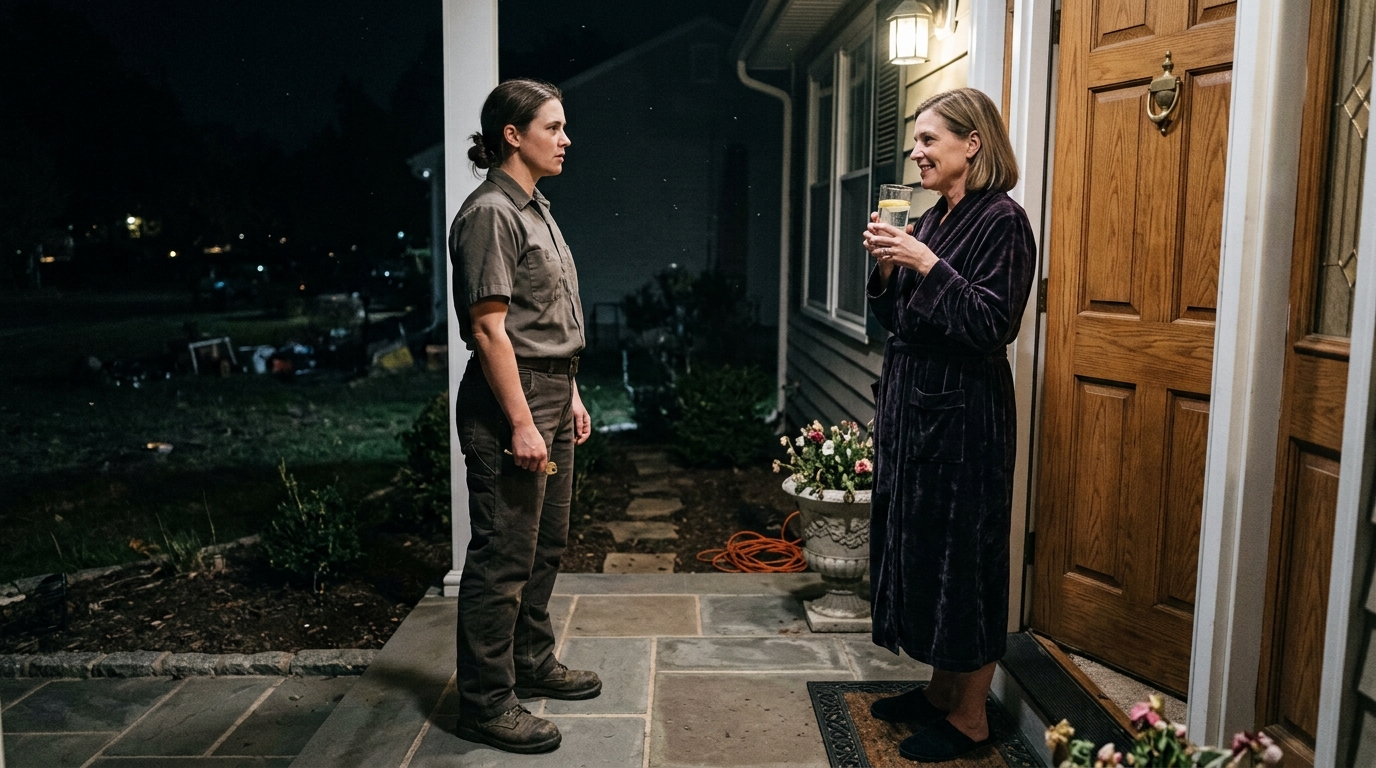
Thirty seconds passed before the heavy oak door pulled back. Karen stood in the doorway wrapped in a crushed velvet robe, holding a tall glass of lemon water. Her face was locked in that familiar, tight-lipped smile she wore when handing out code violation notices.
“It’s late,” she said. No greeting. Just authority.
“There’s a twelve-gauge cord running from my barn sub-panel through your fence,” I said. My voice was flat. Low.
She didn’t flinch. She took a slow sip of her water, the ice clinking against the glass. “Oh. That.”
“That’s my panel, Karen.”
“You weren’t using the excess amperage out there,” she said, waving a hand with casual dismissal. “It’s barely a draw. Don’t be dramatic.”
“It’s utility theft.”
Her smile hardened, the velvet robe rustling as she shifted her weight. “Nobody is stealing anything. Consider it an offset for the visual disturbance your barn causes my back line. You should be glad I haven’t brought your unpainted siding to the board.”
I stared at her for three seconds. The brass key in my pocket pressed sharp against my thigh.
“If that cord stays plugged in,” I said softly, “you’re getting billed.”
Karen let out a sharp, genuine laugh that cut through the quiet night air. “Oh, sure. Go ahead and invoice me.”
She shut the door before the latch even clicked.
I turned around, stepped off her porch, and looked back at her glowing patio light. She thought it was a joke. She thought authority was something you carried on a printed clipboard.
She was about to find out it was something you calculated in kilowatt-hours.
CHAPTER 2: THE COMPLIANCE TRAP
The door latch clicked. A heavy, solid sound that echoed through the quiet midnight air.
I stood on her porch, staring at the painted white wood where her face had been two seconds ago. In my right pocket, the cold brass breaker key felt heavy against my knuckle. My thumb traced its notched edge, back and forth, over and over until the metal warmed to match my body heat.
She thought she was immune because she spoke in the language of suburban authority. She believed a velvet robe, a glass of lemon water, and a dismissive wave could erase a forty-amp draw off my barn’s sub-panel.
I walked down her stone path. The brass key slid into my left pocket, replaced by my phone. The screen’s cold blue light cut through the dark as I brought up a blank document on my screen.
Karen governed by paper. Every warning she had ever issued—every citation for unclipped hedges, every complaint about trash cans left out four minutes past dawn—relied on the psychological weight of a official-looking header. If you hand someone a handwritten note, they fight back. If you hand them a document with a reference code and a sub-clause, their pulse spikes before they even read the fine print.
I sat at my kitchen table while the old refrigerator hummed its single, uninterrupted tone.
I didn’t open a word processor. I opened a desktop publishing layout.
Subdivision Utilities & Infrastructure Compliance Division.
It was a completely fictional entity, but the typography was precise. Heavy sans-serif header. A fake state seal graphic in dark navy ink. A twenty-digit tracking number running across the top margin: REF-404-SUB-9. A subtle nod to the local grid-tech spec line—Grid-Tech 404—that only a line inspector or a paranoid homeowner would ever recognize.
I didn’t charge her forty dollars for stolen power. That would look like a negotiation.
I broke it down into administrative line items:
Residential Energy Redistribution Fee (Unauthorized Draw): $2.14
Extension Line Cross-Boundary Service Charge: $0.75
Infrastructure Load Stabilization Surcharge: $0.25
TOTAL DUE WITHIN 48 HOURS: $3.14
Three dollars and fourteen cents.
I printed it on heavy, ninety-pound linen paper. The warm scent of laser-printer toner filled the kitchen, sharp and chemical. I folded the page twice, placed it inside a dark gray window envelope, and sealed it without a return address.
At 3:30 AM, the night air was dead silent. I crossed the wet grass along the property line, avoiding the weeds near the buried orange cord. A faint, low-frequency hum vibrated through the soil near the fence—a micro-frequency shudder that felt less like an extension cord and more like a industrial transformer struggling under load. I paused, my boot pressing into the damp earth right above the line. The vibration buzzed through the rubber sole of my work boot.
I ignored the anomaly for now, stepped onto her porch, and slid the envelope smoothly into the brass mail slot of her front door.
By 7:00 AM, I was on my second cup of coffee, sitting on my back porch with a pair of compact binoculars resting on the armrest of the wooden chair.
At 7:12 AM, Karen’s front door opened. She stepped out in a crisp beige trench coat, leather purse tucked under her arm. She reached into her mailbox, pulled out the gray envelope, and stopped.
Through the lenses, I watched her thumb run across the heavy linen paper. I saw the micro-expression—the tiny drop of her left eyebrow, the tightening of her lower lip. She looked around the empty cul-de-sac. Her eyes swept past my barn, past the fence line, before settling back on the printed header.
She didn’t throw it away. She didn’t march to my house. She slid it into her purse, closed the mailbox, and walked toward her car with a stiff, deliberate stride.
Twenty-four hours passed.
On the second morning, I walked to my own mailbox at the end of the dirt driveway. Inside, resting against a catalog for farm tools, was a clear Ziploc baggie. Inside the plastic were three crisp one-dollar bills, a dime, and four pennies. Taped to the bag was a yellow sticky note written in tight, aggressive cursive:
Payment enclosed. Consider this matter closed and clear.
A small, cold smile touched the corner of my mouth.
She paid it. Not because she thought it was real, but because the fear of an official record was greater than her pride. To Karen, three dollars was a small price to protect her illusion of total control.
She didn’t realize she had just signed the contract.
That night, I sat down at the printer again.
Invoice #102: Weekly Secondary Phase Balance Adjustment.
Unauthorized Shadow & Shade Interference Surcharge: $0.47
Inter-Property Conductor Maintenance: $2.18
Environmental Ground-Draw Levy: $0.88
TOTAL DUE: $3.53
Week three: $3.17.
Week four: $4.12.
For six weeks, the cycle remained unbroken. Every Tuesday, a gray envelope slipped through her door. Every Thursday, a Ziploc baggie with exact change appeared in my mailbox. She never knocked. She never brought it up. She simply paid her subscription to keep her secret safe.
Then, on the seventh Tuesday, I changed the line item.
Invoice #107: Unmetered Secondary Transformer Draw (High-Voltage Exemption Review).
Base Draw Charge: $47.50
Sub-Level Load Penalty: $112.00
TOTAL DUE: $159.50
I dropped it in her slot at midnight.
Twelve hours later, as I was working in the barn, the heavy oak doors rattled.
Karen stood in the sunlight filtering through the doorway, holding the gray sheet of paper in one gloved hand. Her face wasn’t polite anymore. The tight-lipped HOA smile was gone, replaced by a pale, twitching rage.
“You’ve gone too far,” she said. Her voice was raspy, stripped of its usual smooth authority. “I don’t know what kind of game you’re playing with these fake utility notices, but it stops today.”
I didn’t stop wiping the oil off my wrench. I kept my eyes on the steel tool in my hands.
“Which notice?” I asked quietly.
“All of them!” She slapped the paper against her thigh. “I spoke to the county billing office this morning. They have no record of an ‘Infrastructure Compliance Division.’ You’re frauding me.”
I set the wrench down on the workbench with a sharp, heavy clack.
“Then don’t pay it,” I said, stepping into her space until she had to tilt her head back to look me in the eye. “Don’t pay a single cent. We can just let the board look over the whole file at tomorrow night’s open session.”
Her eyes flicked down to my pocket, where the brass key outline pressed against my jeans. Her breathing turned shallow, ragged.
“You wouldn’t dare,” she whispered.
“Tomorrow,” I said softly, “at seven.”
CHAPTER 3: THE LEVERED ESCALATION
The word hung between us like a drawn blade.
Karen’s upper lip trembled, just enough to break the pristine coat of pink lipstick she wore. She didn’t offer a rebuttal. She didn’t wave the invoice. She simply turned on her heel, her leather soles skidding slightly on the dust-covered concrete of the barn floor, and walked out into the mid-day glare.
I picked up the wrench from the bench. Cold steel. I wiped the remaining grease onto a shop rag, my fingers working in methodical, tight circles.
Thirty-one hours later, the school gymnasium smelled of stale floor wax and damp wool.
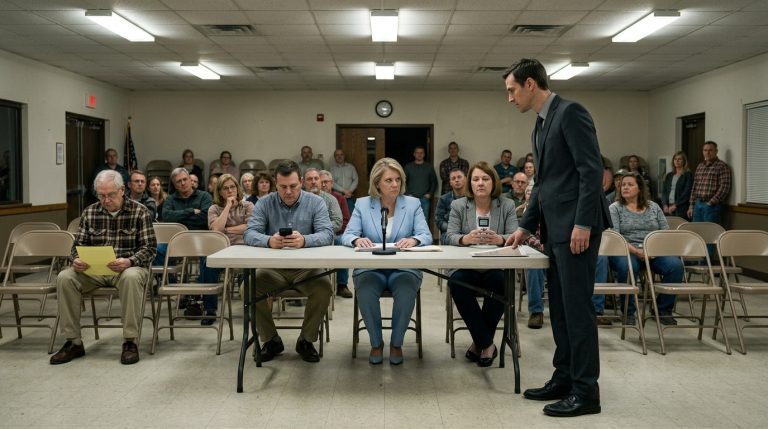
Four rows of metal folding chairs faced a long folding table where the five members of the Oakridge Estates HOA Board sat behind plastic nameplates. A low-wattage projector hummed in the corner, throwing a faint, flickering square of white light onto a pull-down screen.
I sat in the back row. My knees pressed against the cold steel rim of the chair in front of me. In my coat pocket, my hand stayed closed around a thick, manila legal folder.
At 7:05 PM, the HOA president, a retired civil engineer named Miller with wire-rimmed glasses, tapped his pen against a microphone.
“Item four on the agenda,” Miller announced, his voice raspy through the tinny PA speaker. “Open forum petitions.”
Before Miller could finish the sentence, Karen stood up from the front row.
She wore a crisp navy blazer with silver buttons. In her right hand, she clutched a sleek leather folio. She didn’t wait to be called on. She marched straight to the podium at the side of the table, her heels striking the linoleum floor with the rhythmic snap of a marching drum.
“I am invoking Emergency Protocol 6-B,” Karen declared, her voice projecting across the silent gym. “I am submitting a formal petition for the immediate assessment of severe civil misconduct and extortion against the owner of Lot 42.”
She turned slightly, her chin tilted high, her cold glare locking onto me in the back row.
A quiet murmur rippled through the twelve residents scattered across the metal chairs.
“For seven weeks,” Karen continued, pulling a stack of gray envelopes from her folio and laying them out like playing cards across the wood paneling of the podium, “this individual has engaged in a systematic campaign of harassment, impersonating municipal infrastructure officials, and mailing fraudulent extortion notices to my private residence.”
She picked up the top sheet—the $159.50 invoice I had delivered the night before.
“He claims I owe money to a fictitious ‘Infrastructure Compliance Division,'” she said, her tone dripping with outrage. “He has attempted to intimidate a member of this community into paying bogus levies under the threat of public defamation. I have contacted local law enforcement, and I am demanding this board issue an immediate lien against Lot 42 pending a formal review.”
Miller adjusted his glasses, peering down at the gray paper Karen held up. “Karen, these are… utility notices?”
“They are fabrications!” Karen snapped. “Every single one of them!”
“May I speak?” I said.
My voice wasn’t loud, but it cut cleanly through the hum of the projector. I stood up slowly, the manila folder held flat against my side.
Karen didn’t look back at me as I walked down the center aisle. She kept her posture locked, her jaw set, projecting pure untouchable authority.
“Mr. Vance,” Miller said, frowning over his specs. “Do you deny generating these documents?”
“I printed them,” I said, stopping three feet from the podium. “Every single one.”
A sharp gasp came from a woman in the second row. Karen let out a short, triumphant breath, her shoulders easing back.
“He admits it,” Karen told the board, waving her hand toward me. “He admits to grand fraud and extortion.”
“I printed them,” I repeated calmly, opening the manila folder and placing three glossy eight-by-ten photos directly on the board table in front of Miller, “because Karen refused to answer why she was running a high-draw conductor line straight through my fence.”
Miller blinked. He picked up the first photo.
It was a crystal-clear shot of the bright orange twelve-gauge extension cord running through the bottom cedar slat, plugged flush into the outlet on her exterior wall.
“This is ridiculous,” Karen cut in, her voice rising half an octave. “It was an emergency line for a temporary garden fountain! A negligible draw! He is blowing a neighborly misunderstanding out of proportion to cover his criminal enterprise!”
“A garden fountain?” I asked. I didn’t raise my voice. I leaned slightly toward the board table. “A garden fountain doesn’t pull forty amps continuously at two in the morning.”
I pulled a second document from the folder—a printed log from a digital watt-meter I had spliced into my barn’s sub-panel three days prior.
“This is the hourly draw log,” I said, pointing to a spike that ran flat across thirty-eight amperes every single night between 11:00 PM and 5:00 AM. “Last month, my electric bill jumped by six hundred dollars. That isn’t a fountain, Miller. That’s a commercial load.”
Karen’s hands tightened on the edges of the podium until her knuckles turned a mottled, chalky white. Her breathing rasped through her nostrils.
“He’s lying,” she whispered, though the microphone picked it up, throwing the crackle across the gym. “He modified those logs.”
“Then let’s look at the payments,” I said.
I laid a third sheet on the table. It was a scanned copy of every single Ziploc baggie she had left in my mailbox, complete with the yellow sticky notes written in her distinct, aggressive handwriting, along with the exact dates matching the gray invoices.
“If it was extortion,” I said, turning my head to look her dead in the eye, “why did you pay the first six invoices without a single complaint?”
The room went dead quiet. The only sound was the steady click-clack of the projector fan.
Miller looked from the scanned sticky notes to Karen. The other four board members leaned in, whispering among themselves as they passed the photos back and forth.
“Karen,” Miller said, his voice dropping into a flat, dangerous register. “Did you execute an unauthorized bypass tap across property boundaries?”
“It… it was an agreement,” Karen stammered. Her composure fractured, the crisp navy blazer suddenly looking two sizes too big on her frame. “An informal arrangement for property oversight—”
“There was no agreement,” I said. “And the draw isn’t running a fountain.”
I remembered the low-frequency vibration buzzing through my boot sole near the fence line. The micro-frequency shudder that no standard extension cord should ever produce.
“She isn’t just taking light power,” I told the board, watching the color drain entirely from Karen’s face. “Whatever she has plugged in over there is pulling enough current to trip a regional junction box. It’s marked as a standard residential line, but the line draw matches a heavy Surge-Vault array.”
At the mention of the phrase, Karen’s left hand twitched violently, her fingers dropping the gray invoices onto the floor. They fluttered down like dead leaves, scattering across the scuffed linoleum.
“That’s enough,” Miller said, slamming his hand onto the table. “Board vote on Code Violation 12-A—Unauthorized Grid Tampering and Infrastructure Liability.”
“You can’t do this!” Karen voiced cracked, her hands slamming onto the podium. “I am the head of the Compliance Committee!”
“Not anymore,” Miller said coldly. “All those in favor of immediate suspension and referral to municipal line inspectors?”
Five hands went up instantly. Zero opposed.
Karen stood paralyzed at the podium. Her eyes darted from Miller to the scattered papers on the floor, then back to me. The untouchable armor of suburban authority hadn’t just cracked; it had disintegrated.
She didn’t speak another word. She grabbed her leather folio, turned away from the table, and walked fast toward the double exit doors. Her heels didn’t click with a crisp rhythm anymore; they scuffed against the floor in a ragged, frantic hurry.
As the heavy metal doors slammed shut behind her, Miller turned back to the microphone, his expression grave.
“Mr. Vance,” Miller said low. “You said municipal line inspectors?”
“I called them an hour ago,” I said, closing my manila folder. “They’re at her house right now.”
CHAPTER 4: THE SYSTEMIC SURGE
The manila folder slid into my coat pocket as I pushed open the double exit doors of the gymnasium.
The cool night air hit my face, sharp and smelling of damp leaves. Across the asphalt parking lot, two utility trucks with amber warning lights flashing in slow, hypnotic rotations pulled out onto the main road, their heavy diesel engines rumbling into the distance. They were heading north. Toward the cul-de-sac.
I didn’t rush. I walked to my truck, my boots crunching rhythmically on the loose gravel. I unlocked the cab, pulled the door shut, and turned the ignition.
Headlights cut through the dark, reflecting off the yellow stencil on the utility van parked near the neighborhood entrance: County Power & Grid Operations.
By the time I pulled up to my driveway, two utility service vans and a heavy county inspector truck were already idling on the curb outside Karen’s house. Bright white halogen work lights swung around on telescoping booms, illuminating her pristine front lawn in harsh, clinical daylight.
Three men in reflective high-visibility vests stood around her open electric meter box.
I cut my engine, stepped out into the damp grass, and leaned against the side of my truck cab. My right hand instinctively reached into my pocket, my thumb resting on the cold, flat edge of the brass breaker key.
Karen stood on her porch, still wearing the navy blazer, her leather folio clutched across her chest like a shield. She was speaking fast, her chin thrust forward, pointing her finger at a tall inspector holding a heavy digital analyzer.
“I have told you twice,” Karen’s voice carried clearly across the lawn, sharp and breathless. “It is a private residential line! You have no right to open those panels without a forty-eight-hour written notice!”
The lead inspector—a broad-shouldered man named Chief Inspector Vance, no relation—didn’t even turn his head. He pressed the leads of the analyzer into the main lug below her meter glass.
A high-pitched, digital beep pierced the air. Vance looked down at the display, then slowly turned his head to stare at the side of Karen’s house.
“Ma’am,” Vance said, his voice flat, stripped of any suburban politeness. “Your residential line is rated for two hundred amps. This meter isn’t even recording sixty percent of the current running through your main feeder.”
“That is a calibration error!” she snapped. “I demand you leave my property!”
“It’s not a calibration error,” Vance replied calmly, stepping toward the foundation wall where thick, black conduit disappeared into the basement window well. “It’s an unmetered bypass.”
He gestured to one of his technicians. “Get the breaker puller and call the regional dispatcher. Cut the high-voltage feed at the pole line right now.”
“No!” Karen took a sudden, desperate step off the porch steps, her heel catching in the soft turf. “You can’t cut the line! Do you have any idea what is running in that basement?”
I stepped off my truck bed and walked slowly along the fence line, stopping right where the orange cord had been buried in the weeds.
The orange cord was gone—unplugged and lying coiled on the damp earth like a dead snake. But the hum wasn’t gone.
In fact, without the secondary draw from my barn panel to stabilize the circuit, the ground beneath my boots was vibrating harder. A low, rhythmic thrumming echoed up through the soil, accompanied by a distinct, pungent smell of hot copper and ozone hanging in the night air.
Vance knelt beside the cellar window well, shining a hundred-lumen tactical flashlight down through the iron grate.
“Holy hell,” Vance muttered softly under his breath.
He stood up, his face pale under the harsh halogen glare, and pulled a radio from his vest. “Dispatch, this is Inspector Vance on Lot 40. Emergency shutdown protocol immediately. Send a hazmat and heavy grid unit to my location. We have an unregistered commercial Surge-Vault operation drawing directly off the regional trunk.”
Karen froze on the lawn. The leather folio slipped from her numb fingers, landing flat in the wet grass.
“Vance,” I called out from the fence line.
The inspector turned, his tactical flashlight beam catching me in its circle. He walked over to the cedar fence, his heavy work boots sinking into the mud.
“You the owner of the barn?” he asked, pointing to my panel box thirty feet away.
“I am,” I said. “Found the extension cord six weeks ago.”
Vance shook his head, a dark, cynical grimace on his face. “The extension cord was just a bridge, son. She wasn’t stealing your power to light her porch. She was using your sub-panel as a secondary grounding loop to hide the thermal signature from our aerial grid sweeps.”
He pulled a digital printout from his clipboard and held it up. Printed across the top line was a technical code: Grid-Tech 404 – Unauthorized High-Density Node.
“She built a subterranean server vault in her cellar,” Vance said, his thumb pointing back over his shoulder toward her house. “Running sixty high-draw crypto and data-mining racks off a hacked Sub-Meter 9 splice. She hooked into your barn panel to trick our automated balance monitors into thinking the excess load was distributed across two separate properties.”
I stared at the black conduit disappearing into her basement window.
The decoy secret—the idea that she was just a greedy neighbor stealing a few hundred bucks of juice for garden amenities—shattered completely. She hadn’t just taken power. She had engineered a silent, highly dangerous industrial parasitic tap right under the neighborhood’s feet, risking a localized transformer explosion to line her own pockets.
“How long?” I asked quietly.
“Eighteen months,” Vance said. “Total unmetered theft is pushing eighty thousand dollars. Municipal penalties and grid restoration fees will double that.”
Behind us, a heavy utility truck slammed its air brakes, its red and yellow lights painting the dark neighborhood in violent, pulsing color. Two utility workers jumped out with fiberglass hot-sticks, marching straight toward the utility pole at the corner of her lot.
Karen didn’t yell anymore. She didn’t invoke HOA bylaws.
She stood in the middle of her pristine lawn, surrounded by flashing amber lights and county trucks, as a technician slammed a heavy padlock through her main meter box, locking her out of the grid completely.
The low hum beneath my boots suddenly died. The heavy, subterranean vibration ceased instantly, leaving only the quiet rustle of autumn leaves blowing through the trees.
Vance handed me a yellow carbon copy slip. “You’ll get a formal deposition request in the mail, Mr. Vance. You’re the key witness for the county prosecutor.”
I took the paper, folded it neatly, and slid it into my coat pocket next to the brass key.
Karen looked across the lawn, her eyes catching mine through the flashing red glare of the emergency trucks. Her face was hollow, aged ten years in ten minutes.
I didn’t smile. I didn’t nod. I simply turned around and walked back toward my porch.
CHAPTER 5: UNPLUGGED
The yellow carbon copy paper felt crisp between my fingers. I folded it once, slid it into my breast pocket, and sat on the top step of my front porch.
The red and amber lights of the utility fleet gradually dwindled down the driveway, leaving only long, dark tire tracks pressed deep into the wet gravel. By 5:00 AM, the last county truck turned off the main road. The neighborhood fell back into a silence so absolute it made my ears ring. No low-frequency hum. No subterranean shuddering. Just the drip of condensation falling from the tin roof of my barn onto the damp soil below.
I poured a cup of coffee from the insulated thermos beside my boot. Steam rose into the gray morning air, carrying the bitter, roasted scent across the porch.
Two weeks passed before the final clearing began.
First came the county enforcement officers, delivering a stack of formal summonses printed on thick, high-visibility green paper. Then came the unmarked box trucks. For three straight days, technicians in gray coveralls hauled metal racks out of Karen’s cellar—shrouded server chassis, thick bundles of severed copper line, and heavy industrial cooling units stamped with the regional utility asset tags she had illegally spliced into her Sub-Meter 9 bypass.
Karen didn’t step outside while they worked. Her blinds remained shut, her driveway empty except for a single rental car parked under the oak trees.
On the third morning, a wooden ‘For Sale’ sign went up near her mailbox.
There was no grand public departure. No neighborhood block party to mark the exit. Just a plain, white moving van pulling into her driveway at dawn on a rainy Thursday.
I stood by the fence line with a cup of coffee in my right hand, watching two movers load the last of her wicker patio furniture into the back of the truck. The rain was steady, soaking into the knees of my denim jeans and dampening the cedar posts along my property border.
The front door of her house clicked open.
Karen stepped out onto the porch. She wore a simple beige raincoat, her hair pulled back into a tight, low knot. She didn’t look like the woman who had marched into the HOA meeting waving gray invoices, nor the officer who had threatened liens over unclipped hedges. Her posture was diminished, her stride short and cautious as she walked toward her sedan.
She paused at the driver’s side door, her hand resting on the cold chrome handle. Her eyes drifted across the wet lawn, past the freshly patched grass where the bypass trench had been dug, and settled on me.
I didn’t offer a gloating gesture. I didn’t smile. I raised my coffee mug two inches, holding her gaze across the twenty feet of wet grass.
“Don’t forget to unplug,” I said softly.
Her jaw tightened, a microscopic reflex that lasted half a second before she turned her head away, pulled open her car door, and slid into the driver’s seat. The engine turned over with a wet exhaust cough, and the car followed the moving truck down the cul-de-sac, its red tail lights fading into the morning fog.
By Saturday, the rain had cleared.
A mild autumn sun broke through the cloud cover, warming the damp earth along the cedar fence. Miller dropped by around noon, carrying a plastic folder containing the finalized HOA board minutes. The board had formally stripped her of all administrative roles, wiped the citations she had levied against the street, and approved a structural reimbursement grant from the municipal court settlement to cover my inflated utility charges.
“The board owes you a debt, Vance,” Miller said, leaning his arm against my porch railing. “That Surge-Vault setup could have blown the regional transformer bank for three blocks.”
“It’s settled,” I replied, sipping my tea. “That’s all that matters.”
After Miller left, I walked into the barn.
The air inside was cool, smelling of dried hay, motor oil, and sawdust. I walked over to the sub-panel on the back wall, opened the hinged steel door, and looked at Breaker 4. The switch was set to ‘OFF,’ the small red indicator window showing clear black.
I reached into my pocket and pulled out the brass breaker padlock key—the cold piece of metal I had rolled across my knuckles through every midnight confrontation. I set the key on the wooden workbench next to a drop-forged steel wrench.
I picked up a can of mineral oil and a clean rag. For twenty minutes, I worked on the hinges of the barn door, applying two drops of oil to each steel pin and wiping away the rust residue until the heavy oak frames slid shut with a silent, effortless glide.
No dragging. No friction.
I stepped outside, pulling the barn doors tight behind me. The sun was low over the trees, casting long, golden shadows across the lawn. At the fence line, where the weeds had once grown tall and hidden the bright orange extension cord, the ground was smooth, dark soil, seeded with new rye grass.
The property line was quiet. The meter glass on the side of my house turned at a slow, lazy crawl, recording only the steady, honest pull of a quiet house at dusk.