The Hydraulic Truth: A Tactical Retribution Protocol for the Texas Prairie
CHAPTER 1: PRESSURE BASELINE
Eighteen inches. That was the depth of the rut.
I knelt in the damp Bermuda grass, thumbing the edge of a brass pressure gauge. The brass was scratched, pitted from three tours in Helmand with the Corps, but the internal spring still held true. I pressed the probe into the churned clay. The ground was packed dense, squeezed under two tons of gross vehicle weight. SUV. Heavy frame. Fresh tread patterns—all-terrain compounds meant for suburban driveways, not heavy soil.
Across the ridge, the mist tore open.
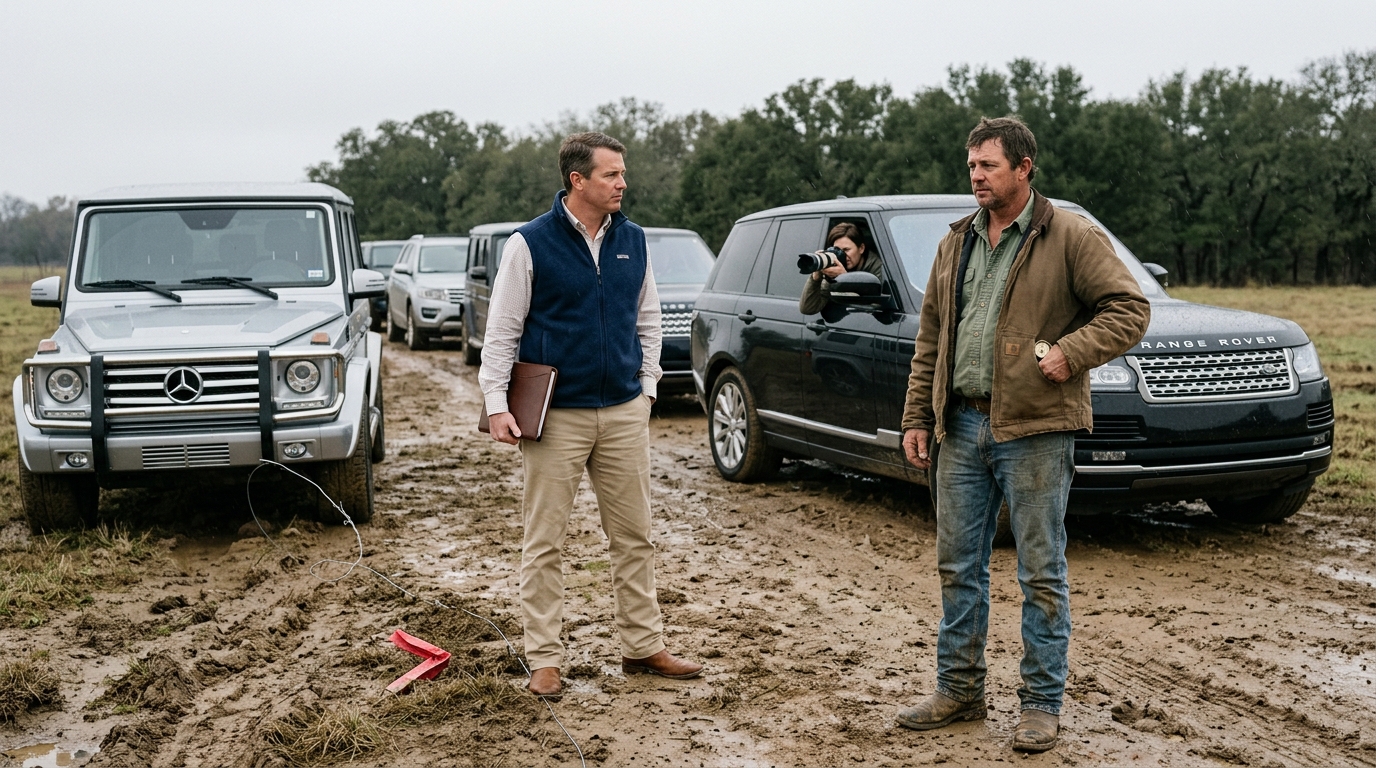
Engines whined in low gear. Eighteen luxury rigs came over the rise in a staggered column, chrome grills catching the flat gray morning light like rows of teeth. They weren’t lost. Lost drivers go slow. These vehicles held thirty-five miles an hour, tearing through forty acres of grazing land like they owned the deed.
My pregnant heifers scattered toward the oak line, hoofs hammering the mud.
I didn’t reach for a rifle. I didn’t shout. I stood up, set my boots shoulder-width apart, and let the brass gauge slide into my coat pocket. My thumb worked the knurled edge of the brass in steady, rhythmic circles. Calibrate. Measure. Control.
The lead rig—a silver G-Wagon with vanity plates reading HOA-P—skidded to a halt ten feet from my boots. The exhaust smelled of high-octane fuel and unburnt carbon.
A man stepped out. Crisp khakis. Tailored fleece vest. Hair styled to survive a hurricane. He didn’t look at the mud on his three-hundred-dollar boots; he looked at me like I was a fence post in his way.
“Jed Hawkins?” He didn’t offer a hand. He pulled a leather-bound folder from under his arm. “Bryce Kellerton. President of Willowbrook Estates Homeowners Association.”
“You’re three hundred yards inside private property line, Mr. Kellerton,” I said. My voice stayed flat, low in the throat. “You broke an eight-gauge top wire at the south gate.”
“Prescriptive easement,” Bryce said smoothly. He didn’t blink. “Martha Hendrix allowed neighborhood access through this parcel for nearly a decade. Under Texas common law, that route is now a public thoroughfare.”
He held out a paper. I didn’t reach for it.
“Martha went into memory care three years ago,” I said. “She passed in November. You’re seven years short of a prescriptive claim, and your surveyor didn’t read the county plat.”
Bryce smiled. It was a practiced gesture—white teeth, zero eye movement. “We have the documentation, Mr. Hawkins. Willowbrook is expanding. Traffic needs to flow. We can do this through the court, or we can do it as neighbors.”
Behind him, a black Range Rover idled. The passenger window was rolled down three inches. A woman inside pointed a high-end lens directly at my face, the shutter clicking in rapid bursts.
I looked past Bryce’s shoulder. In the mud behind his rear tire lay a crushed piece of red plastic—a marker stake from the county hydrologic survey. Someone had pulled it out of the ground before driving over it.
“Your parade is scaring the livestock,” I said.
“They’ll adapt,” Bryce replied. He tapped the folder against his palm. “Or you will.”
He turned back to his driver’s side door, waving his arm in a sweeping motion. The convoy behind him revved in unison, the noise shattering the quiet prairie air as they rolled deeper into my pasture.
I stood ground, feeling the cold weight of the brass gauge against my hip. I didn’t chase them. I took out my notepad, clicked my pen, and wrote down the first license plate.
Documentation wins wars.
CHAPTER 2: SUBTEXT AND SCARS
The red tail lights faded into the tree line, but the hum of six-cylinder diesel engines hung in the heavy damp air like a lingering fever. I didn’t pocket the notepad until the last exhaust note died against the cedar brake at the north property boundary.
My thumb stayed locked against the brass pressure gauge. The metal had taken my body heat, warmed up just enough to lose its bite, but the knurled edge dug a sharp crescent into my skin every time I squeezed.
I walked the track back to the south fence. The top wire was snapped clean, three strands of eight-gauge high-tensile steel unspooling into the mud like coiled snakes. The break was fresh—bright gray zinc flaking where the bumper had sheared the staple right out of the cedar post. It wasn’t an accident. You don’t hit a corner post at thirty-five unless you intend to drive through what’s behind it.
I pulled a pair of fencing pliers from my work belt, caught the loose strand, and cranked it back toward the line post. Metal groaned against metal. The strain burned through my forearms, that familiar dull ache from thirty years of tensioning cable and laying timber.
Behind me, boots crunched on the gravel path leading from the house.
“Dad?”
Emma stood by the well-house, a bowl of dry corn flakes held in one hand, her blue denim jacket zipped up to her chin. She was fourteen, but in the morning fog, framed by the raw timber of the porch, she looked smaller.
“Go back inside, Em,” I said, keeping my eyes on the wire. “Cereal’s getting soggy.”
“Who were those trucks?” She didn’t move. Her knuckles were white where she gripped the rim of the ceramic bowl. “They didn’t stop at the mailbox.”
“Just lost folks,” I lied. The lie tasted like cold ash. “Survey crew checking county lines.”
“Surveyors don’t drive silver Mercedes,” she said flatly. She had her mother’s eyes—sharp, observant, slow to blink. “And they don’t drive through the fence.”
I cinched the wire splice, driving two heavy staples into the cedar post with the flat face of the pliers. Thud. Thud. The sound was flat, swallowed by forty acres of open prairie.
“It’s taken care of,” I told her, stepping over the ditch. “I’m heading up to the north pasture before noon. Get your school books laid out.”
She didn’t argue, but she didn’t agree either. She turned slowly, her sneakers squeaking on the wet flagstones as she walked back toward the farmhouse. I watched her go, noting the slight stiffness in her posture. Kids know when the air turns thin. You can’t hide storm pressure from somebody who lives under the same roof.
By dusk, the mist turned into a steady, needle-fine drizzle.
I set the trail cameras along the creek bed where the pasture dipped into Hydrologic Parcel 88—a three-acre marshy bottom that Martha Hendrix used to leave fallow for the wild turkeys. The units were military-surplus thermal pods, solar-charging, housing night-vision sensors that didn’t flash red when triggered. I bolted the second one six feet up an old post oak, angling the lens down toward the dry wash.
That was when I saw it. Half-buried under a clump of waterlogged bull thistles lay a plastic-laminated map sheet.
I leaned down, hooked it with two fingers, and wiped the black silt off the plastic. It was a topographical overlay map marked Project Vanguard – Draft Site Assessment. Across the bottom corner, a heavy red wax stamp read CLASSIFIED – PRIVATE HOLDING. The map showed my forty acres, but the boundaries were drawn wrong. My farmhouse was shaded in light gray, labeled simply as Structure 4-B (Removal Required).
I stared at the print until the rain washed the rest of the mud across the legend.
Structure 4-B. Not a home. Not a ranch. A line item on an asset sheet.
At 1:17 a.m., the monitor on my kitchen counter chimed once. A low, synthetic beep.
I was sitting in the dark with a cold mug of black coffee, the brass gauge sitting on the table beside my notebook. I didn’t turn on the light. I slid my chair back, stepped to the window, and pulled the edge of the blind back half an inch.
Down by the back fence, three hundred yards out, a dark shape idle without lights. A black Range Rover.
Through the night-vision feed on my phone screen, the scene was laid out in pale green resolution. The driver’s door opened. A figure stepped out—slender, wearing a fitted waterproof shell and heavy mud boots. Sutton Blackwood. She didn’t have a clipboard this time. She had a pair of twenty-inch bolt cutters and a heavy flashlight with a blacked-out lens filter.
She didn’t approach the house. She walked straight to the cattle barn, stooping low to stay below the top rail of the pipe corral.
Click. Click. Click.
The high-end camera around her neck fired off twenty frames in ten seconds, targeting the concrete footings of the barn, the drainage swale behind the feed shed, and the old iron property pin driven into the bedrock back in 1952. She reached into her pocket, pulled out a small aerosol can, and sprayed a quick yellow mark directly onto the corner foundation of my hay storage.
My thumb worked the brass gauge in my pocket until the spring compressed to its absolute limit.
I didn’t open the door. I didn’t step onto the porch with a flashlight. A man who shows his hand at 1:00 a.m. loses the table by breakfast. I watched her work for six minutes, recording every frame to the local server, logging the timestamp, the vehicle frame number, and the exact angle of her camera lens.
She climbed back into the Range Rover, the door shutting with a soft, expensive pneumatic seal, and backed down the access lane without turning on her high beams.
I sat back down at the kitchen table, reached for my pen, and opened the black ledger beside my coffee.
The wire was cut. The boundaries were marked. They were measuring my home for a grave, but they hadn’t checked the depth of the bedrock.
CHAPTER 3: THE PAPER AUDIT
The ink dried black on the ledger page before the first crow called from the oak line.
I didn’t close the book. My hand rested flat over the entry, the cold brass pressure gauge anchored on top of the margin like a paperweight. Across the table, the kitchen window held the grey, greasy light of six in the morning.
Outside, a tailpipe backfired. It wasn’t the throaty rumble of a luxury V8. It was the wheezing, metal-on-metal rasp of a 1998 Buick LeSabre chewing through its third muffler.
The car rattled up the drive, its suspension groaning as the front bumper cleared the cattle guard. It came to a halt twenty feet from the porch, engine dieseling for three seconds before dying with a heavy shudder.
The driver’s door creaked open. Dorothy Peton stepped out, her seventy-eight-year-old frame bent slightly into the rain, wearing a yellow vinyl slicker that smelled faintly of mothballs and damp attic insulation. In her right hand, she carried a thick manila envelope tied with faded red string.
I met her at the bottom step before she reached the porch.
“Coffee’s warm, Dorothy,” I said.
“Don’t have time for coffee, Jed,” she rasped, her voice sounding like two sheets of sandpaper rubbed together. She didn’t offer a smile. She shoved the manila envelope against my chest. Her knuckles were swollen with arthritis, twisted like scrub oak roots, but her grip on that paper was absolute. “They had an executive session last night. Closed doors. No public notice.”
I held the envelope by its string. “Willowbrook?”
“Bryce,” she said, pulling her slicker tight. “He thinks because I’m nearly eighty I don’t read the board packets. He thinks we just sign off on the lawn care contracts and keep our mouths shut about the streetlights.”
She leaned in, the cold drizzle catching in the grey curls around her ears. The smell of her old car—burnt oil and stale peppermint—hung in the air between us.
“Three years ago,” she whispered, her eyes locking onto mine, “the county approved a three-hundred-thousand-dollar bond for the connector road. Bryce’s firm took the money. Said it went into environmental feasibility studies for the drainage slope bordering your south pasture. Hydrologic Parcel 88.”
My thumb tightened against the thick paper of the envelope. Parcel 88. The same parcel from the map I pulled out of the mud.
“The road never got built,” I said.
“Not a foot of asphalt,” Dorothy said bitterly. “They routed the development traffic straight across Martha’s lease instead, called it a temporary detour, and pocketed eight hundred and forty-seven thousand in ‘consulting fees’ paid directly to a shell company listed as The Blackwood Ledger. It’s all in those minutes. Page four. The signatures are right there.”
I opened the clasp, untying the red string with slow, deliberate fingers.
Inside were forty pages of meeting logs, bank routing numbers, and municipal bond receipts. Halfway down the third page, a row of itemized expenses stood out in crisp black font: Environmental Abatement & Boundary Realignment — Project Vanguard.
“He promised the county board the road was delayed due to land access,” Dorothy continued, her breath fogging in the chill air. “He told them you were the holdout. He’s using your refusal to grant an easement as his legal shield for why three hundred grand in taxpayer money vanished into thin air.”
The scent of wet earth and raw diesel drifted off the driveway. For a fraction of a second, my mind flashed back to a bypass route outside Mosul—a culvert washed out, a subcontractor claiming three million in concrete pour costs while the rebar sat rusting in a ditch. The smell of fraudulent diesel and wet iron was the exact same.
“He isn’t trying to buy my land to build houses, Dorothy,” I said, my voice dropping an octave.
“No,” she said, her lips drawing into a thin, pale line. “He needs your deed so he can absorb the parcel into the development master plan. Once it’s inside Willowbrook’s boundary, the county loses audit jurisdiction. The road debt disappears into the HOA’s private infrastructure pool. He buries the fraud under your pasture.”
A red SUV passed the mailbox out on the county road, slowing down just enough for the driver to look across my fence line before accelerating away toward the subdivision gate.
“They’re voting to initiate eminent domain pressure through the county commissioner on Friday,” Dorothy added, tapping her twisted finger against the envelope. “He told the board you were broke. Said your ranching operation was failing and you’d take a lowball payout the second the legal bills started piling up.”
I looked down at the paper in my hand, tracing the typed name The Blackwood Ledger with the tip of my index finger.
The decoy was clear now. Bryce wasn’t a master land developer executing an expansion; he was a petty embezzler running out of time on a county bond audit, hiding an eight-hundred-thousand-dollar hole behind a fake easement dispute.
“They think I’m backed into a corner,” I said softly.
“Are you?” Dorothy asked.
I pulled the brass gauge from my pocket, set it on top of the paper, and pressed the release pin until the internal spring clicked into place.
“No,” I told her, looking out toward the south gate where the tire ruts cut deep into the clay. “They just gave me the exact weight of the load.”
CHAPTER 4: THE CONFESSION TRAP
The release pin clicked into place, but the rain didn’t stop.
I took the stairs slow, carrying Dorothy’s audit packet under my left arm while my right hand stayed deep in my canvas coat pocket, thumb resting against the knurled pressure gauge. Dorothy’s old Buick chugged twice at the end of the gravel lane, its exhaust leaving a thin grey haze that dissolved into the downpour.
By noon, the rain had turned the driveway into a slough of yellow clay. I didn’t shovel it. I left the feed store rumors to do the heavy lifting—complaining to the clerk at the counter about legal retainers, letting my voice carry across the hardware store aisle about land taxes and mounting surveyor fees.
The trap was laid. All it needed was a light touch on the treadle.
At 3:15 p.m., a charcoal Range Rover pulled onto the gravel. It didn’t speed. It didn’t tear up the turf. It rolled up to the farmhouse with the silent, predatory grace of a vehicle that knew its target was running out of diesel.
Sutton Blackwood stepped out under a black umbrella. She wore a tailored wool trench coat, her hair pulled back into a tight, dark knot. In her right hand, she carried a slim leather folio. No camera this time. No night-vision lens. Just corporate authority on high-gloss stationary.
I opened the screen door before she reached the bell.
“Mr. Hawkins,” she said. Her voice was smooth, cultured, perfectly pitched to sound like reasonable advice. “It’s cold out here. May I?”
“Kitchen’s through the hall,” I said, stepping back just enough to let her pass.
The floorboards creaked under her leather flats. She glanced at the worn oak hat rack, at Emma’s yellow raincoat hanging by the stove, at the single framed photograph of the Corps unit sitting on the sideboard. Her eyes were calculating—measuring square footage, calculating maintenance costs, assessing vulnerability.
She sat at the heartwood table, laying her leather folio flat on the oilcloth cover.
“Coffee?” I asked, standing by the stove.
“I’m fine, thank you,” she said. She unclasped the folio with a crisp, metallic snap. “I’ll be direct, Jed. Bryce and the board are moving forward with the county filing on Friday. Once the formal easement dispute enters the public record, your property value drops thirty percent instantly. No bank will refinance a rural mortgage with a pending municipal encumbrance.”
I leaned back against the counter, my arms crossed over my chest. Inside my shirt pocket, six inches from her eyes, the pinhole microphone recorded the steady 44.1 kHz audio stream directly to the server in the pantry.
“I paid cash for this place, Ms. Blackwood,” I said softly.
“And you’ve put every dime of your military pension into fencing, drainage, and stock,” she countered, sliding a single sheet of paper across the table. “Cash flow is different from equity. You’re bleeding four thousand a month in operational costs, and the legal fees haven’t even started.”
I looked at the paper. It was a purchase option agreement. Three hundred and eighty thousand dollars. Sixty grand less than what I’d invested three months ago.
“This is a lowball,” I said.
She tilted her head, a faint, condescending smile touching the corners of her mouth. “It’s an exit strategy. We take the land off your hands, assume the hydrologic liabilities of Parcel 88, and close the file before the county commissioner issues a subpoena.”
I reached out, my fingers tracing the edge of the paper. “Hydrologic liabilities? It’s grazing land.”
Sutton leaned forward, resting her forearms on the table. Her knuckles were pale under the kitchen’s bare bulb. “We’ve successfully transitioned three other rural properties this way, Mr. Hawkins. Once owners understand the pressure that can build—the code violations, the environmental audits, the daily friction—they realize peace of mind has a price.”
“You did this to the Miller ranch,” I said.
“The Miller family relocated to Oklahoma with a clean ledger,” she replied without a flicker of hesitation. “You can do the same. Or you can let Bryce turn this forty acres into a construction staging area while the court takes two years to decide who owns the right-of-way.”
Her phone buzzed against the table. She didn’t look at it, but I caught the preview banner on the glass screen: KELLERTON: Is the deed signed?
I picked up the purchase option, folded it once down the center, and set it directly over my brass gauge on the table.
“I’ll think about it,” I said.
Sutton’s smile vanished. The warmth left her face like water draining out of a pipe. “Don’t take too long, Jed. Phase two launches at seven-thirty tomorrow morning. By eight, you won’t have a fence line left to sell.”
She stood up, buttoned her coat, and walked out without another word. The screen door slammed shut behind her, the spring vibrating against the wood.
I sat down at the table, opened the drawer, and pulled out the audio receiver. The red recording light was steady. Her voice played back through the small speaker, clear and sharp: We’ve successfully transitioned three other rural properties this way…
Through the window, I watched her Range Rover splash through the yellow mud at the gate.
Then my phone chimed in my hand. An anonymous text alert from a local community forum link, forwarded by a contact in town.
I tapped the screen. A digital flyer appeared, complete with Emma’s high school name, her second-period classroom number, and her daily bus route schedule posted under a public comment thread titled Local Obstructionists.
My vision narrowed down to a needle point. The air in the kitchen turned ice-cold.
They had crossed from paper fraud into my house.
I reached for my work boots, pulled them on, and tied the laces tight. I didn’t call the sheriff. I walked straight out to the machine shed, threw the breaker for the shop lights, and pulled the canvas tarp off the hydraulic power unit sitting in the corner.
It was time to set the steel.
CHAPTER 5: HYDRAULIC STEEL
The heavy copper knife-switch locked into the terminal with a hard, metallic clack.
Fluorescent tubes overhead buzzed to life, casting harsh white light across the machine shed floor. I didn’t waste a second staring at the phone screen where Emma’s schedule sat open. I pocketed the device, stepped over the power cables, and dragged the heavy rubber hydraulic hoses toward the south easement gap.
By four in the morning, the rain had backed off to a thin grease on the clay. Under forty inches of reinforced concrete footing—poured three weeks back under the guise of an irrigation valve vault—sat the four retractable bollards. Eight-inch structural steel cylinders, solid-core, rated for heavy industrial security.
I rigged the 12-volt solar activation relay, wired the wireless control box into the main panel on the post oak, and tested the pressure seals with my brass gauge.
3,000 PSI. The pump hummed like an angry hornet, fluid surging through high-pressure lines.
At 7:15 a.m., the sunrise looked like a fresh bruise across the eastern horizon—dull purple and yellow. I stood twenty paces back from the south fence line, dressed in my canvas coat, hand buried deep in the right pocket where the remote transmitter sat.
The drone came first. A high-pitched whining hum above the tree line. Then the rumble of eighteen luxury engines rolling down the county road in close formation, high beams cutting through the dawn mist like tactical searchlights.
Bryce Kellerton was leading in his silver G-Wagon. Behind him, Sutton’s Range Rover, followed by two dozen SUVs, pickup trucks, and local news vans invited for the spectacle. A banner was taped across Bryce’s front bumper: WILLOWBROOK COMMUNITY ACCESS RALLY.
They didn’t stop at the mailbox. They didn’t slow for the fence line.
Bryce hit the rotted cedar gate at thirty-five miles an hour, splintering the rails into toothpicks. The convoy surged onto my pasture like a suburban cavalry charge, tires tearing deep, muddy trenches through forty acres of prime turf, live-stream cameras mounted on four dashboards.
Through his open driver’s side window, Bryce pointed a gloved finger at me, laughing into a cab-mounted camera.
Seven-twenty-nine a.m.
I pulled my hand from my pocket, thumb resting over the red toggle switch on the transmitter.
Seven-thirty.
I pressed the button.
A dull pneumatic hissed from the oak tree relay. Three seconds.
The ground shook under my boots as four thousand pounds of hydraulic force drove four eight-inch steel bollards straight up out of the earth, locking four feet above grade with a deafening structural THUD.
Bryce’s G-Wagon hit the center steel post at thirty-five miles per hour.
The sound wasn’t a crash. It was an explosion of structural kinetic force. The front frame rail collapsed like an accordion, the radiator detonating in a blinding cloud of white steam. The three-ton Mercedes flipped onto its side, sliding thirty feet through the mud before coming to a dead stop against the second post. Airbags deployed with twin gunshot cracks.
Sutton’s Range Rover plowed directly into Bryce’s rear bumper, its hood buckling into a sharp V-shape. Behind them, a lifted pickup tried to swerve right to avoid the pileup, slid sideways across the wet clay, and nose-dived five feet down into the drainage ditch of Hydrologic Parcel 88, stranding its axle on the culvert.
Chain-reaction metal crumpled down the line. Horns blared continuously. Glass shattered. Radiator fluid hissed against hot exhaust manifolds, filling the morning air with the sweet, acrid smell of burnt glycol and scorched rubber.
Silence fell over the pasture, broken only by the steady, rhythmically clicking hazard lights of eighteen wrecked luxury vehicles.
I didn’t run forward. I didn’t yell. I stepped over the splintered remains of my gate rail and walked toward the wreckage with slow, measured strides, pulling my phone from my pocket.
Bryce kicked his driver’s side door open, dragging himself out onto the muddy fender. His designer fleece was torn at the shoulder, a smear of black grease across his forehead, his face pale and contorted with hysterical fury.
“You’re done, Hawkins!” he screamed, his voice cracking as he stumbled onto the turf. “You deployed an illegal trap! This is assault! I’ve got twelve live feeds streaming this across the county!”
“Texas Property Code, Section 75,” I said, my voice cutting through his panic like a cold knife. “Defensive perimeter barriers are permitted on private agricultural land with clear LED warning markers.” I pointed up to the solar-powered red strobe blinking steadily atop the oak post. “You drove through a marked security zone at thirty-five miles an hour on live camera.”
Behind his smoking vehicle, the siren wails started.
Four county sheriff cruisers, two unmarked state trooper sedans, and a black van bearing the seal of the Federal Bureau of Investigation pulled into the pasture, their red and blue strobe lights painting the wrecked convoy in flashing colors.
Sutton Blackwood stepped out of her ruined Range Rover, her expensive coat covered in white powder from the airbag deployment. Her eyes darted from the approaching federal sedans to me, her composure evaporating in real time.
A woman in a grey suit stepped out of the lead unmarked sedan, holding a heavy leather briefcase and an official federal warrant folder. Margaret Smith, lead forensic investigator for the regional financial crimes division.
“Bryce Kellerton?” Margaret called out over the sound of the idling cruisers. She didn’t look at the wrecked cars. She looked straight at Bryce.
“I’m the president of Willowbrook HOA!” Bryce shouted, clutching his shoulder as he backed away toward his door. “This man just destroyed two million dollars in private property!”
Margaret opened the folder. “You’re under arrest for federal wire fraud, interstate land sales fraud, and structural embezzlement under Project Vanguard.” She motioned to the deputies behind her. “We have the bank routing records for The Blackwood Ledger, Mr. Kellerton. Courtesy of an internal audit.”
Sutton froze. She looked down at the mud beneath her boots, then at the black federal van. Her mouth opened, but no sound came out.
I stood beside the center bollard, my hand resting against the cold, unyielding steel post that had stopped two tons of rolling momentum.
The empire hadn’t just fallen. It had run straight into the bedrock.
CHAPTER 6: STRUCTURAL CHECKMATE
The steel of the center bollard was cold under my palm, vibration still humming faintly through the metal frame four feet underground.
Bryce didn’t go quietly into the back of the federal sedan. He lunged back against the deputy’s grip, his mud-caked designer shoes slipping on the wet clay. His face was blotched red, the slick hair completely ruined.
“This isn’t over, Hawkins!” he screamed, his voice raw over the idle of six police cruisers. “You think a few spreadsheets mean anything? The HOA board will tie this land up in chancery court until your grand-kids are dead! I have indemnification clauses under Project Vanguard!”
Agent Margaret Smith didn’t even look up from her clipboard as the deputy forced Bryce’s head beneath the doorframe. She pulled a blue-bound file from her leather bag—the thick, official folder bearing the seal of the Texas Environmental Quality Commission.
“The indemnification clauses were voided three hours ago, Mr. Kellerton,” Margaret said, her voice dry as parchment. She stepped closer to the open car window. “We served the search warrants on your offshore holding accounts at dawn. We didn’t just find the three hundred thousand siphoned from the county road bond through The Blackwood Ledger. We found the chemical soil core samples you suppressed from Hydrologic Parcel 88.”
Bryce froze, his shoulder half-wedged against the leather seat.
“Hydrologic Parcel 88,” Margaret continued flatly, “isn’t just a pasture swale. It’s the primary drainage basin for the entire upper ridge. Six years ago, when Willowbrook Estates laid its phase-one foundations, your contractors dumped forty tons of uncured industrial sealant into the wash to bypass soil stabilization costs. You weren’t driving across Jed’s property to force a shortcut. You needed to seize title to Parcel 88 so you could cap the basin under private HOA jurisdiction before state inspectors detected the heavy metal leachate leaking toward the municipal water table.”
Bryce’s mouth opened, but no words came out. The arrogance that had carried him across my pasture for three weeks dissolved into a hollow, frantic stare.
Behind him, Sutton Blackwood was already sitting in the second cruiser, her head bowed, her hands cuffed in front of her crisp trench coat. She wasn’t shouting. She was watching Margaret’s file with the quiet, cold realization of a strategist who knew every exit ramp had been welded shut.
The deputy slammed the sedan door. The latch caught with a heavy, final thunk.
As the federal column processed the scene, towing the ruined luxury rigs off the pasture one by one, the sun broke through the gray overcast. The yellow mud on the drive began to dry into thick, firm clay.
Six months later, the prairie air smelled of sun-warmed Bermuda grass and fresh pine cedar.
I sat on the front porch step, a pair of heavy fencing pliers resting on my knee. On the gravel drive below, a brand-new three-strand wire fence stretched out to the south corner post—tight, straight, zinc-coated high-tensile steel ringing clear when the breeze hit it.
The settlement from the federal civil forfeiture action had cleared three weeks prior. The county used the recovered funds to construct the public bypass road two miles east, exactly where it belonged, leaving my forty acres isolated once again under the quiet sky.
Footsteps creaked on the porch boards behind me.
Emma walked down the steps carrying two mugs of cold tea. She handed me one, then sat beside me on the timber rail, her sneakers resting on the clean flagstones. She didn’t look at her phone. She looked out across the north pasture where fifteen heritage heifers grazed under the shade of the old oaks.
“Dorothy called from town,” Emma said, taking a sip. “She said the county board approved the agricultural sanctuary designation for Parcel 88. Nobody’s building on it. Ever.”
“Good,” I said softly.
I reached into my pocket, pulled out the scarred brass pressure gauge, and set it on the wooden step between us. The internal spring was recalibrated, polished clean, resting at zero PSI.
“You still going to Austin on Monday?” I asked her.
Emma looked down at the brass gauge, then out at the fence line she’d helped stretch the day before. “Classes start at eight. Pre-law.” She paused, a slight smile touching the corner of her mouth. “Agricultural land rights. Someone’s got to make sure the paperwork stays as solid as the steel.”
I picked up the gauge, slid it into my pocket, and took a long drink of the tea.
The prairie was quiet. The cattle moved slow through the high grass. And for the first time in forty acres and twenty years, the silence didn’t feel like waiting for a storm.
It just felt like home.