The Weight of Concrete and Cold Retribution: How a Quiet Subterranean Blueprint Brought Down a Tyrant
CHAPTER 1: THE FIRST SALVO ON THE LAWN
The air smelled of freshly inverted clay and the cloying, synthetic residue of department store jasmine. It was an offensive combination, sharp enough to cut through the crisp morning breeze that rolled off the manicured lawns of Willow Creek Estates.
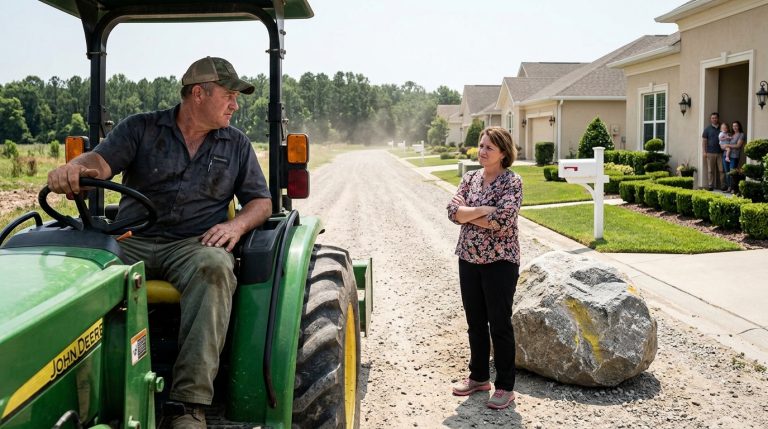
Frank Davies did not blink. His eyes, faded to the pale blue of a stagnant river after twenty-five years of reading topographical maps and concrete density charts, remained locked on the trembling, sausage-like finger pointing directly toward his excavation pit.
“Mr. Davies,” Karen’s voice carried the shrill, practiced cadence of a woman accustomed to settling disputes over HOA-approved mailbox dimensions. “That little hole in the ground of yours is going to cost you more than this entire house.”
The excavator’s steel bucket sat idle twenty feet away, dripping dark, damp soil back into the raw earth. Beneath the sod, the trench for the wine cellar was square, plumb, and mathematically precise—every vertical foot backed by stamped municipal permits signed by a department head who knew what an engineered load-bearing wall looked like. Yet Karen stood there on the edge of the Kentucky bluegrass, her floral-print mumu billowing around her plus-size frame, embodying the absolute fury of someone who had never once encountered a variable she could not bully into submission.
“I have the city’s chief building inspector on speed dial,” she hissed, her face mottling into an ugly, blotchy crimson that clashed violently with her frosted blonde hair. Her arms were crossed so tightly across her chest that her breath hitched on every syllable. “He does not appreciate unpermitted doomsday bunkers being dug in my neighborhood.”
Frank shifted his weight slightly. The iced tea in his glass rattled against the condensation, a low, metallic chime that matched the rhythm of his pulse. He calculated the distance between her position and the property line. Three inches over the curb. A technical violation of the municipal easement, though entirely irrelevant to the immediate tactical engagement.
“Karen,” Frank said. His voice was level, calibrated to a flat, middle-register frequency that he had once used to brief generals in forward operating bases. “It’s a wine cellar.”
“Don’t you patronize me!”
“For the record,” Frank continued, ignoring the spike in her vocal pitch, “every single permit was approved and filed with the city three months ago. Your HOA bylaws, which I happen to have read with considerably more comprehension than you brought to the task, make no mention of subterranean construction. So, with all due respect, you have absolute zero jurisdiction here.”
The silence that followed was heavy, broken only by the distant hum of a lawnmower three streets over. Karen’s face didn’t just redden; it darkened to a bruised, plum hue. The veins at her temples throbbed against her skin.
“We’ll see what Mr. Henderson has to say about your jurisdiction when he condemns this entire property,” she spat, her voice dropping into a venomous register. “You military types are all the same. Thinking the rules don’t apply to you.”
That was the line. The precise vector where a neighborhood nuisance crossed into a declaration of war. Frank felt a cold, clinical detachment settle over his mind, washing away the last remnants of civilian patience.
He set his glass down on the porch railing. The glass made a soft, deadened thud against the wood, perfectly level.
“Call him, Karen,” Frank murmured, his eyes narrowing just a fraction as the sunlight caught the edge of her clipboard. “I insist.”
She whipped around toward her golf cart with surprising velocity, her fingers clawing at the phone in her pocket, entirely unaware that the envelope sitting on her kitchen counter was missing its return receipt confirmation—a subtle, administrative discrepancy that would soon render her entire paper trail legally void.
CHAPTER 2: DRAFTING THE COUNTEROFFENSIVE AT THE OAK DESK
The front door clicked shut with a weighted, solid latch, sealing out the cloying residue of department store jasmine and the harsh glare of the suburban street. Frank did not rush. He walked through the entryway with the measured, deliberate cadence of a man who measured his life in load-bearing calculations and safety factors. In the living room, Sarah stood by the sheer curtains, her fingers curled into the fabric as she watched the canary-yellow cart bounce back down the asphalt toward the cul-de-sac.
“She’s escalating, Frank,” Sarah said, her voice tight, carrying a low hum of tension that she had tried to swallow down. “That woman doesn’t know when to quit. If she gets the building inspector out here, what happens to the schedule?”
“The schedule holds,” Frank replied, his voice a steady anchor against her anxiety. “Concrete cures on its own timeline, Sarah, not Karen’s. Let her call Henderson. Every minute she spends weaponizing bureaucracy is a minute she’s not paying attention to her own structural deficits.”
He didn’t mention the missing return receipt on the certified mail sitting on the side table—a minor, administrative oversight on the HOA’s part that effectively invalidated their statutory notice window. It was a small weapon, but in a war of attrition, small weapons kept the enemy off balance.
Frank turned away from the window and walked back down the short hallway toward his home office. The air changed the moment he crossed the threshold; the sterile scent of the rest of the house gave way to the rich, earthy tang of raw oak shavings and dried linseed oil. His workshop in progress was just visible through the half-open door of the adjoining room, a sanctuary of precision where things were built to last for generations, governed by immutable laws of physics rather than arbitrary neighborhood covenants.
He sat down at the heavy oak executive desk—a surplus piece of military-issue furniture he had hauled across three states during his final active-duty reassignment. The surface was scarred with faint ring marks and small nicks, each one a silent record of a completed project, a briefed mission, or a signed directive.
A sudden, unbidden sensory phantom flickered at the edge of his memory: the stifling heat of a forward operating base in the Diyala province, the smell of diesel exhaust mixed with sun-baked adobe, and a junior officer sliding a crumpled requisition form across a metal table with a panicked look in his eye. The foundations are shifting, Colonel. The drainage culvert is compromised. Frank had looked at the blueprint, smelled the impending failure, and rewritten the drainage protocols within the hour.
He blinked, snapping back to the quiet, air-conditioned refuge of Willow Creek Estates. The stakes here were smaller, wrapped in floral-print mumus and petty suburban tyranny, but the engineering logic remained identical. A failing structure always showed its stress points first where the load was applied unevenly.
Frank reached out and pulled a thick, three-ring binder toward him. The cover was blank white, labeled simply in black marker: HOA CORRESPONDENCE & LEGAL BASELINE.
He opened it to the first section, sliding his reading glasses into place. The pages were neatly organized behind plastic sheet protectors, categorized by date, time stamp, and tracking number. There was Karen’s first demand letter, printed in that aggressive, bold font designed to intimidate retirees into paying arbitrary fines for misplaced garbage cans. There was his own meticulous reply, structured like an after-action report with a formal table of contents, appendices, and highlighted excerpts from the community’s own governing documents.
He picked up a red pilot pen, the ink smooth and sharp against the paper.
The first salvo had been fired on the lawn, but a defensive posture was a losing strategy in urban engineering or neighborhood politics. If Karen wanted to play by the rules of bureaucratic attrition, he would give her an academy-level demonstration of how a quarter-century of military logistics handled an obstinate obstacle.
He began to draft the next sequence of responses, not as emotional rebuttals, but as a preemptive legal architecture. He outlined the exact clauses of the municipal easement, mapped out the precise square footage of his subterranean excavation relative to the property line, and noted the exact time of her verbal threats on the grass. Every entry was factual, stripped of emotion, and backed by verifiable code.
As his pen scratched rhythmically across the white legal pad, the distant rumble of a delivery truck rolled down the street outside, its engine straining against the pavement. Frank didn’t look up. He simply noted the cadence of the traffic, calculated the trajectory of the paperwork he was assembling, and prepared for the next phase of the engagement.
CHAPTER 3: THE INSPECTORS ARRIVAL AND THE PIVOT
The ink from the pen bled slightly into the coarse grain of the paper as Frank finalized the closing paragraph of his structured response. The house was quiet, save for the low, rhythmic thrum of the refrigerator in the kitchen and the distant, muffled clatter of the carpenters wrapping up their morning shift outside. He capped the pen with a sharp, definitive click that echoed off the bare wood of the desk.
Ten minutes later, the sharp buzz of his mobile phone sliced through the silence.
Frank picked it up on the second ring. The screen displayed an unknown local number, but the timing was precise—mathematically predictable, given Karen’s penchant for immediate escalation.
“Mr. Frank Davies?” The voice on the other end was deep, tired, carrying the flat, frictionless tone of a municipal worker who had spent decades dealing with neighborhood feuds over property lines and overgrown hedges.
“Speaking,” Frank said, keeping his register neutral.
“This is Robert Henderson from the city building and safety department. I’ve received a formal complaint regarding unpermitted and potentially hazardous construction at your address. Standard protocol requires an on-site inspection. I can be out there in thirty minutes.”
The adrenaline spike was familiar, a cold, clean rush of focus that sharpened every sensory detail in the room. Frank didn’t hesitate. “Thirty minutes is entirely acceptable, Mr. Henderson. I’ll meet you out front.” He paused, letting a measured cadence enter his voice. “And thank you for the professional courtesy of a direct call.”
A brief, dry exhale came through the receiver. “Not a problem, Mr. Davies. Most of these calls are… well, you understand. See you shortly.”
The line clicked dead. Frank stood up immediately, his movements economical. He walked out of the office and down the short hallway to where the carpenters were packing their tools near the backdoor. He instructed them to take an early lunch, ensuring the workspace below grade was clean, lit, and unobstructed. Then, he returned to the dining room, where he unrolled the full-sized tube of his approved architectural plans across the polished wood surface, weighting down the curling corners with heavy hardcover volumes from his military history collection. Next to the blueprints, he placed the thick, tabbed packet of municipal permits bearing the prominent signature and stamp of department head Miller.
Exactly twenty-nine minutes later, the gravel in the driveway crunched under the heavy tires of a white city-owned pickup truck.
Frank stepped out onto the front porch just as Robert Henderson killed the engine. But before Henderson could even push open his door, a canary-yellow blur screeched to a halt right behind the truck. Karen’s golf cart hopped the curb, coming to a rest directly on the edge of the Kentucky bluegrass. A triumphant smirk stretched across her face like a pulled tendon. She was clad in a blinding yellow pantsuit, looking every bit the part of a self-appointed monarch arriving to witness an execution.
Henderson stepped out of his truck, a tall, angular man in his late fifties with a neat gray mustache and sharp, calculating eyes. He gave Karen’s golf cart a long, unreadable look before turning his attention to the porch. He carried a heavy-duty aluminum clipboard and a digital camera.
“Mr. Davies, I’m Henderson,” the inspector said, extending a hand that was dry, firm, and entirely devoid of pretense.
“Frank,” he replied, taking the grip with equal pressure. “Glad you made it. It’s turning into quite a warm day—can I offer you some lemonade before we head inside?”
Henderson blinked, momentarily caught off guard by the casual hospitality before a faint, dry smile touched the corner of his mouth. “Appreciate the thought, Frank, but let’s get straight to the work.”
Before Frank could answer, Karen waddled across the lawn, her breath coming in short, ragged gasps. “Mr. Henderson! Thank you for coming so quickly,” she blurted out, her voice pitching upward. “As I told you on the phone, it’s a major safety hazard. He’s been digging for months without proper oversight. We’re all terrified our foundations are going to crack.”
Henderson turned slowly, his expression shifting from courteous to rigidly professional. “Ma’am, I’d appreciate it if you’d let me conduct my inspection first. I’ll speak with you if I have any questions.”
Without waiting for her retort, Henderson turned back to Frank. “Lead the way, Mr. Davies.”
They walked past the threshold, leaving Karen fuming on the gravel like a dropped engine part. Inside, Henderson stopped dead in his tracks the moment he saw the dining room table. His eyes scanned the unrolled blueprints, tracing the load-bearing calculations, the rebar schedules, and the precise waterproofing layers.
“These are comprehensive,” Henderson murmured, an unmistakable note of professional respect creeping into his voice. “You don’t typically see this level of detail on a residential addition. Who was your structural engineer?”
“I drew them myself,” Frank replied evenly. “Twenty-five years with the Army Corps of Engineers.”
Henderson let out a low whistle, his eyebrows lifting toward his hairline. “Ah. That explains it.”
For the next twenty minutes, there was no homeowner and no bureaucrat. There were only two men who spoke the language of concrete, physics, and load distribution. They walked down the stairs into the newly excavated cellar, Henderson running his fingers along the smooth, plumb face of the poured concrete walls, checking the electrical conduits and the specialized HVAC ductwork with the practiced eye of a veteran inspector.
When they climbed back up to the main floor, Henderson tucked his pen back into his pocket with a definitive snap. “Frank,” he said, the official stiffness entirely gone. “This is one of the most over-engineered and structurally sound residential builds I’ve set foot in all year. Whoever filed that complaint was wasting my time and yours.”
“I believe in doing things right the first time, Robert,” Frank replied quietly.
They stepped out onto the porch together. Karen was waiting at the foot of the steps, her arms crossed so tightly her shoulders were practically touching her ears, her smirk hardening into an expression of desperate certainty.
“Well?” she demanded, her voice shrill. “Are you shutting him down? Are you writing up the fines?”
Henderson looked down at her, and the flicker of annoyance in his eyes hardened into absolute ice. “Ma’am,” he said, his voice flat and official once more. “Mr. Davies’s project is fully permitted, up to code, and structurally exemplary. There are no violations of any kind. I am closing this complaint as entirely unfounded.”
Karen’s jaw went slack, the color draining from her face in real time. “Unfounded? But… but he dug a massive hole! He didn’t get HOA approval!”
“The HOA is outside my jurisdiction,” Henderson replied smoothly, stepping past her toward his truck. “My jurisdiction is city building code, and there are no issues here. Have a good day, Mr. Davies.”
As Henderson’s truck pulled away, leaving Karen standing frozen in her yellow suit, Frank felt the tactical initiative shift entirely to his side. He didn’t gloat. Instead, he watched the inspector’s vehicle roll slowly down the street toward the community center, knowing precisely which seeds of doubt had just been planted.
CHAPTER 4: THE WHISPERING CAMPAIGN AND THE GATHERING STORM
Frank remained on the porch for three full minutes, his eyes tracking the dust motes suspended in the dry afternoon air. Henderson’s truck was long gone, and Karen’s canary-yellow pantsuit was a vanishing dot near the cul-de-sac, but the perimeter required securing. He picked up the two untouched glasses of lemonade, their ice already melted into lukewarm water, and carried them back inside.
The quiet of the house was short-lived. Two days later, the friction shifted from official channels to the subterranean currents of neighborhood gossip.
Sarah came through the front door just after ten in the morning, her cheeks flushed with a tight, brittle anger that she tried immediately to mask. She dropped her canvas tote bag onto the console table with a sharp clatter. The smell of mulch and clipped grass followed her inside, but it was the tension in her jaw that signaled the breach.
“She’s changing the narrative, Frank,” Sarah said, pulling off her gardening gloves and tossing them onto the tray. “I was down by the community mailbox. Carol intercepted me—you know, Karen’s shadow on the east side.”
Frank didn’t look up from the workbench where he was calibrating a moisture meter for the cellar wall framing. “What did Carol have to say?”
“She wasn’t asking. She was warning me,” Sarah said, her voice dropping an octave as she paced toward the kitchen counter. “Apparently, according to the latest version circulating between the morning yoga mats and the recycling bins, your excavation isn’t a wine cellar at all. They’re telling people you’re installing an industrial-grade survivalist bunker. Carol looked me dead in the eye and said she hoped your heavy machinery wasn’t going to fracture the water main and destabilize the foundations along the entire street.”
Frank set the meter down on the wood surface with a soft, deliberate tap. The core argument was shifting. Karen had failed on the regulatory front, so she was pivoting to psychological warfare, leveraging the universal fear of structural collapse among homeowners who didn’t know the difference between a load-bearing footer and a decorative brick veneer.
“It’s a standard diversion,” Frank said quietly, walking out of the workshop to meet her gaze. “When an opponent loses the legal high ground, they retreat to the court of public opinion where facts are optional.”
“It’s not just gossip, Frank. People are starting to look at our driveway differently. I caught Mrs. Gable staring out from behind her blinds with binoculars this morning.” Sarah gripped the edge of the granite counter, her knuckles whitening slightly. “How long before they start treating us like pariahs?”
“Let them look,” Frank replied, his voice maintaining its flat, unyielding register. “Perception requires maintenance, Sarah. Reality only requires physics. And right now, our physical foundation is sound.”
Yet, even as he spoke the words, Frank recognized the tactical necessity of expanding his own intelligence network. A defensive perimeter could not be held indefinitely if the adversary controlled the communication lines.
That evening, after the sun had dipped below the manicured rooflines and cast long, sharp shadows across the asphalt, Frank laced up his walking shoes. It was time for his evening patrol.
He didn’t take his usual route through the center of the subdivision. Instead, he kept to the perimeter paths, walking with the measured, steady stride of a scout mapping a contested sector. The air grew cooler, carrying the dry scent of dust and crushed gravel. As he rounded the corner of Maple Street, he noticed a familiar figure kneeling beside a row of overgrown tomato plants two houses down from the community center.
Dave Martinez was working the soil with a heavy garden trowel, his movements efficient and methodical. Dave was a retired Marine Master Sergeant who kept to himself, maintaining a neat, unpretentious lawn that completely ignored the HOA’s strict aesthetic guidelines regarding decorative gnomes and flowerbed borders.
Frank slowed his pace, stepping onto the grass near the edge of Dave’s property line. “Evening, Dave.”
Dave paused, looking up from the dirt. He wiped a hand across his forehead, leaving a smudge of dark loam near his brow, and eyed Frank with the cautious appraisal common to men who had seen too much bureaucracy. “Colonel. Heard you had a visitor from the city building department the other day.”
“Henderson,” Frank said, stopping a respectful distance away. “He found the plans in order.”
A faint, dry chuckle rumbled in Dave’s chest. “Figured as much. Word is Karen’s been running around the neighborhood looking like she swallowed a live grenade ever since. She spent an hour this morning cornering the mail carrier about unpermitted earthwork.” Dave stabbed the trowel back into the earth. “She’s got people spooked. Wrote me up last week because my tomato cages were two inches over the allowable height limit for ornamental shrubbery.”
Frank watched the way the streetlamp cast sharp, hard-edged shadows across the sidewalk. The structural integrity of the neighborhood wasn’t the only thing under stress; the pressure points were fracturing along the personal grievances Karen had spent years cultivating.
“Ornamental shrubbery,” Frank repeated, his tone dry. “A critical threat to national security.”
“Something like that,” Dave muttered, standing up and dusting off his knees. He looked down the street toward the looming, beige stucco structure of the community center, its exterior walls sitting silently under the amber glow of the security lights. “Place has been looking a little tired lately anyway. North side foundation has been settling into that clay for years, but try telling the board that when they’re too busy measuring grass blades.”
Frank caught the subtle pivot in the conversation. The north side foundation settling. It was a fleeting, casual observation from a man who spent his weekends with his hands in the dirt, but to an engineer’s ear, it carried the weight of a load-bearing crack.
“Has it?” Frank asked neutrally, keeping his voice light.
“Yeah. Walkway’s been heaving near the main entrance since the winter freeze,” Dave said, shaking his head. “Anyway, keep up the digging, Frank. Some folks around here need to see someone stand up to the clipboard.”
Frank nodded once, a crisp, military acknowledgment, and resumed his walk. As he continued down the pavement toward his own house, the pieces of the puzzle began to snap into place. Karen thought she was building a fortress of petty rules, but every grievance she filed, every arbitrary fine she levied, and every whispered rumor she spread was placing an unbearable load on a rotten framework.
The first crack in her empire wasn’t in his backyard. It was waiting two hundred yards away, sitting quietly in the dark.
CHAPTER 5: THE EMERGENCY MEETING STAGE
The air inside the house was dense with the quiet hum of domestic routine, but Frank’s mind remained fixed on external variables. He didn’t waste time shedding his jacket. Instead, he walked straight to the oak desk in his home office, pulled open the bottom drawer, and retrieved a fresh, unlined legal pad. The conversation with Dave Martinez had crystallized a strategic vulnerability in Karen’s administrative perimeter. Her control over the neighborhood association depended entirely on the illusion of flawless institutional stability.
Two days later, the illusion began to fracture visibly.
It started with a stiff, cream-colored envelope pushed through the mail slot just past noon. Sarah picked it up from the entryway floor, turning it over in her hands before walking it back to the kitchen where Frank was reviewing lumber estimates.
“Another notice,” Sarah said, her voice carrying a dry edge of skepticism. “It’s heavier than the usual fine demands.”
Frank took the envelope. The embossed gold logo of Willow Creek Estates caught the harsh fluorescent light above the island. He sliced the top open with a utility knife, unfolding the thick cardstock inside. It wasn’t a fine, nor was it another vague threat regarding exterior aesthetic compliance. It was an official notice of a mandatory emergency HOA meeting, drafted in language so uncharacteristically frantic that it practically vibrated on the page.
The agenda item was singular: to discuss and vote on the immediate commissioning of a level-two structural engineering assessment for the community center, prompted by what the letter gingerly described as “unforeseen physical anomalies” identified during a preliminary municipal walkthrough.
“She’s trying to get ahead of the fallout,” Frank murmured, his eyes scanning the dense legalistic padding designed to mask a municipal inquiry as routine maintenance.
“She doesn’t look like she’s getting ahead of anything,” Sarah noted, leaning against the counter. “I saw her driving past in that golf cart this morning. She didn’t look at a single lawn. She looked like she was driving straight into a headwind.”
Frank spent the remainder of the afternoon organizing his documentation. If Karen was calling an emergency assembly to manage the narrative, he needed to ensure the facts were structured with absolute clarity. He pulled out his three-ring binder, inserting a fresh chronological divider labeled Community Center Inquiry. He printed out the exact date and time of Henderson’s diversion down Maple Street, cross-referenced it with municipal code requirements for public buildings, and added Dave Martinez’s casual observation regarding the north-side foundation settlement.
When the evening of the meeting arrived, the parking lot outside the Willow Creek Estates Community Center was packed to capacity. Sedan bumpers overhung the curbs, and the usual orderly rows of vehicles looked disordered, reflecting the underlying tension rippling through the subdivision.
Frank and Sarah walked up the concrete walkway together. As they approached the main entrance, Frank’s professional eye caught what Dave had mentioned days earlier: a distinct, hairline heaving at the control joints of the concrete slab, accompanied by a faint, jagged fracture line running vertically through the exterior beige stucco near the north foundation corner. It wasn’t catastrophic yet, but to a structural engineer, it was an unmistakable signature of sub-base saturation and long-term hydrostatic pressure.
Inside, the main hall was suffocatingly warm, filled with the low, anxious murmur of sixty residents packed onto folding metal chairs. At the front table, Karen sat flanked by two board members whose expressions mirrored the trapped rigidity of cornered animals. Karen’s frosted blonde hair was immaculate, but her hands gripped the edges of her clipboard so tightly her knuckles looked like polished ivory under the overhead lights.
She opened the meeting with a hurried, high-pitched preamble, attempting to frame the upcoming engineering expense as an unfortunate, sudden act of nature.
“We are faced with an unexpected structural evaluation,” Karen announced, her voice lacking its usual authoritative cadence. “An inspector during a routine neighborhood check identified areas requiring professional review. To maintain our community standards, the board must authorize an immediate fifteen to twenty thousand dollar engineering study.”
A low rumble of discontent rippled through the rows of folding chairs. Neighbors exchanged skeptical glances. Before Karen could call for a rushed, uncontested voice vote, Frank stood up.
He didn’t raise his voice. He didn’t need to. The quiet, deliberate scraping of his chair against the linoleum floor cut through the murmur of the room like a cold blade.
“A routine check, Karen?” Frank asked, his tone level, carrying easily to the front of the hall. All heads turned instantly, locking onto him. Karen’s face drained of color, her eyes narrowing into dangerous, desperate slits as the first real test of her reign began.
CHAPTER 6: THE FALL OF THE COMMUNITY CENTER FAADE
The murmur of sixty residents died instantly, choked off by the unexpected vector of Frank’s words. Karen’s fingers remained clamped to the edge of the folding table, the skin over her knuckles stretched so tight it looked translucent. Her mouth opened, a faint, dry click escaping her lips before she managed to wrench her voice back under control.
“Mr. Davies,” she hissed, her tone slicing through the heavy atmosphere like a dull blade. “This is an official meeting of the Willow Creek Estates homeowners association. Your personal grievances regarding municipal inspections are completely out of order.”
“Are they, Karen?” Frank asked. He didn’t raise his voice; he simply let the acoustic properties of the community hall carry his words down the center aisle, flat, measured, and stripped of all emotional cadence. “You opened this meeting by informing sixty homeowners that they are facing an unexpected fifteen to twenty thousand dollar engineering assessment due to a routine municipal walkthrough. My question is simple: what was the exact date of that walkthrough, and who initiated it?”
A murmur rippled through the rows. Heads turned from the front table back toward Frank.
Karen’s face mottled into a blotchy, uneven crimson, her frosted blonde hair seeming to vibrate with the sheer volume of her suppressed fury. “The city conducts random safety audits,” she snapped, her voice pitching upward into a defensive register. “It has nothing to do with—”
“Mr. Robert Henderson, chief building inspector, informed me personally on Tuesday, October fifth,” Frank said, stepping past the end of his row to stand squarely in the aisle. He held up a single sheet of paper extracted from his binder. “He was at my residence because you filed a formal complaint regarding my legally permitted subterranean build. When Mr. Henderson completed his inspection and verified that my construction exceeded every applicable code, he walked down the street to this building because I pointed out a visible structural anomaly on the north foundation wall.”
The silence in the room became absolute. The air smelled of stale coffee, floor wax, and collective tension.
“You weaponized the city against a resident,” Dave Martinez shouted from the back row, his deep voice cutting through the space with military precision, “and it blew up in your face, and now you’re trying to hand us the repair bill!”
“That is a complete fabrication!” Karen shrieked, half-rising from her folding chair. Barry, the association treasurer sitting to her right, began sweating profusely, dabbing at his forehead with a rolled-up agenda while refusing to make eye contact with anyone in the audience. “He is retaliating because we caught him digging an unapproved structure! He is trying to sabotage this community!”
“Sabotage is a structural term, Karen,” Frank replied calmly, stepping closer to the aisle marker. “And structural integrity cannot be argued away with rhetoric. The north-side foundation wall is settling because the original drainage grading was compromised years ago. The heaving at the front entrance walkway isn’t new; it’s the result of continuous hydrostatic pressure on unreinforced concrete.”
He didn’t mention the deeper, darker reality lurking beneath the surface—the systemic decay, the rotted rebar, and the decades of administrative negligence that the engineering report would eventually unearth. That information remained securely quarantined in his tactical blueprint, waiting for the proper legal vector. For now, the decoy secret—the narrative that his excavation had somehow triggered the environmental stress—was crumbling under the simple weight of physical evidence.
“Prove it!” Barry stammered, his voice cracking slightly as he leaned into Karen’s line of sight. “You’re just a homeowner with a shovel! You’re not an engineer!”
“Lieutenant Colonel, US Army Corps of Engineers, retired,” Frank said quietly. “In charge of infrastructure design and load-bearing verification for quarter-century operations. I know what a failing foundation looks like, Barry. And I know an engineered cover-up when I smell one.”
The room erupted. The thin veneer of civility Karen had maintained over the neighborhood for three years shattered into a thousand jagged pieces. Homeowners stood up from their metal chairs, shouting questions, demanding answers about reserve funds, requesting audit logs, and turning their backs collectively on the front table.
Karen stood frozen amid the rising storm of voices, her mouth opening and closing like a beached fish. Her empire of clipboard tyranny had evaporated in less than ten minutes, replaced by the cold, unyielding reality of physics and public accountability.
Frank turned away from the front table, sliding his papers back into the binder with methodical slowness. He caught Sarah’s eye in the third row; she offered a subtle, reassuring nod. As they walked out of the hall into the crisp evening air, the sound of shouting followed them through the heavy double doors, marking the undisputed end of an era.
CHAPTER 7: THE LEGAL DECLARATION OF TOTAL WAR
The walk back from the community hall was conducted in a measured, deliberate silence. The autumn air carried a sharp, metallic edge, biting slightly at the skin as Frank and Sarah stepped back onto the manicured turf of Oak Street. The porch light of their home cast a clean, amber glow across the welcome mat, illuminating the clean lines of the entryway.
Inside, the house felt anchored, a stark contrast to the chaotic political theater they had just left behind. But Frank harbored no illusions that a single public confrontation would bring an end to Karen’s retaliation. Tyranny backed into a corner did not concede; it lashed out.
The retaliation arrived three mornings later, delivered not by the polite hand of a postal carrier, but through the aggressive drop of a courier envelope.
Sarah was the one who retrieved it from the porch. She walked back into the kitchen, her expression tight, holding a thick, legal-sized packet bearing the embossed letterhead of Gable and Crutchfield, Attorneys at Law.
“Frank,” she said, her voice dropping as she laid the heavy document on the quartz countertop. “It’s not from the HOA. It’s a formal summons.”
Frank stepped away from the workbench where he was finishing a custom trim piece for his cellar door. He picked up the packet, his eyes scanning the dense paragraphs with the cold, practiced detachment of an officer reviewing a hostile intelligence report. The document was a masterpiece of legal desperation. Karen Miller, acting in her personal capacity alongside the association, was suing him directly for four hundred and fifty thousand dollars.
The text alleged that his unpermitted, heavy-machine excavation for the wine cellar had fundamentally altered the local subterranean water table, diverting moisture toward the community center and structurally compromising its foundation. It framed his construction project as a rogue engineering hazard that had directly caused the building’s sudden, catastrophic decay.
Sarah watched his face, her hands gripping the edge of the counter. “Can she actually do this, Frank? Can she pin the community center’s structural failure on your cellar?”
“Legally, anyone can file a piece of paper if they are willing to pay the filing fee,” Frank said, his voice flat and even. He turned the page, noting the specific statutory citations and the glaring lack of geological data. “Structurally and factually, it’s a house of cards. She’s attempting to use a civil suit as a smoke screen to deflect responsibility for the decay she spent years ignoring.”
The decoy secret—the false narrative that his excavation had destabilized the earth—was now officially locked into a legal pleading. Karen had staked her entire defense on the fiction that his modern, engineered build was the root of a twenty-year rot. But in doing so, she had crossed a critical boundary. Up until now, Frank had maintained a defensive posture, responding to notices and correcting records. A personal lawsuit seeking half a million dollars in fabricated damages was no longer a neighborhood dispute; it was an act of total war.
Frank walked over to his desk in the home office, pulled open the bottom drawer, and retrieved his phone. He didn’t hesitate. He dialed USAA, his long-standing financial and legal services provider for military veterans. Within minutes, he was connected to their specialized referral network, laying out the exact parameters of the summons to an intake specialist who recognized the merit of a retaliatory defense immediately.
They didn’t assign a local neighborhood lawyer. They directed him to Blackwood Stern and Associates, a heavy-hitting firm downtown known for complex real estate and construction litigation.
By afternoon, Frank was sitting across a mahogany conference table from Arthur Blackwood, a senior partner whose immaculate silver hair and predatory, motionless stillness reminded Frank of senior command staff during a high-stakes briefing. Blackwood listened without interrupting once as Frank methodically placed his three-ring binder on the table, opening it to the timeline, Henderson’s inspection report, the HOA notices, and finally, the newly minted lawsuit from Gable and Crutchfield.
When Frank finished sliding the last document across the polished wood, Blackwood leaned back in his leather chair. A slow, thin smile touched the corners of his mouth.
“Lieutenant Colonel,” Blackwood said softly, using the title with deliberate respect. “This isn’t a legal threat. This is a tactical error of magnificent proportions.”
“Explain,” Frank said.
“Mrs. Miller has just handed us the exact vehicle we need to dismantle her entire operation,” Blackwood replied, tapping a finger against the cover of Karen’s lawsuit. “If we simply defend against her claim, we spend months playing in her sandbox. Instead, we are going to file a motion to dismiss this as a frivolous SLAPP suit—punitive litigation designed to chill public safety speech. And then, we are going to launch a full counter-suit.”
Blackwood’s eyes gleamed with cold professional satisfaction. “We won’t just sue her for malicious prosecution and defamation regarding those prepper rumors she spread. We are going to open discovery. In a counter-suit of this scale, her personal emails, her HOA financial records, her board meeting minutes—everything she’s hidden for the last five years—becomes subject to subpoena. We aren’t just going to beat her lawsuit, Frank. We are going to put her entire reign under a legal microscope.”
Frank looked at the documents spread across the table. The friction had reached its threshold limit. The structural integrity of Karen’s empire was about to face a force far greater than a building inspector’s flashlight.
CHAPTER 8: THE SHARK TANK AT BLACKWOOD STERN
Frank did not immediately reply. He let the silence stretch, measuring the man sitting across from him. Arthur Blackwood did not fidget; he possessed the rare, absolute stillness of an apex predator perfectly adapted to its environment. Thirty floors below, the muffled, ceaseless hum of downtown traffic pressed against the floor-to-ceiling glass, but inside this room, the atmosphere was a vacuum of pure calculation.
“Discovery,” Frank repeated, his voice dropping into a low, flat register. He traced the sharp edge of the binder with his thumb. “If we initiate a counter-suit of that magnitude, we don’t just open her records. We expose the association’s entire financial architecture. The vendors, the reserve fund allocations, the maintenance logs.”
“Exactly,” Blackwood said, leaning forward just enough to bring his shoulders into the harsh light of the pendant lamp above. He slid a heavy, silver fountain pen out of his breast pocket, resting it parallel to Karen’s lawsuit. “Gable and Crutchfield are nuisance litigators. They drafted this complaint relying on the assumption that you would settle to avoid the extortionate cost of a prolonged defense. They framed your excavation as the catalyst for the community center’s failure because it’s the only visible variable. But by making that claim in a sworn civil complaint, they have legally chained their client to the burden of proof.”
Blackwood tapped the silver pen against the mahogany, a sharp, metallic rhythm. “To prove your construction altered the water table, they have to establish the baseline condition of the water table and the foundation before you began digging. Which means, Lieutenant Colonel, they have inadvertently authorized us to subpoena every single engineering assessment, plumbing invoice, and water-damage complaint the HOA has received for the last two decades.”
Frank felt the cold, hard geometry of the strategy lock into place. The decoy narrative Karen had constructed—the lie that his perfectly engineered wine cellar was a neighborhood threat—was about to become the exact mechanism of her destruction.
“They won’t surrender the documents willingly,” Frank noted, his eyes narrowing. “Karen operates on isolation and control. She’ll direct the board to destroy the emails or claim executive privilege.”
“Let them try,” Blackwood replied, a ghost of a smile returning to his sharp features. “Spoliation of evidence carries severe judicial sanctions. But we won’t give them the time to start shredding.”
Blackwood reached out and pressed a polished silver intercom button embedded in the surface of the conference table. “Vance. Bring in a standard complex-litigation retainer, and prep an expedited motion for a protective order regarding document preservation. Target is the Willow Creek Estates Homeowners Association and Karen Miller, individually.”
“Right away, Arthur,” a crisp voice answered through the speaker.
Blackwood released the button and met Frank’s gaze. “Before you sign the engagement letter, Frank, you need to understand the friction we are about to generate. We are going to file an Anti-SLAPP motion to strike her lawsuit, citing that your communication with the city inspector was protected speech regarding a matter of public safety. Simultaneously, we file the counter-suit: malicious prosecution, abuse of process, and intentional infliction of emotional distress.”
Frank held the lawyer’s gaze, his posture rigid. “Understood.”
“No, you need to understand the blowback,” Blackwood corrected, his voice losing its polished sheen, dropping into the gritty reality of trench warfare. “Gable and Crutchfield are bottom-feeders, but they are vicious when cornered. When we hit them with this, they will try to drag you through the mud to force a stalemate. They will subpoena your military pension records. They will depose Sarah. They will hire private investigators to comb through your engineering licenses looking for a single misplaced decimal point from a project twenty years ago to discredit your professional standing. This will not be clean.”
Frank looked down at the fabricated lawsuit sitting on the table. He thought of Karen’s white-knuckled fists on his lawn, the whispered rumors designed to isolate his wife, and the sheer, staggering arrogance of a woman willing to bankrupt her neighbors to protect a crumbling, rotten facade.
“My military records are classified under Department of Defense operational security, and my engineering licenses are spotless,” Frank said, his voice as cold as forged steel. “I don’t care if it isn’t clean, Arthur. I care that it is definitive. Do not leave her a line of retreat.”
The heavy oak door of the conference room clicked open. A young, sharply dressed associate stepped in, carrying a pristine stack of legal documents. He placed them on the table between Frank and Blackwood, offering a brief, silent nod before withdrawing and pulling the door shut until the latch engaged with a heavy thud.
Blackwood slid the retainer agreement across the frictionless mahogany. He picked up the silver fountain pen and held it out, grip first.
“Then we burn her empire to the ground,” Blackwood said quietly.
Frank took the pen. The metal was heavy, cold against his skin. He didn’t bother reading the boilerplate liability clauses; he had read enough contracts in hostile territories to know what total commitment looked like. He turned to the signature page, pressed the nib against the thick, cotton-weave paper, and signed his name in sharp, aggressive strokes.
He capped the pen and slid the document back across the table.
“File it,” Frank ordered.
He stood up, gathering his empty binder. The copies of the evidence remained neatly stacked in Blackwood’s domain. The transition from defense to offense was complete. Frank turned and walked out of the conference room, his footsteps muffled by the thick hallway carpet, but echoing loudly in his own mind.
He reached the elevator bank and pressed the down button. The polished steel doors slid open instantly. He stepped inside the empty car, watching the floor numbers begin to descend in rapid, glowing red increments. The sudden drop in elevation created a brief sensation of weightlessness in his chest, a physical manifestation of the plunge he had just taken.
His phone vibrated sharply against his ribs.
Frank pulled it from his jacket pocket. The screen illuminated the dim carriage with a harsh glare. It was a text from Sarah, accompanied by an image attachment.
She’s escalating, the message read.
Frank tapped the image. It was a photograph of the neighborhood community board near the mailboxes. Pinned to the center of the cork, printed on bright red paper, was a notice drafted by Karen. It publicly announced the $450,000 lawsuit against Frank Davies, explicitly naming him as the sole responsible party for the community center’s condemnation, urging residents to avoid his property for their own safety.
Frank stared at the red paper glowing on the screen. The elevator chimed, the doors sliding open to the bustling, marble-floored lobby of the law firm. He didn’t flinch. He simply locked the phone screen, slipped it back into his pocket, and walked out into the street. The trap was set. Now, all he had to do was wait for her to step fully into the jaws.
CHAPTER 9: THE COURTROOM DISMISSAL AND THE SUBPOENAS
The courtroom smelled of floor wax, old paper, and institutional anxiety. Fluorescent panels hummed softly overhead, casting a harsh, flat light across the rows of gallery benches. Frank sat beside Arthur Blackwood at the plaintiff’s table, his posture upright and motionless, hands resting flat on the mahogany partition. Across the aisle, Karen Miller sat flanked by a junior attorney provided by Gable and Crutchfield—a young man with excessive pomade in his hair and an expression that mixed corporate panic with profound regret.
The presiding judge, an experienced jurist with sharp spectacles and a low, resonant voice, didn’t bother looking up immediately. He turned the pages of Blackwood’s motion to dismiss with slow, deliberate friction, the rustle of paper cutting through the quiet room.
“Counsel,” the judge said finally, lifting his eyes to fix them on Karen’s lawyer. “You’ve brought a civil action seeking four hundred and fifty thousand dollars in damages against a resident for an unpermitted excavation alleged to have altered the subterranean hydrology of this municipality.”
“Yes, Your Honor,” the junior attorney stammered, half-rising from his chair. “The physical evidence of construction—”
“The physical evidence,” the judge interrupted smoothly, tapping a finger against the attached municipal inspection report, “includes a fully stamped, verified permit from the city building and safety department signed by Mr. Miller three months prior to the excavation. Furthermore, the plaintiff’s own homeowners association governing documents contain no restriction whatsoever regarding subterranean builds.”
The judge leaned back, his expression hardening. “More critically, counsel, your complaint asserts that the defendant’s six-month-old cellar construction caused structural failure in a municipal building two hundred yards away. Yet the preliminary engineering report attached by the defense demonstrates extensive, multi-decade water intrusion and corroded rebar consistent with twenty years of structural neglect. Do you have any forensic hydrology data to support your timeline?”
The young lawyer opened his mouth, swallowed hard, and looked across the aisle toward Karen. Karen stared straight ahead, her face locked into a pale, mask-like rigidity, her fingers digging deep into the fabric of her black skirt.
“We… we request an extension for discovery, Your Honor, to establish—”
“Motion denied,” the judge said, his voice dropping into absolute finality. “This lawsuit is transparently frivolous, legally meritless, and constitutes an abuse of judicial process designed to chill protected speech and mask municipal liability. The motion to dismiss is granted with prejudice. Furthermore, pursuant to Rule 11, counsel’s firm is sanctioned two thousand dollars for filing without reasonable factual inquiry.”
A sharp intake of breath rattled through the gallery. Karen shrank back against the wooden bench, the color draining entirely from her face.
Blackwood didn’t smile; he merely nodded once, slipping a fresh set of documents from his leather portfolio. “Thank you, Your Honor. In light of the dismissal, we are filing an immediate cross-complaint on behalf of Lieutenant Colonel Davies, naming Karen Miller, Barry Gable, and Linda Vance in their individual capacities for malicious prosecution, abuse of process, and defamation.”
The judge glanced at the thick stack of papers Blackwood slid across the clerk’s rail. “Accepted and docketed. Subpoenas for HOA financial records, electronic correspondence, and vendor contracts are hereby authorized and issued effective immediately. Court is adjourned.”
The gavel came down with a sharp, cracking sound that echoed like a rifle shot through the quiet chamber.
Frank stood up, buttoning his suit jacket with economical precision. As the gallery began to shuffle toward the exit, he caught Karen’s gaze across the aisle. She looked small, stripped of the floral-print mumus and the golf cart throne, reduced to a solitary figure staring into the wreckage of her own architecture. She didn’t say a word. She couldn’t. The legal machine Blackwood had unleashed was already moving.
Outside on the courthouse steps, the midday sun was blinding, reflecting off the glass facades of the downtown buildings. Blackwood pulled a silver cigarette case from his coat, flipped it open, but didn’t light anything. He just looked out over the plaza.
“That’s the shield broken,” Blackwood said quietly. “Now the discovery subpoenas go out. Every email, every text message, every hidden bank statement from the last five years will hit their desks by tomorrow morning. We are going inside the fortress.”
Frank watched the steady flow of traffic moving along the asphalt below. The decoy secret had been obliterated in five minutes of judicial review. The path to Layer 2—the ultimate, buried truth of the community center’s rot—was now fully unblocked. He nodded to his attorney, turned down the stone steps, and prepared for the final approach.
CHAPTER 10: THE DEPOSITION ROOM AND THE SMOKING GUN EMAIL
The conference room at Blackwood Stern and Associates smelled of dry paper, fresh toner, and the sterile crispness of air conditioning. Two long mahogany tables were pushed together to form a tactical command surface, completely buried beneath cardboard banker’s boxes, color-coded sticky notes, and thick bundles of subpoenaed correspondence.
Frank stood at the head of the table, his shirtsleeves rolled up to his forearms, examining a printout of an internal email time-stamped two years prior. Across the room, Arthur Blackwood sat reviewing deposition transcripts, his silver fountain pen resting idly between his fingers.
“They’re starting to crack,” Blackwood said without looking up. “Barry, the association treasurer, was brought in for his deposition an hour ago. He didn’t last twenty minutes under pressure before he admitted that the financial audits were deliberately obfuscated to hide maintenance deficits.”
“What about the physical logs?” Frank asked, his eyes scanning the digital timestamp of the email in his hand.
“Vance is handling the vendor contracts now,” Blackwood replied, glancing up. “She’ll fold by afternoon. But the real kill shot is right there in your hand.”
Frank looked down at the paper. The email was a direct chain between a former board member and Karen Miller, dating back to a period long before Frank had even closed on his property. A maintenance worker had flagged a persistent musty smell and standing water pooling in the subterranean utility room of the community center, explicitly recommending an engineering inspection to check for sub-base saturation.
Karen’s reply, typed in her characteristic hurried lowercase, was brutally clear: Let’s not open that can of worms. We don’t have it in the budget. Just have him put a fan down there and paint over any stains.
There was no mention of Frank Davies. There was no mention of an unpermitted wine cellar, heavy excavation, or altered water tables. There was only the undeniable, timestamped proof of willful concealment—a deliberate institutional decision to paint over rotting rebar and structural water damage rather than face the financial reality of repair.
“She knew,” Frank murmured, the weight of the evidence locking into place with mathematical precision. “She knew the foundation was failing years before a single brick of my cellar was laid.”
“And she chose to conceal it to protect her operational budget and her status as HOA president,” Blackwood added, standing up and buttoning his suit jacket. “Which means when we put her on the deposition stand tomorrow, we won’t be arguing about your excavation. We will be executing a textbook cross-examination on fraud, breach of fiduciary duty, and malicious fabrication of civil claims.”
The door to the conference room swung open, and an associate hurried inside, dropping a fresh file folder onto the stack. “Mr. Blackwood, the formal opposition response from Karen’s new counsel just arrived. They’re attempting to claim the two-year-old email chain is privileged association communication.”
Blackwood let out a dry, humorless laugh. “Privilege doesn’t cover active criminal concealment or fraudulent civil litigation. File an immediate motion to compel with the presiding judge. Attach the email as Exhibit A.”
Frank watched the documents move across the table. The friction had reached maximum velocity. The perimeter Karen had tried to establish around her petty empire was entirely compromised, and the final structural failure of her reign was moments away.
CHAPTER 11: THE FRACTURED ALLIANCE AND THE SETTLEMENT OFFER
The pressure of the discovery subpoenas did not just crack Karen’s defense; it shattered it into irrecoverable shards. Within forty-eight hours of Blackwood’s motion hitting the association’s legal representatives, the fragile administrative alliance that had sustained her presidency dissolved entirely. Barry, the association treasurer, and Linda, her primary board loyalist, realized they were legally exposed to personal financial liability for multi-year fiscal malfeasance and active concealment of structural decay.
They did not wait for a court summons to make their choice. Their respective attorneys contacted Blackwood’s office with a single, desperate proposition: full cooperation, access to private records, and a public statement acknowledging association-wide mismanagement in exchange for being dropped from the personal counter-suit.
Frank sat across from Arthur Blackwood in the same conference room, reviewing the signed settlement addendums from Barry and Linda. The room was quieter now; the towering stacks of banker’s boxes had been reduced to a single, neat file folder resting on the mahogany.
“They folded faster than a cheap card table,” Blackwood remarked, sliding the documents across the table toward Frank. “Barry provided the receipts for the unapproved vendor payouts, and Linda surrendered her personal text archives. They’ve completely isolated Karen. She is facing total financial ruin on her own.”
“And the association recall petition?” Frank asked, his eyes scanning the signatures.
“Spearheaded by Dave Martinez and Ben the lawyer, it’s already cleared the sixty percent threshold,” Blackwood replied, leaning back with a cold, satisfied expression. “The special election is set for next Tuesday. Karen has no board, no legal representation, and no defense left against our defamation and abuse-of-process claims. Her lawyer withdrew this morning.”
The final reality—Layer 2 of the mystery—was now fully exposed. The community center’s catastrophic failure had never been caused by Frank’s modern, engineered wine cellar. It was the direct product of twenty years of substandard original construction, neglected maintenance logs, and Karen’s deliberate, documented decision to paint over water-damaged walls rather than address the rot. The decoy secret had served its purpose, drawing out the adversary’s flawed attacks until her own systemic negligence brought her empire down from the inside out.
“Have her settlement package delivered,” Frank instructed, standing up and buttoning his jacket. “Make the terms non-negotiable: full financial compensation for our legal fees, a published written apology admitting the falsity of her claims, her immediate resignation from the board, and a permanent bar from holding any future community governance position.”
Blackwood nodded slowly, picking up his silver pen. “It will be on her kitchen table within the hour.”
The execution of the settlement was swift and clinical. Faced with the certainty of a public trial that would strip her of her home and her remaining assets, Karen had no room to maneuver. Two days after the package was served, her newly retained counsel signed the agreement without a single modification.
The terms were absolute. The lawsuit was dropped in exchange for full capitulation: a significant financial settlement deposited directly into Frank’s account, an exhaustive written retraction published in the neighborhood newsletter admitting that her claims of structural sabotage were entirely baseless, and her immediate, permanent removal from any association authority.
The old regime was wiped clean in a single afternoon. When the special election concluded the following week, Dave Martinez was officially sworn in as the new HOA president, flanked by Ben and Martha. The first act of the new leadership was not to issue arbitrary fines for garbage cans or grass heights, but to transparently present the engineering audit to the community, outlining a balanced, long-term remediation plan for the community center that replaced panic with competence.
The war of attrition was over. The structural integrity of Willow Creek Estates had been restored, grounded once more in physics, transparency, and immutable facts.
Frank walked down the front steps of his house on a crisp, quiet afternoon, carrying a small cardboard box of tools back toward the workshop. The street was peaceful, empty of canary-yellow golf carts and aggressive circular flyers. As he neared the driveway, he paused.
A moving truck sat idling at the curb in front of Karen’s house. The rear roll-up door was half-closed, revealing stacked cardboard boxes and a disarray of household furniture. Karen stood near the open passenger door, her beige pantsuit replaced by a drab, heavy coat. She looked smaller, her posture bowed under the invisible weight of total defeat.
She turned her head, her eyes locking onto Frank across the manicured strip of Kentucky bluegrass.
Frank did not flinch, nor did he smile in triumph. He met her gaze with a calm, absolute neutrality—the steady, unreadable stare of an engineer surveying a cleared site. He raised his hand in a slow, deliberate motion, offering a single, subtle nod of finality.
Karen looked away, her jaw tightening as she climbed hastily into the vehicle. The truck’s diesel engine rumbled to life, the tires crunching against the asphalt as it pulled away from the curb and rolled down the cul-de-sac, disappearing around the corner.
Frank turned and walked back toward his home. He descended the stairs into the newly completed cellar. The air was cool, held precisely at fifty-five degrees with optimal humidity by the humming HVAC system. The walls were plumb, the poured concrete smooth and unyielding under the soft amber light of the recessed fixtures.
Dave Martinez walked down the steps a moment later, holding two crystal glasses and a dark, heavy bottle. “Thought you might want to test the racking, Colonel,” Dave said, a faint grin breaking through his weathered face.
Frank took the glasses, setting them on the small wooden table in the center of the vault. He pulled a corkscrew from his pocket, the familiar mechanical action smooth and effortless. He drew the cork with a soft, clean pop.
“To solid foundations, Dave,” Frank said, pouring the dark red liquid into the crystal.
They touched the rims of their glasses together. The glass rang out with a clear, resonant tone that echoed softly off the reinforced concrete walls—a sound of absolute balance, unyielding strength, and enduring peace.