The Dirt Beneath Their Feet: A Hardboiled Tale of Contractual Retribution and Rusted Truth
CHAPTER 1: THE ASHES OF OAK AND TILE
The tires of the rental sedan crunched over gravel that shouldn’t have been there.
Sixteen hours from Dubai. Jet-lag in the marrow. I rounded the final turn of Lake View Drive where the pine canopy usually opened to show the water catching the morning sun.
The water was there. The morning sun was there. My house was not.
Where twenty-four hundred square feet of imported stone, timber, and glass had stood since 1962, there was only empty Tennessee sky.
I parked. The door stayed open as I stepped out into the cold March air.
Splintered oak beams jutted from a mound of shattered masonry like broken ribs. Beneath my boots, white dust gave way under pressure—imported Portuguese tile, smashed into powder. The east wing of the main house looked like a giant jaw had clamped down and ripped a chunk clean off the foundation.
Orange plastic safety mesh flapped against a metal fence stake in the breeze. Stapled to a remaining piece of doorframe was a neon-yellow sheet, curling from moisture.
DELINQUENT DUES: 8 MONTHS UNPAID. AUTHORIZED DEMOLITION ORDER.
Signed: Karen Hollis, HOA President.
My thumb rolled over the worn brass casing of my 1962 pocket watch in my jacket. Click. Clack.
My HOA dues were six hundred dollars a month. They had been on automatic bank transfer for six years without a single missed cycle.
I didn’t scream. I didn’t curse. When the brain hits something too absurd to calculate, it just outputs static.
I pulled my phone from my coat, dialed Richard Cole, and spoke into the speaker.
“They brought heavy machinery onto the property, Richard.”
A pause on the line. The rustle of paper. “Who did?”
“The HOA,” I said. My voice was level. Too level. “My guest wing is gone. The main house is ripped open.”
Silence stretched across three hundred miles of landline.
“Don’t touch anything,” Richard said, his tone shifting into cold legal calculation. “I’m calling a driver. I’ll be there in three hours.”
I hung up. I didn’t step back into the car. I walked the perimeter of the rubble, my boots crushing small shards of custom cabinetry.
Near the foundation line, half-buried in dirt, sat a heavy steel bolt that didn’t belong to my house. It was painted industrial yellow—a tooth from an excavator bucket.
Karen Hollis thought she was managing a suburban subdivision. She thought a vacant house meant an abandoned life.
What Karen didn’t know—what she hadn’t bothered to pull from the county land records—was simple.
She owned her roof. She owned her walls.
I owned the dirt beneath her bed.
CHAPTER 2: THE METRIC OF DAMAGE
The heavy yellow tooth felt cold through my leather glove. It weighed four pounds, cast steel, the tip abraded down to raw silver where it had bitten through my foundation wall.
Gravel popped under black rubber. A dark sedan turned off Lake View Drive and rolled to a stop beside my sedan.
Richard Cole got out. He didn’t look at the lake. He didn’t look at the sky. His eyes locked onto the jagged cross-section of split oak joists where the guest wing used to connect to the main structure. He pulled his hands from his topcoat pockets, stepped over a fallen length of copper pipe, and stopped two feet from the perimeter wire.
“They brought a high-reach excavator,” Richard said. His voice was flat, thin in the March wind. “This wasn’t a bobcat clearing brush. They brought heavy plant onto the site.”
“They spent six hours here,” I said, my thumb working the winding crown of the 1962 pocket watch in my pocket. Tick. Tick. Tick. “I checked the tire tracks by the access road. Tri-axle trailer. Big rig.”
Richard reached down, picked up a fragment of crown molding, turned it over, and dropped it. It made a dry clack against a shattered slab of slate.
“Show me the notice.”
I pointed to the curling yellow sheet stapled to the oak jamb. Richard stepped over the orange plastic mesh, his dress shoes taking on a coat of white tile dust. He didn’t tear the paper down. He pulled a pen from his breast pocket, used the tip to flip the bottom edge up, and read the fine print.
“Karen Hollis,” he murmured. “She signed it as President. Authorized under Municipal Ordinance 402 and HOA Bylaw 11.”
“There is no municipal ordinance that allows an HOA to demolish a residential structure for six hundred dollars in unpaid dues,” I said.
“There isn’t,” Richard agreed. He turned around, scanning the perimeter. His eyes stopped on the blue metal surveyor’s stake driven into the dirt forty feet out. “They didn’t just clear the building, Marcus. Look at the ground.”
I walked over to where he stood.
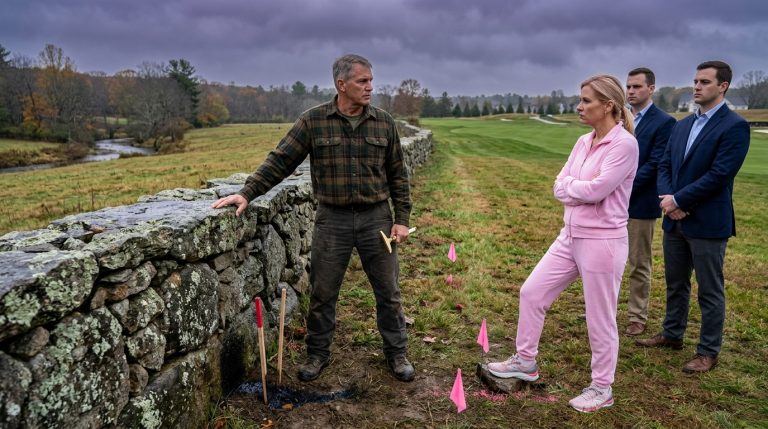
The topsoil had been scraped back. Six inches of dark earth had been pushed into a berm along the property line, leaving bare yellow clay exposed to the rain. A white plastic utility cap was tagged with spray paint: Franklin Parcel 847.
“They re-marked the parcel boundaries,” I said.
“They tried to,” Richard corrected. He pulled his phone out, tapped the screen twice, and held up a digital plot map. “They think this section of the lot falls into the common acreage set aside in 1984. They’re preparing to re-zone the shore frontage.”
“They don’t own the common acreage,” I said.
“I know.” Richard adjusted his glasses, his expression hardening. “You do. Blackwood Capital holds the deed for the entire 847-acre tract under the 1962 master indenture. But Karen doesn’t know that. She thinks she’s dealing with a delinquent homeowner who spent eight months in the Middle East and forgot to check his mail.”
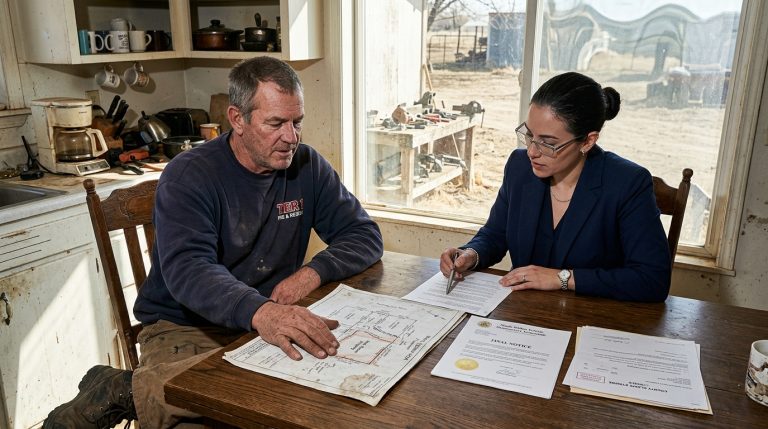
He turned back to the sedan, pulled a thick leather briefcase from the back seat, and set it on the hood of my car. The latch popped with a sharp metallic snap. He pulled out a blue-bound folder—the original ground lease template recorded with the county six decades ago.
“Section 14, paragraph 3,” Richard said, flipping directly to the tabbed page. “Read it back to me. Word for word.”
“Any leaseholder or entity operating under color of authority who causes deliberate, uncompensated structural damage to the ground lessor’s primary real property forfeits all rights of tenancy immediately,” I recited without looking at the paper. “The lease terminates upon notice. Title to all improvements reverts to the ground lessor.”
“It’s a scorched-earth clause,” Richard said softly. “It was drafted in 1962 to keep tenant farmers from tearing down barns before their leases expired. It has never been tested against an incorporated Homeowners Association.”
“It doesn’t need to be tested,” I said, setting the yellow steel excavator tooth on top of his briefcase. “It’s a contract. She signed a copy of this lease when she bought her house at 114 Lake View Drive seven years ago. Every homeowner in this development signed one.”
Richard looked at the tooth, then at the destruction behind me.
“A suit for tortious destruction gives us six million in immediate physical replacement costs,” Richard calculated, his voice dropping into the steady rhythm of a man setting chess pieces. “Punitive damages could double that. The HOA’s insurance policy has a two-million-dollar cap for director liability.”
“I don’t care about the insurance policy,” I said. I looked past him, down the long curve of the access road toward the ridge where Karen Hollis’s three-story colonial sat overlooking the water. “I want the board in a room tomorrow morning. Eight o’clock.”
“They won’t come without their counsel,” Richard noted.
“Then bring their counsel,” I said, turning back toward the ruin of my home. “And bring the master deed.”
CHAPTER 3: THE BORDER OF DIRT
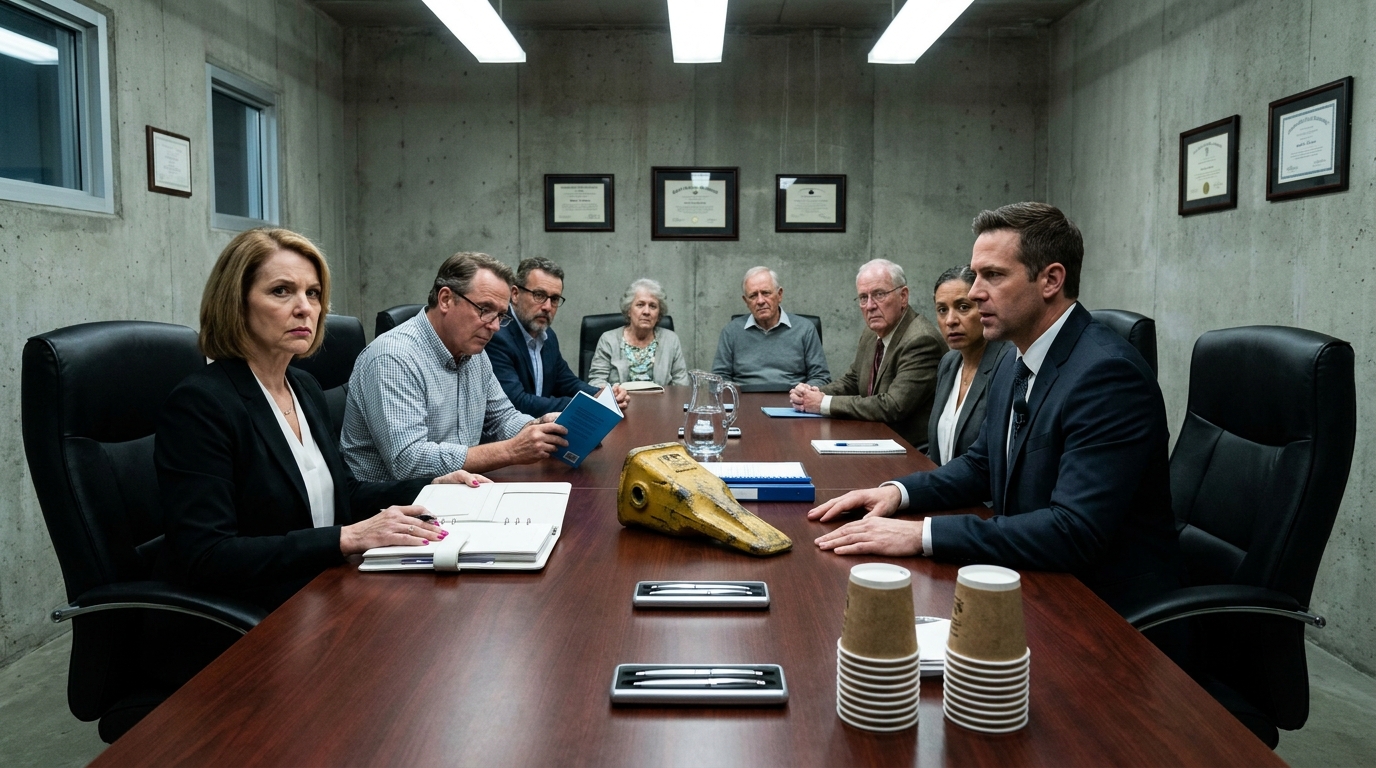
The yellow steel excavator tooth sat in the exact center of the mahogany conference table.
It left a faint smudge of grease on the polished wood. Around the table, eight board members sat in high-backed swivel chairs, their coffee cups untouched, their posture locked. At the head of the table, Karen Hollis folded her hands over a white leather planner, her manicure flawless, her chin tilted up just enough to project authority.
“We followed protocol, Marcus,” Karen said, her voice smooth, padded with the practiced patience of an administrator handling a difficult resident. “The property appeared abandoned. Overgrown turf, zero domestic power draw for six months, eight consecutive months of returned notice envelopes.”
“My dues were paid,” I said. My hands rested flat on the cool mahogany. I hadn’t taken off my coat.
“Our accounting ledger flagged the account as delinquent,” she countered smoothly, tapping the open planner. “Under Municipal Ordinance 402 and community preservation guidelines, when an unmaintained structure poses a physical hazard—”
“Check your bank records,” Richard Cole interrupted from my right. He didn’t raise his voice. He simply slid a single-page wire confirmation across the wood.
Karen didn’t pick it up. The man to her left—a thirty-something corporate accountant named Miller—glanced down at it. His finger traced the line item.
“It came from a corporate clearing account,” Miller muttered, his throat clicking as he swallowed. “Blackwood Holdings. The automated ledger tagged it as an unidentified commercial transfer. It was parked in the escrow suspense account.”
“Meaning you had the money,” Richard said. “You had it every thirty days, on the third of the month.”
Karen’s knuckles whitened slightly against her white planner, the only break in her composure. “If a homeowner fails to correctly designate their transfer references, the board cannot be held responsible for system routing errors. We sent three certified letters to 112 Lake View Drive.”
“To an empty house,” I said. “While you knew I was out of the country.”
“We are not a concierge service, Mr. Vance,” Karen said, her eyes narrowing. “We manage a community. The structure was an eyesore. The board voted six to two to execute abatement.”
Two men near the back of the room—older residents who had sat in stone silence—shifted uncomfortably. One of them, Robert Marsh, looked down at his lap, his jaw tightly clenched.
“Abatement is trimming a hedge, Mrs. Hollis,” Richard said calmly. “It is not bringing a Caterpillar 330 onto a residential parcel and leveling twenty-four hundred square feet of timber and masonry.”
“We acted within our bylaws,” Karen insisted. She leaned forward, resting her forearms on the table. “If you wish to file an insurance claim for the value of the timber, our legal counsel will review it. But do not come into this room with a piece of scrap iron and attempt to intimidate this board.”
Beside her, a sharp-faced man in a charcoal suit—Philip Garrett, legal counsel for the HOA—had been quietly reviewing a blue-bound booklet Richard had handed him upon entering. He hadn’t said a word for twenty minutes.
His thumb was hooked under a folded page near the back. His pen was stationary.
“Philip,” Karen said, not looking at him. “Tell Mr. Vance what our liability cap is so we can conclude this meeting.”
Garrett didn’t look up immediately. He slowly closed the booklet, his eyes tracking the fine print on the leather cover.
“Philip?” Karen repeated, her tone sharpening.
“Karen,” Garrett said softly. His voice lacked any of her polished armor. “Where did you file the survey map for the shore realignment?”
Karen blinked. “The county clerk’s office. Last November. Under the public works exemption.”
“And who signed the authorization as the property owner?” Garrett asked.
“The HOA,” she said, her brow furrowing in genuine irritation. “We own the common areas and the lot easements. We’ve managed them since 1984.”
Garrett turned the blue folder around. He didn’t point to a clause; he simply pointed to the header at the top of page one: Blackwood Master Deed — Franklin Parcel 847.
“The HOA owns the architectural oversight authority, Karen,” Garrett said, his tone dry as dust. “You do not own the land.”
A heavy, suffocating quiet dropped over the room. The air conditioning hummed in the wall, a low, mechanical whistle.
“What are you talking about?” Karen asked, her smile returning, brittle and forced. “Every homeowner here owns their lot.”
“No,” Garrett said, leaning back in his chair and taking off his glasses. “Every homeowner here owns the structure built upon the lot. The ground beneath every foundation—every road, every park, the dirt beneath this very table—is held under a ninety-nine-year ground lease executed in 1962.”
He looked at me for the first time.
“Blackwood Capital Holdings acquired the master ground deed from the developer’s estate six years ago,” Garrett continued, speaking to the entire board now. “Mr. Vance doesn’t just own a house here. He is the landlord for the entire subdivision.”
Karen’s face went rigid. Her eyes darted from Garrett to the blue booklet, then to me. Her mouth opened slightly, but no sound came out. The absolute confidence that had armored her for three years stripped away in a single second, leaving behind the cold, sudden realization of a trespasser caught in the open.
“Section 14,” Richard added quietly into the silence, tapping the yellow excavator tooth on the table. “Material breach of ground lease by an occupying entity. We’ll see you in court on Monday, Mrs. Hollis.”
CHAPTER 4: THE WEIGHT OF THE GAVEL
The gavel hit the brass anvil with a sound like a rifle shot in a tight space.
Judge Warren Holloway didn’t look over his reading glasses. He held a black fountain pen in his right hand, hovering two inches above a thick stack of certified land registry filings.
“Council,” Holloway said. His voice was gravelly, aged by forty years of chancery court disputes. He addressed Philip Garrett, who stood at the defense podium with his posture stooped, his collar visibly tight around his neck. “Explain to me how a suburban neighborhood association orders a heavy demolition contractor onto a titled lot without a sheriff’s writ.”
“Your Honor,” Garrett began, his voice tight. He adjusted a pair of silver-rimmed bifocals. “The board operated under what it reasonably believed to be a public nuisance ordinance. The structure had no active utility draw—”
“The utility draw was suspended by Mr. Vance prior to his overseas deployment,” Holloway interrupted, tapping the pen against a page. “A routine administrative hold. The account balance on his homeowner association assessment was zero.”
“The commercial transfer was unallocated—”
“The commercial transfer was cleared by First Horizon Bank on the third of every month,” Holloway cut in again. The silence in the gallery was absolute. Karen Hollis sat in the second row behind the defense table, her hands clenched so tightly around her handbag that the leather groaned under the strain. “It was deposited into an escrow suspense account managed by your client.”
Holloway flipped a page. The crisp paper rustled across the microphone.
“What concerns this court,” Holloway continued, his eyes finally lifting to lock onto Garrett, “is not a misrouted six-hundred-dollar wire. It is what occurred thirty days before the demolition order was signed.”
Richard Cole leaned slightly toward me at our table. His pen remained stationary on his legal pad. I sat with my forearms flat against the dark oak finish, my thumb tracing the worn knurling of the 1962 pocket watch in my pocket.
Judge Holloway pulled a blue-line survey map from the bottom of the stack. It was stamped with a red county recorder seal.
“On February fourteenth,” Holloway said, reading directly from the exhibit, “an application was submitted to the municipal zoning board to re-subdivide Franklin Parcel 847. The application listed the East Wing footprint of 112 Lake View Drive as ‘abandoned common easement.’ It was signed by Karen Hollis.”
A quiet ripple moved through the board members sitting behind Karen. Miller, the accountant, turned his head sharply to look at her side profile. Karen didn’t move. Her jaw was set like cured cement.
“They didn’t just clear a house,” Holloway said, setting the pen down with a deliberate clack. “They attempted to erase a property line to create a thirty-foot access corridor to the shore frontage.”
“Your Honor,” Garrett attempted, his forehead slick with sweat under the fluorescent lighting. “The board believed the common acreage agreement of 1984—”
“The common acreage agreement of 1984 is subordinate to the original 1962 indenture,” Holloway said, his tone dropping an octave into absolute finality. “The Blackwood Master Deed holds fee simple ownership of the dirt. Your client holds an easement for passage and architectural governance over structures. They do not own the earth. They never owned the earth.”
Holloway reached for his reading glasses, pulled them off, and set them on the bench.
“Bylaws do not override property law,” Holloway stated. “A board resolution is not a decree of condemnation. This is not a boundary dispute, Mr. Garrett. This is textbook material breach executed under color of authority.”
He picked up his pen, wrote three quick lines on the judgment order before him, and looked up at Richard.
“Plaintiff’s motion for summary judgment on liability is granted in full,” Holloway declared. “Damages are assessed as follows: Six million dollars in compensatory structural replacement against the Lake View Heights Homeowners Association. One point two million dollars in punitive damages, assessed personally against Karen Hollis for willful and bad-faith execution of authority.”
Karen gasped—a short, sharp intake of air that broke the court’s strict decorum. She half-stood from her wooden bench, her eyes wide, staring at Holloway as if he had spoken in a foreign language.
“Your Honor—” she started, her voice cracking.
“You are out of order, Mrs. Hollis,” Holloway snapped without looking up. He brought the gavel down once more. Thump. “Court is adjourned.”
The judge stood and walked toward his chambers. The heavy oak door clicked shut behind him.
In the gallery, no one moved for five seconds. Garrett turned around slowly, his face drained of color, looking at Karen.
She remained standing, her fingers still digging into her leather purse, staring at the empty bench.
I stood up, buttoned my coat, and looked down at her. She caught my gaze for a fraction of a second—her eyes filled not with remorse, but with the cold, toxic shock of a dictator who had just discovered her borders were drawn in pencil.
“Thirty days, Karen,” Richard said quietly from beside me, sliding a white envelope onto the defense table. “Section 14 notice of ground lease termination. You have thirty days to surrender the dirt beneath your house.”
CHAPTER 5: THE EVICTION OF SHADOWS
The white envelope lay on the dark wood of the defense table like a heavy stone.
Karen Hollis didn’t touch it. Her fingers twitched twice against her purse strap, but her hand remained frozen. Beside her, Philip Garrett leaned down, picked up the document, and broke the red wax seal with his thumb.
He didn’t read past the third line. He looked across the rail at Richard, then at me.
“Thirty days,” Garrett whispered, his voice barely carrying over the shuffle of spectator feet leaving the gallery. “You’re invoking Section 14 against a primary residence.”
“I am invoking Section 14 against a leaseholder who authorized the destruction of ground lessor property,” I said. “Her structure sits on land governed by the Blackwood Master Deed. The lease is terminated for cause.”
Karen’s head snapped toward me, her eyes wide, white rimmed with red veins. “You can’t take my house! I built that house! My husband and I paid six hundred and eighty thousand dollars for that property!”
“You paid six hundred and eighty thousand dollars for the timber, brick, and drywall,” Richard corrected smoothly, closing his briefcase with two crisp clicks. “You leased the dirt beneath it under Section 14. When you signed the purchase agreement seven years ago, you acknowledged that breach of ground terms forfeited the right of occupancy.”
“It’s retaliation!” she choked out, looking around at the remaining board members, but Miller and the others were already gathering their coats, avoiding her gaze as they slipped out the side exit. “It’s extortion!”
“It’s a contract, Karen,” I said, my voice quiet, flat, unyielding. “The same kind you used to bring heavy machinery onto my lot.”
Four days later, the match cut of legal reality struck.
Shadows stretched long across the dashboard of my truck as I parked at the end of the cul-de-sac on Lake View Drive. The quiet hum of the afternoon was shattered by the rhythmic, mechanical thud of a hydraulic gate dropping onto asphalt.
A thirty-foot yellow moving truck sat parked in Karen Hollis’s driveway at 114 Lake View Drive. Two men in canvas work overalls were carrying out a mahogany dining table, their boots scuffing the manicured stone walk she had spent three years boasting about at board meetings.
I stayed in the cab, the driver’s side window cracked an inch to let in the cool, damp river air.
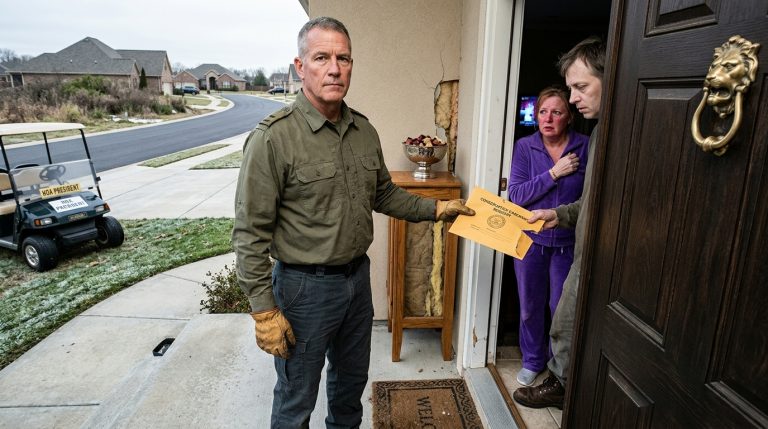
A silver sedan pulled up behind the moving truck. A man in a dark charcoal suit stepped out—not Garrett, but a representative from First Horizon Mortgage Corporation. He carried a clipboard with a red property seizure tag clipped to the top.
Without a valid ground lease, the bank’s underlying collateral for Karen’s four-hundred-and-twelve-thousand-dollar mortgage had effectively vanished. A home without land rights in Franklin Parcel 847 was appraised at salvage value: ninety thousand dollars. The bank had called the entire loan balance due within seventy-two hours.
Karen stepped out through her front door. She wore a plain gray coat, her hair unstyled, pulled back into a hasty clip. There was no makeup, no leather planner, no posture of municipal authority.
She saw my truck sitting sixty yards down the road.
For ten seconds, neither of us moved. The movers grunted as they pushed a leather sofa up the metal ramp, the aluminum flexing with a hollow clang. The bank representative didn’t look at her; he simply slapped a yellow notice onto the glass panel beside her front door, took a digital photo with his tablet, and turned back to his car.
Karen walked down the three stone steps to the driveway. Her steps were uneven. She stopped near the mailbox—the one painted in the mandatory community color she had voted to enforce three years ago.
She didn’t scream. She didn’t approach the truck. She pulled a key ring from her pocket, slid off the front door key, and dropped it into the open palm of the demolition contractor standing by the driveway gate.
She had listed the house for sale at one hundred and ninety thousand. Nobody bought a structure on land they couldn’t stand on. She had sold the framing and fixtures to the contractor for eighty-seven thousand dollars salvage—just enough to cover her personal legal fees before filing for Chapter 7.
She got into her car, closed the door without a sound, and drove past my truck.
She didn’t look through my window. I watched her rear bumper clear the entrance arch of Lake View Heights, turning south toward an apartment complex in Franklin.
My phone buzzed on the console. It was Richard.
“The remaining five board members signed their settlement agreements twenty minutes ago,” Richard reported. “Eighty-five thousand each in personal restitution to the Blackwood asset account. The HOA reserves have been attached by court order.”
“And the dissolution vote?” I asked, my thumb tracing the edge of the watch in my pocket.
“Seventy-nine percent of the homeowners voted to dissolve the old association board this morning,” Richard said. “Robert Marsh is heading the interim steering committee. They want a meeting with you on Friday to sign the standardized ground terms.”
“Tell them I’ll be there,” I said.
I put the truck in gear, turned the wheel, and drove back toward the east wing.
CHAPTER 6: THE FOUNDATION OF DIRT
The gravel dust settled behind the rear tires as I pulled up to the foundation line of 112 Lake View Drive.
The orange safety mesh was gone. In its place, steel footings had been poured four feet deep into the dark red clay, anchoring directly into the bedrock of Franklin Parcel 847. Framers in leather tool belts moved along the yellow pine joists, their pneumatic nail guns firing in rapid, rhythmic thuds that echoed across the water.
Thirty-two hundred square feet this time. Larger, heavy-timbered, balanced against the stone facade as if the land had demanded that specific weight all along.
I stepped over a stack of dry subflooring, my boots coating in fine pine dust, and walked out onto the newly laid deck framing. The lake below was glass, reflecting the cold amber light of a November sunset.
Gravel crunched behind me. Richard Cole walked up the temporary wooden ramp, carrying two heavy crystal glasses and a square bottle of high-proof bourbon. He didn’t have his legal briefcase today. His topcoat was unbuttoned, his collar relaxed.
“They signed the last covenant document at four o’clock,” Richard said, handing me a glass. The ice clinked against the crystal. “Ninety-nine-year renewable ground leases for all three hundred and forty parcels. Cap on annual assessment increases tied to CPI. Mandatory disclosure summaries in every single title packet moving forward.”
“And the board?” I asked, watching the crane boom swing a bundle of roof trusses over the central ridge.
“Robert Marsh is taking the chair permanently,” Richard said, taking a slow sip. “He brought forty pages of community proposals to the conference room this morning. Clear boundaries, transparent records, no secret votes. He looked me in the eye and said if they had understood the master indenture five years ago, Karen Hollis would have been laughed out of the room the first time she brought up parcel realignment.”
“They didn’t want to understand it,” I said, turning the amber liquid in my glass. “Ambiguity is comfortable right up until the contract is enforced. Karen didn’t just stumble into a demolition order, Richard. She thought if she erased my east wing, she could re-classify the shoreline easement under Section 14 loop-holes and sell the access corridor to a resort group.”
Richard paused, his glass halfway to his mouth. “You verified the developer inquiry?”
“I pulled the municipal audit files yesterday,” I replied, pulling the worn 1962 pocket watch from my coat. I didn’t wind it. I just held the heavy brass casing, feeling its steady, unyielding weight. “She had a letter of intent sitting in her private binder from a syndicate out of Nashville. She needed the land cleared to prove the HOA had possessory control over the dirt. She used the six-hundred-dollar delinquency as a decoy to trigger what she thought was a routine abatement.”
“She gambled six million dollars of community money on the assumption that a land deed wouldn’t be enforced,” Richard murmured, shaking his head slowly.
“She mistook position for ownership,” I said. “She thought authority came from a title printed on a letterhead. But authority doesn’t come from a title. It comes from the earth beneath it. Land doesn’t shout, Richard. It doesn’t argue in board meetings. It just stays where it’s anchored and waits.”
We stood in silence for five minutes as the sun dipped beneath the treeline on the far side of the bay. The carpenters lowered their hammers, packed their canvas tool bags, and walked down the gravel path toward their trucks. The site fell quiet, filled only with the soft lap of water against the stone shoreline.
Richard set his empty glass on a pine sawhorse. “Was it worth enforcing the ground lease to the absolute end, Marcus? She lost her home. She lost her standing. She’s living in a rented flat in Franklin.”
I looked down at the newly framed floorboards beneath my feet—solid, level, anchored twenty feet into the dirt of Franklin Parcel 847 under the authority of the Blackwood Master Deed.
“I didn’t destroy Karen Hollis,” I said softly, closing the brass cover of the pocket watch with a quiet, definitive snap. “She tried to build an empire on land she didn’t own. The contract didn’t break her. She broke herself against the contract.”
I took the final sip of bourbon, the burn cold and clean in my throat, and looked out over the quiet water. The house was rising. The foundation was set. The dirt remained mine.