The Weight of the Ledger: A Study in Survival, Stolen Truths, and the High Cost of Legacy
CHAPTER 1: The Rusted Threshold
The air in Maple Street didn’t move today. It hung heavy, stagnant, smelling of baked asphalt and dry, thirsty earth. Marcus let the Harley tick over, the vibration traveling up his arms and settling into his bone marrow. It was 9:18 AM. Three minutes past the ritual.
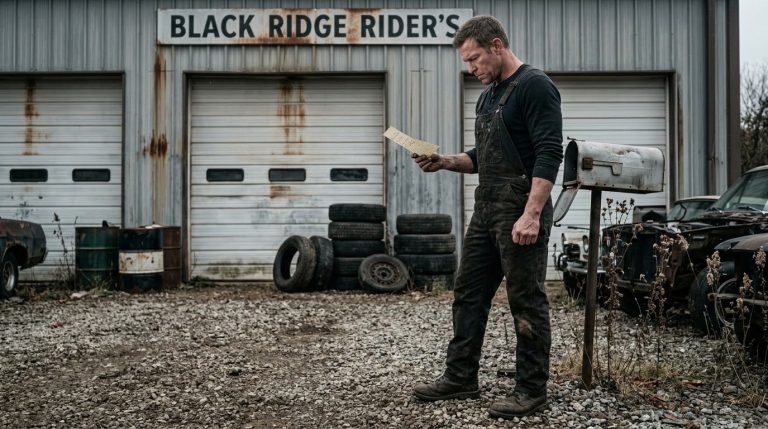
He stared at the mailbox. The little metal door was hanging at an unnatural angle, the latch caught on nothing, the interior empty of the morning post. For six years, the rhythm of this street had been measured by that door. Click, pause, scrape, shut. Today, the street was deafening in its lack of noise.
Marcus didn’t like the feeling. It was a friction in the gut, the same sensation he got when a transmission was about to strip its gears. He pushed the bike into the curb, the kickstand digging into the soft, neglected dirt with a wet, gravelly crunch. He left the helmet on, a black shell between him and the rest of the world.
The path to Eleanor’s house was a sequence of cracked flagstones, each one buckled by the relentless, invasive roots of overgrown weeds. The house itself looked like it was retreating into the earth, the paint peeling away in long, gray strips like weathered bark. He climbed the porch steps, the wood groaning—a sharp, high-pitched protest that felt like a betrayal of the stillness.
“Eleanor?” he called.
His voice was a flat, unvarnished sound. No answer. Just the rattle of a loose screen door flapping in the wind. He stepped closer, the smell of iron and decay bleeding out from the open doorway. It wasn’t the smell of a dead body; it was the smell of something valuable being handled by clumsy, desperate hands.
He nudged the door with his boot. The hinges, caked in years of rust, didn’t fight back; they sighed open. The foyer was dim, the dust motes dancing in the singular, harsh beam of light slicing through the drawn curtains.
A chair lay on its side in the kitchen, one leg splintered cleanly, the mahogany grain exposed and raw. A shattered teacup—a delicate, flowered thing—had been ground into the linoleum. The tea stain had dried, turning into a dark, resinous patch that looked like an old wound.
Marcus crouched. He didn’t touch anything. He looked for the disruption in the flow of the room. He saw the rug, bunched at the base of the hallway like a wave frozen mid-motion. He saw a single, worn slipper lying in the corner, orphaned and alone.
It wasn’t a robbery. Nothing had been taken from the mantle, and the dust on the shelves remained undisturbed. It was an extraction. Someone had come for a specific piece of Eleanor’s life, and they had taken it with the brutal, efficient care of someone who couldn’t afford to leave a mess.
Marcus stood, the floorboards under him emitting a sharp, rhythmic creak. He looked back at the front door. The porch was still empty. The neighborhood was still moving in its blind, oblivious loop. And then, he saw it: a small, dark smear on the doorframe, metallic and fresh, like a smear of grease from a mechanic’s thumb.
He wasn’t looking at a missing neighbor anymore. He was looking at a trail. And he knew, with the cold, hard certainty of a man who had spent his life repairing broken things, that he was the only one who could see the pattern.
The doorframe felt cold, unforgiving under his touch. He wasn’t just standing in a house; he was standing in the middle of a conflict that hadn’t finished its first move.
CHAPTER 2: The Scent of Evidence
The interior of the house was a tomb of mundane things, stripped of the life that usually anchored them. Marcus didn’t turn on the lights. He didn’t want to see how much of the original, chaotic violence had been tidied away. He worked by the sliver of daylight cutting through the curtains, his eyes tracking the dust disturbed by heavier, faster feet than Eleanor’s.
He stepped over the shattered teacup. The porcelain shards were dull, lacking the sharp glint they should have had under the morning sun. Someone had already swept through here, probably looking for something small enough to carry, something they hadn’t found.
His boots made a muffled, rhythmic sound against the hardwood. He moved toward the kitchen table, the spot where the chair had been overturned. He knelt, his hand hovering over the floorboards. There, caught in the deep, rusted-red groove of a wood knot, was a small scrap of paper. Not a note, not a bill. A receipt, crumpled and yellowed, caught beneath the edge of the baseboard.
He pried it loose with the edge of his pocketknife. As he smoothed it out, the smell of the room hit him—a sharp, electric ozone, like a shorted-out circuit.
Instantly, the scent pulled him backward.
He wasn’t in Maple Street anymore. He was back in the garage, ten years ago, standing over a stripped-down motor while the air filled with the thick, acrid smoke of a faulty transformer. He remembered the way his skin had crawled, the way the world had suddenly felt like a trap waiting to snap shut. He shook his head, the memory receding like a tide, leaving him back in the cold silence of Eleanor’s kitchen.
The receipt wasn’t for groceries. It was a transaction record from a private storage facility on the outskirts of the industrial district. Three years old. The ink was fading, but the numbers were clear. It wasn’t the sort of thing a woman like Eleanor would hold onto unless it was a map to something she couldn’t afford to lose.
He slid the scrap into his inner pocket, his jaw tightening. This was the friction. This was the first gear beginning to turn in a machine he hadn’t yet identified.
He moved into the hallway. The air here was thicker, tasting of damp earth and something sweet, like rot. The slipper he’d seen earlier lay near the base of the stairs, pointing toward the cellar door. He hadn’t checked the cellar. Most people on Maple Street didn’t have cellars, but this house was older, built on the bones of a different, more practical era.
He approached the cellar door. It was bolted from the outside. A heavy, rusted iron padlock hung loose, its hasp pried open with such surgical precision that it hadn’t even scratched the wood.
Marcus gripped the handle. The metal was pitted with rust, rough and biting against his palm. He took a breath, letting the tension in his shoulders drop until he was a coiled spring. He pulled.
The door didn’t swing open; it fell outward with a heavy, hollow thud. Beyond it lay a flight of stairs that disappeared into a darkness so absolute it felt like a physical weight.
He didn’t wait for a sign. He pulled a small, high-intensity flashlight from his belt and thumbed the switch. The beam cut a jagged, white path through the darkness, illuminating walls that were weeping dampness. The floor at the bottom of the stairs wasn’t concrete; it was packed, iron-rich dirt.
He descended slowly, testing each step. His senses were screaming. He could hear the house settling above him, but beneath that, he heard the faint, rhythmic ticking of a cooling furnace. He reached the bottom and panned the light across the room.
It was an office. A real one.
There were filing cabinets lined against the back wall, their steel frames scarred by time and oxidation. A desk sat in the center of the room, covered not in tea sets or mail, but in stacks of blueprints and ledger books.
He walked to the desk, his boots kicking up a fine, dry dust. He touched the edge of the wood. It was clean. Far too clean for a cellar. Someone had been working here recently—maybe even an hour ago.
He opened the top drawer. It was empty, save for a single, heavy brass key and a photograph. He picked the photo up. It was a grainy, black-and-white print of a young man standing in front of a factory gate—the same factory where Marcus had ridden his bike past a hundred times.
The boy in the photo was smiling, but his eyes were fixed on something just outside the frame, something he clearly feared.
Marcus stared at the image. The silence of the basement pressed against his ears, humming with the weight of unsaid things. He hadn’t just found a missing woman; he’d found the reason for her existence. And the reason was buried, cold and heavy, in a file cabinet that hadn’t been opened in a decade.
He wasn’t going to call the police. The realization didn’t even require a thought; it was a reflex. The law wouldn’t look at this basement. They would look at the missing person, the broken chair, and the scattered tea. They would see a tragedy. They wouldn’t see the architecture of a war.
He pocketed the key, his fingers grazing the hard, unyielding metal. The air in the cellar suddenly felt thinner. He heard a sound from upstairs—the distinct, sharp creak of a floorboard on the main level.
He snapped off the light. The darkness returned, immediate and total, folding around him like a shroud. He stood perfectly still, his breath shallow, his body tensed for the impact of whatever was moving through the house above his head.
CHAPTER 3: The Geometry of a Secret
Marcus didn’t breathe. He didn’t shift his weight. He became part of the cellar’s geometry, a shadow anchored against the weeping brickwork. Above, the footsteps paused. A floorboard groaned, then a second one, further toward the kitchen, followed by the metallic click of a drawer being opened—not the frantic rummaging of an amateur, but the calculated, rhythmic search of a professional.
He held the brass key in his palm, the serrated edge biting into his skin. He needed to be gone before they realized the basement wasn’t empty.
He didn’t move toward the stairs; that was the obvious path, and he’d be silhouetted against the dim light filtering down from the foyer. Instead, he scanned the cellar wall behind the file cabinet. He had seen the way the dust gathered in the corners—it was thicker near the east wall, suggesting a draft. He pressed his shoulder against the damp brick. It gave way, not with a mechanical clatter, but with the dry, rasping slide of a concealed panel—a secondary access point, likely for utilities, long ago boarded over but never sealed.
He pushed, his muscles straining against the grit and rust, until a sliver of gray, pre-dawn light from the alleyway forced its way in. He squeezed through the gap, his jacket snagging on a protruding nail, and spilled out into the narrow, weed-choked space between the house and the neighboring garage.
He didn’t stop to catch his breath. He kept low, moving with the fluid, measured pace of a man who knew the terrain of a city back alley. He reached his bike, tucked behind a rusted dumpster, and kept his hand on the throttle, but he didn’t start it. He waited.
Three minutes later, the front door of Eleanor’s house opened. A man stepped onto the porch—clean-shaven, wearing a nondescript gray jacket that looked like it had been bought specifically for a task like this. He stood for a moment, scanning the street with the detached efficiency of a hunter. He didn’t look at the alley. He didn’t have to; he had the house.
Marcus watched the man pull a small device from his pocket, tap a screen, and then return to the house. The move was subtle, but the intent was clear: this wasn’t just a search. It was a lockdown.
Marcus didn’t turn the key in the ignition. He pushed the heavy frame of the Harley backward, feet dragging through the dry, iron-rich dust, until he was shielded by the bulk of a parked truck two doors down. Only then did he trigger the starter. The engine let out a low, muffled growl—the kind of sound that could be mistaken for a passing truck or the rumble of distant construction. He eased it into gear and rolled away, keeping his speed low until he hit the main artery of the industrial district.
His destination wasn’t the police station. It was the address on the faded receipt he’d pried from the baseboard: Sector 4, Lot 12.
The ride was a exercise in patience. He had to cross the city, navigating the grid with the caution of a man carrying a live charge. The city felt different tonight—or maybe it was just him. He saw the world in layers: the surface reality, the busy commute, the neon, and the deep, rusted undercurrent that Eleanor had been navigating for six years.
When he arrived at the storage facility, it looked like every other relic of the boom years—corrugated metal, padlocks rusted into permanent grins, and the pervasive smell of ozone and wet iron. He bypassed the main gate by cutting through a section of the chain-link fence that had long ago lost its battle with the weeds.
He found Lot 12. It was a unit tucked in the furthest, darkest corner of the complex.
He pulled the brass key from his pocket. It felt heavier now, charged with the information he hadn’t yet seen. He slotted it into the padlock. It turned with a smooth, synthetic click—a sound that signaled a total disconnect from the decay of the rest of the facility.
He pulled the door up. It groaned, a slow, metallic screech that tore through the quiet.
The space inside was small, climate-controlled, and lit by a single, flickering fluorescent bulb. There was no furniture, just a solitary safe bolted to the floor. And on top of the safe sat a modern, high-end laptop, its screen glowing in standby mode.
He stepped inside, the atmosphere shifting instantly from the damp chill of the street to the sterile, dry cold of the unit. He moved toward the laptop, but a sharp, rhythmic tapping from the wall behind the safe stopped him.
Tapping.
It wasn’t a signal. It was a clock.
He looked closer at the safe. It wasn’t just a vault; it was rigged. A series of wires, delicate and thin as spiderwebs, ran from the back of the safe to the base of the laptop. He saw the readout on the machine—a countdown, red digits flickering in the dim light.
00:04:12.
He had triggered an alarm when he opened the door. The game had just changed. He wasn’t just looking for evidence anymore; he was in a race to see whether the truth would be liquidated before he could read it.
He pulled the laptop toward him, but the moment his fingers touched the casing, the screen locked. A prompt appeared, typed in clean, professional font: Enter User Identifier.
He looked at the safe, then at the photo he had taken from Eleanor’s basement. The boy in the photo, the factory gate, the date stamped on the corner of the print—he started to type, his heart slamming against his ribs, not with fear, but with the cold, hard rhythm of a man who had finally found the thread that would unravel the entire, rusted structure of his neighborhood.
He was in the belly of the beast, and the clock was ticking, not for him, but for the people who thought they had buried the past.
CHAPTER 4: The Digital Ledger
Marcus didn’t waste time on a backup plan. He focused entirely on the screen. The prompt—Enter User Identifier—hung there, indifferent to the fact that his heartbeat was currently hammering against his ribs like a desperate bird. He looked at the photo of the young man again. He typed the factory’s gate number, followed by the date stamped in the corner of the print.
The screen flickered. A new prompt blinked: Access Level: Archivist. Verify Identity.
He felt the cold sweat prickling at his hairline. He wasn’t an archivist. He was a mechanic who had stumbled into a hole that went down to the bedrock. He looked at the brass key he had retrieved from the cellar drawer. It was etched with a small, stylized logo—the same logo etched into the hinge of the laptop. He pressed the key against the integrated reader on the side of the machine.
The countdown stopped at 00:03:02. The screen shifted, revealing a directory of files.
It wasn’t money. It wasn’t simple embezzlement. As he clicked through the first folder, he saw scan after scan of internal memos, invoices, and schematics—not for a standard business, but for a waste disposal firm that had been systematically mislabeling toxic runoff for over a decade. The files didn’t just show the movement of funds; they mapped the deliberate contamination of the local water table, documented by someone who had been working on the inside.
The son.
He wasn’t an embezzler. He was a witness.
Marcus scrolled, his eyes burning from the harsh blue light. He saw names he recognized—local officials, corporate officers, names that appeared on the plaques of buildings downtown. The “debt” the men had been trying to collect wasn’t financial; it was the cost of silencing the record. If this information went public, it wouldn’t just bankrupt a firm; it would tear the foundation out from under the town.
He heard the crunch of gravel outside.
He didn’t need to look. He knew the sound of those heavy, deliberate boots. He had four minutes, maybe less, before the men who had taken Eleanor returned to ensure the job was finished.
He pulled a compact data drive from his pocket—an old tool from his days as a tech-hobbyist—and jammed it into the port. The progress bar crawled across the screen. 10%… 20%… The silence of the unit felt heavy, filled with the static of his own rising adrenaline. Every creak of the metal walls outside sounded like an approaching threat.
The door to the unit groaned as someone pushed against it, testing the lock. Marcus grabbed the laptop, his fingers rigid. He needed more time, but the world wasn’t going to give it to him. He watched the transfer rate. 50%… 60%…
The lock on the unit’s door snapped. Not with a key, but with the flat, sickening force of a crowbar.
Marcus moved before the door was even halfway up. He shoved the data drive into his pocket and abandoned the laptop. He couldn’t carry the dead weight of the machine. He needed to get out, and he needed to disappear into the industrial sprawl before they could pin him to the unit.
He bolted for the rear of the unit. He had seen a ventilation panel near the floor when he entered. He kicked it, once, twice, the rusted screws groaning until the metal gave way. He slipped into the narrow, dark crawlspace behind the wall, his chest heaving, his hands raw from the jagged edges of the industrial refuse.
The unit’s door swung wide, letting in the harsh glare of a high-powered flashlight.
“Empty,” a voice grunted. It was the man from the porch. “He must have triggered the security lock and cleared out.”
“Check the files,” another replied, his voice a cold, sharp blade. “If he got the data, he’s not just a bystander anymore. He’s a liability.”
Marcus stayed frozen, his body compressed against the cold, iron-scented earth beneath the floorboards. He could see their boots through the gap in the partition—thick-soled, heavy, moving with the careless confidence of men who expected to find what they were looking for. He felt the data drive in his pocket, a small, hard weight against his thigh.
They weren’t looking for a person. They were looking for an erasure.
He watched as they picked up the laptop, their movements efficient, devoid of frustration. They weren’t angry; they were just working. That was the most terrifying part. There was no emotion in the way they dismantled the unit, no hesitation.
As they moved toward the door, Marcus waited for the moment they would turn. He had to be gone, and he had to be smart. He had the truth, but the truth was a burden that was currently putting a target on his back. He gripped the edge of the panel, his knuckles white, and prepared to move the second they stepped out. He wasn’t just a observer anymore. He was the only thing standing between the history of this town and a permanent, silent burial.
CHAPTER 5: The Weight of the Thread
Marcus didn’t move. He lay pinned against the cold, iron-rich earth, the taste of rust and dry dust coating his tongue. Above him, the men were walking away. He could hear the heavy rhythmic crunch of their boots on the gravel—thud, thud, thud—a sound that signaled their departure but didn’t guarantee his safety. He kept his breathing shallow, forcing his lungs to work in silence, waiting until the sound of their engine finally choked the air and faded into the distance.
He waited another five minutes. Then, with the agonizing slowness of a man uncoiling a spring, he pushed himself through the aperture and tumbled out into the alley.
He didn’t run. Running attracted attention. He walked—a measured, purposeful stride toward the shadows of the warehouse district. His clothes were stained with grime, his knuckles bleeding from the vent, and the data drive in his pocket felt like a brand, heating his skin with the gravity of what it contained.
He reached the Harley, its frame cold and damp in the night air. He didn’t start the engine. He pushed the bike the length of the block, listening, his senses tuned to the frequency of the city. He needed to process the data, but he couldn’t go home—not if they were tracking his movements. He needed a neutral space.
He found it in an old service garage three miles from the warehouse. It was a place he’d used before, back when he had been a mechanic for a different kind of client—the kind that demanded silence and secrecy. He unlocked the side door with a master key he’d carried since those days, the hinges singing a sharp, familiar tune of neglect.
Inside, the smell was comforting: oil, old rubber, and the metallic tang of machinery. He rolled the bike into the service bay and locked the door behind him. He didn’t turn on the overhead lights. He used a small, dim work lamp, positioning it so the light hit the workbench, not the windows.
He pulled the data drive from his pocket and slotted it into a refurbished terminal he’d kept in the back office. The screen flickered to life.
Accessing… 10%… 40%…
He watched the progress bar with a feeling of profound, sinking exhaustion. Every piece of data that poured onto the screen chipped away at his belief in the world he lived in. He read the reports, the emails, the internal memos. The waste management firm wasn’t just dumping toxic chemicals into the water table; they were doing it under the protection of local ordinances that had been purchased in backroom deals.
The son hadn’t just been a witness. He had been an employee, someone who had seen the mechanics of the destruction and tried to log it. And Eleanor—she hadn’t just been a victim of a crime. She had been the custodian of the archive, the only living piece of evidence left that they couldn’t simply bury.
His head pounded. The room seemed to tilt.
Clang.
The sound came from the front of the garage.
Marcus froze. He reached for the heavy pipe wrench on the workbench, his grip tightening until his arm throbbed. He stood up, his senses sharpened into a razor-thin focus. He had been so certain that no one was following him. He had been so careful.
Clang.
It was closer now. The sound of something metal hitting the floor, followed by the soft, almost imperceptible scrape of a boot on concrete. He didn’t look at the screen. He moved toward the shadows at the edge of the bay. He was a creature of the dark, and he knew this space better than anyone.
He rounded the corner, his heart rate steadying into a calculated, lethal rhythm. He caught the silhouette of a figure near the bay door—a thin, wavering shape that shifted in the moonlight. He lunged, his hand clamping around the figure’s shoulder, the wrench raised high—
“Wait!”
The voice was thin, reedy, and shaking. It wasn’t the man in the gray jacket.
Marcus held his position, the wrench inches from the intruder’s skull. The light from the work lamp hit the figure’s face. It was a kid, no older than twenty, wearing a grease-stained hoodie that looked three sizes too big. He was clutching a toolbox, his eyes wide and leaking with terror.
“I… I just wanted to get my stuff,” the kid stammered, his body shuddering under Marcus’s grip. “I didn’t know anyone was here. Please.”
Marcus slowly lowered the wrench. The adrenaline left him, leaving behind a cold, biting tremor in his hands. “How did you get in?”
“The side vent,” the kid whispered. “I used to work here. They fired me, but I didn’t get all my tools. I wasn’t going to steal anything.”
Marcus let go. He felt a sudden, sharp spike of anger, not at the kid, but at his own frayed nerves. He was losing his edge. He was seeing threats where there were only ghosts. He turned back toward the office, his movements heavy.
“Get your tools,” Marcus said, his voice flat. “And then get out. And don’t ever come back to this place.”
The kid scrambled to gather his things, the metal-on-metal clatter echoing through the garage like gunshots. Marcus leaned against the workbench, his eyes drifting back to the screen. The data was there, but it felt different now. It felt volatile. He was holding onto a truth that could burn the town down, and he was terrified that the first thing it would catch was him.
He looked at the kid, who was now scurrying toward the side vent, his toolbox bumping against his legs. Marcus realized that the kid wasn’t just a distraction—he was a witness. Someone had seen him here. Someone knew the location of his base of operations.
He looked back at the screen. The file transfer was complete. He hit the delete key, wiping the terminal clean. He couldn’t risk leaving a trail. He had to move again. He had to be smarter, faster, and he had to be cold.
As the kid slipped out through the vent, Marcus killed the light. He stood in the total, crushing darkness of the garage, the weight of the data drive in his pocket feeling heavier with every passing second. He had the truth, but the truth was no longer a shield. It was a beacon.
CHAPTER 6: The Fracture in the Foundation
Marcus didn’t move until his heart had slowed to a steady, rhythmic thrum. The garage was cold now, the residual heat of the machines dissipating into the damp night. He reached into his pocket and touched the data drive. It was cool, unyielding, a tiny piece of plastic that had become the fulcrum upon which his entire world was balanced.
He needed to check the files one more time, but not here. He needed a place where he could see the street, a place where he wasn’t just a target.
He pushed the bike out through the side vent, the rusted metal biting into his palms. The night air hit him like a physical blow—crisp, smelling of rain and industrial exhaust. He started the Harley, the engine’s idle a low, reassuring vibration against his boots, and pulled away, keeping to the shadows of the secondary roads. He avoided the main lights, moving through the city like a needle stitching through fabric.
He circled back toward the residential sector, settling into a diner that overlooked the intersection leading to Maple Street. From a booth in the back, he could watch the traffic. He kept the data drive tucked inside his glove, his hand resting on the table.
He didn’t order food. He ordered coffee, black, and watched the street.
His mind kept returning to the files. He remembered a specific invoice he had skimmed during the transfer—a signature, a sequence of project codes that didn’t align with the standard embezzlement flow. He closed his eyes, replaying the document in his mind. The waste firm was being bled from the inside. There were two sets of books, and the men who had taken Eleanor weren’t acting on behalf of the company’s leadership; they were working for a shadow faction, a group that was using the contamination scandal to orchestrate a hostile takeover.
They didn’t want the truth buried because it was a crime; they wanted it buried because it was a weapon.
A sedan pulled into the parking lot—a dark, unremarkable vehicle that coasted toward the curb. Marcus stiffened. His hand moved toward the handle of his jacket, ready to pull the drive. The car didn’t park. It idled, its headlights sweeping across the front of the diner like the eyes of a predator.
Marcus stayed low, his face half-hidden by the steam of his coffee. The sedan lingered for three slow, agonizing seconds, then pulled back out into traffic.
He let out a breath he didn’t realize he’d been holding.
This wasn’t just about Eleanor anymore. The scope had widened, revealing a fracture in the town’s foundation that was far deeper than he had imagined. If he walked into the police station with this, he wasn’t just handing over evidence—he was painting a target on the back of anyone who touched it.
He needed to find Eleanor.
The men hadn’t killed her. They needed her, or they needed something only she could provide. He realized the missing slipper, the undisturbed shelves—they weren’t signs of a struggle; they were signs of a containment. She had been taken to a site that was part of the internal ledger.
He looked at the intersection again. The city seemed to vibrate with hidden, interconnected lines. He had to pivot. He couldn’t just play defense; he had to force the men to come to him.
He left the diner, dropping a crumpled bill on the table. He mounted the bike, the engine’s roar a sharp, defiant sound against the quiet. He didn’t head for the outskirts this time. He headed toward the one place he hadn’t checked: the old archives building, a derelict, half-demolished structure near the river that held the original, physical blueprints of the city’s water system.
If the digital records were a weapon, the physical maps were the target.
The ride was fast, the wind tearing at his clothes, a constant, abrasive friction that kept him grounded. The city lights became a blur of amber and red, a smear of color against the dark canvas of the night. He was running on pure adrenaline now, a man fueled by the grim necessity of a war he hadn’t asked for but was determined to finish.
When the archive building loomed out of the dark, its windows like jagged, empty eye sockets, Marcus didn’t hesitate. He swung the bike into the weeds near the main entrance and killed the engine. The silence that followed was total.
He stepped off, the ground crunching under his boots, and walked toward the entrance. He wasn’t just a protector anymore. He was a seeker of truth, and he knew that somewhere inside that rotting structure, the final, undeniable proof was waiting for him—and with it, the people who would do anything to keep it lost forever.
CHAPTER 7: The Rotted Blueprint
The archive building was a skeleton of damp plaster and exposed wiring. Marcus didn’t just walk in; he drifted, his feet finding the soft patches of floorboard and avoiding the splintered gaps that led down into the black water pooling in the basement. The air here was dead—thick, stagnant, and smelling of wet paper and pulverized concrete.
He moved toward the central records room, his flashlight beam cutting a sharp, clinical path through the dark. He wasn’t looking for a document; he was looking for the original site survey of the water filtration plant. The city had been built on a series of layers, and the truth wasn’t just in the files—it was in the geography of the contamination itself.
His boots crunched on glass. He stopped, his hand hovering over the knife at his belt.
The silence was wrong. It wasn’t just the absence of sound; it was the presence of something waiting.
He reached the records room, a labyrinth of rusted metal shelving reaching toward a sagging ceiling. He started at the letter ‘W’ for Water, his fingers tracing the edges of disintegrating spines. He found it: a leather-bound, dust-caked portfolio from twenty years ago. He pulled it out, the spine creaking in protest.
He opened it on the nearest table, a slab of scarred pine.
The blueprints were hand-drawn, meticulous, and they told a story that the official digital records had neatly scrubbed away. The intake valves for the city’s water supply had been constructed directly adjacent to a subterranean runoff zone—a zone that was explicitly marked as “Hazardous / High-Intensity Waste.” The son hadn’t just been documenting a spill; he had been documenting an engineering death trap, built with the full knowledge of the city’s planning committee.
The embezzlement was the distraction. The destruction was the objective.
He heard the heavy, rhythmic thud of a boot above his head. Then, another.
He shut the portfolio and shoved it into his jacket. He had it. He had the physical proof of the original sin, the thing that would turn the “embezzlement scandal” into a criminal conspiracy of massive proportions.
He moved toward the back exit, but a shadow flickered in the doorway. It was the man in the gray jacket, his silhouette framed by the weak moonlight from the loading dock. He wasn’t alone. He held a high-intensity lamp in one hand, the beam searching the room with the patience of a machine.
“You’re a persistent man, Marcus,” the voice was cool, stripped of any warmth. “But you’re looking for ghosts in a house that’s already been slated for demolition.”
Marcus slipped behind a set of heavy, industrial cabinets, his back pressed against the cold metal. His mind flashed back to a transmission he had failed to fix years ago—a slip of the wrench, a shattered housing, a job left undone. The memory felt like an anchor, a sudden, blinding doubt in his own hands. Could he actually fix this, or was he just breaking things he didn’t understand?
He pushed the thought away, his grip on the knife firming.
“The ghost is real enough,” Marcus called out, his voice steady, carrying through the dead air. “I have the maps. I have the drive. The archive isn’t empty.”
The man in the gray jacket laughed—a dry, rasping sound. “The drive is just code. The maps are just paper. You think this town cares about the water? They care about the price of it. You release that information, and you don’t become a hero. You just become the man who took away their clean slate.”
The man started to move, not toward Marcus, but toward the central structural column of the room. He didn’t have a weapon drawn. He had a heavy, industrial-grade thermal cutter.
He wasn’t going to kill him.
He was going to bring the building down.
Marcus lunged. He didn’t care about the leverage anymore. He crashed into the man, the impact shaking the rusted shelving and sending a cascade of metal tumbling down around them. They hit the concrete in a tangle of limbs and grit. The thermal cutter skittered across the floor, its blue flame hissing as it cut into the floorboards.
Marcus felt the man’s fist strike his ribs, the air rushing out of him in a sharp, jagged gasp. He struck back, his elbow catching the man’s jaw, a dull, sickening crack echoing in the small space. They were locked in a desperate, graceless brawl, the physics of it—the weight, the friction, the exhaustion—taking precedence over any tactical plan.
The man kicked Marcus away and scrambled for the cutter. Marcus scrambled for the blueprints. He grabbed the portfolio, his fingers tearing the leather, and scrambled toward the loading dock. He didn’t look back to see if the man was following. He vaulted over the rusted remains of a forklift and sprinted toward the light.
He hit the alleyway, his lungs burning, his side screaming in protest. He reached the bike and kicked it to life, the roar of the Harley a defiance of the collapsing silence behind him. As he tore away, the archive building behind him gave a long, visceral groan. A section of the roof, burdened by years of rot and the intentional damage to its structural integrity, folded inward.
The truth was still in his jacket. He was alive. But he knew, with a terrifying clarity, that he was now in the final phase of this fight. He couldn’t hide, and he couldn’t run. He had to finish it. He had to be the one to bring it all into the light.
CHAPTER 8: The Settlement of the Ledger
Marcus dragged himself out of the haze of pulverized concrete, his lungs searing with every breath. The archive building was a jagged pile of broken timber and twisted rebar, silent now, save for the rhythmic, distant drip of water somewhere deep in the ruins. He reached into his jacket, his fingers brushing the torn leather of the portfolio. It was still there. Intact.
He didn’t get up immediately. He lay in the dirt, the cold seeping through his clothes, listening to the city beyond the warehouse district—the distant, indifferent hum of traffic, the blinking lights of the suburbs. They had no idea that the foundation beneath them had just shifted.
A pair of headlights swept across the ruins, stopping just short of the debris pile. A car door opened. It wasn’t the sedan. It was a police cruiser. Two officers stepped out, their flashlights dancing over the wreckage, their faces etched with the confusion of men who had been called to a disturbance they didn’t understand.
Marcus watched them, his hand tight around the portfolio. He could slip away, disappear into the dark, and let the chaos of the night be blamed on some structural failure. He could keep the truth, keep the weight of it in his own hands.
But then he saw Eleanor’s house in his mind’s eye—the empty mailbox, the peeling paint, the way she had lived for six years as a prisoner of a secret that was never hers to keep.
He stood up, his body screaming in protest, every muscle a bruised line of tension. He stepped out from the shadows of the twisted rebar.
“Over here,” he said, his voice a gravelly rasp.
The officers spun, their lights blinding him. “Don’t move! Hands where we can see them!”
Marcus didn’t move. He held the portfolio out, letting it fall into the dust at his feet. “Everything you need is in there. The waste firm, the planning committee, the contamination sites. It’s all documented. You want to save this town? Start with the water.”
The officers moved in, cautious, their voices sharp with professional distance. But as they looked at the documents, as they saw the maps and the internal memos, the distance evaporated. They knew these names. They knew the history.
Two days later, the air in Maple Street felt different. It was still hot, still dry, but the stagnation had lifted. The authorities were moving through the town with a surgical, systematic precision, pulling files, questioning officials, and securing the sites.
Marcus sat on the front porch of Eleanor’s house. She was back. She was thinner, her hands shaking slightly as she held a teacup, but her eyes were clear—the eyes of a woman who had walked through fire and finally reached the other side.
He had spent the morning working on the house. He’d fixed the front door hinges, the wood now swinging smooth and quiet. He’d repaired the chair in the kitchen. He’d even cleared the weeds from the mailbox post, scraping away the rust until the metal shone like new steel. It was small work, mechanical, simple—the kind of work he understood.
“You didn’t have to do all this,” Eleanor said, looking at the repaired railing.
“It needed doing,” Marcus replied. He looked at the mailbox, then down the street.
The neighborhood was changing. People were stopping to talk to one another, looking at the ground beneath their feet with a new, guarded suspicion. The silence had been replaced by questions, and for the first time in a long time, the town was actually listening.
“They won’t get away with it,” she said, her voice steady.
“I know,” Marcus said.
He reached into his pocket and pulled out the brass key, the one from the storage unit. He set it on the porch table, beside her cup. It was a cold, functional thing, but it represented a ledger that had finally been balanced.
He stood up, his joints aching—a permanent reminder of the night in the archive. He walked to his bike, the Harley’s engine already ticking, cooling in the afternoon light. He didn’t have a destination, but for the first time in years, he didn’t feel like he was running.
Eleanor watched him, her hand resting on the railing he had fixed.
“You’re a good man, Marcus,” she said.
“I’m just a guy who notices things,” he said. He lifted two fingers from the handlebar—not in a gesture of passing, but in a gesture of arrival.
He pulled away, the engine’s rumble blending into the sounds of a town waking up to a hard, cold, but necessary truth. He didn’t look back. The mailbox stood at the edge of the driveway, the door closed, the latch secure. The routine was over, and for once, the silence didn’t feel like a weight. It felt like space. It felt like the beginning of something that could finally grow.