The Iron Juggernaut That Stripped the Skies of Arrogance and Buried an Empire Under Lead
CHAPTER 1: THE MOCKING SKIES OF FRANCE
The oxygen mask could not hide the smirk behind the crystal-clear canopy.
Oberleutnant Ralph Hermachin watched the ungainly silhouettes laboring upward through the French sky, their blunt noses and barrel-shaped fuselages looking entirely out of place among the clouds.
To veterans accustomed to the sleek lines of nimble interceptors, the incoming American machines appeared almost comical.
They looked like flying milk bottles, struggling for every foot of altitude against the biting cold of 27,000 feet.
The Pratt and Whitney engines strained under a 7-ton weight, vibrating with heavy, unrefined power.
Down below, the formation pressed on regardless, ignoring the laughter echoing over the radio frequencies.
There was no grace in the climb, only the steady, relentless pounding of pistons pushing massive steel through thin air.
Hermachin banked his fighter into a lazy arc, eager to sweep down upon the clumsy interlopers and teach them the cost of entering contested airspace without proper agility.
The formation leaders above adjusted their headings, tightening their grip on the controls as the distance closed.
Nobody on the German side of the canopy anticipated the sheer mass waiting behind those broad, unyielding wings.
CHAPTER 2: THE CRIPPLED GIANT THAT FLEW HOME
The air at 27,000 feet tasted like frozen iron and burnt oil.
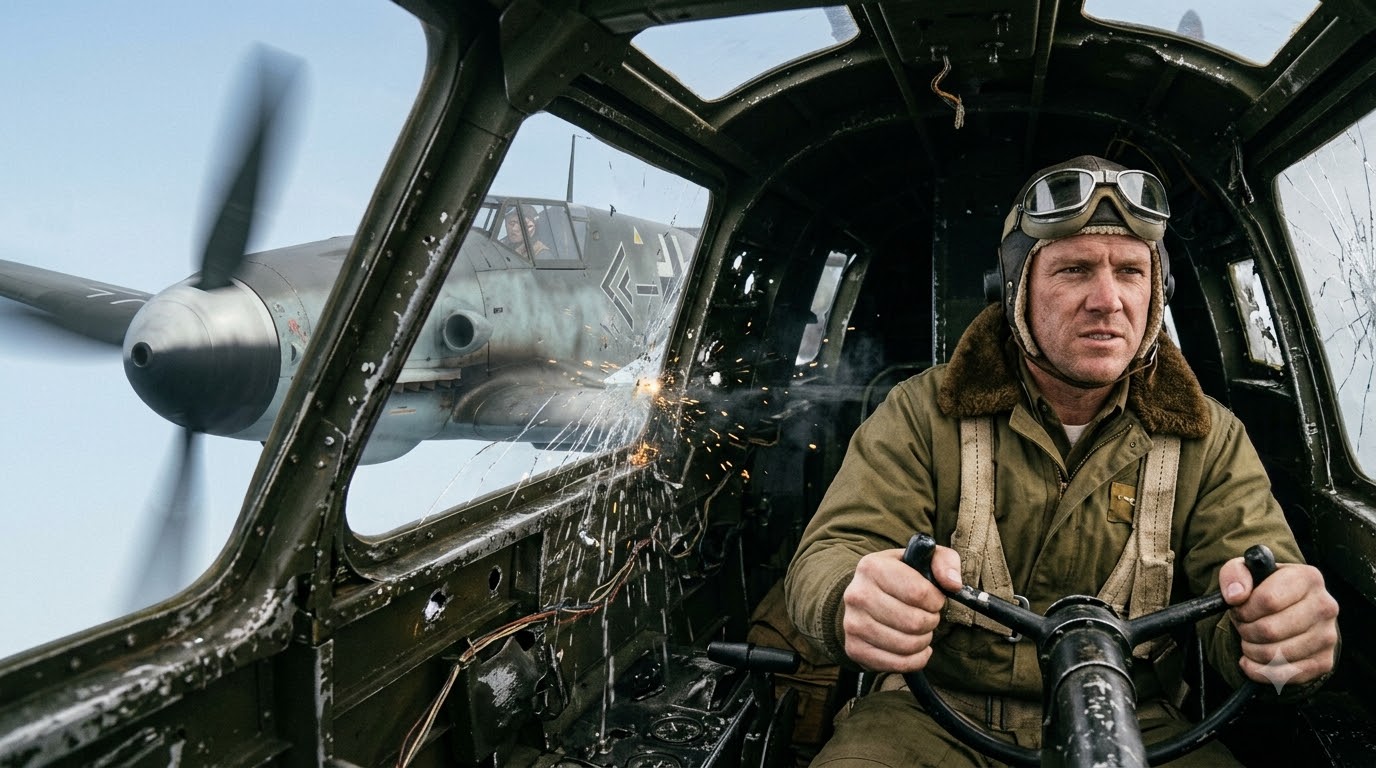
Twenty-two-millimeter shells had blown the canopy glass into a spiderweb of fracture lines, spraying hydraulic fluid across the instrument panel.
The Oklahoma farm boy wedged his boots against the rudder pedals, fighting controls that felt like they were dragging through wet cement.
A lone German fighter crept into his blind spot, positioning itself for a clean execution against the limping machine.
The enemy pilot opened fire with a pair of twenty-millimeter cannons, aiming straight for the leaking oil cooler.
Sparks chewed across the armor plating behind the pilot seat with a sharp, metallic screech.
Instead of dissolving into falling debris, the heavy radial engine simply coughed, swallowed the abuse, and kept its heavy blades turning.
The German pilot pulled alongside the battered fuselage, staring through his clean canopy with absolute confusion.
The expression behind the enemy oxygen mask shifted from clinical confidence to sudden, chilling doubt.
A fist hammered against the jammed canopy track in a desperate bid to bail out before realizing the metal had been welded shut by shrapnel.
There was no turning back, no nimble dive to safety, and no graceful escape route.
The massive machine simply absorbed the punishment, its four main longerons fractured yet holding the frame together by sheer weight of steel.
The enemy pilot checked his gauges, realizing with a start that his ammunition drums were running dry against a hull that refused to break.
CHAPTER 3: THE HAMMER OF INDUSTRIAL MIGHT
The tactical doctrine shifted entirely away from the old rules of tight turning dogfights.
Major Donald Bailey adjusted his goggles, watching the German formations position themselves below in the thin stratospheric air.
The heavy machines rolled inverted, trading altitude for velocity in a screaming dive that bypassed every traditional maneuver.
At thirty thousand feet, the massive engines reached speeds that made defense impossible for the interceptors caught beneath the descent.
— Hold your convergence zone, — Bailey muttered, gripping the stick as the air pressure screamed against the canopy frames.
Eight synchronized heavy machine guns opened fire simultaneously, creating an impenetrable wall of lead and incendiary rounds.
The opposing pilots tried to scatter, but the probability cloud of ammunition left no room for error or clever evasion.
An enemy twin-engine destroyer caught the full weight of the convergent fire pattern, its fuselage instantly disintegrating into a cloud of metal confetti.
There was no room for agile heroics when facing a localized storm of three thousand four hundred rounds per minute.
The arrogant confidence of the defending aces fractured completely as the crushing weight of industrial logic tore through their formations.
Every attempt to climb or turn away was met with an unrelenting wall of high-velocity destruction that refused to yield an inch of airspace.
CHAPTER 4: THE SILENCE OF THE LAST ACE
The flight line stretched into the distance under a heavy grey sky where new airframes arrived faster than the opposition could count.
Veteran commanders stared at the endless rows of heavy metal, realizing that courage and tactical artistry meant nothing against absolute material superiority.
— There is nothing left to rebuild with, — an exhausted voice muttered, looking across the cratered tarmac where the remaining supply lines had finally run dry.
The arrogant laughter that once filled the briefing rooms had dissolved completely into the mechanical roar of thousands of piston engines turning over in unison.
Every attempt to deflect, deny, or substitute sheer skill had collided with the unyielding wall of industrial manufacturing capacity.
The heavy machines owned every altitude from the ground up to the freezing stratosphere, stripping away all room for evasion or escape.
A calloused hand adjusted a loose bolt on a steel cowl, performing a routine maintenance task in complete, uninterrupted silence.
The overwhelming tide of production had done its work, leaving behind an empty horizon where the old order had broken entirely under the weight of lead and steel.