Beyond the Broken Line: How Forgotten Heroes Forged Leadership in the Crucible of War
CHAPTER 1: THE EMPTY RANKS
The grease on the M1 rifle bolt was freezing into a gritty paste, but Lieutenant Vernon Baker didn’t have the luxury of cleaning it twice.
Around him, canvas tents flapped violently against the biting October wind at Fort Huachuca, carrying the sharp scent of damp earth and departing footsteps.
Captain Runyon slammed his duffel bag onto the rear bed of a deuce-and-a-half truck with a hollow metallic thud, avoiding eye contact as he adjusted his woolen service cap.
Baker stood motionless near the supply crates, his thumb mechanically turning a heavy brass compass in his palm.
“They’re clearing out by sundown, Lieutenant,” Sergeant Miller said, his voice low and flat as he stepped up beside Baker.
“Let them,” Baker replied, his gaze locked on the dust trail kicked up by the convoy wheels.
The division roster lay open on the folding table inside the command tent, covered in red ink where dozens of white officers had officially requested emergency transfers.
The paperwork smelled of fresh ink and institutional cowardice, each signed line an admission that they would rather face court-martial than lead black soldiers into Italy.
Baker dropped the compass into his pocket, the metal cold against his knuckles as he stepped past the empty bunks to take command of a platoon left behind by design.
CHAPTER 2: THE FIRST ENGAGEMENT
Lieutenant Vernon Baker lifted the steaming metal to his lips, ignoring the bitter taste and the fine layer of grit settling at the bottom.
Across the assembly yard, two white supply officers from division headquarters stood by the fender of a canvas-covered truck, ostentatiously checking clipboards while ignoring the men of the weapons platoon.
Sergeant Miller wiped down the bolt of a .30-caliber heavy machine gun with an oily rag, his movements deliberate and unhurried.
“They shorted us three crates of mortar rounds again, Lieutenant,” Miller muttered, not looking up from the weapon’s receiver.
“I saw,” Baker said, setting the tin mug down with a sharp clink against the wood.
The official manifest listed standard issue for an infantry support company, but the physical reality in the stacks told a different story of calculated attrition.
Baker didn’t waste breath filing another requisition form that would simply disappear into the administrative dead-letter office at higher command.
He walked down the line of assembled men, his eyes sweeping over the mortar crews who stood waiting in the damp autumn air with quiet, disciplined tension.
A sharp metallic clatter echoed from the supply truck as one of the quartermaster officers carelessly tossed an empty crate onto the gravel.
“Keep the sights zeroed at four hundred yards,” Baker instructed the lead gunner, his voice cutting cleanly through the morning wind.
“The charts say four-fifty for this ridge,” the corporal replied, leaning over the bipod.
“The charts from headquarters were drawn by men who haven’t smelled this valley,” Baker said, picking up the heavy brass compass from his pocket and rolling its cold weight across his knuckles. “Adjust for the crosswind coming off the northern pass.”
The men fell to work without argument, their hands moving with precise, practiced rhythm over the steel plates and baseplates.
From the treeline up the slope, a pair of binoculars flashed in the gray morning light—an observation post watching every movement with cold calculation.
Baker caught the glint of glass through the pine branches and felt the familiar, heavy pressure of an invisible trap closing from above.
“They’re watching the reload drill,” Miller said quietly, pausing to sight down the barrel.
“Let them watch,” Baker replied, slipping the brass compass back into his wool coat as the first distant rumble of enemy artillery rolled across the stone ridge.
CHAPTER 3: THE SEVERED LINE
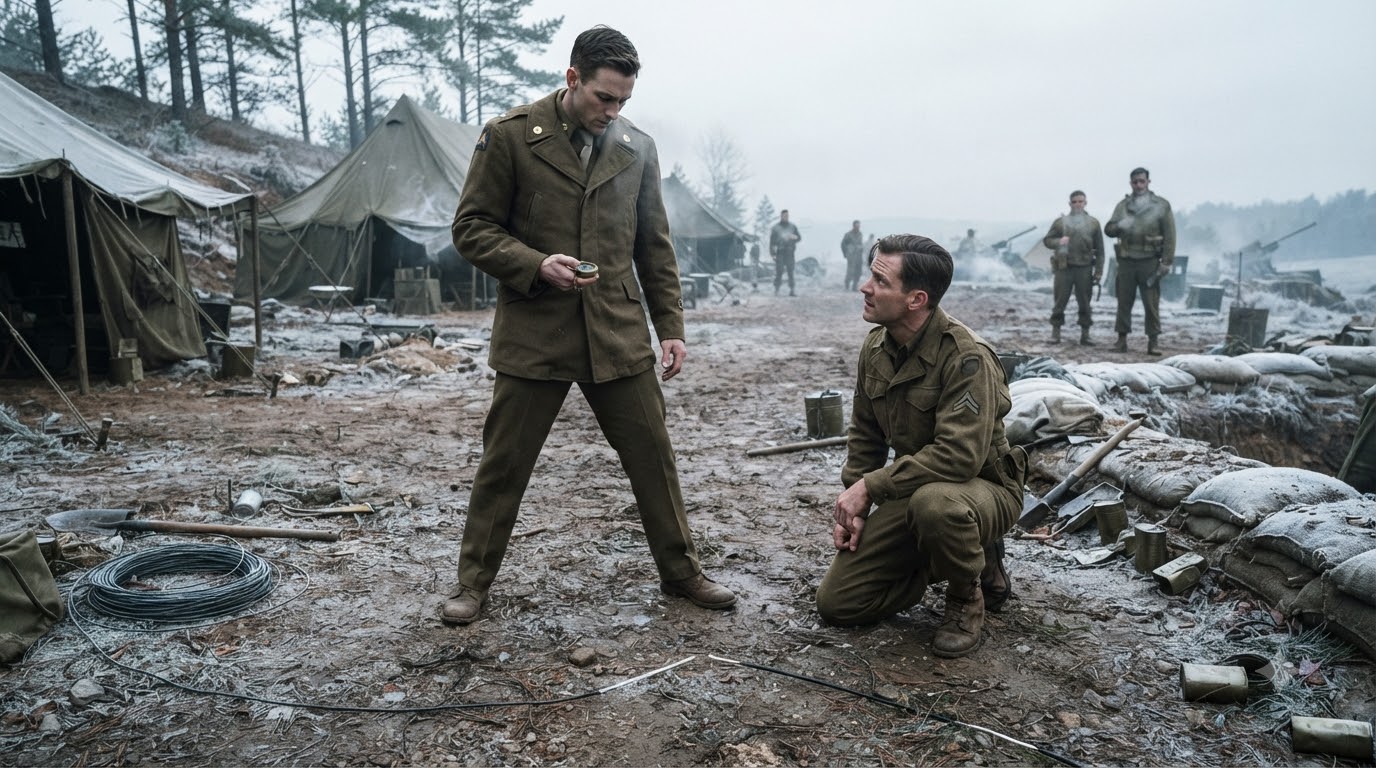
Lieutenant Vernon Baker dragged his bootheel across the frost-heaved dirt to cover the raw tear in the field telephone wire.
The copper strand inside the rubber casing had been cleanly sheared, not by shrapnel, but by a deliberate cut from a sharp blade right outside the battalion communications pit.
Sergeant Miller knelt beside the break, his fingers brushing the smooth, flat edge of the severed wire.
“Rats don’t cut straight lines like that, Lieutenant,” Miller said, his jaw tightening as his gaze flicked toward the rear headquarters tents.
“They don’t have to,” Baker replied, pulling a heavy brass compass from his pocket and rolling it over his knuckles to steady his breathing against a sudden wave of cold fury.
The field telephone remained dead in his hands, emitting only a faint, hollow hiss of static instead of the crisp signal required to coordinate defensive fire.
Up the valley, the low thud of enemy artillery began to walk closer toward their ridge, timing its cadence to the exact blind spot created by the severed wire.
Baker didn’t waste time shouting for a runner or marching back to headquarters to demand an explanation from officers who wanted them isolated.
“Rig the backup signal panels by the ridge crest,” Baker ordered, his voice dropping into a steady, uncompromising tone.
“Without wire, division won’t acknowledge our sector coordinates if the heavy push starts,” Miller warned, pausing with his hand on his entrenching tool.
“Then we make sure they can hear the guns without asking,” Baker said, looking up as a cluster of smoke bloomed over the forward picket line.
The physical reality of their isolation hung heavy in the damp air, forcing every man in the platoon to rely entirely on each other while the command net went silent by design.
CHAPTER 4: THE ALTERED MAP
Lieutenant Vernon Baker pressed his thumb against the smeared black ink, feeling the wet smudge come away on his skin.
Sergeant Miller stood guard by the shattered oak door of the captured command post, his rifle barrel resting lightly against his boot as he watched the gray fog roll across the stone courtyard.
“The grid numbers don’t match our sector, Lieutenant,” Miller said, his breath pluming in the damp air.
“They were never meant to,” Baker replied, his eyes narrowing as he scanned the margins of the official headquarters logbook.
The columns showed registered artillery targets placed three miles behind their actual defensive line, ensuring that any call for heavy support would land harmlessly in empty woods while leaving the ridge completely exposed.
It wasn’t a clerical error or an oversight by tired clerks; it was a calculated paper trail designed to document a phantom failure.
Baker pulled his heavy brass compass from his pocket, using the flat edge of the casing to pin down the curling page before the damp air ruined the evidence entirely.
“They’re writing us off before the push even hits,” Miller muttered, stepping closer to inspect the falsified coordinates.
“Let them write,” Baker said, his voice dropping into a cold, hard cadence as he tore the incriminating page straight from the binding and folded it into his wool coat. “We adjust the guns ourselves.”
The silence outside broke sharply as a distant mortar round struck the lower perimeter wall, showering the courtyard with fine stone dust and jagged splinters.
Baker didn’t flinch, his fingers tightening around the metal casing in his pocket as he turned away from the desk to face the ridge.
CHAPTER 5: THE RIDGE AT DAWN
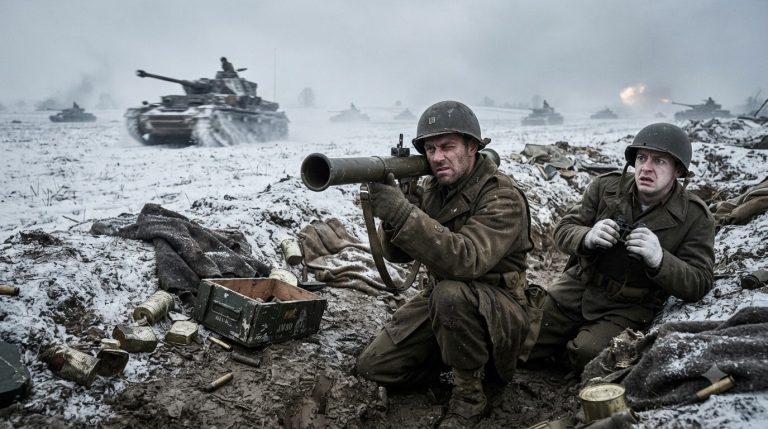
Lieutenant Vernon Baker planted his boot against the shifting earth of the parapet as a wave of concussive force rattled the limestone stones overhead.
Sergeant Miller hunkered down behind the heavy machine gun, his knuckles stark white against the dark steel receiver as the enemy advance surged across the valley floor.
“The rear comms are completely dead, Lieutenant!” Miller shouted over the roar of incoming mortar impacts.
“We don’t need their wires,” Baker answered, pulling his heavy brass compass from his pocket to verify the wind drift for the forward mortar crew.
Without official artillery support or working field radios, every adjustment had to be calculated by eye and executed with whatever rusted scrap they could salvage from the trench line.
The opposing command expected them to break under the first heavy wave, leaving an open corridor for a tactical retreat that would pin the blame squarely on the newly commissioned officers.
Baker didn’t waste a single breath on anger; he moved down the defensive line with grim, calculated precision, steadying the gunners whose shoulders were locked under the terrifying weight of the assault.
“Hold fire until they clear the stone fence,” Baker commanded, his voice slicing through the chaos with absolute authority.
“They’ve got three squads flanking the western trail,” Miller warned, sweat freezing instantly across his forehead despite the biting cold.
“Let them try,” Baker said, gripping the cold metal of his compass as he raised his M1 rifle to meet the rush head-on.
CHAPTER 6: THE UNYIELDING STAND
Lieutenant Vernon Baker closed his palm over the cold metal casing of the compass, feeling the sharp edges bite into his skin as the smoke across the ridge slowly began to thin.
Sergeant Miller leaned heavily against the frost-covered timber of the parapet, wiping a smear of soot from his forehead with the back of a raw, bleeding hand.
“The rear supply column is finally moving up the lower road, Lieutenant,” Miller muttered, his voice rasped from hours of shouting over the mortar concussions.
“Let them come,” Baker replied, his gaze fixed on the shattered line of the enemy advance where their coordinated flank had completely collapsed under manual defense.
The falsified maps and missing crate manifests lay scattered in the mud behind them, rendered entirely meaningless by the sheer, unyielding endurance of men who refused to be written off as scapegoats.
Higher command tried to engineer a silent failure, but the platoon held the line through sheer common-sense grit and calculated discipline without a single reliable radio or guaranteed lifeline.
Baker slipped the brass compass back into his wool coat pocket, feeling the solid weight of absolute closure settle over his chest as the morning sun broke through the gray valley fog.
The institutional machinery of prejudice had stacked every deck against them, but the ground beneath their boots remained firmly theirs.
Miller nodded slowly, looking out over the silent valley where the final traces of opposition melted away into the cold Italian woods.
“We stayed,” Miller said quietly.
“We stayed,” Baker answered, turning away from the trench edge to check the remaining ammunition crates for the long march ahead.