A Duty of Iron: One Man’s Stand Against the Slow Erosion of Home and History
CHAPTER 1: The Perimeter Line
The flag pole was not just steel; it was a stake driven into the earth of Juniper Court. Frank stood in his front yard, the heels of his boots biting into the dry, cracking soil of July. His right hand—the one that carried the tremor, the one that still felt the phantom weight of a rifle stock—gripped the halyard.
He didn’t look at the house next door. He looked at the street.
The air was still, heavy with the smell of scorched grass and the faint, biting scent of rust from his own truck’s undercarriage. His neighbor, Helen, was behind her screen door, her eyes fixed on the empty cul-de-sac. She knew the rhythm of his mornings. She knew the precision of his 0600 drill. But today, the atmosphere felt brittle.
He had found the surveyor’s stake at 0500. It had been driven into the corner of his yard, right where the grass met the asphalt, marked with a bright, aggressive strip of orange tape. It wasn’t county work. It was too precise, too clean, and completely unannounced.
Frank didn’t pull it out. He simply stood over it, his left leg aching with the dull, persistent pulse of an old injury, and studied the angles. He had lived here long enough to know that a neighborhood didn’t just decide to measure property lines without an intent to divide them.
The front door of the house on the corner clicked open. Diane Halverson didn’t walk out; she emerged, her movements efficient, her focus razor-sharp. She held a clipboard against her chest like a tactical shield.
“Mr. Delaney,” she said, her voice cutting through the morning stillness with the clarity of a bell. “I trust you noticed the marker. We’re conducting a survey of the entire cul-de-sac. To bring the neighborhood up to standard, we need to be clear about where the private property ends and the common space begins.”
Frank didn’t turn around immediately. He kept his eyes on the orange tape. He felt the familiar, cold calculation blooming in his chest—the same logic that had kept him alive in the brush of Khe San. He wasn’t just a resident; he was a sentry.
“Common space,” Frank repeated, his voice low, dry as gravel. He finally turned. He didn’t look at her face; he looked at her hands. She was holding the clipboard so tightly her knuckles were white.
“Yes,” she said, stepping off her porch. Her heels didn’t click on the grass; they sank into it, marking her arrival. “We’re looking to enhance the curb appeal. It’s a matter of policy.”
Frank looked past her, toward the empty street, then back to the flag pole. The flag hung motionless, a heavy, silent witness.
“I’ve been here twenty-seven years, ma’am,” he said, his tone devoid of malice, purely transactional. “I know where my property line is. It’s marked by the fence you wanted me to repaint, and it’s marked by the history of this ground. I suggest you take that stake out of my yard.”
“It’s not your yard, Mr. Delaney. Not entirely.”
He didn’t flinch. He didn’t argue. He reached into his pocket, his hand steady for once, and gripped the keys to his 1994 F-150. He had an appointment in Fort Collins, and he didn’t intend to be late. But as he looked at her, he realized the orange tape wasn’t the biggest problem. It was the way she looked at the land—not as a home, but as an asset to be stripped and rebuilt.
He turned toward his porch, his boots crunching rhythmically on the dirt. The silence he left behind him was heavy, a wall of friction between them.
He reached for the door handle, but then he saw it: a small, silver scrap of foil, caught in the grass near the surveyor’s stake. He reached down and picked it up. It was a receipt, discarded and half-buried, for a land-use permit filed by a company he didn’t recognize.
The context of the argument had just shifted, and the trap he’d sensed had finally snapped shut. He didn’t look back at Diane. He stepped inside, locked the door, and reached for his black address book.
CHAPTER 2: The Cold Calculation
The kitchen was quiet, but it was a brittle, fragile quiet. Frank closed the door behind him and locked it—not because he feared an intruder, but because he needed to seal off his space from the shifting variables outside. He stood in the narrow hallway for a moment, his breath steady, his eyes tracing the familiar, worn grain of the wood paneling. He looked at the black address book, then at the receipt in his hand.
The permit was dated two weeks ago. The company, Willow Ridge Holdings, was a name he hadn’t seen on any local news or flyer. His mind, trained in the brutal geometry of combat, began to map the implications. They weren’t just surveying; they were testing the boundaries, checking for soft spots in the ownership records of the houses at the end of the cul-de-sac.
He walked into the kitchen and sat at the table. The air smelled of old coffee and dry dust. He opened his address book to the letter M, his finger hovering over the entry for Marcus. He didn’t dial yet. To call now would be to admit he was under siege, and he needed to know the scope of the threat first. He needed to verify if this was just a realtor’s overreach or if there was a deeper, more calculated machinery at work.
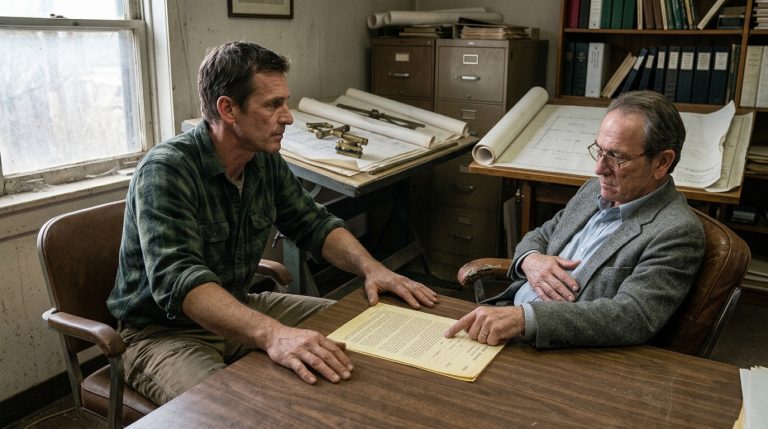
He stood up and walked to the closet, his limp favoring the left leg as he moved. He pulled out a heavy, canvas-wrapped bundle from the floor. Unfolding it, he revealed a set of blueprints from 1997, stained with a single brown smudge that hadn’t moved in twenty-seven years. He laid them flat on the dining table, smoothing the corners with a hand that had stopped trembling entirely the moment he’d recognized the urgency.
As he traced the lines of the lot, a memory hit him with the force of a physical blow. He wasn’t in his kitchen. He was back in the mud outside Khe San, watching the engineers pace off the ground for a secondary defensive line. He remembered the way the soil felt—soft, yielding, hiding things that weren’t meant to be disturbed. He saw the face of James Talbot, eyes bright and expectant, holding the flag that would eventually bear the stain of his life.
The phantom sound of a mortar whistle sliced through the quiet of his kitchen. Frank blinked, the vision receding, leaving him with the cold, sharp reality of the blueprints. He shook his head, clearing the haze. The memory wasn’t a distraction; it was a map. He realized then that the reason the cul-de-sac was being targeted wasn’t just its “curb appeal.” It was because the land underneath his house and the houses immediately adjacent to it had never been properly surveyed as a single, modern tract. It was a vestigial limb of the original property line, a pocket of ground that predated the developer’s reach.
He grabbed a pencil and a protractor, measuring the distances himself. The math didn’t lie. If the HOA reclaimed the “common space,” they would effectively cut off access to the soil beneath his porch. They would have the legal right to excavate, to “upgrade,” and to bury whatever history remained under layers of concrete and manicured turf.
He didn’t just feel anger. He felt a deep, chilling clarity. This wasn’t about aesthetics. It was about erasure.
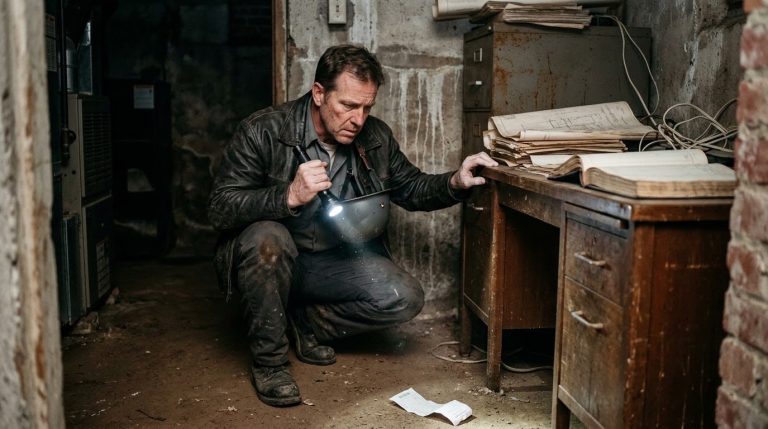
He went to the garage, the concrete floor cool against his boots. He opened the steel drawer of his workbench and pulled out a heavy-duty set of calipers and a magnifying glass. He needed to be sure. He examined the receipt he’d found again, this time looking at the faint, impressed ink of the permit number. It was registered to a holding company that specialized in “underutilized residential infrastructure.”
He spent the next hour in total silence, methodically checking the property tax records he’d kept in a filing cabinet for decades. He cross-referenced the dates, the plot numbers, and the sudden, suspicious amendments the board had pushed through since Diane Halverson took over. Every piece of the puzzle clicked into place. The revitalization meeting, the height restrictions, the “aesthetic standards”—it was all a tactical feint to force long-term residents into compliance or into selling their homes before the real acquisition began.
By the time he stood up, his knees popped, and the low, dull ache in his back reminded him he was eighty-two. But his mind was as sharp as a razor. He knew what he was looking at. He had been an infantryman, a scout, and a survivor; he knew when an army was digging in before the first shot was fired.
He walked back to the kitchen, the blue light of early morning creeping through the blinds. He looked at the phone. He needed more than just a conversation with Marcus. He needed an assessment of the perimeter. He needed to know if the others—Helen, Robert, the families on the other side of the cul-de-sac—had also been visited by the surveyors.
He reached for the receiver, his movements deliberate. He didn’t feel like a victim. He felt like the one man on the street who had finally realized the battle had begun. He dialed the number for the county clerk, his voice firm, his tone that of a man who was used to demanding answers from people who weren’t used to giving them.
“I’m looking for the registration of Willow Ridge Holdings,” he said, his voice as steady as iron. “And I want to know who signed the initial survey order for Juniper Court.”
The person on the other end hesitated. Frank didn’t wait. He began to recount the file numbers, the dates, and the specific codes he had unearthed from his own meticulous record-keeping. He was ready to dig. The trap was laid, but he had spent a lifetime learning how to dismantle them, one wire at a time.
CHAPTER 3: The Paper Trail
“Sir?” The clerk’s voice was thin, filtered through miles of fiber optics, but Frank heard the hesitation. “That holding company… they’re registered under a subsidiary of a national real estate firm. They have local counsel handling the filings. If you want the specific names, you’ll need a formal request.”
Frank didn’t argue. He didn’t raise his voice. He simply held the line, his gaze locked onto the document he’d pulled from his files. “I’m not asking for the names to be nice, ma’am. I’m asking because your office is currently facilitating a violation of federal property guidelines regarding a legacy parcel. If that permit goes through without a full survey of the sub-strata, the county is liable.”
He’d said it with the quiet authority of a man who knew exactly how much damage a single well-placed question could do. There was a long silence on the line. Then, the sound of keys clicking—a sharp, mechanical rhythm that echoed his own heartbeat.
“Wait a moment,” the clerk said.
Frank waited. He looked out the kitchen window at his flag pole. It stood tall, defiant, a sliver of steel against the slate-gray sky. He thought of James Talbot. He thought of the ground in the rice paddy, the way it had tasted of iron and damp earth, and he thought of the secret he had kept buried beneath his own porch for thirty years—not just the flag, but the original hand-drawn plat map that showed this cul-de-sac as a protected historical easement, something the current developers were betting that no one would bother to check.
“Mr. Delaney?” the clerk returned, her voice lower now. “I’m looking at the filings. The signature on the secondary land-use permit… it’s not from a lawyer. It’s a direct digital sign-off from the HOA president’s office.”
Frank felt the cold snap of the trap door. It wasn’t just corporate greed; it was local collusion. Diane wasn’t just working for them; she was effectively laundering the acquisition through her own board to bypass the standard public review process.
“Thank you,” Frank said.
He hung up. He didn’t feel relief. He felt a grim, focused exhaustion. He grabbed his coat, the fabric heavy and stiff, and walked out into the cool, biting air of the afternoon. He didn’t head for the garage to drive; he walked, his gait steady, his boots making a soft, rhythmic thud on the pavement of Juniper Court.
He moved toward the corner house—Diane’s house. He needed to see the perimeter again, not as a resident, but as a surveyor. He walked with his hands in his pockets, his eyes scanning the curbs, the storm drains, and the subtle, unnatural dip in the land where the modern drainage system stopped and the original, untouched soil of the legacy parcel began.
A car slowed down as it passed him—a black sedan, tinted windows, cruising with the slow, predatory grace of a security detail. Frank didn’t turn his head. He kept walking, his attention focused on the way the grass near Diane’s property looked greener, lusher—forced growth, likely over new, shallow piping.
He reached the corner and stopped. He stood perfectly still, his body an anchor in the middle of the street. He looked at the orange stake from that morning. It was still there, but now, he saw it differently. It wasn’t a marker for a project; it was a stake driven into the heart of the ground he had sworn to protect.
He felt a sudden, sharp intrusive memory—the sound of his own heavy breathing in the mud, the sensation of fingers clawing at the earth to reach the flag that James had died to keep above the dirt. The memory wasn’t a shadow; it was a directive.
He walked up to the stake and, with one calm, deliberate movement of his boot, pushed it deeper into the ground, burying the orange tape until it was almost invisible. He wasn’t pulling it out; he was claiming the territory.
As he turned to head back, he saw Diane standing on her porch. She was watching him, her arms folded, the clipboard gone, but her expression held the same clinical, detached interest she’d shown when she’d touched his flag. She wasn’t just a neighbor; she was the gatekeeper for the very forces he was now dismantling.
“Mr. Delaney,” she called out, her voice carrying across the quiet afternoon. “I wouldn’t spend too much time measuring the soil if I were you. It doesn’t belong to you as much as you think it does.”
Frank stopped. He didn’t turn around. He stood there, his back to her, a man of iron and memory standing on a road that was slowly becoming a battlefield. He didn’t answer. He didn’t need to. He had the permit numbers, he had the trail, and for the first time in over fifty years, he had a reason to make a phone call that would change everything.
He kept walking, his steps rhythmic, heavy, and purposeful. He headed home, the smell of dust and coming rain sharp in his nostrils, the plan already forming in his mind with the cold, mechanical precision of a clock. The next move was his.
CHAPTER 4: The Gathering
The van was a hulking, matte-gray silhouette against the backdrop of the suburban street, its side door propped open to reveal a tangle of cables and high-powered acoustic leveling equipment. Two men in high-visibility vests stood near the flag pole, their movements precise, their focus entirely on the base of the pole. Frank didn’t hesitate. He crossed the street, his boots heavy and deliberate, the sound of his approach muffled by the low-frequency hum emanating from their gear.
“You’re on private property,” Frank said. His voice was not loud, but it possessed a resonant, carry-over power—the kind of tone that demanded immediate attention.
One of the men turned, his face obscured by a pair of mirrored sunglasses that reflected the flag pole like a warped, metallic spire. “We have a municipal utility clearance, sir. We’re just mapping the ground stress for the upcoming utility upgrades.”
“There are no utilities under that patch of dirt,” Frank replied, his eyes scanning the equipment. He noted the brand of the sensors—specialized geological surveying tools, the kind used for scanning for buried foundations, not cable lines. “You’re scanning for something else.”
The man didn’t respond. He simply signaled to his partner, who was busy calibrating a tripod near the edge of the grass. A sharp, high-pitched whine erupted from the equipment, a sound that made the hair on the back of Frank’s neck bristle. It was a rhythmic pulse, a sonar sweep.
Frank felt the tremor return to his right hand. He shoved it into his pocket, his grip tightening around the small, black address book. He knew he was outnumbered, but he also knew the geography of this cul-de-sac better than any corporate surveyor. He looked at the street—the way the storm drain three houses down had recently been “repaired,” the way the curb had been reinforced. They were mapping the subterranean voids, the hidden history of the land that the developers were so desperate to overwrite.
Suddenly, a dull thud echoed from the street—a pipe had burst three houses down, sending a fountain of murky, brown water spraying into the air and flooding the storm drain system. The sudden surge of pressure caused the delicate sensors near the flag pole to flicker and surge, the electronic whining turning into a screech of feedback. The technicians scrambled, their movements suddenly clumsy as they fought to protect their gear from the rising water that was pooling rapidly toward the cul-de-sac.
“Shut it down!” the lead technician shouted.
Frank didn’t move. He stood his ground, a silent, immovable object amidst the chaos of the flooding street. He watched as the water, forced up by the system failure, began to wash away the loose topsoil around the base of his pole, revealing the glint of something dark and ancient—a corner of rusted iron, a remnant of a foundational structure that hadn’t seen the sun in half a century.
The technicians were too busy fighting the water to notice. Frank saw it, though. He saw the way the iron responded to the pressure of the earth, the way it held steady even as the mud gave way. It wasn’t just a foundation; it was a marker.
As the technicians began to pack their gear, cursing the sudden malfunction, Frank turned his back on them. He walked toward his porch, his heart rate spiking with a newfound, dangerous energy. He didn’t need to look at the address book. He had the number memorized.
He stepped inside his house, the familiar, dry, metallic scent of his living room greeting him like an old comrade. He walked to the kitchen and dialed the number. The phone rang twice.
“Whitfield,” the familiar, gravelly voice barked.
“Marcus,” Frank said, his voice hard, forged by the realization of what was hidden under his feet. “They’re digging. They’ve brought the heavy scanners. And the land is starting to show its teeth. If we’re going to hold this, I need you here. Not in a week. Now.”
“I’m on the road,” Marcus replied, the sound of a motorcycle engine idling in the background. “I’ve got forty-six of them loaded up and moving. We’ll be there by sunrise.”
Frank hung up. He looked out the window. The technicians were loading the van, their movements frantic, the water still bubbling up from the damaged pipe. They hadn’t seen the iron, but they would be back, and next time, they wouldn’t just be surveying.
He turned to the fireplace and gripped the cedar box on the mantel. He didn’t open it. He simply held it, the weight of the wood, the blood-stained fabric, and the history it contained steadying his soul. He had forty-eight hours to secure the perimeter before the developers returned with the machinery to flatten it all.
He didn’t know what they were planning, but he knew one thing: he wouldn’t let them erase the site of the sacrifice. He stood by the window, watching the gray van pull away, his eyes fixed on the patch of wet, disturbed earth near the pole. The storm was coming, and for the first time in fifty years, Frank Delaney was ready to meet it on his own terms.
CHAPTER 5: The Siege
The sound started as a distant, rhythmic thrum—the collective heartbeat of forty-seven engines moving in lockstep through the cooling mountain air. Frank stood on his porch, his hands gripped the railing so tightly his knuckles turned white. Beside him, the cedar box sat closed, a silent sentinel of the history he was defending. He watched the mouth of the cul-de-sac.
Then, they appeared.
The riders arrived in a perfect, staggered column, their silhouettes dark against the twilight. Marcus Whitfield led the formation, his bike a heavy, well-maintained machine that hummed with a deep, authoritative pitch. As they turned into Juniper Court, the sheer scale of the arrival became clear; it wasn’t just a gathering of men, it was the mobilization of a forgotten, disciplined force. They didn’t shout, they didn’t cheer; they moved with the practiced, somber efficiency of a unit preparing to hold a position at any cost.
They fanned out, bike by bike, creating a literal wall of steel and leather at the entrance to the cul-de-sac. One by one, they dismounted, their movements synchronized. They didn’t go to their bikes for weapons; they went for flags. Each man pulled a folded, heavy-duty American flag from a saddlebag, and with a precision that bordered on the ritualistic, they began to plant them along the perimeter.
Frank walked down the driveway to meet Marcus. The colonel stepped off his bike, his face etched with the weariness of a long road, but his eyes were as sharp as he had been in the mud of 1968. He stood before Frank, the two of them a study in decades of shared, unspoken weight.
“The permits are being pulled,” Marcus said, his voice low but cutting through the idling drone of the engines. “I’ve got a lawyer on the way from Denver. He’s a veteran, too. He’ll have the injunction in hand before the sun comes up.”
“They aren’t just here for the pole, Marcus,” Frank said, his voice as dry as the ground beneath them. “They’re here for the ground. They know what’s underneath.”
Marcus looked at the flag pole, then at the disturbed soil where the technicians had been working. He didn’t ask what Frank meant; he knew the shape of the secret. “Then we hold the ground,” he said.
By midnight, the cul-de-sac was a fortress. The riders had set up a perimeter, their bikes positioned to block any unauthorized entry, their presence a silent, immovable blockade. The neighbors had come out—Helen, Robert, the families—brought by the gravity of the situation. They didn’t stand apart; they integrated into the line. A sense of collective ownership took hold, a hardening of resolve that transcended the HOA’s thin, legalistic threats.
The silence of the night was broken only by the occasional sharp click of a boot on asphalt or the muted, tactical conversation of the men on watch. Frank spent the night in a chair on his porch, his eyes fixed on the house on the corner.
Diane Halverson’s house remained dark, but he knew she was watching. He could feel her gaze—a cold, anxious pressure from behind the cream-colored curtains. She was waiting for the morning, for the moment she thought her authority would be absolute. She didn’t understand that the law she wielded was a paper thin, brittle thing compared to the iron-clad commitment of the people now standing guard over the cul-de-sac.
Around 0300, a car pulled slowly into the mouth of the court—a black sedan, its headlights dimmed. It was a lawyer, clearly, sent by the firm behind the redevelopment. It stopped when it hit the line of motorcycles, the rider stationed there—a man with a face like cured leather and eyes that had seen too much—didn’t move. He simply leaned against his bike, his posture relaxed, his hand resting on the holster of his gear, a silent message that the perimeter was secure.
The car lingered, the engine idling in the dark, before finally turning around and retreating into the night. Frank felt a grim sense of satisfaction. The pressure was mounting. They were losing their leverage, and he knew that when they realized their legal threats wouldn’t work, they would resort to something else.
He closed his eyes for a few minutes, and immediately, the past surged back. He was in the mud, the smell of cordite thick in the air, James Talbot’s face reflecting in the blue of the flag. He wasn’t Frank Delaney anymore; he was a Marine holding a line that didn’t exist, defending a memory that the world had tried to forget. He opened his eyes, the porch light reflecting in his pupils, a steel-hard focus returning to his gaze.
He stood up and walked to the edge of the porch, the night air crisp and cold against his skin. The flags along the perimeter fluttered in a low, constant breeze, a sound like thousands of wings beating in the dark. It was a vigil, a standoff, and a declaration.
He looked at the cul-de-sac. It wasn’t just a street anymore; it was a testament. He was no longer just a resident standing against an HOA; he was a guardian of a truth that was finally, after fifty-three years, going to be brought into the light. He leaned against the porch rail, the wood firm and solid under his weight, and waited for the sunrise. He was ready for the end of the war.
CHAPTER 6: The Final Settlement
Diane Halverson stepped out of her house at 0855. She was dressed in the cream blazer she had planned for the meeting, but the confidence was gone. She walked toward the center of the cul-de-sac, where the motorcycles formed a massive, impenetrable wall. Her heels clicked on the asphalt—a hollow, lonely sound in the absolute silence of the neighborhood.
Frank walked forward to meet her. He didn’t rush. He moved with a measured, heavy gait, his left leg stiff, his right hand steady. Behind him, Marcus and the forty-six riders stood like stone, their presence a weight that seemed to bend the very air of the morning.
“The injunction arrived,” Diane said. Her voice was brittle. She held a thick envelope in her hand, the seal of the court visible at the top. “My lawyers said the permit process was… technically incomplete.”
Frank looked at the envelope. He didn’t take it. “It wasn’t just incomplete, Diane. It was fraudulent. You knew the historical easement on this land. You knew the soil you were surveying was the final resting place of a defense line that doesn’t show up on your modern maps.”
Diane flinched, the color draining from her face. She looked past him at the flag pole, then at the dirt near the base where the iron had been revealed. “I was just trying to improve the asset,” she whispered. “It was just a neighborhood.”
“It was never just a neighborhood,” Frank replied. “It was a home. And the people who built it didn’t build it for profit.”
He turned to the crowd of homeowners—Helen, Robert, the families—who had gathered behind the wall of bikes. They were watching him, not as a neighbor, but as a sentinel. He stepped aside, gesturing to the ground. “This isn’t an ‘underperforming asset.’ It’s a site of memory. And it’s not for sale.”
Diane stood there for a long moment, the morning sun highlighting the fraying edges of her composure. She looked at the bikes, the flags, the faces of the people she had tried to displace. The realization hit her, not with a roar, but with the quiet, suffocating pressure of defeat. She turned the envelope over in her hands, the weight of it suddenly too much to bear. She didn’t offer a defense. She didn’t offer a speech. She simply turned around and walked back toward her Lexus, her stride no longer purposeful, but hesitant, the heavy gait of someone who had lost her map.
The climax didn’t happen with a scream or a struggle. It happened with the slow, inevitable crumbling of a house of cards. By the time Diane reached her door, the news crews that had gathered at the edge of the cul-de-sac were already broadcasting the collapse of the redevelopment deal. The HOA’s legal standing had dissolved the moment the historical easement documentation was verified by the court.
Marcus stepped forward and placed a heavy hand on Frank’s shoulder. It was the first time they had made physical contact since the arrival. “It’s over, Frank.”
“For now,” Frank said.
He walked back to his pole. The sunlight caught the flag, the 5×8 wool-stitch stripes unfurling in the breeze. He looked at the base of the pole—at the dark, rusted iron peeking through the mud. He reached down, his fingers brushing the cold metal, and felt the earth settle around it.
He didn’t need to dig it out. He didn’t need to announce it. It was enough that it was there, protected.
The riders began to depart, the rumble of their engines a fading song in the morning air. One by one, they rolled past him, each man pausing to offer a silent nod, a final, wordless acknowledgment of the line they had held together. By noon, the cul-de-sac was quiet again. The flags remained on the lawns, anchored deep in the earth.
Frank went to the garage and retrieved his wrench. He walked over to his flag pole, where the pulley had developed a slight, persistent squeak. He worked the mechanism, cleaning the rusted grit from the gears, applying a drop of oil, and tightening the tension. The movement was rhythmic, meditative, the sound of metal on metal a comfort in the silence.
He finished the repair and looked at the pole. It was perfectly level. He walked to the porch and sat down in the folding chair—the one that had been Marjorie’s. He picked up his coffee cup, the ceramic warm against his palms.
He watched the street. Helen Margolis was out in her yard, tending to the flowerbed near the flag she had planted the night before. She looked over, caught his eye, and raised a hand in a small, quiet gesture of peace. Frank nodded back.
He thought of the cedar box inside, the blood-stained flag, and the dog tags. He wouldn’t bring them out today. He wouldn’t need to. The ground was safe, the line was secure, and the neighborhood had become a home again. He felt the tremor in his right hand—the one that had started in a rice paddy half a lifetime ago—and noticed, for the first time in years, that it was perfectly, peacefully still.
He sat there as the sun moved across the sky, his eyes steady, his heart rhythmic and slow. He wasn’t guarding a secret anymore. He was simply living on the land he had saved, a sentinel who had finally, after fifty-three years, come home to rest.