The Weight of Steel and Salt: A Test Pilot Confronts the Impossible Reality of an Empire’s Decline
CHAPTER 1: Salt and Aluminum
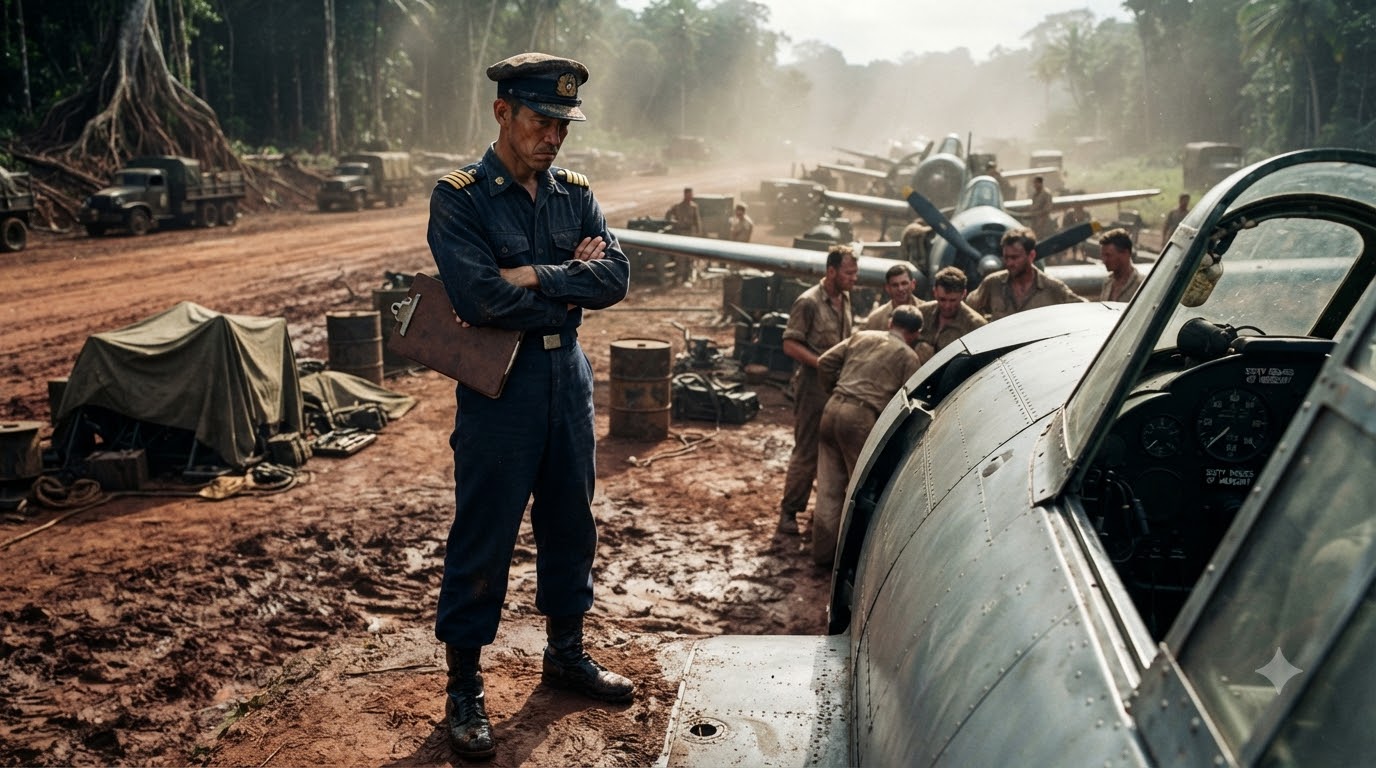
The air at Lakunai Airfield smelled of heavy diesel, rotting jungle roots, and the sharp, chemical tang of aviation fuel.
Lieutenant Commander Tadashi Nakajima stood boot-deep in the trampled mud beside the runway apron, his hand closed tightly around the scarred handle of a heavy brass calibration wrench in his pocket.
Before him sat the salvaged American fighter, pulled straight from the shallow green water near Munda Point just hours earlier.
Its dark blue paint was smeared with gray brine and flecks of white coral sand, the wet fuselage glistening under the brutal afternoon sun like the flank of a trapped deep-sea leviathan.
Junior officers and mechanics milled around the wreckage in uneasy silence, their bare arms slick with sweat as they scrubbed at the encrusted salt along the cowling.
No one spoke above a low murmur, because the sheer size of the machine felt like an open contradiction to everything they had been taught about enemy engineering.
Nakajima stepped closer, his boots squelching softly in the red dirt, and ran his fingers over the thick aluminum skin of the wing.
It did not yield or bend under his touch; it felt rigid, heavy, and brutally solid, entirely unlike the paper-thin plates of the Zero that his own ground crews joked could be punctured with a bare fist.
He glanced up toward the cockpit canopy, where the salt-streaked glass hid the instrument panel from view, waiting for the mechanics to finish clearing the debris from the footwell.
The brass wrench in his pocket dug sharply against his knuckles, a hard, cold point of friction reminding him that he had no official diagnostic manuals or factory telemetry charts to help him decipher what lay inside.
He was entirely on his own with the machine, and the heavy, humid air felt suddenly thin as he took his first deliberate step up onto the wing root.
CHAPTER 2: The Impossible Math
The glass of the manifold pressure gauge was smeared with a thin film of dried salt spray, catching the dim interior shadows of the fuselage.
Nakajima leaned his forehead against the padded edge of the canopy frame, his breath shallow as he stared at the glowing white needle resting squarely against sixty inches of mercury.
It was a number reserved for heavy bombers under emergency war-load conditions, not for a single-seat carrier fighter pulled out of a muddy reef in the Solomons.
He blinked against the humid sweat stinging his eyes and flicked his gaze downward to the tachometer, watching the finely etched increments climb cleanly to three thousand revolutions per minute.
His mind raced through the mathematical formulas of power-to-weight ratios, calculating the torque required to spin an eighteen-cylinder radial engine at that velocity without tearing the airframe apart at the rivets.
The arithmetic refused to balance.
According to every technical doctrine issued by the Yokosuka Arsenal, an engine producing two thousand horsepower required an array of heavy-duty alloys and precision gear tolerances that Japanese manufacturing simply could not mass-produce at scale.
He reached out with a gloved thumb, tapping the outside of the glass casing to see if the needle was merely stuck on a broken spring.
The needle did not flinch, remaining as rigid and stubborn as the thick armor plate behind his seat.
A faint, metallic glint caught his eye from deep within the engine housing beneath the instrument binnacle, drawing his attention to a small, perfectly preserved serial number stamped into the supercharger housing.
Unlike the corroded aluminum surrounding it, the stamp was clean, sharp, and entirely free of saltwater pitting, as if it had been machined that very morning in a factory thousands of miles across the Pacific.
Outside the cockpit, the muffled murmur of the ground crew rose through the hull as Captain Shindo shouted orders to move the canvas tarps away from the wingtips.
“Lieutenant Commander,” Shindo’s voice cut sharp and impatient through the humid air from the tarmac below. “Have you found the source of the electrical short, or are we staring at more damaged glass?”
Nakajima did not answer immediately; his fingers tightened instinctively around the brass calibration wrench in his pocket, feeling its heavy, unyielding edge press into his palm.
He looked back down at the sixty-inch manifold pressure reading, knowing that if he reported these numbers to the command staff, they would dismiss it as an instrument malfunction or a deliberate enemy fabrication.
He pulled himself up slightly on the seat, his muscles tensing as he prepared to climb out and face the mounting skepticism of officers who refused to look past their own pre-war assumptions.
CHAPTER 3: The Brass Wrench
Captain Shindo stood waiting near the command tent, his arms crossed over his stiff canvas tunic while a fine layer of tropical grit settled on his cap.
—You spent an hour inside a sunken hull, Nakajima. The ground crew needs the apron cleared for the supply trucks— Shindo said, his eyes narrowing against the glare reflecting off the damp fuselage.
Nakajima wiped a streak of greasy moisture from his forehead, his fingers brushing against the heavy brass wrench still tucked inside his pocket.
—The instruments are intact, Captain. That is not a wildcat variant we are looking at— Nakajima replied, his voice flat and unyielding against the humid afternoon heat.
Shindo let out a dry, sharp breath, stepping closer until the smell of stale tobacco and sweat filled the space between them.
—Command at Truk expects a standard breakdown report by nightfall, not ghost stories about enemy miracles— Shindo snapped, tapping a leather-bound clipboard against his thigh.
Nakajima did not blink, holding his ground in the mud as he felt the cold metal of the wrench bite into his palm through the fabric of his trousers.
—If we file this as a calibration error, the next squadron we send up will pay for our comfort with their lives— Nakajima said, his tone dropping into a dangerous, level register.
Shindo’s jaw tightened, his gaze darting toward the distant wreckage before locking back onto Nakajima’s face with hardened skepticism.
—Then prove it in the air yourself, Commander, because paper reports will not convince the Admiral— Shindo muttered, turning sharply on his heel toward the briefing tent.
CHAPTER 4: The Iron Rumble
The deep, concussive rumble shook through the entire airframe, sounding less like an aviation motor and more like heavy industrial machinery grinding away in an underground factory.
Nakajima let the oil temperature gauge climb slowly toward the operating range, his eyes fixed on the stable needle of the cylinder head temperature indicator.
There was no stutter in the exhaust, no hesitation in the fuel delivery, and no ominous vibration rattling the engine cowl.
He gripped the throttle lever firmly, feeling the immense torque try to twist the airframe sideways against the chocks before he eased it forward into takeoff position.
—Commander, the engine run-up is exceeding safety tolerances for a salvaged hulk!— a mechanic shouted from the edge of the tarmac, waving his arms frantically against the slipstream.
Nakajima did not look back, his jaw set as he locked his focus entirely on the runway stretching out before the heavy nose of the blue fighter.
The torque of the two thousand horsepower motor was a living force beneath his palms, demanding absolute respect and threatening to flip the machine if handled without precise caution.
He released the wheel brakes simultaneously, feeling the massive airframe surge forward down the damp coral strip with an acceleration that instantly defied its heavy weight.
Within seconds, the tail lifted clean off the ground, and the familiar red dirt of Lakunai blurred into a solid streak of grey beneath the roaring cowl.
He pulled back gently on the stick, and the machine climbed into the humid tropical sky with an aggressive, effortless power that left his breath caught in his throat.
CHAPTER 5: Breaking the Cloud Cover
The heavy airframe punched through the white upper layer of tropical cumulus with zero shudder in the wings, maintaining a smooth, relentless ascent that mocked every aerodynamic principle he knew.
Nakajima shoved the throttle all the way forward, feeling the responsive roar of the eighteen-cylinder radial engine press him heavily back against the armored seat cushion.
The airspeed indicator climbed past five hundred and fifty kilometers per hour, outstripping the maximum level speed of the Zero by a terrifying margin.
He rolled the machine inverted and pushed the stick hard forward, diving straight down toward the sparkling blue expanse of the Solomon Sea at a velocity that would have torn the aluminum skin off any domestic fighter.
The flight controls remained firm and responsive beneath his trembling fingers, refusing to flutter or bind under the immense aerodynamic pressure.
He pulled out of the dive at six thousand meters, his vision greying slightly at the edges from the sudden G-force before clearing as he leveled off into the blinding sunlight.
Every single gauge on the panel confirmed what his mind desperately wanted to reject: the enemy was not just building better planes, they were building an entirely different scale of industrial might.
He banked the heavy blue fighter back toward Lakunai, his thumb unconsciously rubbing the cold, scarred metal of the calibration wrench still hidden inside his pocket.
CHAPTER 6: The Final Report
Captain Shindo was waiting by the canvas flaps of the command tent, his fingers drumming an impatient tattoo against a stack of unread supply manifests.
—Well, Commander? Are you ready to revise those impossible numbers for the record?— Shindo asked, his voice sharp with administrative exhaustion.
Nakajima did not blink, sliding the heavy sheaf of papers across the rough wooden camp desk without a word of preamble.
—The numbers are exact, Captain, and the engine is operating precisely as engineered— Nakajima said, his tone carrying the heavy, unshakeable weight of absolute conviction.
Shindo scoffed, snatching the top page up and scanning the dense columns of manifold pressure calculations and climb-rate data with narrowed eyes.
—This suggests an industrial output we cannot match, Nakajima— Shindo muttered, his defiance flaring as he tried to wave away the evidence as an exaggerated anomaly. —We cannot rewrite our entire procurement strategy based on a single salvaged wreck from a shallow reef.—
—We are not rewriting strategy, Captain; we are looking at the end of our philosophy in black ink— Nakajima replied, his voice dropping into a quiet, crushing finality that left no room for argument.
Shindo’s jaw worked silently as he stared at the pristine serial number reference noted on page three, the arrogant color draining from his face as the crushing reality finally settled over him.
The command tent fell into a heavy, suffocating silence, broken only by the distant rumble of incoming allied transports over the horizon.
Nakajima turned his back on the desk, stepping out into the humid evening air to watch the last rays of the sun fade behind the jungle canopy.
His fingers slipped into his pocket, finding the cold, scarred metal of the brass wrench one last time before he let go, leaving the heavy truth to settle upon an empire running out of time.