The Prairie Dispatcher Who Outsmarted Allied Command Without Asking Permission to Save the Front Lines
CHAPTER 1: THE CHOKED ROAD
The traffic jam stretched back ten miles into the gray French mist.
An American quartermaster stood by the running board of his lead vehicle, wiping a greasy palm across his forehead and staring down a road completely plugged with olive-drab steel.
A single flat tire four trucks up had brought an entire convoy of one hundred vehicles to a complete, dead halt.
Nobody moved. Nobody spoke.
Every driver sat with their engine idling, waiting for a clearance order that had to travel back through three layers of headquarters fifty miles away.
Bill Murphy leaned against the fender of his battered Canadian staff car, clicking his heavy silver pocket watch shut with a sharp metallic snap.
He did not curse, and he did not raise his voice.
He simply watched the exhaust fumes curl into the wet grass and calculated the wasted hours.
Around him, officers from Sandhurst and West Point viewed the gridlock as an unfortunate act of war, an inevitable friction of massive armies moving across ruined European infrastructure.
Murphy viewed it as a bad scheduling error born of people who had never moved a boxcar of grain in their lives.
“How long have they been parked here, sir?” his driver asked quietly, keeping his hands on the steering wheel.
“Long enough for the artillery twenty miles up the road to run dry,” Murphy said, his voice flat and dry as a prairie winter.
He slipped the watch back into his wool pocket and looked past the stalled American trucks toward a narrow dirt track winding off through the abandoned beet fields.
It was an old farm road, unpaved and muddy, entirely ignored by the maps spread across polished mahogany tables in the rear.
The military manuals stated that heavy transport must stick to primary paved routes to maintain formation discipline and central command oversight.
The manuals did not mention that those paved routes were currently a parking lot of broken axles and stalled cargo.
Murphy tapped twice on the roof of his car, signaling his driver to pull around the shoulder.
He had twenty trucks sitting back at the depot with tired engines and worn tires, and they were not going to spend the afternoon staring at someone else’s bumper.
CHAPTER 2: RAILWAY THINKING
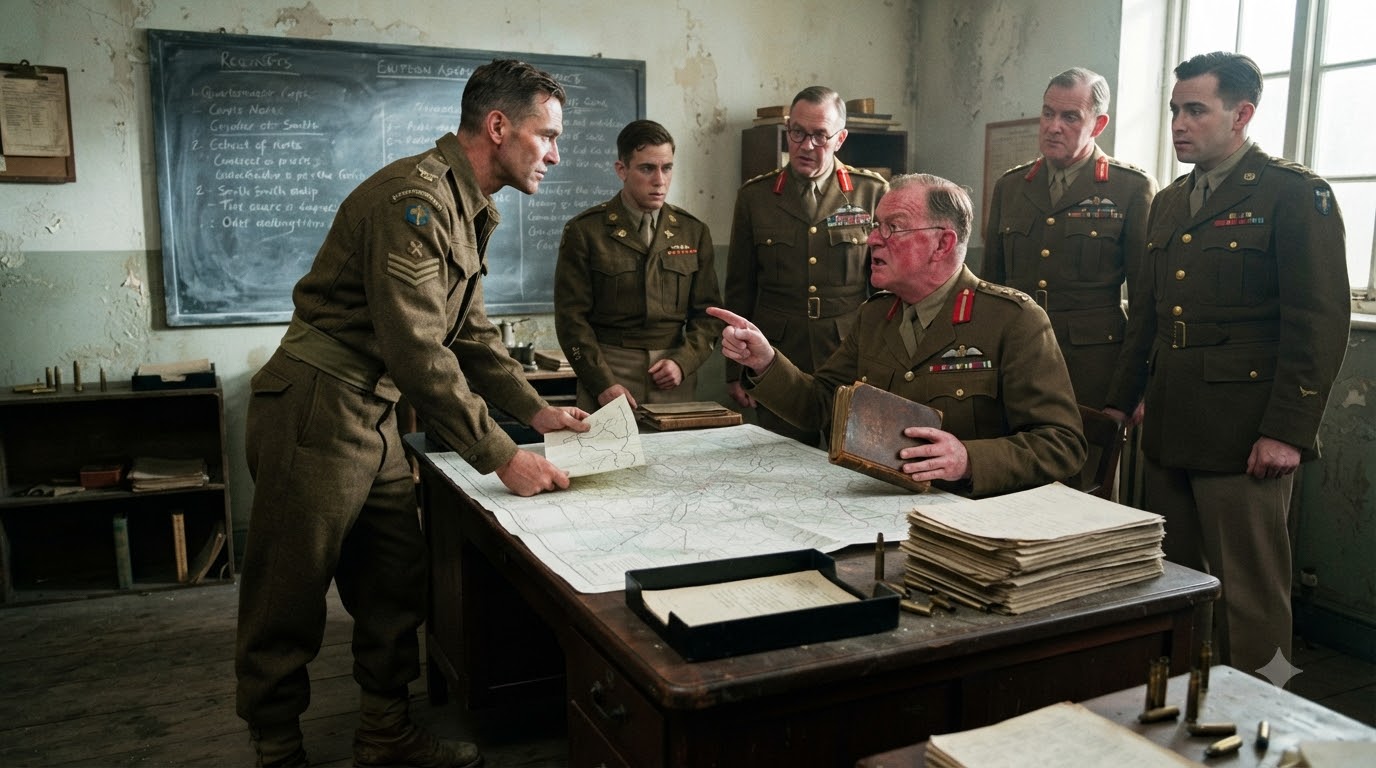
The schoolroom smelled of stale pipe tobacco and damp wool.
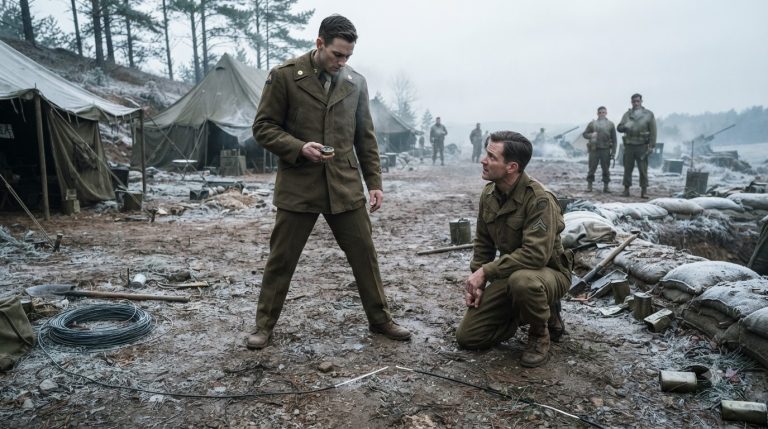
A large tactical map of Normandy was stretched across a mahogany desk at the front of the room, held down at the corners by empty brass shell casings.
Brigadier Smith adjusted his wire-rimmed glasses and looked down his nose at Bill Murphy.
“Convoy discipline has governed military transport since Caesar’s legions, Colonel,” the brigadier said, his voice dripping with the effortless condescension taught exclusively in expensive British finishing schools.
“We are not going to abandon two thousand years of proven doctrine for railway station thinking.”
Around the table, several British staff officers nodded in synchronized agreement.
A junior American liaison officer shifted uncomfortably in his chair, staring fixedly at the grain of the wooden floorboards.
Murphy did not blink.
He reached into his breast pocket, his fingers brushing against a cold steel pen, and laid a folded sheet of scrap paper directly over the brigadier’s pristine route lines.
“Your proven doctrine is currently backing up ten miles outside of Caen because one truck blew a tire,” Murphy said, his voice level and devoid of heat.
“A hundred vehicles parked bumper to bumper do not form a supply line, Brigadier. They form a stationary target.”
The brigadier’s face flushed a mottled shade of crimson.
“We operate on schedules written by men who understand the big picture, Murphy,” the brigadier snapped, tapping a leather-bound rulebook against the edge of the desk.
“You are welcome to return to your little corner of Manitoba when the war concludes, but here, we follow the book.”
Murphy looked past the brigadier toward the back corner of the room.
Sitting half-hidden in the shadows beneath a chalkboard was a tall stack of requisition forms, thick with dust and completely ignored.
He recognized the form numbers instantly; they were requests for basic spare parts that had been sitting unread for three weeks while transport battalions begged for rubber and fuel.
The system wasn’t just slow; it was intentionally blind to the reality outside the window.
Murphy closed his notebook with a soft thud.
“The book is missing pages,” Murphy said quietly, turning on his heel toward the door.
CHAPTER 3: THE UNAUTHORIZED WORKSHOP
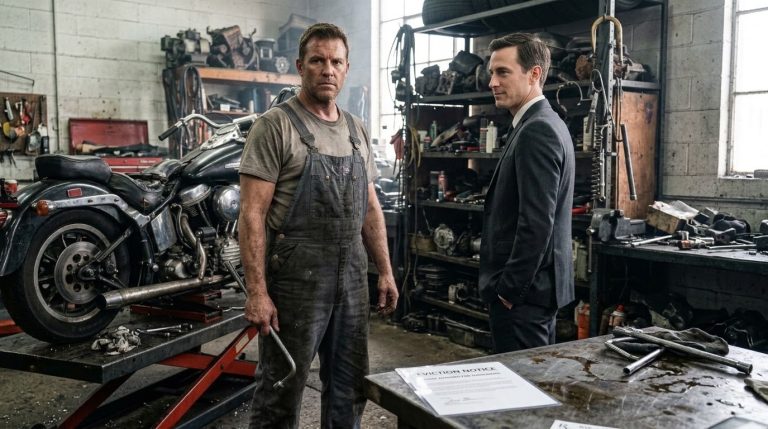
Rain slicked the grease-stained canvas of the tarp stretched over two wooden trestles.
Master Sergeant Dennis stood beside a pile of jagged metal wreckage, turning a bent German mounting bracket over in his thick, oil-stained hands.
“The brass won’t look twice at this scrap, Colonel,” Dennis said, wiping a streak of black soot across his jawline.
“Good thing we didn’t ask them to,” Murphy replied, dropping a heavy box of socket wrenches onto the planking with a dull clatter.
Behind them, three tired military trucks sat on blocks, their transmissions stripped down and waiting for parts that were currently sitting in a blocked warehouse twenty miles away.
There were no official requisition forms here, and no staff officers to tell them how long a repair was supposed to take.
Murphy picked up a heavy cutting torch, adjusting the acetylene valve until it hissed with a sharp, pale-blue flame.
“If we weld these brackets to the side rails,” Murphy said, pointing the blue tip toward the chassis of the lead truck, “we cut the loading time down by half.”
“And if the inspectors come by?” Dennis asked, not looking up from his wrench.
“They won’t,” Murphy said, firing the torch. “They’re too busy staring at maps in Caen.”
The bright flare illuminated the wet mud beneath the trucks as the work began in silence.
CHAPTER 4: THE FARM ROAD RUN
Three transport trucks rumbled out of the muddy depot lot, their modified side brackets rattling softly against the cold French air.
There were no massive convoys here, and no military police standing at every crossroads to wave them through a pre-planned route.
Murphy stood by his canvas tent, watching the taillights disappear down a winding farm lane that mapmakers in Caen hadn’t bothered to name.
Each vehicle carried a precise load of twenty-four tons, spaced two hundred yards apart so a single flat tire wouldn’t lock up the line.
Inside the command cab of the lead truck, a junior officer keyed his wireless handset every fifteen minutes, tapping out short status reports into the gray fog.
No requests for permission. No waiting for central clearance.
Just simple positioning data moving back through the static.
A missing ledger page fluttered on Murphy’s camp desk, blown open by the draft from the canvas flap—an old dispatch log listing standard routes that were currently jammed with dead iron.
The unauthorized packets were already five miles ahead of schedule, cutting through the mud while the official convoys sat frozen in the rain.
Murphy picked up his pocket watch, clicked it open, and listened to the steady, uninterrupted ticking.
CHAPTER 5: THE FRONT ARRIVAL
The first transport truck rolled past the barbed wire perimeter gate ahead of schedule, its tires crunching over loose gravel.
A Canadian quartermaster stepped out from the corrugated tin supply shed, staring at the side brackets with absolute bewilderment.
“You’re twelve hours early,” the quartermaster said, holding a clipboard against his chest like a shield.
“We didn’t take the main road,” the packet leader replied, shifting his truck into neutral with a sharp metallic clunk.
Behind them, the remaining two vehicles rolled into position precisely spaced, their cargo bays unsealed before the dust had even settled.
Word of the early delivery traveled fast down the trench line, reaching Brigadier James Listister inside his command dugout within minutes.
Listister strode out into the gray daylight, his heavy boots sinking into the wet mud as he looked over the neatly stacked crates of artillery shells.
“A British supply officer just called my tent to complain that your trucks bypassed his checkpoint without a signed routing slip,” Listister said, a slow, grim smile cutting across his weather-beaten face.
“Tell him the shells are where they need to be,” Murphy’s voice echoed from the staff car idling near the gate.
Listister tapped his riding crop against his thigh, his eyes fixed on the unauthorized vehicles.
“He threatened to file formal charges against your command for insubordination,” Listister said, leaning against the fender.
“Let him,” Murphy replied, closing his passenger door with a heavy thud.
CHAPTER 6: THE QUIET PROOF
A single porcelain mug of chicory coffee sat cooling on the wood-plank table.
Murphy turned a page of the transport ledger, his thumb running down a column of ink-stained numbers that proved what the staff officers still refused to say out loud.
The delivery success rate sat at ninety-four percent across two hundred independent trucks.
Fuel consumption had dropped by more than a third, and the breakdown rate had flatlined into near irrelevance thanks to roadside repairs.
Outside the canvas tent, Brigadier Smith stood by his staff car, holding an official memo from Allied headquarters that formally recommended the adoption of the Canadian packet system across all European sectors.
Smith’s jaw was locked tight, his gaze fixed on the ground as he crumpled the paper into a tight ball and tossed it into the mud.
“They’re calling it standard doctrine now,” Murphy’s driver said quietly, leaning against the tent post.
“They can call it whatever they like,” Murphy said, picking up his silver pocket watch and snapping it open. “The groceries are moving.”
He closed the watch with a clean, sharp metallic click that cut through the silence of the camp.
There were no ticker-tape parades waiting in Manitoba, and the military history books would eventually give the credit to maps and brass.
Murphy didn’t care about the headlines.
He set his empty coffee mug down on the wood, pulled his wool coat tighter against his shoulders, and reached for the next dispatch slip.