The Fork Tailed Phantom Over Schweinfurt That Shattered Every Rule of High Altitude Combat
CHAPTER 1: THE BROKEN ALTITUDE DOCTRINE
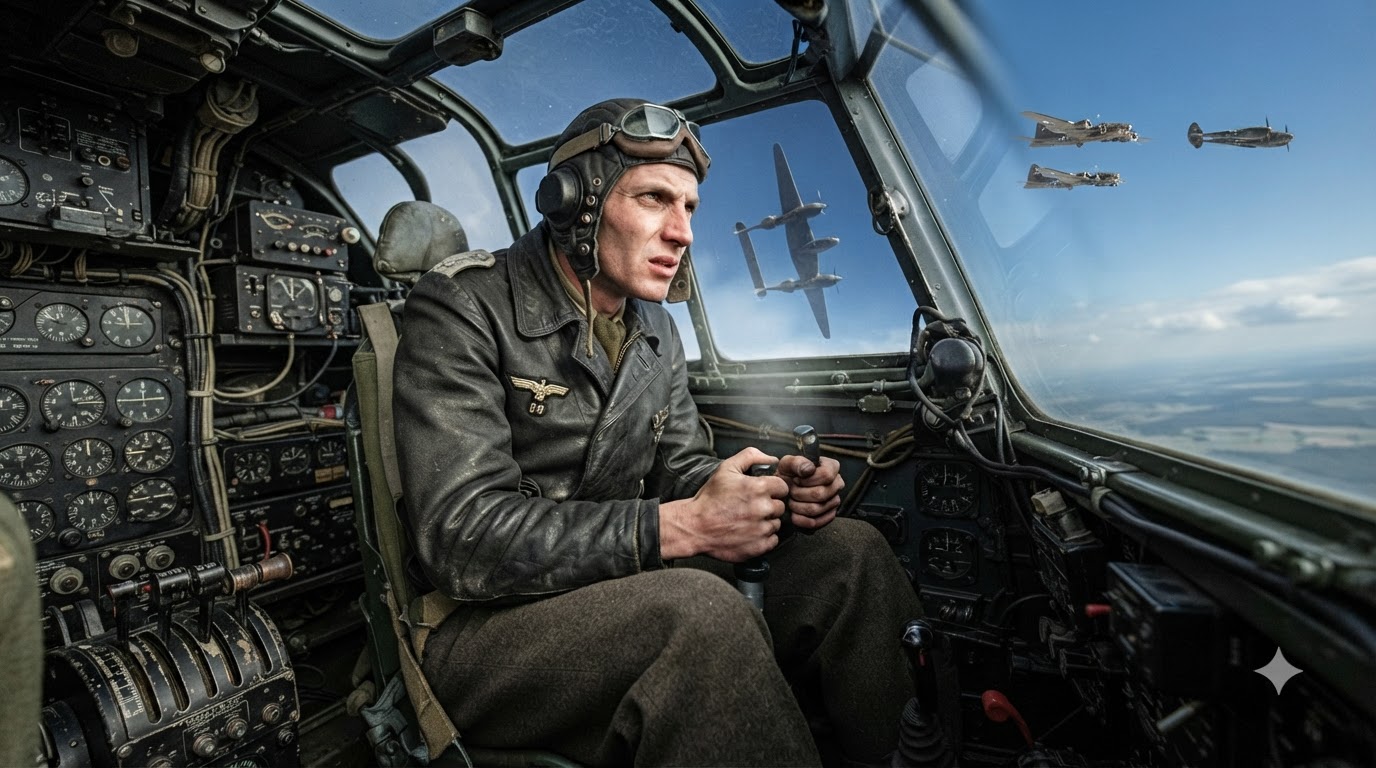
Oberleutnant Franz Stigler pulled back on the stick of his Messerschmitt Bf 109 and felt the airframe shudder. The thin air at this altitude made every control input sluggish, turning every maneuver into an exercise in anticipation rather than reaction. Below him, the formation of American B-17 Flying Fortresses droned eastward, their white contrails streaking against the dark earth. He knew the mathematics of air combat as intimately as a pianist knows scales. Altitude equaled energy, and energy equaled options.
Four silhouettes climbed toward his position from below, twin-boom shapes that intelligence briefings had dismissed as heavy, cumbersome reconnaissance platforms. Stigler checked his altitude advantage, three thousand feet of textbook positioning, and rolled into a shallow dive to build speed for a slashing attack. The lead Lockheed P-38 Lightning did not break formation or dive away. It simply pointed its nose upward and climbed at a near-vertical angle that defied every law of aerodynamics he had ever been taught.
The 3,300-foot-per-minute climb rate ate his altitude advantage in less than a minute. Stigler watched the fork-tailed machine roll inverted above him, converting its vertical momentum into a diving attack with terrifying ease. His hand tightened instinctively on the cold metal throttle, the heavy silence of the cockpit pressing against his ears as the foundational assumptions of his entire military career evaporated into the freezing wind.
CHAPTER 2: BRIEFING ROOM FRICTION
The oil lamp flickered against the damp walls of the operations hut as Franz Stigler dropped the ledger onto the wood. The cover cracked with a dry, protesting sound that cut through the low murmur of the briefing room. Around the table, veteran flight leads stared down at the chalk-marked tactical map without speaking.
—They are heavy machines, Stigler— Hauptmann Riedel muttered, leaning forward to tap a stubby finger against the markings for Schweinfurt. —Twin-engine platforms do not climb vertically. It violates the basic equations of wing-load and thrust.—
—Go down there and tell the altimeter it violates equations— Stigler snapped, his hand flat against the rough grain of the desk.
The silence in the room thickened, heavy with the stubborn pride of men who had ruled the skies of Europe for four years. Riedel looked up, his eyes narrowing as he weighed the tactical impossibility against the unanimous after-action reports piling up from every front sector. The institutional dogma of the Luftwaffe was beginning to fracture under the weight of undeniable physical contradiction.
—The intelligence summaries insist they are sluggish bombers— another pilot murmured from the corner, shifting uneasily in his seat.
—Intelligence hasn’t flown into a 3,300-foot vertical wall of iron at twenty-seven thousand feet— Stigler replied, his voice dropping to a harsh, gravelly whisper.
He reached out and slid the maintenance log across the scarred wood, pointing directly to the erratic fuel-mixture entries scribbled by the ground crews. The mechanical superchargers were screaming for air they could no longer compress, while somewhere in the western sky, an entirely new kind of adversary was rewriting the rules of altitude.
CHAPTER 3: THE COLD MAINTENANCE LEDGER
Franz Stigler stared down at the tool lying in the dirt, his breath pluming white in the unheated hangar. The ground crew chief, an old mechanic with ink-stained thumbs and sunken eyes, wiped his hands on a greasy rag without looking up from the cowling.
—The superchargers can’t handle the strain at twenty-eight thousand feet, Herr Oberleutnant— the mechanic rasped, his voice tight with fatigue. —We are pushing the manifolds past maximum tolerance just to stay in the air, and the metal is cracking under the frost.—
—Make it work— Stigler muttered, picking up the heavy wrench and feeling the bitter chill bite through his leather gloves.
—We can patch the gears, but we cannot invent air where there is none— the mechanic replied, gesturing sharply to a stack of failed gear housings lining the workbench.
The harsh reality of the front line had stripped away every illusion of technical supremacy. Every flight hour logged now demanded a heavier mechanical toll, while the engineering offices back home continued to insist that standard altitude doctrines remained absolute law. Stigler tossed the wrench back onto the bench, the metallic ring echoing off the corrugated iron walls like a warning bell.
CHAPTER 4: THE HIGH FRONTIER TRAP
Franz Stigler shoved the throttle forward, feeling the Daimler-Benz engine cough as the thin air starved the cylinders of power. Above him, the sky turned from bright blue to a bruised, violet-grey expanse where traditional physics ceased to cooperate.
—They are holding formation at thirty thousand— Riedel’s voice crackled brokenly through the radio headset, thin and strained over the static.
Stigler craned his neck, his muscles locking against the freezing g-force as four twin-boom silhouettes materialized out of the glare. Without warning, the lead American machine executed a sharp, vertical pivot, converting its forward speed into an effortless climb that left Stigler’s fighter wallowing in its exhaust wash.
The promised altitude advantage was gone, replaced by an agonizing realization that the upper boundary belonged entirely to the enemy. Stigler hauled the control stick back into a desperate climbing turn, his airframe shuddering violently as the stall warning shrieked through the cockpit.
CHAPTER 5: THE DESPERATE COUNTER MOVE
Franz Stigler slammed the mixture control forward, fighting the heavy airframe as the American twin-engine machine rolled directly into his firing arc. The engine coughed in protest, starved of pressure in the thin atmosphere, while the enemy fighter effortlessly maintained its energy state.
—Break away, Franz! Your oil pressure is dropping!— Riedel’s warning hissed through the headset, drowned out by the harsh mechanical whine of the supercharger failing under the strain.
Stigler refused to yield, kicking the rudder hard to force a deflection shot that missed by inches as the fork-tailed silhouette vanished upward into the blinding sun. There was no tactical cleverness left, no superior positioning to exploit, only the grinding mechanical desperation of a machine pushed past its absolute design limits.
The altimeter ticked downward as Stigler was forced to push the nose over, accepting the bitter defeat of his altitude advantage while the enemy circled above in unassailable mastery.
CHAPTER 6: THE DUSTY HORIZON COLLAPSE
Franz Stigler dropped his heavy leather gloves onto the scarred wood of the briefing table, the leather stiffened by sweat and high-altitude frost. Around him, the room remained dead silent, stripped of the arrogant certainty that had carried their tactical doctrine into the war four years ago.
—They are not flying a heavier fighter— Stigler muttered, his voice flat against the bare walls as he stared down at the chalk lines tracing the Schweinfurt sector. —They solved a different problem entirely.—
Hauptmann Riedel leaned against the closed door, rubbing a hand across his tired eyes without offering a word of bureaucratic defense. The institutional dogma was gone, buried under the raw physical reality of turbochargers that breathed easily where German engines choked and died.
There were no grand speeches left to give, no tactical revisions that could rewrite the math of vertical energy at thirty thousand feet. Stigler picked up a stub of chalk, stared at it for a long, heavy beat, and then laid it down beside the helmet for good.