A Debt of Honor: The Quiet Transformation of a Broken Man and the Legacy of a Master Sergeant
CHAPTER 1: THE THIRD STANZA
The Pinewood Diner smelled of scorched coffee, bacon fat, and the damp, earthy chill of a North Carolina autumn. Brent felt the warmth of the booth seat radiating through his jeans, but it was the coldness in the center of his chest that commanded his attention. He held the sugar dispenser like a talisman, his knuckles white against the chrome.
Forty minutes ago, he had walked in here with a swagger he had perfected in front of motel vanity mirrors. Now, the air in the diner felt thin.
“Excuse me, son.”
The voice had traveled across the linoleum floor with the clarity of a bell struck in a canyon. Brent felt the gaze of the old man in the back booth—Henry, the regulars called him—hitting the back of his neck. It wasn’t the gaze of a customer or a peer. It was the clinical, unhurried observation of a man watching a structure begin to lean.
Brent turned on his stool. He gave the old man his most practiced, friendly smile—the one that usually dissolved skepticism. “Sir? I appreciate the interest, really. The third stanza? You know, it’s been a few years. My memory isn’t what it used to be since the deployment.”
He waited for the polite dismissal. Instead, the old man remained motionless. His face was a map of deep, dignified creases, his eyes the color of a winter sky—pale, clear, and terrifyingly steady. He didn’t blink. He simply looked at Brent with a patience that felt like a physical weight.
“Take your time, son,” Henry said. The cadence was soft, yet it seemed to absorb all the ambient noise of the diner. The trucker at booth four stopped his fork mid-air. The clatter of dishes from the kitchen ceased. “I am not in a hurry.”
Brent felt the sweat prickling at his hairline, cool against his skin. He looked at the waitress, Denise. She was standing frozen with her towel, her eyes wide, moving between the old man and the counter. He looked at the register, where the owner, Pearl, had gone unnaturally still.
“The third stanza begins with one word,” the old man continued, his hands folded neatly over the edge of the table. The wooden cane leaning against the booth caught the morning light, its brass tip a dull, grounding glint. “Give me that one word, and I will help you with the rest.”
Brent’s throat felt as though it had been lined with wool. The lie, usually as easy as breathing, was stuck behind his teeth. He realized, with a sudden, sickening jolt, that the embroidered Ranger tab on his chest—the one he had bought online for nineteen dollars—felt like an insult in the silence of this room.
He didn’t know the word. He didn’t know the stanza. He didn’t know anything but the suffocating need to be somewhere else.
“Sir, with all due respect,” Brent started, his laugh sounding brittle and jagged in the quiet space, “I’m not going to sit in a diner and start reciting—”
“Son.”
The single word wasn’t a shout. It was an anchor. It dropped into the diner and held everything in place. Brent’s sentence shattered. He felt a phantom hand wrap around his throat, cutting off the next defense, the next fabrication, the next layer of the mask.
“I am not your enemy,” Henry said, leaning just an inch forward. The pale gray eyes didn’t waver. “I am a man who is asking you, for your own sake, to stop digging the hole you are standing in. Are you willing to do that?”
Brent looked at the door. He looked at the floor. Then, he looked at the old man, and for the first time in fifteen years, he saw the truth of his own reflection.
CHAPTER 2: THE ANATOMY OF A LIE
The silence in the booth stretched, thick and textured like heavy wool. Brent’s hands, still resting on the laminated table, felt unnaturally heavy. He wanted to look away, to find a distraction in the fading photographs of football teams on the far wall, but the old man’s eyes held him fast. They were a pale, translucent gray, and they seemed to see straight through the black T-shirt, through the fabricated stories of the Second Battalion, and into the marrow of the shame he had cultivated for a decade and a half.
A sudden, jarring memory surfaced—not of a battlefield, for he had never been to one, but of a barracks floor at a local community college during a botched attempt to impress a girl who had once dated a Marine. He remembered the feeling of being cold, a deep, bone-weary cold that had nothing to do with the temperature of the room. It was the cold of being found out, even when no one was looking. That same phantom shiver traced his spine now, sharp and undeniable.
Brent swallowed, the sound loud in the quiet diner. “I don’t know what you want from me,” he whispered. His voice was a thin, ragged thing.
Henry didn’t blink. He reached out with a hand that was spotted with age and mapped with prominent, blue veins. He moved his coffee cup just a fraction of an inch to the left, a deliberate, slow movement that drew Brent’s eyes to the ceramic. It was chipped at the rim, a worn, familiar object.
“I don’t want anything from you, son,” Henry said, his voice as steady as the ticking of a clock. “I’m not asking for your history. I’m asking for the truth. You’ve been wearing that tab for a long time. You’ve been telling people about Iraq, about Mogadishu, about things you couldn’t talk about. You’ve been living in a house made of glass, and you’re surprised that someone finally threw a stone.”
Brent felt his face heat up, a burning sensation that started at his neck and surged toward his ears. “It wasn’t… it wasn’t meant to hurt anyone,” he insisted, though the words sounded hollow even to him. “I just wanted—I just wanted people to look at me the way they look at… at you.”
“People look at me because I’m old, and because I’m quiet,” Henry said gently. “They don’t look at me because of what’s on my chest. They look at me because of what’s in my eyes. You’ve been trying to buy respect with a uniform you didn’t earn, and all you’ve done is ensured that if anyone ever truly looked at you, they’d see right through the embroidery.”
Denise, the waitress, moved past them, her steps muffled by the rubber soles of her shoes. She didn’t look at them, but she slowed, her hand brushing the back of the booth as if to offer a wordless, desperate support to both men. The air in the diner felt pressurized, a storm brewing in a tea kettle.
“What happens now?” Brent asked, his breath hitching. The fear he had been suppressing for years was finally surfacing, unmediated and raw. He thought of his store, the extended warranties, the life he had built on a foundation of carefully curated half-truths. “Are you going to call someone? The police? The VA?”
Henry’s expression softened, the hard lines of his jaw relaxing just a fraction. He shifted, his wooden cane clicking softly against the floor as he adjusted his legs. “The law has its place, Brent. There’s a Stolen Valor Act. It’s a real thing, and it has real consequences. But I’m not interested in the law today. I’m interested in the man sitting across from me.”
He leaned closer, the scent of black coffee and old, pressed khaki surrounding him. “I told you, I’m not your enemy. But I am the man who is going to force you to look at the mess you’ve made. Because if you don’t look at it, you’ll never be able to clear it away. And until you clear it away, you’re just a ghost haunting your own life.”
Brent looked down at the table. He could see his own distorted reflection in the dark, swirling surface of the coffee in his cup. For the first time, he didn’t look like the soldier in the stories. He looked tired. He looked small. He looked exactly like a thirty-eight-year-old salesman who had forgotten how to be anything else.
“I don’t know how to stop,” Brent confessed, his voice barely audible. “It’s been so long. It’s like… it’s like a second skin now. I don’t even know who I am without the stories.”
“That,” Henry said, his voice dropping to a near-whisper that carried the weight of a decree, “is exactly what we are going to find out. But you have to be willing to tear the skin off, Brent. And that is going to hurt more than anything you’ve ever felt in that life of yours.”
Outside, a car roared past on Route 19, the sound rising to a crescendo and then fading into the distance, leaving the diner in a silence so deep it felt holy. Brent looked at the old man, his chest heaving, his spirit breaking. He saw the path before him—not the one he had bragged about in bars, but a much narrower, much steeper, and much more honest road.
He realized then that he couldn’t leave this booth the same man who had walked in. He had to be torn down before he could be rebuilt.
CHAPTER 3: THE TRASH BAG CONFESSIONAL
The drive home was a blur of gray asphalt and the rhythmic, hypnotic flicker of telephone poles passing by. Brent’s hands gripped the steering wheel so tightly his fingers ached, but for the first time in fifteen years, his focus wasn’t on the story he would tell at his next sales conference. It was on the silence inside his own car. He didn’t turn on the radio. The silence was a mirror, and he was finally looking into it without trying to shatter the reflection.
He pulled into his apartment complex as the sun began to dip, casting long, bruised-purple shadows across the parking lot. He walked up the two flights of stairs to his door, his breath hitching as he inserted the key. He had spent years treating this place like a stage set for a character he didn’t actually inhabit. Now, standing in the entryway, the apartment felt like a tomb.
He didn’t go to the kitchen for a drink. He went to the closet.
He opened the door and stared at the collection he had meticulously built. There was the black T-shirt with the gold-embroidered Ranger tab hanging on a dedicated hanger. On the shelf above it sat a wooden challenge coin case he’d bought from a hobbyist site. There were printouts of unit histories, maps he’d found online, and a pair of worn-in boots he’d bought at an army surplus store, distressed to look like they’d seen combat.
It was all so pathetic. The realization hit him with the physical force of a blow to the gut. He reached out and touched the fabric of the shirt, the material rough against his fingertips. He had loved this costume. He had clung to it during every bout of loneliness, every failure, every moment where he felt his life was slipping away into irrelevance.
He pulled a heavy-duty trash bag from under the sink and began the work. He didn’t rush. He didn’t want to miss a single piece of the performance. He pulled the shirt from the hanger and let it drop into the plastic abyss. He swept the challenge coins into the bag, the metal clinking with a sound that seemed to mock his ambition. He tore down the prints and the maps, crumpling them into tight, dense balls.
With every item he discarded, he felt a strange, terrifying lightness. It was the feeling of a scaffold being removed from a building that had never been finished. He was terrified that if he threw it all away, there would be nothing left of Brent Holloway.
He stopped, his hand hovering over the shelf. He found a small, framed photo he’d doctored—a blurry image of a group of soldiers where he had managed to superimpose his own face. It was the centerpiece of his deception. He stared at it for a long, agonizing minute. His heart hammered against his ribs, a frantic, trapped bird.
This was the core of it—the lie that had started as a small, insignificant ripple and grown into a flood. He remembered the recruiter’s office in 2003, the way the air had smelled of antiseptic and disappointment, and the shame that had followed him out that door. He had been trying to fix that shame for fifteen years by layering lies on top of it, but all he’d done was bury the man who had walked out of that office.
He dropped the frame into the bag. It made a dull, final thud.
He tied the bag shut with a sharp, aggressive tug, the plastic straining against the weight of his past. He didn’t keep it in his own dumpster. He remembered Henry’s specific, calm instructions. He walked the bag out to his car, feeling like he was dragging a corpse. He drove eleven miles to a 24-hour gas station on the edge of the next county, a place where he was a ghost, a man with no history and no name.
He heaved the bag into the industrial bin. The sound of the plastic hitting the contents inside was swallowed by the darkness. He stood there for a long time, the cold wind whipping his jacket against his frame, the smell of gasoline and damp asphalt filling his lungs.
He had done it. He had purged the costume. But as he turned back to his car, he felt a hollow, aching void in his center. He was nobody now. The salesman who sold warranties? That was a job. But the man behind the desk, the man who went home to a quiet apartment, the man who was terrified of his own shadow—who was he?
He started the engine, the hum of the machine a solitary note in the night. He had a promise to keep. He had to call his mother. He had to call Mike. The thought of those conversations made his stomach churn, but he didn’t turn back. He drove toward the truth, a man walking a narrow bridge in the dark, with only the memory of a pair of clear, gray eyes to guide him.
He arrived back at his apartment just past midnight. He didn’t turn on the lights. He sat on the edge of his bed, the room bathed in the soft, sickly yellow glow of the streetlamp outside. He took his phone out, looked at the napkin with Henry’s number written in blocky, careful letters, and laid it on the nightstand.
He was scared. He was utterly, completely terrified. But for the first time in his life, he was breathing clean air. The performative ache in his chest had finally, mercifully, begun to subside. He closed his eyes, the memory of the diner—the smell of the coffee, the weight of the booth, the steady, patient voice of the old man—anchoring him to the earth. He would start the calls tomorrow. Tomorrow, he would begin to be the man he had been pretending to be.
CHAPTER 4: THE SUNDAY CALL PROTOCOL
The week that followed the purge of his closet was a slow, agonizing crawl through the wreckage of his own habits. Brent went to work at the chain store as he had for years, but the veneer of his life had become brittle. When a customer asked him about the “military discounts” or made a passing comment about his “service,” the words felt like needles under his skin. He didn’t lie. He didn’t boast. He simply offered a quiet, “I haven’t served, but I appreciate your business,” and watched the confusion flicker across their faces.
It was a small, stinging victory. But it was a victory nonetheless.
He spent the evenings in his apartment, the space feeling larger and emptier without the clutter of his stolen valor. He read. He memorized. He paced. He had three stanzas of the Ranger Creed printed on a piece of paper, propped up against a glass of water on his nightstand. He repeated them until the words lost their external sheen and settled into his blood, becoming a rhythm he could anchor his thoughts to when the old anxiety—the fear of being found out—threatened to claw its way back.
Sunday arrived with a sky the color of slate. Brent didn’t leave his apartment. He cleaned. He reorganized. He made coffee that he didn’t drink, just to have the routine of it. At 6:55 PM, he sat on the edge of his bed, the phone resting on the mattress beside him. His pulse was a frantic bird in his throat, a dull throb in his temple.
This was the bridge. This was the moment the old man, Henry Dawson, had demanded as the price of his silence and his mercy.
At 7:00 PM on the dot, Brent picked up the receiver. His hands were shaking, not with the performative bravado of a liar, but with the genuine, naked terror of a man holding his own future in his grasp. He dialed the number—the one he had transcribed on the napkin from the Pinewood Diner.
The line rang. Once. Twice. Three times.
Each ring felt like a heavy stone dropping into a deep well. Was he going to answer? What if he wasn’t there? What if the old man had forgotten, or worse, what if he had realized that Brent wasn’t worth the trouble?
“Dawson residence.”
The voice on the other end was a woman’s—soft, steady, and warm. Eleanor. Brent’s throat tightened, the words he had rehearsed a hundred times in the last hour nearly deserting him.
“Ma’am,” he started, his voice cracking. He cleared his throat and tried again, forcing the tremor out. “This is Brent Holloway. Mr. Dawson… he is expecting my call.”
There was a brief silence on the other end, but it wasn’t the silence of suspicion. It was a pause of recognition. “Brent,” she said, and there was a flicker of genuine kindness in her tone, a maternal warmth that caught him completely off guard. “Henry told me about you. I’m glad you called. He’s right here. Hold on a moment.”
Brent heard the muffled sound of the phone being moved, the soft scrape of a chair against a linoleum floor, and then the line went quiet again. The anticipation was physical, a tightening in his core that left him breathless. He looked at the Creed on his nightstand, the words Never shall I fail my comrades staring back at him in the dim light.
“Brent?”
The voice was older, thinner, yet carried that same unmistakable, iron-clad steadiness he had encountered in the booth at the Pinewood.
“Yes, sir,” Brent whispered. “I’m here.”
“Are you on the path?”
The question wasn’t a demand for proof of his military service. It was a question about his soul. Brent looked at the empty space in his closet where his costume had hung for so many years. He looked at the clean room, the lack of lies, the absolute, terrifying simplicity of his new existence.
“Yes, sir,” Brent said, his voice finding a resonance he had never known before. “I am on the path. I threw away the T-shirt that day. I threw away everything else by midnight. I called my mother on Friday, and I told her the truth.”
He paused, the memory of his mother’s voice—shattered, then mending—washing over him. “She cried, sir. She said she had always sort of suspected. But she said she loved me anyway.”
He shifted the phone to his other ear, his knuckles white. “I called Mike, too. He was angry. He has a right to be. But he said… he said he’d still be my friend if I really meant it. I’m going to the recruiter’s office tomorrow. I know what they’ll probably say, but I have to ask.”
The line was quiet, a companionable silence that suggested the old man was listening, not just to the words, but to the weight behind them.
“I’m proud of you, Brent,” Henry said. His voice was tired, a man’s voice at the end of a long, long day, but there was a flicker of something triumphant in the inflection. “I know that probably doesn’t mean much coming from a stranger you met in a diner, but for what it’s worth, I am proud of you.”
Brent sat there for a long time after the call ended, the dial tone buzzing softly in his ear before the line went dead. He stayed on the bed, the phone resting in his lap, the room suddenly feeling not like a tomb, but like a place where something new had finally, painstakingly, begun to grow. He had made the call. He had spoken the truth. He was still on the path, and for the first time in his life, he knew exactly who was walking it with him.
CHAPTER 5: THE KITCHEN AT FORT BRAGG
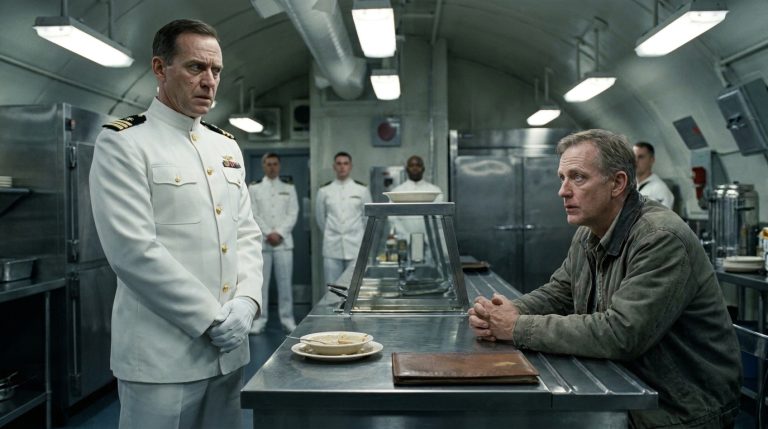
The industrial kitchen at the base was a theater of controlled chaos. Stainless steel prep tables gleamed under the harsh, fluorescent lights, and the air was thick with the scent of boiling potatoes, heavy grease, and the sharp, antiseptic tang of industrial cleaner. Brent moved through the space with the methodical efficiency of a man who had finally found a rhythm that didn’t require a mask. He didn’t tell stories. He didn’t weave tall tales for the regulars. He chopped, he stirred, he served, and he listened.
For three months, this had been enough. The exhaustion of his Saturday mornings was a clean, physical sensation—the kind that allowed him to sleep without the phantom tremors of his old life. But lately, a new tension had begun to knot itself at the base of his skull.
He was serving a group of younger active-duty soldiers, their faces still carrying the smoothness of basic training, their uniforms stiff and smelling of starch. As he ladled eggs onto a tray, one of them looked up, eyes lingering on Brent’s face for a second too long.
“You look familiar, sir,” the soldier said, his brow furrowing slightly. “Did you ever do a tour at Leavenworth? Or maybe training cycles at Benning?”
Brent felt his heart skip a beat, a cold pulse of adrenaline flooding his veins. He kept his hand steady, the ladle not shaking, though his stomach churned with the old, familiar bile of being caught. “No,” Brent said, his voice flat and perfectly controlled. “I’ve never served. I’m with the benefits coordination office.”
The soldier shrugged, seemingly satisfied, and moved on, but the moment left a residue. It was a phantom scratch on his psyche. It didn’t matter that he had discarded the uniform and the lies; the suspicion—the absolute certainty that he was a fraud—had become a permanent shadow. He felt as though he were walking through the base wearing an invisible sign that only the real soldiers could see.
He stepped into the walk-in cooler, ostensibly to check the inventory, but really to steal a moment of solitude. The air was frigid, biting through his thin apron. He leaned against the metal shelving, closing his eyes, and thought of the Sunday call. He had been on the path for months, but the bridge he was walking on felt increasingly fragile. Every time he successfully navigated a social interaction without falling back into the old rhythm of boasting, he felt a strange, sickening thrill of danger, as if he were walking a tightrope without a net.
Was the man he was becoming truly distinct from the man he had been? Or was this just another layer of the performance?
He heard the heavy door swing open, and a middle-aged NCO stepped in, his face etched with the weary lines of a decade of deployments. “Holloway,” the man said, nodding at him. “The kitchen’s running behind. We’ve got an extra platoon coming through for the morning chow.”
Brent nodded, pushing the doubt deep down, beneath the layer of skin he had so painfully earned. “Copy that. I’m on it.”
He returned to the kitchen line, but his perception felt altered. He watched the soldiers moving around him—the way they carried their weight, the way they held their utensils, the subtle, ingrained behaviors that spoke of a shared, brutal reality he would never possess. He wasn’t one of them, and he never would be. The realization, once a source of deep shame, now felt like a cold, hard fact he had to live with.
He worked through the surge, his movements efficient, his focus absolute. He was a utility man, a civilian in the machinery of a war machine, and that was enough. Or, it had to be.
But then, as he was cleaning up the last of the breakfast rush, he saw him—a man sitting at a table near the exit, a man with the same pale, gray eyes and the same unhurried, terrifying steadiness he had seen in the back booth of the Pinewood Diner.
Brent froze, the towel in his hand dropping onto the wet floor. It wasn’t Henry. It couldn’t be. But the way the stranger held his coffee cup—close to his chest, his other hand free, eyes scanning the exits—it was as if he were seeing a ghost of the man who had saved him.
His pulse hammered, a frantic rhythm against the quiet order of the room. He felt a sudden, irrational spike of paranoia, the suspicion that he was being watched, that the “Sunday call” was just the beginning, that the debt he owed wasn’t just to Henry, but to the entire world of men who had actually seen the things he had only pretended to know.
He turned away, busying himself with the dishes, his hands scrubbing at a spot on the metal until his knuckles were raw. He had to get through the day. He had to keep the path, no matter how much the ground underneath him began to tremble. He had to reach the next Sunday, the next phone call, the next confirmation that he was, indeed, still on the path. He had built a life on a foundation of honesty, but today, for the first time, he realized that the foundation might be shifting.
He finished his shift and walked out to his car, the sunlight blinding him after the fluorescent sterility of the kitchen. As he started the engine, he looked back at the base gate, the guards standing at attention, their postures rigid and purposeful. He pulled onto the road, the distance between him and the base growing, but the feeling of being watched, of being held to a standard he had only barely begun to meet, didn’t leave him.
He had done the work. He had thrown away the costume. But the shadows of his lies were long, and they were still trying to catch up to him.
CHAPTER 6: THE WEDDING
The suit was navy, simple, and tailored. For the first time in his life, Brent stood before a mirror and didn’t see a performer preparing for a role. He saw a man, plain and unadorned, standing on the threshold of something permanent.
It was a week before the wedding, and the air in his small apartment felt charged with a different kind of electricity. It wasn’t the manic, desperate energy of his old life—the kind that fueled a fabricated story at a bar—but a quiet, demanding gravity. Catherine was coming over in an hour to finalize the guest list. He had already told her the truth, the raw, ugly, unvarnished history of his fifteen-year charade, and yet, she was still coming.
He moved through his apartment, adjusting a frame, straightening a rug. Every action felt heavy with the stakes of his new reality. He thought of Henry Dawson. The Sunday calls had become his North Star, the rhythmic, weekly anchor that kept him from drifting back into the dark. But with the wedding approaching, the old fear—the one that had whispered to him in the walk-in cooler at Fort Bragg—had begun to roar.
What if someone stood up? What if a real soldier, someone who knew the truth of what a Ranger was, walked into the church and saw him for what he was? A pretender. A costume-wearer. A man who had built a life on a foundation of sand.
A sudden, sharp memory cut through the room: 2003. The recruiter’s office. The harsh, fluorescent glare on the man’s desk. The way the recruiter had looked at his knee, then at his face, and said, “You aren’t what we’re looking for, son.”
He sat down on the edge of his bed, his breath hitching. The phantom itch of a Ranger tab, long since thrown into a gas station dumpster, burned against his chest. He looked at his hands, steady and clean, and felt an overwhelming wave of vertigo.
He picked up the phone. It wasn’t Sunday, and he knew he shouldn’t break the protocol, but the internal pressure was fracturing his resolve. He dialed the number.
“Dawson residence.”
Eleanor’s voice was the only thing that could have pulled him back from the edge. “Eleanor… it’s Brent.”
There was a moment of silence. He heard her exhale, a soft, weary sound. “Brent. It’s not Sunday.”
“I know,” he whispered. He stood up, pacing the length of his bedroom. “I’m getting married next week. And I’m terrified. I feel like… I feel like at any moment, the roof is going to cave in. I feel like everyone at the church is going to see the ‘Before’ version of me. I don’t know if I can do this.”
“Henry is in the garden,” she said, her voice dropping, taking on a conspiratorial softness. “He’s pruning the hydrangeas. He’s tired, Brent. He’s very tired, and he doesn’t talk much anymore. But you come here. You drive over here, right now.”
The hour-long drive was a fever dream of jagged memories and the cold, hard reality of the man he was today. When he pulled into the gravel driveway of the small, unassuming house, he saw Henry. The old man was slumped in a lawn chair, his wooden cane resting against his knees, his pale gray eyes fixed on the horizon. He looked smaller than Brent remembered, his frame weathered by the slow, relentless erosion of time.
Brent walked across the grass, his footsteps crunching in the silence. He didn’t say a word. He just stood there until Henry turned his head.
“The wedding,” Henry said, his voice a gravelly, resonant rasp.
“I’m scared, sir,” Brent said, his voice breaking. “I’m scared that I’m still the liar. I’m scared that this life—this marriage, this job, this self-respect—is just another elaborate setup. That I’m still performing.”
Henry looked at him, and for a moment, the old, terrifying clarity was back in his eyes. He lifted a hand, gesturing for Brent to sit in the chair beside him.
“You know what the difference is, Brent?” Henry asked, his gaze shifting back to the garden. “The difference is that you are suffering for the truth now, instead of enjoying the lie. The lie felt good. The lie was medicine. The truth? The truth is hard work. It’s heavy. It’s uncomfortable.”
Henry leaned forward, his knuckles white against the handle of his cane. “You think a Ranger doesn’t feel fear? You think we didn’t wake up every day wondering if we were good enough for the men standing to our left and right? You’re acting like being a man is some static thing you achieve once and then you’re done. It’s not. It’s a constant, hourly, daily practice of choosing the harder thing. You’re scared because you’re finally awake. That’s the most honest feeling you’ve ever had.”
Brent sat there as the sun began to sink, the garden bathed in a soft, golden light that made the world seem momentarily still. He looked at the old man, the hero he had pretended to be, and realized for the first time that Henry’s strength wasn’t in his lack of fear, but in the crushing, daily weight of his integrity.
“Go back to your girl,” Henry said, his voice drifting toward the shadows. “And when you stand at that altar, you look her in the eye, and you remember that you are a man who has paid his own way. You don’t owe the world a performance. You owe it your presence.”
Brent drove home in the dark, the fear still there, but muted. It was no longer a storm; it was just the weather. He arrived at his apartment just as Catherine was pulling into the parking lot. He got out of the car, straightened his jacket, and walked toward her. He was still Brent Holloway, civilian, age 38, a man who had lied for half a life and was spending the rest of it making amends.
As he reached her, he took her hand. It was warm, real, and steady. He didn’t look back at the parking lot, and he didn’t look at the shadows. He looked at her.
CHAPTER 7: THE FINAL PHONE CALL
Brent stood in the quiet of his kitchen, the Sunday evening light angling through the blinds to paint stripes of gold and dust across the linoleum. It was nearly 7:00 PM. The ritual of the phone call had become the heartbeat of his year—fifty-one Sundays of checking in, fifty-one Sundays of confirming his presence on the path. He felt a profound, heavy stillness in the room. His life, once a sprawling, frantic mess of half-remembered lies and improvised excuses, had been pared down to this singular, essential connection.
He picked up the receiver, his movements deliberate. The phone felt like an extension of his own resolve. He dialed, the clicks of the old rotary-style pulse-dialing on the digital screen bringing him back to that first night in the diner.
The line rang. Once. Twice.
“Dawson residence.”
It was Eleanor, but her voice was thinner than usual, fraying at the edges like old silk. The warmth was there, but it was distant, shadowed by an exhaustion that Brent recognized instantly.
“Eleanor,” Brent said, his throat constricting. “It’s Brent. I… I’m calling for the Master Sergeant.”
There was a long silence on the other end, punctuated only by the faint, rhythmic ticking of a clock in the background of their home. “Brent,” she said, and her voice wavered. “Henry isn’t at the phone today. He’s… he’s in the bedroom. He’s been very weak, dear. He’s been waiting for your call, though. He’s been asking about the time for the last hour.”
Brent felt his heart stop. The fear he had been managing for months, the dread of a future without his anchor, surged up to meet him. “Is he okay? Do I need to—”
“You stay where you are,” Eleanor interrupted, her voice gaining a sudden, surprising strength. “He wants to speak to you. Just a moment. Hold on.”
The phone was set down, the sound of movement echoing through the speaker—soft footsteps, the rustle of bedding, a laboured, whistling breath. Then, the sound of the receiver being picked up again.
“Brent?”
The voice was barely a whisper, a ghost of the resonance that had filled the Pinewood Diner. It was the sound of a man who had walked a very long road and was finally seeing the horizon.
“I’m here, sir,” Brent said, gripping the counter so hard his knuckles burned. “I’m here.”
“Are you… still on the path?”
The words were labored, separated by a heavy, rattling intake of breath. Brent closed his eyes, the memory of his daughter—Eleanor—sleeping in the other room, the smell of his kitchen, the reality of the life he had built, flooding his mind. He wasn’t a Ranger. He would never be a Ranger. But he was a man who had earned his own existence.
“Yes, sir,” Brent said, his voice thick with tears he didn’t try to hide. “I am on the path. I’ve walked it every day. I’m doing the work. I’m taking care of my family. I’m living the truth.”
There was a long, shuddering pause. Then, a slow, rattling exhale that sounded like a weight being lifted from a set of shoulders that had carried it for over sixty years. “Good,” Henry whispered. “Good… boy. The debt… the debt is paid.”
“Sir, please—”
“Brent,” Henry said, his voice sharpening for one final, singular moment, regaining its ancient, commanding weight. “Don’t you ever… ever forget. The Creed. Never fail your comrades. Never fail the truth. You don’t need me anymore. You have the backbone now. You built it yourself.”
“I don’t know how to do this without you,” Brent pleaded, the tears finally spilling over, hot and fast.
“You don’t have to,” Henry murmured, the sound fading into a soft, melodic hum. “You just have to walk.”
The line went silent. The dial tone began to hum—a low, flat, mechanical sound that filled the empty kitchen. Brent stood there for an eternity, the receiver pressed against his ear, waiting for a voice that would not come back. He heard the distant, muffled sound of Eleanor’s soft weeping, then the click of the phone being placed back on the cradle.
He slowly lowered his own hand, the plastic device slipping from his fingers to dangle by its cord. He walked to the window and looked out at the street. The world was still turning. The sun was still setting. People were still driving home, still eating dinner, still living their lives. But the axis upon which his own world turned had shifted.
He reached into his pocket and pulled out the crumpled, soft piece of paper he had kept there for five years. He didn’t need to read it. He knew every word by heart.
Never shall I fail my comrades. I will always keep myself mentally alert, physically strong, and morally straight…
He folded the paper and placed it on the counter, the small, stained square looking like a relic. He had reached the end of the calls. He had reached the end of the borrowed time. Now, he had to see what the man he had become would do when the guidance was gone. He walked into his daughter’s room, the floorboards creaking under his weight, and stood by her crib, listening to the soft, steady rhythm of her breath. He was the guardian now. He was the one who had to carry the lesson.
CHAPTER 8: THE LEGACY FULFILLED
The church was an cavern of polished wood and muted light, packed to the rafters with the ghosts of Henry Dawson’s past. There were the retired generals, their postures still rigid despite the decades, and the younger Rangers, men whose faces were etched with the same steady, unhurried calm Henry had possessed. Brent walked down the center aisle, the heels of his shoes clicking rhythmically against the stone floor. He felt the weight of every gaze—not a judgmental weight, but an expectant one. He had told them who he was. He had told them the truth about the lie. And as he reached the front pew where Eleanor sat, he saw that the silence wasn’t one of condemnation; it was a profound, collective recognition of a burden finally laid down.
Eleanor reached up, her hand thin and trembling, and took hold of his. She looked up at him, her eyes red-rimmed but clear, and squeezed his fingers with a surprising, lingering strength. “He loved you, Brent,” she whispered, her voice barely audible over the collective breathing of the congregation. “You should know that. In the last year, when he was getting weaker, you were one of the things he talked about most. He said you were the proof that he had finally paid his debt.”
Brent felt the wall of his composure threaten to crack, but he held firm. He sat beside her, the wooden pew hard against his back, and let the reality of the moment settle over him like a cloak. This was the final step of the path. The debt Sergeant Walter Brennan had placed on Henry in 1962, the one Henry had carried through the jungles of Vietnam and the corridors of power, had been passed to him. It wasn’t a burden of guilt; it was a legacy of mercy.
As the service continued, the world outside—the diner on Route 19, the gas station dumpster where he had discarded his past, the long, lonely roads he had driven—seemed to coalesce into a single, cohesive narrative. He realized that the decoy secret he had spent fifteen years building—that he was a soldier, that he was a Ranger—had been a desperate, misguided attempt to find the very thing he had now earned through the hard, slow work of being honest. The core truth, the one Layer 2 had kept veiled, was that the Ranger Creed wasn’t about the title. It was about the man who lived it when no one was watching.
He looked at his hands, resting on his knees. They were not the hands of a warrior. They were the hands of a man who cooked meals for the homeless, a man who showed up for his daughter, a man who told the truth even when it cost him everything he thought he wanted.
After the service, the crowd spilled out into the afternoon sun, a blur of uniforms and civilian suits gathered in the churchyard. Brent stood apart for a moment, letting the cool breeze touch his face. He saw Pearl and Denise from the Pinewood Diner talking to a group of veterans, and he felt a surge of quiet, profound gratitude. They had been the silent witnesses to his unmaking and his reconstruction.
He walked over to them, and when they saw him, the conversation ceased. Denise, the woman who had watched him cry over cold eggs, stepped forward and simply pulled him into a hug. There was no need for words. They understood the architecture of the silence.
“He’s proud of you,” Pearl said, her voice firm and final. “You did what you said you would. You kept the promise.”
Brent nodded, a small, genuine smile touching his lips. He walked back to his wife, Catherine, who stood near their car, their daughter Eleanor sleeping in her arms. She looked at him, and he saw the entirety of his life reflected in her eyes—not the hero he had pretended to be, but the husband and father he was. He took her hand, the weight of the day and the journey finally grounding him.
He looked back at the church one last time, toward the place where Henry’s service was officially concluding. The Master Sergeant had been a man of iron and shadow, a man who had seen the worst of humanity and had chosen, in the face of it, to be the person who offered a path to those who had lost their way. Brent knew, with an absolute, piercing clarity, that he was the living record of that choice.
He reached into his pocket, his fingers brushing the small brass key to his home—the home he had built on the truth. The journey hadn’t been a straight line, but it had been a real one. He turned away from the church, away from the phantom life he had once inhabited, and toward the future.
He was not a Ranger. He would never be a Ranger. But as he climbed into his car and buckled his seatbelt, feeling the weight of the life he had built and the promises he had kept, he knew that he was, at last, a man. He started the engine, the sound steady and sure, and pulled out onto the road, the path ahead of him clear, honest, and entirely his own. The debt was settled, the legacy was sealed, and the man he had become was finally, for the first time in his life, at peace.