The Weight of Silence: A Veteran’s Journey to Reconcile the Memory of War with Modern Peace
CHAPTER 1: The Weight of Paper
The amber light of the Korean War wing felt heavier today. It wasn’t the heat of the bulbs; it was the way the light pooled over the display cases, casting long, bruised shadows that seemed to reach for Walter’s ankles. He sat in his usual folding chair, his oak cane resting across his knees like a tether keeping him from drifting too far into the past.
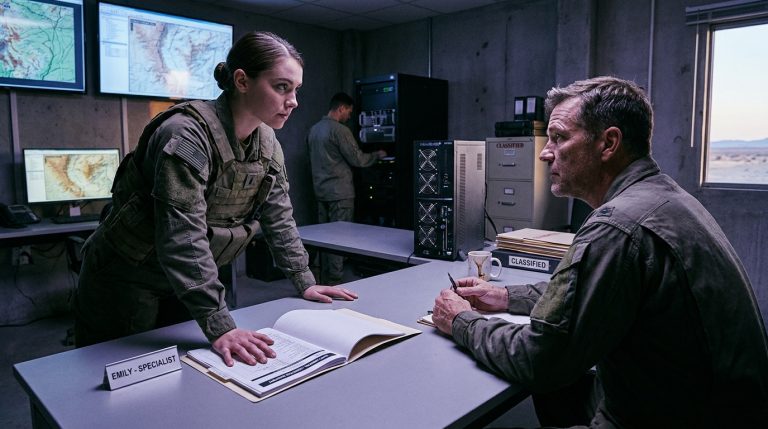
Colonel Fisk stood by the desk, his movements clipped and efficient, a stark contrast to the slow, measured way Walter inhabited his own skin. Fisk had invited him back to the office, a space behind the public exhibits that smelled of dust, old coffee, and the metallic tang of deep history.
“You’ve been a presence here, Walter,” Fisk said, his voice dropping an octave as he closed a thick, tan file folder. He didn’t look at Walter immediately, opting instead to arrange a series of black-and-white photographs on the desk. “The students… they listen. They don’t just hear the words; they feel the intent.”
Walter watched the Colonel’s hands. They were steady, but there was a flicker of something—a hesitation in the way he smoothed the edge of a photograph—that signaled a shift in their dynamic. The professional distance was eroding.
“I tell them about the weight,” Walter said, his voice like dry leaves skittering over pavement. “They seem to think it’s a story. They don’t understand that the weight is the only part that’s real.”
“And the rest?” Fisk turned, his eyes searching Walter’s face, tracing the deep, walnut-creased lines that held a geography of survival. “The parts that don’t make it into the lesson? The parts that stay in the silence?”
Walter felt his fingers curl—that phantom reflex, pulling at an invisible pistol grip. He tapped the brass ferrule of his cane against the concrete floor. Clack. The sound was sharp, lonely, and final.
“The silence isn’t an absence, Colonel,” Walter replied, his gaze shifting to the window, where the autumn leaves were falling in the parking lot. “It’s a container. You pull at the lid, and everything inside spills out. Some things are meant to stay contained.”
Fisk nodded, but his hand hovered over the folder he had just closed. He seemed to be weighing the folder in his mind, the same way Walter had weighed the Browning automatic rifle. The air in the room thickened, charged with a sudden, localized pressure that made Walter’s hip ache in sympathy with the sudden tension.
“I found something,” Fisk said softly, his eyes locking onto Walter’s. He slid the folder across the desk. It wasn’t just records; it was an artifact. “A report from the 31st. Dated March 1951. It mentions a corporal who wasn’t supposed to be where he was.”
Walter didn’t look at the paper. He didn’t need to. He knew the specific smell of a military report—the sharp, acidic bite of ink and aging carbon. His heart didn’t race, but it slowed, thickening in his chest until every beat felt like a heavy, deliberate thud.
“I was where I was told to be,” Walter said, his voice flat.
“Was you?” Fisk asked, his tone devoid of accusation, but heavy with the weight of someone who knew that ‘orders’ and ‘reality’ rarely occupied the same trench. “Because the records from Task Force Faith are incomplete. There are ghosts in those archives, Walter. And some of them are starting to look familiar.”
Walter looked at the folder, then back at the Colonel. The room seemed to contract, the warm amber light turning cold and white, like the glare of a winter morning on a frozen reservoir. He had come here to teach children about geometry and the strength of a tripod, but the ground beneath him felt anything but stable.
CHAPTER 2: The Archives Silence
Walter stood frozen, his hand still resting on the brass ferrule of his cane. The office air felt stagnant, caught in the stale, slow-moving cycle of a room that held more paper than life. The tan file folder sat on the desk, an object of immense, terrifying weight. It wasn’t the weight of a rifle—it didn’t have the balance point he knew by heart—but it felt heavier than any weapon he had ever shouldered.
“I didn’t come here to talk about archives, Colonel,” Walter said, his voice coming out lower than he intended. He could feel the familiar tension blooming in his left hip, a dull, throbbing reminder of terrain he had walked seven decades ago.
“I know,” Fisk replied, his tone remaining carefully neutral. The Colonel leaned back, his chair creaking with a thin, metallic whine. “But you didn’t come here just because the museum needed a speaker, either. You came because you’ve been carrying something, and you’re tired of the lean.”
Walter looked at the photographs on the desk. They were grainy, black-and-white, showing men in heavy, frozen parkas standing against a backdrop of bleak, desolate ridgelines. He didn’t look at the faces. He couldn’t. He knew what kind of eyes those men had; he had looked into them every morning for eighteen months. The smell of the room—dust, old coffee, and the sweet, decaying scent of disintegrating wood pulp—suddenly shifted. For a split second, it wasn’t a Providence office. It was a bunker. It was the smell of damp wool and kerosene, the freezing, biting cold that lived in the lungs, the way the air tasted when it was full of snow and soot.
A sharp, intrusive memory of a single, cold night at the reservoir flickered across his mind like a dying match. He saw the firelight reflecting off the black ice, and he felt the absolute, bone-deep exhaustion that had defined his youth. He blinked, the vision shattering. The office materialized again, but the tremor in his jaw remained. He pressed his teeth together until his molars ached, a practiced, iron-willed blockade.
“Whatever is in that folder,” Walter said, his voice regaining its steel-edged composure, “it belongs to a man who died at Chosin. It doesn’t belong to me.”
“The report says otherwise,” Fisk said, though he didn’t open the folder. He didn’t need to. He knew exactly what the pages contained. “It mentions a corporal from Baker Company who held a position for four hours longer than the orders dictated. It mentions ammunition that was never reported and a missing magazine count that doesn’t align with the official logistics.”
Walter moved to the chair in front of the desk. He didn’t walk; he navigated. His left hip betrayed him for a moment, a sharp, white-hot spike of nerve pain, and he had to lean hard on the oak cane. He sat down slowly, the leather of the chair groaning in protest. He felt old, brittle, and incredibly exposed.
“You’re a historian, Colonel,” Walter said, staring at the Colonel’s hands. “You know that the truth of a war isn’t in the reports. The reports are what people write when they want to justify the cost. The truth is what you remember when you wake up in the dark and can’t find your way back.”
“Then tell me,” Fisk urged, his voice dropping into a register that wasn’t a command, but a plea. “Why did you wait seventy years to show someone what that weight feels like? Why this museum? Why now?”
Walter looked around the office. He saw the boxes of documents, the shelves filled with medals and ribbons, the careful, sterilized way the institution tried to pin the past to the wall like a dead butterfly. He felt a sudden, profound resentment—not for the Colonel, but for the fragility of the peace he had built. He had spent his life in the quiet, in the consistency of eggs over medium and a perfectly washed Toyota Camry, all to keep the silence intact.
“I didn’t come here to be a subject for your research, Raymond,” Walter said, using the man’s first name for the first time. The formality of the ‘sir’ felt like a garment he had finally shed. “I came here because I’m the last one. If I don’t hold the weight, who will? The books? The plaques?”
He reached out and tapped the top of the folder with his knobby, arthritic index finger. The paper underneath felt cold. He was terrified of what would happen if the Colonel opened it. He knew the story inside—the logistical impossibilities, the tactical decisions made in the shadow of total annihilation, the moments where he had been more than human, and less than a soldier.
“If you open that,” Walter whispered, the sound barely audible over the hum of the ventilation system, “there’s no going back. You’ll have your answer, but you’ll lose the man you thought I was.”
Fisk looked at him, his face a mask of conflict. The retired Colonel was searching for the historical thread that connected to his own family, his own history, but he was also seeing, for the first time, the raw, bleeding human cost of his curiosity. He slowly pushed the folder away, just an inch, toward the center of the desk.
“I’m not looking for a hero, Walter,” Fisk said. “I’m looking for the truth. But if you’re not ready to hold it, I can wait.”
Walter stood up, the movement laborious, his body protesting the shift. He grabbed his cane, his knuckles white against the dark oak. He didn’t answer. He turned and walked toward the office door, the rhythm of his cane on the floorboards marking the beat of a heart that had been beating too fast for too long. He left the folder on the desk. He left the Colonel in the amber light. He walked into the hallway, his mind racing with the realization that the silence he had built around his life was no longer a container—it was a cage, and the door was finally, inevitably, starting to swing open.
CHAPTER 3: The Geometry of Routine
The hallway of the New England Military Heritage Center felt longer on the way out than it had on the way in. Each step was a measured calculation, a precise interaction between the rubber tip of his oak cane and the polished concrete floor. Tap. Slide. Step. The rhythm was the only thing holding the world in place. Inside his windbreaker pocket, his fingers brushed against the business card Fisk had given him—the heavy, textured cardstock felt like a foreign object, a sharp reminder of the breach in his carefully guarded reality.
Walter did not stop in the lobby. He did not linger to acknowledge Adrienne or the school group that was now huddled near the gift shop. He navigated the space with the same intense, narrow focus he used to approach a display case, his shoulders set, his chin tucked. The outside air hit him as he pushed through the heavy glass doors, a sharp, October breeze that smelled of damp asphalt and dying leaves. It was cold, but it was honest. It didn’t hold secrets or archival files.
He made it to the 2009 Camry without a tremor. The ritual of the car was a sanctuary: unlock, sit, adjust, buckle. He started the engine, the familiar vibration of the steering wheel buzzing through his palms, a tactile reality he could trust. He drove out of the parking lot, taking the right turn toward Brockton with a deliberate, slow-speed caution. He stayed in the right lane. He kept his eyes on the road. But for the first time in nearly seven decades, the road didn’t look the same. Every passing vehicle, every blurred tree line, seemed to carry the ghost of that folder left behind on the Colonel’s desk.
He arrived at the diner twenty minutes later than his usual time. The waitress, a woman named Sarah who had been pouring his black coffee for six years, didn’t mention the delay. She simply set the mug down in front of him, the steam rising in thin, translucent ribbons.
“The usual, Walter?” she asked, her voice bright and unburdened.
“Yes, Sarah,” he said. The words felt heavy, dragging against his throat.
He watched her walk away, his eyes lingering on the fraying edge of her apron. The world was so fragile, so thin. A few pieces of paper in a file folder, a few questions from a man who shared his rank and his history, and the entire structure of his life was threatening to buckle. He looked down at his hands. They were resting on the laminate tabletop, the knuckles knobby and immobile. He began the small, habitual movement he used to ground himself: rubbing the thumb of his right hand against the forefinger of his left. It was a friction he knew, a sensation of skin on skin that served as an anchor.
He found himself thinking about the balance point of the BAR again—twenty-two inches from the butt plate. He hadn’t thought about the specific measurement in years, but now, sitting in the diner, the number felt branded into his mind. He visualized the weapon, not as the deactivated steel in the museum, but as it had been—oily, freezing to the touch, alive with the potential for violence. He had built his life on the geometry of that weight, on the idea that if you were structural enough, if you didn’t try to fight the physics of the world, you could survive anything.
But what happened when the structure was built on a lie? Or, more accurately, on a piece of truth that was too heavy to ever admit to?
He ate his toast slowly, focusing on the texture of the crust, the faint saltiness of the butter. He drank the orange juice last, just as he always did, the acidic sweetness cutting through the dull ache in his jaw. Every action was a performance of the man he had been for the last seventy years. But under the table, his left leg was stiff, the hip joint protesting the day’s events with a dull, persistent throbbing. He wanted to get up and go home, to lock the front door and turn on the television, to let the familiar, mindless cycle of the news drown out the voice of Colonel Fisk.
He paid the bill, left a tip that was precisely fifteen percent, and stepped back out into the cool, gray afternoon. He stood by his car for a moment, the cane in his hand, looking at the reflection of his own face in the Camry’s window. The man staring back was thin, his skin the color of a walnut shell, his eyes clouded by years of quiet. He looked like an 81-year-old retired corporal. He looked like a man who had never done anything more dangerous than walk through a park.
He climbed into the car and drove home. He didn’t turn on the radio. He let the silence of the cabin fill up with the weight of the questions he hadn’t answered. When he got to his small, neat house, he bypassed the living room and went straight to the kitchen. He took the Colonel’s card from his pocket and laid it next to the salt shaker. He stood there for a long time, his hand hovering over the card. The temptation to throw it away was immense. It would be so easy to snap the link, to walk away and let the archive stay buried. But he knew, with the cold, absolute certainty of a soldier who has survived a withdrawal, that the past wasn’t buried. It was just waiting for the temperature to drop.
He turned off the kitchen light, the house falling into the familiar, quiet dusk, and he sat in the dark, his hands curled inward, waiting for the night to tell him what he had to do next.
CHAPTER 4: The Archivists Invitation
The morning did not offer relief. It offered only the same gray light and the same persistent, dull ache in Walter’s left hip. He had spent the night in his armchair, the television static muttering in the background, his hands folded in his lap as if he were holding a heavy, invisible weight. When the sun finally bled over the horizon, painting the kitchen in pale, washed-out hues, he stood up. The movement was stiff, every joint in his body seemingly aligned against the prospect of another day.
He walked to the counter. The business card, white and stark against the dark laminate, seemed to have gained gravity overnight. He picked it up, the cardstock crisp and unyielding.
He didn’t make breakfast. He didn’t wash the Camry. He drove to Providence in a state of suspended animation, his hands light on the wheel, his eyes fixed on the ribbon of road ahead. He didn’t want to be a speaker. He didn’t want to explain the geometry of a tripod to a group of twelve-year-olds. But the silence had become porous, and he knew that if he didn’t return, the vacuum would be filled by someone else—someone who wouldn’t understand that the weight wasn’t a story to be told, but a life to be endured.
The museum was quiet when he arrived. The lobby was empty, the air smelling of floor wax and silence. He didn’t wait for Adrienne. He took the elevator to the second floor, his cane marking a steady, rhythmic protest against the floor.
He didn’t go to the Korean War wing. He went to the office behind the exhibits.
Colonel Fisk was sitting at his desk, his back to the door, surrounded by stacks of paper that looked like miniature fortifications. He turned when Walter entered, his expression shifting from focused intensity to a slow, measured curiosity. He didn’t look surprised.
“You didn’t throw it away,” Fisk said, gesturing to the card Walter held.
“I don’t throw things away,” Walter replied, his voice raspy. He walked to the desk and laid the card down on the corner, next to the file folder from the day before. “I just put them where they belong.”
Fisk looked at the card, then at Walter. He stood up, his movements fluid, the bearing of a man who had spent his life in the rhythm of command. “I did some looking, Walter. After you left yesterday. I went into the deep archives, the boxes that haven’t been opened since the fifties.”
He reached into one of the stacks and pulled out a small, blue-lined notebook. It was battered, the spine held together with yellowed tape. He opened it to a marked page and turned it toward Walter.
Walter felt his breath hitch—a small, sharp sound in the quiet office. The page was covered in cramped, hurried handwriting. It was a list of names, but it wasn’t a roster. It was a tally of equipment and, beneath it, a series of brief, agonizing notes about the state of the company. It was the handwriting of a man who was writing while the world was ending around him.
“This was recovered from a field bag found near the gauntlet,” Fisk said, his voice lowering. “It belonged to the man who held your position before you arrived at Baker Company. His name was Corporal Silas Thorne.”
Walter didn’t reach for the notebook. He kept his hands behind his back, his fingers curled into fists. He knew the name. Everyone in Baker Company knew the name. Thorne had been the one who had made the initial stand, the one who had figured out the geometry of the hold before he had been cut down by a mortar round. He had been the one who had left the weapon for Walter to pick up.
“Why are you showing me this?” Walter asked, though he already knew.
“Because the notes,” Fisk said, tapping the page, “mention a decision. A tactical decision to abandon a supply cache to save the wounded. But the coordinates in this book… they don’t match the official after-action reports.”
Fisk looked at him, his gaze piercing. “The report says the cache was destroyed to prevent it from falling into enemy hands. But this notebook says it was hidden. And the person who signed off on the diversionary tactic… it wasn’t the captain, Walter.”
Walter felt the room spin. The amber light, the stacked papers, the smell of dust—it all rushed toward him, suffocating and sharp. He had buried that moment. He had buried the memory of the cache, the sound of the metal crates being dragged through the snow, the feeling of his own hands freezing to the iron locks. He had convinced himself that it was a myth, a piece of folklore that he had invented to explain the impossible weight he carried.
“It wasn’t a diversion,” Walter said, the truth finally cutting through the silence. His voice wasn’t raspy anymore; it was cold, precise. “It was a mistake. A desperate, human mistake made by a boy who was too young to be in charge of anything, let alone the lives of his men.”
Fisk was silent. He stood there, the notebook open between them, the weight of the past filling the room. He didn’t press for more. He didn’t ask for the details of the cache or the identity of the boy who had made the mistake. He simply waited, giving Walter the space to exist in the sudden, shattering light of his own confession.
Walter looked at the notebook, then at his own hands, his knobby, arthritic fingers. He had carried the secret of that cache for sixty-eight years. He had carried the weight of the error, the knowledge that he had been the one to hide the truth, to bury it under the snow of the gauntlet so that the company wouldn’t be destroyed by the shame of it.
“I’m not here to talk about the notebook, Colonel,” Walter said, his voice steadying. “I’m here to finish the session with the school group. I told you I would do it, and I’m a man who keeps his word.”
He picked up his cane, the brass ferrule tapping once against the floorboards. He turned and walked out of the office, his back straight, his shoulders square. He didn’t look back at the notebook. He didn’t look back at the folder. He left the truth on the desk, a small, fragile thing, and he walked into the hallway, his body vibrating with the terrifying, beautiful realization that for the first time in his life, he wasn’t carrying the weight alone.
CHAPTER 5: The Fraying Edge
Walter walked into the Korean War wing with his cane tapping a cadence that felt uneven, almost erratic. The school group was already assembled, a cluster of twelve and thirteen-year-olds whose noise level was a thin, high-pitched hum against the amber-lit backdrop of the exhibit. As he approached, the teacher—a man with a frantic, distracted energy—beckoned him over with a nervous smile.
“Mr. Kazlauskas! We were just going over the timeline of the Chosin Reservoir,” the teacher said, his voice straining to be heard over the shuffling of backpacks. “We were hoping you could provide some… personal context.”
Walter didn’t answer immediately. He set his cane against the wall, the wood clattering softly against the metal trim. His heart was drumming a frantic, irregular rhythm against his ribs. Every time he looked at the children, he saw not the present, but the past: the faces of boys in his company who had never grown old, who had remained frozen in the wind-swept desolation of the reservoir.
“I don’t do timelines,” Walter said, his voice flat, cutting through the hum of the room. He felt the gaze of the students—curious, expectant, and entirely unaware of the abyss they were peering into.
He walked to the BAR display. The deactivated weapon sat in its cradle, a cold, inert piece of iron and walnut. He reached out to lift it, but his right hand hesitated. For the first time in all these months, the motion wasn’t fluid. He felt a tremor in his fingers—a betrayal of muscle memory that he hadn’t known was possible. He gripped the pistol grip, and instead of the familiar, balanced weight he expected, he felt only the overwhelming coldness of the steel.
“Sir?” a boy in the front row asked. “My grandpa said the BAR was the most important thing they had. Was it?”
Walter looked at the boy. The question was simple, innocent, but it hit him with the force of a physical blow. He thought of Silas Thorne’s notebook, the pages filled with the grim, hurried tally of a man who knew he was running out of time. He thought of the supply cache buried beneath the snow, the weight of the error he had spent a lifetime trying to hide.
“It was just a tool,” Walter said, his voice sounding hollow. “The importance wasn’t in the metal. It was in the hands of the man who chose to hold it.”
He lifted the BAR. He brought it to his shoulder, but he was clumsy. The stock caught on the collar of his windbreaker, and for a terrifying second, he stumbled. His left hip gave out, a sharp, searing flash of pain that forced him to drop his shoulder. He staggered backward, his heels catching on the concrete, and he had to drop the rifle to catch himself against the display stand.
The room went completely silent. The students stared, their mouths slightly agape. The teacher rushed forward, his hands outstretched in a futile gesture of concern. “Mr. Kazlauskas! Are you alright? Should we sit down?”
Walter felt a wave of dizziness, a nauseating tilt of the world that made the ceiling lights swirl into blinding, amber discs. He was not in the museum. He was back on the gauntlet, the smell of cordite and frozen iron filling his nostrils, the biting, lethal cold of the reservoir seeping into his marrow. He saw the crate—the one he had hidden—rising up through the snow, the lock broken, the truth spilling out into the open air.
“I’m fine,” he snapped, his voice sharp and brittle. He shoved the teacher’s hand away, his own hands shaking uncontrollably now. “I just… I lost my balance.”
He picked up his cane, his fingers fumbling with the handle. He couldn’t look at the students. He couldn’t look at the BAR. He turned and walked away from the exhibit, his stride uneven, his posture broken. He felt the eyes of the students tracking him, their confusion and pity a physical weight that pressed against his spine.
He navigated the hallway, not towards the exit, but toward the restrooms, a sanctuary of cold tiles and locked doors. He needed to be alone. He needed to reassemble the fragments of the man he had been for seventy years, but the fragments were jagged, and they refused to fit.
He reached the restroom, locked the door, and leaned against the cool, white tile of the wall. He was breathing hard, the sound ragged in the confined space. He looked at his hands. They were still shaking. He pressed them against his thighs, trying to force them into stillness, but the tremors were deep, tectonic.
He had shattered the illusion. He had walked into that wing as the stoic, capable veteran, and he had walked out as a broken old man who couldn’t even hold a piece of history steady. He felt a sudden, sharp, and terrifying realization: the archive wasn’t just a place he was visiting; it was a mirror. And he didn’t like what he saw staring back. He was losing his grip on the silence, and once the silence was gone, there was nothing left to stand on. He was standing in the middle of a war that hadn’t ended, and he was realizing, with a sense of dread that defied all reason, that he was the only one left to fight the battle he had been running from since 1951.
CHAPTER 6: The Decoy of Memory
Walter pressed his cheek against the cool, unforgiving ceramic of the wall. The bathroom was a sterile, white-tiled box, a place of forced neutrality that offered no comfort against the spiraling panic in his chest. His breath hitched, shallow and frantic, rattling in his throat like loose gravel. He kept his eyes squeezed shut, but the darkness behind his eyelids was crowded with the gray, featureless expanse of the reservoir.
The tremor in his hands was worse now, a rhythmic, violent agitation. He gripped the edge of the sink, his knuckles white, the porcelain biting into his skin. He needed to be steady. He needed to be the corporal. He needed the geometry. But the tripod he had spent a lifetime building—the shoulder, the spine, the hip—felt like it had been kicked out from under him.
A knock at the door, soft and hesitant, made him jump.
“Mr. Kazlauskas? Walter?” Adrienne’s voice drifted through the wood, thin and guarded. “The Colonel… he’s waiting in the office. He told me to check on you, just to make sure you were okay.”
Walter didn’t answer. He couldn’t. His voice was a locked door, and the key was lost somewhere in the snow. He stared at his reflection in the mirror above the sink. The man looking back was an old, gaunt specter. The walnut-shell texture of his skin seemed to have deepened into trenches, and his eyes, usually so composed, were wide and darting, filled with a frantic, animal energy.
He didn’t recognize the expression. It wasn’t the look of a man at peace; it was the look of a man who had finally realized he was being hunted—not by a foreign army, not by an enemy with a rifle, but by the relentless, encroaching truth of his own history.
He forced himself to push away from the sink. The movement was a struggle, his left hip locking in a stiff, agonizing arc. He reached for his cane, the brass ferrule clicking sharply against the floor—a sound that, only an hour ago, had been a symbol of his control. Now, it just sounded like an alarm.
He unlocked the door and stepped out into the hallway. The museum had changed. The amber lights seemed to have deepened into a bruised, menacing orange, and the silence was heavy, pressurized. Adrienne stood a few feet away, her brow furrowed with concern. She started to reach out, her hand hovering in the air between them, but stopped when she caught the look in his eyes.
“I’m done,” Walter said, his voice a low, gravelly rasp that startled even him. “Tell the Colonel I’m done.”
“Walter, wait,” Adrienne said, her voice rising in urgency. “He just wanted to—he found something else. Another file. It’s not about the cache. It’s about the withdrawal orders.”
Walter froze. The gauntlet. The road they had walked in the dark, the snow clogging their boots, the roar of mortar fire muffled by the sheer, crushing cold. He didn’t turn around. He kept his gaze fixed on the floor, on the concrete that looked, for a fleeting second, like the frozen, blood-stained earth of Quang Tri.
“I don’t care what he found,” Walter said, stepping forward. Tap. Slide. Step. He forced the rhythm, the old, ingrained discipline of the march. Tap. Slide. Step.
He had to get to the Camry. He had to get back to Brockton. He had to go to the diner, order the two eggs over medium, drink the orange juice last, and pretend that the world hadn’t just torn open. But he knew, with a sinking sense of despair, that the routine wouldn’t hold. The file on the Colonel’s desk—the one about the cache, the one about the cache he had hidden—was a physical fact. It was a weight he could no longer calculate.
As he reached the elevator, he glanced back at the Korean War wing. The BAR was sitting there, unattended, its walnut stock gleaming under the spotlight. It looked smaller than he remembered, less like a weapon and more like a prop. The realization hit him with a cold, hollow thud: he had been trying to live in a museum, surrounded by the artifacts of a man who was already dead.
He pushed the elevator button. The doors slid open with a smooth, mechanical efficiency. He stepped inside, the cramped, stainless-steel box feeling like a tomb. As the doors began to close, cutting off the view of the hallway, he saw Colonel Fisk walking toward him, his expression grim and purposeful, holding a folder that caught the light like a sharp blade.
Walter stared at the doors until they sealed him into the darkness of the elevator, but the image remained. He knew what the folder contained. It wasn’t just a report on the cache. It was the proof of everything he had been running from. The truth wasn’t coming for him; it had been waiting for him all along, buried under the snow of seventy years, and now, it was finally time to dig it out.
CHAPTER 7: The Confrontation of Truth
The elevator doors hissed open, and the lobby’s expansive, hollow silence rushed in. Colonel Fisk was standing there, his posture rigid, his eyes focused on the elevator with an intensity that made the air in the small metal car feel brittle. The folder was in his left hand, the edges slightly curled. He didn’t look like a curator. He looked like an infantryman preparing to clear a room.
Walter stepped out. His left hip gave a sharp, agonizing protest, a reminder of the physical cost of his retreat, but he forced himself to stand straight. He gripped his cane, his knuckles aching, and looked Fisk in the eye.
“You didn’t have to follow me,” Walter said, his voice low and steady.
“The archives aren’t a private preserve, Walter,” Fisk replied, his tone stripped of all professional courtesy. “And neither is the 31st Infantry Regiment. I’ve been digging. Not just for history. For something else.”
Fisk motioned toward the office, but Walter didn’t move. He stood in the center of the lobby, the school group’s laughter echoing faintly from the gift shop—a sound that felt like it belonged to a different, kinder reality.
“Let’s get it over with,” Walter said, moving toward the office. His gait was slower now, the rhythm of his cane echoing against the floor. Tap. Slide. Step.
They went into the office and closed the door. The amber light of the Korean War wing didn’t reach this far; here, the lighting was sterile and clinical. Fisk laid the folder on the desk and opened it. He didn’t offer a chair this time.
“The cache wasn’t just supplies,” Fisk said, his voice blunt. “I found the after-action supplement. It was a secondary communication relay. It was essential for the withdrawal coordinates. If you hadn’t hidden it, the relief force would have known exactly where to strike. You didn’t just hide a few crates of ammunition, Walter. You hid the path to the reservoir.”
The world seemed to tilt. The walls of the office—the stacks of paper, the shelves, the framed medals—began to vibrate. Walter felt a cold, biting wind on his neck, a phantom chill that ignored the climate control of the room. He saw the crate again, the one with the broken lock, the one he had shoved into the hollow of a frozen ravine. He had done it because he was terrified. He had done it because, in the moment, he believed that if they had to carry the extra weight of that relay, the wounded men he was carrying would die.
“We couldn’t have carried it,” Walter whispered, his voice trembling for the first time. “The men were dying. It was forty below. We were leaving the dead on the road. If we had taken the relay, we would have been moving even slower. We would have all died.”
“But the relief force,” Fisk said, his eyes hard. “They were waiting for a signal that never came. A whole company was lost because you made the decision to sacrifice the hardware for the sake of the men.”
“It wasn’t a sacrifice!” Walter roared, the sound tearing through the sterile silence of the office. He leaned over the desk, his cane clattering to the floor. His hands were shaking violently, but for the first time in his life, he didn’t try to stop them. “It was survival! It was the only way to get a single soul out of that frozen hell!”
He stood there, gasping for air, the weight of seventy years of silence collapsing under the pressure of the moment. He looked at Fisk, seeing not a Colonel, but a man who had never walked the gauntlet, who had never felt the ice-cold grip of death on his own skin.
“You call it a failure of command,” Walter said, his voice turning icy. “I call it the cost of living. You want the truth of the 31st? You want the history? The truth is that there were no heroes, Raymond. Just men who made impossible choices in the dark, and men like you, who have the luxury of judging them in the light.”
Fisk stared at him. The hardness in his eyes didn’t vanish, but it shifted, a flicker of something like understanding—or perhaps, horror—breaking through the surface. He looked down at the folder, the evidence of a mistake that had cost hundreds of lives, and he realized, with a profound, shattering clarity, that he couldn’t undo what had happened. He couldn’t go back and walk the gauntlet. He could only stand in this room and witness the destruction of the man who had.
“I didn’t bring you here to judge you,” Fisk said quietly, his voice finally matching the heavy, suffocating atmosphere. “I brought you here to see if you were still there.”
Walter didn’t answer. He turned away from the desk, his body feeling emptied out, as if the secret he had been carrying had been the only thing holding his skeleton together. He picked up his cane, the motion clumsy and slow. He was tired. He was so, so tired. He looked at the door, the small, narrow exit to the hallway, and he knew that when he walked through it, the life he had built—the eggs, the coffee, the Camry, the silence—would be gone forever. And for the first time in his life, he didn’t care.
CHAPTER 8: The Threshold of Peace
The hallway outside the office was impossibly quiet. Walter leaned against the wall, his chest heaving as the adrenaline of the confrontation began to bleed out of him. The sound of the closed door behind him was final—a guillotine blade falling on the secret that had defined his existence since the winter of 1951. He looked down at his hands. They were still resting on the head of his oak cane, the brass ferrule digging into the floorboards, but the tremor was gone.
He didn’t run. He didn’t hide. He simply stood there, letting the physical sensation of the building—the vibration of the HVAC system, the distant, muted chatter from the lobby—wash over him. He was eighty-one years old, a small man in a tan windbreaker, but as he stood in the hallway, the exhaustion that had been his constant companion for decades felt… different. It wasn’t the bone-deep, corrosive fatigue of the gauntlet; it was just the weariness of a man who had finally put down a load he was never meant to carry alone.
The door opened. Colonel Fisk stood in the threshold. He looked as though he had aged ten years in the span of an hour. The folder lay open on the desk behind him, its pages no longer a weapon, but merely paper—historical, tragic, and finite.
“The board of directors is going to want a statement,” Fisk said, his voice quiet, lacking the professional cadence he usually carried. “They’ll want to know why the archive was breached. Why the file was exposed.”
“Tell them the truth,” Walter said, not looking at him. “Tell them it was an artifact that needed to be cleaned.”
Fisk stood still, the light from the office casting his face into shadow. He looked at the old man—the corporal who had been more than a soldier, the man who had been a ghost living in plain sight—and then he slowly nodded. “I’ll tell them it was a clerical error. That the record was misfiled.”
Walter felt a small, fragile smile touch his lips. It wasn’t the private, brief acknowledgement he usually offered to the air; it was a real, lingering thing. “Thank you, Colonel.”
He turned and began the long, slow walk toward the elevator. This time, he didn’t count the steps. He didn’t measure the distance. He walked like a man who was heading home. He passed the Korean War wing, glancing one last time at the BAR display. It was just steel and walnut. The magic, the weight, the secret geometry of the tripod—it was all gone, evaporated into the cold light of the museum. He realized then that he had never been held by the weapon. He had been holding onto it.
He rode the elevator down to the lobby in total silence. When the doors opened, he stepped out into the bright, sharp afternoon light of the museum’s entrance. Adrienne was there, standing by the gift shop, holding a stack of brochures. She looked up, her expression uncertain, but when she saw Walter—when she saw the way his shoulders weren’t hunched, the way his gaze was leveled and clear—she simply smiled.
“Are you coming back on Tuesday, Mr. Kazlauskas?” she asked, her voice soft.
Walter paused. He looked out through the glass doors at the parking lot, where his Camry sat under the sprawling, autumnal sky. He thought about the eggs over medium, the black coffee, the habit of drinking the orange juice last. The rituals were still there, but they were no longer cages. They were just his life.
“I think I’ve said enough,” Walter said.
He pushed through the doors and walked out into the crisp, October air. He reached his car and sat inside for a long, quiet moment. He took the Colonel’s card from his pocket, but instead of putting it back, he tucked it into the glove compartment, a souvenir of a battle he had finally won.
He drove home. He didn’t take the right lane. He moved with a flow, a natural momentum that had nothing to do with the geometry of survival and everything to do with the simple act of living. When he arrived at his house, he walked inside, the door clicking shut with a final, peaceful sound. He went to the kitchen and saw the salt shaker, the place where he had always kept his anchors. He took the phone off the wall and called his daughter, Patricia.
“Hi, Dad?” she said, her voice full of a surprise that made his chest ache. “Is everything okay?”
“Yes,” Walter said, his voice clear and resonant, filling the small, quiet room with the sound of a man who was finally present. “I just wanted to hear your voice. I’m thinking about coming over for dinner. If you’re still offering.”
He sat down at the kitchen table, the wood warm beneath his hands. Outside, the leaves were falling, a gentle, golden rain in the fading afternoon. He looked at his hands—the knobby knuckles, the thin wrists—and for the first time in his life, he didn’t see the soldier. He didn’t see the BAR man. He just saw his own hands, resting on the table, waiting for the future to begin.