The Iron Shell That Cracked Beneath the Summer Sun: A Veteran’s Last Stand in Normandy
CHAPTER 1: The Silent Hedgerow
The heavy steel hatch remained cracked open just an inch to let the thick July air cut through the stagnant oil smell inside the turret.
Klaus Bearman wiped a smear of black grease from his forehead with the back of a scarred thumb, his eyes locked on the sunlit gap in the hedgerow.
The binoculars pressed hard against the bone of his eye sockets, framing a stretch of sunken French lane that smelled intensely of crushed grass and diesel exhaust.
Beside him, the massive breech of the 88-millimeter gun sat cold and silent, cradled in thick cast steel that every man in the battalion believed was touched by absolute immunity.
The engine idled down to a low, rhythmic thrum that rattled the loose tool brackets on the exterior hull.
“Keep the coolant gauge watched, Ernst,” Bearman muttered down into the gloom of the fighting compartment without turning his head.
“It’s steady, Hauptmann,” the gunner replied, his voice tight with the strained patience of men who had been sitting in cramped steel boxes since before dawn.
There was no tension in the crew yet, only the dull, heavy fatigue of a military machine stretched past its breaking point across the shattered dust of Normandy.
They had stopped counting the destroyed enemy vehicles weeks ago, trusting the simple mathematics drilled into them from the training grounds of the East.
Eight inches of steel plate up front was a wall nothing on the other side of the hedge could ever hope to pierce.
A sharp snap of dry twigs broke the low drone of the distant artillery rumbling far to the north.
Bearman tightened his grip on the rubber-coated eyepieces, shifting his weight slightly as a plume of white dust rose lazily over the crest of the sunken road.
CHAPTER 2: The First Bell
The high-velocity snap tore through the quiet air before the report of the gun could even reach the hedgerow.
The impact hit the Tiger’s frontal plates with a metallic resonance that felt less like an explosion and more like a massive church bell struck by an iron sledge.
Klaus Bearman didn’t flinch, though his teeth clicked together hard enough to taste copper.
“Ernst,” he rasped, his voice scraping against the dry dust trapped in his throat. “Where was that coming from?”
The gunner didn’t answer immediately, his fingers flying across the traversing gears with frantic, jerky precision.
The interior of the turret smelled instantly of burnt cordite and hot grease, a sharp reminder that the heavy armor was no longer an absolute shield.
“The orchard line,” Ernst finally breathed out, sweat cutting clean channels through the soot on his forehead. “A Sherman. Standard hull, but the barrel… the barrel looked long.”
Bearman blinked away the grit stinging his eyes and leaned back down into the cramped gloom of the fighting compartment.
“Impossible,” the loader muttered from the floor, rubbing his shoulder where the shockwave had thrown him against the ammunition racks. “Frontal hits bounce. They always bounce.”
Bearman said nothing, his hand instinctively reaching out to trace the heavy steel casing of the breech block.
There was no smoke inside the cabin, no fire, but the vibration of the strike still lingered in the marrow of his bones.
He didn’t check the exterior plating yet, preferring the dangerous comfort of the machine’s perceived invincibility just a moment longer.
“Load high explosive,” Bearman commanded, his tone flat and devoid of the easy confidence from yesterday. “Let’s see if their math holds up twice.”
CHAPTER 3: The Dismissal of Doubt
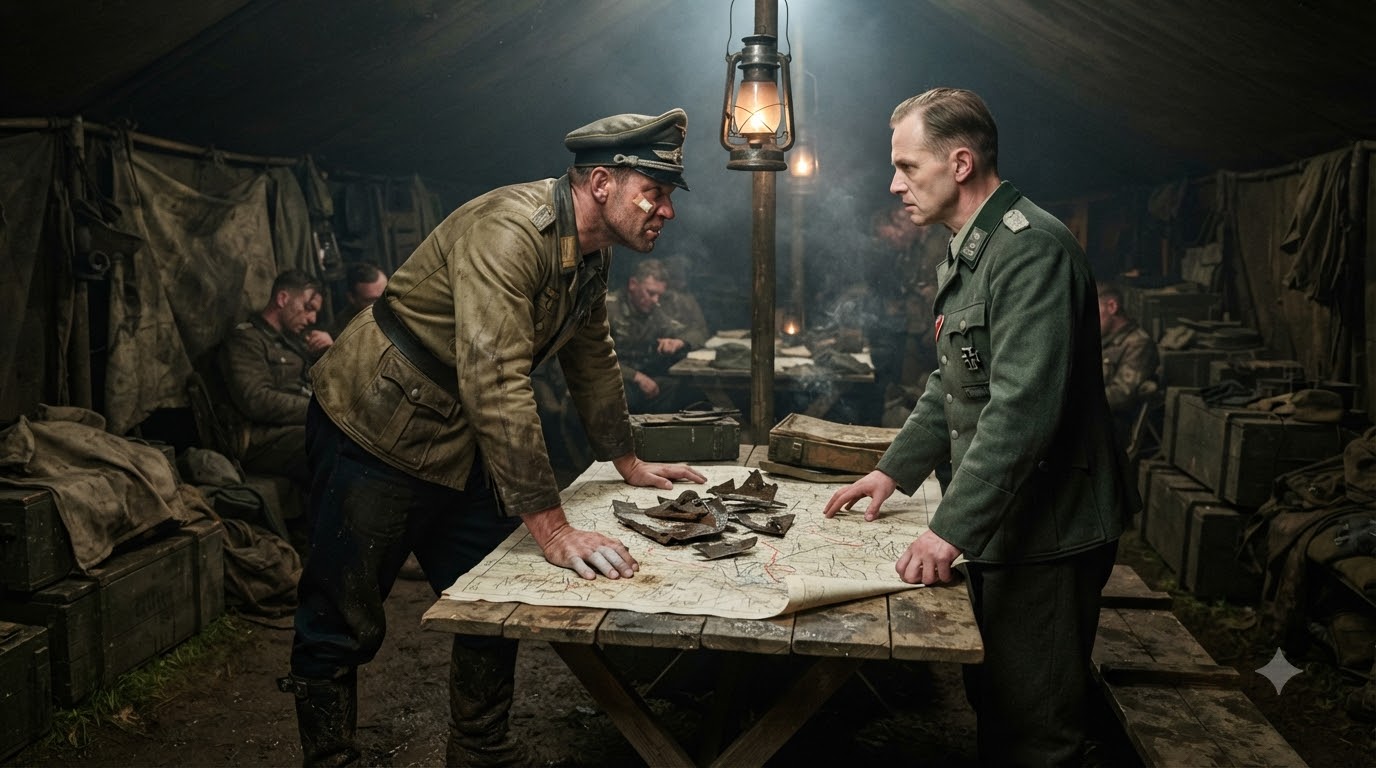
The command post smelled of damp wool, stale tobacco, and the flat exhaustion of men who slept in shifts under muddy tarps.
Major Vogel did not look up from the grease-stained map spread across the folding table when Klaus walked in, his jaw still stiff beneath a crude field bandage.
“A fluke, Klaus,” Vogel muttered, his finger tracing a contour line south of Caen. “Shermans do not punch through one hundred millimeters of hardened glacis unless the plate was flawed at the foundry.”
Klaus dropped a heavy handful of jagged, twisted metal fragments onto the center of the map.
“The plate was fine, Herr Major,” Klaus said, his voice flat and worn down by the weight of the drive back. “The round went through clean enough to take the loader’s hearing and leave a groove across my chin.”
Vogel stared down at the gray shards of steel, his pencil hovering motionless over the paper.
“Command will call it an anomaly,” Vogel murmured, though the absolute certainty in his voice had thinned out. “A freak angle. A lucky placement at zero range.”
“Tell that to the driver in Second Company whose engine block is currently melting into the dirt,” Klaus snapped back, leaning his palms hard against the edge of the table.
The silence that followed stretched out thin and sharp, broken only by the distant, rhythmic thud of heavy artillery shaking the tent poles.
Vogel slowly closed the map case, his knuckles white against the canvas.
“We hold the road tomorrow,” Vogel said quietly, refusing to meet Klaus’s eyes. “Doctrine hasn’t changed because of one bad afternoon.”
“Doctrine doesn’t stop high-velocity tungsten,” Klaus muttered, turning on his heel toward the exit.
CHAPTER 4: The Shrinking Perimeter
The sky above the hedgerow tore open just past dawn with a heavy, screeching roar that drowned out the idling diesel engines.
Klaus threw himself flat against the damp floor of the command trench as cascading clusters of high explosives walked methodically across the ridge line.
Dirt and pulverized chalk rained down inside the collar of his uniform, sticking to the cold sweat on his neck.
“The rear supply road is cut,” Ernst shouted over the rolling thunder, crawling into the trench with soot smeared thick across his jawline.
Klaus wiped the grit from his eyes and grabbed the edge of the timber revetment, his knuckles scraping against raw wood.
“Cut by what? Infantry or armor?” Klaus demanded, his voice strained against the screaming whistles overhead.
“Both,” Ernst gasped, pressing his back hard against the wet earth as another wave of concussive force rattled the dirt walls. “The American columns didn’t wait to clear the flanks. They rolled right through the bombing zone.”
There was no orderly defense left to coordinate, only the chaotic scramble to keep the remaining steel rolling before the trap clicked shut.
Klaus looked down at his watch; the glass face was cracked straight across the center from the morning’s concussions.
“We move the platoon out of the lane now,” Klaus ordered, pulling himself up by the rim of the trench. “Before the hedgerows become our graves.”
CHAPTER 5: The Ridge at Mortain
The dirt ridge at Mortain offered no shelter, only a sweeping view of a valley filling up with olive-drab steel.
Klaus slammed his hatch down with a hollow metallic clang that echoed against the greasy iron walls of the turret.
“They’re coming up the center road in a coordinated rush,” Ernst reported, his thumb hovering over the firing pedal with a visible tremor.
Klaus squinted through the binocular periscope, watching the lead shapes maneuver with a discipline that ignored previous losses.
“Range nine hundred,” Klaus barked, his palms slick against the rubber grip of the traverse handle. “Let’s see if they remember the old math.”
The 88-millimeter gun roared, sending a violent shockwave through the cabin and tearing the lead Sherman apart in a sheet of boiling orange flame.
But the rest of the column didn’t scatter or hesitate; they fanned out into hull-down positions along the lower ridge.
“Another one on the right flank!” Ernst yelled, tracking a long-barreled variant creeping behind a ruined stone wall.
Before Klaus could give the correction order, a razor-sharp impact struck the turret face directly beside the gun mantlet.
The metal didn’t deflect; it groaned, fractured, and yielded entirely to the high-velocity kinetic strike.
Shrapnel screamed across the interior compartment like a cloud of steel hornets, tearing into the equipment racks and cutting Ernst’s fingers clean away from his grip.
“Abandon the tank!” Klaus roared, his ears ringing with a high, deafening pitch that drowned out the screams of his crew.
CHAPTER 6: The Burned Reality
The metal hull behind them crackled with the steady, popping roar of internal ammunition cooking off in the heat.
Klaus dragged Ernst by the collar of his wool tunic, his boots sliding through the loose mud of the hedgerow ditch as another high-velocity shell slammed into the burning wreck.
“Keep moving,” Klaus muttered, his breath coming in ragged, shallow gasps that tasted of sulfur and scorched paint.
They didn’t look back at the iron box that had carried their false security across three continents.
The myth of absolute protection had burned down to a pile of twisted slag in less than three weeks of hard farming country combat.
Industrial output and simple mathematics had replaced the old doctrine with a cold, unyielding truth.
Klaus reached the shelter of a broken stone wall, letting Ernst slide down into the tall weeds while the distant roar of American engines echoed down the road.
There were no grand speeches left to give, and no propaganda films to rewrite the reality of the metal shards embedded in their skin.
He pulled a dented steel cigarette case from his pocket, his thumb flicking the jammed clasp until the lid finally popped open.
The container was empty, holding nothing inside except a fine layer of gray dust carried off the ruined fields.
Klaus snapped the empty case shut with a sharp, final click and set his jaw against the long walk home through the gathering dusk.