The Iron Horizon: How Staff Sergeant Henderson and His Crew Forged a Dangerous New Weapon in the Frozen Mud of the Ardennes
CHAPTER 1: FREEZING FOG
The heavy steel hull of the M36 shuddered as the engine idled in the freezing mud of the Roar River plain.
Staff Sergeant Thomas Henderson kept his eyes fixed on the thick white fog rolling across the clearing ahead.
His breath plumed into the damp morning air, mixing with the acrid smell of burnt diesel and damp wool.
Corporal Mike Petroski leaned against the side of the open-topped turret, his fingers rhythmically tapping a scarred brass shell casing.
The silence across the Belgian border was heavy, broken only by the distant, rhythmic thud of artillery miles to the east.
Nobody spoke of the rumors spreading down the line from the Schnee Eifel.
The technical manuals stowed beneath the ammunition racks promised 129 millimeters of penetration at five hundred yards.
Henderson stared through the frost-rimed glass of his binoculars, watching the dark silhouettes of pine trees sway in the wind.
A sharp metallic clink echoed from somewhere deep within the forest canopy, followed immediately by the deep, unmistakable roar of heavy Maybach engines.
The fog ahead parted just enough to reveal the crushing, flat-fronted shape of an advancing Panther tank grinding through the underbrush.
CHAPTER 2: MECHANICAL DOUBT
The heavy steel casing of the breach slid home with a dull, echoing clang that vibrated through the cramped floorboards.
Corporal Mike Petroski wiped a grease-stained forearm across his forehead, smearing black soot over skin already chapped by the freezing Belgian wind.
“The tables say one hundred twenty-nine millimeters at five hundred yards,” Petroski muttered, his voice tight as he tossed a heavy brass-cased round onto the ready rack. “That assumes we have a clean flat plate and a weather-vane breeze.”
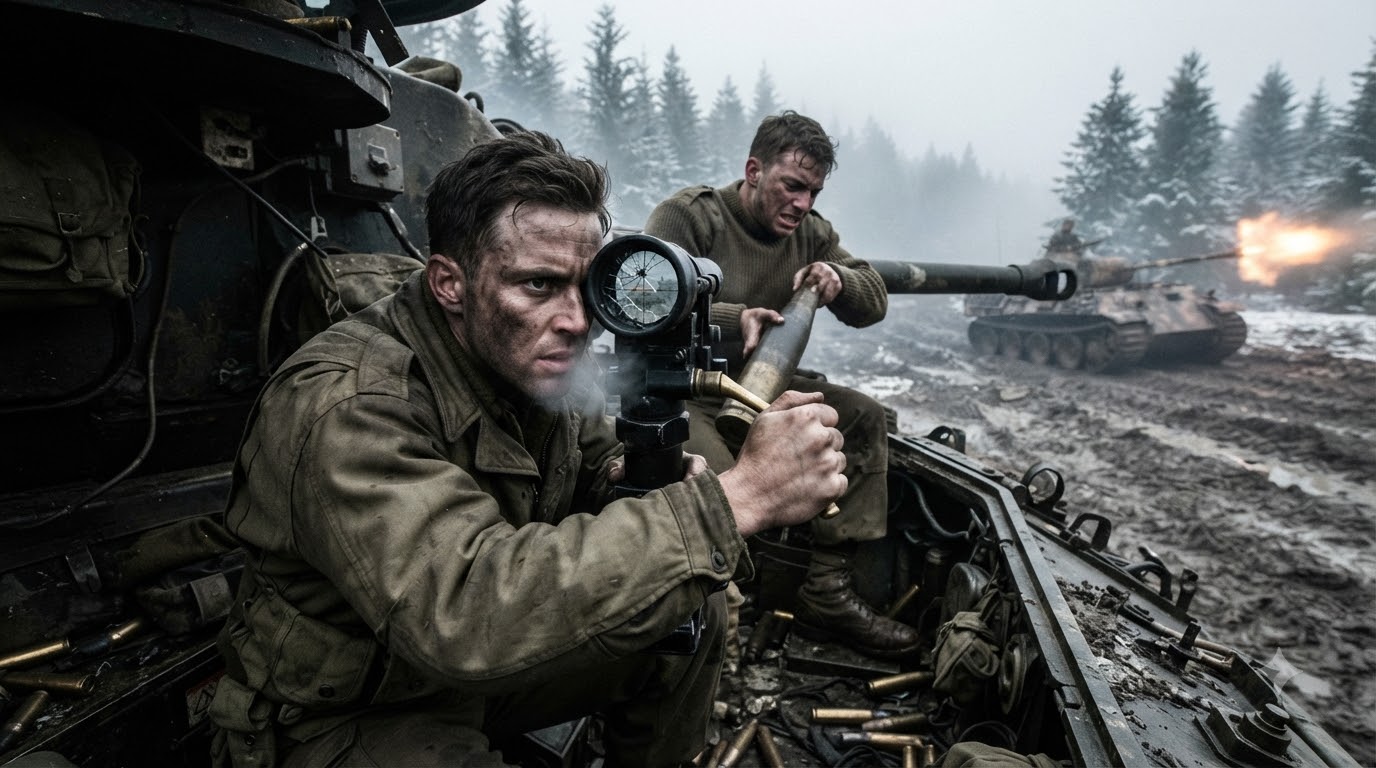
“The tables were written by engineers in Aberdeen who never smelled cordite in a pine forest,” Henderson replied, keeping his eye pressed hard against the rubber eyecup of the M36’s telescopic sight.
Through the cracked lens, the distant tree line fractured into jagged, distorted shards of gray and white.
The vertical hairline was clean, but the diagonal fracture caught the weak morning glare, turning every pine trunk into a double image.
Henderson adjusted the elevation handwheel, feeling the gritty resistance of frozen grease grinding inside the manual gear box.
Without the automated radar directors to lay the gun, every fraction of a mil had to be calculated by eye and muscle memory.
“Petroski, check the electric traverse backup,” Henderson ordered, not taking his eye off the fractured glass. “If the generator stumbles in this sub-zero air, we’re cranking that turret by hand.”
Petroski dropped to one knee beside the battery housing, his boots crunching on frozen cartridge casings scattered around the floor.
“Battery’s sluggish, Sergeant,” Petroski said, his breath pluming in short, ragged gasps as he tested the toggle. “It’ll turn, but she’s going to groan like an old draft horse.”
From beyond the ridge, the deep, grinding iron tracks of the Panther grew louder, vibrating through the frozen mud straight into the soles of their boots.
CHAPTER 3: THE FIRST CLASH
The massive steel beast lurched forward into the open clearing, its wide tracks chewing frozen turf into a brown slurry.
Henderson squinted through his fractured optic, aligning the crosshairs directly against the intersecting angle of the turret ring.
“Hold your fire until it crests the rise,” Henderson muttered, his knuckles whitening around the brass firing lever.
Beside him, Petroski shoved another heavy high-explosive-capped shell into the warm breech block with a harsh metallic scrape.
“She’s turning her nose straight toward our flank,” Petroski warned, his breath catching in his throat as the enemy gun barrel dipped downward.
Without automated radar guidance, every calculation relied entirely on the cold sweat of human intuition and raw mechanical leverage.
The enemy tank’s 75mm main gun flashed in the gray morning mist, sending a supersonic crack directly overhead that rattled the open turret rim.
“Now!” Henderson roared, yanking the trigger lever back with all his weight.
CHAPTER 4: THE HIDDEN FRACTURE
Frozen pine splinters rained down across the open turret rim like shrapnel, stinging Henderson’s cheeks as he forced the heavy handwheel around.
The near-miss concussion rattled the mount’s optics housing, deepening the hairline fracture across the glass until the crosshairs split entirely in two.
“The scope’s completely blinded!” Petroski shouted, coughing as thick white smoke poured back through the open hatch from the breech.
“We don’t need the glass to see iron at four hundred yards,” Henderson barked back, wiping stinging pine resin from his eyes.
Without radar assistance or clean optics, survival depended entirely on raw spatial awareness and brutal mechanical repetition.
The enemy tank’s engine whined as it shifted gears, preparing to pivot its heavy frontal plate directly toward their exposed position.
Henderson locked the manual traverse brake with his boot heel, sighting straight down the bare steel barrel of the ninety-millimeter cannon.
CHAPTER 5: THE FLANKING GAMBLE
tires crushed loose masonry as the heavy vehicle backed hard against the frost-covered stone foundation of an abandoned farmhouse.
Petroski slammed a tungsten-cored high-velocity round into the smoking breech with a sharp, metallic ring that cut through the engine roar.
“The transmission’s overheating on this low gear!” Petroski yelled, sweat freezing instantly along his jawline despite the bitter wind.
“Just keep the round seated,” Henderson replied, his palm slick against the cold steel of the manual traverse wheel.
The enemy tank’s low rumbling tracks echoed directly on the other side of the stone wall, grinding over frozen roof tiles and brick dust.
Instead of pushing forward into another suicidal frontal exchange, Henderson calculated the exact timing of the heavy turret’s rotation.
He tapped Petroski’s shoulder twice—the silent signal to pull the firing lanyard the exact millisecond the enemy’s side flank cleared the corner.
CHAPTER 6: IRON RESOLUTION
The massive 90mm cannon roared, sending a violent shockwave through the open turret that rattled Henderson’s teeth and knocked the frost clean off the armor plating.
Through the thick, acrid cloud of gray cordite, the high-velocity tungsten round covered the short distance instantly.
It struck the Panther’s vulnerable side turret ring with the force of a freight train hitting a brick wall.
The heavy enemy tank shuddered to a violent, immediate halt, its tracks grinding to a dead stop in the frozen mud.
A sharp, metallic squeal echoed across the village square as the enemy’s long gun barrel slowly slumped forward, dead weight against the shattered hydraulic lift.
Henderson didn’t celebrate; he just released a long, shaky breath, letting go of the manual traverse wheel that had bruised his palm.
“Breech clear,” Petroski rasped, his voice hoarse from the fumes, wiping a mixture of soot and freezing sweat from his eyes.
The enemy’s desperate forward push was broken, stopped cold not by advanced radar or perfect textbook doctrine, but by raw iron, stubborn mechanics, and a crew refusing to back down.
The smoking shell casing rolled across the floorboards, coming to rest against Henderson’s boot.
He leaned back against the cold steel rim of the turret, watching the weak winter sun finally begin to burn through the Belgian fog, the heavy silence of survival settling over the ruined square.