The Iron Stakes of Maple Creek: How a Quiet Landowner Defeated an HOA Tyrant with Bureaucracy and Cold Evidence
CHAPTER 1: THE IRON STAKES OF MAPLE CREEK
The engine of the truck died with a dry shutter, leaving behind only the ticking of the cooling manifold and the thin whistle of a dry afternoon wind cutting across the acreage. Daniel did not reach for the door handle. Through the lower curve of the windshield, where the glass had pitted against decades of gravel roads and summer dust, the backyard looked less like a home and more like a staging ground.
Three vehicles choked the gravel shoulder outside the fence line: a bleached white pickup with utility racks, a low-slung flatbed carrying lengths of galvanized pipe, and an SUV bearing a glossy decal that marked it as property of the neighborhood association. Near the center of the lawn, where the soil stayed dampest beneath the shade of the old apple trees, a bright orange spray-paint line cut a harsh, synthetic arc straight through the clover.
Karen stood over it. She held a laminated clipboard against her ribs like a shield, her posture stiff and corrected by years of unearned authority, directing a man in a high-visibility vest who knelt with a heavy steel tape measure. Another worker jammed the iron tip of a shovel into the turf near the perennial bed, the blade tearing through roots that Daniel’s grandfather had laid down before the subdivision ever existed as anything more than dry dirt and tumbleweeds.
In his pocket, the casing of the phone hummed with a low, rhythmic vibration. A micro-burst packet from the east eave. Motion detected. Recording active.
Daniel rested his palms against the steering wheel, feeling the worn grain of the leather beneath his thumbs. He did not feel the hot spike of anger that most men invited into their chests when strangers crossed an unwritten line; he felt only the heavy, cold calculation of weight and leverage. He knew the precise tensile strength of the old cedar fence posts his grandfather had sunk into the hardpan in sixty-three. He knew the exact coordinates listed on page four of the county assessor’s ledger. And he knew that every second Karen spent gesturing toward his garden with her silver-ringed finger was another increment of digital debt she was writing against an account she could never pay back.
One of the contractors straightened up, wiping a smear of red clay across his forehead, and pointed a gloved hand toward the back deck. His voice drifted faintly across the grass, thin and carried on the dry air, asking if the paperwork had actually cleared the desk.
Karen did not hesitate. Her voice came back clear, pitched for authority, dismissing the question before it could take root in the dirt.
Daniel watched her lips form the syllables through the glass, but he did not listen to the words. Instead, his eyes dropped to the edge of the survey tripod resting near the property marker, noticing a subtle, mechanical discrepancy in how the aluminum legs had been leveled against the slope—a careless error made by men who assumed no one would ever look close enough to check their math.
CHAPTER 2: THE FIREPROOF BOX
The vibration in Daniel’s pocket died out as the data packet cleared the local buffer and settled into the encrypted cloud server thirty miles north. He did not look down at the screen. He kept his eyes locked on the tripod’s front leg, where the anodized aluminum met the dirt three inches inside his side of the boundary markers. The men down in the clover were still talking, their voices low and swallowed by the dry afternoon heat, but the mechanical details of their intrusion were already logged, timestamped, and cataloged.
He pulled the truck door open, the rusted latch protesting with a dry clack that carried across the open bed.
The heat hit him first—not the clean heat of open fields, but the baked-iron smell of scorched grass and engine oil that always clung to the subdivision’s border. He walked around the hood, his boots crunching rhythmically against the gravel drive, keeping his pace slow and level. He did not march; he paced himself like a man walking a perimeter he had inherited before the concrete curbs were ever poured.
Karen had turned around by the time he reached the edge of the shadow cast by the old oak. Her chin was lifted, the practiced tilt of a woman who measured her self-worth by how many people backed down when she cleared her throat.
“Daniel,” she said, her voice dropping an octave into that practiced, conciliatory register she reserved for people she intended to manage. “We were just mapping out the corridor alignment. The board voted on the utility clearance last Tuesday. If you’d checked your mail, you would have seen the notice.”
He didn’t answer her. He stopped four paces away—close enough to smell the chemical scent of her laundry detergent, far enough to keep her outside his personal radius. His gaze flicked past her shoulder to the man with the shovel, whose boot heel was still pressed into the edge of the perennial bed where the wild garlic grew.
“That’s a nice tripod, Karen,” Daniel said, his voice flat, stripped of any conversational inflection. “Who manufactured it? Doesn’t look like standard county survey gear.”
Her eyebrows flicked upward, a fractional loss of control that lasted less than half a heartbeat. “The HOA retained a private engineering firm. Everything is standard protocol.”
“Standard protocol requires a county permit filed thirty days prior to any ground disturbance within fifty feet of an established parcel marker,” Daniel said, his tone even, rhythmic, presenting the statutory weight without a hint of performance. “Article four, section twelve of the municipal land code. You didn’t file with the county, Karen. You filed with your own printer.”
The man in the high-visibility vest stopped turning his measuring wheel. The plastic tape hummed as it slackened, coiling back into its housing with a sharp zip.
Daniel turned his back on them without waiting for a rebuttal, leaving the weight of the silence to settle over the survey stakes. He walked past the weathered wood of the back deck, stepping over the threshold into the cool, dark interior of the house. The screen door clicked shut behind him, sealing out the dry wind.
The kitchen was dim, save for a single shaft of amber light cutting across the butcher-block table. There, resting precisely where it had stayed since his father’s funeral, sat the heavy steel box. It was a Fire-King safe from the late fifties, painted olive drab, with a brass latch that required a double-turn to clear the inner gasket.
He didn’t use a key. The combination was committed to muscle memory: forty-two left, six right, nineteen home.
The heavy lid rose with a soft hiss of displaced air, releasing the smell of aging linen, dried ink, and cold iron. Inside, stacked with the neat, obsessive precision of a man who spent his life reviewing government compliance audits, lay sixty years of paper.
He lifted the topmost file—the original 1963 transfer deed bearing his grandfather’s signature in faded iron-gall ink. Beneath it sat the 1978 agricultural survey, hand-drawn by a county surveyor named Vance who had since passed away, marking every oak, every stone, and every iron pin with absolute, unyielding cartography.
His fingers slid deeper into the box, brushing against a small, flat bundle wrapped in oilskin. He pulled it out and unknotted the twine. Inside was a minor document most people would have thrown away: an unrecorded boundary adjustment agreement from 1982, signed by the original developer of the acreage to the east—the very developer Karen’s subdivision had bought the land from twenty years later.
In that document, the original developer explicitly acknowledged that the three-acre parcel retained complete sovereignty over the drainage and access corridor. There was no easement. There never had been an easement. It wasn’t just missing from the county records; it had been legally precluded before Karen’s subdivision was even a pencil sketch on an architect’s desk.
Daniel laid the paper flat on the wood. He didn’t feel triumphant. He felt the cold, steady realization that Karen wasn’t just mistaken—she was trapped in a legal corner she didn’t even know existed yet.
He pulled his phone from his belt, opened the local assessor’s GIS map on the screen, and began cross-referencing the parcel identification numbers from the 1982 agreement with the current commercial zoning permits filed by the development corporation downtown. The pieces weren’t just lining up; they were interlocking like gears in an old mill.
The phone buzzed against the table—a short, local alert.
Daniel looked up. Through the kitchen window, across the patch of green where the orange spray paint still bled into the clover, he saw the black SUV with the HOA parking sticker put its indicator on. The reverse lights flickered white against the dust.
They weren’t done measuring. They were regrouping.
CHAPTER 3: THE COLD WAR OF LETTERS
The tail-light glare of the black SUV smeared a dull, bruised crimson across the lower panes of the kitchen window before winking out behind the neighbor’s cedar hedge. Daniel did not look away from the digital map glowing on his monitor. The coordinate grid lines intersected precisely where the 1982 agreement mapped the drainage ditch, cutting a hard boundary that rendered Karen’s proposed walking path an impossibility under municipal zoning law.
He closed the browser tab, the screen plunging the small room back into the amber wash of the single overhead light.
On the corner of the butcher-block table sat the cardboard file folder. It was thick, bulging at the seams with seventeen distinct envelopes accumulated over the past four months. Each one represented a brick in Karen’s wall of calculated intimidation.
Daniel pulled the folder toward him, his thumb catching on the rough edge of the fourth envelope—postmarked late October, stamped with the automated meter mark of the local postal hub. He slid the single sheet of heavy linen paper out. The text was typeset in a rigid, authoritative font designed to mimic municipal stationery, accusing him of maintaining an unauthorized visual obstruction along the eastern tree line.
There were no official seals. There were no reference numbers tied to county code. There was only the calculated repetition of words like community, shared access, and compliance.
In his line of work with federal infrastructure compliance, he had seen this exact instrument deployed against small landowners in river basins and grazing tracts. Agencies and corporate proxies rarely launched direct legal assaults out of the gate; they wore down the target through administrative static. They made the mailbox a source of friction, turning every sunrise into an audit. They banked on fatigue. They assumed the average man would eventually grow tired of checking seals and filing affidavits, choosing instead to surrender an inch of fence line just to buy a quiet weekend.
He opened a fresh, unlined legal pad and picked up a heavy brass pen.
With slow, deliberate strokes, he began to log each letter in sequence. Date of postmark. Stated violation. Fictitious statutory reference. Linguistic overlap with the development corporation’s public filings downtown. He didn’t write with anger; he wrote with the dry, methodical precision of a man logging stress fractures in a concrete pillar. Every lie had a signature. Every false claim of an easement left a digital footprint in the metadata of the HOA’s distributed circulars.
A sharp clatter from the gravel drive outside interrupted the scratch of the pen.
Daniel paused, his hand steady over the paper. Through the window, a blue delivery van idled briefly near the mailbox, its rear tire clipping the loose gravel of the apron with a sudden, metallic rattle of loose stones against the wheel well. The driver shifted gears, the transmission whining in protest before accelerating down the road.
It was a minor environmental shift, a momentary disruption of the quiet, but it served as a reminder that the perimeter was porous. The world outside his fence line was moving, planning, and pressing against the edges of his property.
He didn’t rush to the window. He finished logging the seventeenth letter, noting the exact date Karen had signed the printing invoice for the fraudulent neighborhood maps.
The file was complete. The paper trail of harassment was no longer a stack of scattered grievances; it was a closed loop of documented bad faith. He placed the heavy steel lid of the fireproof box back over the documents, letting the brass latch snap home with a clean, satisfying weight.
The letters had done their job. They had given him the pattern. Now, the next phase required physical proof from the source itself—not just paper, but the actual administrative record locked inside the county clerk’s public vault downtown.
He stood up, stretching his shoulders against the stiffness of the long afternoon, and reached for his jacket hanging by the back door. The sun had dipped below the ridge, leaving the backyard in a cool, gray shadow where the clover smelled damp and sharp against the coming dusk.
CHAPTER 4: THE COUNTY VAULT
The screen door latched with a dull click that barely cleared the whisper of the evening wind through the lower branches of the oak tree. Daniel did not pause on the porch. He stepped off the weathered cedar planks, his boots meeting the packed gravel of the drive with a steady, crunching cadence that matched the slow descent of the light. The air smelled of dry earth and cooling iron, the scent of a property that had absorbed fifty summers of sun and survived every frost without asking for permission.
He pulled open the driver’s-side door of the truck, the interior smelling faintly of stale coffee and hot vinyl. The engine turned over on the first rotation, coughing once before settling into a low, even idle that vibrated through the floorboards.
The drive to the county seat took twenty minutes through the flat grid of the valley roads. The county administration building sat off the main square—a square block of utilitarian brick and tinted glass built in the late sixties, housing the offices that recorded every transfer of dirt and cedar within three hundred square miles. By the time he pulled into the asphalt lot behind the municipal annex, the fluorescent tubes inside the records bureau were humming behind frosted glass.
Inside, the air was conditioned down to a sharp, mineral chill that smelled of old pulp and toner fluid. The front counter was bolted down, capped with a sheet of scratched acrylic glass that had a brass speaker grill mounted at throat height.
A clerk with a green plastic visor pushed a mechanical counter aside and looked up through the partition. “Closing in twenty minutes, mister. What do you need?”
“Parcel 44-B,” Daniel said, laying his driver’s license flat on the metal pass-through tray. “Certified historical abstracts, original plat maps, and any secondary right-of-way filings associated with the eastern boundary from nineteen-sixty-three to present.”
The clerk frowned, his eyes dropping to the license before flicking up to Daniel’s face. He didn’t move toward the inner stacks immediately. Instead, he reached for a small clipboard where a stack of yellow retrieval slips lay pinned beneath a rusted bulldog clip.
“That’s subdivision fringe,” the clerk muttered, pulling a blank slip toward him with a ballpoint pen. “Most of those old orchard tracts were blanketed under the 2004 master development consolidation. You looking for an easement clearance or a standard title verification?”
“I’m looking for anything filed under block nine,” Daniel said, his voice dropping an octave, flat and unhurried. “Specifically, whether any secondary encumbrances were added without a recorded parcel split.”
The clerk paused, his pen hovering an inch above the yellow paper. A faint, greasy thumbprint smeared the corner of the slip—a fresh smudge of printer toner that did not match the dry, faded ink stamps of the municipal vault. It was a small discrepancy, but in compliance work, a fresh smear on an old register meant someone else had been pulling these exact files within the last forty-eight hours.
“You got a municipal request form?” the clerk asked, his tone shifting from casual indifference to guarded caution. “County policy changed last month. Third-party boundary checks require a formal notice period unless…” He trailed off, his eyes darting toward a side door marked Records Supervisor Only.
“Unless it’s a direct owner verification,” Daniel finished for him, sliding his recorded deed across the steel tray so the raised purple seal of the county recorder’s office caught the glare of the overhead tube. “My grandfather registered this parcel when the county roads were still gravel and the board of supervisors met in a hardware store. There is no third party. There is only the deed.”
The clerk looked down at the purple seal, then up at Daniel. The silence stretched for three long seconds, filled only by the distant hum of the microfiche printer in the back room. Without another word, the clerk pulled the slip back, tore off a carbon copy, and vanished through the heavy swing door toward the metal filing racks.
Daniel stood motionless against the counter, his hands resting flat on the cold steel. The grease smudge on the retrieval slip was still tacky. Someone from the subdivision’s management circle had been here digging through the same drawers, trying to find a paper trail to match the fabricated map Karen had waved in front of the HOA. They had looked for an opening, and when they couldn’t find one, they had simply invented the path themselves.
A heavy metallic thud echoed from the back stacks, followed by the squeak of oiled drawer rollers sliding home. The system was exposed, but the true depth of the corporate collusion hiding behind Karen’s paperwork was about to surface.
CHAPTER 5: THE CAUGHT HAND
The squeak of the oiled drawer rollers echoed off the concrete block walls of the back stacks, dying quickly in the heavy, conditioned air of the municipal vault. Daniel did not shift his weight from the counter. His palms remained flat against the scratched steel pass-through, fingers resting just inches from the greasy fingerprint the clerk had left on the retrieval slip.
A moment later, the heavy swing door groaned on its hinges. The clerk reappeared, carrying a manila folder that looked thick enough to split at the seams. It wasn’t standard archival stock; it was a modern, reinforced expansion jacket held together by a red elastic band.
The clerk dropped the folder onto the metal tray with a heavy, flat thud that stirred up a faint cloud of dry paper dust.
“You wanted block nine historical files,” the clerk said, his voice dropping as he slid the jacket forward. “Including the secondary right-of-way filings from the seventies and eighties. Here they are. But I’ll tell you right now, mister—someone’s been flagging these specific parcels every morning for the past week. You’re not the first person sitting at this counter asking why the utility corridors don’t match the developer’s overlay.”
Daniel unhooked the red elastic band. The rubber was stiff, old, and cracked slightly under his thumb, releasing a sharp, sulfurous smell of aging latex. Inside lay a certified copy of the 1982 boundary adjustment agreement, alongside a modern digital overlay map printed on high-gloss plotter paper.
He didn’t need to read the text word for word; he scanned the marginalia, looking for the stamp that mattered. There it was—a small, square purple block near the bottom right corner, signed by a municipal planning commissioner who had retired twenty years ago. The stamp explicitly prohibited any public access easement across parcel 44-B without a unanimous deed-holder release. No such release existed. Karen’s map wasn’t just an administrative error; it was a direct fabrication designed to bypass the municipal planning board’s zoning restrictions.
“Is there a duplication machine in the public bay?” Daniel asked, his voice steady.
“End of the hall,” the clerk replied, nodding toward the shadows near the microfiche printers. “Ten cents a page. Cash only.”
Daniel gathered the papers, tucking the expansion folder securely beneath his arm, and turned toward the copier. The machine was an old, heavy-duty floor model that smelled of ozone and hot plastic. He fed each sheet through the automatic feeder one by one, watching the glass scan bar flash a harsh, clinical white against the documents. Every page spat out into the tray crisp and clear, creating an exact duplicate of the unassailable truth.
As the final page cleared the rollers, the small television mounted in the corner of the records bureau flickered from a local weather report to an evening community brief. A graphic flashed across the screen: a stylized logo of the Maple Creek Homeowners Association, followed by a live local news crawl mentioning an upcoming board review regarding neighborhood public access corridors.
Daniel stopped. He stared at the screen. Karen wasn’t just fighting an informal property dispute; she was actively manufacturing public momentum to force a municipal hearing. She was setting the board up to vote on a formal encroachment resolution before the county could audit her files.
He slipped the duplicated copies into his briefcase, snapped the brass latches shut with a crisp, double click, and turned away from the machine. The escalation was no longer confined to the backyard fence line; it was moving into the public sphere. And that meant the next move wouldn’t happen on paper—it would happen live, on his land, under the watchful lenses of the cameras he had bolted to the eaves.
CHAPTER 6: THE DEPUTYS LEDGER
The double click of the briefcase latches snapping shut resonated inside the empty copier bay, sharp against the hum of the fluorescent tubes overhead. Daniel tucked the handle into his palm, the cold metal grip grounding him as he walked out of the municipal annex and back toward the truck. The evening air had dropped ten degrees, carrying the sharp, iron scent of damp asphalt and cooling engine blocks across the municipal lot.
He didn’t rush his driving. He kept the truck at a steady, legal speed down the grid of valley roads, watching the amber dashboard lights illuminate the fuel gauge and the mileage counter. When he turned onto his street, the high beams caught the bleached white pickup of the contractors still parked near the shoulder, though their cab was empty.
Before he could pull into his own drive, a county cruiser rolled silently out from the edge of the subdivision’s side lane, its halogen headlights sweeping across his windshield in a wide, blinding arc. For a fraction of a second, the glare distorted the shadows of the old oak tree, making the cruiser look less like a neutral peacekeeper and more like an institutional escort waiting to intercept him.
The cruiser slowed, its amber signal blinking twice before the deputy pulled up parallel to Daniel’s truck, lowering his window with a dry electronic whine.
“Mr. Marsh,” the deputy called out through the gap, his voice flat and professional. “Got a call from the association president ten minutes ago. She claims you’re blockading a designated utility right-of-way with an unregistered vehicle.”
Daniel left his transmission in neutral, the engine purring softly beneath the hood. He didn’t reach for his phone or raise his voice. He simply rested his left hand on the steering wheel and looked across at the badge pinned to the deputy’s shirt pocket.
“There is no utility right-of-way on this parcel, Deputy,” Daniel said, his tone even and unhurried. “I just came from the county records vault. I have the certified 1982 planning board stamp right here in my briefcase. Any vehicle parked inside my fence line is resting on private, unencumbered acreage.”
The deputy studied him for a long beat, his eyes flicking from Daniel’s face down to the briefcase resting on the passenger seat. In small-town compliance work, authority usually belonged to whoever yelled loudest or carried the flashiest letterhead. But paperwork changed the math. A certified municipal seal had a way of cutting through administrative noise like a cold chisel.
“She brought a couple of board members down to the park side twenty minutes ago,” the deputy said, his gaze shifting past Daniel’s truck toward the dark line of the back fence. “They’re trying to push an emergency vote through tonight. If you’ve got certified filings that contradict their map, you might want to have them ready. Because when an HOA starts calling deputies over parking tickets, they’re usually trying to distract from something bigger.”
The cruiser’s window hummed upward with a muffled click. Without another word, the deputy shifted into drive, his tail-lights flaring a dull red as the cruiser turned the corner toward the main thoroughfare.
Daniel pulled into his driveway, killed the ignition, and sat in the sudden, absolute quiet of the cab. The escalation was reaching its apex. Karen wasn’t just bluffing anymore; she was cornered, and a cornered bureaucracy always thrashed before it collapsed.
CHAPTER 7: THE INSURANCE COLLAPSE
The engine vibration died away as Daniel turned the ignition key, cutting off the amber glow of the dashboard instruments. He sat in the dark for a long moment, listening to the ticking of the cooling metal under the hood. The deputy’s warning still hung in the air—a clear signal that the HOA’s emergency meeting was already underway down the block, and that Karen was scrambling to rally a crumbling board before the fiscal reality of her unauthorized contracts hit them.
He stepped out of the truck, the gravel crunching under his boots, and walked straight to the back door. Inside the kitchen, the single overhead light cast a sharp, clean shadow across the butcher-block table. He didn’t turn on the television or check the perimeter feeds immediately. Instead, he pulled his phone from his belt, dialed a direct number, and waited through three rings.
“David Herrera,” a crisp, low voice answered on the other end.
“David, it’s Daniel Marsh. We have the certified planning board stamp from nineteen-eighty-two, matching the county vault duplicates.”
A brief pause rustled over the line, the sound of papers shifting against a mahogany desk. “That changes the liability window completely,” David said, his tone sharpening instantly. “If the planning board explicitly barred public access across that parcel before the subdivision was platted, then Karen didn’t just misrepresent an easement. She forged a secondary zoning overlay to satisfy a commercial option contract.”
“A commercial option contract?” Daniel asked, his eyes narrowing as the final, missing gear of the puzzle clicked into place.
“The real estate holding company downtown,” David confirmed, his voice dropping into a measured cadence. “They’ve been trying to acquire the north access corridor for a retail bypass for six months. If the HOA successfully claimed an easement across your land, the developer could bypass city zoning fees entirely. Karen wasn’t just acting as an overzealous president. She was acting as the local point man for a corporate land flip, using homeowner dues to fund the initial site surveys.”
The silence in the kitchen grew heavy, absolute, and cold. The decoy secret—the fabricated neighborhood map and the minor boundary dispute—was nothing more than a smokescreen. The core truth was an institutional conspiracy disguised as community management.
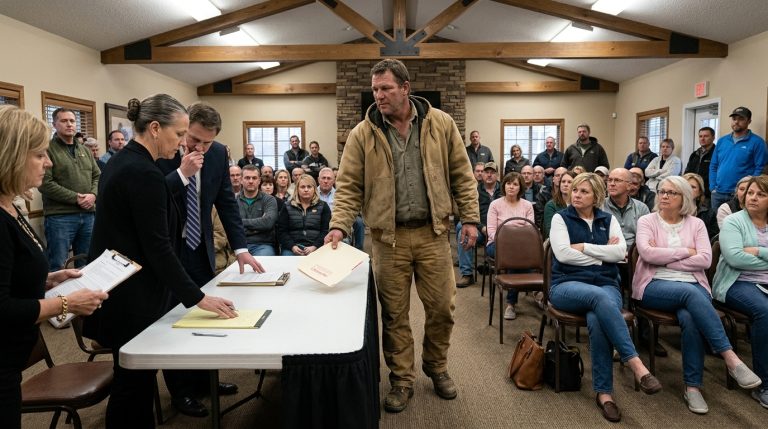
“The HOA’s insurance provider just issued a formal denial letter to the board fifteen minutes ago,” David continued, a faint note of dry satisfaction edging into his voice. “They pulled the policy coverage because fraud voids the indemnity clause. Every single board member is now personally exposed to a six-figure civil suit. They’re meeting right now at the community center, and I guarantee you, Karen is trying to pin the entire liability on the independent contractors she hired.”
“Not for long,” Daniel said.
He reached into his briefcase, pulled out the certified municipal copies and the thumb drive containing every minute of high-definition camera footage, and slid them into a fresh manila envelope.
“I’m sending the complete packet to the board’s interim president tonight,” Daniel said. “Along with a copy of the contractor’s unredacted statement.”
“Good,” David replied. “Let them see the ledger before the hammer drops. When a structure is built entirely on fraudulent paper, you don’t have to push it over. You just pull out the bottom page and let the weight of its own lies do the work.”
The call clicked shut. Daniel placed the phone down on the wooden table, the surface cool beneath his fingers. The pre-climax escalation had reached its absolute breaking point; the final reckoning for the subdivision was already in motion.
CHAPTER 8: THE RUSTED LINE
The sun came up over the eastern ridge like a slow weld, burning the valley mist off the clover and casting long, sharp shadows across the cedar fence line. Daniel stood on the back deck, holding a mug of black coffee that had long since stopped steaming. The air smelled of damp earth and crushed mint, clean and stripped of the synthetic tension that had choked the property for months.
Down by the east corner, where the orange spray paint had once scarred the turf, the grass had grown back thick and green, erasing the temporary markers of a corporate land grab. The fence posts his grandfather had sunk into the hardpan back in sixty-three stood upright and unyielding, their weathered wood catching the golden morning light.
A low rumble from the asphalt outside announced the arrival of the local delivery truck, but it didn’t stop; it rolled past without slowing down. The subdivision had quieted down. Four months after Karen’s resignation, the interim board had settled the litigation in full, covering every dollar of legal fees, restoring the property line in all official maps, and formalizing the new municipal bylaws requiring a two-thirds homeowner vote before any boundary discussions could even be tabled. Karen herself had packed her bags and moved out before the insurance audits could attach liens to her personal assets, leaving behind an empty house and a neighborhood that had learned the hard way what happened when people traded due diligence for a comfortable lie.
A light knock sounded at the front door—not the aggressive, demanding rapping of an official notice, but a single, hesitant rap.
Daniel walked through the dim hallway, the floorboards groaning slightly beneath his boots, and pulled the front door open.
Rick stood on the porch, his hands jammed deep into his jacket pockets, his eyes fixed on the welcome mat. He didn’t look like a man delivering demands anymore; he looked like a neighbor who had finally learned how to read a deed.
“Morning, Daniel,” Rick said, his voice quiet, carrying none of the old neighborhood friction. “Gerald sent over the final executed copies of the settlement agreement. The board voted unanimously on the new buffer zone amendments last night. No one’s ever going to touch your line again.”
Daniel looked at him for a long beat, noting the genuine exhaustion and the quiet acceptance in the man’s posture. “Thanks, Rick. Come on in for a minute.”
They sat on the porch benches as the morning sun warmed the planks beneath their boots. Daniel didn’t offer a victory speech or bring up the past months of bureaucratic warfare; there was no need. The facts were settled, the paperwork was stamped, and the boundary was secure.
After Rick left, walking back down the sidewalk toward his own house, Daniel stood by the garden bed and reached down to touch the rough bark of the old oak tree his grandfather had planted forty years ago. A man planted a tree not for himself, but for the people who came after him—to mark a place where no one got to take what wasn’t theirs just because they convinced a crowd it was okay.
He walked back inside, set his empty mug down on the wooden counter beside the fireproof steel box, and closed the lid with a clean, satisfying snap. The house was quiet. The fence was standing. And the land remained exactly what it had always been: private, unencumbered, and absolute.