Rusted Soil and Hard Ratios: How a Colorado Farmer Stood Down a Hollywood Machine Without Asking for Permission
CHAPTER 1: Dawn on Ruined Rows
The frost was still clinging to the barbed wire when Garrett reached the edge of his field, staring down at four acres of flattened stalks that should have fed his family through the snow.
He didn’t yell. He didn’t curse the sky.
His boots crunched into the pulverized dirt, smelling sharply of bruised pulp and fresh manure.
Twelve sets of heavy hoofprints led straight from the break in the fence toward the humming generator trailers parked on the neighboring state line.
Garrett wiped a cold bead of sweat from his forehead with the back of a calloused hand.
He unlatched the gate, let it swing open against the post with a dull iron clatter, and pointed his truck down the gravel road toward the circus tents of Hollywood.
CHAPTER 2: The Locked Door
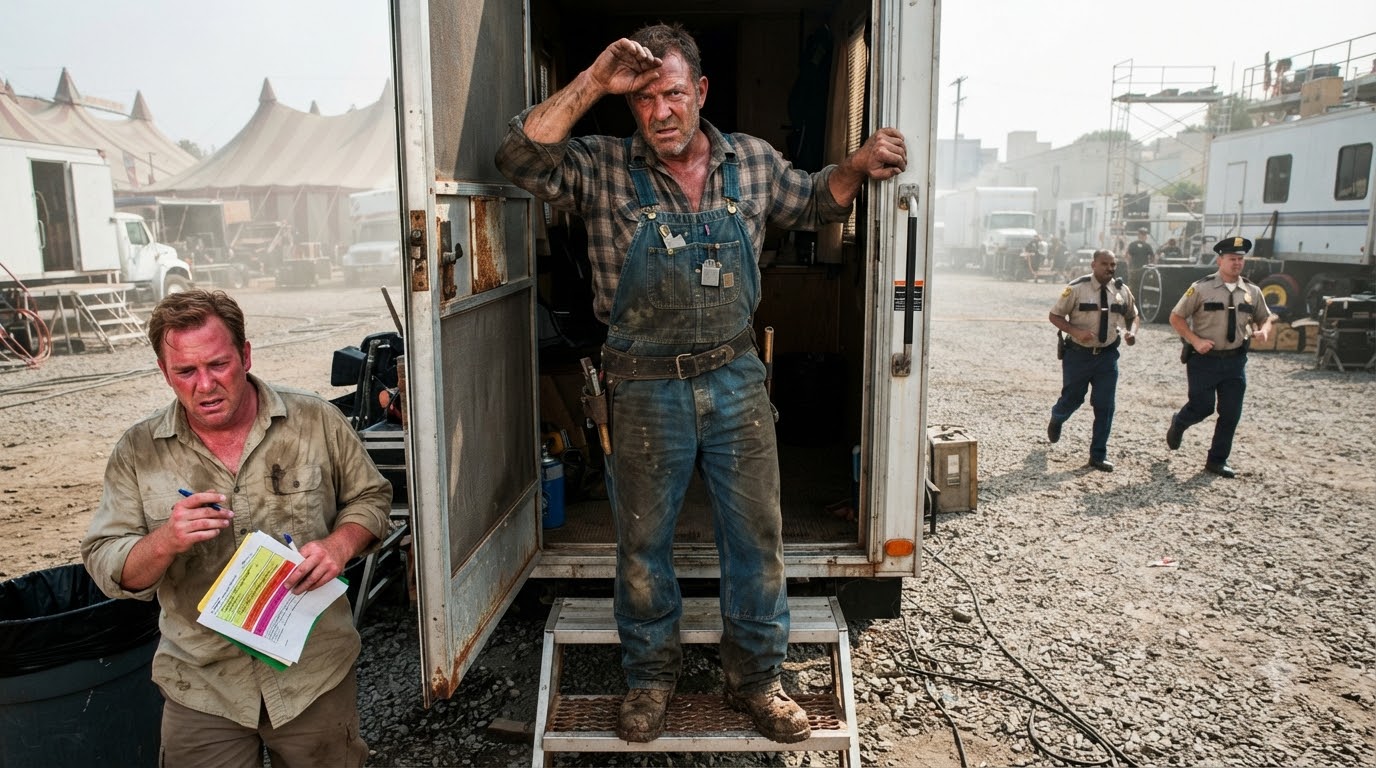
The screen door of the trailer hung slightly crooked on a rusted hinge, vibrating with the low, constant thrum of a heavy diesel generator parked just outside.
Garrett stepped up the aluminum stairs.
Before his knuckles could hit the corrugated metal, the door swung open from the inside, nearly catching him across the jaw.
A young man in a rumpled khaki shirt stepped out, clutching a stack of color-coded call sheets to his chest like a shield.
“We’re closed for general inquiries,” the coordinator said, his eyes already darting past Garrett’s shoulder toward the craft services tent. “If you’re looking for extra work, casting wrapped yesterday.”
Garrett didn’t move an inch. He kept his boots firmly planted on the metal grate of the top step, blocking the exit.
“I’m not looking for extra work,” Garrett said. His voice was flat, carrying the dry, unyielding weight of four acres of flattened corn stalks. “I’m looking for the man who signs the checks for the livestock damage.”
The coordinator let out a sharp, theatrical sigh, shifting the heavy stack of papers to his other arm.
“Look, friend, the field office handles claims on Tuesdays and Thursdays between two and four,” the coordinator snapped, trying to sidestep past Garrett’s shoulder. “Come back then or leave your paperwork in the drop box by the gate.”
Garrett raised his hand, not threateningly, but just enough to block the narrow doorway.
The heavy silver Zippo lighter in his pocket pressed hard against his thigh, a cold metal anchor while his patience wore thin.
“Tuesday is five days too late,” Garrett said, his tone dropping an octave. “The stalks are rotting into the mud right now, and my winter feed bill just arrived in the mail.”
The coordinator’s face flushed pink beneath a sunburn, his pen twitching nervously between his fingers.
“You people think you can just drive your heavy iron onto private land and leave the gate open for the horses,” Garrett continued, stepping closer until the coordinator was forced to back up a half-step into the cramped doorway. “I’m not leaving until I speak to the manager.”
“You can stand here and yell until your throat bleeds,” the coordinator muttered, his hand tightening on the doorframe. “It won’t change the fact that nobody is talking to you today.”
CHAPTER 3: The Second Wall
Nora stood on the cracked concrete sidewalk twenty yards away, her fingers wrapped tight around their two-year-old son’s hand.
The boy wore a wool cap that slipped sideways over his ear, blinking against the exhaust haze rolling off a massive generator truck.
Garrett didn’t look back at them, keeping his boots locked onto the threshold while the coordinator’s face tightened with bitter exhaustion.
“I brought my wife this time,” Garrett said, his voice carrying clearly over the idling diesel engines. “And I brought the boy who eats the corn you trampled into the mud.”
The coordinator tried to push past the barrier again, his shoulder hitting the doorjamb with a sharp thud.
“This isn’t a family consultation room,” the coordinator snapped, his knuckles white as he squeezed his clipboard. “Take your check from the drop box and get off the lot before security escorts you both out.”
A pair of private guards in mismatched uniforms started jogging across the gravel lot from the main gate, their boots crunching a steady, rhythmic warning.
Garrett reached into his coat pocket, his thumb brushing against the cold, familiar metal of his Zippo lighter as he held his ground.
“You call that slip of paper a settlement,” Garrett said, pointing toward the open office door behind the panicked coordinator. “That number doesn’t even cover the seed cost, let alone five months of labor.”
The guards arrived at the foot of the aluminum stairs, their heavy hands dropping heavily onto the wooden handrails.
“You heard the man,” the lead guard barked, stepping up the first riser with a cold stare. “Step down off the trailer right now or we’ll make it official.”
Garrett slowly turned his head to look the guard in the eye, refusing to yield an inch of elevation.
“Go ahead and try,” Garrett muttered, his jaw set like stone against the rising tide of corporate indifference.
CHAPTER 4: The Ledger Slip
The lead guard’s hand closed tightly around Garrett’s coat sleeve, pulling downward with sharp, unyielding friction.
Garrett wrenched his arm free with a sudden, dry snap of fabric, refusing to budge from the top step.
“Keep your hands off,” Garrett said, his voice dropping into a low, gravelly rasp that made the guard hesitate for a fraction of a second.
Inside the small office doorway, a duplicate ledger sheet fluttered off the edge of the coordinator’s cluttered desk, catching a sudden gust of wind before settling flat against the bottom step.
Garrett’s eyes caught the numbers inked across the blue carbon paper before the coordinator could dive down to grab it.
“Twenty thousand dollars allocated for local crop indemnity,” Garrett read aloud, his voice cutting cleanly through the idling generator roar.
The coordinator lunged forward, his face turning a violent shade of crimson as he snatched the paper away and crushed it into a tight ball inside his fist.
“You have no business looking at studio accounts,” the coordinator stammered, his breath coming in short, panicked gasps. “Get off this property right now or you’re looking at a trespassing charge.”
Garrett didn’t blink, his mind calculating the stark difference between the meager twenty-dollar check in his pocket and the massive figures printed on that fallen sheet.
The slush fund wasn’t an accident; it was a built-in margin designed to rob every local farmer blind.
“That paper says you’ve got the funds right here in this trailer,” Garrett said, stepping down one single stair to tower over the panicked coordinator. “And I’m not leaving until every cent of that actual damage is settled on this table.”
CHAPTER 5: The Ledger Table
The screen door bounced hard against the aluminum frame as Garrett shoved past the panicked coordinator and stepped directly into the cramped office.
A heavy oak desk dominated the center of the room, piled high with receipts, coffee cups, and open checkbooks.
The production manager looked up from his paperwork, his expression shifting instantly from mild annoyance to sharp, defensive hostility.
“You’re trespassing in a restricted administrative space,” the manager snapped, standing up so fast his metal chair scraped harshly against the linoleum floor. “Get out before I have the local sheriff drag you off this lot.”
Garrett reached into his coat pocket, pulling out the crumpled blue carbon paper he had snatched from the stairs and flattening it hard across the center of the desk.
“You don’t need to call the sheriff,” Garrett said, his voice as heavy and unyielding as a winter frost. “You just need to explain why your private ledger lists twenty thousand for local crop damage while you’re handing out twenty-dollar checks at the gate.”
The manager’s face drained of color, his eyes darting frantically toward the exposed figures on the carbon sheet before he slammed his palm down over the numbers.
“That’s internal studio accounting,” the manager snarled, his breath hitching as he tried to back-pedal against the filing cabinet. “You have no legal right to look at corporate documents.”
“I have every right when your loose horses eat my family’s winter survival,” Garrett muttered, leaning his weight forward onto his fists against the desk. “Write the full payout in cash right now, or this ledger goes straight to the county prosecutor before sunset.”
CHAPTER 6: Dust Settles Quietly
The production manager’s hands trembled as he hauled the heavy steel cash box out of the bottom desk drawer, slamming it onto the scarred wood between them.
“Take it and get out,” the manager spat, his voice cracking with humiliated fury as he flung the lid open to reveal thick stacks of banded currency. “Take every last cent before I have you thrown off this property for good.”
Garrett didn’t flinch.
He didn’t celebrate or trade insults with the man who had dismissed him four times over.
His fingers slid across the banded bills, counting out the exact mathematical total required to cover four flattened acres of winter feed and months of grueling labor, leaving the rest locked inside the box.
“I only take what belongs to my family,” Garrett said, his voice level and cold as stone.
He dropped the heavy steel lid back down with a sharp metallic echo, turned his back on the trembling manager, and walked straight out of the trailer into the bright mountain air.
Nora and the boy were waiting by the truck, watching him approach with tired, anxious eyes.
Garrett held up the brown paper envelope filled with cash, climbed into the cab, and turned the key without a word.
The truck rolled down the gravel road, leaving the Hollywood tents and the noise far behind them in the dust.
Back home on the edge of the quiet valley, the sun dipped behind the jagged peaks, casting long shadows across the unbroken fence line.
Garrett sat at the plain wooden kitchen table, a warm cup of black coffee cooling between his calloused hands while Nora tucked their sleeping son into bed down the hall.
The cornfield outside remained trampled and quiet in the dark, but the mortgage was covered, the winter feed was secured, and the boundary lines were ironclad.