A Fragile Peace: Rebuilding the Broken Soul of Willow Creek Through Shared Remembrance and Quiet Grace
CHAPTER 1: THE ECHO OF THE BELL
The bell over the door didn’t just ring; it seemed to mourn.
Marla leaned her forehead against the cool, grease-slicked stainless steel of the kitchen prep station. Her knuckles were white, pressed so hard against the counter that the bones threatened to pierce the skin. The diner was empty, yet the air felt crowded—heavy with the residual heat of twelve men who had moved like shadows and departed like ghosts.
She could still see the imprint of their boots in the dust near the entrance. She could still feel the phantom weight of the silence they had imposed, a silence that wasn’t empty, but expectant.
Ramon was working in the corner, his movements uncharacteristically sluggish. He was scrubbing a skillet, the steel wool rasping against the cast iron with a sound like dying teeth. He didn’t look at her. He didn’t need to. They both knew the center of the world had shifted, and they were the only ones left standing in the crater.
Marla reached for the rag, but her fingers stopped. There, on the host stand, sat the receipt book. It was slightly askew. Beside it, the small, circular indentation in the wood where Harold Vance had set his cap was still visible—a permanent mark on a temporary surface.
She walked over, her steps sounding too loud on the worn linoleum. She picked up the cap, or rather, she touched it, afraid that if she gripped it, she might shatter. It was rough, the fabric worn to a thin, translucent grey. It didn’t smell like war. It smelled like the attic of her childhood, like dried lavender and the heavy, comforting musk of a father who had come home and never truly left his own head.
“He’s not coming back for it,” Ramon said. His voice was a flat, dull ache.
Marla didn’t answer. She pulled her gaze toward the window. Through the glass, the street was deserted. The neon sign sputtered, the “O” in “OPEN” flickering out, leaving only “PEN.” It was a cruel irony, she thought. Everything was open now. The wounds, the history, the silence.
She turned back to the counter, and her heart skipped. The framed photograph of the Rangers—the one she had dusted a thousand times—was gone. In its place, leaning against the register, was a small, hand-painted wooden box, its edges worn smooth by decades of touch. She hadn’t put it there. She reached out, her breath catching in her throat, and lifted the lid. Inside lay a single, dried rose petal, brittle and dark as blood, and a note written in the same precise, blocky hand that had haunted her father’s desk for years.
The note simply said: Forgiveness is a muscle. Exercise it.
The bell over the door clicked. Not a ring—just the metallic settling of the mechanism. Marla spun around, her heart slamming against her ribs, expecting the old man, expecting the ghosts.
The door was swinging wide, letting in a swirl of dead leaves and the biting October chill. Standing on the threshold was not Harold, but the librarian, Joyce, her face pale, holding a stack of books she clearly didn’t intend to return.
“The library is closed,” Marla said, her voice cracking.
“I know,” Joyce whispered, stepping inside and locking the door behind her. “I’m not here for books, Marla. I’m here because I don’t know how to be the only person in this town who remembers what that uniform means.”
Marla gripped the edge of the counter, the wood biting into her palms. She looked at the empty booths, the abandoned coffee cups, and the shadow that still seemed to linger in the corner booth. The realization hit her with the force of a physical blow: the bell hadn’t stopped ringing. It was just echoing inside her.
CHAPTER 2: THE KITCHEN FLOOR
The bell’s metallic click died, leaving behind a silence so absolute it felt structural, as if the diner were a house of cards waiting for the slightest breath to collapse. Marla’s hands were still locked on the edge of the counter, the Formica cool and unyielding under her palms. She didn’t turn around at first. She couldn’t. The phantom smell of her father—stale tobacco and the sharp, chemical tang of cheap engine degreaser—had suddenly flooded the space between her and the librarian.
She felt the memory bloom like a bruise. It was the same smell that had clung to the hallway floorboards of the trailer when she was eight, the same scent that signaled she should make herself small, silent, and invisible.
“Marla?” Joyce’s voice was softer now, stripped of the librarian’s practiced authority.
Marla took a ragged breath, the scent of rosewater from the note on the counter warring with the phantom grease in her head. She turned, her movements stiff. Joyce was standing by the door, her coat damp with the morning mist. She looked small, stripped of her usual poise, clutching a stack of books as if they were a shield.
“I need to close,” Marla said. Her own voice sounded foreign, thin and reedy. “There’s nothing for you here, Joyce. Not anymore.”
“I saw them,” Joyce said, taking a step forward. Her eyes were fixed on the empty space where the Rangers had stood. “I saw them file out. I saw the way the town looked at them. Nobody looked them in the eye, Marla. They looked at the floor, they looked at their coffee, they looked at the walls. But they didn’t look at the men who saved them.”
Marla moved away from the counter, needing distance. She walked past the empty booths, the red vinyl cracked and peeling like sun-baked skin. She reached the kitchen threshold and stopped. “They’re just men, Joyce. They’re old men in costumes. Why does it matter?”
“Because you know it’s not a costume,” Joyce replied, her voice tightening. She walked to the center of the diner, her footsteps dull on the linoleum. “You felt it. The moment that man walked in, the diner changed. The air changed. You aren’t afraid of the jacket, Marla. You’re afraid of the mirror.”
The word mirror sent a jolt of ice through Marla’s chest. She retreated into the kitchen, the space she had claimed as her own, the place where she could at least control the temperature of the skillet. Ramon was still there, his back turned, his shoulders hunched. He hadn’t said a word since the bell stopped ringing.
Marla sank down. Her legs simply decided they were done. She hit the tile floor hard, the cold seeping through her jeans, and she pulled her knees to her chest. She hid her face in her arms, trying to block out the sight of the diner, the sight of the empty booths, the sight of the town that had suddenly become a map of things she didn’t want to find.
She thought about her son, tucked away in that facility in Missoula, his life stalled in a concrete cage. She thought about the three pills she took every night just to quiet the static in her brain. She had come to Willow Creek to disappear, to fold herself into the cracks of this forgotten town, and for six months, it had worked.
Then Harold Vance had walked in.
“He just wanted breakfast,” she whispered into her knees. “He just wanted a seat.”
“He wanted to be seen,” a voice answered. It wasn’t Joyce. It was Ramon. He had turned around. He wasn’t scrubbing anymore. He was holding the skillet, his knuckles white. He looked at Marla, and for the first time in their three months working together, she saw a terrifying, jagged honesty in his eyes. “You didn’t see him, Marla. You saw your ghost. And now, the ghost is back, and it’s brought a regiment with it.”
“I didn’t know,” she sobbed, the sound muffled by her arms. “I didn’t know who he was.”
“That’s the point,” Ramon said, stepping closer. He looked down at her, not with pity, but with a weary, pragmatic exhaustion. “You didn’t need to know his name. You just needed to see that he was a man who had walked through hell. But in this town, we’re so busy keeping our heads down, keeping our tabs paid, and watching the price of diesel that we’ve forgotten how to look at each other.”
Marla looked up. Her eyes were bloodshot, her face streaked with the grime of the morning’s panic. “What am I supposed to do now?”
Ramon walked to the kitchen door and looked out into the dining room. Joyce was still standing there, waiting, her books set down on a table like an offering. “The bell is going to ring again, Marla. It might be tomorrow, it might be next week. But the men who sat at that table, the ones who didn’t want the food, they’re going to come back. And when they do, you’re going to be the one who pours the coffee.”
“I can’t,” she gasped.
“You have to,” Ramon said. “Because if you don’t, then you really are the person you thought you were this morning. The one who just throws people out.”
Marla looked at her hands. They were trembling, but the frantic, erratic rhythm had slowed. She looked at the floor, at the dust motes dancing in a shaft of pale, fading light. She remembered Harold’s eyes—the way they hadn’t held anger, but a profound, heavy patience. She remembered him telling her that she was tired, not bad.
She stood up. It was a slow, painful process, her knees clicking in protest, but she managed it. She smoothed her apron, the fabric coarse and familiar, and she walked to the kitchen door. Joyce looked up, her expression a mix of hope and profound sadness.
“I’m not closing,” Marla said, her voice steadying. She walked past the empty booths, the air still thick with the memory of the veterans, and she grabbed the pot of coffee from the warmer. It was cold. She turned back to the kitchen, her movements purposeful. “Ramon, get the coffee started. Fresh. The whole pot.”
She didn’t know if the town would forgive her. She didn’t know if she could forgive herself. But as she stood there, the silence felt different. It was no longer a weight; it was a space. A space she had to fill.
CHAPTER 3: THE FIRST SATURDAY
The coffee pot let out a wet, sputtering hiss—a sound that felt uncomfortably loud in the quiet diner. Marla poured a cup for Joyce, her movements practiced, yet her hands felt heavy, weighted by the sudden necessity of ritual. She set the mug down on the Formica counter. The steam curled into the air, ghosting across the silver edge.
“Saturday,” Joyce said, her voice barely a murmur. She hadn’t moved from the stool. She was staring at the space where the Rangers had sat, a look of profound, almost painful expectation on her face. “That’s when they’ll come back. They’ll expect a place to sit, Marla. They’ll expect more than just coffee.”
Marla gripped the edge of the counter, the Formica cold against her fingertips. “I’m just one person, Joyce. I can barely keep this place open on a Tuesday, let alone a Saturday morning rush.”
“It won’t be a rush,” Joyce said, finally looking up. Her eyes were rimmed with a fragile, hopeful light. “It will be a homecoming. You don’t need to be a dozen people. You just need to be the person who holds the door open.”
The door chime clicked—not a ring, but a soft, rhythmic vibration as the wind pushed against the frame. Marla felt a shiver run down her spine. The diner felt different tonight. The shadows didn’t seem to hide anything anymore; they seemed to be waiting, holding their breath alongside her.
She turned back to the kitchen, where Ramon was methodically prepping for the next day. The hum of the refrigerator was a low, steady pulse. He looked up as she entered, his eyes scanning her face, searching for the crack that had been there only an hour ago. He saw none, or perhaps he saw the strength she was forcing into her posture.
“Everything’s prepped,” he said, his voice a gravelly monotone. He pointed to a stack of crates near the delivery entrance. “The distributor sent extra. More bacon, more eggs than we usually go through in a month.”
Marla frowned, walking over to the crates. She tugged at the plastic wrap. They weren’t just standard bulk orders. Among the eggs and the sides of bacon were boxes of heavy-duty, clinical-grade antiseptic wipes, boxes of sterile gauze, and several canisters of high-protein supplement drinks—the kind you’d see in a hospital cafeteria, not a roadside diner.
She touched a box of gauze, her thumb tracing the stiff, cardboard corner. The packaging was marked with a medical supply serial number that looked sterile and cold against the warm, cluttered reality of the kitchen.
“Ramon, what is this?”
Ramon wiped his hands on his apron, his face unreadable. “It came with the morning delivery. The driver said it was ‘on the house’ for the Willow Creek Cafe. Didn’t say who paid for it. Didn’t ask for a signature.”
Marla pulled her hand away as if the box had burned her. The sterility of the supplies felt like an intrusion, a foreign element that didn’t belong in the grease-and-maple-syrup world of Willow Creek. It was as if the diner were being prepared for something other than breakfast—something more urgent, more fragile.
She walked back into the dining room. Joyce was still at the counter, her mug untouched. The librarian was staring at the photograph on the register, the one Marla had thought was a ghost in the morning but was now a permanent fixture of the morning’s reconstruction.
“Joyce,” Marla began, her voice steady despite the tremor in her gut. “Did you ever hear anything about them? The men who came in? Did you know they were… that they were sick?”
Joyce looked at her, her expression softening into something pitying and ancient. “You think it’s just the age, Marla. You think it’s just the years catching up. But a man like Duke Callahan doesn’t walk into a diner in a diamond formation just to get a plate of eggs. They’re looking for a place to put their burdens down. Maybe they just wanted to know that when the time comes, they won’t be doing it in a room full of strangers.”
The realization settled into Marla’s stomach like lead. The supplies in the kitchen, the precision of their arrival, the way they moved—it wasn’t a reunion of soldiers. It was a pilgrimage of the end.
She turned and looked out the window. The mist had begun to clear, revealing the jagged, dark silhouettes of the pines against the starlit sky. The gravel of Ponderosa Lane was barely visible, a winding, broken vein leading out of town toward the dark.
“They’re going to be here Saturday,” Marla said, more to herself than to Joyce. “And we’re going to be ready.”
“Yes,” Joyce whispered. “We are.”
Marla walked back to the kitchen. She didn’t look at the medical supplies. She looked at the griddle, the worn spatulas, the simple, honest tools of her trade. She would not let the weight of what was coming break her. She would turn this diner into a place where a man could sit, and eat, and be human for one more hour.
She stood at the stove, the cold air from the delivery door still clinging to her coat, and began to organize the morning’s workflow. She would need the extra burners. She would need the patience of a saint. And as she worked, the rhythm of the kitchen—the clinking of metal, the hiss of the pilot light—began to drown out the noise in her own head.
She was ready. For the first time in years, she felt like she was exactly where she was supposed to be.
CHAPTER 4: THE WEIGHT OF CEDAR
The pre-dawn light was a bruise-colored smear against the kitchen windows. Marla stood at the prep station, the rhythm of her knife against the cutting board a steady, grounding pulse. She had been at this for hours, the preparation for the “Ruth Vance Breakfast” consuming every scrap of her nervous energy.
She sliced the sourdough with a steady, practiced hand, the bread yielding with a crusty, comforting rasp. Each slice was a piece of the bridge she was building between her old, guarded life and the unpredictable future now sitting on her doorstep.
Ramon was working the stove in a companionable silence. The scent of browning butter and crisping bacon filled the diner, a thick, nostalgic warmth that finally seemed to soften the harsh, lingering chill of the previous week. He moved with a care she hadn’t seen before, treating the ingredients not as commodities, but as components of a sacred act.
Marla wiped her brow with the back of her wrist, leaving a faint streak of flour. She glanced at the clock: 5:12 AM. The diner was a sanctuary of soft, amber light, a pocket of warmth in the vast, shivering cold of a Montana October. Outside, the world was silent, the gravel of Ponderosa Lane muffled under a thin, crystalline layer of frost.
Harold would be coming soon. She didn’t know if he would be alone, or if he would be leading his line of ghosts once again.
She walked to the front of the diner, the hardwood floor groaning slightly under her boots. She checked the tables one last time, ensuring the chairs were perfectly aligned. She had set the table for thirteen, right in the center, underneath the soft glow of the hanging lamps. The plates were clean, the silverware polished to a dull, honest sheen.
It felt less like a diner and more like a waiting room—a place for a transition, a threshold between the world that had forgotten and the world that was finally remembering.
She heard the crunch of tires on gravel. It was a slow, deliberate sound, the laboring of an older engine. She walked to the window and peeled back the corner of the curtain. A battered pickup truck, its olive-drab paint faded to the color of dry leaves, pulled into the lot.
Harold stepped out. He moved with that familiar, favored stiffness, his hip catching as he navigated the frost. He wasn’t wearing his hat. He had it held in his hand, a small, dark shape against the morning mist. He stopped near the host stand, his gaze sweeping the empty parking lot before settling on the diner window.
He didn’t look like a hero. He looked like an old man who had walked a very long way and was finally, for the first time, not afraid of where he had arrived.
Marla felt a lump form in her throat. She pushed open the door and stepped out into the biting, thin air.
“Good morning, Harold,” she said.
He looked at her, his eyes clear and steady. The cedar-and-rosewater scent that clung to him was almost palpable in the cold. “Morning, Marla.”
“You’re early.”
“I am,” he admitted, a small, tight smile playing at the corners of his mouth. “The house gets quiet, this time of year. Hard to keep the coffee hot for two when there’s only one of me.”
“We’ve got the pot on,” she said, gesturing toward the interior. “And we’ve got thirteen chairs waiting.”
Harold paused, his eyes traveling past her to the illuminated, expectant interior of the diner. He looked at the table set in the center, the silver catching the morning light. A flicker of something—gratitude, perhaps, or a deep, ancestral ache—crossed his face.
“Thirteen,” he repeated softly. “That’s a lot of chairs for a town this size.”
“It’s not for the town,” Marla said, and she found that she meant it. “It’s for the breakfast.”
He nodded, a gesture of profound acceptance. As he walked toward the door, he stopped beside the host stand where he had stood only days ago. He looked at the framed photograph of himself and his men, the one now polished and set in a place of honor. He reached out and touched the glass, his fingers trembling, just a fraction.
He didn’t say anything, but as he moved to the head of the table, he seemed to shed a layer of the invisible armor he had been wearing for fifty-five years. He sat down, his hands resting on the table, and looked up at her with a quiet, expectant peace.
“It smells good in here,” he said. “Smells like… beginnings.”
Marla returned to the kitchen, her heart drumming a steady, confident beat. She started the bacon, the sound of the fat sizzling in the pan a promise of the day to come. She knew they were coming—the others, the men with the tan berets and the heavy, silent ghosts—but for this moment, in the cool, blue light of dawn, she was simply the person holding the door.
She reached for the orange juice pitcher, her hands firm, and felt the weight of the morning settle into place. It was going to be a long day, but she was ready to bear the weight.
CHAPTER 5: THE GHOST IN THE FILES
The diner was humming. It was a low-frequency vibration, the sound of thirteen men eating with a focused, military efficiency that made Marla feel like a stranger in her own kitchen. She moved between the tables with a pot of coffee, the steam blurring the edges of her vision.
She noticed it now—the details she had missed in the initial chaos of their arrival. It was in the way Duke Callahan gripped his fork, his knuckles white, his breath hitched in a shallow, uneven rhythm every time he reached for his orange juice. It was in the way Luis Ortega, the medic, kept his movements constrained, as if he were trying to keep his body from betraying his fatigue.
Marla retreated to the kitchen, her heart hammering a frantic beat against her ribs. She needed a moment. She leaned against the stainless steel prep table, looking at the delivery crates still piled by the back entrance. The medical supplies—the gauze, the sterile wipes, the protein drinks—were no longer just “supplies.” They were a map.
She grabbed a box of the antiseptic wipes. The packaging was cold, clinical. She didn’t want to know, and yet, the knowing was the only thing holding the world together. She began to unpack the remaining boxes, her hands moving with a desperate, frantic speed.
Behind her, Ramon was working the grill. He didn’t look back, but he stopped for a second, his spatula hovering over the eggs. “They’re not just here for breakfast, are they?”
Marla didn’t answer. She kept unpacking, her focus narrowing down to the sterile, white boxes. She found a file tucked inside one of the larger crates—a plain, manila folder with no marking other than a sequence of letters and numbers that looked like a military designation. She opened it, her fingers clumsy.
Inside were reports. Not combat reports, but medical ones. Pages upon pages of diagnostic summaries, lab results, and oncology notes. She scanned a page—the name Duke Callahan stood out in bold, black ink. Beside it, the words Stage IV were circled in red. She flipped to the next page: Luis Ortega. Progressive systemic failure.
She felt the air leave the room. The smell of bacon and roasting coffee, usually so comforting, now felt suffocating, a thin veil over the harsh, medicinal reality of what was unfolding in her dining room. They weren’t soldiers here to be honored; they were ghosts making a final, silent circuit of their history.
She heard a footstep behind her. She slammed the folder shut, her heart leaping into her throat. She spun around, expecting the worst.
It was Luis, the medic. He was standing in the doorway, his eyes dark, tired, and deeply knowing. He didn’t look angry. He looked sad, with a heaviness that seemed to pull at his shoulders, dragging him toward the floor.
“You weren’t supposed to see that,” he said. His voice was a rasp, a whisper of wind through dry leaves.
Marla held the folder against her chest, the cardboard sharp against her skin. “Why are you here, Luis? Why would you drive three hundred miles just to sit in a diner if you’re… if you’re like this?”
Luis walked slowly into the kitchen, his gait labored. He reached out and touched the edge of the prep table, his hand trembling slightly. “Because when you spend your whole life fixing broken things, you learn that it’s not the fixing that matters. It’s the witness. We’re here because Harold is our sergeant. And because Harold is the only one who knows how to hold the silence when the noise gets too loud.”
“You’re dying,” Marla whispered, the word feeling like an accusation.
“We’re all dying, Marla,” Luis said, his gaze shifting to the window, to the gray, vast Montana sky. “Some of us just have a better sense of the schedule.”
He turned back to her, his expression softening into a painful, fragile grace. “Don’t tell him. Don’t tell Harold. He thinks we’re here for the reunion. He thinks we’re here because we’re Rangers. If he knows… if he knows we’re here to say goodbye, he’ll carry it. He’ll put us all on his back, just like he did in the A Shau Valley, and he’ll try to carry us all the way to the end. And he’s too old to carry that much weight anymore.”
Marla looked at the folder, then at Luis. She felt the tears pricking her eyes, hot and sharp, but she held them back. She thought of Harold at the table, his posture upright, his eyes clear and steady as he looked at the second plate.
“I won’t tell him,” she promised, her voice barely audible.
“Thank you,” Luis said. He nodded once, a gesture of profound respect, and turned to leave. As he walked back into the diner, his movements were slightly straighter, his burden masked by the simple, iron-clad dignity of his duty.
Marla stood in the kitchen, the room spinning around her. The reality of the situation—the medical supplies, the terminal diagnoses, the silent, mounting grief—was a tidal wave she couldn’t outrun. She walked to the trash can and looked at the box of gauze, the stark white contrast against the black plastic.
She went back into the diner. The Rangers were still eating, their voices low and rhythmic. She walked to the table, her heart a steady, painful drum, and picked up Duke’s empty coffee cup.
“More coffee, Sergeant?” she asked.
Duke Callahan looked up. His pale blue eyes were clear, and for a moment, they seemed to see through her—to the folder, to the medical reports, to the secret she was now carrying. He offered a small, weary smile.
“Yes, thank you, Ma’am,” he said. “It’s a good day for coffee.”
Marla poured the coffee, the liquid dark and steady as it filled the cup. She looked at Harold, who was listening to a story Sy Washburn was telling, a faint, contented smile on his face. She poured for him, her hand steady, and as she did, she made a silent vow. She wouldn’t let them carry the weight alone. If they were going to spend their last days in her diner, then by God, she would make sure they were fed, and they were seen, and they were, for as long as it lasted, home.
CHAPTER 6: THE BRIDGE TO MISSOULA
The vow settled into Marla’s chest like a heavy, cold stone, dragging her out of the diner before the breakfast rush even fully ebbed. She couldn’t just stand there and pour coffee anymore, not while knowing what she knew. She left Ramon in charge of the grill, the old cook merely nodding once, his eyes reflecting the same weary understanding that now lived in hers.
She pushed out the back door, the October air hitting her face like a wet sheet. The gravel crunched under her boots as she practically ran to her car, a rusted-out Honda that smelled permanently of old pine needles and regret. She fumbled with the keys, her hands shaking, not from the cold, but from the sudden, terrifying momentum of her own decision.
She cranked the engine. It whined, caught, and settled into a rough idle. She gripped the steering wheel, the cracked vinyl digging into her palms, and threw it into drive.
She wasn’t going home. She was going to Missoula.
The drive was supposed to be three hours. It felt like a lifetime. The highway stretched out ahead of her, a gray ribbon cutting through the vast, bruised landscape of western Montana. The pines stood like silent sentinels, dark and unforgiving against the pale sky. She turned the heat up, but the chill was internal, seeping into her bones.
Every mile marker she passed felt like a tick on a clock she couldn’t see. She thought of Duke Callahan’s pale blue eyes, the way his breath hitched, the undeniable truth hidden in that manila folder. They were men running out of time, seeking comfort in a place that barely knew how to comfort itself.
We’re all dying, Marla, Luis had said. Some of us just have a better sense of the schedule.
The words echoed in her mind, layering over the rhythmic thrum of the tires. And with them came a sudden, sharp memory—not of her father, but of her son. The day they took him away. The heavy thud of the cruiser’s door. The way he had looked back at her through the smudged window, his eyes wide and terrified, completely devoid of the tough-guy exterior he tried so hard to project. She remembered the smell of the rain that day, the cold, metallic scent of the handcuffs, and the hollow ache in her stomach as she watched him disappear down the road.
She gripped the wheel tighter, her knuckles whitening. She was doing it again. She was watching people she cared about slip away while she stood on the sidelines, paralyzed by her own exhaustion.
She hit the outskirts of Missoula just as the sun began to dip below the horizon, painting the sky in faded streaks of violet and gray. The juvenile detention center sat on the edge of town, a squat, concrete block surrounded by chain-link fences and razor wire. It looked like a scar on the landscape, a place where things went to be forgotten.
She parked the car, the engine rattling to a stop. She sat there for a moment, the silence of the cabin pressing in on her. She looked at her hands, still trembling slightly. She wasn’t Harold Vance. She hadn’t carried men out of a jungle. She had barely managed to carry herself out of a trailer.
But Harold had told her she could come back from tired.
She got out of the car. The wind whipped her hair across her face, carrying the faint, acrid smell of exhaust and impending snow. She walked toward the entrance, her boots loud on the pavement.
The waiting room was stark, lit by harsh fluorescent lights that buzzed with an irritating consistency. The walls were painted a sickly, institutional green. A guard sat behind a thick sheet of plexiglass, his expression bored and indifferent.
“Name?” he asked, not looking up from his monitor.
“Marla Briggs,” she said, her voice sounding thin and small in the cavernous room. “I’m here to see my son. Tommy Briggs.”
The guard finally looked up, his eyes sweeping over her. “Visiting hours are over, Ma’am.”
“I know,” Marla said, leaning closer to the glass. “But I drove three hours. Please. It’s important.”
“It’s always important,” the guard sighed, typing something into his keyboard. “Doesn’t change the rules.”
Marla felt a surge of panic, a desperate need to break through the apathy. She thought of Duke, of Luis, of Harold. They wouldn’t turn back. They wouldn’t accept a closed door.
“Listen to me,” she said, her voice dropping lower, finding a strength she didn’t know she had. “My son is in there, and he thinks the world has forgotten him. I need five minutes. Just five minutes to tell him that he’s not invisible. That I’m not giving up.”
The guard paused, his fingers hovering over the keys. He looked at her, really looked at her this time. He saw the fatigue, the desperation, and perhaps, a reflection of the same exhaustion that haunted the halls of his facility.
He picked up a phone, pressed a button, and murmured something into the receiver. He hung up and looked back at her.
“Five minutes,” he said, his voice flat. “Booth four.”
Marla let out a breath she didn’t know she was holding. “Thank you.”
She walked through the heavy metal door, the electronic lock buzzing with a harsh, final sound. The hallway was long and narrow, echoing with the distant sound of slamming doors and muffled voices. She found Booth 4, a small cubicle divided by thick glass and a metal grate.
She sat down, her hands folded tightly in her lap. A moment later, the door on the other side opened, and Tommy walked in. He looked smaller than she remembered, his shoulders hunched, his eyes fixed on the floor. He sat down, not looking at her.
“Tommy,” she said softly.
He didn’t answer. He just stared at the scarred metal surface of the table.
Marla felt the familiar ache of failure, the urge to retreat, to let the silence win. But she remembered the promise she made in the diner. She remembered the weight of the coffee pot, the smell of the antiseptic wipes, the desperate need to hold the space for someone else.
She leaned forward, pressing her hand against the glass. “I’m here, Tommy. I’m right here.”
He finally looked up, his eyes wide and uncertain. And in that moment, Marla saw the reflection of the town she had left behind—a place full of people who were tired, broken, and desperately waiting for someone to simply tell them they were seen.
CHAPTER 7: THE MIRROR HELD UP
The drive back to Willow Creek was a descent into a deeper, more claustrophobic dark. The highway, once a simple path of asphalt and memory, now felt like a conduit for a storm she had unwittingly invited into her life. Every mile back toward the diner was a mile deeper into the heart of the town’s silent, simmering hostility.
When she finally pulled into the parking lot of the Willow Creek Cafe, the building was shrouded in an eerie, unnatural quiet. No neon sign hummed. No light spilled from the windows. For a terrifying second, Marla thought they had left—that the thirteen chairs were empty and the mission had dissolved into the mist.
She scrambled out of the car, her boots skidding on the frost-slicked gravel. The air smelled of woodsmoke and old, dampened earth. She pushed the front door open, the bell emitting only a dull, muffled clack.
Inside, the diner was a cavern of shadows. A handful of patrons—the familiar faces of the school bus drivers and a few town elders—were scattered in the back booths, their forms indistinct, their faces hidden by the gloom. They weren’t eating. They were sitting in total silence, watching the center table.
Harold Vance sat at the head of the table, his posture as rigid and upright as if he were still back in that valley fifty-five years ago. The other eleven men were arranged around him in a protective arc. But the air in the room was thick with a new, sharper kind of tension. It wasn’t just silence anymore; it was pressure.
“We told you to leave,” a voice drifted from a corner booth. It was the rancher, Dale McAllister. He wasn’t looking at Marla; he was looking at Harold. “We told you this town wasn’t ready for your ghosts, Harold. And look at what you’ve done. You’ve turned this place into a shrine for something that needs to stay buried.”
“The dead don’t stay buried,” Harold said, his voice a low, steady rumble that seemed to vibrate through the floorboards. “And neither do the things we’ve left behind.”
“You’re killing us, Harold,” another voice chimed in. It was hollow, the voice of a man who had spent his entire life in the shadow of the mill, and now, seeing these men with their fading bodies and their unwavering eyes, felt the precariousness of his own existence. “Every time you come in here with that jacket, with those berets… you make us look at ourselves. And we don’t like what we see.”
Marla stepped forward, her heart hammering against her ribs. She moved toward the light switches, but before she could reach them, the overhead lights flickered—once, twice—and then died completely. The diner plunged into a total, suffocating blackness.
A collective gasp went up from the booths. In the sudden dark, the sound of movement was magnified: the scrape of a chair, the heavy thud of a boot, the sharp intake of breath.
“You’re just afraid,” Marla said, her voice cutting through the dark with a newfound, jagged clarity. She didn’t know where the words came from, only that the silence demanded a voice. She fumbled in her apron, her fingers finding her lighter. She flicked it. The small, orange flame bloomed, a tiny, defiant beacon in the center of the room.
She held the lighter up. Its flickering light cast long, dancing shadows across the tables. She looked at the faces of the townsfolk—men and women she had poured coffee for, served pie to, and listened to for months. In the gloom, they looked less like neighbors and more like strangers caught in the act of something shameful.
“You’re afraid because for the first time in your lives, you’re being forced to look at something that actually matters,” Marla continued, her gaze sweeping the room. She looked at Dale, who was gripping the edge of his table until his knuckles were translucent. “You’re afraid because these men remind you that you’re not the center of the world, and that there are things—things like honor, and sacrifice, and the simple act of standing for your brother—that exist outside the price of diesel.”
“That’s enough, Marla,” Dale said, his voice trembling.
“No, it isn’t,” she snapped, stepping closer to their booth. The flame of her lighter danced in the draft, casting wild shapes on the walls. “It’s not enough. You’ve sat in this town, in these booths, for forty years, convinced that your smallness is a virtue. But it’s not. It’s just an excuse. And these men? They’re dying. Every single one of them. They’re here because they’re running out of days, and all they wanted was one last breakfast with the man who saved their lives.”
The silence that followed was heavy, absolute, and suffocating. The flame of the lighter began to burn down, the heat stinging her thumb, but she didn’t let go. She looked at Harold. He was watching her, his expression unreadable, his eyes reflecting the tiny, dancing flame.
“Is that true?” Joyce, who had appeared near the counter, whispered. “Are they… are they dying?”
Harold didn’t answer. He didn’t have to. The truth hung in the air, thick and undeniable.
A chair scraped, and then another. The men in the back booths began to shift, the bravado of their resentment crumbling under the weight of the revelation. They weren’t just looking at ghosts anymore. They were looking at men. Aging, fragile, dying men who had simply come home to say goodbye to the only piece of themselves that still felt whole.
“We’re not ghosts,” Duke Callahan said from the center table. His voice was steady, even in the flickering dark. “We’re just the men who decided that even when the world gets cold, you still find a way to sit at the table.”
Marla let the lighter flame die. The darkness returned, but it felt different now. The hostility had been replaced by a heavy, profound sense of shame. She heard the sound of someone crying—a rough, choked-off sound coming from the corner booth.
“Ramon,” Marla said into the dark, her voice firm. “Get the lanterns. We’re finishing this breakfast.”
The air shifted. The tension remained, but the nature of it had changed. It was no longer a threat; it was a reckoning. And as the distant, flickering light of a lantern began to glow in the kitchen, Marla knew that the town of Willow Creek would never be able to pretend it was just a town again. It had seen itself in the dark, and there was no going back.
CHAPTER 8: THE FINAL TABLE
The morning light that filtered through the diner windows wasn’t the harsh, judgmental gray of the previous week; it was a soft, forgiving gold, the kind that polished the edges of every surface it touched. Marla stood at the counter, her hands steady, as she watched the final act of a story she had only just begun to understand.
The diner was full. Not with the angry, resentful crowd of the night before, but with a quiet, somber gathering of people who had finally decided to stop hiding. The booths were occupied by families, school teachers, and the same old men in feed caps who had spent their lives watching the town drift into apathy. They were eating, they were talking in hushed, respectful tones, and for the first time, they were looking at the center table.
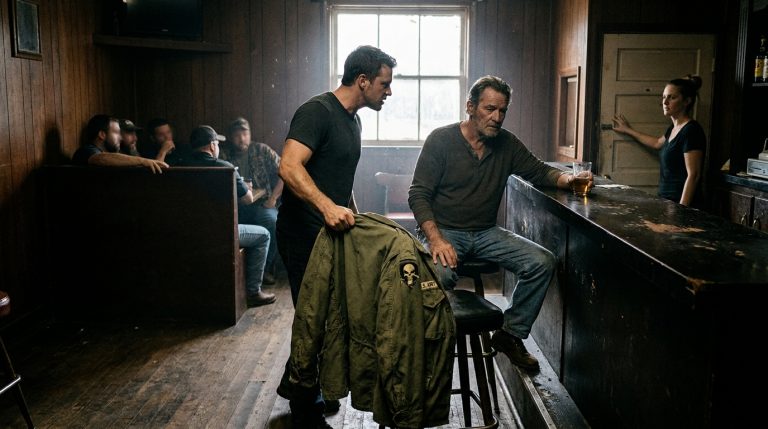
Harold Vance sat at the head, his M-65 jacket draped over the back of his chair, revealing the worn, thin sweater beneath. He looked older today, the fragility of his frame more apparent in the clear, honest light of day, but his eyes were bright, almost youthful. Beside him sat Duke, his posture finally relaxed, his hands no longer clenched in pain.
They weren’t eating a meal; they were concluding a life.
Marla approached the table, the pot of coffee in her hand. She felt a profound, quiet strength settling into her limbs. She had repaired the photograph earlier that morning, cleaning the dust from the frame and tightening the backing. It was back on the wall, and this time, it felt like a part of the building, a foundation stone rather than a decoration.
She poured coffee for Harold, then for Duke, then for the others. As she did, she looked at their faces. There was no fear there, no ghosts, just the simple, heavy reality of men who had done their job and were waiting for the final relief.
“The breakfast was perfect, Ma’am,” Harold said, his voice quiet but clear. He reached out and touched the edge of Ruth’s empty plate. He didn’t look at it with the grief that had defined him for forty-one years; he looked at it with a steady, quiet love.
“I’m glad,” Marla said.
Duke Callahan leaned back, his gaze sweeping the diner. He saw the families, the neighbors, the quiet shift in the town’s atmosphere. He leaned toward Harold. “You did it, Sergeant. You brought them home.”
Harold shook his head, a small, knowing smile touching his lips. “I didn’t bring them home, Duke. I just kept the door open long enough for them to find their way.”
The atmosphere in the room shifted. It wasn’t the sudden, jarring revelation of a secret; it was the slow, methodical settling of a truth that had been present all along. The town hadn’t been fighting Harold; they had been fighting their own fear of being small, of being forgotten, of being unloved. By witnessing these men—by choosing to see the fragility of their courage—Willow Creek had stopped running.
The revelation of their terminal journey didn’t come from a speech or a document. It came from the way they held each other’s hands during the prayer, the way they moved slowly and deliberately, and the way the entire town, in a silent, unspoken collective agreement, stood up as one when it came time for the Rangers to leave.
There were no salutes today. Just nods. Just a profound, heavy silence as the men rose, their joints aching, their bodies failing, but their heads held high. They walked toward the door, their steps out of sync, a broken line of heroes making their way back into the world.
Marla walked with them to the entrance. She opened the door, letting the cool, clean autumn air fill the room.
“Thank you,” she whispered, her gaze meeting Luis Ortega’s.
“Thank you, Marla,” he replied, his voice a ghost of its former strength. “For the coffee. For the witness.”
They stepped out into the golden morning. Harold was the last to go. He paused at the doorway, his hand on the frame. He looked back at the diner—at the polished silver, the clean floor, the framed photograph, and the woman who had finally learned how to hold a space for the things that mattered.
“Keep the pot on,” he said softly.
“I will,” Marla promised. “Always.”
He nodded, a final, complete gesture of surrender and peace, and stepped out into the light.
Marla watched them go. She watched until the last Suburban disappeared into the rolling hills that cradled the town, their path marked by a plume of dust that caught the sun and turned it into gold. She closed the door, the latch clicking with a final, satisfying resonance.
She turned back to the room. It was quiet, but it was a warm, living quiet. She walked to the center table and began to clear the plates. She picked up Ruth’s plate, the napkin folded neatly beneath it. She wiped the table clean, the cloth moving in a circular, rhythmic motion that felt like a meditation.
She stopped at the host stand. She saw the photograph, the twelve men in their tan berets, their faces etched with the hard-won dignity of men who had seen the worst of humanity and chosen to be the best of it. She took a cloth and wiped the glass, her reflection staring back at her—not the terrified, guarded woman who had arrived months ago, but someone who had been broken, pieced back together, and now understood the value of the cracks.
She had lost the men, but she had gained the town. She had lost the ghost of her father, but she had gained the memory of her own strength.
She walked to the window, the morning sun warming the back of her neck. She looked out at the road, the world wide, beautiful, and desperately in need of witnesses. She reached for the light switch, but paused. The room was bright enough. She turned and went back to the kitchen, the promise of the coming shift a welcome, steady rhythm.
She was home. And for the first time in her life, home was a place she didn’t have to hide from.