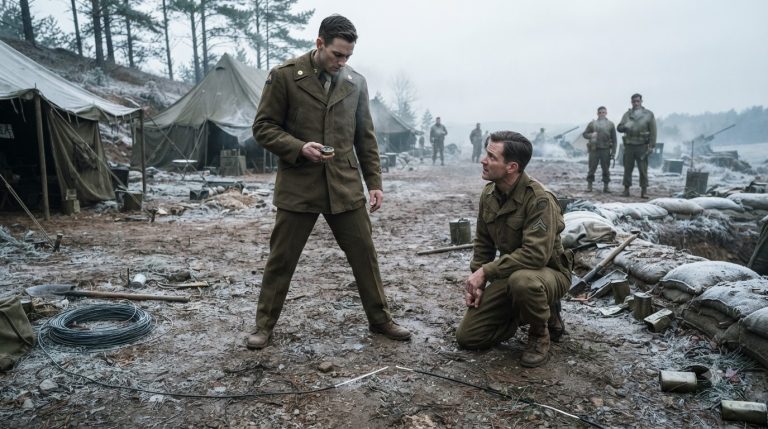
A Bridge of Echoes: The Silent Legacy of Sergeant Major Elias Thorne and the Reshaping of Fort Benning
CHAPTER 1: The Weight of a Salute
The mess hall at Fort Benning did not breathe. It was a space suspended in the amber of a thousand eyes, all fixed on the thin, stooped back of the man who had just dismantled a captain with two words. Elias Thorne felt the air around him change—not from the sudden surge of respect, but from the realization that he was no longer a secret. He was a beacon.
He held the general’s salute, his own hand shaking with the ghost of a muscle memory he hadn’t tapped into for decades. General Vance’s face was a mirror of conflicting emotions—the professional mask had shattered, revealing the raw, unpolished grief of a man whose history had just walked into his mess hall.
“Sergeant Major,” Vance repeated, his voice vibrating with a cadence that belonged more to the front lines than the polished floor of an officer’s dining area.
Thorne lowered his hand, feeling the joints protest the sudden exertion. Around them, the rhythmic thud-click of hundreds of soldiers coming to attention was a chorus of apology. It was a sound Thorne had spent forty years trying to forget, the sound of an army that demanded recognition of its own mortality.
“General,” Thorne said, his voice a low gravel that seemed to absorb the ambient noise of the room. He didn’t look at Captain Hayes. To look at him would be to acknowledge the pettiness, and Elias had no room left for the small things.
Vance stepped closer, his hand resting on Thorne’s shoulder—a grip that was firm, apologetic, and terrified. “Let’s get you out of here,” Vance murmured, his eyes flicking briefly to the terrified, ashen-faced captain. “This is not the place for ghosts to walk.”
As they navigated the aisle of rigid, saluting figures, Thorne noticed the details he had been ignoring for years: the fraying stitching on a young private’s sleeve, the scuff marks on the boots of the sergeant near the door, the specific, tired way the light hit the dust motes dancing in the cafeteria air. He was a man made of past-tense, and yet the present was pulling at his coat, begging for attention.
They reached the heavy steel doors. Before they stepped through, Thorne paused, glancing back at the room. He saw Miller—the young private with the wide, questioning eyes—standing frozen, a forgotten tray in his hands. There was a hunger in the boy’s face, not for food, but for the truth that Thorne carried in his bones.
Vance pulled the door open, the corridor beyond bright, sterile, and blindingly modern. “I have a car waiting, Sergeant Major,” the General said, his voice dropping to a confidential tone. “There is so much you haven’t been told.”
Thorne stopped. He felt the pull of the office, the comfort of the General’s plan, but the image of the young soldiers remained burned into his vision. “General,” Thorne said, his voice stopping the older man in his tracks. “The soldiers in there… they don’t need a history lesson. They need to know why they wear the uniform.”
Vance turned, his face etched with a sudden, sharp clarity. “And do you know, Elias? After all the blood, the prison, the erasure?”
Thorne looked at his own calloused hands, the skin papery and thin. “I know that it’s not about the mission, sir. It’s about who you’re standing next to when the fire starts.”
As the heavy doors clicked shut behind them, sealing them away from the mess hall, the sudden quiet was punctuated by a sharp, rhythmic tapping from down the hall. A courier was approaching, holding a file that looked significantly more battered than anything else in this pristine building—a file that had clearly been pulled from the deepest, most restricted archives of the base.
CHAPTER 2: The Archives Breath
The heavy doors of the mess hall clicked shut, a final, muffled sound that severed the connection between the spectacle of the last hour and the reality of the present. The silence of the corridor was different from the silence of the room behind them; it was clinical, polished, and hummed with the faint, electronic vibration of high-end climate control.
General Vance kept his pace measured, his shoulders squared, but Thorne could hear the slight irregularity in his breathing. He wasn’t just walking; he was marching away from a reckoning.
The courier, a young man who looked as though he had been pulled straight from a desk in the deepest bowels of the Pentagon, stood rigid against the wall. He gripped the file—its edges frayed, its leather casing scarred by time—like a holy relic. When he saw the General, he snapped to attention so sharply that the sound echoed down the linoleum like a pistol shot.
“Sir,” the courier clipped. “Requested documentation. Emergency access granted.”
Vance reached out, his hand steadying for a fraction of a second before he took the file. As he did, he didn’t look at Thorne. His eyes remained fixed on the scarred leather. “Thank you, Specialist. You’re dismissed.”
The courier vanished as quickly as he had appeared, his boots fading into the distance. Vance stopped at the intersection of the main hallway and the restricted wing. He didn’t look back, but his voice was tight, thin as parchment. “I did not know you were here, Elias. But when the reports started coming in from the gate security logs—not the digital ones, but the handwritten ones—my chief of staff called me. They had flagged a name that wasn’t supposed to be on any list.”
Thorne watched the play of light on the General’s uniform. The gold bars of his rank caught the fluorescent glare, turning them into cold, unyielding points of brilliance. “People have long memories, General,” Thorne replied softly. He felt a sudden, sharp ache in his chest—a phantom sensation triggered by the hum of the ventilation. It reminded him of the prison, the way the air in the cell felt just like this: recycled, filtered, and entirely devoid of life. It was a [V-2] memory, unbidden and cold, forcing him to plant his feet firmly to keep from swaying.
“I need to know,” Vance said, finally turning to face him. His eyes were no longer those of a three-star general; they were the eyes of the young man he had been forty years ago, reading the initial mission brief that his father had placed on a mahogany desk. “Was it him? Did my father authorize the extraction, or did he leave you in the dirt to preserve the optics of the ceasefire?”
Thorne stared at the file. The leather was weathered, a faded, cracked texture that felt like dry earth under his fingertips. He remembered the feeling of that same leather in a bunker a lifetime ago. “You’re looking for a hero or a villain, sir. The truth is usually just a man making a choice because he’s out of time.”
“The file says otherwise,” Vance whispered. He opened the folder just enough for Thorne to see the seal. It was a deep, bruised purple, the mark of a command that had been scrubbed from every official record.
Thorne felt the weight of it. Every step they took toward the General’s office felt like walking deeper into a crypt. He had spent decades ensuring that the echoes of that mission stayed buried, a quiet Kintsugi of a life held together by the glue of silence. Now, the General was trying to pull the seams apart.
“You aren’t protecting me, General,” Thorne said, his voice gaining that resonance that had silenced the mess hall. “You’re trying to absolve a ghost.”
Vance didn’t answer. He turned on his heel and continued walking, his movements precise, almost mechanical. Thorne followed. The hallway seemed to stretch, the walls lined with portraits of men who had fought wars the world had already forgotten. He was walking among his own kind, yet he felt like an intruder in a museum dedicated to his own death.
When they reached the General’s office, the doors opened with a soft, pneumatic hiss. The room was dim, illuminated only by the soft glow of a desk lamp. It was a space designed for decisions that were never meant to see the light of day. Vance set the file down on the center of the desk and walked to the window, staring out at the expansive, darkened parade ground.
“You were meant to die, Elias,” Vance said, his back to the room. “The file confirms it. There was a secondary directive in the original planning phase. It wasn’t just to stop the conflict. It was to ensure that the team who stopped it never made it back to talk about how it was done.”
Thorne stood in the center of the room, the faded texture of the carpet grounding him. He didn’t feel rage; he felt a profound, weary sadness. The secret was out, not because of a betrayal, but because of a son’s need to mourn a father he never truly knew.
“I know,” Thorne replied, his voice barely a whisper. “I’ve known since the first night we crossed the border.”
Vance turned, his face pale, the weight of the revelation shifting the entire foundation of the room. The silence that followed was not one of peace, but of a long-overdue collapse.
CHAPTER 3: The Archives Weight
General Vance’s admission hung in the stale, conditioned air of the office, heavier than the mahogany desk it hovered over. Elias Thorne didn’t move. He kept his hands at his sides, fingers slightly curled, feeling the persistent, dull ache in his joints—the tax paid for a life spent in the shadows. He looked at the General, watching the way the man’s jaw muscles corded, the sign of a man realizing that the foundation he had built his career upon was made of sand.
“You say that like it’s a surprise, General,” Thorne said, his voice quiet, steady as a heartbeat in a hushed room.
Vance shook his head, finally turning away from the window. The ambient light of the desk lamp caught the graying temples of his hair, highlighting the exhaustion he had been hiding behind his rank. “I knew there were gaps in the records. I knew the mission was a ghost story. But to see it in black and white, to see the signature of the man who held my father’s trust… it’s not just a surprise. It’s a betrayal.”
Vance reached out, his hand hovering over the file, but he didn’t open it. The leather cover looked archaic here, surrounded by digital tablets and secure communication lines. It was a fragment of a different world, a tactile reminder of a time when decisions were made with ink and blood rather than algorithms.
“I need to know what happened at the objective,” Vance pressed, his eyes searching Thorne’s face. “The file ends at the extraction point. It claims the team was compromised by a deliberate failure of the comms relay.”
Thorne took a slow step forward. The carpet was plush, absorbing the sound of his movement, but he could feel the grit of dust beneath his heels—a remnant of the base’s older, uncleaned sections that had likely found its way into the ventilation. He moved toward the desk, his gaze dropping to the file. He noticed something—a subtle [V-1] inconsistency. The ink on the final, redacted page was inconsistent in density, as if the person who had redacted it had hesitated, their hand shaking for a split second before they committed to the black bar.
“The comms didn’t fail, General,” Thorne said, his voice dropping an octave. “They were cut. From the inside.”
Vance went still. The room felt like it had been vacuum-sealed. “Why?”
“Because if we succeeded, the war would have ended in a week. And a war that ends in a week doesn’t have a place in the budgets of the men who write the history books.” Thorne didn’t need to read the file to know what it contained. He could feel the weight of it in the room, a physical manifestation of a forgotten truth.
Before Vance could respond, a soft, insistent beeping emanated from the General’s console. It was the secure line—a signal that interrupted the weight of the moment. Vance looked at the terminal, then at Thorne, then back to the file. His hesitation was brief but telling. He was torn between the urge to finish the conversation and the necessity of his station.
“I have to take this,” Vance said, his voice strained. “Stay here. Do not leave the office.”
As the General turned to the console, Thorne watched him. He saw the way Vance walked—the posture of a man carrying a burden he had only just realized wasn’t his to bear. Thorne turned back to the file. He knew he shouldn’t touch it. It was a trap, a lure, or perhaps just a mistake. But as the General began the coded handshake with whoever was on the other end of the line, Thorne’s fingers brushed the scarred leather cover.
He didn’t open it. He didn’t need to. He leaned down, his eyes scanning the desk’s surface. Beneath the edge of the file, tucked partially out of sight, was a scrap of yellowed paper—a receipt or a note. It wasn’t part of the official archive. It was a personal note, scribbled in a handwriting he recognized from forty years ago.
He didn’t reach for it. He simply stood there, his mind racing. He had come here for a cup of coffee, and now he was standing in the center of a storm he had walked away from decades ago. The room felt smaller, the walls closing in as the General spoke into the comms, his voice low, urgent, and increasingly defensive.
Thorne looked at the door. It was closed, secure, and monitored. He was an invited guest, yet he felt the old, familiar instinct of a man trapped behind enemy lines. He glanced at the General, who was now engaged in a heated, muted argument with his caller. Thorne took a breath, the smell of old paper and ozone filling his lungs, and reached out to adjust his jacket. His hand hovered over the scrap of paper on the desk. He didn’t know who had put it there, but he knew that if he walked out of this room without it, the truth would be buried again—and this time, it might not be a ghost story. It would be a crime.
He caught a glimpse of himself in the reflection of the darkened window. He looked older, tired, and fragile. But for the first time in years, the ancient steel in his eyes was glowing. He was no longer just an old man sitting in a library; he was a participant in a history that refused to stay buried. He looked at the General, then down at the scrap of paper. He reached out, his movements fluid and unhurried, and slid it into his palm.
CHAPTER 4: Echoes in the Barracks
The General’s voice remained a low, rhythmic drone as he sparred with the unseen caller, his silhouette framed by the stark, artificial glow of the terminal. Thorne stood motionless, his back to the man, his fingers curling inward to shield the scrap of paper. He felt the paper’s edge—sharp, brittle, and impossibly dry against his skin. It was a tangible, physical discrepancy in a room filled with polished glass and high-tech security, a piece of the past that refused to be digitized.
He did not look at the General again. He kept his breathing shallow, rhythmic, the kind of control that had served him in places where sound was a death sentence. He stepped toward the office door, his movements fluid, calculated to avoid the sweep of the security sensors he knew were mounted in the upper corners of the frame. He had navigated systems like this before; they were designed to detect motion, but they were notoriously poor at differentiating between a threat and a shadow.
He slipped out into the hallway. The silence of the corridor was absolute, a stark contrast to the urgency of the conversation he had just escaped. His destination wasn’t the exit. He needed to find Miller—the young private whose earnest face had been the first crack in the rigid armor of the base’s current culture. He needed to understand if this base was truly as modern and detached as Hayes had led him to believe, or if there were still soldiers who knew how to listen.
Thorne walked with a subtle, dragging hitch in his gait, an old man playing the part of a relic, but his eyes were sharp. He moved through the arterial corridors of Fort Benning, his senses adjusting to the environment. He smelled the faint, chemical scent of floor wax and the metallic tang of heavy machinery—a familiar sensory texture that triggered a [V-4] realization. For years, he had accepted his memories of the mission as a single, cohesive narrative. But as he walked, he noticed the way the lighting in the hall mimicked the exact frequency of his bunker-prison—a subtle, persistent, low-grade hum. He stopped, leaning his hand against the cool, damp concrete of the lower barracks stairwell. Was it a coincidence, or was his own sense of recall, his own grasp of the “truth,” a carefully curated architecture?
He pushed the thought down. He reached the barracks, a stark, functional structure that smelled of communal life and damp wool. He found Miller in the common area, surrounded by a group of younger privates. They were hunched over a tablet, their faces pale in the blue light, but as Thorne stepped into the room, the atmosphere shifted. They didn’t just stop talking; they stood, a reflexive, awkward movement that spoke of a deep-seated, sudden respect.
“Sergeant Major?” Miller blinked, his voice hovering somewhere between disbelief and awe.
Thorne walked over, his presence slowing the room. He didn’t look like a hero; he looked like a man who had seen too much and was tired of carrying it. He held out the scrap of paper, his fingers steady. “I need you to tell me what this is,” he said, his voice a low, gravelly rasp that seemed to anchor the room.
Miller stepped closer, squinting at the faded ink. The room was deathly quiet. A few of the privates shifted, their boots scuffing on the concrete floor, a sound that felt like sand in a watch movement. “Sir,” Miller whispered, “this is a requisition code. It’s an old one, used for ‘Deep Field’ asset management. It’s not for personnel. It’s for… equipment recovery.”
Thorne looked down at the scrap. The ink density, the way the numbers were spaced—it wasn’t just a code. It was a location. A coordinate set that he had never seen before, yet his brain felt the pull of it, a physical ache in his temple.
“Why would it be on the General’s desk?” one of the other privates asked, his voice trembling slightly.
Thorne didn’t answer. He looked at the faces around him—young, untainted by the ghosts of his war, yet burdened by the reality of their own service. He saw the shift in them, the way they looked at him not as a curiosity, but as a map to a truth they had all suspected but never dared to touch.
“Because,” Thorne said, his voice gaining that resonance, that ancient, hard-won steel, “some ghosts don’t want to stay buried. And some missions never actually end.”
He turned to the door. He didn’t need to say more. The air in the barracks had shifted. The smell of damp concrete and the low, hum of the base had become a backdrop to something far more dangerous. He walked out, his hand gripping the scrap of paper. He felt the weight of the base around him, the thousands of lives that were built on the lie of his sacrifice. He wasn’t just a visitor anymore. He was the catalyst.
CHAPTER 5: The Library of Shadows
The darkness was not absolute; it was a deep, charcoal gray, punctuated by the rhythmic, dying pulse of emergency exit signs. Thorne didn’t move. He stood in the center of the library, the scrap of paper still clutched in his palm, his senses hyper-alert. The sudden cessation of the air handling units had turned the room into a tomb of stagnant, paper-laden silence. He could feel the weight of the shelves surrounding him—thousands of books, thousands of records, thousands of years of human endeavor, all held in suspended animation by the loss of the grid.
He knew this wasn’t a mechanical failure. This was a tactical blackout. Someone was cutting off the eyes and ears of the facility, and he was currently standing in the center of the kill zone.
He moved toward the archives, his boots silent on the carpeted floor. He needed to get to a terminal that wasn’t networked, one that relied on the base’s older, analog infrastructure. If the General was being compromised by an unseen caller, the paper in his hand—the requisition coordinate—was the only map to the truth.
He found the entrance to the archival vault, a heavy, brushed-steel door that required a manual override. As he gripped the cold, metallic handle, the emergency lights flickered, casting long, dancing shadows that seemed to distort the architecture of the shelves. He pushed the door open. The vault smelled of ozone and deep, undisturbed dust. It was the smell of the past being kept alive through friction and neglect.
He didn’t use his flashlight. He didn’t want to alert whoever was pacing the hallway outside. He navigated by the dim, filtered light of the exit sign, his hands sweeping across the metal file cabinets until he found the row marked with the date of his last mission.
He began to pull the drawers, the sound of metal sliding on metal a harsh, discordant scraping in the quiet vault. He wasn’t looking for files anymore; he was looking for the requisition logs, the physical ledgers that would contain the matching entry for the coordinate he held.
Suddenly, the silence was shattered by the rhythmic, heavy clatter of boots in the hallway—not the hesitant, soft-soled steps of a private, but the deliberate, heavy stride of a security detail. They weren’t patrolling; they were hunting.
Thorne pulled a ledger from the bottom drawer, the paper brittle and yellowed, a faded texture that felt like dry, dead leaves under his touch. He opened it, his eyes tracing the faded ink in the flickering, dying light. He found the coordinate. It wasn’t for equipment recovery, as Miller had guessed. It was for a clandestine transport flight, marked for the same night his team had been sent behind enemy lines. The transport had been waiting, idling, not at the extraction point, but at a secondary rally point that had never been disclosed in the official briefings.
His heart didn’t race; it slowed, a cold, clinical thud against his ribs. He had been sold out not just to preserve a war, but to facilitate a diversion. The extraction hadn’t failed; it had been canceled before they even landed.
The footsteps stopped outside the vault. A shadow crossed the threshold, the silhouette of a man holding a weapon, the barrel of the light-refracting off the emergency glow.
“Sergeant Major?” a voice called out. It wasn’t a soldier’s voice; it was too smooth, too polished—a voice that belonged in a courtroom, not a barracks. “The General has requested your presence. And he’s asked that you bring all the documentation you’ve… recently acquired.”
Thorne didn’t look up from the ledger. He felt the cold iron of the file cabinet against his spine. The realization crystallized: the General wasn’t the one hunting him; the General was the bait. Someone else was running the show here, someone who had waited forty years to close the file on Operation Phoenix.
“I’m afraid I’m in the middle of a history lesson,” Thorne replied, his voice a low, steady rumble that seemed to vibrate against the metal walls.
The man in the doorway stepped into the vault, his posture too rigid, his eyes scanning the shelves with an indifference that was more dangerous than malice. He was a creature of protocol, a man who saw no moral weight in the shadows of the past. “History is a matter of interpretation, Sergeant Major. I’m here to finalize the edit.”
Thorne felt the weight of his own history, the thousands of days he had spent believing in the necessity of his own silence. He felt the scrap of paper, the ledger, and the cold, unyielding reality that the past was a weapon, and he was the only one who knew how to hold it. He didn’t reach for a weapon. He didn’t look for an exit. He stood his ground, the ledger open, the truth staring them both in the face, and he waited for the man to make the first move. The darkness seemed to thicken, the emergency lights dimming to a final, fading spark, leaving them in the hollow, echoing silence of the archive.
CHAPTER 6: The Architect of Silence
Thorne didn’t look away. His eyes, clear and ancient, tracked the gunman’s posture. The man was balanced, his weight shifted slightly to the balls of his feet, his grip on the weapon a lesson in practiced, sterile efficiency. He wasn’t a soldier; he was a cleaner, a man who viewed the past as a structural defect to be removed.
“Finalize the edit,” Thorne repeated, his voice low, a sound that seemed to draw the stagnant air of the vault toward him. He didn’t drop the ledger. He held it against his chest, a shield made of ink and forgotten promises. “You talk like a man who’s never had to look a ghost in the eye.”
The man in the doorway didn’t blink. “I don’t believe in ghosts, Sergeant Major. I believe in documentation. And your continued presence is a clerical error.”
The gunman moved, a sudden, blurred shift of motion that was as fast as it was precise. Thorne shifted, his own body reacting with a fluidity that shouldn’t have been possible for a man of his years. He slammed the heavy steel drawer of the cabinet shut, the clang echoing like a cannon blast in the confined space of the vault. The sound acted as a physical barrier, a discordant noise that forced the gunman to pause, his aim flickering for a fraction of a second.
In that heartbeat, the memory hit Thorne—a [V-2] phantom of a cold, wet night forty years ago. He remembered the specific, high-pitched static of a radio dying, the sound of a voice—his commander’s voice—telling him that the extraction had been scrubbed. He remembered the smell of rain and sulfur. The memory was so vivid, so visceral, that for a split second, the library vault and the jungle clearing overlapped. The gunman wasn’t just a threat; he was a manifestation of the same cold, administrative indifference that had left his team behind.
Thorne lunged forward, not toward the man, but toward the light—the dim, pulsing exit sign. He swiped his hand across the emergency lighting circuit, his fingernails catching on the rough, frayed edges of the internal wiring. A spark jumped, a sharp, white-hot bite of electricity that surged through his arm, but it achieved his purpose. The circuit tripped.
The room plunged into absolute, suffocating darkness.
The sound of the gunman’s movement changed—a sudden, sharp intake of breath, the rustle of synthetic fabric against metal shelves. Thorne didn’t stay still. He knew the geography of this vault; he knew how the sound of a breathing man moved through the stagnant, dust-choked air. He moved toward the back of the archives, his heart a steady, calm rhythm against his ribs. He was no longer the frail old man. He was the commander of Phoenix 1, moving through the dark, through the fire, through the silence.
“You can’t delete history, son,” Thorne whispered, his voice appearing to come from everywhere at once, drifting off the metal shelves, echoing in the corners of the room. “You can only bury it deep enough that it rots the ground you stand on.”
The gunman fired—a quick, muted thwip-thwip of a suppressed weapon. The rounds struck the metal filing cabinets near Thorne’s shoulder, the impact spraying metal shavings and old, dry dust into the air. The taste of copper and grit was thick on Thorne’s tongue. He realized then that he didn’t need to defeat the man in front of him. He needed to expose him.
Thorne reached the terminal he had been seeking—the manual override for the base’s public address system. He had noticed it earlier, a relic of a time before digital management, a simple, hardwired connection that bypassed the General’s secure network. He jammed the coordinate scrap into the interface, his fingers finding the familiar, tactile ridges of the legacy hardware.
He didn’t need to hack it. He just needed to broadcast the frequency.
“General Vance,” Thorne said, his voice amplified, carrying through the dormant speakers of the base, a ghostly resonance that sounded like the voice of the dead returning home. “I’m in the vault. The edit is being finalized.”
The gunman froze. The sound of his footsteps, now cautious and erratic, signaled a shift in his confidence. He was no longer a cleaner; he was a man being watched. Thorne felt the man’s panic, a palpable, jagged texture in the air.
“You’ve triggered an alert,” the man hissed, his voice finally losing its polished composure. “The General will be here in minutes. You’re trading your life for a secret that died in 1985.”
Thorne leaned against the cabinet, the cold bite of the steel grounding him. He could hear the distant, growing cacophony of sirens and the heavy, thundering sound of the base’s security forces converging on the archives. He looked at the ledger, then at the shadow in the doorway. He had survived the mission, the prison, and the forty-year silence. He was ready for the morning.
CHAPTER 7: The Burden of Command
General Vance moved with a leaden, mechanical gait, his service pistol held in a low-ready position that spoke more of internal agony than tactical preparedness. The security team behind him stood like granite statues, but it was Vance’s presence that dominated the room—the weight of his uniform, the three stars on his collar gleaming under the harsh white strobe of the tactical lights.
“Put it down, Elias,” Vance said. His voice was not the booming command of a general; it was brittle, a fragile thing that cracked at the edges.
Thorne didn’t move. He stood in the shadows of the filing cabinets, the ledger still gripped against his chest. He could see the General clearly now—the way his fingers trembled against the grip of the pistol, the way his gaze kept flicking to the scrap of paper on the floor, as if it were a contagion. Thorne felt a strange, cold clarity. He had spent his life believing that the military was a machine of precision, but standing here, watching the most powerful man on this base crumble under the weight of a paper record, he realized it was just a collection of men trying to hide from their own shadows.
“You know what this is, don’t you?” Thorne asked, his voice steady. He didn’t raise his hands. He held his ground. “You’ve known since you were a lieutenant, scouring your father’s desk for signs of why he went gray overnight.”
Vance stopped ten feet away. The air between them was thick with the scent of ozone from the fried circuit—a sharp, stinging texture that clung to the back of Thorne’s throat. “I’ve spent twenty years trying to balance the ledger, Elias. I thought if I could build a base, a career, a legacy that was beyond reproach, I could bury the stain of what was done to your team.”
“You haven’t buried it,” Thorne said, stepping forward. The movement was deliberate, a slow, predatory advance that forced Vance to adjust his aim. “You’ve been feeding it. Every time you redacted a file, every time you looked away when a captain like Hayes abused the rank, you were just adding soil to the grave.”
Vance’s face darkened, a flash of something raw and deeply buried—the [V-1] discrepancy—the way he finally looked Thorne in the eye, his gaze not filled with authority, but with a desperate, naked plea. “If this comes out, the entire command structure is compromised. The lives of thousands of men, the stability of the region—it all rests on the belief that we are, and always have been, honorable.”
“Honor isn’t a coat you wear, General,” Thorne replied, his voice rising, carrying through the vault, hitting the metal walls and bouncing back. “It’s what you do when the cameras are off and the files are burned. If you want to be honorable, stop protecting the ghosts. Start protecting the soldiers.”
Thorne opened the ledger. He didn’t hide the pages. He held them out, the yellowed, brittle paper looking impossibly fragile in the harsh tactical light. “You have a choice. You can finish what your father’s mentors started, or you can finish what Phoenix 1 began.”
Vance’s weapon dipped. The silence in the room was no longer the silence of an ambush; it was the suffocating, heavy silence of a verdict. The security detail shifted, uncertain, caught in the wake of a conflict that defied their training manuals. They weren’t trained to handle a confrontation between a legend and their commanding officer.
Vance looked at the ledger, then at the man he had once viewed as a myth—a frail, stooped figure who suddenly seemed to possess more authority than the entire Pentagon combined. The General’s breath hitched, a sound of absolute, devastating surrender.
“I don’t know if I can undo it,” Vance whispered, the pistol lowering until it pointed at the floor.
“You don’t undo the past,” Thorne said, closing the ledger with a soft, decisive thud that seemed to ring through the vault. “You just stop pretending it isn’t happening right now.”
Thorne walked past the General. He didn’t rush. He didn’t offer a hand. He simply moved into the hallway, the security team instinctively parting to let him through. He left Vance standing in the center of the vault, a man surrounded by the ghosts he had spent his life protecting, finally facing the reality of his own hollow command. Thorne’s journey wasn’t over, but the walls of the base—those cold, sterile, impenetrable walls—finally felt like they were starting to crumble.
CHAPTER 8: The Morning of Truth
The sunrise over Fort Benning was not a spectacle; it was a slow, muted brightening of the world, a transition from the cold blue of pre-dawn to the soft, desaturated gray of a new day. Elias Thorne walked across the parade ground, his boots crunching rhythmically on the fine, damp gravel. He did not look back. He did not need to. The General was behind him, standing in the doorway of the archives—a figure diminished by the light, clutching the burden of a secret that had finally stopped burning.
The truth, revealed in the quiet intensity of the archive vault, had been a sharp, clean cut. General Vance’s father had not just sent the Phoenix team into the meat grinder; he had been the architect of the silent extraction, the man who had prioritized political posturing over the lives of his best soldiers. The General had lived his entire life beneath the shadow of that sin, building a monument of gold and procedure to hide the fact that his legacy was built on betrayal.
But the Payoff had arrived not with a thunderclap, but with the cold, hard evidence of the requisition log. Vance was now faced with the only logical outcome: the total, transparent dismantling of his own command. He would have to admit the truth to his superiors, or he would be destroyed by it. Thorne had left him with no other option.
As Thorne reached the edge of the base, he stopped. His field jacket, weathered and worn, felt heavy on his shoulders—a comfortable, familiar weight. He reached into his pocket and pulled out a small, metallic object he had kept since the prison camp: a simple, bent brass pin from a compass. He had spent years trying to straighten it, a physical manifestation of his need to find a way back home. He looked at it now, held it between his calloused thumb and forefinger, and finally, with a calm, deliberate motion, he pressed it into the soft, damp earth at the base of a flagpole. Symbolic closure. He didn’t need the compass anymore. He knew exactly where he was.
A soft sound broke the morning quiet. It was Private Miller, approaching from the direction of the barracks. The young soldier stopped a few paces away, his face etched with a mix of exhaustion and a burgeoning, quiet resolve.
“Sergeant Major,” Miller said, his voice stripped of the nervous energy that had defined their earlier encounter. He held out a cup of coffee, the steam rising in a thin, fragile coil into the morning air. “The canteen’s open.”
Thorne took the cup. The warmth was deep, radiating through his fingers, a contrast to the chill of the morning. “Thank you, Private.”
“What happens now?” Miller asked, looking out toward the main gates, where the base was slowly beginning to hum with the activity of a new day—a day that would surely be defined by the tremors of the night’s revelation.
Thorne took a slow, thoughtful sip. He thought of the General, the files, the men who had died, and the soldiers who were left to inherit the mess. He thought of the forty years of silence he had maintained to keep the peace, and the way that silence had only served to harden the rot. “Now?” Thorne repeated, his voice soft, the gravelly edge smoothed by a profound, internal peace. “Now, the real work begins. Not the fighting. The remembering.”
He looked at Miller, seeing the future not as a destination, but as a path to be walked with eyes wide open. He realized that the “Phoenix” mission hadn’t failed; it had simply taken a very long time to finish. The healing of a culture—the Kintsugi of the soul—wasn’t something that happened in a single night. It was a slow, deliberate process of acknowledging the cracks and choosing to fill them with the gold of the truth.
He patted the young soldier on the shoulder, a gesture that bridged the gap of generations and experiences. He didn’t offer any more advice, any more legends, or any more secrets. He simply turned and walked toward the gate. His pace was steady, his back straight, and for the first time since the day he left the jungle, he walked like a man who wasn’t hiding from anything.
The base continued its morning routine behind him, but the air felt different. It was cleaner, stripped of the heavy, hidden weight of the classification stamps. Elias Thorne stepped out into the light, leaving the ghosts behind, moving into a world that finally had the chance to be honest. He was an old man with a story that would no longer be a secret, and in that honesty, he found the only victory that had ever mattered.