The Weight of Iron: A Legacy Tested Under the Blistering Sun of the High Desert
CHAPTER 1: The Sight of Dust
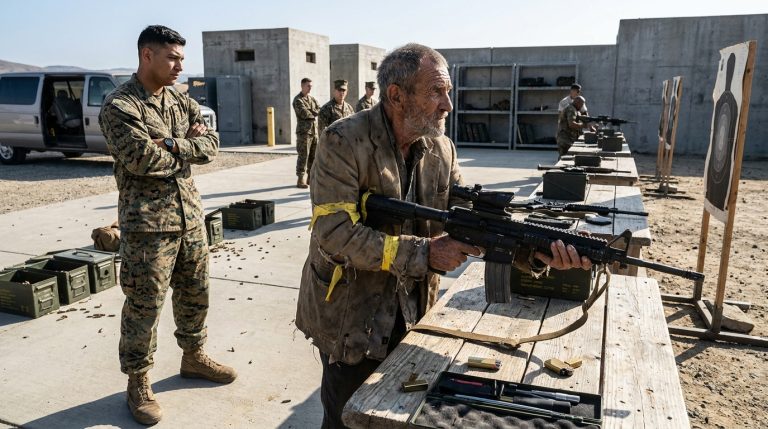
Silas Kane’s thumb traced the checkered walnut stock of the rifle he held—a weathered, iron-sighted bolt action that had seen more winters than the boy standing across the bench. He didn’t look up. He watched a single bead of sweat track a path through the dust on the barrel, watching it evaporate before it could reach the action.
“Five thousand dollars,” the voice repeated, strained now, stripped of its earlier, practiced levity. “Unless you’re scared the old tech can’t handle the distance, Silas.”
Silas finally turned. His eyes, rimmed with the crinkles of decades spent squinting into sun-bleached horizons, landed on the boy. Julian. He looked like his father—the same sharp jaw, the same frantic, shallow breathing that screamed of a need to be seen. But it was the way Julian rested his hand on the Barrett’s grip that stopped Silas cold. The boy hooked his thumb through the webbing of the grip in a way that hadn’t been taught in any civilian training manual. It was a ghost of a habit, a quirk that belonged to a man who had been dead in the ground for twenty years.
“The money isn’t the point, son,” Silas said, his voice like grinding stones. He set his rifle down with agonizing deliberation. The wood clicked against the metal stand—a hollow, final sound. “The point is that you’re carrying a cannon to a conversation that requires a whisper.”
He walked toward the firing line, his boots crunching rhythmically against the dry earth. He didn’t care about the five grand. He cared about how a kid who couldn’t be older than twenty-five knew the specific, idiosyncratic tension a man applied to a trigger when he was trying to hide a tremor.
As he reached his station, a sudden gust of wind kicked up a veil of grit between them. Through the haze, Silas caught a flash of something strapped to the boy’s tactical vest—a small, silver carabiner, rusted and mangled at the hinge. It was an piece of gear from the ’04 extraction.
Silas felt the cold prickle of realization, a sharp spike of adrenaline that cut through his fatigue. That carabiner wasn’t bought at a shop. It had been recovered from the debris field where Silas had walked away alone.
Julian was looking at him, a half-smile playing on his lips, but the eyes were dead, calculating. He wasn’t here to shoot targets. He was here to collect.
CHAPTER 2: The Echo of Iron
Silas didn’t blink. He watched the way the sun caught the edge of the carabiner—a jagged, silver tooth against the olive-drab webbing of Julian’s vest. The sound of the wind, which moments ago had felt like nothing more than a desert nuisance, suddenly took on the quality of a low-frequency hum, vibrating against the hollows of his inner ear.
He looked back at the Barrett. The rifle was a heavy, industrial slab of cold-rolled steel, its muzzle brake looking like a serrated crown. Julian had placed it on the sandbags with a practiced, almost arrogant grace. But it was the way the boy’s hands hovered—not touching, but anticipating—that pulled a memory from the dark back-vault of Silas’s mind.
It was 2004. A ridge in a country that had no name on the map they’d been given. His partner, Elias, had possessed that same twitch. A nervous, flickering energy that manifested in his hands whenever the clock started running down. When the extraction had gone sideways, when the world had turned into a cacophony of incoming fire and screaming metal, Elias had reached for his gear with that exact, frantic cadence.
Silas took a breath, the air tasting of grit and ancient, baked minerals. He shifted his stance, his joints protesting with the dry, muted creak of ungreased machinery. He wasn’t going to acknowledge the carabiner. To give it voice was to give the boy the upper hand.
“That’s a lot of rifle for a Saturday,” Silas said, his voice level, stripped of the jagged edge it held a moment ago. He moved to his station, his movements slow, deliberate, and entirely devoid of wasted energy. He began to prep his own bolt action. “It’s going to bruise your shoulder before you even find your zero.”
“I don’t mind the recoil,” Julian replied. The boy had stepped back, his eyes tracking Silas’s hands. “My father always said you’re only as good as the steel you trust. He respected you, Silas. Said you were the only one who didn’t buckle under the pressure.”
Silas didn’t look up as he chambered a round. The sound—a sharp, metallic clack-hiss—was visceral. It was the sound of a closing door. “Your father was a romantic. Romantics have a habit of misinterpreting survival as integrity.”
“Is that what you call it?” Julian’s voice dipped, losing its performative bravado. It became sharper, more personal. “Survival?”
Silas paused, his finger resting lightly on the cold trigger guard. The memory of the ’04 extraction wasn’t just a scene in his head; it was a physical sensation of burning shrapnel and the taste of blood in the back of his throat. He felt the phantom weight of a man’s shoulder against his own as he’d dragged him toward the extraction zone, only to be forced to let go. He had told himself for two decades that he’d had no choice. But looking at Julian, he realized the lie had become the foundation of his entire life.
He brought the rifle up, the stock biting into his shoulder—a familiar, bruising comfort. He didn’t look at the targets, which were barely visible shimmering shapes through the heat haze at eight hundred yards. He looked at Julian’s reflection in the safety glass of his own sight. The boy was staring at him with a predatory intensity, waiting for a crack in the armor.
“I call it what it is,” Silas murmured, more to the empty air than to the youth.
He steadied his breathing, slowing his heart rate until the world outside the aperture of his sight became a blurred, unimportant smear of brown and gold. He was no longer a man on a firing range in the twenty-first century. He was a ghost in a desert, and the man standing ten feet away was a living embodiment of every mistake he had failed to bury.
Silas exhaled, a long, controlled release that emptied his lungs and tightened his core. He didn’t squeeze the trigger; he let the rifle fire when the arc of his own heartbeat told him the moment was right.
The crack of the report was sharp, sudden, and violent. The bullet kicked up a plume of dust exactly one inch to the left of the steel plate. Not a hit. A warning.
Silas ejected the casing. The brass pinged against the concrete, a discordant, high-pitched bell in the silence of the range. He knew Julian had seen the miss. He also knew that Julian had seen the deliberate inaccuracy. The game had shifted from a contest of marksmanship to something much more dangerous, and for the first time in twenty years, Silas felt the cold, familiar thrill of a fight he wasn’t sure he could win.
“Your turn,” Silas said, stepping back from the line.
CHAPTER 3: The Mechanics of Failure
The echo of the shot died against the canyon walls, leaving behind a silence so dense it felt pressurized. Silas kept his posture rigid, his finger outside the trigger guard, eyes fixed on the distant target—or rather, the empty space one inch to its left.
Julian didn’t move. He stood behind the firing line, the Barrett resting on its bipod like a predator waiting for a mistake. The boy’s gaze shifted from the steel plate to Silas, then back to the target. There was no confusion in his expression, only a slow, deliberate tightening of his jaw. He knew, just as surely as Silas did, that the miss wasn’t a failure of skill; it was a statement of intent.
Then, the range system shuddered. A grinding, metallic shriek erupted from the target rail, and the target carriage—the one Silas had just grazed—jerked, sagged, and jammed midway down the tracks. It hung there at a precarious forty-five-degree angle, swinging in the dry desert wind.
“Equipment failure,” Julian said, his voice clipped and devoid of its earlier, mocking charm. He didn’t look at the target. He kept his eyes locked on Silas. “Seems the gear is as tired as you are, old-timer.”
Silas sighed, a sound of profound weariness. He laid his rifle down on the rubber matting, the metal making a dull, hollow thud against the wood. “Range master’s off today. Guess we’ll have to fix it ourselves if we want to finish this.”
“Or,” Julian said, stepping forward, his boots crunching loudly on the sun-baked gravel, “we could just call it. You missed. I’d say that’s a clear enough answer.”
Silas didn’t offer the bait. He reached into his pocket and pulled out a heavy, leather-bound multitool, the brass hinges worn smooth by years of use. He began the slow, rhythmic walk toward the target rail. The heat rose in shimmering, translucent waves off the ground, distorting the horizon until the world seemed to be liquefying. He felt the familiar weight of the earth under his boots, the steady, unrelenting pressure of the sun on his shoulders—a physical reminder of the stakes he’d been navigating for two decades.
Julian followed. He didn’t keep distance. He walked close enough that Silas could hear the soft, rhythmic clink of the gear on his vest. The carabiner—the rusted, mangled thing—seemed to pulse with every step, a silent, mocking testament to the day the ’04 extraction had collapsed. Silas could feel the boy’s eyes on his back, searching for a tremor, for a sign of age, for a reason to finally push.
When they reached the jammed carriage, Silas knelt. The metal was burning to the touch, searing his skin through his calloused palms. He didn’t wince. He focused on the jammed drive chain, his mind working through the mechanical problem with the same detached, clinical precision he’d once used to calculate windage and bullet drop.
“You have a lot of your father in you,” Silas said, not looking up. He worked the jammed link, the metal resisting his efforts with stubborn, oxidized friction. “He used to walk that same way. Like the ground was an insult he hadn’t yet decided how to avenge.”
Julian stopped. The air between them grew thick, saturated with the smell of scorched dust and old oil. “You knew him well, then. My mother said you were the one who brought his belongings home. The ones that weren’t burned in the wreckage.”
Silas froze, his hands gripping the iron link. The world narrowed down to the grit under his nails. He felt the weight of the moment, the dangerous proximity of the truth he had spent twenty years burying under a mountain of silence. “I brought back what I could find. It wasn’t much.”
“It was enough,” Julian said, his voice dropping into a register that made the hair on Silas’s arms stand up. “But I think you left something behind. Something you weren’t supposed to.”
Silas turned his head, looking up from his crouch. Julian was standing over him, the sun framing his silhouette in a blinding, white-hot corona. The boy looked less like a challenger and more like a judge, his eyes hard, unblinking, and filled with a cold, unrelenting clarity that had nothing to do with the target range or the five thousand dollars.
Silas realized then that the decoy was gone. The money, the Barrett, the arrogance—they were just the smoke. The fire was whatever was inside that vest, whatever secret Julian had spent his life waiting to drag into the light. Silas pushed the link home with a loud, satisfying click. The carriage groaned, dislodged, and rattled back into its track.
He stood up, his knees popping like dry twigs, and met the boy’s gaze. The range felt smaller now, the walls of the canyon pressing in, turning the clearing into a box.
“If you’re looking for answers in the dirt, son,” Silas said, his voice barely a whisper against the rising wind, “you might find things you aren’t prepared to carry.”
Julian didn’t answer. He just stared, his hand drifting toward the mangled carabiner, his expression a perfect, terrifying mirror of the man Silas had once called his best friend.
CHAPTER 4: The Serial Discrepancy
Silas didn’t stand immediately. He remained in the dirt, the heat radiating off the ground soaking into his knees through his heavy trousers. He kept his head tilted, his peripheral vision locked onto the boy’s boots. They were expensive, tactical, and unnervingly clean. He needed a moment to reset the rhythm of his own pulse, to push the phantom of ’04 back into the box where it belonged.
“You speak of my father as if he were a ghost,” Julian said, his voice dropping from a shout to a low, serrated murmur. “But ghosts don’t leave trails. And they certainly don’t leave behind a ledger of their mistakes.”
Silas forced his hands to relax, opening his fingers one by one. The skin was cracked and dry, ingrained with the dark, fine dust of the desert. He stood up slowly, ensuring the movement was fluid, showing no signs of the stiffness that had begun to plague him in the mornings. He kept his eyes averted, focusing instead on the Barrett rifle resting back at the shooting bench. It was a masterpiece of modern engineering, yet as he looked at it from this distance, something in its profile didn’t sit right with his memory of the weapon.
“A ledger,” Silas repeated, turning to face the boy. He kept his expression neutral, a mask of carved stone. “People like your father, they tend to mistake guilt for a record. He wasn’t a bookkeeper, Julian. He was a man who wanted to believe that if he could just tally up his failures, they might eventually balance out to a win.”
He began the walk back toward the firing line. Julian moved with him, maintaining a stride that was perfectly synchronized—a tactical shadow. Silas felt the pressure of that proximity. Every step was a calculation. He needed to get back to the bench, to the rifle, to get a closer look at that discrepancy he had glimpsed from the corner of his eye.
“You’re avoiding the question,” Julian said, his tone sharpening. “He told me about the extraction. The one that was supposed to be a ‘clean sweep.’ He told me he was the only one who didn’t come back whole.”
Silas reached the bench and rested his hand on the forearm of the Barrett. The metal was unnaturally cool compared to the furnace-like air. He glanced at the bolt carrier, tracing the edge of the stamped serial number. He had seen thousands of these rifles in his time, from the early prototypes to the production models currently flooding the civilian market. He knew the format, the font, the way the numbers were laser-etched into the steel.
But this one was different. The alignment of the last three digits was slightly off-center, and the typeface was a fraction thinner than it should have been. It was a field-expedient repair, or perhaps a custom-serialized component stolen from a restricted inventory. Silas’s heart skipped a beat, the realization hitting him with the force of a physical blow. The gun wasn’t just a toy for a rich kid; it was a ghost. It was a component-build, likely scavenged from the same armory that had supplied their unit two decades ago.
“The past is a graveyard, Julian,” Silas said, his fingers lingering on the bolt. “You dig around in it long enough, you’re bound to hit bone. You sure you want to be the one to do the uncovering?”
“I’m not looking for bones,” Julian said, reaching out and grabbing the barrel of the rifle, his hand closing over Silas’s. “I’m looking for the man who pulled the trigger on his own partner.”
The air in the clearing seemed to vanish, leaving them in a vacuum of sheer, suffocating tension. Silas didn’t pull his hand away. He felt the heat radiating from Julian’s palm, a desperate, angry warmth. For a second, the years between them—the twenty years of silence, the two decades of self-imposed exile—dissolved. Silas looked into the boy’s eyes and didn’t see a stranger. He saw the exact, haunting shade of blue that Elias had possessed in the final moments of that mission.
Silas withdrew his hand with a sharp, controlled movement, picking up his own bolt action. “If you think you know what happened, then you’ve already decided how the story ends. There’s no point in us shooting targets.”
“I haven’t decided anything,” Julian hissed, his hand hovering over the grip of the Barrett. “I’m just waiting for you to tell me the truth.”
“The truth,” Silas said, stepping back toward the edge of the range, “is that you’re carrying a dead man’s rifle and asking a ghost to explain why the world is the way it is. You want to finish this? Put the steel on the target, Julian. And let’s see if you have the stomach for the recoil.”
He didn’t wait for a reply. He walked toward his own gear bag, leaving the boy standing over the weapon. Silas needed to distance himself, to think, to figure out how a civilian kid had gotten his hands on an armory-restricted serial. He sensed a trap, not just in the conversation, but in the hardware. He felt the prickle of eyes in the distance—not the range targets, but something beyond the fence line.
The wind shifted, carrying the scent of dry earth and old, metallic regret. Silas reached into his bag, his hand finding the grip of his secondary, concealed in the side pocket. The game had turned, and he knew, with a certainty that chilled his blood, that the next shot fired on this range wouldn’t be hitting a piece of steel.
CHAPTER 5: The Tense Standoff
The desert sun had climbed to its zenith, bleaching the color from the landscape and leaving everything in shades of blinding white and deep, shadow-drenched black. Silas felt the grit of the ground under his boots, the texture of the earth coarse and unforgiving. He didn’t turn around, but he tracked the subtle shifts in the air behind him—the faint rasp of Julian’s breathing, the rustle of synthetic fabric, the way the boy’s weight shifted from heel to toe.
“You have a choice, Silas,” Julian said. The voice was no longer trying to sound like a rival; it carried the cold, flat tone of an executioner. “You can walk away, get in that truck, and keep your secrets in the dirt where they belong. Or we can finish what started in ’04.”
Silas turned slowly, keeping his body positioned at a slight angle. He looked at the Barrett, then up at the ridgeline that bordered the property. For a flicker of a second, the heat-haze seemed to form a shape against the skyline—a silhouette that mirrored the ones they had faced in the valley. He blinked, the phantom image dissolving into the dancing air, but the spike of adrenaline remained, sharp and hot in his gut.
“That mission wasn’t a choice, Julian,” Silas said, his voice steady, anchoring him against the swirling disorientation. “It was an extraction that turned into a funeral. You’re playing with fire because you think it’ll burn the truth into existence. All you’re doing is setting the stage for more wreckage.”
Julian stepped into the light. The boy’s face was drawn, his skin mapped with sweat, his eyes focused with an intensity that bordered on the manic. He reached into his vest, pulling out a small, worn photograph—it was crinkled, the edges frayed, showing two men standing in front of a transport chopper. One was a younger, unrecognizable version of Silas; the other was a man whose eyes mirrored Julian’s.
“He died because you wouldn’t hold the line,” Julian said, his voice trembling slightly. “He died because you decided his life was the price for your own.”
“Is that what the ledger says?” Silas asked. He felt the cold iron of the sidearm in his pocket, the weight a stark contrast to the boiling heat of the afternoon. He wasn’t going to pull it. Not yet. He watched Julian, analyzing the boy’s stance. The kid was holding his breath, his finger twitching against the sling of the rifle. He was terrified, and that terror was the most dangerous thing on the range.
Silas took a step forward, closing the distance between them. “Your father was the best man I ever knew. But he was compromised. He was hurt, and the extraction was collapsing around us. The order came down to leave the equipment and secure the perimeter. I was the one who had to make the call to pull back, but he was the one who chose to stay behind. He didn’t die because of me. He died because he wouldn’t let his own broken pride dictate the safety of the unit.”
“Liar!” Julian lunged, not for the rifle, but for Silas.
The movement was sloppy, fueled by raw, unvarnished rage. Silas shifted, the years of muscle memory taking over. He sidestepped the charge, the air whooshing past him as Julian stumbled and hit the gravel. The boy scrambled to regain his footing, his hand clawing at the dirt, but Silas was already over him, his boot pinning the strap of the Barrett to the ground.
The sound of the struggle—the scrape of leather on stone, the ragged gasps for air—was agonizingly loud in the dead air of the canyon. Silas looked down at the boy, seeing the same desperate, hollow pain he had seen in his partner’s eyes two decades ago. The realization was a dull, heavy ache in his chest. Julian wasn’t here to kill him; he was here to be killed, to force Silas to finish the act he had started in the valley.
“Get up,” Silas commanded, his voice devoid of anger, stripped down to its core of hard, pragmatic authority.
Julian scrambled to his feet, eyes wide, breath hitching in his throat. He looked at Silas, then down at the rifle in the dust. The façade was shattering, the anger bleeding away to reveal the raw, exposed nerves of a son who had grown up on half-truths and shadows.
“If you want to know the truth,” Silas said, looking toward the fence line where the distant, unnatural glint of something metal caught the light, “look behind you. Your father didn’t just leave you a grudge. He left you a target.”
The distant, rhythmic sound of an approaching vehicle cut through the heat—the heavy, diesel rumble of a truck moving fast over the washboard road. Silas’s internal alarm bells didn’t just ring; they screamed. This wasn’t part of the challenge. This wasn’t Julian’s doing.
The dynamic of the range shifted in a heartbeat. The prey-predator game had been interrupted by an outside force, and Silas realized, with a sinking sensation, that they were being watched by something far more calculated than a grieving son.
CHAPTER 6: The Intersection of Past and Present
The roar of the engine grew, a guttural, irregular vibration that shook the loose stones beneath Silas’s boots. He didn’t look at Julian. He looked at the horizon, where a thick plume of dust was rising against the cobalt sky. It wasn’t the sound of a delivery vehicle or a local rancher’s work truck; it was the heavy, labored cadence of an armored transport.
Silas moved. He reached down and snatched the Barrett rifle from the dust before Julian could recover. The boy stared at him, bewildered and suddenly stripped of his momentum by the external threat. Silas didn’t offer an explanation. He shoved the rifle toward the back of the firing line, behind the heavy sandbag wall, and hissed at Julian, “Get down. Now.”
The boy didn’t move fast enough. A shot—the flat, sharp crack of a suppressed high-caliber round—shattered the air above them, kicking up a spray of dirt where Julian had been standing a second ago. The impact was violent, sending a shower of grit into the air.
Silas tackled the boy, driving him into the cover of the earth-berm. They hit the ground hard, the impact knocking the wind out of both of them. The smell of sun-scorched brush and hot iron filled Silas’s lungs. He crawled into a defensive position, his eyes scanning the ridgeline, his hand tight around his secondary weapon.
“What is that?” Julian wheezed, his face pale, his bravado replaced by the wide-eyed realization of real, lethal danger. “Who’s out there?”
“The people who don’t want the truth about ’04 to reach the light,” Silas said. He peered over the top of the berm. Through the haze, he saw the silhouette of a vehicle crested on the ridge, its headlights obscured by a thick, tactical brush guard. Men were spilling out, their movements disciplined, precise—nothing like the haphazard amateurism Julian had displayed. They were professionals, the kind who cleaned up loose ends before the trail could even get cold.
The realization hit Silas like a physical blow: Julian wasn’t just a disgruntled son. He was a beacon. He had been tracked, his own erratic movements and inquiries serving as a signal flare for the very people who had been waiting for someone to finally stumble into the graveyard.
“Your father’s ledger,” Silas whispered, shifting his grip on his sidearm. “It wasn’t just a list of names, was it? You brought something with you. Something they need back.”
Julian stared at him, his mouth opening, then closing. He fumbled with the hidden inner pocket of his vest, his hands shaking so violently he could barely find the zipper. He pulled out a small, encrypted drive—the kind used by intelligence units for secure data transfer. “He told me to keep it safe. He told me it was the only way to prove you were innocent.”
Silas felt a bitter laugh rise in his throat. The irony was a jagged piece of glass. “I’m not innocent, Julian. I just survived. There’s a difference.”
A second shot hammered into the sandbags, the force of it shifting the pile. The attackers were advancing, taking the terrain with systematic, flanking precision. They weren’t shooting to wound; they were closing the gap to finish the sweep. Silas looked at the boy, then at the rifle he had pulled to cover.
“If we stay here, we die,” Silas said, his voice dropping into the familiar, cold cadence of the field. “And they get what they want. If we move, we have a chance to draw them out, to make them commit to a position where they aren’t looking for us.”
He looked at the Barrett, then back at Julian. The boy was shaking, but there was a new glint in his eyes—not of vengeance, but of survival. The truth of the mission was no longer an academic debate; it was the only thing that gave them a reason to keep breathing.
“The rifle,” Silas commanded, pointing toward the Barrett. “You wanted to see if you had the stomach for it? Now’s your chance. I’ll draw them toward the left flank. You take the high ground and keep their heads down. Don’t engage unless you have a clean shot, and for the love of everything, don’t miss.”
Julian grabbed the rifle. He looked at Silas, the anger finally drained away, leaving behind a raw, desperate trust. It was the look of a son who had finally realized his father’s ghost wasn’t a monster, but a man who had been trapped in the same machinery as them.
Silas took a deep breath, the taste of dust coating his tongue. He kicked off from the berm, sprinting toward the far end of the range. The air erupted with gunfire, the sound of bullets tearing through the desert quiet. He felt the sting of a near-miss, a graze against his shoulder, but he didn’t stop. He was moving, he was active, and for the first time in twenty years, he was finally fighting a war he understood.
CHAPTER 7: The Final Gambit
Silas pivoted behind a rusted, abandoned water tank, the corrugated metal shrieking as a round punched through it, showering him in red-brown flakes of oxidation. His breath was a ragged, shallow rhythm, his heart hammering against his ribs like a bird trapped in a cage. He could hear Julian’s uneven fire from the high ground—the Barrett’s thunderous, echoing boom ringing out, followed by the metallic tink-tink of brass hitting rock. The boy was holding them. For now.
Silas peered around the edge of the tank, his eyes scanning the scrub. The attackers were closing in, a tactical pincer that left no room for error. He watched one of them—a tall, heavily plated figure—step over a patch of sun-bleached sagebrush. It was then that Silas saw it: a small, faded patch sewn onto the man’s shoulder. It was a unit insignia, but not one from any active branch. It was a ghost, a black-on-black design he hadn’t seen in two decades. It was the mark of the people who had erased Elias and were now here to erase him.
The realization didn’t shock him; it simplified everything. This wasn’t a corporate hit or a random act of violence; this was an internal audit, one that had been pending for twenty years. Silas checked his sidearm. One magazine left.
He didn’t need a miracle; he needed to be a ghost.
He moved, not toward the attackers, but back toward the firing range, skirting the edge of the wash. The ground was loose, a treacherous mix of shale and sand that demanded total concentration. He used the terrain—every fold in the desert floor, every outcropping of bleached rock—to break his silhouette. He knew the layout of this place better than anyone; it was the only piece of land he had ever called home, and he used it now as his final defense.
He caught sight of Julian’s position. The boy was exposed, his silhouette stark against the white sky. One of the attackers was flanking him, creeping up the slope with a cold, terrifying lack of urgency.
Silas didn’t think. He didn’t calculate. He emerged from the cover of the wash, his sidearm leveled. He fired three shots—not at the attacker, but into the ground at the man’s feet, the bullets tearing up a cloud of rock and dust that forced the man to dive for cover.
“Julian, move!” Silas roared, his voice cutting through the ringing in his ears.
The boy reacted, sliding down the ridge, his movements chaotic but desperate. As he hit the bottom of the slope, he turned back, his face a mask of terror and adrenaline. Silas reached out, grabbed the back of Julian’s vest, and shoved him toward the cover of a deep, narrow ravine that cut through the center of the range.
“They aren’t just here for the drive,” Silas said, his voice hard, urgent. “They’re here to make sure nobody knows why it was taken.”
“Why?” Julian gasped, his chest heaving. “Why keep it secret for this long?”
“Because the man who signed the order to leave your father behind is the same one who’s funding the people currently trying to kill us,” Silas replied. He looked down at the encrypted drive in Julian’s hand. The reality of the situation crashed down on them—a weight of corruption that spanned decades, a web of lies that had turned his life into a slow-motion unraveling.
Silas looked back up toward the attackers. They were regrouping, their silhouettes coalescing in the heat haze. They were waiting, watching, and he knew they wouldn’t stop until every witness was gone.
“Get that drive to the main road,” Silas said, pushing Julian toward the path leading out of the canyon. “There’s a radio in the truck. You get to a town, you find a broadcast station, and you push everything on that drive to the cloud. Do you understand?”
“I’m not leaving you,” Julian said, his voice cracking.
Silas grabbed the boy by the shoulders, forcing him to meet his eyes. “You aren’t leaving me, kid. You’re finishing the mission. This is the only way your father’s death matters. You go, or everything we’ve done in the last hour means nothing.”
The boy hesitated, his gaze locked on Silas’s weathered, hard face. For a heartbeat, the fear evaporated, replaced by a resolve that Silas hadn’t thought possible. Julian nodded, then turned and began to scramble up the ravine, his feet digging into the soft earth.
Silas watched him go, then turned to face the canyon. He stripped the magazine from his sidearm, checked the chamber, and settled his feet. He felt the weight of the desert around him, the immense, indifferent silence of the canyon. He was alone now, the ghost of ’04 finally standing his ground.
He waited for them to come. He waited for the truth to be the only thing left standing.
CHAPTER 8: The Weight of Silence
The final shot didn’t ring out with the violence of the others; it was a singular, punctuation mark of cold finality. Silas stood over the lead operative, who lay motionless against the rock face, his tactical gear a jagged, dark blotch against the bleached stone. The rest of the team had retreated, their extraction vehicle vanishing into the swirling dust clouds of the desert floor, their mission abandoned. The canyon was suddenly, jarringly silent.
Silas took a long, steady breath, the metallic tang of cordite slowly being replaced by the cooling, dry scent of the high desert. His shoulder ached where the bullet had grazed him, a dull, throbbing reminder of his own fragility. He walked toward the center of the range, his steps heavy. He found Julian kneeling by the edge of the ravine, the encrypted drive held tightly in his hand. The boy was looking at him—not with the accusatory fire of a few hours ago, but with a hollow, stunned exhaustion.
“They’re gone,” Silas said, his voice raspy and thin.
Julian nodded, slowly standing up. He held out the drive. “You were right. The radio in the truck… it picked up a broadcast signal. It wasn’t just a hit squad. The coordinates on this drive, they link back to a shell company owned by the Senator’s office. The one who spearheaded the committee that oversaw our unit’s budget.”
Silas didn’t take the drive. He walked to the firing bench, where his old bolt-action rifle lay. He picked it up, his touch gentle, tracing the grain of the wood. The revelation was not a thunderclap; it was a slow, agonizing slide into a truth he had known in his gut for two decades. Elias hadn’t been abandoned because of a tactical error; he had been liquidated because he had discovered the embezzlement, the off-books trade of restricted assets that funded a political career built on shadows. And Silas—Silas had been the scapegoat, the man who was supposed to die in the fire so the lie could be written in blood.
“It’s not for me,” Silas said, his gaze shifting to the boy. “You keep it. You take it to someone who doesn’t owe them a seat in the capital. You make sure it doesn’t stay in the dark.”
“What about you?” Julian asked, his voice wavering. “You can’t just stay here.”
Silas looked out across the range, toward the targets he had been shooting at—the targets that had, for so long, represented his only connection to a world that had moved on without him. He felt the weight of the armor he had been wearing all these years—the suspicion, the tactical caution, the refusal to let anyone close. It had been his shell, his way of protecting the secret, but it had also been his prison.
“I’ve been here for twenty years, Julian,” Silas said, a ghost of a smile touching his lips. “I think it’s time I saw what the rest of the world looks like.”
He walked over to the firing line, his movements slow, deliberate. He took his rifle, opened the bolt, and removed the firing pin—a small, trivial piece of metal that rendered the powerful machine a useless hunk of steel. He set it down on the bench. Symbolic closure. He had been defined by this craft, by this weapon, for so long that the idea of letting it go felt like losing a limb. But as he stepped away from the bench, the physical relief was immediate.
He turned back to Julian, who was watching him with a newfound, fragile respect. Silas reached into his pocket and pulled out the small, worn brass casing—the one he had carried for twenty years. He placed it in Julian’s hand.
“Your father wasn’t a hero, and neither was I,” Silas said quietly. “We were just men who made impossible choices under impossible orders. But you? You’re the choice that actually mattered.”
He walked to the truck, the desert dusk painting the sky in deep hues of violet and bruised gold. He climbed into the driver’s seat, the engine turning over with a steady, reassuring rumble. Julian stood by the gate, the drive in his pocket and the brass casing clenched in his hand, a solitary figure against the vast, darkening expanse of the desert.
As Silas pulled away, the dust rising in his wake, he didn’t look back at the range. He watched the road ahead, the horizon stretching out into an endless, quiet expanse. The secret was out, the ghost of the mission finally laid to rest. He felt, for the first time in his life, the lightness of a man who no longer had to carry the weight of a world built on lies. The desert air was cool, the wind through the open window soft, and for the first time in twenty years, he wasn’t tracking an enemy. He was just driving.