The Cold Earth Beneath the Dock: A Legacy Written in Concrete and Wire
CHAPTER 1: CATERING ON THE GRAVESITE
“Real sweet, real calm, Trevor,” the woman said. She tilted a flute of cheap prosecco toward the gravel driveway. “Don’t make this awkward.”
I didn’t turn off the truck. The diesel engine of the F-250 chugged between us, sending a heavy vibration through the steering wheel and up my forearms.
Fifty people. Fifty strangers standing on the cedar decking my father had square-beveled with a hand plane in eighty-four. Someone had string-lit the porch rafters with party lights. A catered chafing dish hissed steam near the workshop door.
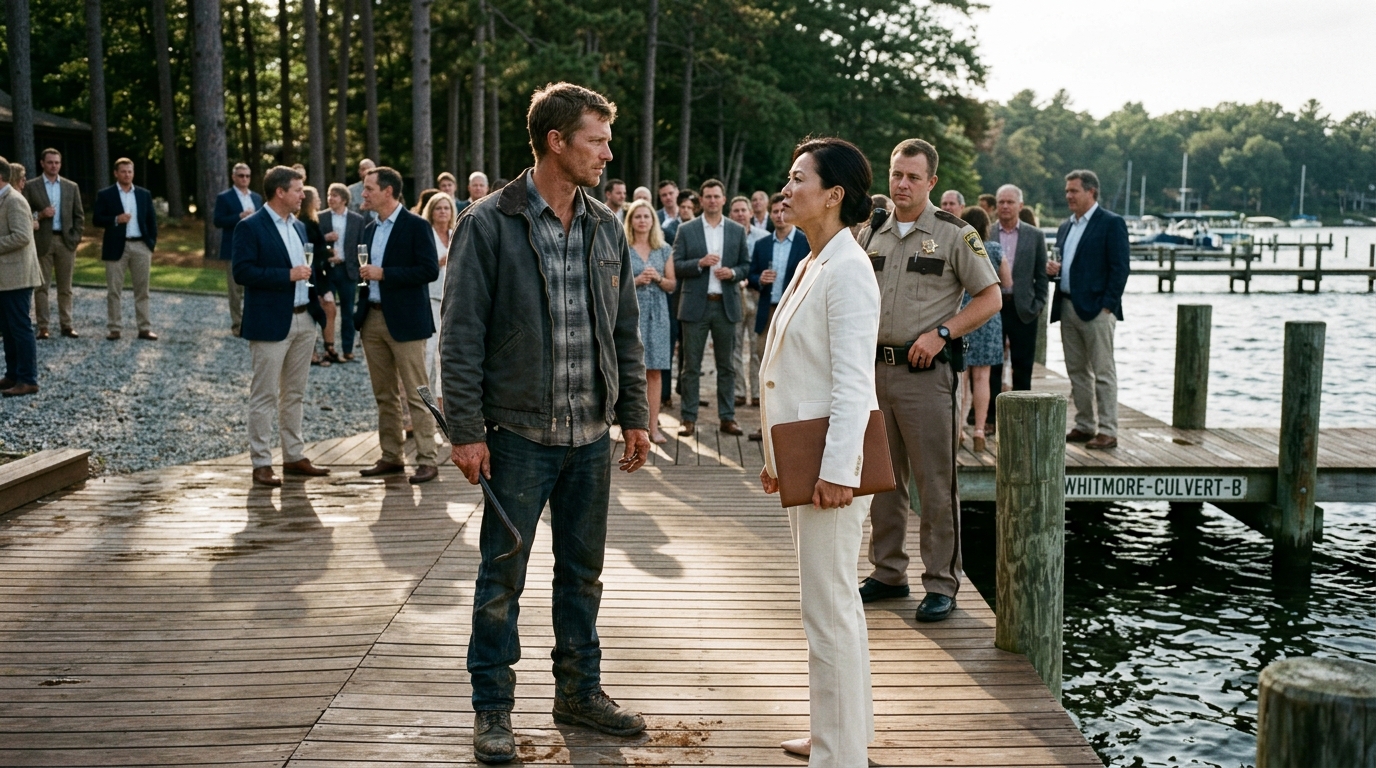
Karen Ho didn’t blink under the glare of my headlights. She wore a white linen blazer, tailored close, and cream slacks that had never touched lake mud.
“Get off the porch,” I said. My voice was flat. It sounded small against the idle of the engine.
“We made improvements,” Karen said. She took two steps down the fieldstone path, her heels clicking against the granite flagstones my father had hauled out of the quarry. “The catering and the sound equipment came to thirty-five hundred. You can settle the invoice with the treasurer by Friday.”
I shifted the truck into park. The transmission clunked.
I pulled the keys from the ignition, slipped my thumb into my pocket, and felt the cool, nicked brass of my father’s old engineer compass. Click. Click. The mechanical latch caught under my nail.
“You broke the latch on the side gate,” I said, stepping down into the dust. My boots hit the gravel hard. “That gate was oak.”
“It was non-compliant,” Karen replied smoothly. She didn’t retreat. She had the easy composure of a person who believed municipal ordinances were written by her inner circle over brunch. “An abandoned lakefront property lowers the valuation for the entire south shore. The HOA board exercised emergency maintenance authority under Bylaw 4.”
Behind her, a guy in a tailored polo moved my dad’s tackle box off the outdoor bench to make room for a tray of cocktail napkins. The tackle box was rusted iron at the corners, scuffed with thirty years of lead sinkers and dried catfish bait.
My thumb pressed hard against the compass brass until the metal bit into the flesh.
“My father’s name is on the deed,” I said.
“Your father has been dead three days, Trevor,” she said. Her voice softened into that synthetic, practiced grief people use when they want you to yield space. “The property is unmaintained. The dock is a structural hazard to neighborhood craft. We are simply showing the community its functional potential.”
“You broke into a private dwelling.”
“We entered a neglected parcel to host a board-sanctioned civic event.” She adjusted her watch—a thick gold ring around her wrist. “If you cause a scene, I’ll have Deputy Vance write you a citation for public disturbance. He’s at the buffet.”
I looked past her shoulder. Sitting by the fire pit was Vance, his uniform shirt unbuttoned at the throat, chewing on a rib. He didn’t look at me. He looked at the water.
The air smelled of charred hickory, spilled wine, and 2-stroke boat fuel from the marina down the point. The lake hit the shore in slow, rhythmic slaps against the pilings.
Click. Click.
“Check your email by midnight, Karen,” I said.
She frowned, the smooth line between her eyebrows tightening for a fraction of a second. “Is that a threat?”
“It’s a notice,” I said. I turned away from her, walked back to the driver’s side door, and grabbed the iron pry bar from the truck bed.
The crowd went quiet. The music from the portable speakers didn’t stop, but the laughter died down like water poured on coals. Vance stopped chewing.
I didn’t look at Karen. I walked past her, past the chafing dishes, straight to the amplifier plugged into the exterior outlet my dad had wired behind the cedar siding. I drove the tip of the pry bar into the plastic junction box, twisted once, and ripped the main lead clean out of the wall.
The music died with a dull pop. Spark dust dusted the grass.
In the dead silence that followed, the only sound left was the wind pulling through the red pines and the low, heavy clicking of the brass compass in my fist.
“Party’s over,” I said to the yard. “Leave the food.”
CHAPTER 2: FORMAL NOTICES AND COLD GRAVEL
Deputy Vance’s leather holster creaked. His hand stayed flat on the black grip, his thumb resting over the retention snap. He didn’t draw, but he didn’t let go either.
“Drop the iron, Trevor,” Vance said. He took one step up the fieldstone path, his boots crunching on the coarse gravel my dad had laid down fifteen years ago. “You’re making a bad afternoon worse.”
I didn’t drop it. I leaned the pry bar against the cedar post, letting the heavy iron head clatter against the pine floorboards. Copper dust from the sheared junction box drifted down, settling onto the toes of my work boots.
“He’s destroying community property!” Karen shouted. Her white blazer was spotless, but the tight line of her jaw was twitched raw. She pulled a slim leather folder from under her arm, tapping it against her hip. “Vance, write the citation. Public mischief, destruction of HOA infrastructure, and criminal intimidation.”
“It’s his wall, Karen,” Vance said, though his voice lacked any real edge. He looked at the severed wire, then at me. “Though you can’t go ripping live copper out of the siding when there are fifty people standing on the grass, son. You know better than that. Thomas taught you better than that.”
“Thomas isn’t here to answer for this eyesore,” Karen cut in. She stepped past Vance, her heels biting into the soft earth at the edge of the lawn, right where the native sedge grass met my dad’s garden border. “And neither are his excuses. The county code enforcement officer reviewed the parcel yesterday. You have fourteen active violations, Trevor. The dock is structurally compromised. The outbuildings violate setback lines under the new municipal shoreline framework.”
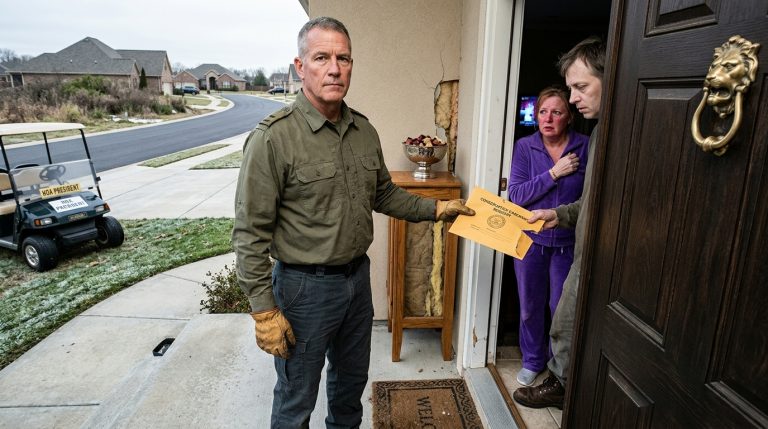
I pulled my hand out of my pocket, leaving the brass compass nestled in the lining. I reached into my jacket, pulled out a folded white envelope, and held it out toward her.
She didn’t take it. She looked at the paper like it was covered in bilge water. “What is that?”
“Formal notice of representation,” I said. “And an explicit revocation of implied consent for entry. Signed by Sarah Chin. She’s the managing partner at Chin & Mercer over in County Seat.”
Karen’s eyes flicked over the letterhead. For a micro-second, her left eyelid flicked—a tiny, involuntary micro-action that contradicted the smug composure of her posture. She knew the name. Everyone on the lakeboard knew Sarah.
“Sarah Chin represents commercial entities,” Karen said, her voice dropping an octave, losing its airy, civic-host tone. “This is an residential dispute under private covenant.”
“It’s a trust property,” I said. My voice remained level, grounded in the dull ache of my shoulder where the truck door had bounced back against me earlier. “The Donnelly Family Trust was filed in seventy-eight. It predates the Whitmore Lake Homeowners Association by twelve years. The covenant you’re holding doesn’t attach to this deed.”
Karen let out a short, dry laugh, but her fingers tightened on her leather binder until the knuckles went pale. “Every lot on this point is bound by the master agreement, Trevor. Your father paid his road maintenance dues for twenty years. That constitutes acceptance of the association’s jurisdiction.”
“He paid road dues because he plowed the road,” I said. “He kept receipts. And he noted every check with ‘Under Protest – Utility Maintenance Only’.”
Vance sighed, taking his hand off his weapon. He hitched his duty belt up over his stomach, looking between us with the dull exhaustion of a rural deputy who wanted to be anywhere else. “Karen, if there’s an active legal representation notice on file, I can’t clear the property on an administrative trespass claim tonight. Not without a signed civil order from the magistrate.”
“He just sabotaged the event!” she hissed, pointing a manicured finger at the dead amplifier. “We have three hundred dollars in catered shellfish spoiling in the sun!”
“Then take it to your car,” I said.
I turned my back on her—a deliberate, tactical calculation to force her to either advance or leave—and walked down the three steps toward the dock. The cedar planks groaned under my weight.
That was when I noticed the physical discrepancy.
Four inches above the water line, stamped directly onto the main creosote piling my dad had sunk with a hand-rigged driver in ninety-two, was a fresh stencil of bright yellow industrial paint.
It wasn’t an HOA mark. The HOA used green aluminum tags for lot surveys. This was a crisp, high-contrast block stencil: WHITMORE-CULVERT-B.
The paint was so fresh I could smell the chemical solvent floating over the damp odor of rotting lake weed.
I didn’t touch it. I didn’t stop to stare. I kept my stride smooth, walking to the end of the dock where the water ran dark and deep, but the mark burned into the back of my eyes.
Behind me, the crowd was already thinning. People who had come for free wine didn’t want their names on a deputy’s incident log. Doors slammed. SUV engines turned over on the gravel.
Karen didn’t run. She stood by the fieldstone path, watching me from fifty feet away while Vance escorted the catering van out the gate. When the last vehicle cleared the drive, she didn’t get into her white luxury crossover immediately. She walked to the boundary line, stopped right where the gravel met the county right-of-way, and looked down at her leather folder.
“Your father thought he was very smart, Trevor,” she called out over the sound of the lap-water against the pilings. Her voice was sharp, stripped clean of any fake warmth. “He spent forty years holding onto a dead piece of dirt. But dirt doesn’t care about trusts. Dirt moves where the water tells it to.”
She got into her vehicle, the heavy door shutting with a dense, airtight thud.
I stood on the dock until the red tail lights disappeared around the bend toward the highway. The lake was quiet again, save for the hum of the cicadas in the high pines and the low, mechanical click of the brass compass turning in my pocket.
I looked down at the yellow stencil on the piling again. Whitmore-Culvert-B.
My dad had spent thirty years working for the Army Corps of Engineers. He knew every culvert, every drainage pipe, and every pressure valve within fifty miles of this basin. He wouldn’t have let anyone paint a municipal tag on his dock piling unless they did it while he was in the hospice bed—or unless he was waiting for them to do it so he could catch them on the record.
I walked up the steps, stepped over the severed wire on the deck, and unlocked the heavy oak front door of the cabin.
The air inside was cool, smelling of dried pine needles, old oilskins, and the faint, bitter tang of cold coffee left in the pot three days ago.
CHAPTER 3: THE FOOT LOCKER AND THE DECOY DEED
The heavy oak door settled into its frame with a dull, iron latch-click.
Inside, the cabin was motionless. The noise of the lake road—the last departing luxury crossover, the dying hum of cicadas—faded behind three inches of solid pine and double-paned glass. The air held the bitter, lingering ghost of cold coffee left in the enamel percolator on the stove, mixed with the sharp scent of raw cedar oil my father used on his workbenches.
I didn’t turn on the overhead light. I didn’t need to.
I walked past the bench where his yellowed field caps still hung from iron spikes driven into the log wall. My boots made no sound on the rag rug covering the floorboards, but the floor itself gave a tiny, familiar groan under my heel right at the threshold of his small back room.
A psychological phantom hit me as I reached for the light switch—a sudden, sharp memory of my dad sitting at his draft table in sixty-nine-percent humidity, his shirt sleeves rolled past his forearms, a cold cup of chicory coffee sitting on a pile of topographical maps while he calculated load tolerances for the river bypass. He’d looked up without pausing his pencil and said, “A man who only builds a wall is just waiting to be surrounded. You build the lock, but you keep the key in the creek.”
I reached under the corner of his draft table, feeling for the cold iron lip of the floor plate.
The plate didn’t yield easily. The damp air off the water had expanded the tongue-and-groove white pine surrounding it. I wedged the flat edge of my pocket knife into the seam, applying steady, levered pressure until the wood gave up a dry crack and the hatch lifted six inches.
Beneath the floor lay the dark green steel of Thomas’s Army Corps foot locker.
It wasn’t locked with a brass padlock. He’d removed the tumbler years ago, replacing it with a simple internal spring latch wired through a tiny drill hole hidden beneath a decorative brass furniture tack on the desk leg. I pressed the tack with my thumb. The latch popped with a dry, mechanical snap.
I hauled the foot locker up onto the desk. The handle hardware was pitted with rust from thirty years of lake humidity, leaving a faint orange smear across my palm.
Inside, resting on top of a folded wool service blanket, was a heavy manila folder bound with a rubber band that had dried and snapped into four brittle pieces.
On the cover, written in Thomas’s stiff, draft-room lettering, was a single line:
COUNTY ROAD COMMISSION – PERMIT FILE #88-B / DECOY DEED & EASEMENT CLEARANCE.
I pulled the top document out under the low glow of the desk lamp.
It was a certified copy of a municipal redevelopment grant—stamped with the seal of the County Regional Planning Board and signed by a municipal officer whose name had been crossed out in red grease pencil. Attached to the front was a formal notice of demolition authorization issued under something called The Apex Grant.
I leaned closer, tracing the faded red pencil line.
The grant document authorized the immediate clearing of “non-conforming waterfront structures” along the south point of Whitmore Lake, citing a multi-phase infrastructure modernization project. According to the stamp, the parcel—my father’s parcel—had been reclassified as “Unclaimed Municipal Drainage Right-of-Way” six months before Thomas died.
Midway down the second page, where the boundary coordinates were listed, a physical discrepancy stood out like a jagged nail.
The lot numbers didn’t align with the county recorder’s master grid. The document claimed the property was subject to emergency administrative seizure because of “unresolved structural code infractions” filed by a regional water safety board. But the authorization code at the bottom didn’t belong to the county code enforcement office.
It was a dead credential—a retired municipal file number issued under a defunct federal drainage program from nineteen-ninety-four.
Karen hadn’t just filed HOA violations. She was using a forged municipal grant framework, leveraging an expired redevelopment authorization to create the illusion of legal government seizure before the trust papers could be produced in civil court. She wanted me to think the county was taking the land, forcing me into a slow administrative appeal while her husband’s equipment moved onto the point.
It was Layer 1. A calculated, bureaucratic decoy designed to make a grieving heir hire a generic real estate lawyer and fight a lost war against municipal eminent domain.
I reached deeper into the foot locker, past the paper files, until my knuckles hit the cool, hard casing of an encrypted external drive tucked into an oiled canvas pouch.
Next to the drive was a small leather-bound notebook. On the first page, Thomas had written three lines in black ink:
They will show you the grant first. It looks like a building permit. It isn’t.
Check the piling under the east deck planking. Look for the yellow stencil.
They aren’t trying to clear the house. They are trying to reach the pressure line.
My thumb went back to my pocket, finding the brass compass. Click. Click.
The yellow stencil I’d seen on the dock piling twenty minutes ago—WHITMORE-CULVERT-B—wasn’t a drainage survey mark at all. It was a location marker.
I picked up the canvas pouch, slid the drive into my jacket pocket, and picked up the paper file containing the forged Apex Grant. My hand was steady, but the cold, quiet fury in my chest had settled deep into my ribs.
From the front porch outside, a floorboard gave a soft, wet flex under sudden weight.
Someone was standing on the cedar deck, right outside the unlit window.
CHAPTER 4: NIGHT VISIONS AND THE HIDDEN LEVERAGE
The floorboard didn’t just creak. It yielded with a low, wet flex that meant a boot was pressing ninety pounds of pressure right over the soft cedar joist by the front window.
I stood frozen beside the draft table, my left thumb buried in my jacket pocket, gripping the cold brass casing of my dad’s compass. The canvas pouch with the encrypted drive was heavy against my ribs.
A pale beam of LED light cut through the gap in the curtains, tracking slowly across the room. It swept over Thomas’s drafting tools, clipped the iron edge of the open floor hatch, and stopped dead on the empty foot locker resting on the desk.
Through the glass, a shadow shifted. A gloved hand reached for the sash latch, trying the iron butterfly catch. It didn’t turn. Thomas had driven a three-inch hardened steel pin through the outer frame twenty years ago after a spat with a local squatter.
The lock jammed solid. Outside, a muffled curse broke through the quiet lap of the lake.
The flashlight beam dropped. The boots retreated off the deck, crunching away toward the side shed where the main breaker panel sat.
I didn’t use a light. I knew the geometry of the cabin the way a blind man knows his own hallway. I slid through the pantry doorway, my boots silent on the rag runner, and reached the back utility porch. The air back here was colder, carrying the damp tang of pine rot and river silt from the marsh behind the lot.
I pulled Thomas’s field monitor from behind the hot water heater. It was a ruggedized, gray-cased industrial tablet powered by a deep-cycle marine battery sitting in a rubber crate under the floorboards. Thomas hadn’t bought off-the-shelf security cameras; he’d wired four low-lux thermal sensors into the decorative birdhouses perched along the tree line, using shielded coaxial cable buried eighteen inches in PVC conduit.
The screen flickered to life, casting a dull amber glow against my knuckles.
Camera Two—mounted in the hollowed cedar owl by the woodpile—showed Karen Ho.
She wasn’t wearing the white blazer now. She had on a dark rain jacket, her hair pulled back under a baseball cap. In her right hand, she held a heavy pry bar. In her left, a red plastic folder.
She was working on the padlock to the utility shed. Her arms shook with the effort, her shoulders tense, her face drawn into a tight, frantic grimace that had nothing to do with her polite HOA posture.
She wasn’t looking for copper wire or boat tools. She was searching for Thomas’s original surveying ledgers—the paper logs that mapped the easement boundaries before the municipal water board redrew the county charts.
I watched the screen as she finally sheared the cheap brass latch on the shed door. The door swung open, and she stepped inside, her flashlight beam bouncing off old paint cans and rusted lawnmower blades.
On the monitor, I zoomed Camera Three into the interior of the shed.
She bypassed the tool rack. She went straight for the rusted metal filing cabinet in the corner—the one Thomas had filled with useless engine manuals and old road commission receipts. She began ripping folders out, tearing through the yellowed paper, tossing them onto the oil-stained dirt floor.
Her mouth was moving. I turned the audio gain dial on the monitor’s receiver. The hidden microphone in the shed rafters picked up her ragged breath, followed by a sharp, whispered mutter:
“Where is the survey for Valve-7? Where did he put the culvert log?”
Valve-7.
The name hit my ears like a hammer on an anvil. It wasn’t in the forged Apex Grant files. It wasn’t in the HOA complaint records.
Valve-7 was the primary pressure relief control for the main reservoir intake—the heavy cast-iron gate valve buried forty feet under the lakebed, right where the deep channel crossed my father’s water lot.
Karen wasn’t trying to clear a non-conforming cabin to raise property values. She needed the land clear because her development group couldn’t break ground on the new marina without accessing Valve-7 to drain the sub-basin—and my father’s trust deed granted him absolute, exclusive subsurface mineral and water-gate rights to that exact grid square.
She wasn’t trying to enforce a covenant. She was trying to destroy the physical proof that Thomas owned the shut-off switch to the entire regional water expansion project.
On the screen, Karen found a blueprint rolled in a plastic sleeve. She pulled it out, her gloved fingers trembling as she unrolled it against the workbench. When she saw it was just an old schematic for an outboard motor, she slammed her fist onto the workbench, knocking a box of rusted nails onto the floor.
She reached into her coat, pulled out a small aerosol can of industrial adhesive, and sprayed it across the papers on the floor, then reached for a pocket lighter.
I didn’t wait for the spark.
I reached out, clicked the red toggle on the side of the field monitor, and closed the circuit on Thomas’s auxiliary relay.
Outside, in the dark timber behind the shed, a twelve-volt air horn—salvaged from an old tugboat—blared with a deafening, metallic roar that shook the cedar siding.
Simultaneously, two hundred-watt halogen floodlights mounted high in the white pines burst open, blinding the yard in harsh, white glare.
On the monitor, Karen screamed. She dropped the lighter, stumbled backward over a mound of firewood, and fell hard onto her hip in the mud. She scrambled up on all fours, her face pale, her eyes wide as sauce dishes under the blinding white light, staring directly into the lens of the cedar owl.
She didn’t try to set the fire. She didn’t grab the papers. She bolted out of the shed, tripping over her own coat hem, and ran through the high weeds toward her vehicle parked half a mile down the dark public access road.
I stood in the unlit kitchen, watching her shadow disappear on the monitor screen while the tugboat horn slowly died down to a low, hissed wheeze.
I pulled the encrypted drive from my pocket, set it on the draft table next to the brass compass, and looked out the window at the white floodlights burning through the pine needles.
The decoy grant was dead. Layer 1 was broken.
Now I had the name of the valve, the location of the pressure line, and a recorded video of the HOA president breaking into a private utility shed with an incendiary device in her hand.
I picked up the cabin phone and dialed Sarah Chin’s direct landline.
“Sarah,” I said when she picked up on the third ring. “Bring the county prosecutor. We aren’t negotiating about road dues anymore.”
CHAPTER 5: THE AMBUSH ON THE DOCK
The dial tone hummed against my ear. I lowered the bakelite receiver onto the wall cradle with a dull clack.
Outside, the hundred-watt floodlights cut through the mist rising off Whitmore Lake, pinning the lawn in stark, shadowless white. The tugboat horn had died, but the silence that followed was heavy, wet, and cold.
I walked out to the kitchen counter, picked up the canvas pouch containing Thomas’s encrypted drive, and slid the paper file for the forged Apex Grant into my leather work binder. My thumb clicked the brass compass in my pocket once—click—before I grabbed the heavy iron flashlight off the workbench and headed for the front door.
By seven-forty-five, the fog had rolled in off the channel, thick enough to bead moisture on my canvas jacket. I didn’t wait in the house. I sat on the top step of the porch deck, resting my elbows on my knees, watching the driveway entrance through the pine trunks.
At seven-fifty-eight, headlights swept across the gravel curve.
It wasn’t a county sheriff’s cruiser. It was Karen’s white luxury crossover, followed closely by two heavy-duty crew-cab pickups bearing the blue seal of the Regional Water Board. Behind them rolled a dark sedan—Sarah Chin’s Volvo.
Karen stepped out before her door had fully swung open. She had changed out of her dark jacket into a beige trench coat, but she hadn’t scrubbed the dirt off her palm where she’d fallen near the shed. Her posture was stiff, her jaw set like poured concrete.
“Trevor,” she said, stepping onto the flagstone path. She held a thick, stamped folder against her ribs. “This is Deputy Commissioner Vance’s field team. We are executing an emergency maintenance override under Section 4 of the Lake Drainage Code. The property is cleared for municipal access.”
Beside her, two men in high-visibility vests pulled heavy valve wrenches and a portable hydraulic jack from the bed of the lead truck.
I didn’t stand up. I leaned against the cedar post, letting my hand rest flat over my leather binder.
“Section 4 doesn’t apply to trust land, Karen,” I said. “And it definitely doesn’t cover Valve-7.”
Her face went pale—a sudden, sharp drain of color under the harsh glare of the pine-mounted floodlights. Her fingers twitched against the folder, crumpling the bottom corner of the paper.
“The culvert line is public utility,” she said, her voice rising half an octave, losing its smooth municipal cadence. “You don’t own the water flow.”
“He owns the bed,” Sarah Chin said, stepping out of the Volvo. She wore her dark wool coat, carrying a briefcase in her left hand. She didn’t look at Karen; she looked straight at the two technicians holding the valve wrenches. “Gentlemen, if those tools touch that dock piling, you will be named individually in a federal injunction for tampering with a designated Army Corps infrastructure asset. Drop the iron.”
The two men looked at each other. The taller one lowered his wrench two inches.
“Don’t listen to her!” Karen snapped, turning on them. “The Apex Grant overrides the 1978 survey! We have clearance from the Regional Board to open Whitmore-Culvert-B for sub-basin drainage!”
“The Apex Grant was retired in ninety-four, Karen,” I said, finally stepping off the porch. My boots hit the gravel with a heavy, wet crunch. “You used a dead municipal file code to forge a county seizure order so your husband’s development company could bypass the intake shutoff.”
“That’s absurd,” she spat. But her left shoulder dropped, her eyes darting past me toward the dock where the yellow stencil—WHITMORE-CULVERT-B—glowed under the floodlights.
I pulled the encrypted drive from my canvas pouch and held it up.
“My father didn’t just build the cabin, Karen. He logged the pressure specs for Valve-7 for thirty years. He recorded every meeting your husband had with the water board chairman. And twenty minutes ago, his thermal sensors recorded you breaking into his utility shed with an aerosol canister and a lighter.”
The silence on the driveway was absolute.
One of the technicians stepped back toward his pickup, tossing his wrench into the bed with a loud, metallic clang. “We aren’t part of this, Karen. You said this was a cleared right-of-way.”
“It is cleared!” she screamed, her voice cracking against the pine trees. She stepped directly into my path, her hands shaking as she pulled a folded court paper from her trench coat. “I have an emergency injunction signed by Magistrate Miller! The dock is condemned! Move out of the way or I’ll have Vance arrest you for obstruction!”
“Magistrate Miller lost his administrative authority over water district disputes three weeks ago,” Sarah Chin said quietly, pulling a certified county stay from her briefcase. “And Deputy Vance is currently at the station reviewing the video feed from Thomas Donnelly’s shed.”
Karen stared at Sarah, then at me. Her mouth opened, but no sound came out. The polished, unshakeable HOA president was gone; in her place was a cornered developer watching a ten-year paper trail collapse into the mud under two hundred watts of white light.
“You think this saves the cabin?” she whispered, her voice dark, stripped of every fake polite edge. “Without the sub-basin drainage, the lot is worthless. The water board will zone this whole point as a flood hazard by spring.”
“Then we’ll build a higher dock,” I said.
I turned away from her, walking past the technicians, past the idling trucks, down to the end of the cedar planks where the dark water slapped against the pilings.
Behind me, the red tail lights of Sarah’s Volvo flared as the county prosecutor’s vehicle pulled into the drive.
CHAPTER 6: THE SILENT CHANNEL
The wood beneath my boots didn’t shake. My dad had driven those three-inch cedar posts five feet into the hardpan clay when I was twelve, pouring two buckets of quick-set concrete around each footing before the lake level rose in the spring.
Behind me, down by the gravel turnaround, doors slammed shut. Heavy diesel engines idle-chugged as the water board trucks backed out through the main gate, their tires grinding gravel against the drainage ditch.
Sarah Chin stayed by the hood of her Volvo, her arms crossed inside her wool coat, watching the county prosecutor hand Karen a folded carbon copy of the state grand jury subpoena. Karen didn’t scream this time. She didn’t wave her leather binder. Her white coat was soaked around the hem from the wet grass, and when she stepped into the back of the prosecutor’s sedan, her heels made a hollow, uncalibrated sound against the asphalt.
The red tail lights swept over the pine trunks one last time, then vanished around the bend toward the highway.
The driveway was silent again.
I walked to the very end of the dock, pulled the flashlight from my belt, and clicked the beam down into the dark water. Three feet below the surface, right where the creosote piling met the lakebed, the bright yellow stencil—WHITMORE-CULVERT-B—stared back through the clear, cold runoff.
Next to it, bolted directly into the submerged iron housing of Valve-7, was Thomas’s old brass inspection tag. The stamped numbers were covered in a thin layer of lake silt, but the metal underneath hadn’t rusted.
He’d known about The Apex Grant before Karen’s husband ever drafted the development prospectus. He’d known that the regional water board was plotting to drain the sub-basin to build sixty luxury concrete pads over the marsh. He hadn’t fought them with angry emails or public HOA shouting matches. He had simply built his dock straight over their primary pressure release gate, registered the water-gate easement under an unassailable 1978 family trust, and waited for them to overreach into criminal territory.
They thought they were trying to remove a stubborn old man’s dilapidated cabin. In reality, they were walking into a forty-year structural trap laid by a retired Army Corps engineer who understood load tolerances better than they understood their own books.
I knelt on the wet cedar planking, my knees soaking through my canvas trousers. I reached into my coat pocket, pulled out the worn brass engineer’s compass, and laid it flat against the top of the piling.
Click. Click.
The needle spun once, caught the magnetic north pull off the deep channel, and held dead steady.
The morning air was starting to turn gray over the ridge line to the east. The heavy mist off the water began to break apart into thin, ragged ribbons against the white pines. The smell of burnt copper and spilled prosecco from the night before was completely gone, replaced by the clean, sharp scent of damp cedar, cold mud, and deep water.
I stood up, walked back up the dock steps, and stopped at the side gate.
I picked up the iron pry bar I’d left leaning against the porch siding. The latch was broken—the oak frame split where Karen’s men had forced it open two days ago.
I walked into Thomas’s workshop, grabbed a box of four-inch galvanized wood screws, a heavy iron clamp, and his old hand-brace drill.
I didn’t rush. I set the broken oak jamb back into its mortise, aligned the grain until the split lines vanished, and drew the clamp tight until the wood groaned. I set the bit against the pilot hole and turned the crank, feeling the steady, rhythmic resistance of the heartwood as the steel bit bit deep into the pine.
One screw. Two screws. Three.
When I released the clamp, the gate swung on its iron hinges with a quiet, solid click. It didn’t sag. It didn’t drag in the gravel.
I walked up the three stone steps to the front porch, unlocked the cabin door, and went inside.
The stove was cold, but the house was solid. I set the brass compass back on the mantlepiece right next to his old field cap, sat down in his wooden armchair by the unlit fireplace, and watched the first gray light of morning settle across the lake.