Cold Steel and Contract Law: A Veteran’s Calculated War Against Suburban Tyranny
CHAPTER 1: The Line in the Turf
The voice cut through the heavy, pollen-thick afternoon air with the clean, vicious snap of a tripwire.
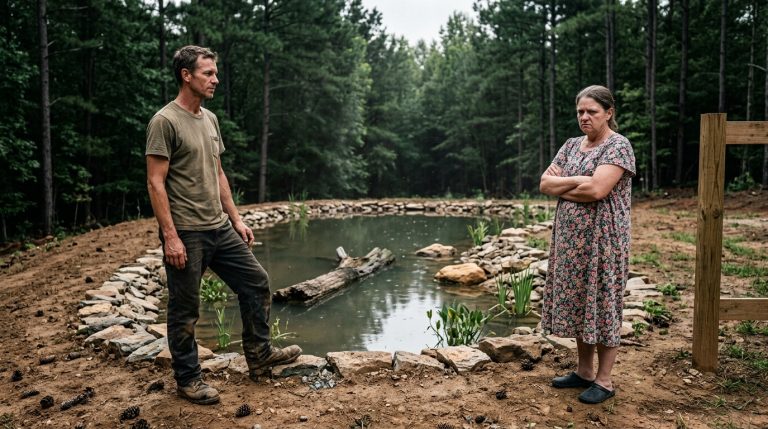
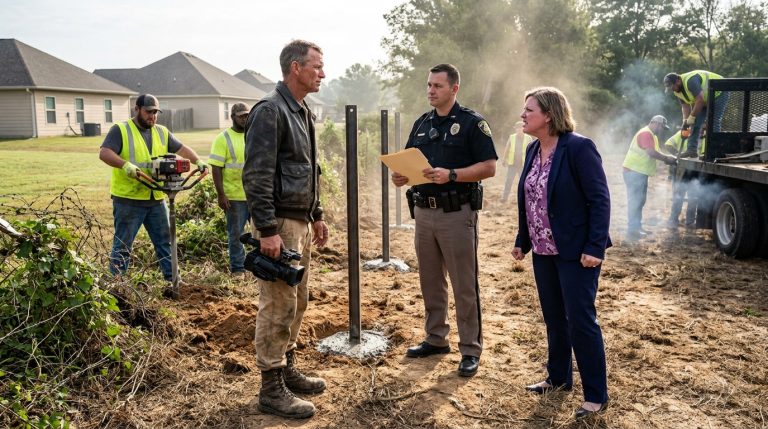
I paused, my hand resting against the cool, cross-braced galvanized steel of the newly anchored lattice tower. Down at the base, where ten tons of fresh concrete gripped the earth like a fist, the shadows were lengthening. Five feet across the mowed boundary line stood Karen Miller. Her floral-print muumuu billowed around her frame like a spinnaker caught in a crosswind, and her hand clutched a yellow legal clipboard as if it were a tactical slate.
One foot tapped a steady, rhythmic demand against the manicured turf of the Oak Ridge development. It was a calculated performance, designed to draw an immediate, undisciplined reaction.
“That illegal monstrosity comes down by Friday,” she called out, her voice pitched to carry across the property gap without requiring her to step an inch onto my soil. “Or I’m bringing in a crew and billing you for the demolition, plus a ten-thousand-dollar fine.”
I didn’t answer immediately. I let the silence stretch, watching her through the magnified lens of my own stillness. Twenty years of maintaining secure comms relays on desolate mountaintops taught me one immutable law: the party that speaks first in a standoff surrenders the initiative. Every muscle in my torso remained loose, trained to suppress the old adrenaline spike that flared behind my ribs—the familiar, cold prickle I hadn’t felt since my final tour downrange.
Instead of looking at her furious face, I looked down at the grass right between us. A small, rust-capped iron property pin, long overgrown with crabgrass, peeked through the soil just three inches inside my marker. She was standing precisely on the edge of her manufactured empire, threatening me with a binder of bylaws she treated like martial law.
“You’re standing on an unrecorded easement boundary, Karen,” I said, my voice low and level, cutting the distance cleanly. “And your notice lacks a mandatory timestamped arbitration clause. If you send a crew onto this property on Friday, they aren’t committing a civil infraction. They’re committing criminal trespass.”
Her pen froze mid-stroke, hovering over the clipboard like a dagger caught in amber. For a fraction of a second, the immaculate calculation behind her thick glasses faltered, replaced by a sudden, jagged twitch in her jawline.
She opened her mouth to snap a counter-threat, but I turned my back on her entirely, looking up toward the fading crimson horizon where the first stars were beginning to burn through the atmospheric haze.
As I walked slowly toward the house, leaving her stranded on her side of the turf, my phone buzzed deep within my tactical jacket pocket. It wasn’t a standard text notification. It was a automated system alert signaling a drop in local network stability—the very dead zone that had plagued the ridge for months. But as I glanced at the screen, a new data packet flashed across the terminal, routed through a secondary server I had quietly provisioned three days prior.
The system wasn’t just dropping calls anymore. It was tracking every single outgoing transmission originating from the HOA president’s home router.
CHAPTER 2: The Bureaucratic CounterStrike
The kitchen was dark except for the amber glow of the spectrum analyzer sitting next to the toaster. I dropped my jacket over the back of a wooden chair and pulled out the thick binder of HOA covenants, conditions, and restrictions. Sarah was upstairs, the steady murmur of her voice coming softly through the baby monitor as she tucked Lily into bed. They shouldn’t have been dragged into this, but Karen’s reach was indiscriminate, built on an appetite for absolute neighborhood compliance that left no room for exceptions.
I pulled the certified violation notice from my pocket and smoothed it flat against the butcher-block counter. The paper felt heavy, crisp, and aggressively expensive—funded, no doubt, by the community dues meant for landscaping and streetlights.
For three hours, I did what I had spent two decades doing in rooms with low ceilings and high-stakes green-screen monitors: I mapped the seams in an adversary’s logic.
The letter cited half a dozen vague infractions, leaning heavily on the construction of an “unapproved ancillary structure” and the disruption of “aesthetic harmony.” But municipal law enforcement and property covenants operated under strict boundaries. I flipped past the sweeping prose to Appendix C, section 17.4b, the grandfather clause protecting pre-existing land parcels from structural limitations unless a demonstrable safety hazard existed. My tower was anchored in ten tons of reinforced concrete. It had professional engineering specs that exceeded most of the home foundations in Oak Ridge.
More importantly, the bylaws explicitly mandated that any formal fine required a pre-action hearing before the Architectural Review Committee—a mandatory step Karen had completely bypassed in her rush to establish dominance. She hadn’t just overstepped her mandate; she had tripped over her own procedural red tape.
The kitchen clock clicked softly, the digital numbers shifting to 11:42 PM.
I opened a blank document on my laptop and began drafting the response. I didn’t use emotive language. I didn’t lean into anger or frustration. I wrote with the cold, measured cadence of a compliance audit, citing clause 17.4b, attaching the full engineering safety certificate, and formally invoking my right to a committee hearing. Every sentence was engineered to box her into a corner where her only options were to publicly acknowledge her procedural failure or double down and expose her board to civil liability.
As I hit print, the printer hummed to life, its mechanical clatter sounding loud in the midnight stillness of the house.
My phone buzzed on the counter beside the analyzer. A new data packet had just cleared the local router log. It wasn’t a standard alert. It was a metadata timestamp from an external IP address registered to the Oak Ridge HOA administrative terminal—logged at nearly midnight. Karen wasn’t sleeping either. She was already searching for another loophole, combing through digital satellite maps of my property line to find a blade of grass out of place or a shadow that crossed her line of sight.
I folded the printed response, slipped it into a manila envelope, and set it squarely beside my keys. The first skirmish was over, but the terrain was shifting. Tomorrow, I wouldn’t just mail a letter; I would deliver a blueprint for her undoing.
CHAPTER 3: Reconnaissance in the Sea of Beige
The gravel under my boots crunched with a flat, dry rhythm as I stepped off the porch and walked past the edge of the shadow cast by the lattice tower. Down the ridge, the sprawling expanse of the Oak Ridge development lay under a uniform blanket of artificial amber streetlamps—a sea of identical beige roofs stretching out like rows of gravestones in a quiet cemetery.
The memory hit me without warning, cold and sharp as a winter wind off an abandoned runway: a concrete bunker in a high-desert relay station where every movement was dictated by coordinates and calculated telemetry. Out here, the terrain was supposed to be different. It was supposed to be green, open, and quiet. But looking down at the neat rows of houses, I recognized the architecture of control immediately. It wasn’t about property values or aesthetic harmony. It was about boundaries designed to restrict movement and suppress dissent.
I kept my hands shoved deep into the pockets of my jacket, my eyes scanning the tree line separating my five acres from their curated lawns.
If Karen was going to comb through digital satellite maps at midnight, she was looking for vulnerabilities—blind spots where her rules could be leveraged into fines. That meant I needed to know every foot of the perimeter before dawn.
I took the narrow footpath that wound down the western slope, moving with the practiced, low-impact stride of a man accustomed to navigating unlit perimeters. The air grew cooler beneath the canopy of oaks, smelling of damp soil and decaying leaves. Every few yards, I paused, listening past the crickets and the distant hum of traffic on the valley road.
About two hundred yards down, near the border where my land met the municipal drainage easement, a low shadow detached itself from the trunk of a massive oak.
I didn’t flinch or reach for anything; I simply stopped, letting my weight settle onto my back foot, shifting my gaze to read the silhouette. It was a man, hunched slightly over a small garden trowel, working quietly near the edge of a flower bed just inside the neighborhood perimeter.
As I stepped closer, the man froze, his shoulders stiffening before he slowly straightened up, wiping a hand across his forehead. It was George, the homeowner with the immaculate flower bed from my earlier walks, looking around nervously as if caught trespassing on his own property.
“Quiet night for yard work, George,” I said quietly, my voice carrying just enough to reach him without cutting through the stillness of the woods.
George jumped, dropping the trowel into the soft mulch with a dull thud. He let out a ragged breath, pressing a hand against his chest as he recognized my face in the dim moonlight filtering through the branches.
“Jesus, Jack,” he muttered, his voice trembling slightly as he glanced over his shoulder toward the distant glow of Karen’s street. “You move like a ghost. I thought… well, I didn’t know who was out here.”
“Just checking the perimeter,” I replied, closing the distance until I stood beside him on the edge of the mulch bed. “You look like you’re hiding.”
George let out a bitter, exhausted laugh, kicking a stray pebble with the toe of his work boot. “Hiding? More like trying to fix a mistake before morning. Karen drove by here yesterday evening. She didn’t say a word, just pointed her clipboard at my perennial border. Said the edging stones were two inches out of alignment with the approved community palette. She gave me twenty-four hours to fix it or face a hundred-dollar compliance review.”
He knelt down, his fingers clawing into the damp earth to straighten a border stone that looked identical to every other stone in the county.
“It’s never about the stone, George,” I said softly, looking down at the worn lines of his hands. “It’s about making sure you’re looking down at the dirt instead of looking up at what she’s doing.”
George stopped digging. He looked up at me, the amber glow from the distant street lamps reflecting in the lenses of his glasses, catching a deep, tired resentment that had been cultivated over years of micro-management.
“What are you planning to do about her, Jack?” he asked, his voice dropping to a low, conspiratorial whisper. “Everyone’s talking about your tower up on the ridge. She’s foaming at the mouth because she can’t touch it.”
“I’m not planning anything,” I answered, stepping back toward the shadow of the treeline. “I’m just waiting for her next move.”
I left him there in the damp dark, wrestling with his border stones, and continued my sweep of the property line. The perimeter was secure, but the terrain was shifting beneath our feet. Karen wasn’t going to wait for Friday’s demolition deadline to strike back; the midnight metadata packet proved she was already assembling her next wave of infractions. And when she moved, I would be waiting right where the lines crossed.
CHAPTER 4: The Telecommunications Alliance
The kitchen was still warm when I stepped back inside, the single indicator light on the spectrum analyzer pulsing with a slow, rhythmic green. I didn’t bother turning on the overhead lights. I dropped my keys onto the butcher block and walked straight to the landline phone, bypassing the consumer gadgets entirely to dial a direct sequence into the secure direct-dial interface I kept maintained for old unit channels.
It wasn’t a civilian line. Twenty years in Air Force communications meant my network of contacts wasn’t limited to local directory assistance.
The line clicked twice before a heavy, flat voice answered on the other end, devoid of corporate pleasantries. “Go ahead.”
“Mark,” I said, keeping my tone level. “It’s Jack Ryder. Out in Summit Creek.”
There was a brief pause, the faint crackle of long-distance static bridging the gap between regional infrastructure and my kitchen counter. “Jack. Good to hear from you. You still sitting on that ridge with the dead zone problem?”
“The problem is structural, but it’s no longer just mine,” I replied, leaning my hip against the edge of the counter. “Your coverage maps show a permanent blank spot over the Summit Creek valley because local zoning makes new tower permits impossible. But I have a forty-foot freestanding lattice structure sitting at the highest elevation on my acreage, anchored in ten tons of concrete, with an unobstructed line of sight across the entire residential grid below.”
A soft, sharp intake of breath came through the receiver. “You’re built?”
“Engineered, anchored, and finished,” I said. “And right now, it’s operating as a private intercept point because the local property association thinks they can regulate radio frequency spectrums with a binder of bylaws.”
Mark let out a low, gravelly whistle. “An HOA trying to zone a comms rig. That’s a quick way to invite a federal subpoena. What’s your play, Jack?”
“A long-term lease,” I said, spelling it out with the clinical precision of a field report. “You get a turnkey microcell and repeater installation on prime real estate with existing power and zero permitting delays. I get the bandwidth required to keep my home network stable. But there’s a strict condition: the contract has to designate the structure and its affixed transmission lines as critical telecommunications infrastructure under the Federal Communications Commission framework.”
“That elevates it past municipal covenants,” Mark noted immediately, the professional gears turning in his head. “State and local boards can’t touch federally protected utility lines without running straight into a wall of preemption.”
“Exactly,” I said. “Send a survey team tomorrow morning. Take measurements, check structural integrity, and draft the paperwork. We’re going to give the neighborhood paperwork they can’t burn.”
By the time I hung up, the kitchen clock read 2:14 AM.
As I set the receiver back on its cradle, a strange, metallic scent drifted in through the open kitchen window—a faint, distinct trace of fresh asphalt and heavy machinery grease that didn’t belong to the damp forest air. I walked over to the glass, peering out into the moonlit yard. Down near the lower access road where the property met the municipal easement, a single, unlit utility van had paused for less than thirty seconds before rolling its lights out and disappearing down the asphalt grid.
Karen wasn’t just relying on paper anymore. She was starting to map out the physical terrain for her next move, and the grease on the wind was the first sign of the machinery she intended to deploy.
CHAPTER 5: The JAG Officers Legal Masterstroke
The conference room at David Chen’s downtown office smelled of old paper, floor wax, and uncompromising professional order. There were no decorative flourishes on the walls—just a pair of framed maritime charts and a whiteboard covered in clean, tactical timelines. David sat across the mahogany table, his navy suit jacket draped neatly over the back of his chair, rolling a black brass pen between his fingers as he reviewed the documents I had brought down from the ridge.
He didn’t look like a standard civilian attorney. Ten years as a military prosecutor had left him with a posture that could crack ice and a habit of reading people’s intentions before they finished their sentences.
“She’s operating under a basic municipal playbook,” David said, his voice low and steady as he tapped a fingernail against Karen’s initial violation notice. “She thinks the neighborhood bylaws are an absolute monarchy. She issues a vague threat, counts on the target panicking, and collects compliance fees or forces expensive teardowns before anyone checks the county recorder’s office.”
“She missed clause 17.4b in Appendix C,” I replied, sliding the engineering safety certificate across the polished wood. “Pre-existing land parcels incorporated during the 2021 expansion are legally exempt from structural outbuilding limitations unless a demonstrable safety hazard exists. My tower rests on ten tons of reinforced concrete. It’s safer than half the load-bearing walls in the Oak Ridge development.”
David caught the pen in his palm, a sharp, humorless smile touching the corners of his mouth. “And she skipped the mandatory pre-action arbitration hearing before the Architectural Review Committee. Which means not only is her violation notice legally void, but she’s also exposed the board to procedural liability for issuing bad-faith fines.”
He stood up, walking over to a tall filing cabinet and pulling out a clean sheet of heavy bond paper. He didn’t write immediately. He looked out the high window toward the slate-gray morning sky over Summit Creek, his expression turning calculating.
“Logic alone isn’t going to stop her, Jack,” David said, turning back to face me. “People like Karen don’t retreat when they’re proven wrong; they double down on the bureaucracy. If we want to shut down this entire harassment loop permanently, we need an institutional firewall. Something that takes your tower completely out of her jurisdiction.”
I reached into my inner jacket pocket and slid the freshly printed, preliminary draft of the telecommunications lease agreement across the table.
David picked it up. His eyes scanned the header, tracked down through the operational parameters, and lingered for a long moment on the specific clauses designating the tower and its affixed transmission lines as critical infrastructure protected under the Federal Communications Commission guidelines.
The silence in the room stretched for several seconds, broken only by the steady hum of the office ventilation system. When David looked back up, the professional detachment in his eyes had been replaced by genuine, unadulterated admiration.
“My God, Jack,” he breathed, leaning back against the edge of the filing cabinet. “She thinks she’s fighting a guy with an oversized ham radio setup. She has no idea she’s about to pick a fight with a federally regulated public utility.”
“The survey team is already scheduled for tomorrow morning,” I said quietly, keeping my hands flat on the table. “Once the hardware is logged and the federal protections are stamped into the contract, her municipal bylaws become completely toothless.”
“Then we don’t counter-sue yet,” David said, sliding the contract into his leather briefcase with deliberate care. “We let her send her demolition crew on the fifteenth. We let her think she’s executing the final blow. And when her contractors show up at your gate with a heavy excavator, we hand them a federal injunction and watch her entire administrative empire evaporate in real time.”
He walked back to the table, resting both hands on the surface as he looked me square in the eye. “She’s been swinging a rulebook like a club. We’re about to drop an entire law library on her head.”
CHAPTER 6: The Flatbed Mack Confrontation
The fifteenth of the month dawned cold, clear, and relentlessly bright. The sun cleared the eastern hills by seven o’clock, casting long, stark shadows across the gravel driveway and the ten-ton concrete footing of the tower. I stood by the main gate, a cup of black coffee cooling in my hand, watching the valley road below.
Right on schedule, at precisely 8:00 a.m., the heavy, diesel-laden rumble of a hydraulic transmission broke the morning stillness.
A massive flatbed Mack truck hauled its weight up the narrow incline, carrying a compact excavator with a heavy steel demolition claw mounted on its boom. Trailing right behind it was a pickup truck bearing the bold logo of Apex Demolition on the door panels. The convoy rolled to a stop just outside my property line, kicking up a light cloud of dry dust that settled slowly over the manicured grass.
The driver’s door of the pickup swung open, and a man in his forties with a sun-beaten face and a cautious, weary posture hopped down. He was the foreman, adjusting the brim of a stained baseball cap as he scanned the towering steel lattice structure rising against the pale blue sky.
“Morning,” he said, keeping his eyes carefully averted from mine as he walked toward the gate. “Got a work order to clear out an unapproved ancillary structure at this address. Signed by Karen Miller, association president.”
I took a slow, measured sip of the coffee, letting the heat register before I lowered the cup. “You’re standing on private property, and the structure you’re looking at is fully compliant with municipal exceptions.”
Before the foreman could formulate a defensive response, the passenger door of the sedan parked behind my truck clicked open. David Chen stepped out, impeccably dressed in a sharp navy suit that looked utterly incongruous against the rural gravel, holding a thick leather briefcase under one arm like a tactical dossier.
“And we’re here to ensure your company doesn’t accidentally commit a federal offense,” David said, his voice dropping into that smooth, disarming register that signaled total legal control.
The foreman’s eyes flickered from my face to David’s polished wingtips, a shadow of genuine apprehension crossing his features. He held up a defensive palm. “Look, mister, I’m just following a signed work order. I don’t want any trouble, and I certainly don’t want to get mixed up in a neighborhood feud.”
“This hasn’t been a neighborhood feud since sunrise,” David replied smoothly, flipping open his leather briefcase and extracting a heavy sheaf of documents bound with official covers. “This is a formal cease and desist notice. The structure your company has been contracted to dismantle is a designated telecommunications relay under active contract with a national cellular provider, protected under Title 47 of the United States Code.”
He extended the first document toward the foreman, who took it gingerly, his fingers brushing the heavy cardstock as if it were wired to a detonator.
“Attempting to disable, dismantle, or interfere with federally regulated transmission infrastructure carries substantial civil and criminal liabilities,” David continued, his tone never wavering. “Furthermore, here is the active lease agreement, and here is a notice of intent to hold your contracting firm personally liable for all operational downtime, legal fees, and punitive damages.”
The foreman’s color drained rapidly under his tan. He scanned the dense blocks of legalese, his lips moving silently as he processed terms like federal jurisdiction, injunction, and punitive damages. He was a working contractor trying to protect his business license, not a soldier in Karen’s private war.
“Federal?” he muttered, wiping a bead of cold sweat from his forehead with the back of a calloused hand. “Nobody said anything about federal equipment. This was supposed to be a standard HOA teardown.”
“Karen Miller omitted a few crucial details,” I said quietly, stepping forward.
The foreman didn’t hesitate a second longer. He spun on his heel, walked rapidly back to his pickup truck, pulled his mobile phone from his holster, and punched in a call. He kept his voice low, but the rising panic in his tone carried clearly across the gravel. Within seconds, he held the phone out toward us on speaker mode.
Karen’s voice shrieked through the tiny speaker, sharp and brittle as breaking glass. “What do you mean you’re stopped? I signed the work order! I am paying your firm to tear that monstrosity down right now!”
The foreman winced, holding the phone away from his ear as if it were venomous. “Ma’am, with all due respect, your association contract doesn’t hold any weight against federal communications law. These gentlemen just handed me an injunction and an FCC compliance packet. If we touch that tower, my company loses its operating license. We’re loading up and getting off this property.”
The shriek that erupted from the phone was entirely devoid of human reason—a raw, frantic sound of absolute, impotent fury. Before Karen could launch into another wave of threats, the foreman hit the end call button with a sharp stab of his thumb.
He looked back at us, his expression a mix of profound relief and lingering shock. “My apologies, gentlemen. We’re out of here.”
Within ten minutes, the flatbed and the excavator had backed down the narrow drive, their diesel engines roaring as they vanished down the valley road. The confrontation was over before it truly began, leaving behind only the scent of exhaust and the quiet rustle of the wind through the steel tower above. But down in the valley, behind the closed doors of her beige fortress, Karen was running out of rules to break—and desperation is a dangerous architect.
CHAPTER 7: Weaponized Citations and the War of Attrition
The dust kicked up by Apex Demolition’s tires took nearly twenty minutes to settle completely over the gravel drive. I stood watching the empty gateway long after the truck had vanished around the lower ridge curve. Karen had played her primary physical card—brute intimidation via contracted heavy machinery—and it had completely misfired against the federal protections woven into the cell provider’s lease. But a bureaucratic adversary operating under the delusion of absolute control doesn’t surrender when a single tactic fails; they simply pivot to a war of a thousand paper cuts.
By the following Monday morning, the predictable artillery fire arrived in the mailbox.
It wasn’t a certified letter demanding the demolition of the tower this time. It was a standard-issue yellow violation envelope bearing the Oak Ridge HOA logo, crisp and aggressively bureaucratic. I tore it open on the kitchen counter while Sarah poured coffee. The charge sheet was a masterclass in petty escalation: an official citation for improper lawn maintenance, supported by a blurry, close-cropped photograph of the grass blades near my mailbox. According to Karen’s interpretation of bylaw 7.2, the tips of the grass were allegedly exceeding the mandatory three-inch height limit by a fraction of an inch. The fine was fifty dollars.
Three days later, a second envelope appeared. This one targeted my garbage bins, which had allegedly been rolled out to the curb at 7:00 p.m. the evening before sanitation pickup—two hours earlier than the strict twelve-hour window permitted by community code. Fine: seventy-five dollars.
By the end of the week, a third notice arrived, citing a dark, silver-dollar-sized patch of oil on the concrete apron of my garage floor beneath my 1988 Ford F-150. Classified as a hazardous material violation and a stain on community aesthetic harmony, it carried a hundred-and-fifty-dollar fine alongside a mandatory demand for professional power-washing receipts.
Sarah set her coffee mug down, her brow furrowed with genuine worry as she looked over the stack of brightly colored violation slips. “Jack, she’s not stopping. Every single day it’s something more absurd. How many of these can we fight before it drains us?”
“She’s trying to manufacture compliance through exhaustion,” I said calmly, pulling a fresh legal pad toward me across the butcher block. “She thinks I’ll pay the fines just to make the noise go away. But she’s making a fundamental tactical error. Every single one of these notices requires a formal arbitration hearing before the Architectural Review Committee under Section 9.”
I didn’t get angry. I didn’t vent frustration. I treated each absurd citation with the exact, unyielding procedural rigor I had once applied to communications audits on active-duty deployments.
For the lawn violation, I walked out to the mailbox with a digital caliper and a camera, capturing high-resolution, time-stamped macro photographs of the grass blades to prove mathematically that ninety-nine percent of them sat well below the three-inch threshold. For the garbage bins, I printed out the county’s official municipal sanitation schedule, highlighting the exact pickup windows that invalidated her time-limit claims. For the oil drip, I took a clear picture of myself scrubbing the concrete surface with a five-dollar bottle of commercial degreaser, attaching the store receipt as my certified proof of service.
Every single citation was met with an immaculate, formal packet of counter-evidence drafted with David Chen’s legal oversight, invoking my absolute right to a full committee hearing.
We weren’t just defending ourselves; we were flooding their administrative pipeline. The Oak Ridge HOA board, which had spent years acting as Karen’s unquestioning rubber stamp, suddenly found themselves legally obligated to schedule, attend, and formally adjudicate protracted hearings over a single blade of grass and a drop of motor oil. The machinery of her petty tyranny was beginning to choke on its own red tape.
CHAPTER 8: The Slide Presentation at the Community Clubhouse
The folding chairs in the Oak Ridge community clubhouse were arranged in rigid, unbroken rows that felt less like a neighborhood assembly and more like a military tribunal. Fluorescent lights hummed overhead, casting a harsh, sterile glare across the linoleum floor. At the head of the long folding table sat Karen Miller, her face set into a mask of grim, unyielding authority, flanked by four silent board members who looked entirely uncomfortable in their seats.
I walked down the central aisle carrying a slim aluminum laptop case and a portable projector, my boots striking the floor with a rhythmic, measured cadence.
The room was packed to capacity. Neighbors who had previously stayed behind closed blinds to avoid catching the HOA president’s eye now lined the perimeter walls, their expressions a mix of tense curiosity and quiet resolve. George sat near the front row, giving me a subtle, sharp nod as I passed his row.
Karen slammed a yellow folder onto the table, the sharp slap echoing off the bare walls. “Mr. Ryder,” she announced, her voice pitched to cut through the hum of the overhead lights. “This special hearing has been convened to review your multiple code violations. We are here to establish the final penalties for your failure to comply with community standards.”
“The citations are out of order, Madam President,” I said, my voice remaining flat, low, and completely devoid of defensive warmth as I set my equipment down on the edge of the table. “Under Section 9 of the bylaws, every administrative penalty requires a verified evidentiary review before any final assessment can be levied. You skipped the preliminary validation phase.”
Karen’s jaw tightened, a dark flush spreading up her neck. “Your technicalities do not apply to open violations of property aesthetics. You were cited for lawn height, improper waste container placement, and hazardous fluid discharge. The board’s stance is final.”
“The board hasn’t seen the data yet,” I replied quietly.
I plugged the projector into my laptop, aimed the lens toward the bare white wall behind the head table, and clicked the remote. A crisp, high-resolution digital image flashed onto the wall, magnified twenty times life-size: a close-up macro photograph of a blade of grass next to a digital micrometer scale.
A quiet murmur rippled through the seated rows of neighbors.
“This is a calibrated measurement of the turf near my mailbox taken at 0700 hours on the morning of the citation,” I said, maintaining an even, clinical cadence as I walked through the slide data. “Ninety-nine percent of the turf sits precisely at two point eight inches—two tenths of an inch below the mandatory threshold in bylaw 7.2. The citation was mathematically impossible.”
Karen tried to cut in, her voice rising in panic. “That photograph is irrelevant! We are looking at an overall pattern of defiance!”
“Hold on, Karen,” Arthur, the retired accountant sitting on the far end of the board table, leaned forward, adjusting his glasses as he squinted at the projected scale. “The measurement is right there. If the grass is under the limit, the fifty-dollar fine was improperly assessed.”
“Arthur, keep quiet,” Karen snapped, her composure fracturing under the collective weight of the room’s gaze.
I didn’t pause. I clicked to the next slide, displaying the county’s official municipal sanitation schedule next to the timestamped photograph of my garbage bins. “Sanitation code explicitly mandates placement the evening prior. The citation was issued in direct contradiction of local ordinance, which overrides neighborhood covenants.”
By the time I brought up the third slide—the cleaning receipt and digital photo documenting the removal of the microscopic oil spot—the atmosphere in the room had shifted entirely. The sterile, intimidating enclosure Karen had engineered to enforce her authority had been transformed into an audit of her own administrative incompetence.
One by one, the other four board members began shifting uneasily in their seats, casting furtive glances down the table at their president. They had signed up to approve landscaping plants and review holiday lighting contests; they had not signed up to defend falsified code violations against a methodical, unyielding opponent who brought a slide projector to a kangaroo court.
“Mr. Ryder’s evidence is clear,” Arthur said, breaking the heavy silence that had settled over the room. He looked directly at Karen, his voice steady. “I move that we vote on dismissing all three citations.”
Karen stood up half an inch out of her chair, her eyes blazing behind her thick glasses. “You cannot do that! This is an assault on the community standards I swore to protect!”
“Second the motion,” muttered another board member near the center, refusing to meet Karen’s furious glare.
The vote was four to one. Karen sat alone in the dissent, her authority publicly dismantled not by shouting or threats, but by cold, unshakeable documentation. As the applause rippled softly through the back rows of the room, I packed my laptop into its case, knowing the battle was moving from paper to the physical terrain of the ridge.
CHAPTER 9: The Backyard Barbecue and the Coalition of the FedUp
The following Saturday afternoon broke with a crisp, clear autumn sun that warmed the dry grass along the ridge. We didn’t issue formal invitations or print flyers. Word traveled through the neighborhood the way news always travels when a dam finally cracks—quietly at first, then all at once. By one o’clock, the gravel drive winding up to my property line was dotted with sedans, station wagons, and families walking on foot up the grade, carrying coolers, folding chairs, and paper plates.
More than thirty families converged on the wide lawn beneath the shadow of the lattice tower.
There was no sense of clandestine conspiracy, only a profound, palpable release of tension. Lily set up a plastic sprinkler near the garden edge, and the sound of children laughing cut through the dry mountain air, a clean counterpoint to the months of manufactured friction Karen had imposed on the grid.
I stood by the heavy steel barrel grill, turning burgers and hot dogs while neighbors I had only ever nodded to from a distance stepped up to shake my hand or offer a quiet word of thanks.
About mid-afternoon, George walked up, holding a paper cup of iced tea, looking out over the sprawling gathering with a slow, disbelieving shake of his head. “I haven’t seen this many people on this ridge without a zoning dispute attached in five years, Jack,” he said softly, keeping his eyes on the clusters of neighbors talking near the edge of the trees. “Karen’s house down on Elm Street looks like a bomb shelter. Blinds drawn tight, driveway empty. Word is she hasn’t stepped off her porch since the clubhouse vote.”
“She relied on isolation,” I replied, flipping a burger with the edge of a heavy spatula as a plume of white smoke drifted upward toward the steel cross-braces. “People who think they’re fighting alone are easy to corner. When they realize the rules apply equally, the framework collapses.”
Before George could answer, Mrs. Henderson—the mother who had been forced to take down her daughter’s plastic play set the previous spring—approached the grill, her voice trembling slightly with emotion. “Jack, we just wanted to say thank you. We didn’t think there was any way to push back. Every time we got a notice, we just paid it because we couldn’t afford the legal fees.”
“You aren’t paying fees anymore,” David Chen said, stepping smoothly out from the shadow of the porch with a legal pad tucked under his arm. He had dropped by earlier as a guest, but the atmosphere on the lawn had naturally shifted into something sharper—an impromptu strategy session disguised as a neighborhood cookout.
David set his pad down on the wooden picnic table, and within minutes, a circle of residents had formed around him.
“If we want to make sure this system is permanently restructured, we need an organized front,” David told the gathered neighbors, his voice cutting cleanly through the murmur of the crowd. “Document every past fine, every arbitrary citation, every threat of a lien. We organize a formal homeowners committee, present a unified voting block at the next general election, and strip the executive board of its unchecked penal authority.”
The idea caught fire instantly. Right there on the grass, amid the smell of charcoal and cut lawn, the Oak Ridge Concerned Homeowners Committee was officially born. They didn’t nominate a politician or a corporate mediator; they turned unanimously toward the ridge and drafted me as their interim chair.
It was no longer Jack Ryder against a petty tyrant. It was an entire community reclaiming its footing. But looking down toward the lower valley where the sea of beige roofs sat under the amber afternoon sun, I knew Karen wasn’t finished. A predator backed into a corner doesn’t surrender; they lash out at the most vulnerable structural lifeline they can reach. And down in the easement trench by the main utility line, the soil was already beginning to shift.
CHAPTER 10: The Severed Line and the Digital Blackout
The notification flashed across the monitoring dashboard at 9:14 a.m. on a Wednesday with the sharp, clean strobe of a warning beacon.
I was standing by the kitchen counter, wiping down the surface with a damp cloth, when the green carrier status indicator for the secondary fiber link abruptly flatlined. A secondary alert pinged beneath it: optical power loss, interface dropped at utility easement node four.
I didn’t rush or drop the cloth. I walked slowly over to the screen, watching the diagnostic data scroll through real-time telemetry. The break wasn’t a random equipment failure or a software glitch. The telemetry logs showed a sudden, violent severing of the optical fiber core right where the underground conduit crossed the ten-foot-wide strip of common land bordering the lower municipal boundary.
Down in the Oak Ridge development, the local cell towers and microcells connected to the grid experienced an immediate, catastrophic cascade.
It was the trap David Chen and I had mapped out weeks ago, executed precisely as anticipated. Cornered by the collapse of her executive authority and the mounting community revolt, Karen had resorted to her final, desperate maneuver. Under the guise of a routine neighborhood beautification project and drainage remediation, she had authorized a landscaping crew with a mini excavator to trench across the easement, deliberately severing the primary data cable feeding the tower.
In her administrative tunnel vision, she believed cutting the fiber would disable the tower’s telecommunications relay, stripping away its federally protected status and allowing her to resurrect her original demolition campaign.
Instead, she had just handed us the detonator.
My phone buzzed instantly against the counter. It was Mark, the regional network engineering director, his voice crackling through the receiver with a cold, metallic fury that needed no preamble.
“Jack, our monitoring systems just lit up like a Christmas tree,” Mark said, every word clipped and hard. “Optical telemetry confirms a deliberate physical shear at the easement crossing. You said she was going to try and dig it up?”
“She just did,” I replied, keeping my eyes fixed on the data terminal. “The crew is out there right now wrapping up the trench.”
“Good,” Mark said, a hard edge of satisfaction cutting through his tone. “Our legal department has been standing by for this exact telemetry log. Deliberate interference with critical infrastructure under federal telecommunication statutes isn’t a civil infraction, Jack. It’s a federal felony. We are dispatching corporate counsel and a specialized technical recovery crew immediately.”
I hung up the phone and walked out onto the front porch. The morning sun was bright, but across the valley, a strange, silent panic was already beginning to ripple through the sea of beige houses. Without the microcell relay, hundreds of mobile devices across the development blinked out simultaneously into total digital darkness. Remote workers lost their connections mid-sentence, online classes froze, and vital data links collapsed.
Within minutes, the community’s official online forum erupted into an inferno of frantic posts and escalating outrage. But the most dangerous consequence of Karen’s spite unfolded three streets away, where an elderly resident’s medical alert pendant—reliant on the local cellular grid—failed to transmit an emergency signal during a sudden physical crisis, forcing her family to frantically scramble for an analog landline.
Karen had engineered a blackout, but the darkness she created wasn’t hiding her anymore. It was illuminating every single fracture of her abuse.
CHAPTER 11: The Boardroom Execution and Unanimous Collapse
The emergency board meeting was called for seven o’clock that same evening, hosted in the sterile, fluorescent-lit confines of the Oak Ridge community clubhouse. The atmosphere inside the room was heavy, smelling of stale coffee, damp wool, and unmitigated panic. The other four board members—Arthur, the retired accountant, and three silent participants who had spent years rubber-stamping Karen’s executive decrees—sat clustered tightly at the far end of the long folding table.
Karen sat completely isolated at the opposite end. Her usual blustering confidence was entirely gone, replaced by a rigid, hollow stillness. Her face was pale, her fingers twitching nervously against the smooth laminate surface of the table as she stared straight ahead at the blank wall.
I walked down the central aisle alongside David Chen, whose leather briefcase carried the weight of the federal telecom lawsuit and the certified telemetry logs confirming the severed easement cable.
The room was packed to absolute capacity. Residents lined the walls, standing shoulder-to-shoulder, their faces hard and unforgiving in the harsh light. There was no need for slide presentations or complex legal arguments tonight. The physical reality of the digital blackout had stripped away any remaining illusions about who controlled the community.
David stepped up to the front of the room, laying a single folder flat against the table. His voice cut through the tense silence with the sharp, clean authority of a courtroom prosecutor.
“Pursuant to Article Five, Section Three of the community bylaws,” David began, his tone unwavering, “I am presenting a formal motion for a vote of no confidence and the immediate, unconditioned removal of President Karen Miller from the board.”
He didn’t raise his voice, but every word hit the room with the force of an indictment. He detailed the precise sequence of events: the deliberate sabotage of the underground fiber optic cable, the resulting public safety emergency that compromised emergency medical alerts, the multi-million-dollar federal liability exposure brought upon the association, and the long-standing pattern of selective financial extortion through fraudulent code violations.
“She has violated every fiduciary duty entrusted to this office,” David concluded, looking directly at the remaining board members. “Her actions have brought legal and financial catastrophe to your doorstep. She must be removed immediately.”
Arthur was the first to move. He stood up slowly, his expression etched with profound betrayal as he looked down the table at Karen. “I second the motion,” he said, his voice shaking slightly with suppressed anger. “We trusted you, Karen. We let you run this board because we believed you were protecting our property values. We never knew you were running a personal shakedown.”
Karen finally turned her head, her eyes flashing with a desperate, venomous defiance. “You can’t do this! I built this community! Without my rules, this entire neighborhood would turn into a slum!”
“Your rules didn’t protect the neighborhood, Karen,” Arthur shot back, his voice hardening into steel. “They protected your ego.”
The vote was called. It was unanimous, four to zero, with Karen legally barred from participating in her own dismissal. With a simple show of hands, her reign of administrative terror was officially stripped away. She sat frozen in her chair as the title, the authority, and the illusion of her absolute control dissolved into the stale air of the clubhouse.
Before the room could even settle, David introduced a second motion: the immediate installation of a new, democratically elected slate of neighborhood representatives, nominating George, Eleanor Vance, and three other community members who had suffered under Karen’s regime. The vote was an overwhelming landslide.
Arthur, stepping in as interim president, turned his gaze directly toward me where I stood near the back row. “The board formally rescinds every fine, citation, and violation issued to Mr. Jack Ryder,” he announced clearly. “And we extend our deepest, public apology for the harassment you and your family have endured.”
Karen sat alone at the empty end of the table as the room around her began to exhale, the heavy weight of fear finally lifting from the community. Her fortress of paper-thin rules had collapsed entirely, leaving her facing personal financial ruin and the total disgrace of her own making. The war was over, and the community had taken back its home.
CHAPTER 12: The Stargazers Horizon and the Steady Red Pulse
The evening air on the ridge was crisp, carrying the dry, earthy scent of fallen leaves and cooling steel. We walked up the long gravel incline in silence, the valley below us quiet and dark except for the warm, scattered clusters of porch lights glowing through the oak trees across the Oak Ridge development. The administrative storm that had shaken the community for weeks had finally blown over, leaving behind a clean, settled atmosphere.
Lily walked just ahead of me, her hand holding mine as we stepped past the ten-ton concrete footing at the base of the lattice tower.
Down in the valley, the digital blackout had been entirely reversed within twenty-four hours. Mark’s technical crews from the cell provider had flown in a specialized splicing unit, repairing the severed fiber optic link across the municipal easement and upgrading the transceivers on my platform to a next-generation 5G array. Summit Creek was no longer a dead zone. The neighborhood’s communication grid was faster and more reliable than it had ever been, humming quietly in the background without intrusion or fear.
Karen’s house down on Elm Street was dark. A sleek moving truck had pulled into her driveway earlier that afternoon, loaded up her belongings, and carried her away from the neighborhood she had sought to govern through intimidation and manufactured fines. There was no public celebration, no cheering crowd as she drove off; the community simply watched her leave with a collective, quiet indifference. An era of manufactured fear had ended, replaced by an unwritten agreement rooted in common sense and mutual respect.
We climbed the narrow metal staircase of the tower, step by measured step, until we reached the open platform forty feet above the ground.
The sky overhead was a vast, unbroken canvas of deep indigo, crowded with brilliant fields of stars that stretched from horizon to horizon. The wind picked up slightly, brushing against the cross-braced galvanized steel beams with a soft, steady hum.
Lily pointed upward, her small finger tracing the very top of the structure just above our heads, where the small, red FAA-mandated warning light blinked with a regular, dependable rhythm.
“Dad,” she said softly, looking up with wide, quiet eyes. “It looks like a heartbeat.”
I smiled, pulling her closer against my side as the residual tension that had coiled deep within my ribs for months finally dissolved entirely. “It does,” I answered quietly. “A steady pulse in the dark.”
The tower was no longer just a private sanctuary for my telescope or a strategic circuit breaker against administrative bullying. It had become something enduring—a landmark of resilience, proving that a single well-anchored light could push back an overwhelming amount of darkness when a community chose to stand together.
Reaching out, my fingers brushed against the cool, solid steel of the railing, feeling the slight vibration of the equipment humming beneath the evening sky. I took a slow, deep breath of the mountain air, feeling the profound stillness settle into my chest. For the first time since we laid down roots on the ridge, the quiet around us wasn’t the silence of an isolated struggle, but the living, breathing quiet of a world set right. We had protected our home, we had restored our neighbors’ peace, and looking out across the infinite expanse of the stars, I finally knew we were truly home.