The Weight of the Shadow: A Veteran’s Silent War Against the Arrogance of the New Guard
CHAPTER 1: THE TENSION OF GLASS
The tumbler felt like an anchor in Richard’s hand. The glass was cool, damp with condensation that slipped through his weathered knuckles, a stark, tactile reality that kept his feet grounded on the scuffed wooden floor of the bar.
“I’m serious,” the young man said. Marcus. The name felt sharp in the air, a flick of a blade. He leaned in, his body coiled in that specific, rigid way Richard had seen thousands of times before—the posture of a man who assumed the world was a chessboard designed solely for his victory. “This isn’t the VFW Hall, Pops. You’re out of your depth.”
Richard didn’t turn. He watched the whiskey in his glass, the amber liquid swirling as the bar’s bass hummed through the stool. He calculated the weight of the moment: the five men in the booth, the shift in the bar’s atmosphere from casual drinking to predatory stillness, and the way the bartender, Sarah, had stopped wiping the counter. The room was a pressure cooker, and these boys were holding the lever.
“It’s just a drink,” Richard murmured, his voice a low, gravelly vibration that he kept carefully flat.
Marcus chuckled, a short, dry sound that lacked any real amusement. He reached out, his fingers grazing the sleeve of the faded field jacket draped over the stool. His touch was an insult. It was a violation of the quiet anonymity Richard had cultivated for a decade, a breach in the walls he had built to keep the past buried.
“Nice patch,” Marcus taunted, his thumb tracing the frayed threads of the insignia. “Looks like something you’d find at a flea market for a dollar. You wearing this to feel special? To play soldier?”
Richard’s gaze hardened. He felt the phantom pressure of a different strap, a different weight across his shoulder, one that hadn’t carried a light jacket but a combat load that would have crushed a man like Marcus. He saw the gleam of malice in the younger man’s eyes—the toxic certainty of someone who thought they were defending something sacred, entirely unaware they were stomping on the grave of the very thing they claimed to worship.
The air in the room warped. The scent of spilled beer vanished, replaced by the suffocating, thick heat of a jungle at midnight, the silence punctuated by the distant, rhythmic thrum of rotor blades that only he could hear.
Marcus leaned closer, his voice dropping to a dangerous, serrated whisper. “I’m asking you one last time, old man. What unit? Because if you can’t say, I’m going to make sure you never wear that jacket in this town again.”
Richard’s hand tightened around the cold glass, his knuckles white against the dark wood of the bar. He could end this now. He could speak one word—one call sign—and turn these men into statues of sheer terror. But he looked at the raw, undisciplined rage in Marcus’s eyes, and he hesitated. He remembered the fire, the same fire that had once burned in his own gut, blinding him to everything but the mission.
He didn’t answer. He simply stared into his drink, waiting for the inevitable, while the silence in the bar grew so heavy it felt like it might shatter the windows.
CHAPTER 2: THE ANATOMY OF A BREAKING POINT
The silence in the bar was not empty; it was pressurized. Marcus’s fingers were still hooked into the coarse cotton of Richard’s field jacket, the fabric pulling against Richard’s shoulder with a harsh, rhythmic tension. Every second that passed without a retort from the old man felt like a slight against the younger man’s authority. Marcus shifted his weight, his boots scraping against the worn floorboards—a sound that echoed like a gunshot in the stagnant air.
Richard kept his eyes fixed on the condensation on his glass. He was acutely aware of the four men standing in the semicircle behind Marcus. They were no longer just patrons; they were an obstacle. His shoulder ached, a deep, phantom throb that pulsed in time with the distant, internal rhythm of memories he usually kept locked behind iron doors. The patch on his sleeve—the frayed, indecipherable skull—felt heavier than it should, as if it were made of lead rather than thread. It was a physical discrepancy, a nagging weight that didn’t belong to the reality of a retired veteran, yet it burned against his skin.
“You’re a stubborn one, aren’t you?” Marcus breathed, his voice dropping into that predatory register that signaled he had stopped playing and started hunting. He yanked the jacket slightly, forcing Richard’s posture to shift. “Most people would have given me a lie by now. A story. A fabricated memory of some skirmish in some desert I’ve never heard of. But you? You just sit here, holding your whiskey like it’s a shield.”
Richard didn’t flinch. He didn’t even blink. He focused on the way the light refracted through the amber liquid, a tiny, glowing universe of golden hue. To react was to acknowledge the provocation. To acknowledge the provocation was to enter their game, and Richard knew, with the cold, crystalline logic of a lifetime spent in the dark, that if he entered their game, they would lose. And he didn’t want them to lose; he wanted them to walk away.
“I have nothing to say to you, son,” Richard said. His voice was steady, lacking the tremor of age or the crack of fear. It was just the sound of a man who was tired.
The reaction was immediate. Derek, the broad-shouldered man who had circled around to Richard’s left, let out a sharp, incredulous laugh. “‘Son.’ He’s calling us ‘son.’”
The other men joined in, a chorus of dismissive, jagged laughter that filled the narrow space between the bar and the booth. Marcus’s face went rigid, the smug amusement evaporating, replaced by a dark, simmering irritation. He leaned in so close Richard could smell the sharp, metallic tang of the cheap draft beer on his breath.
“I’m not your son,” Marcus hissed. “And I’m not some civilian you can patronize. I’m the man asking you, for the last time, to explain that patch. Because if you don’t, I’m going to consider it a direct insult to every man I’ve ever served with. And I don’t take kindly to insults.”
Richard finally turned his head. His pale blue eyes were not glassy with age; they were clear, focused, and utterly devoid of the warmth Marcus expected to find in an eighty-one-year-old. For a fleeting second, the younger man faltered. He saw something in those eyes—a terrifying, vast emptiness that suggested a man who had seen the world end and simply walked through the ash.
“You don’t know what you’re asking,” Richard said, his tone devoid of threat, yet heavy with a sudden, oppressive gravity.
“Try me,” Marcus challenged, though the confidence in his voice was fraying at the edges.
Sarah, standing behind the bar, felt the shift. She had spent two decades watching men come and go from Fort Bragg, watching the way they carried their trauma and their arrogance like a second skin. She knew the look of an explosion before it happened. She saw Marcus’s hand tighten again, his knuckles turning white, and she saw Richard’s hand shift on the bar—not toward the glass, but toward the flat, dark surface, his fingers spreading slightly, an unconscious move to anchor himself against the coming storm.
She didn’t wait for the violence. She turned, her heart hammering against her ribs, and slipped into the small, windowless office. The door clicked shut, muffling the voices, but she could still feel the vibration of the confrontation through the wall. She moved with a purpose that felt entirely alien to her—the motions of someone acting on a directive she hadn’t known she possessed. She opened the drawer. She reached for the card.
Outside, the confrontation was reaching its crescendo. Marcus was pulling the jacket harder, his patience entirely spent. “You’re coming with us,” he declared, his voice rising, drawing the eyes of the entire bar. “We’re going to clear this up, one way or another.”
Richard felt the tension pull against his hip, that old, familiar ache flaring up. He didn’t fight, but he braced himself. He wasn’t afraid of the men, and he wasn’t afraid of the law. He was afraid of what might happen if he stopped holding the line. He glanced at the patch on his sleeve again, the threads fraying, and for a terrifying second, he wasn’t in a North Carolina bar at all. He was back in the cabin, the red light bathing everything in the color of fresh blood, the roar of the rotors vibrating through his teeth.
The reality of the bar—the sound of the television, the clinking of bottles, the smell of sawdust—began to bleed into the memory of the mission. He was an old man, and he was a ghost, and the line between the two was becoming dangerously, impossibly thin.
CHAPTER 3: THE FREQUENCY OF THE PAST
The muffled click of the office door closing behind Sarah was a definitive punctuation mark. Richard sat still, his hand remaining anchored to the cool, dark wood of the bar top. He felt the phantom pressure of a radio headset pressing against his temple, the white noise of a long-dead frequency hissing in his ears. Marcus, oblivious to the shift in the room’s energy, had let go of the jacket, but his presence remained a jagged, encroaching shadow.
“You’re making a mistake, son,” Richard said, his voice barely audible over the hum of the cooling units. He wasn’t talking to Marcus anymore. He was talking to the ghost of his own younger self, the man who would have reacted to this aggression with a swift, calculated neutralization. He had to resist that impulse. The discipline that had kept him alive for decades was now being tested by a handful of boys who thought that courage was measured by how loudly one could raise their voice.
Marcus leaned back, his chest rising and falling in sharp, agitated bursts. He gestured to his men, a silent signal that kept them rooted in their defensive arc, effectively walling Richard in. “I’m tired of the cryptic nonsense, Pops. You want me to leave? Tell me who you are. Give me a name, a unit, a deployment history that doesn’t sound like it came from the back of a comic book.”
Richard looked at him. The young man’s face was flush with a mix of adrenaline and righteous indignation. It was the face of a true believer, and that made him dangerous. If Richard told the truth, it would shatter Marcus’s world—the institutional pride he carried, the rigid hierarchies he bowed to. To reveal the truth was to strip the young operator of his foundational myths. Richard wasn’t sure if that was an act of mercy or an act of cruelty.
He shifted his weight, the old injury in his hip sending a dull, radiating ache through his leg. He reached out with his other hand, tracing the rim of his glass. “Some names aren’t meant to be spoken in places where people come to forget,” Richard said.
Before Marcus could respond, the sound cut through the bar—not the bell this time, but the sharp, insistent trill of the landline in the back office. It was a harsh, discordant noise that seemed to demand attention. The bar patrons, who had been holding their breath, collectively shifted. The tension, already thick, turned electric.
Marcus glanced toward the office door, his brow furrowing. “Who’s she calling?”
“Doesn’t matter,” Richard said, his gaze remaining fixed on the amber liquid in his glass. He knew. He could feel the gravity of that phone call shifting the entire geography of the room.
Inside the office, Sarah’s voice was low, strained, and rapid-fire. She wasn’t asking for help; she was reporting a breach. She had recognized the specific, toxic energy of these men—a level of professional arrogance that belonged to a different, more lethal world—and she had gone to the one fail-safe she had been holding for nearly twenty years. She was a woman who prided herself on the safety of her establishment, and she was currently witnessing the total evaporation of that safety.
Richard didn’t turn to look as Sarah emerged from the office. Her face was pale, her expression set in a grim, immovable line. She walked directly behind the bar, her movements precise and efficient, completely bypassing the operators who had been looming there just moments before. She looked at Richard, and for a fleeting moment, their eyes locked. There was an understanding there—a silent, heavy acknowledgment that the routine of the evening had been permanently severed.
Marcus stepped toward the bar, his curiosity finally overriding his aggression. “You called the cops? You really think they’re going to care about a little argument over a jacket?”
Sarah didn’t look at him. She began to clear glasses from the counter, her hands steady, though her jaw was clamped shut. “I didn’t call the police,” she said, her voice brittle.
Marcus frowned, his gaze flickering back to Richard, then to the office door, then back to Sarah. The uncertainty was starting to gnaw at him. The atmosphere in the room had shifted from a personal confrontation to something institutional, something that felt like it had been waiting in the periphery for years.
Richard felt the dissonance in his mind beginning to coalesce. The internal memory of the jungle, the roar of the rotors, and the reality of the bar’s quiet, flickering lights began to sync. He realized that the protection he had sought in anonymity was gone. The moment Sarah stepped out of that office, the secret he had kept—the identity he had spent forty years erasing—was no longer his to hold.
He looked at his hands, gnarled with age, and then at Marcus. “You want to know who I am?” Richard asked, his voice suddenly sharp, cutting through the ambient noise of the bar like a razor. He sat up, his posture correcting, the fatigue of the old man momentarily replaced by the rigid, terrifying stillness of the operative. “You’re about to find out exactly why you were told never to ask.”
The air in the room seemed to vacuum out, leaving the operators standing in a sudden, cold vacuum. Marcus took a reflexive step back, his hand dropping to his side, his bravado finally flickering out. He realized, in that singular, terrifying moment, that he wasn’t standing in front of a victim. He was standing in front of something he didn’t have the training to comprehend.
CHAPTER 4: THE ARRIVAL OF THE STORM
The heavy, metallic jangle of the door bell was not the soft chime of a patron entering a local watering hole; it was the sudden, violent rupture of the bar’s fragile equilibrium. The door swung open with a hydraulic hiss and a force that sent it slamming against the interior stop, vibrating through the floorboards.
Three black, immaculate SUVs had pulled to the curb outside, their headlights cutting through the dark like searchlights, illuminating the dusty, neglected exterior of the bar. From the shadows of the vehicles, six men emerged. They moved with a terrifying economy of motion—no wasted steps, no shifting weight, no unnecessary dialogue. They were silhouettes of authority, their forms dark against the neon glow of the streetlights.
Inside, the atmosphere changed instantly. The arrogance that had fueled Marcus and his team for the last hour evaporated, replaced by a sudden, sharp clarity. They were soldiers; they knew the telltale signs of a tactical deployment, and this was not a social call.
The six men flowed into the bar like water, their eyes sweeping the room in one fluid, practiced motion. They ignored the patrons, ignored the tables, and ignored Sarah, who had frozen behind the bar. Their gaze locked onto the circle of men standing around Richard.
At the center of this new, encroaching force stood a man whose face seemed carved from granite. His hair was close-cropped, graying at the temples, and his eyes were like cold, polished flint. He did not look at the other patrons; he looked at the hand Marcus still had gripping the air—a phantom remnant of his assault on Richard—and the way the operators had positioned themselves to contain the old man.
Marcus’s hand dropped as if the air itself had burned him. His face, which had been set in a sneer of righteous indignation just moments before, drained of all color. His companions were equally transfixed, their bodies locking into rigid, involuntary postures of distress. They knew who this was.
Colonel Anderson took a single, measured step forward. His polished shoes made no sound on the floor, yet the impact of his approach was seismic. He walked straight toward Richard, cutting through the semi-circle of operators as if they were nothing more than scenery. The men parted before him, their heads bowing, their eyes fixed firmly on the floor. They were effectively erased from the scene, their presence rendered irrelevant by the sheer gravitational pull of the newcomer.
Richard, for his part, did not move. He remained on his stool, his shoulders hunched, his hands resting on the bar top. He felt the weight of the moment—the shift from a personal skirmish to an institutional intervention. He saw the Colonel, a man he hadn’t seen in over a decade, a man who had risen to a level of command that required the kind of detached, ruthless intellect Richard had long ago abandoned.
Anderson stopped three feet from Richard. The room was so quiet that the drone of the refrigerator in the corner sounded like a roar. Then, the Colonel did something that made the patrons gasp. He snapped his heels together with a sharp, resonant click, straightened his spine into a perfect, razor-sharp line, and raised his hand in a salute—not a lazy, casual gesture, but a deep, reverence-filled acknowledgement.
“Mr. Cain,” the Colonel said. His voice was not a shout; it was a low, clear tone that carried the weight of absolute authority. “It is an honor, sir.”
Richard slowly, laboriously pushed himself off the stool. His hip throbbed, a sharp, white-hot line of fire, but he straightened his back as much as his age would allow. He looked at Anderson, then at the men standing behind him. He saw the shift in the Colonel’s eyes—from the rigid discipline of the soldier to the flicker of something else, something closer to raw, protective fury.
Anderson held the salute for a lingering beat, then dropped his hand, his expression hardening as he pivoted to face Marcus. The Colonel’s eyes were like ice, the kind that could crack stone.
“Explain,” Anderson said. The word was a single, devastating drop of water hitting a frozen surface. He didn’t ask for a report; he asked for an explanation of why his men were standing in a local establishment, acting like common bullies.
Marcus tried to speak. His jaw worked, his throat bobbing, but the words wouldn’t come. The power dynamic of the room had been inverted so violently that he was struggling to find his equilibrium. He looked at the Colonel, then at the old man in the faded jacket, and finally at the six tactical agents standing behind Anderson. The realization of his own hubris was beginning to settle in, a cold, suffocating weight that made it hard to breathe.
“We thought, sir…” Marcus managed to choke out, his voice cracking. “We thought he was… a fraud.”
Anderson didn’t blink. He took one step closer, invading Marcus’s personal space until the younger man was forced to look up into those cold, flinty eyes. “You thought,” the Colonel repeated, his voice dripping with such profound, controlled contempt that it felt like a physical blow. “You are not here to think, Specialist. You are here to represent the discipline of this unit. And you have failed.”
Richard reached out, his gnarled hand touching the Colonel’s sleeve, a subtle, desperate attempt to deflate the pressure before the structural reality of the confrontation turned into something worse. But Anderson remained unmoved, his focus locked onto the five men in front of him, his posture screaming of the absolute, unforgiving standards he enforced. The air in the bar, already thin, felt completely depleted, leaving them all in the eye of a storm that had only just begun to manifest.
CHAPTER 5: THE UNMASKING OF THE GHOST
Marcus stood frozen, his world tilting on its axis. The man he had spent the last hour mentally dismantling—the old man he had labeled a fraud, a liar, a parasite on the legacy of real soldiers—was currently being addressed as ‘sir’ by the highest authority Marcus recognized. The shame began as a prickle at the base of his neck, then expanded into a cold, hollow ache that felt like it might consume him.
Colonel Anderson did not offer him an out. He didn’t turn away, and he didn’t lower his gaze. He simply stood there, a manifestation of the very standards Marcus had claimed to defend, his presence serving as a mirror that forced Marcus to see his own reflection: not as a hero, but as a petulant, reckless boy who had wandered into a room full of giants.
“You speak of valor,” Anderson continued, his voice dropping into a low, resonant register that vibrated through the floorboards. “You speak of it as if it were a costume you put on, a badge you earn through ego and volume. You have no idea what it costs.”
Anderson turned slightly, gesturing to Richard, who stood with his back straight, his gaze fixed on the middle distance. “This man held the northern flank at Takur for seventeen hours, alone, after his team was decimated. He didn’t do it because he wanted a patch on his sleeve. He did it because the mission was the only thing left in the world.”
The bar was deathly silent. The patrons, who had been witnessing a mere neighborhood dispute, now understood they were watching the unraveling of a legend. Sarah, standing behind the counter, leaned her weight against the back wall, her eyes fixed on Richard. She had heard the rumors, heard the whispers from the old two-star general who had given her that card, but hearing it articulated—the cold, hard facts of a life spent in the shadows—made the truth feel insurmountable.
“He went into Cambodia in ’71,” Anderson said, his voice softer, touched now with a strange, haunting reverence. “A mission that never happened. A conflict that officially remained a void. He designed the very techniques you use in your daily drills, Specialist. Techniques you perform with such casual arrogance, never bothering to wonder whose blood paved the foundation of that training.”
Marcus’s chest felt tight, as if the air in the room were being sucked into a vacuum. He looked at Richard’s field jacket—the frayed, indecipherable patch on the sleeve. He had called it a joke. He had called it a flea market find. Now, he saw it for what it was: a relic, a piece of history that had survived when everything else had been burned away.
Richard finally spoke. His voice was not the gravelly murmur of an old man anymore; it was clear, sharp, and possessed a terrifying cadence that Marcus hadn’t heard before.
“The patch,” Richard said, his eyes locking onto Marcus. “It was the last thing they gave us before the extraction. We were four. Only one came back. I kept it because it was the only thing that proved we were ever there.”
He took a step toward Marcus. He didn’t look like an eighty-one-year-old with a bad hip; he looked like a predator who had spent his life waiting for the moment to move. “You think you’re protecting the honor of the uniform, son? You’re not. You’re playing at war because you’ve never had to see what happens when the mission stops being a game. You’re lucky. You’re so, so lucky that you’ve only ever fought in the light.”
The operators were devastated. Their posture had collapsed; they looked like children who had realized their hero was not only fallible but human, and that they had spent their evening trying to break the very thing that made their own lives possible. Derek, the broad-shouldered man, had retreated into the shadows of the booth, his head bowed, his face entirely obscured by his hands.
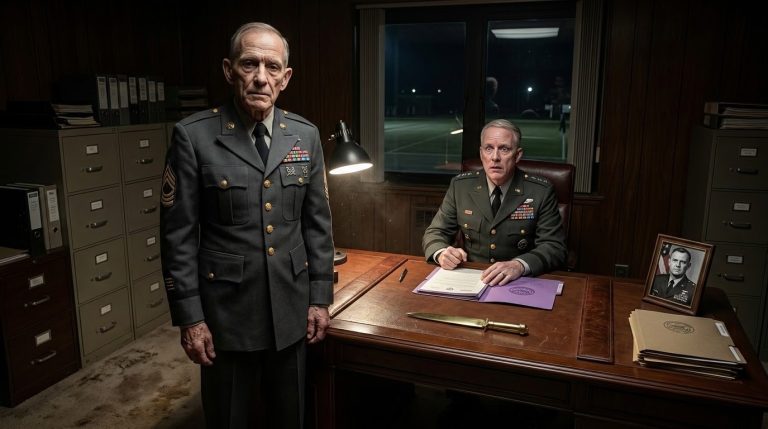
Colonel Anderson looked at his men, then back to Marcus. The judgment was absolute. “My office. 0500. You are all on report. I want your badges on my desk, and I want an unredacted history of MACV-SOG written by each of you by the end of the week. You are stripped of all operational status until I am satisfied that you have learned the difference between a soldier and a bully.”
Anderson turned away, his back to the broken men, and placed a hand on Richard’s shoulder. It was a gesture of profound respect—a hand, not a hold. “Let us get you home, sir,” he said.
Richard nodded slowly, his gaze lingering on Marcus for one last, piercing second. There was no hatred in his eyes, only a profound, hollow pity. Marcus couldn’t meet it. He remained bowed, the weight of his own insignificance pressing down on him, the silence of the bar ringing in his ears like a permanent, stinging echo.
CHAPTER 6: THE ARCHITECTS FINAL COUNSEL
The bar had been hollowed out. With the Colonel and his tactical team gone, the silence that remained was not the tense, expectant silence of a confrontation, but the exhausted, flat quiet of a room that had been stripped of its illusions. The patrons had returned to their drinks, but the air felt thin, sterilized. Marcus remained in the center of the floor, his back to the bar, his shoulders slumped as if he were carrying the weight of the entire building.
Richard didn’t move from his stool. He watched the younger man—the boy who had entered this place with a chest full of bravado and a mind full of dangerous misconceptions. Now, the boy was hollowed out, his uniform of confidence discarded on the floor like a dead skin.
Marcus turned around slowly. He didn’t look at the other men in his unit; he looked at the field jacket. He looked at the patch—that frayed, meaningless piece of cloth that he had used as a justification for his crusade. The mockery he had felt earlier was gone, replaced by a raw, jagged vulnerability that he clearly didn’t know how to process.
“I didn’t know,” Marcus said. His voice was a thin, raspy thread, lacking any of the predatory bite from an hour before.
Richard reached out, his gnarled, liver-spotted hand resting on the smooth, polished surface of the bar. He felt the cold texture of the wood, a grounded, physical reality that served as a tether. He didn’t offer a platitude. He didn’t offer forgiveness. He simply existed in the space where the truth had finally settled.
“Knowledge is a choice,” Richard replied. “You chose to see a target because it was easier than seeing a person. You chose to value the symbol over the substance.”
Marcus looked down at his own hands, then back at Richard. “The Colonel said… he said you designed the techniques. That you were one of the four.”
“I was,” Richard said. The admission was simple, lacking any pride. He didn’t dwell on the title of “Reaper One” or the dark mythology of Shadow Forge. To him, those weren’t badges of honor; they were descriptors of a function he had performed in a world that no longer existed. “But that man is gone. He died in the same places that patch was earned.”
The “5-Pillar Catharsis” began to take shape in the silence. First, the Payoff: Marcus’s complete internal collapse, the physical manifestation of his own arrogance being stripped away by the inescapable reality of the man he had tried to humiliate. Then, the Poetic Justice: the realization that the very things Marcus worshipped—the tactics, the tactical discipline, the rigid command structure—were the very tools that were now being used to dismantle his career and his self-image. He had tried to use his status as a soldier to destroy a legend, and in doing so, he had proven himself unworthy of the status he held so dear.
The Denouement followed, a slow, atmospheric settling of the world. Richard turned toward Sarah, who was still standing behind the bar, her face softened by a mixture of exhaustion and relief. He caught her eye and gave a small, almost imperceptible nod. He then turned his attention to the field jacket draped over the stool. He picked it up—a heavy, cumbersome thing—and began to methodically smooth out the creases. It was a gesture of repair, a symbolic closure. He wasn’t just fixing the jacket; he was re-anchoring his own history, acknowledging the weight of it without letting it crush him.
“You have fire,” Richard said, finally looking at Marcus. The tone was not a rebuke; it was a clinical assessment. “The Colonel is right about that. But fire without direction is just a wildfire. It destroys everything it touches, including the person holding the torch.”
Marcus took a hesitant step forward, his posture reflecting the internal shift—less of a soldier on the hunt, more of a student realizing the depth of the lesson he had missed. “What do I do now?”
Richard didn’t answer immediately. He stared at the patch, his fingers tracing the frayed edges of the skull. “You learn to listen to the silence,” he said. “You learn that the most dangerous man in any room isn’t the one who makes the most noise. He’s the one who is quiet enough to hear the truth before it hits him.”
The interaction was a quiet moment of deep emotional connection, not of friendship, but of recognition. Richard saw the mirror of his own past in Marcus—the raw, unrefined intensity that needed to be tempered by the cold reality of loss. Marcus saw the potential for the man he might actually become, if he could learn to bury his ego.
Richard stood up, his hip protesting the movement, and leaned on his cane. He didn’t look back at the bar, and he didn’t offer a final, dramatic send-off. He walked toward the door, his gait steady, his presence reclaiming the anonymity he had fought for years to preserve.
The bar remained in a state of quiet grace. Marcus didn’t follow. He stayed at the bar, staring at the empty stool, his own future an open, frightening question. Outside, the night air was crisp, and the silence of the street was a vast, open space where the echoes of the night had finally, mercifully, come to rest. Richard walked into the dark, the weight of the jacket on his shoulders no longer a burden, but a testament to a life that had been lived—fully, brutally, and quietly—until the very end.