The Weight of Stone and Law: How a Retired Combat Engineer Dismantled a Suburban Empire
CHAPTER 1: The Boundary Line
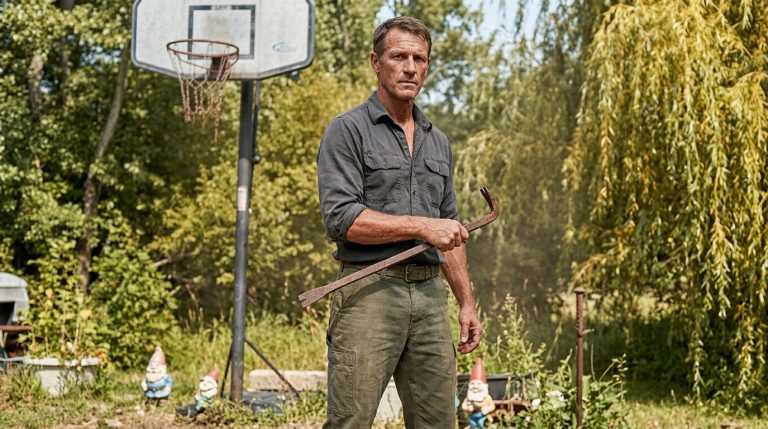
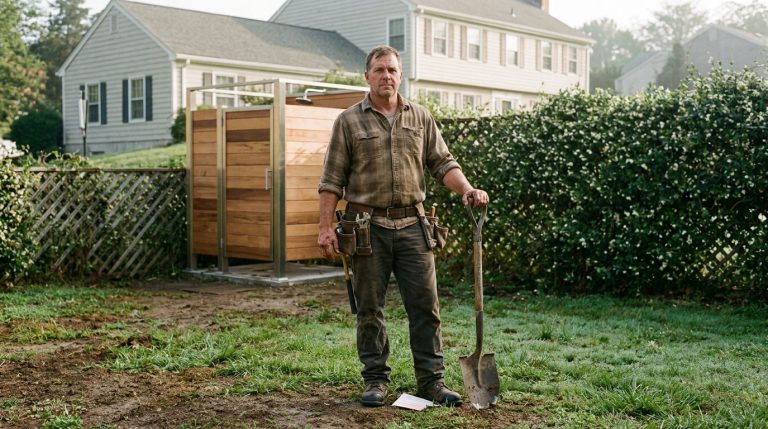
The voice was a grating symphony of entitlement and cheap perfume, a sound that could curdle milk from fifty paces. Jack didn’t rush his turn. He let the handle of the steel post-hole digger rest against his thigh, feeling the coarse grain of the wood through his calloused palms.
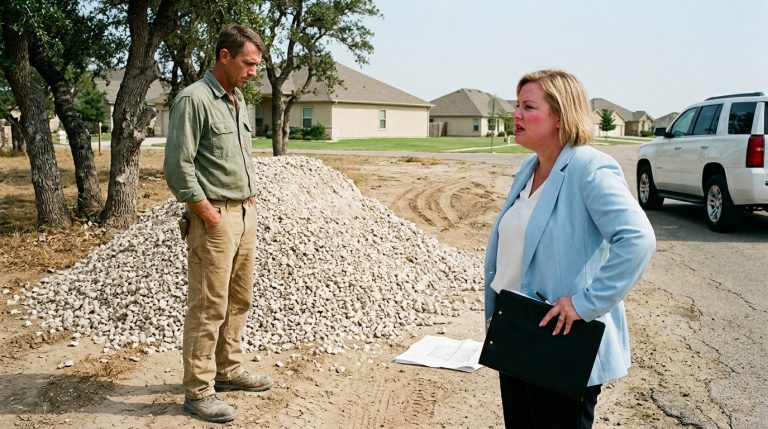
Before him, shimmering in the heavy, breathless heat of the South Carolina lowcountry, stood Karen Prescott. Her floral-print muumuu strained against an engineered boundary of fabric, a bright, loud barrier marking the center of her self-appointed universe. In one hand, she gripped a clipboard like a magistrate’s staff; in the other, a black walkie-talkie tuned to the frequency of suburban paranoia. Her custom electric golf cart sat askew across the asphalt, blocking the lane with the casual arrogance of someone who believed the county plat maps were written in her honor.
Jack looked past her, his gaze dropping to the two pillars framing his driveway. They were four feet tall, three feet square, built from dark river stones he had hauled out of the creek bed himself. Every joint of gray mortar had been laid with the meticulous precision he had once used to grade forward operating bases in Helmand. They were solid. They were level. And they sat a full ten feet inside his legal property line.
“Ma’am,” Jack said, his voice level, stripped of any inflection that might invite debate. “I pulled the permits six months ago. The paperwork is filed in my office. These pillars are staying put.”
Karen’s smile was a bloodless slash, the corners of her mouth twitching with manufactured grace. “An administrative oversight, Sergeant Major. The junior committee member who processed your paperwork has been… reassigned. The architectural board convened an emergency session this morning. Your approval is retroactively revoked.”
She tapped her acrylic nail against the wooden clipboard, the sharp clack-clack cutting through the hum of distant cicadas.
“You have seventy-two hours to clear those stones, or the association will contract for their removal at your expense. Plus a five-thousand-dollar fine for willful non-compliance.”
Jack’s blood pressure remained flat, but a cold, clinical focus clicked into place behind his eyes. He had smelled this exact brand of petty tyranny in half a dozen different zip codes across the globe—small minds elevated by small authority, mistaking an HOA covenant for an iron crown. He knew better than to argue. Arguing implied legitimacy.
He didn’t raise his voice. He didn’t shift his weight. He simply looked at the way her knuckles whitened around the plastic casing of her walkie-talkie, noting the micro-tremor of panic masked beneath her aggressive posture. She was rushing her cadence, pushing for a fast capitulation because she needed compliance to validate her control.
“Karen,” Jack said softly, stepping an inch closer to the boundary line, “you might want to double-check your survey data before you start pricing out demolition crews. The ground you’re standing on right now isn’t nearly as stable as you think.”
Her eyes narrowed, the synthetic warmth dropping away to reveal a sharp, defensive glare. “My data comes directly from the developer’s master plat, Sergeant Major. You signed the covenants. You don’t get to rewrite the rules just because you spent twenty-five years digging trenches.”
She spun on her heel, her sandals slapping against the asphalt as she climbed back into her golf cart. She jammed the throttle forward with a sharp jerk, the electric motor whining as she sped down the street to deploy her next warning.
Jack stood motionless in the humid glare, listening to the fading hum of her cart. He looked down at the dark, wet river stones of the pillar, then back toward the dark window of his home where Sarah stood watching through the glass, her hands wrapped tight around a ceramic mug. The micro-tension in the air hadn’t dissipated; it had only tightened. He turned slowly toward the garage, his mind already calculating the distance to the county records office, and the exact chain of title that would tear her entire kingdom apart.
CHAPTER 2: The Dust of the Archives
The air in the Charleston County Records Office tasted of oxidized iron and centuries of slow, silent decomposition. It was a suffocating, windowless room tucked behind the main public registry, where the humidity was kept at a low, shivering hum by industrial dehumidifiers that rattled against the tile floor. Jack sat hunched over a heavy oak table, the collar of his shirt damp against the back of his neck, his thumb tracing a spidery ink line drawn by a surveyor who had been dust for generations.
The modern plat map of Oak Ridge Meadows—crisp, corporate, and cleanly printed on stark white bond paper—lay pinned flat under a stainless-steel paperweight directly beside the ancient document.
Two worlds, separated by nearly a century, pressed against each other under the glare of a single overhead goose-neck lamp.
Jack’s eyes burned, but he didn’t blink. For four hours, he had cross-referenced the coordinates block by block, moving his heavy magnifying glass across the margins like a combat engineer sweeping a suspected minefield. Every parcel in the modern development had a neat, tidy designation, flowing outward from the main entrance like a well-drilled regiment. Except for one. A solitary, perfectly rectangular notch carved into the eastern quadrant, right where the manicured turf of the Oak Ridge Meadows Community Center met the treeline.
According to the 1932 ledger, that acre had never changed hands. It had been carved out during a tax sale in the depths of the Great Depression, marked with a heavy red grease pencil and labeled Reserved – Silas Vance Estate. When the paper company bought the surrounding three hundred acres in 1998 to pave the way for suburban sprawl, their title search had suffered from a terminal case of institutional laziness. They had copied the outer boundary lines from an outdated tax map, assumed the interior notch was a municipal easement, and built their crown jewel—an Olympic-sized pool and an expansive clubhouse—squarely on top of dead men’s ink.
A sharp, intrusive memory flickered behind Jack’s eyes: a forward operating base in the Arghandab Valley, where an intelligence officer had looked at a satellite photo of a dry riverbed, declared it safe for transport, and missed the subtle shadow of a culvert pipe packed with copper wire. The human mind loved convenience. It loved to look at a vast, orderly grid and assume nobody had left a spike in the concrete.
Jack reached into his breast pocket, pulled out a small mechanical pencil, and made a single, precise tick mark on his legal pad.
The door to the records room creaked open, admitting a thin slice of fluorescent light from the hallway, accompanied by the dry, paper-rustling shuffle of Mrs. Gable, the head archivist. She pushed a heavy metal cart laden with more leather-bound volumes, her silver spectacles sliding halfway down her nose.
“Finding what you need, Sergeant Major?” she asked, her voice dry as parchment. “Most folks come in here looking for a simple deed transfer or a boundary dispute over a fence line. You look like you’re mapping a invasion.”
“The maps don’t lie, Mrs. Gable,” Jack said, his voice dropping an octave as he kept his eyes locked on the plat. “They just wait for someone to read them correctly.”
“Well, the county clerks in ninety-eight certainly didn’t read them,” she muttered, adjusting a stack of registry books on a nearby shelf. “Developers come through here with slick suits and fistfuls of cash, and the boys upstairs stamp whatever paper gets slid across the counter. Nobody checks the old paper anymore. Too much dust.”
She patted the spine of an 1890 tax ledger before shuffling back out into the hall, leaving the heavy door half-ajar.
Jack didn’t reply. He leaned back in the creaking wooden chair, letting the tension uncoil from his shoulders while his analytical mind methodically mapped the next phase. Karen Prescott thought she was fighting a tactical skirmish over two river-stone columns at the end of a driveway. She viewed the world through the narrow, high-contrast lens of a homeowner association rulebook, where every infraction was a minor victory and every neighbor was a potential recruit for her little patrol. She had no concept of deep structure. She didn’t understand that an institution built on an unverified title was nothing more than a house of cards resting on a rotten sill.
He pulled his phone from his pocket, checking the screen. No new messages from Sarah, but a quiet notification from his bank reminded him of the mounting legal retainer fees he had discussed with Maria Sanchez. It was a calculated risk. Every hour spent hunched over these tables, every dollar funneled into certified copies and title abstracts, represented a tangible cost. There was no clean victory in civil law; there was only endurance.
Jack stood up, his joints popping in the heavy stillness of the archive room, and began carefully unpinning the antique maps. He stacked them by date, each movement deliberate and measured. He had the coordinates. He had the chain of title. He had the exact geographical footprint of Karen Prescott’s empire laid out like a blueprint for a demolition charge.
He closed the heavy leather binder with a dull, echoing thud that seemed to swallow the hum of the dehumidifiers. The first phase of the reconnaissance was complete. The ground had been surveyed, the weakness identified, and the line drawn.
When he walked out of the county building and stepped into the blinding Charleston afternoon, the humid air hit him like a physical wall, thick with the scent of pine and asphalt. He climbed into the cab of his Ford F-250, started the engine with a low, rumbling purr, and pointed the truck toward the highway. The trap was no longer just an idea; it was loaded, primed, and waiting for the enemy to step across the threshold.
CHAPTER 3: The Tactical Nuke in the GlassWalled Office
The door to Maria Sanchez’s office swung shut with a muffled, expensive click, sealing out the hum of downtown Charleston. The room was a study in clean lines and cold geometry: polished concrete floors, a stark glass-topped desk, and an absolute absence of clutter. The only object breaking the clinical aesthetic was a framed, sepia-toned photograph mounted on the far wall—a cluster of tired, dust-streaked Marines in the Afghan desert, standing shoulder-to-shoulder with expressions carved from hard grit and mutual survival.
Maria sat behind the glass desk, her fingers steepled beneath her chin, her eyes tracking Jack as he crossed the room and dropped a heavy, weathered file folder onto the surface.
“You look too relaxed for a man currently facing a ten-thousand-dollar penalty and a lien on his front yard, Sergeant Major,” Maria said, her tone dry, carrying the sharp cadence of a former military prosecutor who had spent years dissecting bad orders.
Jack pulled out the chrome-framed chair opposite her and sat down, resting his forearms on the edge of the glass. “Karen doesn’t know what she’s holding,” he said quietly. “She thinks this is a turf war over two river stones. She’s operating on the assumption that her bylaws are absolute law because nobody ever bothered to look past page one of the master plat.”
“People rarely do,” Maria replied, leaning forward as she untied the string securing Jack’s folder. She slid out the 1932 plat map and the modern county registry copies, her eyes darting across the dates, parcel numbers, and highlighted coordinates with surgical speed. The silence in the room stretched, broken only by the faint, rhythmic hum of the building’s central HVAC system.
For several minutes, Maria didn’t speak. She traced the boundary lines of the notched acre with the tip of a red grease pencil, her brows drawing together as the systemic implications of the paperwork mapped themselves out in her mind.
When she finally looked up, the professional detachment in her eyes had been replaced by a sharp, predatory glint.
“Jack,” she said, her voice dropping into a low, appreciative hum. “This isn’t just a quiet title action. This is a tactical nuke.”
She stood up, walking over to the floor-to-ceiling window that overlooked the harbor traffic below, her arms crossed tight over her dark blazer.
“The developer who carved out Oak Ridge Meadows in ninety-eight didn’t just make a clerical error. They pulled a blanket description from an old tax abstract without running a physical chain of title. They built their crown jewel—the community center, the Olympic pool, and eighty parking spaces—right inside your great-grandfather’s reserved parcel.”
She turned back to face him, a faint smirk touching the corner of her mouth.
“The bank holding the mortgage on that community center is going to have a corporate seizure when they realize their multi-million-dollar collateral is legally defective. The title insurance company that guaranteed the developer’s original deed is on the hook for millions. And the individual homeowners? They’re sitting on top of an active fault line.”
Jack didn’t smile. He kept his expression neutral, his internal calculus running parallel to hers. “We don’t want to burn the neighborhood down, Maria. The people living in those beige houses didn’t build the system; they’re just trapped in it by thirty-year mortgages and a woman with a walkie-talkie.”
“True,” Maria conceded, returning to her seat and tapping a pen against the glass. “But leverage isn’t about destroying the target indiscriminately. It’s about applying pressure precisely where the structure is weakest so that the authority collapses under its own weight. If we drop this into the Court of Common Pleas right now, Karen’s little regime shatters overnight.”
“She won’t go quietly,” Jack said, his thoughts flashing back to the tight, angry lines of her face by the driveway. “She’s going to double down. She’ll try to escalate, bring in towing companies, or force a demolition before she admits she’s standing on ground she doesn’t own.”
“Let her,” Maria said smoothly, picking up the pink final warning notice Karen had mailed earlier in the week and tearing it cleanly down the middle. “Every aggressive move she makes from this point forward is just another exhibit for our damages brief. Document everything. Record the interactions. When she strikes next, she’ll be handing us the rope herself.”
Jack stood up, buttoning his jacket as the architectural weight of the plan settled into place. The perimeter was marked; the dossier was locked. He nodded once, a crisp, precise gesture born of long habit, and turned toward the door. The counter-offensive had moved from the drawing board into the field.
CHAPTER 4: The Tow Truck Gambit
The voice on the other end of the line was thick with professional indifference. It belonged to an dispatcher at Big Earl’s Towing, relaying a work order generated directly from the Oak Ridge Meadows Homeowners Association. An unauthorized commercial vehicle, license plate matched down to the digit, parked in violation of covenant nineteen-B.
Jack stood at the kitchen window, holding a ceramic mug of black coffee, watching the pale morning light catch the edges of his stone pillars. His truck sat on the asphalt outside, perfectly clean, devoid of any commercial lettering, and legally parked within public right-of-way bounds. It was a transparent power play, designed to draw him out into a public confrontation.
“Thank you for the courtesy call,” Jack said, his voice flat and controlled. “Tell your driver to hold off on the chains. That vehicle is legally parked, and any attempt to hook up to it will be treated as an unauthorized seizure. The county sheriff’s department has already been notified to log the incident.”
He hadn’t called the sheriff yet, but as he clicked the phone off, his thumb immediately slid across the screen to dial 911.
Five minutes later, the heavy air of the suburban street was split by the low, guttural roar of a diesel flatbed hauling into position. The driver, a mountain of a man with a heavy beard and grease-stained overalls, hopped down from the cab with a length of steel chain clinking against his thigh. Without a word of warning, he dropped to his knees behind Jack’s F-250, whipping the heavy metal links toward the axle.
Simultaneously, a Charleston County patrol cruiser swung quietly around the corner, its blue and white panels gleaming in the morning sun before it drifted to a halt directly behind the tow truck. Deputy Miller stepped out from behind the cruiser door, his boots crunching sharply on the loose gravel of the shoulder.
Jack walked out onto the front steps, his movements deliberate, every step measured against the crisp morning air. He didn’t rush. He let the silence work as an anchor while the tow truck driver looked up, his expression shifting from arrogant certainty to sudden, jittery calculation at the sight of the uniform.
“What seems to be the problem here, gentlemen?” Deputy Miller asked, his hand resting comfortably near his utility belt as he stepped between the two vehicles.
“Got a valid work order straight from the HOA president,” the driver grunted, jabbing a thick, grease-darkened finger toward the windshield of his truck. “Says this rig’s a commercial nuisance blocking residential flow.”
Jack pulled a folded plastic sleeve from his inner jacket pocket and handed it across to the deputy. The paperwork was pristine: state vehicle registration listing the truck as a non-commercial personal asset, backed by municipal ordinances explicitly protecting public street parking.
“Officer, that work order was issued by Karen Prescott in an ongoing campaign of harassment,” Jack said clearly, ensuring his voice carried to the neighbors who had already begun parting their curtains down the block. “This vehicle is fully compliant. Any forced removal is grand theft.”
Deputy Miller scanned the documents, his face tightening with weary familiarity. He looked down at the tow truck driver, whose hands were still resting awkwardly on the steel chain. “You hook up to this truck, mister, and you’re driving it straight into a criminal liability suit. The owner presses charges, and I’m writing the arrest report. Drop the chains.”
The driver stared at the deputy for three long seconds, weighed the economic value of an HOA contract against the grim reality of a felony record, and spat a curse onto the asphalt. He stood up, unclipped his gear with sharp, angry jerks, and climbed back into the cab. Within two minutes, the flatbed backed out and rumbled away down the street, its hazard lights flashing an ignominious retreat.
As the exhaust fumes drifted away, the front door of a nearby house clicked open. Tim Henderson stepped out onto his porch, his expression a mix of nervous hesitation and profound relief. A moment later, old Mr. Abernathy shuffled across the asphalt from the opposite direction, his hands trembling slightly as he clutched a worn leather notebook.
By afternoon, the living room table was covered in crumpled pink slips, threatening letters, and handwritten accounts of administrative abuse from half a dozen different households. The resistance was no longer an isolated front; it had become an organized dossier. Karen Prescott had meant to isolate an adversary, but her escalation had welded the neighborhood into a single, cohesive force.
CHAPTER 5: The Demolition Blockade
The convoy didn’t arrive with a warning letter; it arrived with the brute-force architecture of an ambush. Two heavy flatbed trucks turned the corner in tight succession, hauling a commercial Bobcat equipped with a steel jackhammer head, followed closely behind by a dump truck designed for concrete debris. Four men in high-visibility yellow vests and heavy hard hats spilled out onto the asphalt before the vehicles had even fully stopped.
Leading the formation from the center of the lane was Karen Prescott’s customized electric golf cart. She sat rigid in the driver’s seat, her khaki pantsuit sharp and unyielding against the humid morning light, her grip fixed tight on the wooden handle of her clipboard.
Jack turned away from the window, walked through the quiet hallway, and stepped out onto the front porch. He didn’t rush his descent down the wooden steps. He kept his hands loose at his sides, his eyes locked on the front line of the Bobcat as its diesel engine let out a sharp, metallic cough of blue exhaust.
By the time he reached the edge of the asphalt, right between the two unyielding river-stone pillars of his driveway, Karen had already brought her golf cart to a skidding halt.
“Mr. Riley,” Karen announced, her voice pitched to carry across the quiet street for the benefit of the waiting demolition crew. “As per the final notice and board authorization, we are here to execute structural remediation. You have one final opportunity to stand down before we remove these unapproved obstacles at your expense.”
Jack didn’t blink. He let the silence stretch, a heavy, calculated gap that forced the lead foreman—a broad-shouldered man with a thick handlebar mustache—to shift uncomfortably from boot to boot.
“Karen,” Jack said, his voice dropping into a calm, level register that cut easily through the background hum of the idling excavator. “This is your last chance to turn your convoy around. You are standing on ground you don’t own, preparing to commit a felony on private property. Walk away now.”
The foreman laughed, a short, dismissive bark, and looked toward Karen for authorization. She gave a sharp, definitive nod. “Proceed,” she commanded.
The Bobcat driver jammed the throttle forward. The metal tracks bit hard into the shoulder of the road, and the pneumatic jackhammer head swung upward like the barrel of an anti-tank gun, pointing directly at the left stone pillar.
“That’s far enough,” Jack said.
At that exact micro-second, Deputy Miller stepped out from the deep shadow of the porch overhang, where he had been quietly observing the confrontation from the side of the house. His hand rested lightly, professionally, on the retention strap of his holster as he crossed the gravel driveway.
The effect was instantaneous. The Bobcat driver slammed his boots onto the brake pedal, the hydraulic system hissing as the machine shuddered to a halt inches from the stonework. The foreman’s jaw dropped slack. Karen’s expression twisted from absolute triumph into sudden, chaotic confusion.
“What’s going on here?” Deputy Miller asked, his voice carrying the effortless authority of the state.
“This woman hired us to take down these pillars,” the foreman stammered, holding his hands up defensively as he stepped back from the machine. “Standard HOA contract. We were told it was legal.”
Miller turned his gaze toward Karen, who was gripping her clipboard so hard her knuckles had turned bone-white. “Ma’am, did you hire this crew to destroy private property?”
“It’s an HOA matter!” Karen shrieked, her voice cracking under the sudden pressure. “He’s violating the covenants! I’m the president!”
“Ma’am, you are on private land directing a third party to demolish structures that do not belong to you,” Miller replied coldly. “That is not a civil dispute. That is a felony charge for conspiracy to commit destruction of property. Jack, do you want to press charges?”
“Not today, Deputy,” Jack said quietly, his eyes fixed on Karen’s disintegrating composure. “Let’s let them pack up and leave.”
The foreman didn’t wait for another word. He turned on his heel, yelled at his crew to secure the equipment, and scrambled back into the cab of the flatbed. Within ninety seconds, the entire convoy was reversing down the street in a chaotic scramble of dust and burning rubber.
Karen sat alone in her golf cart in the middle of the empty road, staring blankly at the unmovable stone pillars. Deputy Miller calmly pulled a citation book from his pocket to log her illegal obstruction of the roadway, while down the street, front doors began to open one by one as the neighborhood watched the collapse of her reign.
CHAPTER 6: The Fall of the Queen
The air inside the Oak Ridge Meadows Community Center was thick with the scent of stagnant coffee and sudden, collective panic. Every seat was filled, and the overflow crowd spilled down the walls, their shoulders pressed against the wood-paneled trim. Jack remained seated in the center of the front row, his posture rigid, his hands resting quietly on his knees. To his right, Maria Sanchez maintained a look of absolute professional composure, her briefcase resting flat against the floor. To his left, Sarah let out a long, quiet breath that seemed to dissolve the final remnants of months of tension.
Up on the raised stage, behind a long mahogany table, Karen Prescott gripped the edges of her notes with fingers so tight her skin had turned the color of bleached bone. Her bright red power suit, chosen for a triumph that had evaporated, now hung around her frame like an ill-fitting costume.
She had called the emergency meeting to ram through a two-thousand-dollar special assessment per household, certain that tribal fear of the outsider would rally the neighborhood behind her authority. Instead, she had walked directly into an architectural trap built on twenty years of unexamined paperwork.
When Maria stood up, holding the single-page settlement offer, the absolute silence in the room had shifted from apprehension to raw calculation.
“My name is Maria Sanchez,” she announced, her voice carrying effortlessly without the aid of the microphone. “I represent Mr. Jack Riley. And contrary to what has been claimed tonight, my client has no desire to close your community center or seize your pool.”
Karen slammed her plastic gavel down, the sharp crack echoing off the ceiling tiles. “This is a closed meeting! You are not a homeowner. You have no standing to—”
“On the contrary,” Maria interrupted smoothly, stepping forward and lifting a heavy, gold-sealed certified copy of the title abstract high enough for the front rows to read. “As my client is the legal owner of the one-acre parcel upon which this very building, the swimming pool, and sixty of your parking spaces sit, that gives him every right to address this room. In fact, under the current legal reality, you are all guests on his property.”
A sharp collective gasp rippled through the crowd. Frank, the veteran neighborhood accountant sitting near the edge of the stage, leaned forward, his eyes darting to the board members beside him who were already frantically avoiding eye contact.
Maria didn’t rush. She laid out the architecture of the disaster with cold, clinical precision: the 1932 tax map, the missing chain of title from the 1998 corporate buyout, the voided title insurance, and the impending bank default that would freeze every mortgage in the development. She didn’t shout. She didn’t need to. The gravity of the facts did the work for her.
“The lawsuit filed in the Charleston County Court of Common Pleas is not baseless,” Maria concluded, her voice dropping into a steely register. “Your own counsel has already advised you that your position is legally fatal. Therefore, Mr. Riley offers a clean resolution. He will deed this entire parcel—clubhouse, pool, and parking lot—free and clear to the homeowners of Oak Ridge Meadows for the sum of one dollar.”
The room held its breath.
“However,” Maria continued, her gaze shifting like a laser toward Karen, “that offer is contingent on two absolute conditions. First, the immediate and permanent dissolution of the current Homeowners Association board, and the establishment of a transparent, democratically elected successor. Second, Karen Prescott is barred in perpetuity from holding any position of authority or volunteer service within this community.”
For three long seconds, time seemed to fracture. Karen opened her mouth, her breath hitching as she looked out across the rows of familiar faces—neighbors she had bullied over lawn heights and door colors, people who now stared back at her not with fear, but with cold, lucid realization.
“You can’t do this,” Karen whispered, her voice cracking, losing its synthetic authority entirely. “I built this place. I protected these property values. You’re letting a terrorist steal our foundation!”
She looked toward Frank, expecting her usual automatic backing, but the accountant slowly stood up, picked up his notepad, and turned his back on her.
“I move we accept the settlement,” Frank said clearly into the microphone.
A dozen voices seconded the motion from across the room before he had even finished the sentence. When the interim president called for the vote, the affirmative roar was deafening—a thunderous, cathartic wave of sound that shook the very rafters of the hall. There was not a single dissenting voice. The reign was over.
The aftermath settled over the neighborhood like a cool rain after a summer drought. Within a week, the formal dissolution papers were signed, the old punitive bylaws struck through with heavy red ink, and the deed transferred for a single crisp dollar bill that now sat framed on Jack’s office wall. The Hendersons repainted their door blue; Mr. Abernathy added a companion gargoyle to his garden; and the streets filled once more with the sound of children playing without looking over their shoulders.
Karen vanished behind the drawn curtains of her beige house for nearly a month before a massive professional moving truck appeared in her driveway. On the morning of her departure, Jack stood out on his front lawn, applying a final, smooth coat of weather sealant to the gray river stones of his pillars.
He paused, watching as Karen carried a cardboard box down her front steps. She stopped midway, her eyes drifting across the immaculate asphalt to lock onto the two solid, unyielding monuments guarding the entrance to his drive. There was no fire left in her posture—only the hollow, exhausted weight of a small tyrant who had discovered too late that her empire was built on sand.
Without a word, she loaded her box into the back of her sedan, got behind the wheel, and drove away, never looking back.
That evening, the low southern sun painted the sky in deep shades of amber and bruised purple. The air was cool, carrying the faint, sweet scent of damp earth and blooming jasmine. Jack and Sarah sat side by side on the porch swing, the rhythmic, gentle creak of the chains blending into the steady hum of the night crickets.
The soft, warm light from the living room spilled out across the gravel, catching the dark, textured faces of the river stones standing guard at the property line. They looked heavy. They looked permanent. They looked like they had always belonged right where they were.
Sarah leaned her head against his shoulder, her hand sliding over to find his calloused fingers.
“Was it worth it?” she asked softly, her voice carrying the quiet peace of a settled world. “All the stress, the late nights at the archives, the legal battles?”
Jack looked out across the quiet, liberated street, watching the golden light settle over the trees. He thought of the heavy stones, the precise mortar, and the deep, abiding quiet of the land that stretched out behind them.
“Yeah,” Jack said, his thumb brushing the back of her hand. “It was worth it.”
They had their roots, and they were anchored deep in stone.