The Quiet Guard Under the Concrete Bridge Where Forgotten Heroes Stand Unbroken Against the Tide of Time
CHAPTER 1: THE FIRST STONE
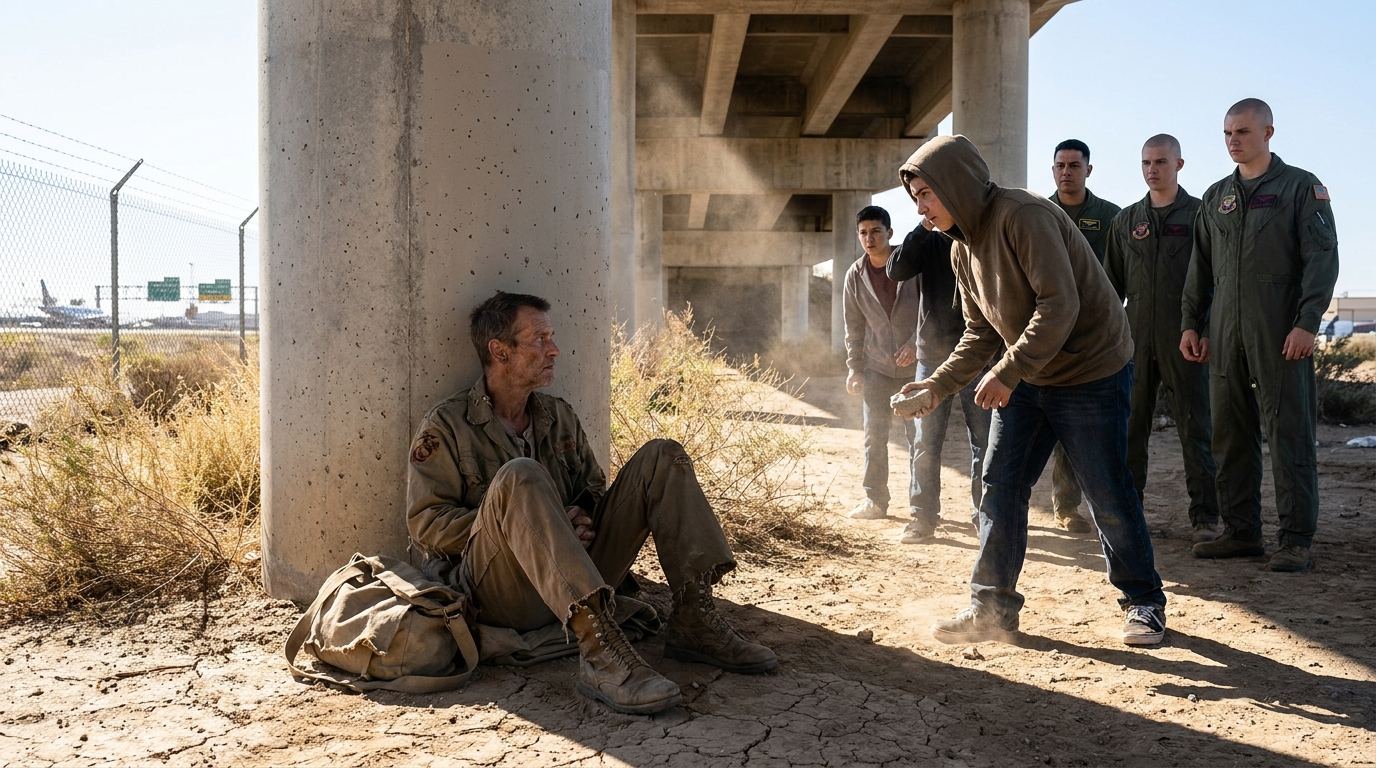
The heat radiating off the asphalt near Marine Corps Air Station Miramar was thick enough to taste. Thomas kept his back pressed firmly against the cool concrete of the overpass pillar, his eyes fixed on the eastern horizon. His fingers traced the frayed edge of his canvas bag.
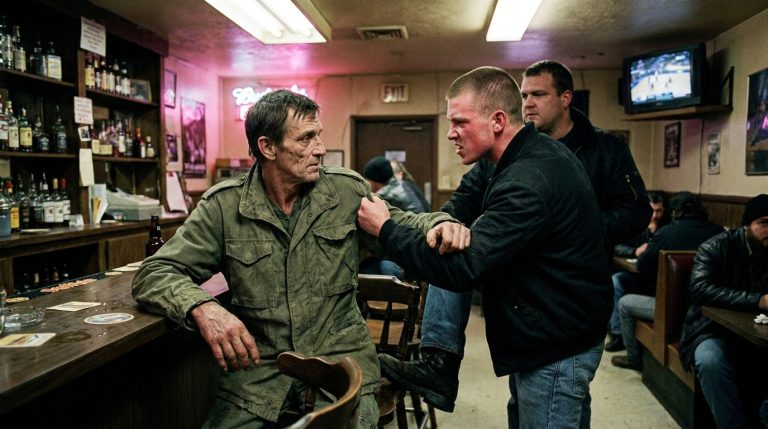
Across the dry brush, five teenagers slouched against a chain-link fence. Derek swung a jagged chunk of limestone from side to side, his sneakers grinding impatiently into the dirt.
“Watch this,” Derek muttered, stepping forward and cocking his arm back with a sharp jerk.
The stone cut through the dry air, clattering violently against the pavement just shy of Thomas’s boots. The boys laughed, high-pitched and reckless with suburban boredom. Thomas did not blink. He slowly uncurled his legs, his knees popping with a dull ache that weather always brought out.
“Hey, wake up, you bum,” Derek shouted, emboldened by the absolute silence.
Thomas opened one eye, fixing the teenager with a flat, level stare that held zero anger and infinite weight. The silence stretched thin, heavy as lead. Two of Derek’s friends instinctively took a half-step backward, their smiles faltering under the quiet intensity of that gaze.
Derek clenched his jaw, refusing to back down with his audience watching. He reached down to pick up a larger rock, his fingers tightening around the rough edges as he prepared to throw again.
“Drop it.”
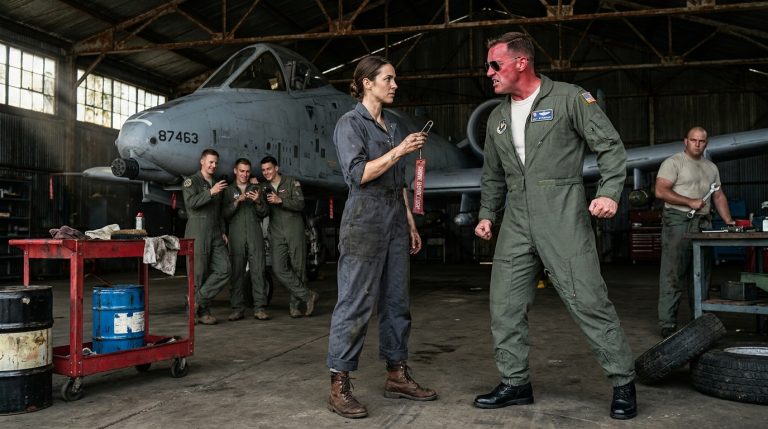
The voice cut through the afternoon haze like a cold blade. Derek froze, his arm locked halfway back. Four Marines in crisp flight suits stood twenty feet away, coffee cups in hand, their expressions locked in a hard, uncompromising stare.
CHAPTER 2: THE STAFF SERGEANT
Staff Sergeant Torres closed the distance between the chain-link fence and the overpass pillar with deliberate, measured steps. His flight suit rustled faintly against the dry heat. He didn’t look at the scattering teenagers; his gaze remained fixed entirely on the man sitting against the concrete.
“You throw rocks at people who can’t fight back,” Torres said, his voice dropping an octave as he addressed Derek’s retreating back. “That how your parents raised you?”
Derek had no answer. He scrambled backward over a patch of dry scrub, his sneakers kicking up dust before he turned and bolted toward the neighborhood streets. His friends scattered like startled birds, leaving behind only the echo of their hurried footfalls.
Torres stopped three paces from the old man. The silence rushed back in, thick and heavy with the hum of distant traffic from the interstate.
The old man shifted his weight, his shoulders rolling back with an unconscious, automatic discipline. He looked up slowly, his eyes meeting the staff sergeant’s gaze without a trace of defensiveness.
“You’re out of uniform for a social call, Sergeant,” the old man said. His voice was gravel over dry riverbeds, worn down by decades of disuse.
Torres didn’t smile. He looked closer, scanning the posture that defied the sagging posture of a typical transient. He noticed the way the old man’s boots were laced—tight, double-crossed, tucked in with the lethal efficiency of someone who expected to move at a moment’s notice.
“Not a social call,” Torres answered, dropping his coffee cup onto a flat stone with a dull thud. “Just checking the perimeter. You look like you’re holding a very lonely post.”
The old man offered a faint, humorless twitch of his mouth. “The post is fine. The company leaves something to be desired.”
Torres crouched slightly, bringing himself eye-level with the veteran. A subtle scent of rusted iron and worn canvas drifted from the small bag at the man’s side. The friction between the clean, pressed lines of the active-duty flight suit and the weathered rags of the overpass seemed to bend the very air around them.
“Staff Sergeant Torres,” Torres said, offering his hand.
The old man looked at the extended palm for three long seconds. Slowly, he raised a calloused hand with knuckles scarred deep into the bone and took the grip. The handshake was dry, brief, and entirely unyielding.
“Walker,” the old man said.
Torres held the grip an instant longer than courtesy required, feeling the raw, wiry strength hidden beneath skin like cured leather. Something beneath the surface of the interaction tugged at his memory, a ghost of old photographs kept in a basement box back home.
CHAPTER 3: THE GHOST OF KHE SANH
The canvas bag gave a dry scrape against the concrete as Thomas pulled it closer to his knee. The slight movement caught the harsh glare of the sun, exposing the faded blue lines of an old-style Marine Corps emblem just beneath the rolled hem of his frayed shirt.
Torres stared at the ink. A bead of sweat cut a clean path through the dust on his temple, but he did not move to wipe it.
“0317,” Thomas said, his voice barely louder than the hum of the distant traffic. “Scout sniper.”
The words hung in the superheated air, stripped of any boast or theater. They were simply a matter of record, dropped like lead weights onto the asphalt.
The younger Marines standing a few paces back shifted uncomfortably, their hands dropping from their coffee cups. One of them let out a short, sharp breath that sounded like a dry cough.
“That’s not just a field MOS,” Torres whispered, his mind racing backward through old stories told over kitchen tables in fading photographs. “First Recon. The things they don’t print in the casualty reports.”
Thomas did not confirm it. He simply met the staff sergeant’s gaze with eyes that looked entirely empty of yesterday and entirely burdened by tomorrow.
“What was your call sign, old-timer?” one of the younger corporals blurted out, the nervous energy of youth breaking through protocol before he could bite his tongue.
Thomas closed his eyes for three slow seconds. The lines around his mouth deepened like carved granite.
“Reaper Storm,” he murmured.
Torres’s coffee cup slipped from his fingers, hitting the hard concrete with a sharp crack. Brown liquid splashed across the dust and stones, but neither man looked down.
“My father,” Torres said, his voice thickening with a sudden, unbidden wave of emotion that caught in his throat. “Second Battalion, twenty-sixth Marines. Khe Sanh.”
Thomas opened his eyes. The hardened mask of indifference cracked just enough to let a sliver of raw history through.
“Little Mike,” Thomas said softly, the name tasting like old dust and iron on his tongue. “He kept a picture of his girl tucked behind the sweatband of his helmet.”
Torres froze, every muscle in his frame locking tight. No one outside of an old footlocker in Ohio knew that detail.
“He made it home because of you,” Torres said, his chest rising and falling in sharp, heavy jerks. “He told me about the three days in the spider hole. He said you stopped an entire advance by yourself.”
Thomas looked down at his double-laced boots, his thumbs hooking instinctively into the frayed straps of his bag.
“I didn’t stop an advance,” Thomas said, his voice dropping into a register so quiet it barely carried over the wind. “I just delayed the inevitable. The ones who didn’t come back—they’re the ones who stayed behind in the green.”
The heavy silence returned, suffocating and absolute. Torres stood motionless, staring at a ghost who had walked out of the jungle decades ago only to find there was nowhere left to land.
CHAPTER 4: THE CANVAS BAG
Torres rose with the broken ceramic in his palm, his jaw set against the rising heat of the afternoon. He tossed the fragments into a nearby refuse bin and turned back to the old man with a stack of paperwork tucked firmly under his arm.
“The base commander sent these down,” Torres said, holding out a collection of printed housing vouchers and medical intake forms. “There’s a room waiting at the transition facility. Clean sheets. A hot shower.”
Thomas did not look at the papers. His thumb brushed over the metal edge of the dog tag resting against his collarbone before he tucked it back beneath his fraying collar.
“I don’t need a room, Sergeant,” Thomas said. His voice was flat, carrying the absolute finality of a closed door. “I’ve spent forty years learning how to sleep on concrete. A mattress just feels too soft.”
The younger Marines hovered near the edge of the shadow cast by the overpass, watching the exchange in tense silence. They had brought heavy wool blankets and insulated flasks of coffee, laying them quietly a few feet from the canvas bag as a peace offering.
“It’s not charity,” Torres insisted, stepping closer and dropping the intake forms onto a flat stone beside Thomas’s boots. “It’s a debt. My father taught me what honor looked like because of you. Let us return a fraction of it.”
Thomas looked at the papers fluttering slightly in the dry wind. A bitter shadow crossed his weathered features, the heavy burden of survivor’s guilt tightening his chest like a tourniquet.
“Honor doesn’t keep the ghosts away,” Thomas muttered, his fingers tightening around the strap of his canvas bag. “The programs, the counseling, the pills—they all try to fix a machine that was built to break. I stay here because the jets overhead remind me of when the mission had an end.”
Torres stared down at the veteran, realizing that no amount of official bureaucracy or institutional goodwill could pierce the armor of a man who had chosen his own exile.
“Then at least take the boots,” Torres said quietly, nodding toward a fresh pair of standard-issue footwear resting atop the donated blankets. “Your soles are worn down to the threading.”
Thomas glanced at the boots, then gave a slow, measured nod. “I’ll take the boots. But the rest stays here.”
CHAPTER 5: THE FINAL WATCH
The pale blue light cut across the cracked plaster of the makeshift room, illuminating the deep canyons etched into Thomas’s face. His thumb hovered over the screen before he tapped the receiver icon, pressing the device to his ear with slow, deliberate precision.
“Walker,” he said. His voice was gravel dragged over broken glass.
“Thomas,” the voice on the other end came back immediately, thick with an adult’s steady sorrow. “It’s Michael. Michael Torres.”
The silence stretched across the line, heavy with the weight of unsaid things and passing seasons. Thomas shifted his weight on the narrow cot, his breath catching slightly as a sharp, familiar pain flared deep in his chest—the silent reminder of what he had ignored for years.
“You kept the number,” Thomas said, staring up at the dark ceiling where the phantom sound of jet engines rumbled in his memory.
“I never put it down,” Torres answered, his tone unwavering. “The hospital called the base. They said you checked yourself in three hours ago.”
Thomas let out a dry, rattling exhale that sounded like wind through dead brush. “The body finally figured out how to quit. Took it long enough.”
“We’re coming, Thomas,” Torres said, the line crackling with background static from a base staging area. “Every single one of us. You’re not sitting this post alone.”
Thomas closed his eyes, the hard shell of his lifelong isolation finally cracking under the sheer, stubborn loyalty of men who remembered a debt that balance sheets could never measure.
“Don’t march down here like it’s a formation,” Thomas rasped, a faint, tired ghost of a smile touching the corner of his mouth. “Just bring some decent coffee. The stuff they serve here tastes like old engine oil.”
“On my way, Sergeant,” Torres said before the line went dead.
CHAPTER 6: WALKERS WAY
The pale morning light spilled across the polished linoleum floor, catching the dust motes suspended in the quiet air. Thomas sat propped up against the pillows, his breathing shallow but steady.
Staff Sergeant Torres stood near the foot of the bed, his flight cap held tightly in both hands. Around them, a dozen Marines filled the room and spilled out into the corridor, standing at a silent, respectful parade rest.
“You’re late for PT, Sergeant,” Thomas rasped, a dry rattle in his chest softening into a faint, exhausted smirk.
” We adjusted the formation, sir,” Torres replied, his voice thick with unspilled emotion. “The base commander renamed the access road near the overpass. It’s official. Walkers Way.”
Thomas closed his eyes. The ghosts that had haunted his decades in the shadows finally seemed to step back, replaced by the warm, steady presence of brothers who understood the cost of the uniform.
“Tell them not to track mud on the concrete,” Thomas murmured, his hand slipping slowly from the edge of the blanket.
The sun crested the horizon, washing the tarmac outside in a brilliant wash of gold and amber. At precisely 0600, Thomas Walker took his final breath, surrounded by a family forged in honor and kept alive by memory.
Outside the window, along the stretch of road bearing his name, a squad of young Marines paused their morning run, turned toward the rising sun, and raised their hands in a crisp, unbroken salute.