The Iron Ridge: How One 19-Year-Old Marine Shattered an Impregnable Fortress When All Hope Vanished
CHAPTER 1: THE BROKEN LINE
The 19-year-old Marine pressed his palms hard against the rough, baking volcanic rock. His knuckles were smeared with dried sweat and gray coral dust. Three days on Peleliu, and the sun was already hammering down past one hundred degrees like an anvil. To his left, the heavy thud of a Type 92 machine gun tore through the humid air, turning the earth into flying splinters.
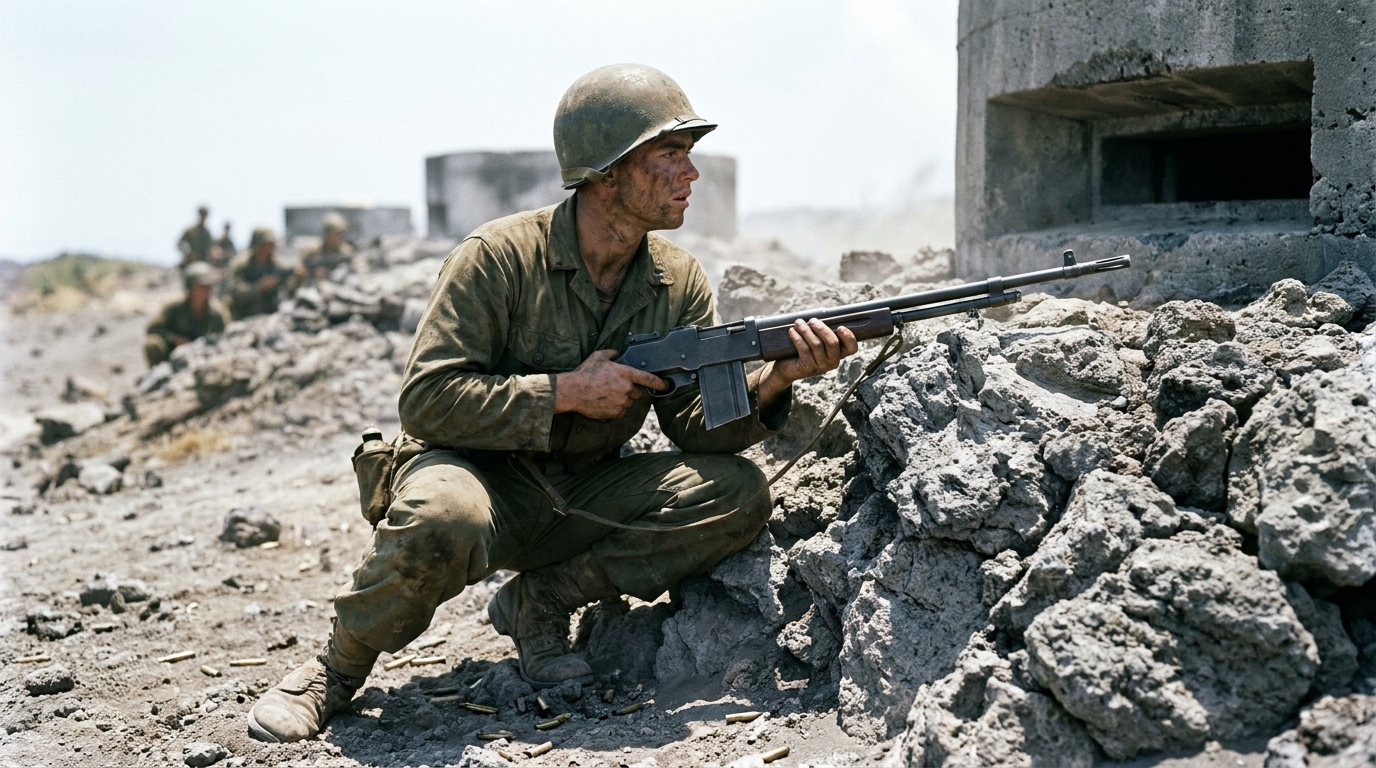
Arthur Jackson didn’t look back at the platoon pinned behind the jagged ridge. He stared directly at the concrete silhouette fifty yards ahead. The pillbox walls were three feet thick, angled to sweep every inch of the approach with overlapping fire. His Browning automatic rifle weighed nineteen pounds, resting cold and heavy across his knees. Every breath burned his throat with the taste of sulfur and dust.
The sergeant was shouting something unintelligible over the deafening crack of rifle fire. Jackson ignored the voice entirely. He kept his eyes locked on the narrow firing slit of the concrete box where an enemy gunner was methodically walking rounds toward the American lines. Waiting for an armor column or an artillery barrage was a dead man’s errand in these jagged ridges.
Jackson jammed a fresh magazine into the BAR with a sharp metallic snap. He checked the heavy metal ammunition crate resting beside his boulder, using its hard edge for a split second to steady his thumb. There was no hesitation left in him, only the grinding, stubborn weight of necessity. Without a word to the men behind him, he hauled his weight up from the dirt.
The air instantly filled with the vicious snap of lead as the Japanese gunners caught movement. Jackson didn’t duck; he surged forward into the open coral gauntlet, bringing the heavy weapon up to his hip as his boots crunched hard against the razor-sharp stone.
CHAPTER 2: INTO THE APERTURE
The heavy lead slugs struck the three-foot-thick concrete wall with a dry, chaotic rattle, sparking white against the volcanic rock. Jackson didn’t waste a single breath waiting for the smoke to clear. He kept the trigger depressed just long enough to force the enemy gunners inside to duck away from their firing slit.
The heat radiating off the coral ridges was enough to make his skin crawl, slicking his forehead with greasy sweat that stung his eyes. Around him, the second pillbox loomed like a jagged gray tooth embedded in the earth. Every inch of the approach was swept by overlapping fire from neighboring positions, leaving zero room for hesitation.
Jackson scrambled forward on his knees, his boots scraping raw against the sharp edges of the volcanic rock. He reached the blind spot directly beneath the concrete overhang where the enemy’s angles of fire completely failed them. Panting hard, he dropped his empty magazine and slammed a fresh twenty-round clip into the receiver with a sharp metallic clack.
A muffled shout echoed from deep within the damp concrete bunker, followed immediately by the desperate clatter of a heavy weapon being dragged across the floor. The defenders inside weren’t yielding; they were simply shifting their positions to cover the rear access point. Jackson didn’t wait to see what they were planning. He hauled his weight up the sloping wall, his fingers finding purchase on the rough, uneven surface of the ventilation shaft.
CHAPTER 3: THE VENTILATION TRAP
The heat radiating off the baked gray concrete felt like the inside of an open furnace. Jackson dropped flat onto his stomach, ignoring the sharp shards of volcanic stone biting into his forearms. He dragged the nineteen-pound Browning automatic rifle forward, keeping the muzzle low against the blistering surface.
A muffled clamor of voices rose from directly beneath him, echoing up through the narrow iron-banded air duct. The defenders inside were frantically shifting ammunition crates, their boots scraping against the damp flooring in a panicked rhythm. They knew someone was above them, but the thick concrete roof offered them a false sense of absolute security.
Jackson didn’t hesitate. He jammed the snout of his heavy weapon straight down into the four-inch metal shaft. Without waiting for a clear target, he squeezed the trigger and held it down. The weapon’s violent shutter shook his collarbone as thirty-caliber rounds ricocheted wildly off the interior walls.
The screams from below were immediate, sharp, and cut short by the suffocating roar of lead bouncing in a confined metal box. Jackson didn’t pause to listen or admire the wreckage. He yanked the smoking barrel free, rolled off the slanted concrete slope, and hit the hard coral earth below with a jarring thud that sent a fresh wave of nausea through his gut.
CHAPTER 4: THE HIDDEN TUNNEL
A sudden scraping sound broke through the persistent crackle of rifle fire, coming from a patch of jagged coral just yards behind his position. Jackson whipped around, his boots sliding dangerously across the loose gravel as he brought the heavy Browning automatic rifle up to his chest.
A camouflaged slab of limestone shifted outward, revealing a dark, foul-smelling subterranean opening that had remained entirely hidden beneath palm fronds. Before Jackson could even catch his breath, an enemy soldier emerged from the gloom with a fixed bayonet gleaming dully in the harsh midday glare.
—Watch out!— a nearby voice yelled out, though the warning was instantly drowned out by the metallic clatter of boots hitting stone inside the narrow passageway.
Jackson didn’t have room to swing the long barrel of his weapon, so he slammed the heavy metal stock forward with a sharp, brutal grunt. The impact threw the advancing soldier off balance, sending him stumbling backward toward the dark mouth of the underground trap.
More shouting echoed from the depths of the tunnel network as additional defenders scrambled upward to seal the breach. Jackson dropped to one knee in the abrasive dust, his fingers frantically working the bolt as he prepared for the coordinated counter-move pushing up from beneath his feet.
CHAPTER 5: THE CROSSFIRE RIDGE
The volcanic rock erupted in a blinding shower of gray splinters as bullets cracked inches overhead. Jackson jammed his shoulder hard against the limestone outcrop, using the dead weight of the weapon to anchor his trembling muscles.
—Keep your heads down and watch the flanking ridge!— the squad sergeant yelled from behind a jagged boulder, his voice raspy and choked with fine dust.
Jackson didn’t reply. He squeezed off controlled, deliberate bursts into the advancing line of defenders, feeling the scorching heat of the barrel burn through his sleeve. Every movement demanded a heavy physical toll, his wounded leg throbbing with a dull, persistent ache beneath his torn trousers.
The enemy wasn’t retreating; they were pressing forward through the narrow corridors with disciplined coordination, exploiting every gap in the stalled American advance. Jackson ejected the spent metal clip, slammed a final improvised magazine into place, and locked his eyes on the remaining stronghold blocking the path ahead.
CHAPTER 6: THE FINAL STRONGPOINT
The triangular complex loomed like a jagged crown over the scorched ridge, its three reinforced concrete bunkers linking fields of fire that had stalled an entire regiment. Jackson dragged his wounded leg forward, the makeshift fabric bandage soaked through with warm blood that smeared against the gray stone.
—We can’t wait for heavy support, Jackson— muttered the corporal beside him, his fingers fumbling with the pin of a heavy fragmentation charge.
Jackson didn’t look back at the warning, knowing full well that no armor or artillery was coming to clear the path. He hauled his nineteen-pound weapon up across his chest, using the sheer friction of the rough terrain to haul his exhausted frame upward.
The defenders inside the central stronghold let loose a final, defiant burst of machine gun fire, refusing every chance at surrender as they doubled down behind their thick concrete walls. Jackson didn’t argue or shout commands; he simply reached the central aperture and shoved his final explosive package deep into the dark interior.
He threw his weight backward off the ridge just as the charge detonated, lifting the heavy structure off its foundations in a suffocating wall of gray debris. When the dust finally settled across the scorched slope, the last stronghold lay shattered in the dirt, and the heavy perimeter stood completely broken under the glaring midday sun.