The Old Man in the Back Row: A Story of Silence, Audacity, and Earned Truth
CHAPTER 1: THE PUBLIC DISGRACE
The red dry-erase marker tapped three times against the whiteboard. Tap. Tap. Tap.
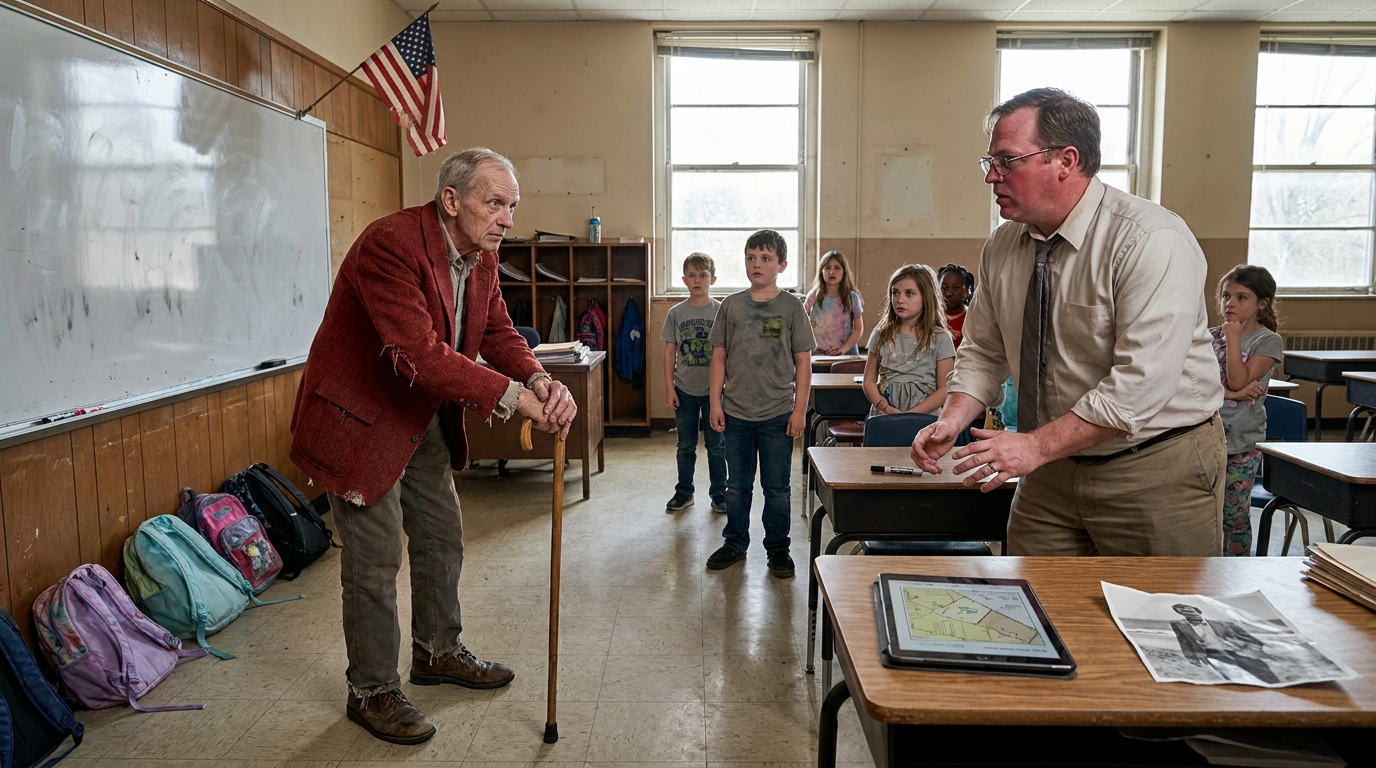
“Is this supposed to be a history presentation or a creative writing exercise, Lily?” Mr. Henderson did not turn around when he spoke. He stayed facing the board, his cheap polyester tie hanging limp against his dress shirt.
In the second row, ten-year-old Lily Clayton pulled her shoulders toward her ears. Her hands gripped the faded wool of her grandfather’s sleeve.
Beside her, Roger Clayton sat in a blue plastic chair designed for a ten-year-old body. His bad hips forced his knees out at an awkward angle. His red tweed jacket—frayed at the cuffs, smelling faintly of cedar and wool—bunched around his neck. His hands rested on the rounded head of a wooden cane.
“It’s history, Mr. Henderson,” Lily whispered. Her voice didn’t make it past the third row. “My pop was a frogman. Before they called them SEALs.”
A boy near the pencil sharpener snickered. Across the room, two girls put their hands over their mouths.
Mr. Henderson turned around slow. He took off his wire-rimmed glasses, folded the arms, and slid them into his breast pocket. He looked at his wrist.
“We have state standardized assessment testing on Tuesday, Lily,” Henderson said. His voice had that flat, practiced tone teachers use when they want thirty children to know someone is wasting their time. “I have a syllabus. I do not have time for fairy tales about underwater commandos.”
He stepped toward the desk. He didn’t look at Roger’s face. He looked at the bunched slacks around Roger’s ankles, then at the scuffed leather of his shoes.
“I appreciate that you love your grandfather,” Henderson said, addressing the room rather than the girl. “I’m sure he was a very fine clerk. Or mailman. But actual military organizations have standards. They do not sit in fourth-grade rooms wearing moth-eaten bargain-bin coats.”
Lily’s breath hitched. She reached into her denim jacket and pulled out a crinkled three-by-five black-and-white photo.
“He’s not a liar,” she choked out. “Look. That’s him on the beach.”
Henderson didn’t reach for it with two hands. He pinched the corner between his thumb and index finger, held it three inches from his eyes for one second, and tossed it onto the corner of his desk. It slid across the laminate and hit a stack of lined paper.
“Anyone can print an image off a search engine, Lily,” Henderson said. “Claiming honors you didn’t earn is stolen valor. It’s disrespectful to actual veterans.”
He pointed a long finger toward the hallway door.
“Sir, I’m going to have to ask you to wait by the administrative office. You are distracting the students, and reinforcing this fantasy isn’t helping her.”
Roger Clayton didn’t flinch. His left thumb moved in a slow, rhythmic circle over the silver rim of a pocket watch tucked into his jacket pocket. Click. Click.
He didn’t look at Henderson. His pale blue eyes stayed locked on the small paper American flag stapled above the chalkboard.
“I’m just sitting with the girl,” Roger said. His voice sounded like dry gravel dragged over stone.
“You’re sitting in my classroom, sir,” Henderson replied, stepping directly into Roger’s line of sight. “And frankly, looking at you, you can barely support your own weight on that stick. You expect these kids to believe you were jumping out of planes?”
He turned to the fourth-graders.
“Does this look like a warrior to you, class? Or does it look like someone who forgot his morning routine?”
The room broke into a quick, sharp burst of nervous laughter.
Lily dropped her head until her forehead touched the cold laminate of her desk.
In the back row, sitting in one of the adult visitor chairs near the cubbies, Jim Miller shifted his weight. Jim was thirty-two, wearing a grease-stained work shirt from his auto body shop down on Route 9. He was waiting to take his son to a 10:15 dentist appointment.
Jim’s jaw tightened until a muscle in his cheek twitched. He wasn’t looking at the red tweed jacket. He was looking at the way the old man’s right foot was set—turned inward at thirty degrees, braced hard against the floorboard, taking sixty percent of his body weight off his ruined hip without making a sound.
Jim had seen that posture once before. On an artillery range in Lejeune, held by an old master sergeant who didn’t talk to anyone under the rank of captain.
Jim reached into his pocket. He didn’t pull out a phone to call the base. There was no base nearby that mattered for this, and Jim knew how administrative bureaucracy worked.
Instead, Jim pulled out his tablet, logged onto the county public records database, and typed two words into the property search bar: Clayton and Lincoln Elementary.
At the front of the room, Mr. Henderson picked up his red marker again.
“Time’s up, Mr. Clayton,” Henderson said. “Walk yourself down to the office, or I call security to escort you off school grounds.”
Roger slowly shifted his hands to the top of his cane. The wood groaned under his weight, but he didn’t say a word. He just kept winding the watch in his pocket.
CHAPTER 2: THE BUREAUCRATIC TRAP
“I’m waiting, Mr. Clayton,” Henderson said. He crossed his arms over his cheap tie, tapping his dress shoe against the linoleum. “The administrative wing is straight down the hall. I’m sure the principal will have a pair of district officers escort you if your legs are as bad as you claim.”
Lily didn’t raise her head from her arms. Her small shoulders shook in rhythmic, silent surges.
Roger slowly let his breath out through his nose. He didn’t rise. He leaned slightly to the left, shifting his weight onto the solid ash wood of his cane until the joints in his wrist clicked.
“The girl’s mother comes at three,” Roger said. His voice was a slow, low drag of dry earth. “I’ll sit till three.”
“You don’t get to negotiate school policy, sir,” Henderson sneered. He took two fast steps toward Lily’s desk, reaching out to snag the girl’s backpack by its top strap. “She’s going to the office with you. I won’t have my instruction interrupted by family delusions.”
Before Henderson’s fingers touched the nylon strap, a sharp, metallic snap echoed from the back row.
Click.
It wasn’t a weapon. It was the heavy plastic casing of an iPad snapping shut against a steel desk frame.
Jim Miller stood up from the low adult visitor chair by the coat cubbies. He was six-foot-two in his work boots, his denim shirt bearing a dark grease stain over the right pocket where his shop rag lived. He walked down the center aisle, his boots making a deliberate, unhurried thud against the tile.
“Leave the kid’s bag alone, Henderson,” Jim said.
Henderson spun around, his face reddening. “Excuse me? Mr. Miller, you are here as an observer for your son’s dentist dismissal. You have zero authority in this classroom.”
“I pay property taxes in this district,” Jim said softly, stopping three feet from Henderson’s elbow. He didn’t look at Henderson; he looked down at the crinkled black-and-white photograph resting on the teacher’s desk. “And I know how to read a public ledger on the county auditor’s site.”
“That has nothing to do with this,” Henderson spat. He grabbed his red marker again, brandishing it like a baton. “This individual is claiming a falsified record. I checked the district’s official guest speaker registry this morning. There is no Roger Clayton listed under verified military personnel. District policy 402-B clearly states—”
“Policy 402-B applies to unverified volunteers,” Jim interrupted. He reached into his back pocket, pulled out his phone, and tapped the screen twice. He held the display six inches from Henderson’s nose. “What does that say at the top of the county property map?”
Henderson blinked, recoiling slightly from the screen. “That’s… that’s a parcel map. For the school ground.”
“Read the deed line, Henderson,” Jim said. His voice was flat, carrying the cold authority of a man who worked with iron and torque. “Read who transferred parcel 408 to the city in 1974.”
Henderson glanced down, his eyes darting across the small text. His brow furrowed. “It says ‘Clayton Trust’. So what? A local real estate company owned the dirt fifty years ago. That doesn’t prove this man was a frogman, and it certainly doesn’t give him the right to violate district policy.”
Roger Clayton didn’t look up from his cane. His thumb kept moving over the silver watch face in his pocket, counting the seconds. Click. Click.
“The trust didn’t just sell the dirt, Henderson,” Jim said quietly. “Look at the second page. The tax exemption clause.”
Henderson pulled his head back, his lips tightening into a thin, furious line. “I don’t have time for this legal theater. I am calling Principal Vance right now to clear this room.”
He reached for the black wall phone mounted next to the whiteboard. He slammed his hand onto the receiver, lifting it to his ear with a sharp jerk.
“Do it,” Jim said, stepping back and folding his arms over his chest. “Ask Vance why the foundation plaque outside his front office has a middle name scraped off the brass with a chisel.”
Henderson froze with the receiver halfway to his head.
CHAPTER 3: THE COLD AUDIT
“What plaque?” Henderson’s voice cracked slightly, losing its smooth classroom resonance. “What are you talking about, Miller?”
Jim didn’t answer right away. He tapped his thumb against his tablet, opening a scanned PDF of the city’s 1974 municipal land registry. He slid his arm past Henderson’s shoulder, resting the tablet directly over the teacher’s lesson plan.
“Lincoln Elementary wasn’t built on city land,” Jim said. His tone remained low, clipped, and completely stripped of emotion. “It was built on forty acres donated by Roger Clayton after he came back from his third deployment in 1973.”
Lily raised her head from her arms. Her eyes were red-rimmed, but she blinked, looking between her grandfather and the screen.
Henderson slammed the phone receiver back into its wall cradle with a loud thud. “That’s absurd. This school is public property funded by district bonds.”
“The bonds covered the brick and mortar,” Jim replied. He pointed a grease-stained finger at line forty-two of the auditor’s ledger. “The land had a single covenant attached. The donor reserved the right to use the facility for veteran family events and educational days without administrative interference. Forever.”
Roger Clayton shifted his hands on his ash-wood cane. He didn’t boast. He didn’t smile. He just pressed his left index finger against the side of his pocket watch, feeling the smooth metal case warm against his skin.
“Look at the trustee signature, Henderson,” Jim continued. “R. R. Clayton. Roger Raymond Clayton.”
Henderson’s chest rose and fell in fast, shallow cycles. Sweat began to sheen across his forehead, ruining his composed image. He looked at the classroom door, then back at the tablet screen.
“Anyone can share a name,” Henderson muttered, stepping back toward his desk. His fingers twitched near his dry-erase marker. “This proves nothing about military service. He could be a relative. A nephew. He still doesn’t have a verified military profile on the district database.”
“He doesn’t have a profile because the school board sealed the donor files thirty years ago to keep reporters off the family property,” Jim said. “You didn’t find a fraud, Henderson. You found a record you weren’t cleared to see.”
A silence fell over the classroom. The children, usually fidgety before the morning recess, sat frozen, sensing that the dynamic between the adults had completely shifted.
Henderson grabbed his glasses off the desk and shoved them back onto his face. His hands shook slightly as he adjusted the frames.
“We are going to the main office,” Henderson said, his voice dropping into an angry whisper. “Right now. We will put this paper before Principal Vance. If this is a fake document, Miller, I will have you removed for bringing fraudulent records into a school.”
Roger Clayton slowly planted both feet flat on the tile. He leaned forward, his joints cracking like dry pine branches underfoot.
“Lead the way, teacher,” Roger said softly.
CHAPTER 4: THE CORNERED ADMINISTRATOR
Henderson yanked the door open so hard the brass latch rattled against the frame. “Follow me. All of you. Let’s see what Principal Vance has to say about non-cleared visitors attempting to leverage municipal paperwork.”
Lily picked up her backpack, holding her grandfather’s forearm with both hands. Roger walked with slow, deliberate thuds of his rubber-tipped cane, his left hand resting inside his tweed jacket pocket over the silver pocket watch. Jim Miller followed three paces behind, the tablet tucked under his arm.
They moved down the main hallway, passing framed class photos from the 1980s and student artwork taped to the cinderblock walls.
Outside the administrative suite, next to the glass trophy case, stood a heavy bronze foundation plaque mounted to the wall. The metal was darkened by decades of dust, but right in the center, beneath the engraved words LINCOLN ELEMENTARY SCHOOL – DEDICATED 1975, a sharp, jagged gouge ran through the second line of text.
Jim stopped at the plaque. He tapped the brass with his knuckle.
“Notice anything, Henderson?” Jim asked.
Henderson didn’t turn around. He pushed through the frosted glass door into the principal’s reception office. “I don’t have time to inspect building maintenance issues, Miller.”
Behind the reception counter, Principal Vance—a woman in her late fifties with sharp reading glasses suspended from a silver chain around her neck—looked up from her computer monitor. She frowned as the group filed into the small waiting area.
“Mr. Henderson?” Vance said, taking off her glasses. “What is going on? Why are you out of your classroom twenty minutes before the first lunch block?”
“Principal Vance, I have a disruptive situation,” Henderson said, his voice rising in pitch as he pointed back toward Roger and Jim. “This individual was brought into my classroom by a student under the guise of a military presentation. He has no clearance in our guest registry. When I asked him to step out per policy 402-B, Mr. Miller here intervened with unverified property documents.”
Principal Vance turned her gaze to Roger Clayton. She looked at the red tweed jacket, the worn slacks, and the ash cane. Then her eyes drifted to the small, tarnished metal pin on his lapel—the old, blackened trident pinned into the coarse wool.
Her hand froze on the edge of her desk.
“Mr. Clayton?” Vance whispered.
“He claims his name is Roger Clayton, Principal,” Henderson interrupted, stepping closer to the counter and gesturing wildly with his hands. “He’s filling these children’s heads with unverified military fables. And now Miller is claiming this man owns or donated the school land based on some forty-year-old tax loop.”
“Quiet, Arthur,” Principal Vance said. Her tone wasn’t raised, but it was stone cold.
Henderson blinked. “Excuse me?”
“I said quiet,” Vance repeated. She stood up from her chair, her knees pressing against the edge of the mahogany desk. She didn’t look at Henderson; her eyes were locked onto Roger’s face. “Arthur, did you check the vault archives before you raised this issue?”
“The vault archives?” Henderson’s mouth stayed open. “Why would I check physical paper vault archives for a daily classroom visitor when we have the digital database?”
Jim Miller stepped forward and placed his tablet on the counter, turning the screen toward Principal Vance.
“He doesn’t need the physical vault, Principal,” Jim said. “He just needs page three of the original land deed transfer from 1974. The one with the non-interference clause for the donor’s family.”
Henderson grabbed the edge of the counter, his face turning a deep, mottled red. “This is ridiculous! That digital file is an unverified external upload! Anyone can spoof a PDF!”
“It’s not spoofed, Arthur,” Vance said quietly. She reached into her top drawer and pulled out a heavy steel key ring. “Because the original deed sits in my safe. And the middle name scratched off that bronze plaque outside my door belongs to the man standing in front of you.”
CHAPTER 5: THE PUBLIC RECKONING
“That plaque was damaged during the HVAC renovation in ninety-two, Arthur,” Vance said, her voice dropping an octave as she unlocked the low wooden gate leading into the inner office. “Someone scraped off the donor’s middle name because they thought it was an old city councilor. But the deed doesn’t lie.”
Henderson’s head snapped toward Vance. “You’re taking the word of a parent with a tablet and a man who refuses to produce standard identification?”
“I don’t need to ask him for identification, Arthur,” Vance said, pulling a yellowed leather-bound ledger from the metal fire-safe behind her desk. “I was a junior secretary here when Roger Clayton signed the library endowment check in eighty-four.”
Henderson stepped backward, hitting the corner of a filing cabinet. His face flushed a dark, angry purple. “This is a violation of protocol! Even if he owned the land fifty years ago, he has no standing in a fourth-grade classroom during testing prep! I am filing a union grievance for administrative harassment!”
Jim Miller leaned against the counter, tapping his tablet screen. “Go ahead and file it, Henderson. Just make sure you attach the audio recording from your room’s intercom.”
Henderson froze. His eyes darted up to the square speaker mounted above the doorway. The red monitoring light was glowing steady.
“The room four intercom has been live since you started shouting about stolen valor, Arthur,” Vance said quietly. She placed the opened ledger on the counter, turning it so the black-ink signature faced the hallway. “The office secretary flagged the call the second you threatened to have a veteran removed by security.”
“That’s entrapment!” Henderson slammed his hand onto the filing cabinet, rattling the brass handles. “I was maintaining order in my classroom! I have state testing on Tuesday! My performance evaluation depends on curriculum delivery, not entertaining ancient fantasies!”
Roger Clayton stepped forward. His cane made a single, sharp thud on the carpet runner.
He pulled his left hand from his jacket pocket, laying his silver pocket watch flat on the counter next to the leather ledger. The glass face was cracked straight down the middle, a fine hairline fracture running from the twelve to the six.
“The girl didn’t bring me here to talk about testing, teacher,” Roger said. His voice was gravelly, low, and perfectly steady. “She brought me because she was proud.”
Henderson glared at the old man, his chest heaving, his mouth twisting into a tight, desperate snarl. “You think having your name on a piece of paper forty years ago makes you immune to school rules? You’re a distraction, old man. You and your fake jacket.”
“Arthur, that is enough!” Vance snapped, taking two strides toward him.
“No, it isn’t enough!” Henderson shouted, doubling down as his eyes bulged behind his glasses. “I am the credentialed educator in that room! I dictate what is historical fact and what is personal fiction! I’ll have the district superintendent review this entire office by noon!”
CHAPTER 6: THE QUIET DEPARTURE
“Go ahead and call the superintendent, Arthur,” Vance said. She picked up her desk desk telephone and slid it across the wooden counter until the base hit Henderson’s knuckles. “In fact, I’ll dial for you. But while you’re explaining your performance metrics to central office, you can also explain why you publicly accused a founding school board trustee of fraud in front of thirty children.”
Henderson looked down at the plastic phone. A drop of sweat ran down the side of his nose, hanging at the tip before falling onto his cheap polyester tie.
“This is an administrative trap,” Henderson muttered, stepping back from the counter and pulling his lapels straight with trembling fingers. “You’re sacrificing instructional time to protect a technicality. I’ll be taking personal leave for the rest of the day.”
He snatched his glasses off his face, jammed them into his front pocket, and turned toward the back exit door, his dress shoes squeaking violently against the waxed linoleum as he fled into the administrative hallway.
Principal Vance watched the door click shut. She let out a long, slow breath, turning to face Roger.
“I am deeply sorry, Mr. Clayton,” Vance said. “There is no excuse for how you were spoken to today. I will be issuing a formal written reprimand for Mr. Henderson, and a replacement teacher will handle room four for the remainder of the week.”
Roger didn’t answer right away. He picked up his cracked pocket watch, sliding it back into the deep pocket of his red tweed jacket.
“Don’t fire him, Principal,” Roger said, his raspy voice settling into the quiet room. “Just make sure he reads the front of that bronze plaque outside before he comes back on Monday.”
Jim Miller picked up his tablet, tucking it into his work belt. He reached out and shook Roger’s hand once, a firm, brief grip between two working men.
“I’ve gotta get my boy to the dentist, Mr. Clayton,” Jim said softly. “It was an honor.”
Roger nodded once in silent acknowledgment.
Lily stepped beside her grandfather, sliding her small hand into his weathered palm. Roger adjusted his grip on the curved handle of his ash cane, taking a slow step toward the front entrance.
Outside, the mid-morning sun hit the brick facade of Lincoln Elementary. Roger stood on the concrete walkway, resting his weight on his good hip while Lily zipped up her denim jacket.
“Pop Pop?” Lily asked, looking up at his faded blue eyes.
“Yeah, kiddo?”
“Are we still going to get ice cream before Mom picks me up?”
Roger reached into his jacket, pulled out the silver watch, and clicked the latch open. The small second hand moved in steady, quiet sweeps beneath the cracked glass face.
“We have twenty minutes,” Roger said, closing the watch with a soft snap. “Plenty of time.”