The Concrete Ledger of Vengeance: A Tactical Blueprint for Suburban Counter-Insurgency
CHAPTER 1: THE ACCENT ON THE LAWN
Twenty-five hundred dollars.
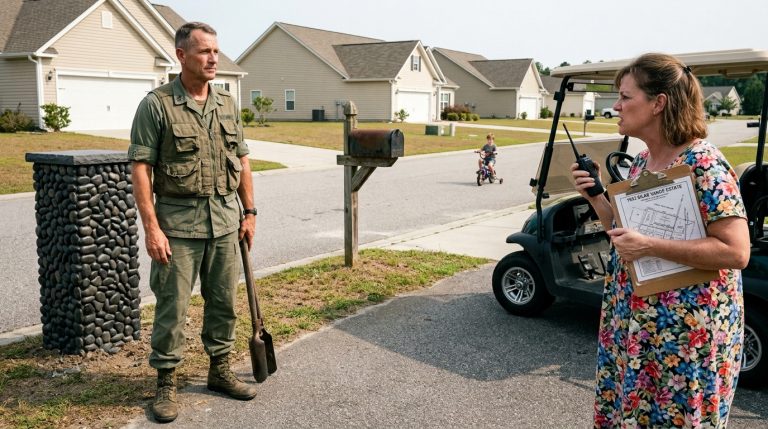
The figure hung in the humid afternoon heat, heavy with the stench of freshly cut rye grass and cheap vanity. Karen’s powder-blue pantsuit strained against her shoulders as she adjusted her grip on the pressboard clipboard. Behind her, Brenda held a digital camera with a finger resting nervously on the shutter.
I didn’t answer. I kept my thumb pressed against the sharp point of the heavy brass drafting compass resting inside my right pocket. The steel point bit into my skin. Four millimeters of pressure. It kept the pulse in my neck from spiking.
“Code seven point fourteen,” Karen said. Her voice lacked rhythm—sharp, nasal, clipped at the edges like a bad broadcast. “Unapproved exterior modification. You’ve got thirty days before the lien hits the county recorder.”
I looked past her shoulder at the wall. The finish was raw limestone on the base, topped with custom-mixed taupe. Smooth, matte, balanced. The late sun hit the wall at forty-five degrees, throwing zero glare. It wasn’t just paint. It was a calculated thermal-reflective compound I’d specified eight years ago when the master layout was still a vector file on my workstation.
“The palette is approved,” I said. Voice low. Flat. No friction.
“Was approved,” Karen corrected. Her crimson nail tapped the paper. A sharp, dry snap. “Board updated the restrictions last spring. We retired the earth tones. You didn’t submit a request to the Architectural Review Committee.”
“I am the Architectural Review Committee,” I said softly.
Karen didn’t blink. Her small, buried eyes tightened, calculating whether to treat the line as arrogance or delusion. “You’re a homeowner with an unpaid citation, Mr. Caldwell. Brenda, take the picture. Get the house numbers in the frame.”
Brenda stepped forward. The camera clicked. The flash was useless in the direct sunlight, a useless little burst of light that revealed the gray dust on Karen’s patent-leather shoes.
“Welcome to Harmony Creek,” Karen said, turning on her heel. Her weight shifted heavily across the turf, leaving deep, square depressions in the sod. “We expect teamwork here. It’s a shame you started off on the wrong foot.”
I didn’t watch them walk away. I turned my attention back to the corner joint where the taupe meets the stone casing.
A tiny physical discrepancy caught my eye. Right at the seam where the trim met the drywall soffit, a thin line of white chalk had been drawn—a single, clean diagonal stroke barely three inches long. It wasn’t contractor’s chalk. It was industrial grease pencil.
I reached out, rubbing my forefinger across the mark. The grease didn’t smudge. It had been applied cold, with deliberate force.
My mind didn’t jump to neighborhood vandalism. It reverted to structural logistics. You mark a target before you cut. You brand a timber before you haul it.
I pulled the brass compass from my pocket, turned the knurled center wheel three clicks to the left, and scraped the point across the grease mark until the metal beneath showed gray.
Karen wasn’t just collecting fines. She was tagging the house.
CHAPTER 2: BLUEPRINT RECONNAISSANCE
The golf cart turned off Willow Lane, its electric motor whining softly against the silence of the cul-de-sac. I didn’t watch it clear the curb.
I stared down at the tip of the drafting compass. The white grease sat thick on the hardened steel point, waxy and dense. It smelled faintly of mineral spirits and industrial preservative. Construction-grade marker. The kind steelworkers use to write heat numbers on I-beams before they leave the rolling mill.
My right index finger traced the cold metal of the compass body. Three turns on the knurled wheel brought the legs together with a sharp, metallic click.
“Mark?”
Sarah stood on the porch, her hands wrapped around a ceramic mug. The steam rose in a thin, straight line in the windless air. She didn’t look at the taupe wall. She looked at my shoulder posture—the slight inward rotation, the locked elbow. The posture I held when an engineer handed me a survey map with a miscalculated load bearing.
“She gave you a notice,” Sarah said. Statement, not a question.
“Thirty days,” I replied. “Code seven point fourteen.”
“We checked the palette when we closed, Mark. It was on the sheet.”
“I know.” I slipped the compass into my front pocket, letting it rest against my pocketknife. “Go inside. I’ll be down in the office.”
She hesitated, her thumb sliding over the rim of her mug—a unconscious, repetitive motion she only made when the moving boxes brought back the lingering dust of three different military bases. She didn’t ask if I was going to call a lawyer. She knew my sequence. First the data. Then the structural assessment.
I walked past her into the house, bypassing the kitchen, and went straight down the basement stairs.
The basement smelled of concrete sealer and old oak. My drafting table sat in the center of the room beneath a high-output LED rig. On the far wall, three galvanized steel shelves held row after row of black buckram binders—every project I’d stamped over a twenty-year career with the Corps and the consulting firm that followed.
I didn’t need to check the labels. Fourth shelf from the top. Third binder from the left.
Harmony Creek Subdivision – Master Architectural Specifications & Permitting Index.
I pulled the binder down. It was six inches thick, heavy enough to dent the pine edge of the desk when I dropped it. The leatherette cover was scratched at the corners, showing white threads beneath the black synthetic grain.
I flipped past the drainage schematics, past the soil density tests, and stopped at Section 12: Exterior Aesthetic Guidelines and Material Matrix.
Page 12-B held the physical swatches, glued to cardstock with industrial adhesive. Third row down, middle column. A two-inch square of warm, matte earth tone.
HC-07. Caldwell Taupe.
Beneath the swatch, the technical specifications were printed in clear 10-point Helvetica: Base formulation, Iron Oxide yellow 2.1%, Raw Umber 0.8%, Titanium Dioxide 94.0%. Approved for exterior masonry, cementitious board, and structural trim.
I ran my thumb across the paper. The paper was smooth, but right beside the swatch label, where the developer’s seal was stamped in red ink, something was off.
I pulled a magnifying glass from the drawer and leaned over the page under the bright white LED.
The red seal bore the city planning commission’s approval stamp, dated eight years prior. But overlapping the bottom curve of the emblem was a string of tiny, micro-printed alphanumeric text, printed in gray ink so light it almost faded into the fiber of the page.
Vector-Caldwell / Sub-Index 04 / Aegis-7 Release.
My thumb froze over the glass.
Vector-Caldwell. My old firm’s internal project designation. But Aegis-7 wasn’t a residential architectural term. It was a corporate asset code. The kind used by private holding firms when bundling distressed civil infrastructure for liquidation.
I opened the top drawer, grabbed my phone, and snapped a high-resolution macro shot of the micro-print.
Then I reached for the photocopied document Karen had left in our welcome packet six months ago—the “Updated Bylaws” she claimed the board had adopted last spring.
I laid the two documents side by side under the lamp.
Karen’s document was a mess of irregular spacing and uneven toner density, clearly output from an old desktop laser printer. Article 7, Section 14 had been inserted between two existing paragraphs, forcing the margins out of alignment by three millimeters. It banned four specific color codes. HC-07 was first on the list.
It wasn’t just an edit. It was a crude, home-brewed patch overlaid onto a legally binding civil blueprint.
A quiet knock sounded at the top of the stairs.
“Mark?” Sarah’s voice drifted down. “Arthur from next door is at the driveway. He says his water pressure dropped again.”
I closed the six-inch binder. The heavy cover slammed shut with a dull, heavy thud that kicked up a tiny puff of paper dust into the white light.
“Tell him I’ll be right up,” I called back.
I picked up the brass compass, turned the wheel until the legs were spread exactly two inches wide, and set it squarely on top of the black binder.
Karen thought she was enforcing a neighborhood rule. But she was using a code that didn’t belong to her—and the mark on my garage wall was just the first line of an equation she didn’t know how to solve.
CHAPTER 3: THE ASSEMBLY ROOM
The basement steps creaked once under my heel, a short, dry snap of pine that sounded like a rifle hammer setting into half-cock.
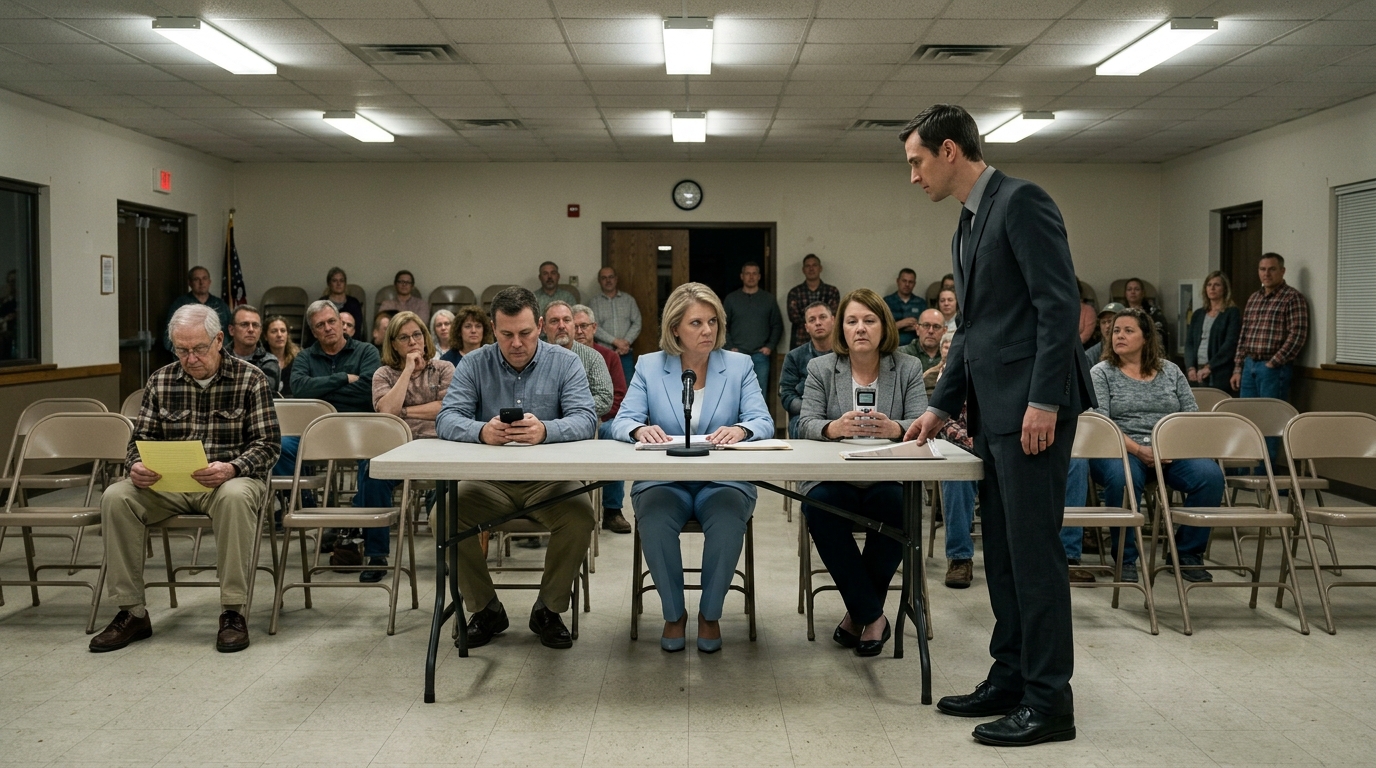
By eight o’clock, the air inside the Harmony Creek Clubhouse smelled of commercial floor wax and stale coffee. Fluorescent tubes hummed overhead, casting a cold, flickering glare across eighty beige folding chairs. Half were empty. The rest held residents sitting with their shoulders hunched, coats resting on their laps, speaking in low, clipped murmurs.
I walked down the center aisle. My boot heels hit the vinyl tiles with a rhythmic, measured strike. I carried a thin, manila folder under my left arm—not the heavy master binder, but three high-resolution printouts and a single sheet of city ordinance filings.
At the front of the room sat the board behind a long laminate folding table.
Karen sat in the center. Her blue pantsuit looked stiffer under the harsh lights, her thick wrists resting on a stack of neatly collated papers. To her left, Gary, the treasurer, picked at a fraying thread on his cuff, his eyes fixed firmly on his phone screen. Brenda sat to Karen’s right, a brand-new digital voice recorder humming quietly between her hands.
Karen didn’t look up until I pulled out a metal folding chair in the front row. The legs scraped against the floor, a sharp screech that cut through the low chatter of the room.
“We are calling the monthly meeting of the Harmony Creek Homeowners Association to order,” Karen said, her voice amplified by a cheap desktop microphone that crackled on the high notes. “First item on the agenda: procedural compliance and aesthetic maintenance.”
She didn’t waste time with reading minutes. She didn’t call for a treasurer’s report.
“As many of you know,” Karen continued, her small eyes scanning the front row until they locked onto mine, “our community’s property values rely on absolute visual uniformity. When individual residents decide that personal preference supersedes community covenants, it degrades the investment of every family in this development.”
In the third row, an elderly man in a flannel shirt shifted uncomfortably, his fingers tightening around a folded piece of yellow lined paper. Arthur. I’d seen him earlier at his driveway; his hands had been stained with garden soil, his face gray with the quiet exhaustion of a man who’d received three separate citations for an unapproved stone birdbath.
“We have a primary citation outstanding at 124 Willow Lane,” Karen announced. Her fingers tapped the table. Snap. Snap. Snap. “An unapproved exterior repaint. The owner has been issued a formal notice of violation under Article Seven, Section Fourteen.”
Silence settled over the room, dense and suffocating.
“Mr. Caldwell,” Karen said, leaning slightly toward the microphone. “You requested time on the agenda to address the board.”
I didn’t rush. I stood up slowly, picking up my manila folder. I didn’t walk up to the podium. I stood right where I was, my body angled forty-five degrees to face both Karen and the residents behind me.
“Article Seven, Section Fourteen,” I said. My voice was level, calibrated to carry clearly to the back wall without straining against the room’s dead acoustics. “I reviewed the copy of the bylaws provided in the closing packet six months ago.”
Karen smiled—a thin, practiced movement of her lips that didn’t reach her eyes. “Then you understand your obligations.”
“I understand document hierarchy,” I replied. I opened the manila folder and pulled out the first sheet. “This is a certified copy of the original subdivision master plan filed with the County Recorder’s Office, Document Number 08-4421.”
Gary stopped picking at his cuff. His thumb hovered over his phone screen.
“Under Section Twelve of the legally binding covenant,” I continued, “the approved palette includes specification HC-07. It is registered under the commercial designation Caldwell Taupe. It was approved by the city planning commission prior to the breaking of ground on Phase One.”
“That document is historical, Mr. Caldwell,” Karen interrupted, her voice dropping an octave into a hard, patronizing cadence. “The board exercised its authority under Article Nine to update and restrict the palette last spring. HC-07 was retired.”
“To amend a recorded covenant under Article Nine,” I said, holding up the second sheet, “requires a two-thirds majority vote of the general membership, properly noticed thirty days in advance, followed by a formal filing with the county.”
I laid the paper gently on the laminate table right in front of Brenda’s recorder.
“I spent three hours at the County Records Building this morning,” I said quietly. “There is no record of an amendment filed for Harmony Creek since the original developer turned over governance three years ago. There is no notice in the meeting archives. There is no recorded vote.”
Karen’s posture didn’t crumble, but her hands flattened against her stack of paper. Her knuckles turned white under the fluorescent tubes.
“Board policy updates do not require county re-filing for internal enforcement,” she said smoothly, though her eyes darted toward Gary for a fraction of a second. “You are in violation. The fine stands.”
Behind me, Arthur cleared his throat. A quiet rustle went through the back rows as two other homeowners leaned forward, their eyes shifting from Karen to the paper lying on the table.
“It’s not a board policy,” I said. “It’s an unrecorded change made on a home computer without a quorum.”
I leaned down slightly, placing my hand flat on the table, three inches from Karen’s clipboard. Close enough that she could see the faint trace of white grease still embedded in the grain of my thumb.
“And if you attempt to file a lien against my property based on an unrecorded rule,” I added, lowering my voice so only the front table could hear, “you personally assume civil liability for clouding a legal title.”
Gary swallowed hard, his throat moving against his stiff collar. Karen stared back at me, her expression hardening into a stone wall of pure, unyielding fury.
“Your thirty days are running, Mr. Caldwell,” she whispered, bypassing the microphone entirely. “And this board does not back down.”
I didn’t answer. I picked up my folder, turned, and walked out of the room. As the heavy double doors clicked shut behind me, I caught a glimpse of a commercial flatbed truck parked near the curb outside, its side panel bearing a faded stencil: Apex Construction Logistics.
Another piece of the structure, sitting in plain sight.
CHAPTER 4: ECHOES IN THE GRASS
The heavy doors slammed behind me, sealing the fluorescent hum inside the clubhouse. Night had dropped fast over Harmony Creek. The air smelled of damp pine bark and sulfur from a poorly adjusted irrigation pump across the street.
I didn’t head for my driveway.
The flatbed truck with the faded stencil had pulled away from the curb, its diesel exhaust hanging in a blue haze under the streetlamp. I watched its red taillights shrink down Willow Lane before turning into Arthur’s front yard.
Arthur stood near the edge of his property line, a corroded brass valve key in his right hand. His knuckles were raw, stained dark with potting soil and iron rust. He was staring down at a shallow pit he’d dug beside his water meter casing.
“They shut it down two turns,” Arthur said. He didn’t look up when my boots crunched on the gravel border. His voice was gravelly, thin from the cold dampness. “Claims I’m using municipal volume for an unapproved garden bed.”
I knelt in the grass, the dampness soaking through my jeans at the knee. The soil in the pit was dark, heavy clay. I reached in and ran my fingers along the iron pipe.
“The shutoff valve isn’t municipal,” I said, feeling the squared head of the curb stop. “This is private plumbing on your side of the boundary. The city doesn’t touch this without a utility work order.”
“Gary came by with a plumber from the commercial park yesterday,” Arthur murmured. His left thumb rubbed nervously against the T-handle of the valve key—an involuntary, rhythmic gesture that scraped skin against cold metal. “Said the board authorized an intake restrictor. Claimed my pressure drop was affecting the main loop.”
I pulled my flashlight from my coat pocket and clicked the narrow beam onto the valve.
It wasn’t a standard utility restrictor. A heavy steel locking collar had been clamped over the stem, fastened with a tamper-proof penta-bolt. Stamped into the side of the galvanized collar was a series of small, crisp letters: Apex-Vanguard Supply / Mod-4.
Another footprint. Not a neighborhood contractor. An industrial equipment distributor that dealt exclusively in commercial foreclosures and receivership hardware.
“How much did they bill you, Arthur?”
Arthur let out a dry, rattling cough. “Three hundred for the inspection. Four hundred for the flow restriction. Gary said if I pay before Friday, they won’t add the late surcharge to my dues.”
“Don’t pay it,” I said.
“Mark,” Arthur looked at me then, his eyes wide and milky behind thick lenses. The glare from my flashlight caught the tremor in his jaw. “I’m seventy-two. My pension doesn’t cover a legal fight with a board that has a three-thousand-dollar legal retainer line item. If they put a lien on this house, my daughter loses her equity.”
“They aren’t spending three thousand on lawyers, Arthur,” I said, shining the light directly on the locking collar. “They’re buying eighty-dollar commercial locks and pocketing the difference. Look at this.”
He leaned closer, his knees cracking loudly in the dark. He squinted at the stamped steel. “Apex? That’s the contractor on the bypass road.”
“They aren’t just building a bypass,” I said. “They’re installing control points. Every house in this block that receives a citation gets a physical restriction within forty-eight hours.”
“Why?”
“Because a house with a utility violation and an active board lien can’t be refinanced,” I said, standing up and dusting the damp clay from my knees. The movement was crisp, tactical. “It locks the owner in place. You can’t sell, you can’t borrow, and you can’t fight without liquid cash.”
Arthur stood up slowly, using the brass key like a cane. “She’s been doing this for two years, Mark. Mrs. Gable at number forty-two—they took her fence down, fined her five thousand, and she moved out in ninety days. Sold at a forty percent loss to an LLC out of the county.”
I didn’t answer. I reached out and took the brass valve key from his trembling hand.
The metal was freezing, but the shape was familiar. Standard three-quarter-inch socket.
“Go inside, Arthur,” I said softly. “Keep your lights on.”
I walked back toward my house, the brass key heavy in my palm. The cost of this fight was escalating from paper filings to physical sabotage. Karen wasn’t just managing an HOA; she was executing a methodical displacement strategy, block by block, using forged rules to manufacture defaults.
When I reached my driveway, I saw a white sheet of paper wedged beneath the windshield wiper of my truck.
I pulled it out. It wasn’t an HOA notice. It was a printed property record printout for 124 Willow Lane—my home—with a red highlighter marker dragged heavily across the line showing my original purchase mortgage holder.
And stamped right across the top margin in fresh grease pencil was a single phrase:
Vector-Caldwell / Priority Target / Expedite.
CHAPTER 5: THE CLANDESTINE UNIT
The yellow paper felt cold under my thumb, stiffened by the night damp. The grease-pencil letters—Vector-Caldwell / Priority Target / Expedite—didn’t smear when I pressed my thumb over the text. It was petroleum-based marking chalk, industrial-grade, built to survive outdoor exposure on steel framing.
I crumpled the sheet once in my fist, folded it tightly into a square the size of a matchbook, and slipped it into my coat pocket next to the brass drafting compass.
I walked straight past the front porch light and down the side yard into the basement entrance.
By nine-fifteen, the basement office smelled of stale drip coffee and wet leather. I’d hauled four steel folding chairs down from the garage, arranging them around the drafting table in a narrow semicircle facing the illuminated glass top.
Arthur arrived first, his steps slow and heavy on the wooden stairs. He carried a battered leather accordion folder tucked beneath his elbow. Maria followed five minutes later—a young mother from two doors down, her windbreaker still glistening with rain, her knuckles raw from scrubbing grease off her hands after her shifts. David, the IT network engineer from Snapdragon Circle, came in last, shutting the basement door behind him with a quiet, deliberate click of the latch.
None of them spoke right away. They looked at the blueprints unfurled across the drafting glass—the original civil drainage maps, the lot boundaries, the highlighted utility easements.
“The board sent three notices to my house this week,” Maria said softly, breaking the silence. She sat on the edge of her folding chair, her fingers nervously twisting the rubber band around her wrist until the skin turned white. “Two hundred for the portable hoop. One hundred for an unapproved storage container in the driveway. It’s half my grocery allowance for the month.”
“They aren’t looking for compliance, Maria,” I said, leaning against the edge of the desk. “They’re building an asset file.”
David adjusted his glasses, his eyes scanning the technical legends on the lower corner of the blueprint. “An asset file for who? The HOA is a non-profit registered with the secretary of state.”
“A non-profit whose financial reports haven’t included a line-item vendor audit in four years,” I replied. I reached into my drawer and pulled out a stack of manila folders, dropping them on the table with a firm, hollow thud. “Arthur gave me his citation logs. Maria, you gave me your fine history. Look at the dates.”
David leaned over the glass, flipping through the sheets. His expression shifted from confusion to razor-sharp focus. “They’re staggered. Every sixty days, another cluster of three homes gets hit.”
“And every home hit sits on a primary utility easement or has an existing mortgage held by a regional lender,” I said. “Look at the corner marks.”
I pulled out the matchbook-folded printout I’d taken off my windshield ten minutes ago and smoothed it flat across the white LED surface.
Arthur leaned in, squinting through his thick lenses. “That’s your deed summary, Mark. Where did you get this?”
“Off my windshield. Someone left it right after the clubhouse meeting.” I pointed to the grease-pencil stamp. “This isn’t an HOA code. It’s a land-development index. Vector-Caldwell was the firm code used during the initial land survey before the infrastructure was turned over.”
Maria looked up, her lower lip trembling slightly, though her jaw set firm. “So Karen isn’t just power-tripping?”
“Karen is the operational front,” I said. My voice was quiet, dry, stripped of emotion. “She uses the bylaws to generate defaults. Gary handles the paper trail. Once a homeowner accumulates five thousand in fines, the board files a summary lien. A summary lien triggers a default clause on conventional mortgages. The bank steps in, or an investment entity buys the paper at a discount.”
“Apex-Vanguard,” Arthur muttered, his hand going to his coat pocket. “The mark on my water line.”
“That’s the receiver,” David said, his fingers tapping a fast, silent rhythm on his thigh. “They buy the distressed debt, clear the title through a foreclosure sale, and bundle the lots.”
“We need proof,” Maria said. Her voice lost its tremble, replaced by a cold, practical edge. “Not just maps and codes. Paper trail. Checks, invoices, bank accounts.”
“We get the paper trail through the law,” I said. “Under state civil code, any member in good standing has the right to inspect all books, minutes, and vendor ledgers upon written notice. Karen relies on people being too intimidated or broke to file the demand.”
I reached into my desk drawer and pulled out four pre-printed, legally formatted certified letter templates, each stamped with an official state statutory citation.
“We don’t file one request,” I said, placing a pen on top of the stack. “We file four identical requests tomorrow morning by certified mail. Four different homeowners. Four separate paper trails. If they ignore us, they violate state banking and corporate disclosure laws.”
Arthur reached out first. His dirt-stained hand picked up the pen without hesitation. He signed his name along the bottom line, his signature jagged but deep, indenting the heavy paper stock.
“They’ve taken enough,” Arthur said softly.
Maria took the pen next, signing her name beside her house number. David followed, his signature swift and precise.
As David capped the pen, a sudden, heavy metallic clang echoed from the driveway above our heads—the sound of a heavy steel tool striking the frame of my truck.
I didn’t reach for the light switch. I reached for the heavy brass compass on the desk, slipping its sharp points between my knuckles as I stepped toward the basement stairs in the dark.
CHAPTER 6: THE GARAGED ARSENAL
I took the basement stairs two at a time, keeping my boots flat on the risers to deaden the impact. The brass compass points bit hard into the skin between my fingers. Three pounds of steel pressure. Silent, measured kinetic preparation.
Arthur and David didn’t move from the drafting table. Maria stood near the light switch, her thumb resting on the plastic toggle, waiting for my signal.
I reached the door leading to the garage, turned the deadbolt with a slow, noiseless quarter-rotation, and pushed the slab open two inches.
The damp night air smelled of exhaust fumes and cold asphalt. Standing beside the driver’s side door of my truck was a man in a dark oilskin jacket, holding a long steel crowbar. He wasn’t trying to pry the door lock. He was tapping the frame above the door, using the blunt heel of the bar to probe the roof seam.
A second man stood near the bumper, holding an industrial LED flashlight pointed at the driveway pavement.
“Nothing on the frame,” the man with the crowbar muttered. His voice was low, phlegmy. “Check the wheel wells. They said the tag was applied yesterday.”
“Check it yourself,” the second man grunted, adjusting a clipboard under his arm. “Gary wants the photo before thirty minutes are up.”
I stepped out onto the concrete apron. My shadow stretched long across the gravel as the garage motion sensor clicked on above the door.
Both men spun around. The one with the crowbar didn’t drop the tool; he shifted his grip down to the center of balance, his body settling into an athletic, low stance. On the left breast of his oilskin jacket was a embroidered gray patch: Apex Construction Logistics / Field Ops.
“Private property,” I said. Voice dropped into the dead center of my chest. No tremor, no elevation.
“HOA compliance inspection,” the man with the clipboard replied instantly, stepping forward to block my path to the truck. He didn’t look nervous. He had the calloused, indifferent face of a private bailiff used to serving eviction notices. “Unapproved vehicle storage overhang. Article Four.”
“Article Four covers non-operational commercial trailers,” I said, narrowing the gap between us by two paces. “This is a registered light truck. You’re trespassing.”
“Tell it to the board,” the man with the crowbar said, taking a half-step sideways toward the lawn. “We’re subcontracted.”
“You’re documented,” I corrected.
I raised my left hand, pointing my phone’s camera directly at his face. The flash fired twice in rapid succession—a blinding white pulse that caught the embroidered patch, the crowbar’s serial stamp, and the license plate of the white panel van idling at the curb.
The man with the crowbar cursed, raising his forearm to block the lens. “Put that away, chief.”
“You have ten seconds to clear the lot,” I said, slipping the phone into my pocket while keeping my right hand inside my coat, fingers wrapped around the brass compass. “After that, the footage goes directly to the county sheriff along with the statutory notice we signed ten minutes ago.”
The man with the clipboard stared at me for three long seconds, evaluating my stance, the width of my shoulders, the complete absence of defensive retreat in my posture. He tapped his partner’s arm with the edge of his board.
“Let’s go,” he muttered. “We got the picture.”
They walked back to the panel van without looking back. The diesel engine roared, its tires spitting wet gravel against the curb as it pulled away into the dark.
I waited until the taillights disappeared over the rise before stepping over to my truck. Beside the front tire lay a soggy, lopsided cardboard box that had been dumped onto the wet asphalt from the back of their van.
Written on the side in thick, permanent marker was my address, surrounded by a heavy red circle.
I didn’t open it on the driveway. I hauled the box inside, carrying it down to the basement war room where Arthur, Maria, and David were waiting.
I dumped the contents onto the secondary worktable. A thick cloud of paper dust and old mildew filled the air. Loose invoices, illegible carbon copies, rusted paperclips, and crumbling rubber bands spilled across the green cutting mat in an unstructured heap.
“What is this?” Maria asked, stepping back from the smell.
“Karen’s response to my records request,” I said, pulling my pocketknife and slicing through a bound bundle of receipts. “A document dump. She thinks if she gives us forty pounds of unindexed paper, we’ll drown in the noise.”
“She under-estimated us,” David said, pulling his laptop closer and opening a blank spreadsheet. “We sort by date, vendor, and amount. I’ll build a relational database.”
For four hours, no one spoke except to read off numbers and vendor names. The basement was quiet save for the crisp rustle of paper, the snap of dry rubber bands, and the clatter of David’s keyboard.
At 1:15 AM, Arthur paused, holding a yellowed carbon sheet up to the overhead LED light.
“Mark,” he said, his raspy voice cutting through the silence. “Look at the signature on these equipment rentals from 2023.”
I stepped over his shoulder. The invoice was from Harmony Landscaping LLC for ’emergency drainage remediation’—an eight-thousand-dollar line item. But the signature on the authorization line wasn’t Karen’s loopy script.
It was Gary’s handwriting. And below his signature was a secondary tax identification number registered to a holding entity: Apex-Vanguard Asset Management.
“The board didn’t vote to change the color palette,” Arthur whispered, his reading glasses slipping down his nose. “There are no minutes for that meeting because the meeting never happened. Look at the date.”
I took the sheet. The date of the alleged vote was April 14th of last year.
“I checked the county property index for April 14th,” David said, his fingers flying across his screen. “Brenda—the board secretary—was out of the country on vacation. The meeting didn’t have a quorum. Karen, Gary, and one other member wrote the amendment in a private kitchen and declared it law.”
Layer 1 had cracked wide open.
The entire enforcement apparatus—the fines, the retired taupe code, the liens—was built on a completely illegal, unvoted amendment designed to manufacture artificial debt.
“It’s a decoy,” I said softly, staring at the paper.
David looked up from his screen. “What do you mean? It’s fraud. We can destroy her with this.”
“It’s local fraud,” I corrected, pointing to the Apex-Vanguard tax ID at the bottom of the page. “Karen thinks she’s taking kickbacks for her brother-in-law’s landscaping business. But she’s using asset management forms provided by an outside buyer. She’s doing the ground work for a takeover she doesn’t even understand.”
I pulled the brass compass from my pocket, set its point directly over Gary’s signature on the yellow carbon, and pressed down until the steel pierced through the paper and bit into the oak table beneath.
CHAPTER 7: THE SHELL COMPANY CRACK
The steel tip of the compass stood vertical in the oak grain, vibrating with a faint, high metallic pitch that died against the quiet of the basement.
Arthur didn’t take his eyes off the punctured yellow receipt. His right hand remained hooked in his coat pocket, his thumb making that dry, scraping circle against his coat lining.
“Eight thousand dollars,” David said, his voice dropping into a flat, monotone register as his fingers moved across his laptop keyboard. “Paid out on May twelfth to Harmony Landscaping LLC. The check number is 4402. Drawn on the HOA’s primary account at First Regional.”
“Look at the clearing stamp on the back,” I said. I pulled the compass free with a slight twist, leaving a neat, dark pinhole through Gary’s signature. “The deposit wasn’t made at a local branch counter.”
David leaned over the optical scanner, zooming in on the reverse scan of the canceled check. The purple ink of the endorsement stamp was faint, faded at the edges like a ribbon printer running low on dye.
For Deposit Only – Account 8819-B. Commerce Station, P.O. Box 412.
“A P.O. Box,” Maria said, her coat rustling as she took a half-step closer to the illuminated glass. “Not a physical office?”
“Commerce Station is six miles south on Route 9,” David said, his screen flashing as he pulled up the State Secretary’s corporate registry. “Corporate filing record for Harmony Landscaping LLC. Registered agent: Robert Peters.”
“Peters,” Arthur repeated slowly. He leaned back slightly, his shoulder hitting the edge of the steel shelving unit. “Cynthia Peters is Gary’s sister. Her husband is Robert.”
“It’s not just a kickback,” I said. “It’s an automated siphon. Look at the billing frequency.”
I pulled three more sheets from the sorted pile—invoices dated July, September, and November of last year. Every single one was billed for exactly seven thousand nine hundred and fifty dollars. Ten dollars below the eight-thousand-dollar threshold that required a dual-signature authorization under the original developer covenants.
“Gary approves the invoice as treasurer,” David said, tracing the lines on his screen. “Karen signs the disbursement check as ARC chair. The funds go to a post office box six miles away, and thirty percent of it is wired directly back into a sub-account flagged under Apex-Vanguard Supply.”
“They aren’t just skimming dues to fix up their own kitchens,” Maria said. Her hands stopped twisting the rubber band. Her voice hardened, stripped of the hesitant fear she’d brought down the stairs two hours ago. “They’re using our money to pay the contractor who’s marking our houses.”
“They’re financing their own acquisition pipeline,” I said.
I picked up the black land-line handset on the wall behind my desk and dialed a ten-digit number from memory.
The line rang twice before a sharp, gravelly voice answered. “Riley.”
“Jack,” I said. “It’s Caldwell.”
A short pause on the line, followed by the faint rustle of paper and the distinct click of a Zippo lighter closing. “Tell me you didn’t throw the president off her porch.”
“Worse,” I said. “We cracked the ledger. We have canceled checks, forged committee minutes with no quorum, and a self-dealing loop between the treasurer and a shell LLC registered to his brother-in-law.”
Jack stayed quiet for three seconds. “How much total?”
“Over one hundred and fifty thousand across thirty-six months,” I said. “And the invoices cite equipment rentals provided by an entity called Apex-Vanguard.”
“Apex,” Jack said, his tone shifting instantly from relaxed banter to a cold, razor-sharp legal focus. “That’s not a local mower outfit, Mark. Apex-Vanguard is a debt-restitution holding trust out of Wilmington. They buy distressed commercial municipal bonds and municipal tax liens.”
“They’re using the HOA fines to build the default margin,” I said. “Karen issues the violation, Gary stacks the daily penalty, and when the balance hits five grand, they assign the collection right to Apex.”
“That’s a civil racketeering pattern,” Jack said. “If you can tie the board members directly to the assignment agreements, you aren’t just fighting an HOA fine. You’re holding a lever that pulls down the entire board.”
“I need a formal cease-and-desist drafted by morning,” I said. “Addressed to Karen, Gary, and every sitting member of that board personally.”
“Personal liability,” Jack murmured. “That breaks their umbrella insurance coverage. Once they realize they’re on the hook for individual indemnification, the unity crumbles.”
“Draft it,” I said. “Include the state banking statutes for unrecorded self-dealing. I’ll have Arthur and Maria sign as co-complainants.”
“It’ll be on your printer in twenty minutes,” Jack said. “Mark—one thing.”
“State it.”
“If Apex-Vanguard is already holding paper on those lots, they won’t cut Karen loose gently. When you hit that board with those letters, you’re stepping between a regional trust and two million dollars in land equity. Watch your perimeter.”
I hung up the receiver.
The rain outside had picked up, heavy drops tapping against the high, narrow basement window above the workbench.
I turned back to the table. Arthur, Maria, and David were watching me. The initial fear was gone, replaced by the grim, quiet focus of people who had finally seen the blueprint of their own trap.
“Tomorrow morning,” I said, picking up the brass compass and setting it inside my pocket, “we deliver seven certified envelopes to seven front doors.”
CHAPTER 8: THE SEVEN ENVELOPES
The telephone receiver settled into its plastic fork with a dull, heavy click.
Outside, rain tapped a steady, irregular rhythm against the basement glass. I didn’t wait for the printer to cool down. The machine fed seven sheets of heavy thirty-pound cotton bond through its rollers, the mechanical hum vibrating through the pine desk.
Each letter bore Jack’s formal legal letterhead at the top margin: Riley & Associates, Civil Litigation & Title Law. Below it, in precise, bold face type, were the statutory references for personal officer indemnification failure under State Civil Code Section 702.
I stacked the pages on the drafting table. Arthur handed me seven crisp, white legal envelopes, his dirt-stained fingers trembling slightly as he aligned the edges.
“Seven,” Arthur whispered. “Karen, Gary, Brenda, Harold Jenkins, Susan, Margaret, and the vice-chair.”
“Seven,” I confirmed. I picked up a black fountain pen, filled the ink chamber with three steady plunges of the piston, and addressed each envelope by hand in clean, block architectural lettering. “Delivered by certified courier with signature required upon receipt.”
Maria picked up the first envelope, her thumb pressing hard against the gummed flap to seal it tight. “When do they get them?”
“Seven-thirty tomorrow morning,” I said. “Before Karen leaves for her morning drive in the golf cart.”
I didn’t sleep that night. I sat at the drafting desk under the single white LED bulb, turning the knurled wheel of my brass compass. Three turns left. Three turns right. The steel point traced tiny, overlapping circles into a scrap block of pine until the wood smelled of friction and pine resin.
By six-forty5 AM, the rain had tapered off into a gray, hanging mist.
I stepped out onto the driveway carrying a leather courier pouch. The air was cold, damp, smelling of earth and wet asphalt. The street was dead quiet. A single mail truck idled near the entrance of Willow Lane, its exhaust rising in a thick plume against the gray sky.
I walked down the sidewalk, my boots striking the wet concrete with measured, unhurried steps.
My first stop was Harold Jenkins’ house—a tidy, brown-trimmed ranch two doors down from the clubhouse. Harold was a retired postal clerk who sat on the ARC committee and nodded whenever Karen spoke.
I didn’t knock. I stepped onto his porch, slid the thick white envelope beneath his brass door knocker, and pressed the red certified delivery receipt label firmly onto the wood frame beside his door chime.
The adhesive held tight.
I moved to Susan’s house next, then Margaret’s. By seven-fifteen, six envelopes were posted, six red certified labels marking six front entryways like crimson seals on a row of closed vaults.
The last envelope belonged to Karen.
Her powder-blue golf cart was parked in her driveway, its charging cable snaking across the wet grass to an exterior outlet. The front curtain of her living room window twitched as my shadow crossed the driveway apron.
I stepped onto her porch. The front door opened four inches before my boot reached the top step.
Karen stood in the gap. She wasn’t wearing her blue pantsuit. She wore an oversized beige cardigan buttoned wrong at the collar, her gray hair unbrushed, her small eyes rimmed with red.
“You’re trespassing, Caldwell,” she said. Her voice lacked its usual sharp, booming projection. It sounded thin, dry, like paper scraping against stone.
“Certified service,” I said flatly.
I didn’t reach for her hand. I slid the thick envelope through the gap in the door, wedging it firmly between the aluminum frame and the deadbolt latch.
Karen didn’t touch the paper. She stared at the red certified label affixed to the face of the envelope. Her right hand went to her throat, her thumb sliding over the top button of her cardigan—a rapid, involuntary twitch that contradicted the hard glare in her eyes.
“This is harassment,” she whispered. “The board will meet tonight to double your fine.”
“The board won’t meet tonight, Karen,” I said, leaning in until my face was eighteen inches from the screen. “Because under Paragraph Four of that notice, any board member who votes on a matter involving an active personal liability claim forfeits their indemnification defense under the HOA charter.”
She swallowed hard. The muscle in her jaw twitched once, twice.
“And Gary’s bank records for Account 8819-B,” I added, lowering my voice to a bare whisper that barely carried over the drip of the rain gutter, “were attached to the copy served on the County Prosecutor twenty minutes ago.”
Her small eyes widened. The color drained from her cheeks, leaving her skin the gray, mottled texture of wet newsprint.
She slammed the door. The deadbolt shot home with a heavy, metallic thunk that echoed across the empty porch.
I turned and walked back down her driveway.
Across the street, parked beside a fire hydrant, sat a black sedan with tinted windows. On its front bumper was a subtle, metal dealer frame stamped with a single line of block lettering: Aegis-7 Regional Portfolio Management.
The sedan’s engine started with a low, rumbling hum, but it didn’t pull away. It stayed idling in the mist, watching me walk back to Willow Lane.
CHAPTER 9: FRACTURING THE GUARD
The rumble of the idling sedan at the curb faded into the distance as I stepped back down into the basement office.
My phone rang at 8:02 AM. The screen displayed an unlisted local number.
I picked it up on the second ring. “Caldwell.”
A heavy, unsteady breath rasped through the speaker, accompanied by the distinct background clink of a ceramic mug against a kitchen counter.
“Mr. Caldwell… Mark. It’s Harold Jenkins.”
His voice was paper-thin, vibrating with a rapid, uncontrolled tremor.
“Harold,” I said, keeping my tone flat and unhurried. I reached into my coat pocket, pulled out the brass drafting compass, and set it on the glass table top. “You received the notice.”
“We all did,” Harold whispered. He paused, the sound of paper tearing softly coming through the receiver—he was unsealing the red certified tab. “Susan is here. Margaret too. We’re… we didn’t sign off on any asset assignments, Mark. Gary told us the collection agreements were standard municipal filings.”
“Ignorance doesn’t shield an officer from personal indemnification, Harold,” I said. “Section Four of state corporate code makes board members individually liable if gross negligence allows fraudulent self-dealing.”
“We didn’t know about Harmony Landscaping!” Susan’s voice cut in from the background, sharp and breathless. “Gary handled the account ledgers. Karen brought the motions to a vote during executive sessions.”
“Then you have a ten-hour window before Jack files the civil suit with the county clerk,” I said. “At four o’clock, your names are attached to the primary petition.”
Silence hung over the line for four long seconds. I could hear Harold’s labored breathing, the low hum of his refrigerator, the frantic whispering between the three board members in his kitchen.
“What do we do?” Harold asked, his voice cracking on the final syllable.
“My house,” I said. “Tonight. Eight o’clock. No Karen. No Gary. Bring your copy of the corporate seal and the ARC registry log.”
“Karen called an emergency executive session for six,” Susan blurted out. “She said we’re voting to retain private legal counsel using the HOA contingency fund.”
“If you vote to spend community funds to defend a fraud claim against individual officers,” I replied calmly, “you commit a second felony before sunset. Don’t show up to her session. Show up to my garage.”
I hung up without waiting for an answer.
At 7:55 PM, three figures walked down my driveway in the dark. Harold wore a faded yellow rain slicker, his head bowed against the mist. Susan and Margaret walked close behind him, holding large manila envelopes tucked beneath their arms like shield plates.
They didn’t speak as I opened the garage side door.
Inside, the fluorescent shop lights threw a hard white glare over the folding tables. David sat behind his laptop, the relational database active on his screen. Arthur sat in the corner, his dirt-stained hands resting quietly on his knees.
Harold froze at the threshold, his eyes darting from the scanned documents pinned to the wall to the black buckram binder sitting open on the main table.
“Sit,” I said, pointing to three empty folding chairs.
Susan sat down first, her fingers clutching her purse strap so tightly her knuckles showed white beneath the skin. “Karen sent an email at six-fifteen. She said you’re trying to force a corporate takeover.”
“Look at the screen, Susan,” David said quietly, turning his laptop forty-five degrees.
She leaned forward. On the display was a high-resolution scan of the April 14th meeting minutes—the unvoted amendment that retired Caldwell Taupe—cross-referenced with Gary’s bank transfers to Account 8819-B.
“That’s Gary’s signature,” Harold whispered, pulling his reading glasses from his pocket with a trembling hand. “He… he signed for the ARC committee as treasurer.”
“And here,” I said, dropping a second printout on Harold’s lap, “is the assignment agreement Gary signed three weeks ago with Apex-Vanguard Asset Management. He used the unpaid fines from my house, Arthur’s house, and Maria’s house as collateral for a commercial line of credit.”
Margaret let out a sharp, choked gasp. “He leveraged our community’s land?”
“He leveraged your authority,” I corrected. “Every time you nodded during a board meeting without checking the ledger, you stamped his credit application.”
Harold sank back into the folding chair, his face graying under the fluorescent tubes. His thumb rubbed frantically against the seam of his yellow rain slicker. “God… what do we do? We don’t have fifty thousand dollars for legal defense.”
“You don’t need fifty thousand dollars,” I said, leaning over the table and placing my hands flat on the wood. “You call an emergency public meeting for tomorrow night at the clubhouse. You exercise your majority under Article Six.”
“To do what?” Susan asked, her voice barely audible.
“To strip Karen of the presidency,” I said. “To suspend Gary as treasurer. To order an immediate third-party forensic audit, and to formally rescind every fine levied under the illegal April fourteenth amendment.”
Harold looked at Susan, then at Margaret. The terror in their eyes shifted—a slow, visceral realization that their survival depended on severing their tether to Karen before the county prosecutor stepped in.
“She won’t go quietly,” Harold whispered. “She sent an email to the whole neighborhood an hour ago. She called a special assembly for tomorrow night. She’s telling everyone you’re suing the community to bankrupt the HOA.”
I picked up my brass compass, turning the knurled wheel until the steel points clicked shut.
“Let her call the assembly,” I said softly. “She just built the stage for her own execution.”
CHAPTER 10: THE MEDIA TRAP
The snap of the compass joints echoed through the dark garage as Harold, Susan, and Margaret stood up from the folding chairs. They didn’t speak as they stepped out into the damp night, pulling their coats tight against their collars.
By seven-forty-five the next evening, the rain had settled into a fine, freezing drizzle that coated the clubhouse windshields in a skin of ice.
Over sixty vehicles filled the parking lot. Headlights cut through the mist, illuminating a white television news van idling near the main entrance. The side panel bore the bold blue lettering of Channel 8 News—Investigative Unit. Beside the van, a crew member was uncoiling a heavy black coaxial cable across the wet asphalt.
I walked through the double doors accompanied by Arthur and David.
Inside, the clubhouse was suffocating. Fluorescent lighting glared off ninety metal folding chairs, every seat occupied. Residents stood three deep along the back wall, murmuring in anxious, hushed tones.
At the front of the room, Karen stood behind the podium. She wore a sharp charcoal-gray blazer, but her face was pale, her skin slick under the harsh lights. To her right, Gary sat behind the folding table, his fingers nervously shuffling a thin stack of printed emails.
Harold, Susan, and Margaret sat at the far left edge of the board table, five feet of clear space separating them from Karen. They sat rigid, hands folded over their manila folders.
Karen tapped the microphone three times. The screech of feedback cut through the chatter, forcing the room into a tense silence.
“We are calling this emergency general assembly to order,” Karen announced, her voice clipped, straining against the room’s dead air. “As stated in my broadcast email, our community is facing an existential threat from internal bad-faith actors seeking to dismantle our covenants through frivolous legal action.”
She pointed a trembling finger directly at me in the second row.
“Mr. Caldwell has served individual board members with baseless notices designed to intimidate this administration,” Karen declared, raising her chin. “He seeks to force a default so he can bypass our architectural standards. The board is requesting an immediate emergency authorization to deploy fifty thousand dollars from our reserve fund to retain private defense counsel.”
A murmur rippled through the back rows.
“Fifty thousand dollars?” a man near the back shouted. “Our dues just went up fifteen percent!”
Karen slammed her palm onto the podium. Thud. “Order! It is a necessary protective measure against—”
“It’s an illegal disbursement,” I said, standing up from my seat.
My voice wasn’t raised, but it carried effortlessly through the room. I stepped into the center aisle, holding a single black leather binder.
Karen’s jaw tightened. “You are out of order, Mr. Caldwell. You do not have the floor.”
“I have the floor under Article Five, Section Three,” I said, walking slowly toward the front table. “Which allows any member to present a point of order regarding fiduciary breach.”
Behind the back row, the Channel 8 news reporter—a sharp-eyed woman holding a microphone—nodded to her cameraman. The red tally light on top of the camera clicked on. A bright LED panel lit up the front table, exposing every bead of sweat on Gary’s forehead.
Karen flinched against the sudden glare. “Turn that camera off! This is a private executive session!”
“This is an open assembly,” I corrected, stopping four feet from her podium. I opened the black binder flat on the table right in front of Gary. “And these are the bank statements for First Regional Account 8819-B.”
Gary pulled his hands back from the table as if the paper were hot iron.
“Over the past thirty-six months,” I said, turning to address the crowded room, “one hundred and fifty thousand dollars in HOA dues and violation fines have been transferred directly from our operating reserve to a P.O. Box registered under Harmony Landscaping LLC.”
A sharp collective gasp cut through the hall.
“Harmony Landscaping is owned by Robert Peters,” I continued, pointing to a highlighted line on the page. “Mr. Peters is Gary’s brother-in-law. And thirty percent of those funds were re-routed into an investment account flagged as Apex-Vanguard Supply.”
“That’s a lie!” Karen shrieked, her voice cracking into a high, frantic register. “Those were authorized maintenance contracts!”
“Show us the board minutes,” Arthur called out from the third row, standing up with his hands resting on his cane. “Show us the vote for the April fourteenth amendment!”
Harold Jenkins stood up from the board table. He didn’t look at Karen. He pulled a microphone toward his face.
“There was no vote,” Harold said, his voice trembling but clear. “The April fourteenth amendment was written in private. There was no quorum. I am making a formal motion to suspend President Fletcher and Treasurer Fletcher immediately, pending an independent forensic audit.”
“Seconded!” Susan shouted, standing beside him.
“Seconded!” Margaret added, her hand raised high.
Karen stared at them, her mouth opening and closing without sound. “You… you can’t do this. I built this board!”
“The motion is carried by a majority of the sitting quorum,” Harold announced into the microphone.
The room erupted. Shouts of anger and relief echoed off the hard vinyl floor. Homeowners stood on their chairs, pointing at Gary, who was frantically packing his papers into a leather briefcase.
Karen turned toward the side exit, her eyes wide with a mixture of rage and terror. But as she reached the door, two uniformed county sheriff’s deputies stepped through the entryway, accompanied by an investigator carrying a manila folder marked with the District Attorney’s seal.
The investigator stepped between Karen and the exit. “Mrs. Fletcher? We have a subpoena for the records of Harmony Creek HOA and a search warrant for Account 8819-B.”
Karen froze. Her hands dropped to her sides, the oversized blazer hanging loose around her shoulders. She looked past the deputies, past the glare of the news camera, her eyes locking onto mine for three long seconds.
It wasn’t just panic in her eyes. It was the hollow, sudden realization that she had been a cog in a machine much larger than her petty authority—a machine whose gears had just ground to a halt.
I didn’t watch them lead her out.
I reached into my pocket, pulled out my brass compass, and adjusted the knurled wheel until the steel points clicked together with a final, clean stroke.
The local war was over. But on the page resting inside my binder, beneath Gary’s signature, the corporate registration for Project Aegis-7 still waited.
CHAPTER 11: THE SEVENSECTOR DISMANTLING
The flashing blue light from the county cruiser swept across the clubhouse ceiling, turning the harsh white fluorescent hum into a slow, rhythmic pulse of shadow and glare.
Karen was gone, escorted through the side exit by the district investigator without a word of protest, her heels clicking an uneven, hurried rhythm against the concrete. Gary followed ten paces behind, his head ducked low beneath his briefcase.
The room didn’t erupt into cheers; it settled into a heavy, suspended quiet. Sixty homeowners remained seated, staring blankly at the front table where the black ledger lay open under the camera lights.
Jack Riley pushed through the back double doors at 8:14 PM, his gray trench coat dark with rain at the shoulders. He didn’t stop to shake hands. He walked straight down the center aisle, dropped a thick, red-tagged parcel onto the table beside my binder, and pulled out a metal folding chair.
“The state forensic team just seized the server from Apex-Vanguard’s regional dispatch office on Route 9,” Jack said, his voice low and sharp enough to cut through the room’s lingering static. “The local embezzlement was just the storefront. What we’re looking at is a standardized municipal liquidation pipeline.”
He opened the red-tagged parcel, revealing a schematic printed on heavy blueprint stock. Across the top margin, stamped in bold purple ink, was the designation: Project Aegis-7 / Master Expansion Grid.
“What is Project Aegis-7?” Harold Jenkins asked, leaning forward from the board table, his hands trembling as he rested them on his knees.
“It’s a regional real estate consolidation scheme,” Jack said, sliding the blueprint toward the center of the table. “Eight years ago, when Harmony Creek was first surveyed, the development corporation used a consulting architecture firm called Vector-Caldwell to map out the master civil utility lines.”
I didn’t blink. My thumb brushed against the cold metal of the brass compass in my coat pocket.
“Vector-Caldwell designed the zoning layouts,” Jack continued, pointing to a series of shaded residential blocks on the blueprint. “But the underlying financial covenants contained a dormant reversion clause. If a neighborhood association accumulated more than twelve percent aggregate debt through engineered HOA liens within a ten-year window, the master development rights automatically defaulted to a secondary holding trust.”
“Apex-Vanguard,” David murmured, his eyes fixed on the schematic.
“Apex-Vanguard,” Jack confirmed. “They didn’t buy this subdivision to collect two-thousand-dollar paint fines. They engineered the fines to manufacture defaults, trigger the reversion clause, and clear the titles on sixty-three individual residential lots for a commercial bypass expansion.”
The silence in the clubhouse grew absolute. Homeowners looked at one another, the sudden, terrifying realization dawning that their homes—their life savings, their quiet cul-de-sacs, their children’s yards—had been targeted not by an overzealous neighbor in a blue pantsuit, but by an automated corporate formula designed to erase them from the map.
“Karen didn’t know?” Maria asked, her voice tight with disbelief.
“Karen thought she was a queen bee,” Jack said coldly. “She was a collection agent on commission. Her brother-in-law’s landscaping shell was just the washing machine used to move the legal fees through local accounts while Apex funded the background litigation.”
I stood up, stepped to the table, and laid the original developer binder beside the Project Aegis-7 schematic.
The two documents matched down to the micro-printed grid coordinates. The color code Caldwell Taupe—the very shade Karen had fined me for—wasn’t just an aesthetic preference; on Apex’s master grid, it was color-coded as Sector-4 Target, designating properties whose mortgage structures made them most vulnerable to rapid foreclosure.
“The board emergency motion to rescind all fines is already filed with the county clerk,” I told the room, my voice steady and measured. “Jack’s firm has served Apex-Vanguard with an emergency federal injunction blocking any assignment of liens originating from Harmony Creek.”
Harold Jenkins swallowed hard, looking down at the official seal on the paperwork. “And the board? What happens to us?”
“You cooperate fully with the forensic auditors,” I said. “You return every dollar of fraudulent revenue to the community reserve. And you help us lock down every physical gate, valve, and property marker these corporations tried to subvert.”
Jack closed the red-tagged parcel with a sharp snap that echoed off the metal chairs. “The injunction goes live at midnight. By morning, Apex’s legal shield is void.”
I turned away from the table and walked out of the clubhouse doors into the damp night air.
The black sedan with the Aegis-7 metal dealer frame was still parked near the far corner of the parking lot. But its headlights were dark. Its engine was cold. As I walked past it toward Willow Lane, I could see the driver’s seat was empty—the corporate portfolio had already pulled its personnel off the ground, abandoning the local front line now that the ledger had broken in half.
CHAPTER 12: RESTORING THE LEDGER
The empty sedan remained dark beside the fire hydrant as I turned off the main driveway onto Willow Lane. My boots hit the wet pavement with a slow, even rhythm. The mist had cleared, leaving the night air cold and sharp, smelling of pine bark and wet concrete.
At 124 Willow Lane, the warm glow of the porch light spilled across the driveway.
The taupe wall—the matte earth tone Karen had declared a monstrosity—stood solid against the limestone foundation. Under the soft amber light, there was no glare, no reflection, just the quiet stability of a structural compound mixed to hold its ground against cold rain and summer heat.
I walked to the side of the garage.
The white grease-pencil mark on the soffit seam—the Vector-Caldwell asset tag applied three days ago—was still there. I pulled my pocketknife from my coat, opened the three-inch steel blade with a clean, metallic snap, and scraped the edge firmly across the drywall trim.
The grease came away in a single, thick curled strip, falling into the damp grass below. Beneath it, the smooth coat of Caldwell Taupe remained unmarred.
I wiped the blade against my jeans, closed the knife, and walked up the front steps.
Inside, the house was quiet. Sarah sat at the kitchen table, a single lamp lit beside her drawing pad. A mug of tea rested between her hands, its steam rising straight in the still air. She didn’t ask if the deputies had come. She looked at my hands, at the absence of tension in my shoulders, at the slow way I unbuttoned my heavy coat.
“It’s done?” she asked softly.
“The injunction is filed,” I said, setting my leather pouch on the counter. “The board voted out the officers. The county prosecutor took the ledger files.”
She nodded once, her thumb tracing the rim of her mug in that familiar, quiet circle. “And the house?”
“The title is clean,” I said. “The palette stands.”
At nine o’clock the following Saturday morning, the neighborhood gathering wasn’t held in the stuffy, fluorescent-lit clubhouse. It took place on the open lawn beside the community park.
A large commercial paper shredder had been rolled out onto the grass near the pavilion, powered by an orange extension cord running from the maintenance shed. Over forty residents stood in a loose circle around it.
Arthur stood at the front, wearing his garden boots and a fresh flannel shirt. He held the thick, photocopied stack of Karen’s unauthorized April 14th bylaws—the document that had generated three years of fines, harassment, and engineered defaults.
Arthur looked at me across the crowd. He didn’t make a speech. He didn’t shout. He simply switched on the shredder motor.
The machine roared to life, its blades whirring with a sharp, mechanical cadence. Arthur fed the first bundle of pages into the throat of the hopper. The teeth caught the paper, pulling it through in a fraction of a second, spitting fine white confetti into a heavy canvas bin.
Maria stepped up next, dropping her stack of bogus citation notices into the chute. David followed, then the Hendersons, each resident taking a turn at the machine until the entire stack of fraudulent regulations was reduced to a pile of weightless fiber.
Down the street, in front of Arthur’s house, his daughter was adjusting the stone gargoyle on the fence post, fixing its base into a bed of fresh mortar. Across the cul-de-sac, Maria’s son was shooting a basketball against the backboard, the rhythmic, hollow thump-thump-thump of the ball echoing off the asphalt without interruption.
I walked back down the sidewalk toward my house.
The heavy six-inch master binder sat on my basement drafting table, closed and resting in its steel rack. Beside it lay my brass drafting compass.
I picked up the tool, turning the knurled center wheel until the steel points touched with a tiny, imperceptible click. I wiped a fleck of paper dust from the knurling, set the compass neatly inside its felt-lined wooden box, and closed the lid.
The blueprint had been redrawn. The boundary was held.