The Cold Math of Iron and Bone: A Maplewood Commons Reckoning
CHAPTER 1: THE TACTICAL ANOMALY
The tow truck’s hydraulic boom hissed against the March damp, the sound cutting through the raw morning air like an air line blowing out on a rig.
I stopped thirty inches short of the curb line. My left socket was biting into the scar tissue above the tibia—a sharp, dull throb that meant the damp had seeped through the sleeve. I didn’t adjust it. I kept my hands rested flat on the rubber push-rims of the chair, tracking the angle of the flatbed. Space 7 was clear, save for the blue latex paint cracking along the asphalt seam.
Standing dead center in the blue box was Beverly Cratch.
Her pastel polo was tucked tight into pleated khakis. A yellow plastic lanyard dangled a brass key against her chest, right beside a clip-board held like a tactical shield.
“That spot isn’t yours anymore,” Beverly said. She didn’t look at my face. She looked at the center cap of my front wheel. “Move the chair.”
I didn’t reach for my keys. My thumb slid into my jacket pocket, feeling the cold hexagonal edge of my titanium Allen wrench—the four-millimeter tool I used to set the torque valves on my prosthetic ankles. I rolled it once across my knuckles, the metal clicking against my ring.
“The board approved Space 7 three years ago, Beverly,” I said. My voice stayed down in my chest, flat as a plank. “It’s tied to Building C’s ramp. You signed the resolution.”
“Administrative review,” she said, her voice rising an octave to catch the attention of the guy leaning out of the tow truck cab. She tapped the top paper on her clipboard with a manicured nail. “Pending verification of current disability status under revised community guidelines. Unassigned vehicles are subject to immediate removal under Section 84-B.”
Section 84-B. The code sounded fresh off an inkjet printer.
I looked down at the empty pant legs pinned neatly beneath my thighs, then back up at her glasses. “My legs haven’t grown back since Fallujah, Beverly. The VA files don’t change because the calendar turned.”
“The board requires updated physical verification,” she snapped. She turned her phone over in her palm, her thumb hovering over a speed-dial entry labeled Vanguard Towing. “You have three minutes to clear the vehicle before I order the hook.”
Behind her, the driver—a kid no older than twenty-two with grease under his fingernails—stepped out onto the running board. He looked at the blue handicap sign mounted on the steel post, then at my chair, then at Beverly. His jaw worked on a piece of gum, his boots shifting uncomfortably on the wet pavement.
“Ma’am,” the kid muttered, touching the side of his high-vis vest. “It’s got the state tag on the rear plate. If this is a private lot dispute—”
“Hook it, Jimmy,” Beverly said. She didn’t turn around. “I have the administrative authorization right here. The HOA assumes all liability.”
I pulled my phone out with my left hand, flipped the camera on, and lifted it to chest height. No speech. No dramatic threats. Just the steady red recording light pointed straight at her badge, the truck’s logo, and the blue stencil on the ground.
Beverly’s posture went rigid. The corners of her mouth twitched downward, her fingers tightening on the clipboard until the plastic bowed. “Record all you want, Garrett. You don’t own this asphalt.”
The winch cable began to unspool with a heavy, grinding groan, the iron hook clattering against the rear axle of my SUV. The air smelled of diesel exhaust and wet salt. I sat perfectly still, feeling the vibration of the winch motor travel through the rubber tires of my chair, straight into my palms.
CHAPTER 2: RECONNAISSANCE IN THE DUST
The steel hooks tore into the subframe with a dry, screeching bite that vibrated straight up through the rubber tires of my chair.
Beverly didn’t blink. She lowered her clipboard by half an inch, watching the black SUV tip backward onto its rear axle. The diesel exhaust from the Vanguard Towing rig rolled low over the wet pavement, thick and white in the damp air, carrying the reek of unburnt fuel and burnt transmission fluid.
“Section 84-B,” she repeated, her voice cutting through the mechanical whine of the winch. She didn’t look at me; her eyes stayed locked on the vehicle’s rear bumper as it cleared the curb. “Notice is served, Mr. Dillard. The lot will remain clear until administrative compliance is verified.”
I didn’t answer. I kept the phone steady in my left hand, letting the lens capture her pastel collar, the exact angle of the tow boom, and the yellow stencil of Space 7 disappearing under a slick film of oil. My thumb slid down to my pocket, the cold hexagonal edge of the titanium Allen wrench biting into the flesh between my index finger and knuckle. I squeezed it until the scar tissue over my left tibia throbbed in rhythm with my pulse.
The truck pulled away, its duals grinding through the slush at the C-Building exit. The space was empty. Just a dark rectangle of dry asphalt where the frame had sheltered the ground from the early morning drizzle.
Beverly turned on her heel, her rubber-soled flats squeaking against the wet concrete. “Have a good day, Garrett.”
I let the camera run until her yellow lanyard disappeared behind the heavy security door of Unit 102. Then I saved the file, backed it to the secure server, and pushed the wheels of my chair six inches forward, right to the edge of the curb.
The cold was coming down hard now. The light rain had turned into a needle-thin sleet, the kind of Ohio weather that doesn’t just sit on your clothes—it crawls under the skin and turns every old bone fracture into an anvil. My socket was loose. The sudden drop in atmospheric pressure was shrinking the residual limb, making the carbon-fiber sleeve shift against the scar tissue.
I pulled my gloves tighter, spun the chair ninety degrees, and rolled down the ramp toward the visitor spaces.
Opel Whitmore was already waiting in her nine-year-old Buick, the engine idling with a soft, rhythmic valve tick. She didn’t ask questions when I transferred across the door frame. She just grabbed the folded frame of my chair, hauled it into the back seat with the practiced efficiency of a woman who had spent thirty years handling heavy school supplies, and slammed the door.
“The lot on Route 9?” Opel asked. Her hands were tight on the steering wheel, her knuckles white against the cracked blue vinyl.
“Vanguard,” I said, pulling the seatbelt across my chest. “Behind the diesel repair shop.”
“She’s out of her mind, Garrett. Truly.” Opel shifted into drive, the transmission clunking into gear. “She tried to tell Warren yesterday that the gutters on C-Block were private improvements. Said the HOA isn’t responsible for the runoff near the swale.”
I looked out the passenger window, watching the neat, identical rows of Maplewood Commons slide past. Suburban order. Uniform beige siding, identical brass porch lights, meticulously measured lawns. But down near the retention pond at the south edge of the property, a thick yellow bypass pipe stuck out of the earth, dumping gray, silt-heavy water directly into Drainage Line 4. The concrete around the corrugated iron was brand new, completely unpainted, smelling of wet lime.
“She’s rushing,” I said, watching the yellow pipe disappear behind the treeline. “People only haul a car off in ten minutes when they’re afraid of what happens if it sits still.”
The Vanguard lot was three miles out, tucked behind a corrugated tin barn surrounded by chain-link and razor wire. The yard was a graveyard of rusted salt trucks and impounded sedans sitting on flat tires in three inches of gray mud.
The office was a converted shipping container. Inside, a space heater hummed under a desk covered in oily invoices and half-empty styrofoam cups. Behind the counter sat a guy with a faded union tattoo on his forearm and a grease-stained ballcap.
“Three hundred and twelve,” he said before I even reached the counter. He didn’t look up from his computer monitor. “Cash or card. Storage starts ticking at noon.”
I pulled my wallet out, laid the card on the laminate counter, and pointed with my chin toward the receipt printer. “Who called it in?”
“Management,” the guy said flatly. “Authorization line four. We don’t get into the middle of HOA drama, pal. We just haul the iron.”
“Section 84-B?” I asked.
The guy paused, his fingers hovering over the keypad. He looked up, his eyes dropping to the folded cuffs of my jeans, then back up to my face. A small, subtle shift went through his jaw—not pity, but the quiet recognition of a man who knew what a bad order looked like.
“The paper says administrative hold,” he muttered, sweeping my card through the reader. “Signed by Cratch. She’s got a line of credit with the owner. We pick up three or four cars a month out of Maplewood.”
“Who else?” I asked, keeping my voice level.
“Old guy in a Buick. Last month it was some gal with an ankle brace in Building D.” He slid the receipt across the counter along with a brass key. “Spot 14 in the back. Watch the mud near the fence—the drainage line back there is backed up to the axle.”
I took the key. “Appreciate it.”
Twenty minutes later, the black SUV was idling near the gate, the hand controls responding smooth and firm under my right palm. But I didn’t drive home. I pulled onto the shoulder half a mile down Route 9, killed the engine, and pulled out my notebook.
I dialed Cornelius Brandt.
He answered on the fourth ring, his voice thin, dry, and gravelly—the voice of a man who hadn’t used his vocal cords much since the winter set in.
“Cornelius,” I said. “It’s Garrett from Building C.”
Silence on the line for three full seconds. The sound of a heavy wool blanket shifting over a chair.
“She take your spot?” Cornelius asked softly.
“An hour ago,” I said. “Towed to Vanguard.”
Cornelius let out a long, wheezing breath that ended in a quiet cough. “She’ll keep doing it, Garrett. She’s got the papers. She’s got the lawyer from the management company behind her. I spent four hundred dollars in April trying to get my spot back. Ended up just selling the truck to my nephew. It’s easier to stay inside.”
“It’s not easier,” I said, looking at the ice forming in the corners of my windshield. “It’s just quieter. Cornelius, did she show you a paper with a code on it? Section 84-B?”
Another long pause. Across the line, I heard the faint, metallic clinking of a pill bottle being turned over and over in a dry hand.
“She didn’t show me nothing,” Cornelius said, his voice dropping an octave, heavy with a bitter, settled truth. “She just told me the board was reallocating the spaces based on property assessment value. Said the accessible spots were slated for infrastructure upgrades. Then the shovels showed up near the swale.”
I gripped the hand control lever tighter, feeling the steel rod flex under my palm. “What shovels, Cornelius?”
“The ones digging up Drainage Line 4,” he whispered. “Right behind your spot.”
CHAPTER 3: THE FRICTION POINT
The word shovels stayed in the cabin long after I pressed the disconnect button on the steering wheel.
I didn’t turn back toward the highway. I held the hand control firm, watching a drop of condensation drag a slow, jagged path through the frost on the side mirror. The yellow pipe sticking out near the retention pond wasn’t an emergency repair. It was a footprint.
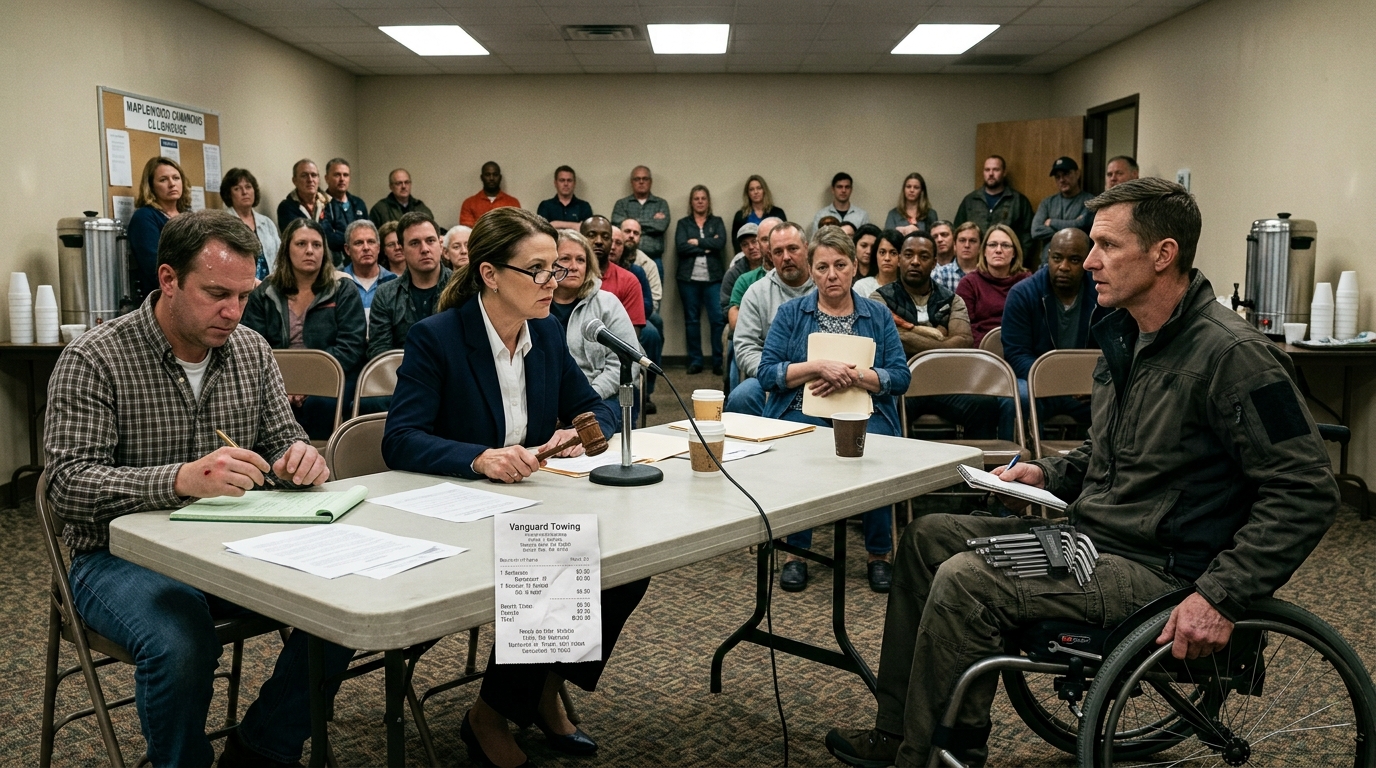
By seven-fifteen, the fluorescent lights of the Maplewood Commons clubhouse were buzzing with that high, thin drone that gets behind your eyes after ten minutes. The room smelled of wet carpets, stale drip coffee, and the faint, sweet tang of floor wax. Thirty folding chairs were arranged in neat, claustrophobic rows facing a long folding table where the board sat.
Beverly sat dead center. She had traded her pastel polo for a dark navy blazer, her reading glasses parked precisely on the bridge of her nose. To her left sat Doug, the treasurer, nervously tapping a brass cross pen against a green ledger book. To her right sat Shirley Voss, her hands folded flat over a manila folder, her eyes fixed entirely on the coffee urn in the corner.
I rolled in through the double doors, the wet rubber of my wheels leaving twin dark tracks across the linoleum. Opel was two paces behind me, her coat buttoned to the chin, holding a thick ring-binder under her arm like a weapon.
The chatter in the room didn’t stop; it just dropped down an octave, turning into a low, rustling murmur.
“Item three on the agenda,” Beverly said, her voice amplified through a small desktop PA speaker that rattled whenever she hit a hard consonant. She didn’t look toward the back aisle where I stopped. “Review of common area maintenance protocols and parking zone compliance.”
I didn’t wait for her to invite the floor. I unlocked my wheel-brakes, pushed forward three feet into the central aisle, and laid a single white envelope on the edge of the board table.
“I’m skipping the public comment timer, Beverly,” I said. My voice wasn’t loud, but it had the flat, dry weight of a iron pipe dropping onto dirt. “That’s the receipt from Vanguard Towing. Three hundred and twelve dollars. Plus forty for the cab.”
Beverly didn’t touch the envelope. She adjusted her glasses with her index finger, her expression smooth, bland, and entirely devoid of heat.
“Mr. Dillard,” she said, addressing the microphone rather than my face. “The board issued administrative notice under Section 84-B regarding unverified physical accommodations. The lot enforcement policy was distributed electronically in January.”
“You don’t have the statutory authority to revoke an approved ADA accommodation with an email notice,” I said. My thumb reached into my pocket, feeling the six sharp corners of the titanium wrench. I pulled it out, resting it against the armrest of my chair, the grey metal dull under the tube lights. “The board voted unanimously on Space 7 three years ago. It’s registered with the county housing authority.”
Doug cleared his throat, his thumb rubbing a raw, red blister on the side of his hand. “Garrett, the… the legal environment around designated spaces has evolved. The board’s counsel advised us that all permanent reservations require annual re-certification to maintain our umbrella insurance—”
“Show me the legal opinion,” Opel interrupted, stepping up beside my chair. She didn’t open her binder; she just laid her palm on top of it. “Show us the written notice from the insurer, Doug. Because I called Nationwide this afternoon, and they told me parking allocations have zero bearing on the master liability policy.”
Beverly’s jaw set hard, a tiny muscle flexing near her earlobe. She picked up a wooden gavel, held it two inches above the sound block, but didn’t strike it.
“This is not a debate, Mrs. Whitmore,” Beverly said quietly. “If Mr. Dillard wishes to formalize an appeal against the administrative hold on Space 7, he is welcome to submit a Class-C Grievance Form to the committee.”
“What’s the filing fee on a Class-C?” I asked.
Beverly looked directly at me then. Her eyes were pale, light gray behind the bifocals, completely empty of hesitation. “Fifty dollars. Non-refundable. Processed at the next quarterly review in June.”
A quiet, uncomfortable rustle went through the third row. Warren Taft, sitting two chairs down from the wall, shifted his weight, his heavy work boots squeaking against the tile. He looked at Beverly, then down at his hands, his mouth opening as if to speak, then closing tight.
“Fifty dollars to ask for my own legs back,” I said.
“Fifty dollars to initiate an administrative review,” Beverly corrected, her voice dropping into that calm, rehearsed tone used by bureaucrats who know the clock is on their side. “Until such time, Space 7 remains unassigned visitor property. Any unauthorized vehicle parked therein will be removed by Vanguard Towing at the owner’s expense.”
She struck the gavel once. The sharp crack of wood on wood bounced off the low ceiling tiles.
“Item four,” she announced, turning a page on her clipboard. “Proposed capital expenditure for drainage maintenance along the southern swale, specifically Line 4.”
Across the table, Shirley Voss’s fingers twitched against her manila folder. She didn’t look at Beverly. She looked down at the floor near my wheels, her lower lip pulled tight between her teeth until the skin turned white.
I reached down, engaged the wheel-locks on my chair with two distinct, metallic clicks, and pulled my notebook from my side bag. I didn’t leave the aisle. I sat right there, dead center in the room, five feet from her table, and opened the pen.
“Keep reading, Beverly,” I said softly, my voice carrying clean over the hum of the lights. “I’m taking notes.”
CHAPTER 4: UNEARTHING SECTION 84B
Beverly’s gavel didn’t stop me from writing.
I recorded every line item, every vote, every muffled throat-clear from Doug. When the board adjourned forty minutes later, Beverly swept her papers into a navy leather briefcase, snapped the brass latches with two hard, metallic thuds, and walked out without looking toward the center aisle.
The room emptied fast. People squeezed past my wheels, avoiding eye contact, their rubber-soled shoes squeaking against the damp floor. Opel stayed right beside me, her palm heavy on her binder.
“Franklin’s office in Columbus sent the initial county run,” she whispered, leaning down. “We’ve got sixty minutes before the recorder’s desk closes for the night.”
The drive south on Interstate 71 took forty minutes through a blinding grey sleet. The windshield wipers on my SUV slapped a steady, rhythmic cadence against the glass, clearing arcs of road salt and slush. Every bump in the asphalt transmitted a dull, stinging jar through the hand control lever, straight into the scar tissue above my knees.
Franklin Oaks’ office sat on the third floor of a brick building two blocks from the county courthouse. It smelled of old carpet, radiator steam, and dry paper. Franklin didn’t stand up when we rolled in. He was fifty-five, sharp-eyed, wearing a dark grey suit with the sleeves rolled up to his forearms, exposing a thin silver wristwatch.
He laid three thick manila folders flat across his mahogany desk.
“You were right about the review notice being junk, Garrett,” Franklin said, his voice quiet, dry, and precise. “Section 84-B isn’t an HOA code. It’s a municipal citation template used by the city building inspector for commercial loading zones. Beverly copied the formatting off an old municipal portal to make it look official.”
I pulled the titanium Allen wrench from my pocket, resting it against the edge of his desk. “She forged administrative authority to clear Space 7.”
“Worse,” Franklin said, tapping the second folder. “She cleared Space 7 because she had to wipe the lot record clean before Friday. The city building department flagged Maplewood Commons for a routine municipal audit last month. That’s Layer 1.”
I looked at the documents inside the folder. Watermarked public filings, municipal notices, and stamped county registry maps.
“She’s hiding non-compliant parking assignments from the city auditor,” I said, feeling the pieces lock together. “If the auditor sees designated spots that don’t match the original 2018 site plan, the HOA gets fined.”
Franklin paused. His right hand reached out, his thumb lightly rubbing the brass corner of his desk blotter. His eyes stayed fixed on my face, cool and unreadable.
“That’s what Beverly wants everyone to think,” Franklin said softly. “That this is just a board president trying to dodge a municipal paperwork fine for unauthorized spot assignments. But look at the land grant maps in Folder 3.”
He slid the final folder toward me. I reached out, my fingers cold against the smooth manila cardstock, and flipped open the cover.
Inside was a copy of an old public ledger from six years ago. Stamped at the top in faded red ink were the words: Federal Community Infrastructure Grant — Compliance Registry. Attached to it was an itemized budget totaling $180,000 for accessible parking installation, ramp grading, and storm-water management.
“Six years ago, Maplewood Commons took federal funds to build C-Block’s ramp and pave Space 7,” Franklin said, pointing a pen at a line item near the bottom. “Under the terms of that grant, those spaces are federally protected for twenty years. Removing them, altering them, or charging residents for access isn’t just an HOA violation. It’s a federal breach.”
I stared at the line item. Drainage Line 4 Modification & Swale Alignment — Allocation: $42,000.
“They didn’t build the drainage line near Space 7 to specs,” I said, the realization hitting like a cold draft. “The whole lot is sloped wrong. If an inspector measures the grade of Space 7 or tests the runoff near the swale, the federal grant gets audited.”
“And if the federal grant gets audited,” Franklin said, leaning back in his leather chair, “the government claws back the entire hundred and eighty thousand dollars from the HOA. Every homeowner in Maplewood Commons would face a five-thousand-dollar emergency assessment on the spot.”
I looked down at my hands. The skin over my knuckles was tight, red from the cold, but my fingers were perfectly steady.
“It’s not about parking,” I said.
“No,” Franklin replied. “Space 7 sits directly over the non-compliant junction for Drainage Line 4. Beverly didn’t tow your SUV because she hated your wheelchair, Garrett. She towed it because as long as your vehicle sat in Space 7, nobody could bring an excavator in to dig up that pipe before the inspectors arrive.”
Opel let out a breath, her hand dropping onto my shoulder. “She’s trying to destroy the evidence before the federal audit hits.”
I picked up my titanium wrench, slid it back into my jacket pocket, and locked my eyes on Franklin. “Call the HUD investigator. Tell them to bring a surveyor to the special assembly on Thursday.”
CHAPTER 5: THE SPECIAL ASSEMBLY
The paper felt thin in my fingers, but the ink had the weight of lead.
Franklin didn’t reach for the folder when I closed it. He just watched my left hand slide down to my pocket, the titanium wrench clicking against my ring as I tucked the ledger into my side bag.
“Thursday night,” I said, my voice steady against the rattle of sleet on his windowpane. “The clubhouse.”
Forty-eight hours later, thirty-seven homeowners packed into the Maplewood Commons assembly room until the back wall was lined two deep with winter coats. The air was thick with the humid heat of fifty people breathing in a tight space, mixed with the sharp tang of wet rubber boots and lukewarm urn coffee.
Beverly sat behind the head table, flanked by Doug and Shirley. She had her glasses resting on her chest, her navy blazer pressed sharp. But her fingers—those small, manicured fingers—kept adjusting the corner of her legal pad, moving it a quarter-inch left, then a quarter-inch right, over and over.
When she reached for the gavel, I unlocked my wheel-brakes.
The metal wheels groaned against the linoleum as I pushed dead center into the open space before the board. I didn’t hold a speech. I laid a single, heavy black binder flat on the table, right next to her water glass.
“Special business,” I said. My voice didn’t rise. It carried through the room like iron dragged over stone. “We’re skipping the committee reports tonight, Beverly.”
“Mr. Dillard, you are out of order,” Beverly said, her knuckles turning chalk-white as she gripped the gavel handle. “This meeting follows an established parliamentary—”
“Thirty-seven homeowners signed the petition for this assembly,” Opel said from the second row, her voice ringing clear as a bell. “You’re bound by Section 12 of the bylaws to hear the floor.”
Beverly’s jaw locked. She looked toward Doug, but Doug was staring straight at his shoes, his thumb frantically rubbing a raw blister on his knuckle.
“You brought Vanguard Towing in three times in eight days,” I said, opening the binder to page one. “You cited Section 84-B. You told this community it was an administrative hold to verify disability status under municipal guidelines.”
I turned the page. The plastic sheet-protector crinkled in the quiet room.
“That was Layer 1,” I said, looking her dead in the eye. “A fake citation to make people think you were just enforcing city parking codes. But Vanguard Towing didn’t tow my SUV because of a parking permit, Beverly. They towed it because Space 7 sits directly on top of Drainage Line 4.”
A murmur rippled through the fourth row. Warren Taft stood up half an inch, his heavy brow furrowing as he looked from me to the board.
“What’s Line 4 got to do with parking?” Warren called out.
“Six years ago,” I said, turning to face the room, “this HOA accepted a hundred and eighty thousand dollars under a federal infrastructure grant. The money was earmarked specifically for accessible parking, ramp grading, and storm-water management. Space 7 and C-Block’s ramp were built with those funds.”
I turned back to Beverly. Her face hadn’t flushed red; it had gone a flat, waxy yellow.
“Under the grant terms, those accessibility modifications are federally protected,” I continued, laying a stamped county record over her legal pad. “You didn’t purge the parking records to clear administrative backlog. You cleared Space 7 so an excavator could dig up Drainage Line 4 and cover up where forty-two thousand dollars of that grant money was diverted into private property grading.”
“That is an unproven, defamatory lie!” Beverly snapped, slamming the gavel down. The sharp crack made Shirley Voss flinch. “The board acted entirely within its fiduciary scope—”
“Then you won’t mind explaining it to her,” I said.
A woman in a dark grey trench coat stood up from the back row near the kitchen doors. She reached into her breast pocket, pulled out a leather credential holder, and flipped it open. The gold emblem caught the harsh overhead tube lighting.
“My name is Agent Miller,” the woman said, her tone completely devoid of emotion. “Department of Housing and Urban Development, Office of Fair Housing and Equal Opportunity. We received a formal non-compliance filing regarding federal grant registry number 402.”
The room went dead silent. The only sound was the low, electric hum of the coffee urn in the corner.
Doug’s chair scraped loudly against the floor as he pushed himself back three inches, putting physical distance between his elbow and Beverly’s sleeve. Shirley Voss didn’t move a muscle; she simply reached into her handbag, pulled out a signed, two-page statement, and slid it across the table toward the agent.
Beverly looked at Shirley, her mouth opening slightly, her breath coming in shallow, ragged hitches. For the first time in three years, the clipboard in her hands looked impossibly small.
“The board,” Beverly whispered, her voice cracking at the edge, “the board was protecting the property values…”
“The board is in breach,” Agent Miller said flatly.
I looked at Beverly’s hands—still trembling against the edge of her pad, still trying to align the paper—and felt no heat in my chest. No surge of victory. Just the cold, heavy settling of an overdue account.
CHAPTER 6: ORDER RESTORED
Beverly didn’t reach for her gavel again. Her fingers twitched twice against the edge of her clipboard, then dropped flat against her lap, her knuckles white against her dark trousers.
Agent Miller stepped past my chair, her heels clicking once against the linoleum. She didn’t raise her voice. She pulled a blue fountain pen from her coat, uncapped it with a deliberate, metallic snap, and laid a single yellow compliance summons over the board’s ledger.
“The federal audit for registry 402 is formally opened as of five p.m. today,” Miller said, looking directly at Beverly. “All administrative holds issued under Section 84-B are voided by federal order. Any further interference with designated accessible parking will be cited as willful retaliation under Title VIII.”
Doug didn’t wait for Miller to finish. He reached out, grabbed his green ledger book, and slid it six inches away from Beverly’s elbow, his face completely pale. “I wasn’t involved in the line-item allocation for Drainage Line 4,” he muttered toward the third row. “The board minutes reflect I abstained.”
Beverly didn’t look at him. She looked straight ahead at the empty center aisle, her lips pressed into a thin, colorless line. Her mouth opened as if to cite another procedure, another rule, another hidden clause in the bylaws, but no sound came out. The script had run out. The authority she had carried around like a heavy coat was stripped down to raw, useless noise.
Eleven days later, the board released a one-paragraph notice on the community board: Beverly Cratch had tendered her resignation, citing personal reasons.
By mid-May, the Ohio spring finally broke through the gray. The sleet turned to mild rain, washing the salt crust off the asphalt and settling the dust along the retention swale. Shirley Voss took over as interim president, and her first official act was bringing in a state-certified contractor to regrade Drainage Line 4 to federal standards.
I rolled out of Building C at seven in the morning.
The air was cool, carrying the smell of wet earth and freshly cut grass. In Space 7, the contractor had scraped away the old, flaking coat of latex and laid down fresh, thick blue paint that caught the morning light like glass. The steel post was mounted plumb, four inches higher than before, holding a bright new aluminum accessibility sign.
A silver sedan pulled into Space 6 right beside me.
Cornelius Brandt cut the engine, stepped out into the crisp air, and leaned against his driver’s door. He wasn’t using his cane. He stood upright, his work jacket unbuttoned, watching the morning sun hit the blue stencil on the ground.
“Looks straight,” Cornelius said softly, his voice clear and rested.
“It’s straight,” I said. “Three-inch pitch on the ramp, fully compliant.”
Cornelius nodded once, reached into his pocket, and pulled out a small brass key ring. He slid his keys into his pocket, rested his hand flat against the clean hood of his car, and looked across the lot toward the clubhouse.
“She’s moving out end of the month,” Cornelius said. “Sold to a family from Canton.”
I didn’t answer. I reached down into my jacket, pulled out my titanium Allen wrench, and loosened the side pinch-bolt on my left socket by a sixteenth of an inch. The sleeve settled smooth against the scar tissue over my tibia, locking the torque valve into perfect alignment with a faint, clean click.
I slid the wrench back into my pocket, grabbed the push-rims of my chair, and rolled up the smooth, even slope of the ramp toward my front door.