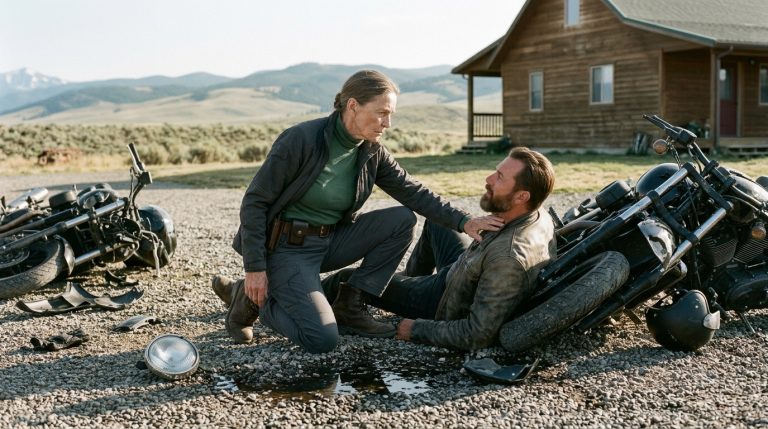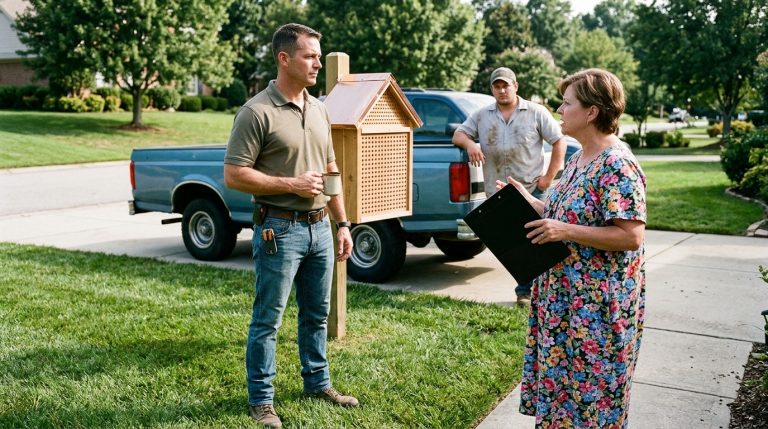
The Iron Boundary: A Retired Soldier, a Suburban Enclave, and the Weight of Unyielding Texas Soil
CHAPTER 1: THE LINE IN THE DIRT
The sound was a dry, grating symphony of cheap perfume and institutional panic. It cut through the steady hum of the cicadas like a rusty blade drawn across dry hide.
Mark did not turn around immediately. He kept his gloved hands braced against the weathered top rail of the corral fence, his gaze fixed on the northern horizon where the scrub brush met the blinding white of a Texas noon. Behind him, the low-slung, sun-bleached trailer sat in quiet isolation—forty acres of untamed pasture, completely untouched by the sterile, cookie-cutter ambitions of the development pressing against its western edge.
“This unsightly industrial blight is a violation of covenant 7.4b,” the voice rasped, vibrating with the practiced indignation of someone who had never once faced a real consequence in her life. “And as president of the Whispering Pines Homeowners Association, I am having it removed from the community at your expense.”
Mark let out a slow, measured breath through his nose, feeling the familiar, cold pinch of adrenaline that always preceded an engagement. Twenty-five years in Army logistics taught him how to measure a threat by its logistics, and this one smelled of bad asphalt and administrative fraud.
He turned slowly. She stood ten feet away, a plus-size empress entombed in a beige pantsuit that looked entirely too heavy for the punishing heat. Her orthopedic heels were planted firmly—not on the pavement of her pristine subdivision, but three inches past the rusted iron surveyor’s stake that marked the absolute boundary of Mark’s deeded land.
Behind her, an idling tow truck leaked a dark puddle of transmission fluid onto the baked dirt, its yellow emergency lights flashing in rhythmic, mocking strokes across her rigid chin. The driver leaning against the cab door wore grease-stained overalls that strained against a formidable gut, his hand absently rattling a length of heavy-duty steel chain.
“Ma’am,” Mark said, his voice dropping into that flat, register-free register that had once made green lieutenants check their map references twice. “You are standing on private property. And your vehicle is idling on a county right-of-way that you do not control. Tell your man to drop the chains.”
Karen didn’t blink. She offered a short, sharp bark of laughter that sounded entirely like a terrier snapping at heels. “Oh, that’s adorable,” she cooed, waving a hand heavy with costume gold. “You must be new here. We have an aesthetic easement. Fifty feet past the boundary. Your little rusted metal box is coming down.”
She pointed a manicured finger toward the twenty-foot industrial shipping container sitting fifty yards into the grass—the box that held every single tangible remnant of a quarter-century spent serving a flag that didn’t issue zoning permits.
Mark didn’t look at the container. He kept his eyes locked on hers, noting the nervous twitch at the corner of her left eyelid—the small, betraying physical artifact that proved she knew exactly how thin her legal ice was.
“There is no easement,” Mark said quietly, his hand drifting down to brush against the smooth wood of his pocket knife. “You’re trespassing, Karen. And if that winch turns one inch, you’re committing grand larceny.”
Karen’s smile vanished, replaced by the granite mask of a bureaucrat whose administrative universe had just suffered an unscripted glitch. She turned sharply to the driver. “Dale. Hook it up.”
Dale gave Mark a brief, apologetic shrug—the universal sign of a man who knew he was hauling garbage but loved the cash too much to argue—and dropped the heavy steel hook onto the corner casting of the container.
As the winch began to whine, biting into the dry earth and tearing a deep, bleeding gash across the grass Mark had spent six months trying to nurture, the low hum of the countryside vanished entirely, replaced by a sudden, absolute stillness that tasted of iron and approaching storm.
CHAPTER 2: THE DUST AND THE DESK
The screech of industrial-grade steel biting into a twenty-foot corrugated wall carried a sound that went straight to Mark’s teeth. It was the sound of a gear stripping, a jagged, tearing friction that left white-hot lines across the hard-packed dirt of his south pasture.
Mark didn’t flinch. In logistics, a compromised supply line or an unverified manifest didn’t get fixed by yelling at the shipping clerk; you pulled the manifest, you checked the ledger, and you cut off the fuel supply at the primary depot.
Karen stood six feet away, her arms crossed tight over the beige canvas of her suit jacket, her expression settled into that heavy, complacent smugness of someone who had never once paid retail for a municipal favor. Dale, the tow truck driver, leaned his weight into the winch lever, his thick back muscles bunching beneath a grease-stained canvas vest as the heavy container skidded another six inches, gouging a parallel trench of dead buffalo grass and pulverized caliche.
“You’re making a very expensive mistake, Dale,” Mark said, his voice level, carrying none of the heat that prickled the back of his own neck.
Dale paused, half-turning his head. A drop of sweat traced a clean path through the gray stubble on his cheek, cutting a streak in the grime. He looked from Mark’s face down to the rusted surveyor’s stake hammered into the parched earth not four feet from his left boot—the stake wrapped with faded orange flagging tape that the county engineer had set during the initial title registration three years back.
“Hey, pal,” Dale muttered, his voice gravelly and thick with stale cigarette smoke. “Lady’s got the paperwork. She says it’s an aesthetic violation under subsection seven. I got a dispatch order and a guaranteed fuel advance. You got a problem, take it up with the board.”
“There is no subsection seven,” Mark replied, his weight shifting slightly onto the balls of his boots—not a lunge, but the balanced posture of a man assessing a perimeter breach. “And she doesn’t own five feet past that rebar. Put the safety pin back in the winch drum.”
Karen stepped forward, her orthopedic heel crunching down hard on a dry patch of thistle. “Don’t you dare talk to my contractor like a common criminal,” she hissed, her face mottling to a dull, bruised plum under the Texas sun. “We gave you seventy-two hours notice via the community portal. You chose to ignore the guidelines of Whispering Pines. That eyesore is coming off this county corridor whether you like it or not.”
She turned her back on him, dismissing him with a sharp wave of her hand—the universal gesture of an administrator closing a ticket.
Mark didn’t argue. He didn’t pull out his phone to record her again, nor did he reach for the heavy Colt Commander he kept locked in the glove box of his Ford. Instead, he watched the exact angle of the winch cable, calculated the tension load on the rusted anchor points of his container, and turned his back on them both.
The heavy aluminum screen door of his trailer slammed behind him with a dry rattle.
Inside, the trailer was a study in austere military efficiency. A folding cot neatly made with hospital corners, a metal desk bolted directly to the wall studs to prevent vibration from the highway traffic, and an industrial three-ring binder resting beside a cold cup of instant coffee. The air smelled of old paper, gun oil, and the dry insulation of a mobile home baking under a tin roof.
Mark pulled out the metal chair, sat down, and dragged the thick binder toward him.
He didn’t need to look at the county plat map; he had memorized the metes and bounds survey the afternoon he signed the deed at the county clerk’s office in Bastrop County. The 1984 annexation agreement explicitly drew the eastern boundary of Whispering Pines along the natural creek bed—three hundred yards west of where Karen’s development currently sat. The developer had later petitioned the county for an expanded utility easement in ’98, but the commissioners’ court had tabled it indefinitely after environmental studies proved the runoff would contaminate the water table.
Karen hadn’t cited a real covenant. She had cited a draft proposal that was rejected twenty-eight years ago.
Mark opened the legal pad resting on top of the binder. With a black ballpoint pen, he wrote three lines of crisp, all-caps block letters:
VERIFY MUNICIPAL LIEN AUTHORITY (BAILEY COUNTY RECORDS).
PULL DALE’S TOWING DOT REGISTRATION AND INSURANCE BOND.
INVENTORY THE SENSITIVE FREIGHT.
His fingers stopped over the third line. Inside that twenty-foot steel box sitting on the bed of Dale’s truck right now—being dragged across his pasture toward an illegal impound yard fifteen miles away—wasn’t just his father’s lathe or his old field jackets. Sealed behind a false bulkhead welded into the front wall of the container was a heavy-duty Pelican case containing a tactical SINCGARS radio terminal, serial number and cryptographic interface plates intact, signed out under his direct supply officer authority during his final month at Fort Hood as a temporary cross-load transfer for the upcoming National Guard winter maneuvers.
It wasn’t civilian property. It was federal inventory assigned to a military logistics chain that tracked every serial number down to the microchip.
Mark picked up his encrypted satellite-linked mobile phone, bypassed the local cellular network entirely, and dialed a direct seven-digit extension that hadn’t changed since the Bush administration.
“Provost Marshal’s Office,” a crisp, low voice answered on the second ring. “Special Investigations Division. Sergeant First Class Davis speaking.”
“Davis,” Mark said, his tone dropping into the flat cadence of an operations briefing. “This is Chief Warrant Officer Four Peterson, retired. I need to log a preliminary report concerning unauthorized seizure of accountable federal assets within a civilian municipal jurisdiction.”
There was a micro-second pause on the line—the sound of a keyboard clacking as a database was accessed. “State your location, sir, and verify the asset classification.”
“Bastrop County, Texas. County Road Three,” Mark said, looking out the narrow window of his trailer just in time to see the yellow emergency lights of Dale’s tow truck dip as it hauled his life over the cattle guard and onto the paved road. “An entity operating under a fraudulent municipal umbrella has just towed a commercial container containing a controlled tactical communication terminal off my deeded land. They are currently transporting it toward an unverified commercial salvage yard.”
“Copy that, Chief,” Davis said, his voice instantly losing its bureaucratic drag. “Are the cryptographic zeroize plugs secured?”
“They’re in my wall safe,” Mark said, his eyes tracking the dust plume fading down the gravel lane. “The hardware is in their hands. Let’s see how long their aesthetic easement holds up against a federal property recovery warrant.”
Mark hung up the phone, closed the binder with a sharp slap that kicked up a thin circle of dust from the desk, and laced his fingers together. The first phase of the maneuver was complete; the enemy had successfully taken the bait and loaded the trap into the back of a truck.
CHAPTER 3: THE RANSOM YARD
The Ford’s tires crunched over a sprawling bed of rusted muffler scraps and crushed beer cans as Mark pulled the truck to a dead halt ten feet outside a chain-link fence topped with sagging barbed wire. A weather-beaten wooden sign hanging crookedly from a rusted post read Dale’s Discount Towing and Recovery.
Mark didn’t rush his exit. He kept both hands resting on the steering wheel for three slow heartbeats, letting the engine idle down with a low, rhythmic vibration. Through the cracked windshield, the midday heat rose off the gravel lot in wavy, distorted ripples, turning the sea of impounded sedans and flatbed trailers into a shimmering mirage of rusted iron and peeling decals. Fifty yards into the yard, sitting squarely between a burned-out Ford pickup and a stack of semi-truck tires, was his twenty-foot shipping container. Its corrugated steel doors were padlocked with a heavy brass lock that didn’t belong to him.
He killed the ignition, stepped out into the dry, stifling air, and let the door swing shut with a solid, metallic thud.
The office was a converted single-wide trailer rusted out at the seams, its single window coated in a thick film of road grime and cigarette tar. A bell chimed a cheap, two-tone electronic note as Mark shoved the screen door open. The interior air hit him like a physical blow—a dense cocktail of stale Camel smoke, cheap instant coffee, and the underlying chemical tang of industrial solvent.
Dale sat behind a particle-board counter that was littered with greasy fast-food wrappers and a stack of handwritten carbon-copy receipts. The man didn’t look up immediately; he was busy scratching a lottery ticket with a dirty thumbnail, his mouth working a toothpick from one corner to the fat of his cheek.
“Yard’s closed for heavy recoveries,” Dale muttered without lifting his eyes. “You want an impound release, come back tomorrow morning with cash in hand. Five hundred base, three hundred admin, and two hundred a day storage. Non-negotiable.”
Mark walked slowly across the warped linoleum floor, his boots making a dry, sharp clatter. He stopped two feet short of the counter, planting his weight evenly, his gaze locked on the grease stains on Dale’s overalls.
“I’m here for the container,” Mark said. His voice was flat, carrying no anger, only the heavy, dense weight of an operational directive.
Dale finally stopped scratching. He tossed the plastic stub aside, looked up, and squinted through a haze of smoke curling off a fresh cigarette smoldering in a chipped ceramic tray. Recognition flickered in his watery eyes, followed quickly by a slow, arrogant grin that stretched his chapped lips.
“Oh, it’s the rancher,” Dale chuckled, leaning back in his squeaking metal chair until the springs groaned a protest. “Well, look at that. You walked all the way into town without your army. Tell you what, pal, price just went up another two hundred bucks for the attitude. Cash only. You want that big metal box back, you pay the ransom.”
Mark didn’t reach for his wallet. He didn’t raise his voice. He reached into the breast pocket of his denim shirt, pulled out a folded manila envelope, and laid it squarely in the center of a greasy clipboard on the counter. He smoothed the paper down with two fingers.
“You towed property across a county boundary without a valid municipal warrant or a signed sheriff’s dispatch order,” Mark said, his tone clinical. “Under Texas Transportation Code Section 684, that constitutes an illegal non-consensual tow. Furthermore, the property inside that container is registered under a federal inventory manifest.”
Dale snorted, picking up the cigarette and taking a long, slow drag before blowing a gray cloud straight toward Mark’s face. “Federal manifest? What are you, a lunatic? Karen told me you were eccentric, but you’re starting to sound touched. You don’t have a lien release, and you don’t have cash. So turn around, walk back down my gravel, and come back when you’ve got thousand-dollar bills.”
Mark didn’t blink through the smoke. Instead, he let his eyes drop to the desk, noticing a small detail that Dale had overlooked in his haste: a discarded carbon copy of the dispatch ticket tucked beneath the greasy keyboard. Upside down, the handwritten text showed a different authorization code than the one Karen had cited—a municipal development code bearing the signature of a zoning board member who had resigned four years ago.
The paperwork wasn’t just forged for an HOA rule; it was cross-linked to a commercial rezoning filing. Karen wasn’t just protecting her grass; she was clearing the eastern sightline for a planned commercial strip extension, using the HOA as a blunt instrument to bully unaligned landowners off their acreage. The container wasn’t an eyesore; it was an obstacle on a map that someone else had already sold.
“You think you’re working for a neighborhood association, Dale,” Mark said softly, his voice dropping an octave as he leaned slightly over the counter. “You’re actually acting as an uninsured transport asset for an unregistered real estate syndicate committing mail fraud and wire tampering across county lines.”
Dale’s smile faltered for a fraction of a second. The toothpick stopped moving in his mouth. “What are you talking about? You’re crazy.”
“The military police unit out of Fort Hood is already logging the asset chain of custody,” Mark said, his face a mask of absolute, unyielding stone. “They aren’t coming with a civil summons, Dale. They’re coming with a federal property recovery order that voids every bond your towing company holds with the state.”
Before Dale could formulate a retort—before the cheap plastic lighter in his hand could hit the counter—the distant, heavy rumble of twin diesel engines rolled across the gravel lot, vibrating the thin aluminum walls of the trailer. Mark didn’t turn around to look. He knew the sound of a heavy-duty tactical utility vehicle dropping into low gear.
The trap was no longer just baited; the jaws were beginning to close.
CHAPTER 4: THE QUIET ALLIANCE
The screen door of Arthur’s split-level home in Whispering Pines didn’t squeak; it was oiled with the precision of a man who treated domestic infrastructure with the same gravity as corporate litigation.
Mark stepped out of the humid afternoon glare into a living room that smelled faintly of old parchment and lemon oil. It was a sterile, perfectly vacuumed replica of suburban tranquility, yet the air felt thin, charged with the nervous energy of a courtroom waiting for a hostile witness to take the stand. Arthur stood near the hallway archway, a retired corporate attorney whose linen shirt was unbuttoned at the collar, his gray hair neatly combed despite the mounting crisis outside.
“The insurance broker called twenty minutes ago,” Arthur said, his voice dropping to a low, gravelly register as he gestured toward a leather armchair. “They caught wind of the Military Police inquiry through a municipal liaison at the county courthouse. Policy’s flagged for non-renewal. If Karen doesn’t back down by Friday, every single homeowner in this development loses liability coverage.”
Mark didn’t take the chair. He remained standing by the heavy oak dining table where a thick stack of neighborhood newsletters and architectural guidelines lay spread out like tactical maps. He reached down, picking up a stapled packet titled Whispering Pines Master Covenant & Restrictions (Rev. 2012). His thumb found page forty-two immediately—the section governing utility easements and boundary adjustments.
“She isn’t backing down because she can’t,” Mark said, his eyes scanning the fine print. “This isn’t just about lawn height or a shipping container blocking a sunset view. Look at the sub-clause appended to the eastern corridor development rider.”
Arthur adjusted his wire-rimmed glasses, stepping closer to peer over Mark’s shoulder. His finger traced a dense paragraph of legal jargon. “Exemption for municipal infrastructure expansion… signed by the county planning board in conjunction with… wait. This signature isn’t current. It’s dated four years before this phase was even platted.”
“It’s a ghost amendment,” Mark said, his voice flat and steady. “Karen didn’t invent it out of thin air. She inherited it from the original real estate syndicate that flipped these parcels. They filed a conditional zoning swap to clear a twenty-foot commercial right-of-way right through my south pasture, intending to turn the acreage into an access road for a planned strip mall on the highway. When the county stalled the project, the easement lapsed. But Karen kept enforcing it as an active rule because the developers are still paying her underground consulting fees under the table.”
Arthur let out a dry, humorless laugh, shaking his head slowly. “Good grief. She’s acting as an enforcer for a defunct corporate shell game. If the other board members find out she’s exposing them to direct civil liability for a fraudulent commercial land grab…”
“They’ll turn on her faster than a dropped rifle,” Mark finished.
A sharp rap on the front window interrupted them. Through the sheer curtains, a woman in her late thirties—the same resident Mark had spoken to during his door-to-door reconnaissance two days prior—stood on the welcome mat, casting nervous glances up and down the cul-de-sac. Arthur unlocked the deadbolt and pulled the door open just enough to let her slip inside before latching it shut again.
She was breathing heavily, clutching a manila folder to her chest like a shield. “She’s calling an emergency executive session for tonight,” the woman whispered, her voice trembling slightly. “Karen pulled public records from the county clerk herself. She thinks she found a loophole in your deed registration, Mark. She’s telling the board you’re operating an unzoned commercial storage facility, and she’s drafting a formal demand for immediate seizure.”
Mark looked at her, noting the fine tremor in her fingers—the exact physical sign of someone pushed past their breaking point by petty tyranny. He didn’t offer false comfort. In logistics, you don’t soothe a panicked unit; you give them a clear objective and a secure perimeter.
“Let her draft the demand,” Mark said quietly, his hand resting flat against the wood of Arthur’s dining table. “Let her file every piece of paper she has. Every signature she puts on an illegal seizure order is another nail in the board’s legal coffin.”
Arthur looked from the nervous resident back to Mark, a grim, calculated smile touching the corners of his mouth. “In that case, it’s time we invited a few more neighbors to the conversation. If we can get thirty homeowners in that clubhouse tonight, we won’t just stop her motion. We’ll strip her of the gavel permanently.”
CHAPTER 5: THE FEDERAL CARD
The dashboard clock glowed a dim, muted green as Mark kept his truck idling fifty yards down the paved perimeter of Whispering Pines. The headlights were cut, leaving the Ford shrouded in the deep, ink-black shadow of a towering live oak. Through the windshield, the distant gravel lot of Dale’s Discount Towing looked like an abandoned scar across the dry scrubland, marked only by a single flickering security light buzzing above the gate.
Mark’s right hand rested lightly on the cold rubber of the steering wheel while his left thumb absently tapped a steady, calculated rhythm against his thigh. He didn’t have to wait long. At precisely 1900 hours, two unmarked, dust-caked utility vehicles rolled off the state highway without their light bars engaged, their heavy diesel engines muffled to a low, mechanical purr. They pulled in directly behind the Ford, headlights dowsing instantly as Major Evans stepped out from the lead vehicle.
The major moved with the sharp, economical stride of a man accustomed to operating outside normal jurisdictional boundaries. He pulled open Mark’s passenger door, sliding into the cab with a sharp click of his seatbelt and bringing the sharp scent of cold rain and military-issue leather into the confined space.
“Provost Marshal’s office cleared the asset verification ticket twenty minutes ago,” Evans said, his voice low and devoid of preamble. “Serial number matches the active inventory registry for the 13th Sustainment Command. That container isn’t just civilian storage anymore; it’s an official federal impound site under military jurisdiction.”
Mark didn’t look over; his eyes remained fixed on the distant security light of the tow yard. “Dale’s got a commercial lien filed through a local magistrate, but the underlying paper trail ties back to an expired municipal zoning rider controlled by the HOA president.”
“We aren’t arguing liens with a magistrate tonight, Mark,” Evans replied, leaning his arm against the center console. “We’re executing a direct asset recovery warrant under Title Eighteen. If that tow operator or the neighborhood president attempts to obstruct, they aren’t looking at a civil fine anymore. They’re looking at federal detention.”
The transition from planning to execution left no room for hesitation. Mark dropped the F-150 into gear, rolling forward without kicking up a gravel spray, leading the two military utility vehicles out of the tree line and straight toward the chain-link gates of Dale’s compound.
The confrontation at the gate was swift and brutal in its efficiency. When Dale lumbered out of the trailer office waving a grease-stained clipboard and shouting about after-hours impound fees, two military police officers moved with calculated precision, bypassing his protests entirely by slapping a heavy federal seizure seal across the office door jamb. Dale’s face drained of color as Major Evans handed him a single sheet of heavy bond paper bearing the Department of the Army letterhead.
Inside the yard, the heavy-duty bolt cutters made short work of the commercial padlock on Mark’s container. The steel doors swung outward with a long, metallic groan, revealing the dark, packed interior of his life’s work. Behind the false bulkhead at the rear, the olive-drab Pelican case sat undisturbed, its numerical seal intact.
“Asset recovered and verified,” the lead MP sergeant reported crisply, stepping back out into the gravel lot.
Mark stood beside the open container, running a gloved hand along the corrugated steel edge. The immediate tactical objective was secured, but the greater friction remained untouched. Karen was still holding court in Whispering Pines, believing her administrative shield was impenetrable.
“Major,” Mark said quietly, turning his gaze toward the distant, glowing rooftops of the subdivision visible over the tree line. “The hardware is safe. But the network behind it is still operating.”
Evans followed his gaze, a hard, dry smile touching the corner of his mouth. “Then I suggest we deliver the receipt to the front door.”
CHAPTER 6: THE UNIFORMED CONVOY
The convoy did not slip into Whispering Pines under the cover of night; it rolled through the grand stone entryway at precisely 2015 hours with headlights blazing, casting stark, surgical white beams across the identical brick mailboxes and perfectly clipped lawns.
Mark sat in the cab of his Ford F-150, trailing fifty feet behind the second military utility vehicle. Through the cracked window, the sterile perfection of the subdivision felt suddenly brittle, like dried shellac over rotten timber. Gardeners’ leaf blowers sat silent beside empty front porches; a few faces flickered behind sheer curtains before vanishing instantly. The arrival of olive-drab vehicles bearing federal plates in a cul-de-sac dedicated to beige conformity acted as an immediate social solvent.
Major Evans’s lead SUV swung hard into the curved driveway of 42 Whispering Pines Lane, the tires crunching over decorative gravel borders. The vehicle stopped squarely across the path of Karen’s pristine white Lexus SUV parked in the open double garage.
Mark killed his engine and stepped out into the humid evening air, keeping his boots on the asphalt near his tailgate. He didn’t approach the house. His role here wasn’t the lead interrogator; he was the anchor of the perimeter, watching the physical architecture of Karen’s neighborhood crack under pressure.
Major Evans and two military police officers dismounted with synchronized precision. Their boots hit the pavement with a heavy, flat authority that belonged on a training range, not a residential driveway. Evans didn’t bother using the brass door knocker shaped like a pinecone; he struck the heavy oak door twice with the flat of his hand—a sharp, concussive knock that echoed down the quiet street.
After a long, tense pause, the heavy lock turned with a mechanical click.
The door swung open to reveal Karen standing in the entryway. She wore a heavy silk bathrobe over her pastel leisure wear, her hair slightly displaced from its usual rigid architecture. The fierce, unyielding glare she typically wore when confronting contractors or unaligned neighbors flickered for a fraction of a second, replaced by a sudden, hollow confusion as she took in the olive-drab uniforms and the grim, impassive faces of the MPs.
“Can I help you?” she demanded, her voice climbing half an octave higher than usual, weaponizing the brittle insulation of her homeowner authority. “This is a private residential association. You have no legal right to park commercial or government vehicles blocking a private drive—”
“Mrs. Peterson,” Major Evans interrupted, his voice dropping into a register that carried zero emotion and absolute command. “My name is Major Evans, United States Army. We are here pursuant to an ongoing federal inquiry regarding the unlawful seizure of serialized military hardware and obstruction of federal logistics.”
Karen’s jaw tightened, the color draining rapidly from her cheeks until her face matched the stark white trim of her front porch. “I have no idea what you are talking about. That was a municipal code enforcement matter handled through the proper legal channels of the Whispering Pines HOA. My attorney—”
“Your attorney is currently reviewing a non-renewal notice from your D&O insurance carrier,” Evans cut across her smoothly, stepping one deliberate inch closer to the threshold. “And the municipal code enforcement office has already confirmed that your so-called aesthetic easement expired alongside the original 1984 commercial rezoning rider. You executed a non-consensual seizure of private property that happened to house a classified tactical radio unit. Under federal statute, that is a felony offense.”
A neighbor two doors down stepped out onto their front porch, a smartphone raised discreetly, recording the scene with the cold blue glow of a screen reflecting off nervous eyes. Other windows along the cul-de-sac cracked open, the collective silence of the subdivision breaking under the weight of whispered conversations.
Karen’s gaze darted past Major Evans’s shoulder, locking instantly onto Mark standing motionless beside his truck across the street. In that split second, the facade completely fractured. The absolute certainty of her petty kingdom dissolved into the raw, panicky realization that the rules she had invented didn’t apply to the wider world.
“You…” she breathed, her voice cracking as she pointed a trembling finger toward Mark. “You did this. You brought outsiders into our community over a simple trash container.”
“It wasn’t a trash container, Karen,” Mark said, his voice carrying clearly across the quiet asphalt without a hint of malice. “And this isn’t a community dispute. It’s the end of the line.”
Evans turned slightly, gesturing to the MP sergeant standing by the flank of the SUV. “Mrs. Peterson, you will retrieve the remaining administrative files associated with the county right-of-way dispute and accompany these officers to the local county substation for a formal deposition. Any further refusal or concealment of documentation will result in your immediate apprehension under federal warrant.”
Karen looked from the major’s stone-cold expression to the open doors of the military vehicle idling in her driveway. For the first time since she had planted her orthopedic shoes on Mark’s side of the survey stake, she had nowhere left to hide behind a bylaw.
CHAPTER 7: THE CLUBHOUSE EXECUTION
The double doors of the Whispering Pines Community Clubhouse stood wide open, yet the air inside was thick, stagnant, and heavy with the body heat of eighty residents crammed into folding chairs and standing shoulder-to-shoulder along the wood-paneled walls.
Mark walked through the entrance alongside Arthur and Hank, their boots clicking against the polished linoleum floor. Mark wore his old Class A military service uniform, the dark green jacket clean and unwrinkled, the rows of ribbons and polished brass reflecting the harsh overhead lights. It was a silent, immutable symbol of order stepping into a room that had spent years governed by petty chaos.
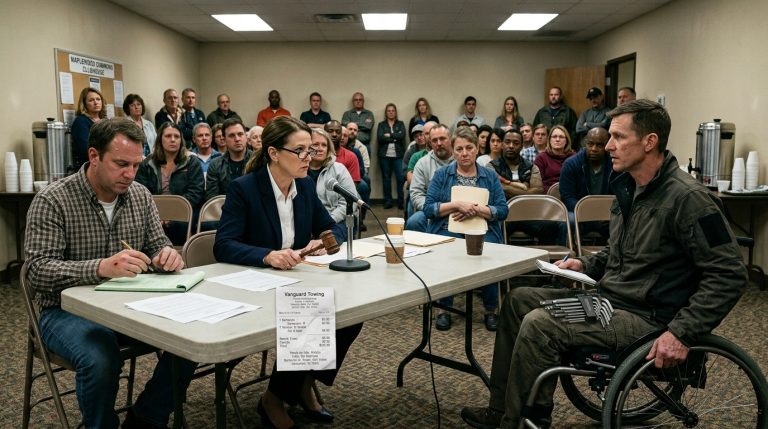
At the front of the hall, behind a long mahogany table, four remaining board members sat like defendants awaiting a military tribunal. They looked pale, their eyes fixed on their folded hands as whispers rippled through the seated crowd. Karen was absent—her seat in the center empty, her gavel left abandoned on the wood like a dropped weapon.
Arthur moved directly to the small podium set up before the dais, laying down a thick leather binder containing the certified copies of the expired municipal easements, the insurance cancellation notices, and the federal asset recovery receipts.
“The executive session is called to order,” Arthur announced, his voice carrying clearly across the quiet room without needing a microphone. “Given the recent events involving the unauthorized seizure of unaligned property and the subsequent federal inquiry, the board has surrendered its administrative mandate.”
A murmur surged through the crowd, rising like wind through dry brush. A middle-aged man in the third row stood up, his face flushed. “Is it true about the insurance? Are we all personally exposed because of Karen’s lawsuits?”
“Every single property owner in this association was placed at direct financial risk by a board operating outside its legal charter,” Arthur replied calmly. He turned his gaze toward the trembling treasurer sitting at the center of the dais. “Unless the board moves immediately to dissolve the architectural committee, settle the outstanding damages, and initiate full resignations, the civil liability filings will be unsealed tomorrow morning.”
The treasurer swallowed hard, his Adam’s apple bobbing violently. He looked to his left and right at the other board members, who offered only defeated, downward nods. With a shaking hand, the treasurer reached across the table, picked up a single sheet of paper, and slid it toward Arthur.
“We resign,” the man whispered into the dead silence of the hall. “All of us. Effective immediately.”
The tension in the room didn’t snap with a cheer; it settled into a heavy, profound exhale. People looked at one another, the invisible grip of years of petty fines, microscopic rule enforcement, and neighborhood surveillance suddenly evaporating into thin air.
Mark remained standing near the back, his hands clasped behind his back, watching the quiet collapse of an empire built on paper authority. He didn’t gloat. In logistics, you didn’t celebrate when a broken supply chain was cleared; you simply noted that the route was open again and prepared for the next horizon.
Arthur held up the signed resignation letters, looking out over the sea of residents. “A temporary transition committee will be formed tonight. Whispering Pines will return to its original charter, and all non-consensual liens on adjacent properties are null and void.”
The applause that followed wasn’t thunderous; it was steady, grinding, and absolute—the sound of a community heavy with the weight of its own release.
CHAPTER 8: THE CLEAR HORIZON
The dawn broke over County Road Three without fanfare, painting the wide Texas sky in strokes of pale amber and dust-filtered gold.
Mark stood near the southern edge of his property, his heavy leather work gloves hanging from his back pocket as he watched the contractor’s grading tractor smooth out the final raw scars left in the earth. The deep trench where Dale’s winch cable had dragged his shipping container three weeks prior was gone, filled in with fresh topsoil and seeded with native buffalo grass that would catch the coming rains.
The container itself rested squarely on its reinforced concrete piers, its heavy steel doors unlocked and propped open to let the morning breeze sweep through the interior. Inside, the boxes containing his father’s tools, his mother’s framed photographs, and his old service records were neatly stacked against the insulated walls.
A shadow fell across the gravel drive. Hank’s pickup truck rolled to a stop near the trailer, the old rancher stepping out with a pair of iced coffees in hand. He walked over, handing one to Mark without a word, and leaned his forearms against the top rail of the newly mended fence.
“Town’s quiet this morning,” Hank said, taking a slow sip of the coffee and looking toward the distant, hidden rooftops of Whispering Pines. “Heard Karen put her house on the market yesterday. Movers were loading up a single white Lexus before the sun was even up. No big send-off. Just drove away into the gray.”
Mark took a measured sip, feeling the cold bite of the drink against the dry heat already rising from the earth. “She was running an operation built on paper that didn’t exist,” he said quietly. “When the paper dissolved, there wasn’t anything left underneath.”
“Well,” Hank grunted, spitting a speck of dust into the grass. “You made sure the boundary stakes aren’t moving anytime soon. County commissioner stopped by my place yesterday afternoon. Said they officially expunged that old ghost easement from the municipal registry once and for all. Whole tract is clean. Unencumbered. Just like your deed said it was from day one.”
Mark nodded, turning his gaze toward the skeletal wood framing of his future house rising against the open horizon. The foundation had set hard, square and true against the prairie floor, anchored deep into the limestone base beneath the topsoil.
The conflict had demanded a heavy price in friction, patience, and calculated risk, but the territory was restored. Every boundary marker was firm. Every legal fiction had been stripped away, leaving only the stark, honest reality of the land and the labor required to cultivate it.
Mark reached into his pocket, pulling out a small, bent iron bracket that had been snapped off the container’s anchor point during the initial illegal tow. He walked over to his workbench, fired up the small electric welder, and spent the next twenty minutes carefully heating, shaping, and fusing the metal back into alignment until the joint was stronger than it had been before the break.
When he finished, he set the cool piece back down on the wooden shelf, wiped his hands on a clean rag, and walked out into the center of the pasture. The air smelled of dry iron, damp earth, and the clean promise of an uncrowded horizon. He stood there alone under the vast open sky, feeling the profound, uncompromised silence settle into his bones.
The perimeter was secured. The work was finished. He was finally home.