The Weight of Silence: A Soldier’s Dignity Echoes Through the Fragile Glass of Modern Apathy
CHAPTER 1: THE WEIGHT OF THE BLUE
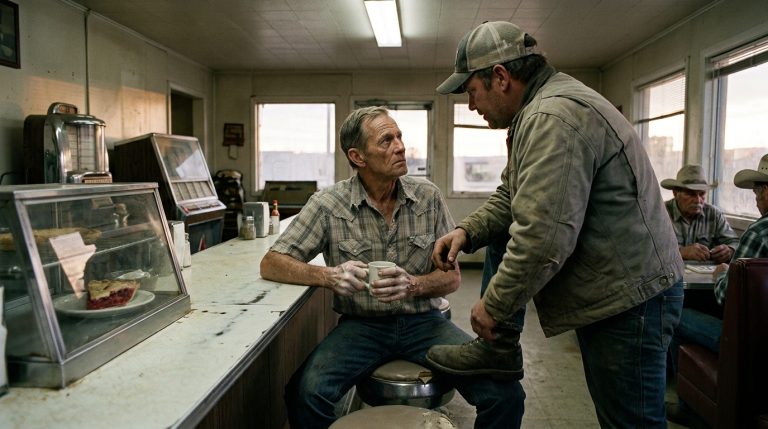
The Oak Barrel Diner held the morning light in a haze of amber, a sanctuary of dust motes and lingering coffee grounds that usually offered Raymond Clark a quiet place to exist. But today, the atmosphere was brittle. The table, a four-top that felt like a continent, was suddenly occupied by the jagged energy of the fraternity boys.
“Are you going to move, or do we have a problem?”
The boy, Chad, stood over the table. His sweatshirt was too clean, his haircut too calculated, and his eyes searched for an audience that had already gathered. Raymond didn’t look up immediately. He focused on the ceramic mug between his gnarled fingers. The glaze was cracked in a web of spider-thin lines, the warmth seeping into his joints—a small, familiar comfort against the sudden chill of the boy’s tone.
Raymond raised his head. His eyes, the color of a winter sky, met Chad’s. “Is your name on it?”
The girl, Jessica, moved in. Her phone was a black mirror held at eye level, capturing the scene. “This is classic,” she whispered, the stage-performance quality of her voice scraping against the quiet. “The entitlement is real. It’s like they don’t know the world has moved on.”
She zoomed in on Raymond’s chest—the VFW blazer, the fabric worn soft by decades of cleaning and pressing, the medals that caught the harsh fluorescent light. Her finger hovered near the screen’s capture button. “Look at the costume. Like he’s waiting for a parade that stopped passing by forty years ago.”
The word costume struck the air. Around the diner, the low murmur of other patrons—the truck drivers and the early-morning nurses—withered. A waitress near the kitchen paused, her hand gripping a stack of menus until her knuckles turned white.
Raymond felt the shift. It wasn’t just the insult; it was the casual, effortless way they dismantled his presence. For a moment, the diner wall seemed to recede. He wasn’t sitting on worn vinyl anymore. He was on a ridge, the air thin and biting, the metallic scent of iron thick in his throat as he held a young boy—Miller—against his chest, feeling the frantic, fading rhythm of a heart that he had promised to carry home.
The present returned with the sharp tap of Chad’s hand against the Formica table. “Hey. Are you deaf, or just stubborn? Move.”
Raymond placed his mug back on the saucer. The clink was small, yet it carried the finality of a closing door. He looked at the boy, and for a terrifying second, Chad faltered, his own bravado clashing against an intellect that seemed to be observing him from a distance of eighty years.
“I am a paying customer,” Raymond said, his voice a low, gravel-smooth rumble.
“You’re a relic,” Jessica countered, stepping closer. “And relics belong in museums, not in the way.”
As she moved to frame him again, the spoon Raymond had left on his napkin caught the light, gleaming—a single, silver sliver of reality in the staged theater of the diner. He felt the cold iron of that Korean night in the marrow of his bones. He was not moving. The conflict was not about the booth; it was about the sanctity of the memory he carried, and as he braced himself, a new, jarring realization dawned: there was a shadow moving in the far corner of the diner, a man in a sharp suit who had stopped eating, his face hardening with a recognition that promised the balance of the room was about to break.
CHAPTER 2: THE PHANTOM OF THE RIDGE
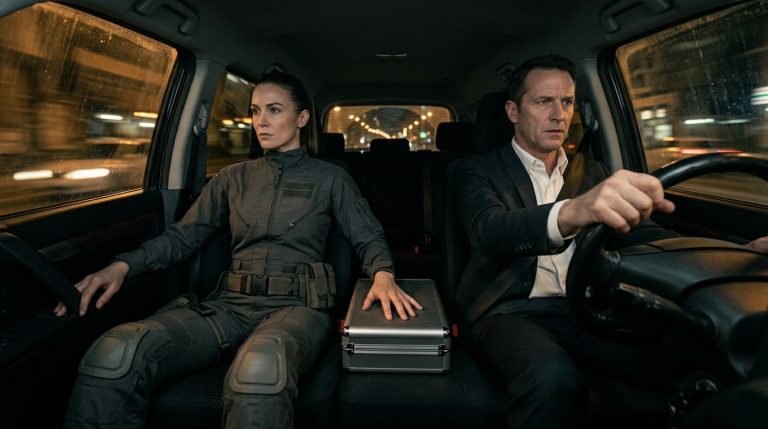
The rumble began not as a sound, but as a tremor beneath the soles of Raymond’s boots. It was a low-frequency vibration, the kind that traveled through the marrow, stirring memories he had kept buried under layers of routine and quiet order. Outside, the world was shifting. The diner, usually an island of mundane comfort, was being enveloped by the disciplined, mechanical precision of the black SUVs pulling to the curb.
Raymond did not turn his head toward the window. He didn’t need to. He could feel the shift in the air, a drop in pressure that signaled the arrival of something heavy. His hand remained on the ceramic mug, his knuckles white against the faded blue of his blazer. The phantom weight of the past was pressing in; the dry, static-charged cold of a Korean winter seemed to bleed into the humid, onion-scented warmth of the diner.
Beside him, the fraternity boys—Chad, Kevin, and the girl with the phone—had frozen. Their smug, performative confidence had evaporated, replaced by the instinctual, animal realization that they were no longer the apex predators of this small, vinyl-booth ecosystem. Jessica’s hand, holding the phone, trembled. The screen glowed, a sterile, artificial light reflecting off the chrome of the napkin dispenser, but the content she had been filming—a narrative of youthful dominance—was now irrelevant, rendered obsolete by the arrival of the uniforms.
The bell above the door jingled. It was a cheerful, tinny sound that had no business being in the room, and then the space was occupied by them. Six Marines. They moved with a synchronized, rhythmic inevitability, the click of their heels against the linoleum not just a sound, but a statement of purpose.
Raymond watched them through the periphery of his vision. He recognized the geometry of their movement, the way they held their shoulders, the absolute focus in their eyes. They were a phalanx. He felt a sudden, sharp ache in his chest—not from the weight of his years, but from the memory of the ridge. He saw the snow again, white and blinding, and felt the dead weight of Miller, the boy from Ohio, slumped against his shoulder. The cold had been so absolute it felt like a flame, and the promise he had made—I will carry you, son, I will not leave you to the ice—burned in his mind with more clarity than the fluorescent lights flickering overhead.
Sergeant Major Thorne stepped forward. He did not look like a man; he looked like a monument carved from granite and honor. When he clicked his heels, the sound snapped through the diner like a gunshot. The salute was a perfect, vertical extension of his discipline, a blade held in silence.
“Gunnery Sergeant Clark,” Thorne’s voice was the rumble of distant artillery. “On behalf of the Commandant and the entire United States Marine Corps, we apologize for the delay. We are here to provide your escort, sir.”
Raymond’s own hand moved before he consciously decided it. His posture corrected, the years of slouching against the indifference of the world falling away. He stood, his knees protesting, but his spine was a steel rod. He was no longer just an old man in a diner; he was a Gunnery Sergeant, and the weight of the silver star on his breast pocket was no longer a burden, but a testament.
The students were shrinking. Chad’s bravado had collapsed into a hollow, jagged fear. He looked at the Marines, then at Raymond, his eyes darting as if searching for a way to rewrite the last five minutes of his life.
“Sir, your legendary actions on Hill 1282…” The young Marine speaking was barely twenty, his face smooth, his voice steady. The words flowed from him like water from a spring, a recitation of history that belonged in a textbook, not in the grease-stained aisles of a diner. Every word was a hammer blow against the silence.
Raymond looked at the girl, Jessica. She had lowered the phone. The device dangled at her side, the screen blackening, its battery dying like the narrative she had tried to weave. She looked terrified, not of the men in blue, but of the sudden, yawning realization that the world contained depths she was fundamentally unequipped to navigate.
The Sergeant Major’s gaze turned to the trio. It was a quiet, suffocating look. He didn’t raise his voice, but the entire diner could hear the underlying command in his tone. “The uniform you called a costume is a testament to a life of honor, courage, and commitment that you will never know.”
Raymond felt the heat of the moment, the intense, kinetic energy of the standoff. He placed a hand on Thorne’s arm—a gesture of restraint, a veteran’s understanding of the fragility of power. “Easy, Sergeant Major,” he murmured. His voice was cracked, but audible. “They’re just kids. They don’t know any better.”
The apology was not for the students; it was for the Sergeant Major, a subtle signal that the lesson had been delivered, but the slaughter was not necessary. He looked at Chad—at the sweat beading on the boy’s forehead, the way he clutched his own arms as if trying to hold his sanity together. Raymond felt a strange, detached pity. He had seen men break under fire, and he recognized the look of a soul realizing it had been standing on the wrong side of a moral fault line.
As they began to move, the diner felt like a vessel being emptied. The customers stood—the middle-aged couple, the truck driver, the waitress. They were rising not for a spectacle, but in a reflexive gesture of humanity. Raymond moved slowly, the phalanx of blue uniforms surrounding him, shielding him from the remnants of the humiliation he had endured. He didn’t look back. He didn’t need to see the broken pieces of the boys’ pride. He focused on the door, the cool air waiting outside, and the persistent, nagging phantom of the snowy ridge that whispered in his ear, you held the line, Gunny. You held the line.
He was walking out, but the secret—the full weight of the star and the boy from Ohio—remained tucked behind the blue fabric, locked in the silence of his own chest.
CHAPTER 3: THE FRICTION OF THE THRESHOLD
The bell above the Oak Barrel Diner’s front door let out a strained, metallic protest as Raymond pushed outward, his gait slow but steady, supported by the invisible pressure of the Marines flanking him. The door, caught in its hinge and struggling against the sudden shift in barometric pressure caused by the two idling SUVs, hesitated. For a heartbeat, Raymond stood trapped in the frame—the warm, greasy sanctuary of the diner behind him, and the stark, slate-gray sky of the afternoon ahead.
It was a small, mechanical inconvenience, yet it magnified the tension. The cold air rushed in, cutting through the stagnant scent of fried onions and stale coffee. Behind him, he could hear the muffled, frantic scurrying of the manager, Mr. Henderson, as he hovered in the wings, his face a mask of panic. The students—Chad, Kevin, and Jessica—were still huddled in their booth, their earlier aggression replaced by the wide-eyed, fragile vulnerability of those who have suddenly realized the world is larger and colder than they had ever imagined.
“Sir, let me,” the young Marine to his right said, his voice clipped and efficient. He stepped forward to catch the door before it could slam shut, his movements a masterclass in controlled, purposeful grace.
Raymond stepped onto the sidewalk. The pavement was damp, slick with the remnants of an earlier drizzle, and it caught the reflection of the lead-gray sky. The SUVs sat like armored sentinels, their dark glass reflecting nothing, their engines emitting a low, rhythmic thrum that vibrated through the soles of Raymond’s boots.
He didn’t move immediately. He felt the weight of the moment, the way the street—usually just a thoroughfare for the mundane traffic of the town—had become a staging ground. People were stopping on the opposite side of the road. A woman pushing a stroller slowed her pace, her gaze lingering on the phalanx of dress blues. There was no sound of conversation, only the ambient hum of tires on wet asphalt and the insistent, deep thrum of the idling vehicles.
Raymond felt the cold biting at his cheeks, a sharp, familiar nip that transported him back to the frozen stillness of the Chosin. He adjusted his garrison cap, his fingers lingering on the stiff, wool-blend fabric. It was then, as he stood on the threshold of the street, that he saw it: a small, discarded flyer, wet and pulpy, stuck to the sidewalk near his shoe. It had the school’s logo on it, a bright, garish thing that seemed incongruous against the somber elegance of the uniforms surrounding him.
He looked back at the diner. Through the large front window, he could see Chad standing up now, his hands stuffed into his pockets, his posture slumped. He wasn’t looking at the Marines anymore; he was looking at Raymond. It was a look of quiet, dawning comprehension, a reflection of the “social experiment” he had tried to orchestrate, now shattered by the reality of the hero he had attempted to diminish.
“They’re watching, sir,” Sergeant Major Thorne said, his voice pitched low, intimate. He remained at ease, his eyes scanning the perimeter with the seasoned vigilance of a man who never truly left the field. “Does the gentleman wish to address them further, or shall we proceed to the appointment?”
The appointment. Raymond had almost forgotten. A simple lunch, a meeting with a friend from the old days, a task that now felt like a lifetime ago. The escalation of the day, the intensity of the confrontation, had burned through the hours, leaving him feeling drained, yet strangely sharpened.
“Proceed,” Raymond said, his voice a low, gravelly rumble that held no room for argument.
As he turned, his gaze drifted to the manager, who was now standing tentatively in the doorway, wringing his hands. The man’s tie was still askew, his face flushed with a mixture of embarrassment and the dawning realization of the business fallout he was about to endure. He caught Raymond’s eye, and for a second, the veteran saw the man’s panic—the fear of the “yours” and “ours” of the world, the desire to be on the side that possessed the most leverage.
Raymond felt a flicker of the old, cold logic. He could say something, could offer a word of grace, but the logic of the situation dictated otherwise. He was the catalyst, the spark that had exposed the rot, and to intervene now would be to dilute the lesson that had been so clearly, and so painfully, administered.
He moved toward the lead SUV. As he stepped up, he felt the sharp pain of his knee, a protest from the years of damp, cold winters, but he pushed through it, a slight catch in his breath that went unnoticed by the men around him. He wasn’t done yet. The realization hit him, hard and absolute: this wasn’t just about the diner. The encounter had unsealed something in him, a need to confront the erosion of the respect he had spent a lifetime defending. He leaned into the vehicle, the scent of leather and machine oil a stark contrast to the diner, and as the door clicked shut, he caught a final glimpse of Chad through the window. The boy was still watching, his hands no longer in his pockets, his shoulders square, a hesitant, ghost-like attempt at dignity that Raymond knew was only the beginning of a long, arduous process of repair.
The SUV began to pull away, the motion smooth and deliberate, and Raymond felt the weight of the Silver Star against his chest—a heavy, silent promise that burned with a cold, unrelenting light. The escalation was not yet finished; it had only shifted into a new, more dangerous gear, one that demanded he face the full, unvarnished truth of his past before the day was through.
CHAPTER 4: THE QUIET AT THE END OF THE STORM
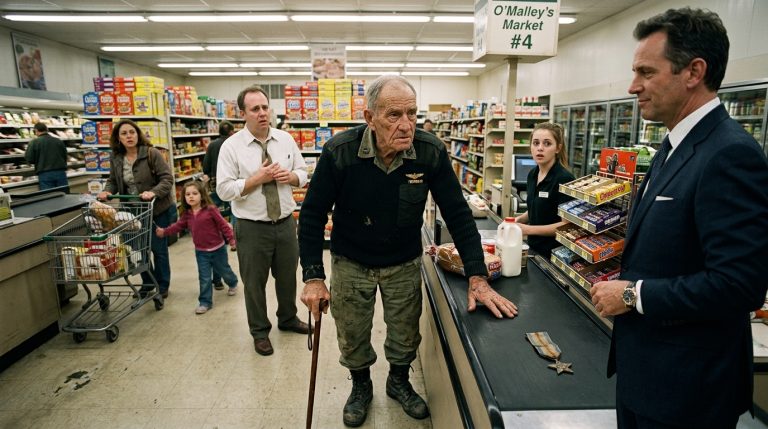
The grocery store was a landscape of sterile brightness, a vast, climate-controlled expanse that stood in jarring opposition to the raw, wind-whipped intensity of the afternoon. Raymond moved down the canned goods aisle, his footsteps soft against the linoleum. The silence here was thick, punctuated only by the distant, rhythmic cycling of a compressor. He stopped before the shelves, his eyes tracing the labels—creamed corn, whole kernel, peas—as if they were ancient, inscrutable artifacts.
His hand reached out, his fingers brushing the cold, corrugated surface of a metal can. It was a mundane action, yet it carried the weight of the entire day. He thought of the Oak Barrel Diner, the sharp, angular tension of the students, and the way the air had solidified when the Marines arrived. That conflict had been the surface-level tremor; the real seismic event, the one that truly stirred his blood, was the return of the memory he had kept under lock and key for over seven decades.
As he gripped the can, the aisle seemed to stretch, the grocery displays blurring into the desolate, frozen landscape of Hill 1282. He wasn’t in the store anymore. He was in the white-out, the wind a physical hammer against his back, and the boy—Miller—was a slumped, agonizing weight against his shoulder. He felt the specific, terrifying texture of the wool field jacket Miller wore, soaked through with icy mud and blood.
He hadn’t been fighting for a booth or for his pride that day at the diner; he had been fighting to hold onto the fragment of that boy’s life that lived within him. The Silver Star on his blazer wasn’t a prize. It was a tombstone. It marked the moment he had realized that even the most desperate act of holding on could not stop the inevitable. He had promised Miller he would bring him home, and he had—not the boy, but the memory, which he had carried through twenty-two years of service, through marriages, through the quiet, slow march of his later years, until it had become the very architecture of his soul.
“Mr. Clark, sir.”
The voice was hesitant, stripped of the unearned, slick confidence that had defined it at the diner. Raymond turned. Chad stood at the end of the aisle, wearing a grocery store apron that looked two sizes too large. The boy’s face was pale, his eyes rimmed with the exhaustion of someone who had not slept well in days. He stood with his hands tucked into his pockets, his posture lacking the rigid, defensive tension of the previous week.
Raymond didn’t speak. He allowed the silence to hold the space between them, a heavy, quiet currency.
“I… I just wanted to apologize,” Chad stammered, his eyes flickering toward the floor, unable to bear the steadiness of Raymond’s gaze. “For everything. That day. I was an ignorant fool. What I did—there’s no excuse for it.” The boy looked up, and for the first time, Raymond saw something genuine in the set of his jaw. It wasn’t the performative contrition of a social media apology; it was the raw, hollowed-out shame of someone who had seen their own reflection and found it wanting.
Raymond studied the boy. He saw the flicker of fear, the desire for absolution, and the lingering, painful lesson of having been humbled by a force that transcended his narrow, digital worldview. Raymond felt the phantom weight of Miller finally lighten. The promise he had made in the snow had been about holding onto a life, but perhaps the act of holding onto the humanity of others—even those who had once been his tormentors—was the true, final dimension of that oath.
Raymond gave a single, slow nod. “I know,” he said. His voice was soft, devoid of judgment or the lingering sting of the ordeal. It was the voice of a man who had seen the threshold of everything and had chosen, in the end, to offer the simplest form of mercy.
He turned back to the shelves, his hand selecting the can of creamed corn with a deliberate, steady precision. He placed it in his cart. The metal felt cold, grounding.
“Remember,” Raymond added, not looking back as he began to walk toward the checkout lanes, “it doesn’t cost anything to be decent. And that is a freedom no one can take from you.”
He left Chad standing in the aisle, the boy appearing small, anchored to the floor by the sheer gravity of the moment. Raymond didn’t look back again. He moved past the displays, the colors of the labels blurring into a soft, indistinct palette, and pushed his cart toward the registers. The fluorescent lights overhead seemed less harsh now, the atmosphere of the store settling into a quiet, functional hum. He had carried the past through a blizzard of steel and the even more treacherous drifts of his own long life, and here, in the mundane, soft-lit reality of a Tuesday afternoon, he had finally reached the denouement.
He walked out into the cool, fading light of the late afternoon, the world quiet, the air crisp and clean, the burden of the ridge finally, mercifully, left behind. He was alone, but it was not the loneliness he had known before. It was a space, cleared and quiet, a place where he could finally just be Raymond.