A Quiet Life Reclaimed: Marcus Hale Navigates the Rusted Truth of Service, Legacy, and Hard-Earned Redemption
CHAPTER 1: THE FRICTION OF THE LOT
The heat at Pinewood Plaza didn’t just radiate; it pressed against the skin like a physical weight. Marcus Hale sat in his truck, the air conditioning struggling against the midday sun, his eyes locked on the white Honda Civic trapped three rows over. His daughter, Emma, tugged at his sleeve. Her fingers were small, persistent, a stark contrast to the tactical stillness Marcus had practiced for twelve years.
“Daddy, please help her.”
The words weren’t a request; they were an observation of a wrong that required righting. Marcus didn’t look at his daughter, but his posture shifted. The casual slouch of a tired repairman vanished, replaced by a calculated alertness. He assessed the scene: three men, heavy on bravado, light on situational awareness. The alpha, a gym-built man in a tight tank top, occupied the space that mattered—the path of egress.
“Stay here, Emma,” Marcus said. His voice was a flat, low register, devoid of the warmth he usually saved for her. It was the voice of a man who dealt in outcomes, not explanations.
He stepped out of the truck. The ground felt wrong beneath his boots—too stable, too predictable. He crossed the asphalt, the smell of burnt rubber and dry earth rising to meet him. He felt the familiar, uncomfortable grind of his joints, the wear of a body that had been pushed past its design limits years ago.
He stopped ten feet from the group. The air between them was thick with the scent of cheap energy drinks and unearned confidence. The leader, Derek, turned. His eyes raked over Marcus—the graying beard, the faded shirt, the dull fatigue in his posture.
“We’re good, pops,” Derek said, his smirk revealing the rot of his own insecurity. “Just talking to our friend.”
Marcus didn’t move. He kept his gaze neutral, focused on the space between Derek’s shoulders. He could see the tension in Derek’s jaw, the slight tremor in his hand—the tell-tale signs of a man who wanted to be feared but didn’t know how to sustain it. The reality of the situation was cold and pragmatic: the woman behind the Honda needed a path, and Marcus was the only mechanism available to create it.
“She’s trying to leave,” Marcus said. His voice didn’t carry; it absorbed the ambient noise of the parking lot. “You’re blocking her. Move.”
Derek stepped forward, invading Marcus’s personal space. He smelled of synthetic sugar and aggression. “What are you, like 50? You really want to do this, grandpa?”
Marcus didn’t flinch. He didn’t feel the surge of rage the younger man was trying to provoke. He felt only the friction—the grinding, rusted friction of a machine that had been designed for one purpose and forced into another. He was the protector, but his hands were empty, and the world was asking for more than he had left to give.
Derek’s hand shot out, a clumsy, telegraphed shove. Marcus didn’t think; he reacted. The movement was a blur of calculated efficiency—a pivot, a redirection, the application of leverage that turned Derek’s own momentum into his undoing. Marcus stopped the takedown an inch from the pavement, the asphalt vibrating with the sudden shift in gravity.
“Don’t,” Marcus whispered, the word sharp as a razor.
He stepped back, the silence that followed heavier than the heat. He hadn’t won; he’d merely managed a complication. And he knew, with the cynical certainty of a man who had seen too many sunsets in the wrong places, that this wasn’t the end of the day—it was just the beginning of the cost.
CHAPTER 2: THE WEIGHT OF THE TRIDENT
Marcus stood by the open passenger door of the truck, the metallic click of the seatbelt latch sounding unnaturally loud in the stifling afternoon heat. Emma was settled, but her eyes were still wide, tracing the line of his jaw, trying to reconcile the tired, gray-shirted man who fixed air conditioners with the entity that had just dismantled a bully with the precision of a scalpel.
He reached into the glove compartment to stow the registration, his fingers brushing against something that didn’t belong with insurance cards and tire gauges. It was a cold, hard edges against his calloused fingertips. He pulled it out.
The trident.
It was a piece of jewelry, yet it felt like a lead weight in his hand. The gold was tarnished, the eagle’s wings slightly worn at the tips, the trident and anchor intertwined with a history that felt too heavy for a suburban grocery store parking lot. Emma caught the glint of it, her head tilting.
“Daddy, what’s that? It looks like a toy.”
Marcus’s thumb grazed the sharp point of the trident. The parking lot at Pinewood Plaza seemed to distort, the edges of the horizon blurring into the jagged, slate-gray ridges of the Hindu Kush. He wasn’t standing on asphalt anymore; he was kneeling in the frozen mud of a drainage ditch in Helmand Province, his breathing shallow, the scent of diesel and cordite so sharp it tasted like copper on his tongue.
“Daddy?”
The voice brought him back, but the transition was jagged, like pulling rusted metal through a narrow slot. He looked at Emma. For a fleeting second, her face overlaid with the terrified expression of the interpreter’s young daughter he’d once pulled from a collapsing room. The dissonance sent a jolt of alarm through him—a warning, a glitch in his own mental map. He was losing the filter. The armor he’d built over seven years of domesticity was showing cracks, and the cold was leaking through.
“It’s not a toy, Emma,” he said, his voice raspy. He forced a smile, though it felt mechanical, an imitation of warmth. “It’s a reminder. From an old friend.”
“Is he still your friend?”
Marcus gripped the trident so tightly the metal bit into his palm. He thought of Torres—the wet, ragged cough as the life left him, the way he’d pressed this very pin into Marcus’s hand with the weight of a dying man’s final commandment. Get them home.
“He’s… gone,” Marcus managed, the word feeling like dry earth in his throat. He snapped the glove compartment shut, the sound echoing the finality of a bunker door locking. He tucked the trident into his pocket, his heart rate spiking with a familiar, unwanted adrenaline.
He didn’t look back at the spot where Derek Moss stood. He didn’t look at the other shoppers who were still glancing his way with that uncomfortable blend of curiosity and fear. He simply climbed into the driver’s seat and turned the key. The engine roared to life—a rough, unrefined sound that spoke of maintenance and long use. It was a sound he understood. It was a sound that didn’t ask questions.
As he pulled out of the parking lot, the friction of the tires on the gravel felt like the scraping of memories against his mind. Every turn he took was precise, practiced, a ghost-path of evasion tactics he’d long ago convinced himself he didn’t need. He checked the rearview mirror—not for traffic, but for patterns. He scanned the intersection not for pedestrians, but for lines of sight, for ambush points, for the structural vulnerabilities of the neighborhood.
He was supposed to be going to the school for the Father’s Day event. He was supposed to be a man who worried about his daughter’s glitter-glue project. Instead, his skin felt too tight, his nerves buzzing with the phantom sensation of a rifle weight against his shoulder. The trident in his pocket felt like it was burning through his jeans, a constant, stinging reminder that the rusted iron of his past was not buried; it was simply waiting for the right vibration to resurface.
“Are you okay, Daddy?” Emma asked, her voice smaller now.
Marcus glanced at her. He saw the genuine concern in her blue eyes—the same eyes that had watched him with awe only minutes ago. He realized then that he hadn’t just exposed his history to the world; he had invited the darkness into Emma’s quiet, sun-drenched day. He had failed the mission he’d set for himself: to keep the two worlds separate.
“I’m fine, Emma,” he lied, keeping his eyes on the road, his hands locked at the ten-and-two position. He didn’t tell her that he was currently mapping the perimeter of the street, that he was listening for engine sounds that didn’t match the flow of traffic, that he was already calculating how to get them to safety if the man in the tank top decided to follow. He had transitioned into the Sovereign Protector, and the rusted truth was that the war never really ended; it just changed its terrain.
CHAPTER 3: THE GYMNASIUM OF ECHOES
The walk from the truck to the elementary school gymnasium felt like a patrol across no-man’s-land. Every step Marcus took was measured, his eyes scanning the periphery—the parked sedans, the clusters of parents, the shadowed alcoves of the building’s entrance. He could feel the trident in his pocket, a cold, hard anchor pulling him toward a past that refused to stay buried. Beside him, Emma’s hand was warm and small, her fingers skipping lightly against his palm, a rhythmic pulse that anchored him to the present.
“You’re walking too fast, Daddy,” she said, pulling back slightly.
Marcus slowed, but the tension in his shoulders didn’t dissipate. He watched a group of fathers ahead, their laughter loose and easy, their movements fluid without the stiffness of constant vigilance. He was an impostor here, a ghost in civilian clothing, trying to mimic the gait of a man who had never held a weapon.
As they entered the gymnasium, the acoustics hit him first—the cavernous, hollow sound of high ceilings and linoleum floors. It was the same sound signature as the interior of the compound in Helmand. His peripheral vision flared, the glare of the gym lights reflecting off the polished floor like moonlight on a rain-slicked wall. For a heartbeat, the banners and streamers didn’t look like decorations; they looked like tactical markers. He saw the exits, not as points of departure, but as choke points.
He forced his lungs to expand, breathing in the smell of floor wax and sawdust—a sharp contrast to the diesel and rot of his memories.
“Mr. Hale?”
Marcus turned. Derek Moss stood near the side wall, his frame stiff, wearing a staff polo that looked like a costume. The man’s face was a study in controlled agitation. His eyes darted to the trident case Emma held, then up to Marcus. There was no greeting in his gaze, only a raw, jagged vulnerability masquerading as defiance.
“Moss,” Marcus acknowledged, his voice neutral. He didn’t offer a hand. He didn’t need to.
“I didn’t know you were coming to this,” Moss said, his voice dropping. He gestured toward the parents filling the folding chairs. “I thought you’d want to avoid the attention after… yesterday.”
“My daughter has a project,” Marcus replied, his focus remaining on Moss’s posture. He was looking for the tell—the shift in weight, the reach for a hidden tool, the flick of an eye toward an accomplice. “That’s the only priority here.”
Moss hesitated, his fingers twitching against his side. “They’re talking about you, you know. Word gets around. People are asking questions about the parking lot. About you.”
“Let them talk.” Marcus kept his expression unreadable, the quintessential mask of the operator. “Talk is cheap. Keeping your head down and doing your work is the only thing that matters.”
“That’s easy for you to say,” Moss spat, the bitterness finally leaking through. “You’ve got the reputation. You’ve got the legend. What do I have? I’m just the guy who got pushed around.”
Marcus looked at him then, really looked at him, and saw the rusting machinery of the man’s ego. Moss wasn’t a threat; he was a symptom. He was the byproduct of a culture that prioritized the myth of strength over the reality of discipline.
“You want to be strong, Moss?” Marcus said, his voice dropping to that low, resonant frequency that had once forced hardened insurgents to pause. “Stop looking for an audience. Start looking at what you’re actually protecting. If you’re here for the kids, be here for the kids. If you’re here to settle a score, you’re in the wrong building.”
Before Moss could answer, the heavy double doors at the front of the gym groaned open. The sound was too heavy, too deliberate. Marcus shifted, his body turning slightly, a reflexive move to shield Emma.
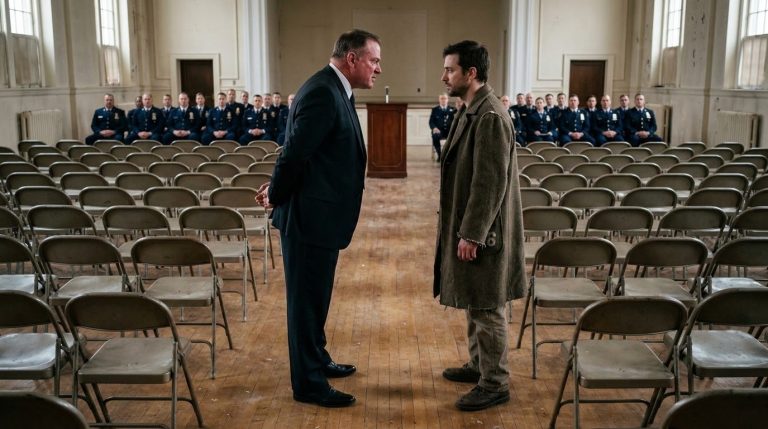
Four men entered, moving in a formation that had nothing to do with school spirit and everything to do with intent. They were in dress blues, their movements synchronized, their presence sucking the air out of the room. The lead officer, a man with silver stars and eyes that had cataloged the cost of too many missions, locked his gaze onto Marcus.
The gymnasium went silent, the collective intake of breath audible. Marcus felt the familiar, cold pit of realization opening in his stomach. The past hadn’t just caught up; it had arrived with full military honors.
Emma squeezed his hand, her eyes wide. “Daddy? Why are they looking at us?”
Marcus didn’t have an answer. He felt the weight of the trident in his pocket and the sudden, suffocating reality that the wall he had built between his life and his shadow had just been breached. He braced himself, not for a fight, but for something far more difficult—the exposure of the truth he had tried so hard to protect.
CHAPTER 4: THE PRAGMATIC LURE
The gymnasium was so quiet that the hum of the overhead ventilation felt like a mechanical pulse. Admiral Caldwell didn’t look at the crowd; his focus was as narrow and steady as a weapon sight, locked entirely on Marcus. The other three officers flanked him, their presence creating a distinct, pressurized vacuum in the center of the gym. Parents retreated, pulling their children back as if the space between the Navy men and the HVAC technician was a live wire.
Marcus didn’t move. He stood with his feet planted at shoulder width, the trident in his pocket pressing against his thigh—a sharp, cold reminder of a life he had been attempting to prune away. Emma’s hand trembled slightly in his. He squeezed back once, a subtle, rhythmic signal for her to stay grounded.
“Mr. Hale,” Caldwell said, his voice carrying the calm authority of a man who commanded fleets. “Permission to speak privately.”
It wasn’t a request. Marcus felt the weight of the moment, the shift in the air that signaled the end of his quiet existence. He looked at Emma, then at the principal, who was hovered in the wings with an expression of panicked bewilderment. He looked at Derek Moss, who had retreated into the shadows of the bleachers, his face pale and slack-jawed.
“Five minutes,” Marcus said, his voice flat.
He led the Admiral and his retinue toward the hallway, away from the prying eyes of the other parents. The hallway was narrow, the linoleum flooring scuffed and worn—a stark, mundane contrast to the high-stakes theater they had just exited. The sound of their footsteps was a rhythmic, disciplined beat that Marcus felt in his own chest.
Once they reached the relative seclusion of the administrative office, Marcus turned. He didn’t wait for the Admiral to start.
“You chose a hell of a place to stage an operation, Admiral,” Marcus said, his voice barely above a whisper, laced with a grit he hadn’t used in years. “My daughter’s school is not a theater of operations.”
Caldwell signaled for the other officers to step out into the hallway, leaving them alone. The Admiral didn’t flinch at the accusation. He leaned against the closed door, his posture relaxing just enough to suggest an old acquaintance, though the tactical alertness in his eyes remained undiminished.
“I didn’t choose the place, Marcus. You did. You chose to engage in that parking lot,” Caldwell said, his voice even, devoid of malice but thick with bureaucratic calculation. “You think you can go back to being a civilian? You think that trident in your pocket stops being a mark just because you’re fixing air conditioners?”
“I’m done,” Marcus said, the words feeling like iron filings in his throat. “I fulfilled my end of the bargain seven years ago. I walked away.”
“You walked away from the service, not the responsibility,” Caldwell countered. He reached into his inner coat pocket and pulled out a manila folder, setting it on the administrative desk. “We have a problem. The transition rate for operators coming back to the civilian sector is failing. They’re coming home with the same instincts you have, but they don’t have the discipline to keep the two worlds from bleeding together. They’re escalating. They’re becoming liabilities.”
Marcus looked at the folder, but he didn’t reach for it. “That’s not my fight anymore.”
“It is,” Caldwell insisted, his tone hardening. “Because when they break, they reach out to the legends. They reach out to the men who did it right. If you don’t help us build the protocol—the Whiplash Protocol—you’re leaving them to drift until they find themselves in the same place you were yesterday: standing in a parking lot, one bad decision away from ruining their lives.”
Marcus looked at the desk, at the institutional seal on the folder. He felt the phantom pressure of the past—the compound in Helmand, the weight of Torres’s body, the promise he had made on that helicopter. The Admiral was playing a game of tactical leverage, using Marcus’s own moral code against him.
“You’re using my past as a recruitment tool,” Marcus said, his voice low.
“I’m using your experience as a safeguard,” Caldwell corrected. “You don’t have to go back to the teams. You don’t have to carry a rifle. We need you to teach them how to be the shield, how to exist without the war. If you don’t do it, I’ll find someone else. But they won’t be you. And the men who don’t learn? They’ll keep burning down their own lives.”
Marcus glanced toward the closed door, toward the gymnasium where Emma was waiting. He felt the weight of his promise to Torres—Get them home. All of them. Always. He had gotten them home, but he had never truly ensured they stayed there.
The friction of the situation was immense. To say yes was to reopen the door to a world he had painstakingly cemented over. To say no was to accept the inevitable collapse of other men, men who were just like he was.
“I have a daughter,” Marcus said, the mention of her name feeling like a concession.
“I know,” Caldwell said, his tone softening slightly. “That’s why I came here. She deserves to know who her father is. She deserves to know that the man who protects her is a man who understands the value of peace.”
Marcus looked at the folder again. The rusted truth of his existence was that he was not a civilian; he was a man in transition, and the transition never truly finished. He placed his hand on the folder, the material feeling like sandpaper beneath his palm.
“I’ll look at it,” Marcus said, his voice a flat, non-committal promise. “But if this gets anywhere near my family again, if you make me a spectacle, the protocol is dead.”
Caldwell gave a single, sharp nod—an operator’s acknowledgment. “Understood.”
Marcus turned and opened the door. He walked back toward the gym, his pace measured, his mind already running through the tactical consequences of what he had just agreed to. He wasn’t just fixing machines anymore; he was stepping back into the machinery of service, and for the first time in seven years, he realized the war hadn’t ended in 2011. It had just moved to a different theater, one where the casualties were measured in lives unlived and potential burned to ash.
CHAPTER 5: THE FRICTION OF THE ARCHITECT
The training facility at Dam Neck felt like an echo chamber. Everything was too clean, the lighting too starkly fluorescent, and the air filtered to a sterile, scentless void that irritated Marcus’s lungs. He walked beside the project coordinator, a man named Henderson, whose pace was brisk and entirely devoid of tactical awareness. They were heading toward the classroom assigned for the first Whiplash Protocol session.
Marcus kept his hands in his pockets, his fingers tracing the cold metal of the trident. The facility’s layout was familiar, yet twisted—a map he knew by heart, now rearranged to accommodate a new, sanitized reality.
“We’ve got fifteen candidates waiting,” Henderson said, checking his watch. “All active duty, all struggling with the transition. They’ve heard the rumors, of course. Who you are. What you did.”
“I’m not here to be a legend,” Marcus said, his voice cutting through the hollow hum of the hallway. “I’m here to teach them how to put the weapon down when the mission ends.”
“That’s the goal,” Henderson agreed, though his tone betrayed a hint of doubt. “But some of them have been out there for a long time. They don’t know how to exist without a target.”
Suddenly, the overhead lights flickered—a brief, rhythmic stutter that shouldn’t have happened in a facility of this caliber. A low, distorted chime pulsed through the building’s intercom system, followed by a burst of static that sounded like a garbled transmission from a distant radio. Henderson stopped, frowning at the nearest ceiling speaker.
“Internal power spike,” Henderson muttered. “The grid’s been temperamental since the upgrades. Give it a second.”
Marcus didn’t wait. He didn’t trust the stability of an environment that relied on such precarious infrastructure. He stepped to a side door, pushed the panic bar, and entered a service corridor. It was darker here, the walls lined with exposed conduits and rusted junction boxes—a raw, industrial space that mirrored the state of his own internal landscape.
“Wait, Marcus, that’s restricted,” Henderson called out, but Marcus was already ten paces ahead.
The corridor was a shortcut, a way to bypass the main atrium where a group of curious onlookers had gathered. As he walked, the friction of the space began to grate on him. He passed a rusted ventilation shaft, the metal groaning under the pressure of the facility’s cooling system. The smell of copper and stale oil returned, pulling at his senses, demanding he pay attention to the environment in the way he had been trained to—not for obstacles, but for threats.
He reached a junction point where the hallway split. A series of server racks stood against the wall, their blue LEDs blinking in a chaotic, hypnotic rhythm. His tactical brain, tuned to the nuance of environmental cues, noticed it immediately: a discrepancy. One of the cables had been partially pulled, the plastic sheath frayed, exposing the copper wiring inside.
He stopped, his eyes narrowing. It was a minor detail, easily overlooked, but it was out of place. It was the kind of detail that in Helmand would have signaled a tripwire.
“You see something?” Henderson asked, catching up, his breath coming in short, uneven bursts.
Marcus didn’t answer. He leaned in, his fingers brushing the frayed cable. It wasn’t wear and tear. The cut was clean, intentional.
“Is this facility on lockdown?” Marcus asked, his voice dropping.
Henderson blinked, his composure faltering. “No, why?”
“Because someone’s been tampering with the infrastructure.” Marcus stood, his posture shifting, the dormant weight of his past rising to meet the present. The facility wasn’t just undergoing upgrades; it was being compromised.
He heard it then—the faint, rhythmic scrape of leather on concrete, coming from the far end of the corridor. It was the sound of someone trying to move silently, but failing to account for the grit on the floor. Marcus pushed Henderson into a nearby alcove, his movements fluid, efficient, and entirely reflexive.
He didn’t draw a weapon; he didn’t need one. He waited, his breathing slowing until it was almost non-existent. The figure emerged from the shadows—a man in a maintenance uniform, his hand hovering near his waistband. He wasn’t a maintenance worker. The way he held his shoulders, the way he scanned the corridor before moving forward—it was the stance of an operator, an outsider who had slipped past security.
Marcus didn’t give him the chance to react. He moved out of the alcove, closing the distance in three long strides. He used the rusted conduit pipe on the wall as a pivot point, slamming the man against the server rack with a force that sent a shower of sparks flying.
The man gasped, his hand dropping. Marcus caught his wrist, twisting it into a lock that forced the man to his knees. The man’s face went white, his eyes darting toward the corridor’s end.
“Who sent you?” Marcus asked, his voice a low, dangerous vibration that left no room for evasion.
The man didn’t speak, but his gaze flicked to a small, encrypted communicator strapped to his forearm—the same kind of tech used by high-level security teams.
“I said, who sent you?” Marcus repeated, applying pressure.
“You’re supposed to be retired, Whiplash,” the man choked out, his voice a gravelly rasp. “You’re supposed to be a civilian.”
Marcus felt the truth of it then: the protocol, the Admiral’s offer, the parking lot—they were all interconnected. He wasn’t just being recruited; he was being baited. The rusted machine of his past had been set in motion, and it was spinning faster than he could control.
CHAPTER 6: THE FRACTURE IN THE FOUNDATION
Marcus didn’t loosen his grip. The intruder’s arm was held at a tensioned angle that made even a slight movement agony, but the man’s eyes—cold, flat, and devoid of the panic Marcus expected—told a different story. He wasn’t afraid. He was waiting.
“You think you’re being baited?” the intruder hissed, a grimace of pain twisting his features. “You have no idea. You were never meant to come here to teach, Hale. You were brought here to be validated.”
Marcus ignored the bait, his eyes flicking to the man’s tactical vest. He reached out with his free hand, stripping the communicator from the man’s forearm. The device was sleek, military-grade, and the small LED display pulsed with an intermittent amber light. It wasn’t transmitting to a field unit. The signal was local.
He moved his thumb across the display, toggling the frequency. It was tied to a static transmission loop—a broadcast from the elementary school gymnasium he had just left. The realization hit Marcus with the force of a physical blow. The security of his daughter, the sanctity of the one place he believed was off-limits to the shadow world, had been compromised from the start.
“Who else is in the school?” Marcus demanded, his voice dropping to a dangerous, serrated whisper.
The intruder laughed, a short, wet sound. “The Admiral needs a clean slate, Hale. You’re the only piece of the old puzzle that doesn’t fit the new design. You’re the liability.”
Marcus shoved the man hard against the server rack, the metal groaning in protest. He didn’t waste time on further questions. The man was a courier, a cog, and the real threat was already in motion. Marcus turned, his eyes locking onto the service corridor’s exit. He had to move, but his mind—his sovereign, tactical mind—was already working through the implications. The Admiral hadn’t just recruited him; he had orchestrated a theater of war in a place where only children belonged.
“Henderson,” Marcus barked, not looking back. “Call the front desk. Shut down the perimeter. Now.”
Henderson, still huddled in the alcove, scrambled for his radio, his face pale. “I—I can’t. The line’s dead.”
Marcus didn’t wait to see if he was successful. He sprinted toward the end of the corridor, his boots striking the concrete with a rhythm he hadn’t used in seven years—the predatory, silent stride of a man hunting. His internal compass, long dormant, was screaming. The friction in the air was thick, heavy with the scent of ozone and the metallic tang of an impending conflict he had spent his entire civilian life trying to avoid.
He breached the door to the gymnasium’s rear entrance, his body moving in a fluid, calculated motion. He wasn’t thinking about the protocol or the mission anymore. He was thinking about Emma. The gymnasium floor was covered in streamers, and the sound of distant, distorted chatter filled the room. He scanned the bleachers, the stage, the parents still milling about.
Derek Moss was gone.
Marcus moved through the shadows of the stage, his gaze sweeping the exits. He saw the Admiral standing near the main entrance, engaged in a conversation with the principal, his posture relaxed, entirely unaware—or pretending to be—of the chaos unfolding in the facility’s heart.
Marcus didn’t approach him. He didn’t have the luxury of words. He found Emma near the equipment closet, her back to him, staring at a cluster of parents. She was safe, but the way the crowd was shifting, the way the local security team was moving toward the exits, signaled that the perimeter was tightening.
He crossed the floor, his presence a dark, sudden shift in the room’s atmosphere. He reached Emma, his hand resting on her shoulder. She turned, her eyes bright with a mixture of fear and confusion.
“Daddy? The Navy men are closing the doors.”
Marcus looked up. The heavy main doors of the gymnasium were indeed being sealed, the security guards moving with a precise, military efficiency. The “Father’s Day” assembly was being transformed into a containment zone.
He looked at the Admiral again. Caldwell was watching him, a faint, almost imperceptible tilt to his head. It was an invitation—a challenge. The trap was sprung, and Marcus was the target. The rusted truth of his life surfaced: he had been trying to build a shelter for his family, but he had unknowingly been building it on ground that belonged to men who never learned how to stop fighting.
He pulled Emma closer, shielding her with his body. He wouldn’t fight them here—not in front of the kids, not in the light. He needed an exit, and he needed it now. He looked at the high-set windows, the emergency gear, and the layout of the building he had already memorized. He was the architect of his own survival, and he would not let the rusted iron of his past tear down the life he had fought so hard to build.
CHAPTER 7: THE ARCHITECTURE OF THE COLLAPSE
The gym’s air had turned stagnant, trapped behind the sealed doors. Marcus felt the weight of the collective anxiety in the room—a low-frequency vibration that rattled the folding chairs. He didn’t look at the Admiral anymore. To look was to confirm the trap, and he couldn’t afford to be identified as the prey.
“Stay low, Emma,” he murmured, his voice steady despite the adrenaline surging through his veins. He steered her toward the back of the bleachers, where the metal structure offered a dense, rusted cover. “We’re going to walk, slow and steady, toward the stage. Don’t look back.”
As they moved, Marcus’s vision flickered. The overhead lights pulsed with an irregular, rhythmic buzz—a fault in the grid that his tactical training instantly identified as a remote-controlled kill switch. The gymnasium wasn’t just being contained; it was being primed.
He caught sight of Derek Moss again, standing by the stage’s curtain, his hands gripped tightly on a radio. Moss wasn’t just a disgruntled employee; he was the local anchor, the man tasked with ensuring the target—Marcus—couldn’t leave. The betrayal tasted like iron in Marcus’s mouth, but he pushed the emotion aside. Emotions were a luxury for men who weren’t in the line of fire.
“Daddy, I’m scared,” Emma whispered.
“I know,” Marcus said, his eyes scanning the rafters. “But I’m here. And I’m not going anywhere.”
He reached the stage, the heavy velvet curtain providing a momentary shroud. He could hear the Admiral’s voice, amplified now, a booming, distorted broadcast that seemed to come from the very walls. “Mr. Hale, we know you’re in here. This doesn’t have to be violent. Just step out, and we can conclude this transition.”
The hypocrisy of the words was staggering. It wasn’t a transition; it was an extraction—a forced removal of the only man who could testify to the corruption rotting the heart of the Whiplash Protocol. Marcus didn’t bother responding. He scanned the stage floor, finding a heavy, floor-mounted electrical conduit. It was old, the iron casing rusted and brittle.
He didn’t need a weapon. He needed leverage.
He jammed his boot into the gap between the conduit and the floor, applying the full, calibrated weight of his body. He heard the metallic groan of metal giving way, the screech of bolts shearing from the concrete. It was the same friction he’d felt in the compound in Helmand, the same desperate, earned effort of a man making his own path.
The conduit snapped, the heavy iron pipe swinging free. He used it to pry open the heavy, reinforced rear access door hidden behind the stage—the service entrance for the school’s sound equipment. The door was locked, but the rusted hinges were no match for the leverage he’d created.
“Go, Emma,” he ordered, holding the door open just enough for her to slip through into the dark service tunnel.
As she disappeared, he felt the first wave of guards hitting the bleachers. The gymnasium was descending into chaos—parents screaming, children crying, the sound of boots on linoleum a terrifying, thunderous roar. The Admiral’s clean slate was rapidly turning into a public relations disaster, which meant they would be moving to finish it quickly.
Marcus stepped through the door and into the tunnel, the darkness swallowing him whole. He didn’t run; he moved with the predatory, calculated efficiency of the man he had been seven years ago. The walls of the tunnel were lined with old pipes, covered in layers of flaking, rusted paint. The air smelled of damp earth and cold metal—a scent that suddenly, unexpectedly, brought a sense of clarity.
He heard the heavy thud of the stage door being kicked open behind him.
“He’s in the service tunnel!” a voice shouted.
Marcus didn’t turn. He picked up his pace, his boots landing silently on the concrete floor. He was no longer the father who fixed air conditioners, nor the man who stood in the parking lot and walked away. He was Whiplash Six, and he was finally in his element. The trap hadn’t broken him; it had stripped away the last of the civilian illusion he had been clinging to.
He reached a junction, a point where the tunnel split toward the school’s main boiler room. He knew the building’s layout better than any of them, not because he’d studied the blueprints, but because he knew how to read the structure of a space, how to see the vulnerabilities in the walls and the paths that were meant to remain hidden.
He wasn’t going to hide. He was going to turn the facility’s own architecture against them. He reached into his pocket and pulled out the trident, holding it for a second—a cool, solid weight against his palm. He wasn’t leaving it behind. He was going to use it to ensure that when the dust settled, the rusted truth of what they had tried to do here would be exposed for everyone to see.
The tunnel ahead was dark, but he didn’t need light. He had the friction, the sound, and the memory of every hard-earned lesson he had ever learned in the shadows. The hunt had begun, but this time, he was the one setting the parameters.
CHAPTER 8: THE FINAL TRUTH
Marcus moved through the dark heart of the facility, the air thick with the smell of scorched iron and stagnant heat. The boiler room was a graveyard of industrial relics, a maze of rusted pipes and humming machinery. He didn’t need to see; he could feel the architecture of the space, the vibration of the systems, the exact location of every vent and egress. Emma was tucked into a crawlspace behind a heavy, vibrating steam drum, her breathing steady, her eyes closed in the darkness. She was the one thing he had protected, and the one thing he would not sacrifice.
He stepped out into the center of the room, his posture upright, his hands empty. He didn’t wait for them to find him. He signaled the space, a calculated shift in his stance that drew the search team out of the shadows. Two men emerged, their weapons leveled, their faces obscured by tactical gear.
“Hale,” one of them barked, his voice distorted by the comms. “Drop to your knees. Now.”
Marcus didn’t move. He stood, his gaze fixed on the Admiral, who stepped into the doorway behind them, his dress blues immaculate even in the filth of the boiler room.
“It’s over, Marcus,” the Admiral said, his tone one of weary, professional disappointment. “You’ve made your choice. You’ve proven you’re a liability to the Protocol.”
“The Protocol isn’t a safeguard,” Marcus said, his voice ringing against the iron pipes, clear and absolute. “It’s a disposal mechanism. You don’t want to teach these men how to transition; you want to make sure they never do.”
The Admiral didn’t flinch, but his eyes narrowed. The decoy—that Marcus was an obstacle to a “better” future—was stripped away. The truth was colder, more pragmatic: he was a witness to a system that consumed its own operators. The realization didn’t shock Marcus; it confirmed everything he had sensed since the parking lot. The “Whiplash Protocol” was a trap designed to keep operators in the field long after they had served their purpose, a loop of manufactured conflict.
“If you won’t participate,” the Admiral said, signaling his guards, “you won’t leave.”
Marcus didn’t wait for the order. He moved, not with the frenetic speed of a man desperate to live, but with the measured, lethal precision of a man who had already accepted his fate. He swiped a wrench from the nearby workbench, catching the first guard’s barrel as he stepped forward, twisting it with a leverage that sent the weapon clattering into the darkness. He followed through with a strike to the second guard’s radial nerve, disarming him instantly.
He didn’t fight to kill; he fought to end it. He used the environment, the steam pipes, the rusted iron, and his own body’s memory, turning the room’s industrial structure into his shield. He slammed the first guard against the boiler, the resulting clang of metal echoing like a bell. He was a force of nature, a relic of a war that had never left him, a man whose discipline was his final and only weapon.
When the last of them was down, Marcus stood over the Admiral, his chest heaving, the dust of the room settling on his clothes like snow. The Admiral looked at him, his face devoid of fear, his gaze still calculating.
“You think you’ve won, Marcus? You’ve just made yourself the enemy.”
“I was never your friend,” Marcus said, his voice cold. He pulled his phone from his pocket, the screen already flashing with the transmission he’d initiated during the fight—a direct, encrypted stream to the Department of Justice’s internal affairs division, carrying the entirety of the facility’s secure logs he had hacked using the intruder’s communicator. “I was the man who kept the promise. You didn’t get them home. I did.”
The Admiral’s gaze flickered to the phone, and for the first time, he looked uncertain. The payoff was not a bullet, but the absolute, systematic dismantling of his operation. The poetic justice of his own tools—the protocol, the surveillance, the very infrastructure he used to control his men—was now the evidence that would seal his downfall.
The denouement came not with a roar, but with a profound, heavy silence. The boiler room stopped humming. The steam stopped hissing. The facility, for a brief, breathless moment, felt like a tomb. Marcus walked over to the crawlspace and pulled Emma out. He didn’t look at the defeated men on the floor. He didn’t look at the Admiral. He looked at his daughter.
He led her out of the boiler room, through the service tunnel, and out into the cool, evening air. The school gymnasium was empty, the streamers hanging like discarded skin, the floor covered in a fine layer of dust. He walked to the center of the room, stopped, and picked up a piece of her construction paper project that had been trampled during the chaos.
He knelt, brushing the dirt from the surface, his hands steady. It was a picture of him—a stick figure with a beard and a gray shirt, labeled My Hero. He had been a shield in a world that only valued swords, and tonight, he had held that shield until the light finally reached the other side.
They walked to the truck. The drive home was quiet, the radio silent. He didn’t turn on his tactical awareness. He didn’t scan the horizon. He simply drove.
When they arrived home, he spent the next hour in the garage, methodically repairing a shelf that had been broken for weeks. It was a simple, manual task—measure, drill, secure. It was the repair of a world that felt small, tangible, and completely his own. Emma came in, watching him, her eyes tired but clear. She reached up and placed the trident case on the workbench.
“Is the war over, Daddy?”
Marcus wiped the grease from his hands, the smell of oil comforting and familiar. He stood, looking at his daughter, and for the first time in seven years, the shadow of the compound in Helmand didn’t darken his vision.
“The mission is finished, Emma,” he said, his voice soft. “And now, we just get to be home.”
He looked at the shelf—sturdy, secure, and built to last—and then at the trident, still and silent on the bench. He had carried the weight for them all, the living and the dead, and now, the weight was gone. He walked over, turned off the garage light, and stepped into the house, leaving the past in the dark, where it finally, and rightfully, belonged.