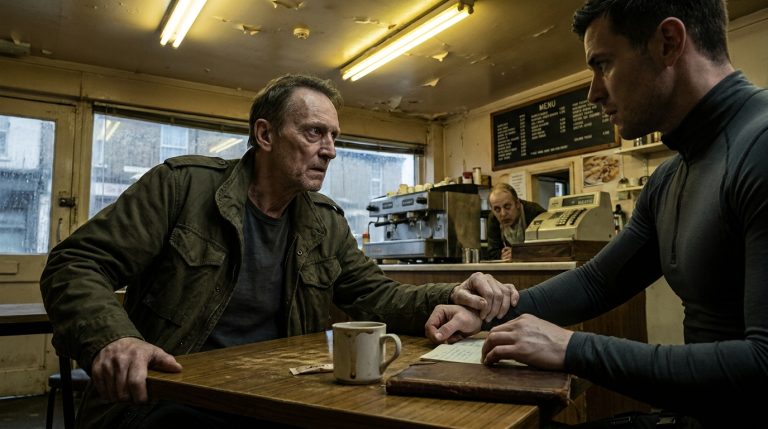
The Weight of Wings: A Legacy Reclaimed in the Silence of a Dying Engine’s Last Breath
CHAPTER 1: The Bitter Scent of Oil
The heat radiating from the airfield tarmac felt like a physical weight, pressing down on Arthur’s shoulders. He stood a few paces from the Cessna 182, his eyes narrowed, focusing not on the arrogance in Jake’s posture, but on the rhythm. Drip. A dark, oily smudge blossomed on the gray concrete. Drip.
“You’re missing the pattern,” Arthur said, his voice a low gravel, barely audible over the mechanical stuttering of the engine. He didn’t move toward them. He knew the type—young men who mistook experience for an anchor dragging them back.
Jake chuckled, glancing at Marco. The younger pilot was leaning against the wing strut, arms crossed, his confidence as thin as the paint on the fuselage. “We’ve got a tight window, Arthur. The payload is time-sensitive. We can’t sit here while you count drips.”
Arthur didn’t take the bait. He stepped closer, his boots kicking up a small cloud of red dust. He ignored the hostility and focused on the underside of the cowling. He wasn’t just seeing a leak; he was seeing a deliberate, surgical tear in the line. The edges of the rubber were too clean, the positioning too strategic to be the result of vibration alone.
“It’s not just a leak,” Arthur insisted, his heart hammering a warning against his ribs. He felt the familiar, ache of a memory—a similar morning, a similar silence, and a crash that had defined the last twenty years of his life. “Look at the sealant. It’s been tampered with.”
Marco straightened up, his smirk faltering for a fraction of a second before he masked it with a sneer. “Tampered with? Nobody’s been near this crate all morning, save for us.”
“That’s what you think,” Arthur said softly, his gaze locking with Jake’s. He saw the flicker of doubt in the pilot’s eyes—the way Jake looked at the engine with a sudden, sharp clarity. It was a fleeting moment, a crack in the veneer of their shared defiance.
Jake reached out, his hand hovering over the cowling. He hesitated, his fingers trembling ever so slightly, before he pulled back, turning away with a dismissive wave. “Start her up, Marco. We’re losing the sun.”
As the engine roared to a deafening, irregular life, Arthur stood frozen, the stench of fuel clinging to the air like a funeral shroud. He watched them climb into the cockpit, their faces hardened, their minds set on the sky. He reached into his pocket, his hand brushing against the cold metal of his pocket watch, but his breath hitched in his throat.
There, wedged in the wheel well of the plane, was a small, brass-colored wrench that hadn’t been there when they landed. It was marked with a symbol that turned Arthur’s blood to ice—a mark he hadn’t seen since he lost the company to his own flesh and blood.
CHAPTER 2: The Stutter of Truth
The Cessna lurched, a sickening, momentary loss of lift that threw Arthur against the vibrating door frame. In his palm, the brass wrench felt heavy, an incongruous weight that seemed to pulse in time with the engine’s faltering heartbeat. Up front, Jake’s hands gripped the yoke so tightly his knuckles had turned the color of bleached bone.
“Marco, check the pressure gauge,” Jake snapped, his voice tight, stripped of its earlier arrogance.
“It’s dropping, man. Fast,” Marco replied, his gaze flickering from the glass dial to the scrubland rushing beneath them. “That fuel leak—it’s not a leak anymore, it’s a siphon.”
Arthur didn’t need to look at the gauges. He could hear it. The engine wasn’t just leaking; it was being drained by a bypass that created a false equilibrium in the line, a trick he’d seen in older, more desperate times. The vibration in the floorboards shifted from a low-frequency hum to a jagged, metallic grinding.
“You need to bank left,” Arthur shouted, leaning forward between the seats. The air in the cabin was thick with the smell of ozone and the sharp, chemical sting of raw fuel. “If you try to maintain current altitude, the engine will seize before you clear the ridge.”
Jake’s jaw set. He glanced at Arthur in the rearview mirror, his eyes darting with a mixture of terror and lingering pride. “We don’t need instructions, Arthur. We need to reach the delivery point.”
“The delivery point won’t matter if you’re a charred wreck in the valley,” Arthur countered, his voice steady despite the violent shivering of the airframe. He reached over, his movements calculated and precise, and tapped the altimeter. “Look at the descent rate. The pressure drop isn’t just affecting the fuel flow—it’s compromising the hydraulic seals. You’re losing control of the rudder.”
The plane dipped again, the left wing dipping dangerously toward the sun-scorched earth. Marco cursed, grabbing the secondary handle. The cockpit became a chaotic swirl of motion and noise—a cacophony of failing metal and high-tension nerves.
Arthur remained the calm center of the storm. He wasn’t thinking about the past, or the history he shared with the men who had orchestrated this sabotage. He was focused on the immediate physics of their survival. He watched the way Jake’s hands danced across the console, identifying the micro-tensions in the pilot’s posture. He saw the exact moment the younger man’s confidence shattered. It was a subtle thing—a slight relaxation of the shoulders, an admission of defeat in the set of his mouth.
“The engine is going to quit, Jake,” Arthur said, his voice dropping to a low, authoritative pitch that cut through the engine’s dying wail. “It’s not a question of ‘if.’ It’s a question of where.”
Jake looked out the window at the rugged, uneven terrain. The ground was a tapestry of faded, sun-bleached grasses and jagged, weathered stone. There was no landing strip for miles.
“There,” Arthur pointed toward a flat, debris-strewn clearing that looked like an old, abandoned drainage basin. It was a perilous choice—choked with brush and uneven, but it was the only option that offered a chance for a controlled dead-stick landing.
“That’s a death trap,” Marco yelled.
“It’s a chance,” Arthur retorted. “You fight the plane, you lose. You guide it, you live.”
Jake looked at Arthur, really looked at him, for the first time that day. He saw not the interference of an old man, but the grim reality of a veteran. The engine gave a final, agonizing cough, a sound like a wet cloth being ripped in two, and then the propeller shuddered to a halt, leaving the cockpit in a jarring, hollow silence.
The silence was heavier than the roar had ever been. It was the sound of reality setting in, of the momentum carrying them forward into the unknown. Jake pulled back on the yoke, the wind whistling against the fuselage with a shrill, lonely cry. Arthur braced himself, his hands gripping the back of the pilot’s seat. He felt the plane lose its bite on the air, transitioning from a vehicle into a falling stone.
The earth rushed up to meet them, a landscape of blurred, dusty grays. Arthur closed his eyes for a split second, not in fear, but to calibrate his internal sense of the plane’s center of gravity. When he opened them, he saw the clearing, the path of least resistance marked by the shadows of the scrub oaks. He watched the way the wind caught the nose, a sudden, unpredictable gust that threatened to roll them.
“Ease the flaps,” Arthur whispered, a command born of muscle memory and long-forgotten flight logs.
Jake followed the instinct, his hands moving with a fluid, desperate grace. The plane groaned, the metal screaming in protest as it skimmed the treetops, tearing through the canopy of a low-lying thicket. The sound was a symphony of destruction—twigs snapping like bone, the fuselage shuddering as it shed its outer layers of paint and aluminum.
They hit the ground with a force that knocked the wind from Arthur’s chest. The landing gear buckled, the nose digging into the soft, unforgiving silt of the drainage basin. The Cessna skidded, a violent, sliding dance of friction and ruin, before spinning ninety degrees and coming to a bone-jarring halt in the center of the clearing.
Dust billowed around them, a thick, suffocating cloud that blocked out the sky. For a long, terrifying moment, there was nothing but the sound of settling metal, the ticking of the cooling engine, and their own ragged, uneven breathing.
Arthur pushed against the jammed door. It resisted, held fast by the twisted frame, but he put his shoulder into it, forcing the metal to give. He tumbled out into the blinding, white-hot glare of the afternoon, the smell of dust and dry, crushed earth filling his lungs. He turned back toward the wreckage, his heart racing with the realization of their survival, and saw Jake struggling to climb out of the cockpit, his face smeared with grease and sweat, his eyes wide with a mixture of shock and the dawning terror of what they had just escaped.
CHAPTER 3: The Price of Survival
Arthur pulled himself away from the crumpled nose of the Cessna, his movements stiff and deliberate. The heat of the drainage basin was immediate, a physical weight that pressed against his sweat-slicked skin. Behind him, the wreckage ticked—a rhythmic, cooling contraction of metal that sounded unnervingly like a clock winding down.
Jake was on his knees, his hands buried in the fine, gray silt of the basin floor. He was breathing hard, a jagged, wet sound that betrayed his internal state far more than his silence. Marco, a few feet away, was trying to stand, his leg giving way with a grunt of sharp, suppressed pain.
Arthur didn’t rush to them. He stood, steadying his breathing, and scanned the perimeter. The brush around the basin was dense, the shadows of the scrub oaks stretching long and distorted across the parched earth. They were miles from the nearest road, and the plane, though intact enough to have shielded them from death, was a hollow, twisted shell.
“Don’t move too quickly,” Arthur said, his voice cutting through the ringing silence. “Check for internal injuries. Adrenaline hides a lot of damage.”
Jake looked up, his face streaked with dust and a smudge of oil that tracked from his temple to his jawline. His eyes were no longer burning with the pride that had characterized him before takeoff. They were hollow, reflecting the stark, unforgiving light of the basin. “We’re down, Arthur. We’re really down.”
“We’re alive,” Arthur corrected, walking over to the crumpled remains of the wing. He knelt down, tracing the jagged edges of the metal where the primary fuel line had been severed.
He didn’t mention the wrench yet. Not while the shock was still thick in the air. Instead, he pulled a small, multi-tool from his pocket—a worn, heavy thing that had seen as many decades as he had—and began to probe the jagged tear. The cut wasn’t accidental; the metal was curled inward, a sign of precise, intentional shearing.
“Marco, help me with the cowling,” Arthur commanded, not looking up. “We need to see if the internal pump is salvageable. If we can bypass the damaged section, we might be able to get a signal out on the emergency radio.”
Marco limped over, his face pale, but he obeyed. There was a shift in the hierarchy of the moment; the arrogance that had defined the pilots was gone, replaced by the instinctual need for order. As they pulled at the scorched metal, Arthur noted the way Jake watched them. The younger man was still struggling with the concept of their failure, his mind likely spinning through the consequences of the missed delivery, the lost payload, the potential professional ruin.
“Why are you helping us?” Jake asked suddenly, his voice raspy. He was watching Arthur work, his gaze fixed on the older man’s hands as they navigated the wreckage with practiced, economical movements. “You told us not to fly. You knew this was going to happen.”
Arthur stopped, his wrench hovering over a frayed wire. He looked at Jake, seeing the younger man’s vulnerability for the first time. It was a mirror of a thousand moments from his own life—the pride that came before the fall, the stubborn refusal to listen to those who had already walked the path.
“I didn’t know it would happen,” Arthur said quietly, focusing back on the wire. “I just knew the cost of being wrong. There’s a difference.”
“You could have just let us go,” Marco muttered, helping Arthur pry the panel loose. “You didn’t have to follow us out here.”
Arthur’s hand tightened around the wrench. He remembered the phone call he’d received three days ago—the voice on the other end, the familiar, mocking cadence of the man who had systematically dismantled his aviation company, piece by piece, until nothing was left but the name on a legal document. The sabotage wasn’t about the fuel line. It was a message, a cruel reminder that his past was still capable of reaching out and breaking what he had left.
“I’m here because I know what it feels like to have the ground taken out from under you,” Arthur replied, his voice barely audible. He looked up at the sky, a vast, indifferent blue that offered no answers. “And I’m here because I don’t intend to let anyone else pay that price, regardless of their own mistakes.”
The silence returned, heavier now. They worked in tandem, a grim, efficient unit. The heat continued to build, the air shimmering above the hot metal of the plane. They cleared the debris, stripped the damaged shielding, and exposed the skeletal remains of the engine.
As they worked, Arthur’s eyes caught a flash of something in the dust near the landing gear. He leaned down, his joints aching, and picked up a small, torn piece of a shipping label. It was partially burned, the ink scorched, but a single fragment of a serial number was still visible.
He slid the piece of paper into his pocket, his heart rate spiking. He knew that sequence. It was a fragment of a shipping manifest for a company that didn’t exist, a front used to move restricted parts—the same parts that had led to the final, disastrous audit of his company years ago.
He looked at Jake, who was struggling to loosen a stubborn bolt on the fuel pump. The young man was sweating profusely, his face contorted with the effort, his determination finally channeled into something tangible. Arthur felt a surge of something—not quite affection, but a cold, hard sense of responsibility.
“The pump is still sealed,” Arthur said, breaking the silence. “If we can bridge the connection with the secondary line, we might be able to create enough pressure for a short-range transmission. But it’s going to be a delicate job.”
Jake looked up, nodding slowly. “I can do it. I just need a steady hand.”
Arthur watched him, a ghost of a smile touching his lips. “Then keep your breathing steady, son. That’s the first rule of keeping anything alive.”
For the first time since they had crashed, the tension in the basin felt different—no longer a chaotic scramble for survival, but a focused, purposeful labor. They were building something, or at least attempting to, and in the shadow of the broken plane, the lines between mentor and pilot, past and present, began to blur into the grit and the heat.
CHAPTER 4: The Ghost in the Manifest
The heat in the drainage basin was no longer just an environmental factor; it was a pressure that distorted the horizon, making the scrub oaks appear to shiver in the shimmering air. Arthur kept his hands moving, even as his mind raced. He had the fuel pump housing partially disassembled, the oily stench of gasoline clinging to his skin like a second layer.
Jake was positioned on the other side of the fuselage, his brow furrowed in concentration as he attempted to bridge the severed line using a length of copper tubing salvaged from the plane’s heating system. He was quiet, his movements stripped of the bravado he’d brought to the airfield earlier.
“Steady,” Arthur murmured, watching Jake’s fingers. “If you pinch that line, the pressure will build until the seal blows out the moment you turn the pump on.”
Jake nodded, not looking up. “I know. My dad used to… he used to handle these overhauls himself. Before everything went south.”
Arthur paused. The mention of ‘dad’ hit him with the force of a physical blow. He didn’t look at Jake, instead focusing on the frayed wiring he was inspecting. “Your mentor, the one you were flying for—he was close with your father?”
Jake hesitated, his hands trembling for a fraction of a second before he stabilized them. “They were partners. A long time ago. They ran a regional freight company together. The one that folded during the 2018 audit.”
Arthur felt the blood drain from his face, leaving him cold despite the blistering heat. The 2018 audit. It was the same one that had dismantled his own firm, the one that had been triggered by a series of ‘anonymous’ reports regarding safety violations and unauthorized hardware. He had always assumed the reports were filed by a competitor, but the serial number fragment he had found—the one he still kept tucked in his vest pocket—pointed elsewhere.
“He told you it was a bad luck bankruptcy?” Arthur asked, his voice steady, though his heart was hammering against his ribs.
“He told me it was a setup,” Jake corrected, finally looking up. His eyes were hard, the hollow exhaustion of the crash giving way to a sudden, sharp curiosity. “He said someone inside the industry wanted us gone. Said they planted evidence to make it look like we were cutting corners on pressurized systems.”
Arthur turned his back to Jake, pretending to dig for a wrench in his pocket. He was staring at the scrap of paper he’d retrieved from the gear well. It was a fragment of the same fraudulent manifest he had seen in his own files seven years ago. The realization was as sickening as the crash itself. They hadn’t just sabotaged this flight; they were finishing a job that had started nearly a decade ago.
The ‘sabotage’ wasn’t meant to ground them. It was a lure. By forcing a crash in this specific basin, whoever was pulling the strings was drawing him back into the circle of his own destruction, using the next generation of pilots as pawns.
“We need to move faster,” Arthur said, his tone shifting. He stood up, wiping his greasy hands on a rag that was already stained black.
“We’re almost finished with the bypass,” Jake replied, standing up to face him. “But Arthur, why the sudden rush? We’re going to be here until dark anyway.”
“Because we aren’t alone,” Arthur said. He had heard it—a faint, rhythmic hum that was entirely out of place in the vast, empty desert. It wasn’t the wind, and it wasn’t the sound of the plane cooling. It was a high-frequency drone, the distinct sound of a commercial-grade drone survey unit, circling the basin at a distance.
He didn’t wait for Jake to process the news. He walked to the edge of the clearing, scanning the ridgeline. The drone was small, a mere speck against the harsh glare of the late-afternoon sun, but its presence was undeniable.
“They’re watching,” Arthur whispered to himself. The realization grounded him. The game had evolved, and the stakes were no longer just about survival in the desert. They were about the truth of what had happened to their companies—and the truth was a commodity someone was willing to kill to protect.
He turned back to the wreckage. Jake was staring at him, his face pale, the gravity of the situation finally sinking in. The bridge they were building between their lives was no longer just about flying; it was about the wreckage of the past that had brought them to this point.
“Help me move the fuselage,” Arthur commanded, pointing to a small, hidden depression behind a cluster of boulders near the basin wall. “If they’re looking, let’s give them something to watch. We’re going to need to be gone before they get close enough to see that we survived.”
Jake didn’t ask questions. The hierarchy had vanished entirely; they were two men against an invisible, encroaching threat. As they heaved the heavy, twisted metal, Arthur felt the weight of the years pressing down on him, but for the first time in a long time, the weight didn’t feel like a burden. It felt like an anchor, one that he was finally ready to cut loose.
CHAPTER 5: The Blinding Ascent
The wind picked up with a sudden, mournful howl, transforming the calm heat of the afternoon into a wall of swirling, suffocating grit. Arthur squinted, his hand instinctively rising to cover his mouth and nose as the world shrank to the narrow radius of his own reach. The sky, once a brilliant, indifferent blue, was now a bruised, churning gray that tasted of copper and dry earth.
“Stay close,” Arthur shouted, his voice snatched away by the gale. He could barely see the silhouette of the Cessna’s tail fin, only a few yards away, let alone the boys.
“Arthur!” Jake’s voice was close, sounding strained. A hand gripped Arthur’s shoulder—firm, desperate. “The ridgeline is to our north. If we stay in the basin, we’re sitting ducks for that drone.”
“If we climb the ridge in this, we’ll lose our footing!” Arthur replied, turning to face him. He could see Marco trailing behind, his limp making every step a labor of agony against the shifting, abrasive silt.
The wind shrieked, a high-pitched vibration that made the teeth in Arthur’s head ache. It was a classic desert squall, localized and brutal. He knew they couldn’t stay here, not with the drone survey unit potentially recalibrating its sensors to track their heat signatures. But moving blindly meant risking a fall that could leave them crippled before they even reached the high ground.
“Follow my boots,” Arthur commanded, his decision hardened by the necessity of the moment. He lowered his head into the wind, relying on his memory of the landscape—the specific slope of the basin, the angle of the rocks that would lead them toward the shelter of the limestone cliffs.
He moved with a steady, measured gait, his internal compass guiding him through the haze. Every step felt like a gamble. The ground beneath his feet was treacherous, a mixture of fine sand and loose scree that slid away with each shift in weight. He reached out, his fingers grazing the rough, weathered surface of a rock outcropping. This was the marker.
They moved as a chain, hands linked—Arthur leading, Jake in the middle, and Marco gripping the back of Jake’s pack. It was a primitive, visceral connection. Arthur could feel the frantic energy radiating from Jake through his own arm, a feedback loop of fear and determination.
As they ascended, the air grew colder, the abrasive bite of the sand intensified by the increasing altitude. Arthur’s lungs burned, a sharp, metallic agony that reminded him of years past, of the times he had spent in the cockpit, fighting against the limitations of his own machinery. He wasn’t the pilot today, but the navigation was the same. It was all about the feel—the angle of the ground, the frequency of the wind, the subtle shift in the vibration of the earth underfoot.
A sudden, jarring shift in the slope sent Marco tumbling. He let out a sharp cry, his hand slipping from Jake’s grip.
Arthur turned, his boots skidding as he lunged to grab the boy’s coat. The wind buffeted them, threatening to toss them over the side of the narrow trail they had been traversing. Arthur dug his heels into the scree, his muscles screaming under the strain. He caught Marco by the collar, the fabric ripping slightly, and hauled him back against the rock wall.
“Don’t let go,” Arthur roared, his face pressed close to theirs. “Focus on the ground, not the sky. The wind is trying to trick you. Keep your center low.”
They huddled there for a moment, pressed against the limestone face. The grit lashed at them, a constant, stinging barrage. Marco was shaking, his breath coming in ragged gasps, his eyes wide and unfocused.
“I can’t—my leg—” Marco started, his voice cracking.
“You can,” Jake interjected, his own face contorted with the effort to remain strong. He gripped Marco’s arm, his eyes locked on the older pilot’s. “You do what Arthur says. We move when he moves.”
Arthur watched them, a flicker of something like hope—or perhaps just grim recognition—taking root in his chest. They were beginning to understand. The crisis wasn’t an obstacle to be bypassed; it was the reality of the profession. Survival wasn’t about avoiding the storm; it was about moving through it with enough precision that the storm couldn’t find a purchase.
He turned back to the ascent. The slope began to level out, the violent whipping of the wind softening as they reached the leeward side of the ridge. They crested the rise, stumbling onto a high, barren plateau that offered a moment of respite from the worst of the grit.
Arthur stood, wiping the dust from his eyes, and looked back at the basin. The wreckage was entirely obscured by the storm, a hidden secret in the heart of the desert. But he knew it was there, and he knew that whoever was tracking them was now staring at a blank screen.
“We have to keep moving,” Arthur said, pointing toward a faint, flickering light in the distance—the solitary, blinking beacon of a distant communications tower. “If we reach that, we can tap into the landline. We can let someone know we’re here.”
“And if they’re waiting for us?” Jake asked, his gaze fixed on the light.
“Then we’ll be ready,” Arthur said, reaching into his pocket and pulling out the brass wrench. He held it up, the metal dulled by the sand and the years, and for a moment, it seemed to glow with a strange, dark promise. “We’ve got the proof they don’t want us to have. That’s not a target, Jake. That’s an advantage.”
They began to walk across the plateau, their silhouettes bent against the churning, gray sky, three men carrying the weight of a decade’s worth of broken promises, moving forward into the teeth of the storm.
CHAPTER 6: Frequencies of Betrayal
The communications tower loomed out of the swirling gray like the ribcage of a leviathan, its iron girders slick with wind-blown sand and moisture. Arthur leaned against the cold metal, his breath hitching as he felt the structural vibration of the structure. It was alive with the hum of high-voltage equipment, a rhythmic, deep-seated pulse that resonated in his very marrow.
“This is it,” Jake said, his voice stripped of all remaining doubt. He was looking up at the blinking red light with a mixture of hatred and awe. “If there’s a landline to bypass the cellular network, it’s in that relay shack at the first landing.”
Marco didn’t speak; he was leaning heavily against a nearby concrete support, his leg clearly throbbing with the effort of the climb. Arthur didn’t need to be told the severity of the boy’s injury. He could see the way Marco’s jaw was clamped, the way his knuckles were white as he gripped the tower’s base.
“Stay here, Marco,” Arthur said, his voice firm. He didn’t offer a platitude; he offered a directive. “Keep watch. If you hear anything—a engine, a drone, anything—you signal us immediately.”
“I’m not staying behind,” Marco grunted, though he made no move to climb.
“That’s an order, son,” Arthur said, the authority of decades spent in the industry coloring his tone. It wasn’t the authority of a boss, but of a man who had learned that survival required hard, ugly choices. “Jake, you’re with me. We need two sets of hands to strip the junction box without triggering a circuit break.”
They began the climb. The metal was cold and abrasive, the wind whipping through the girders with renewed intensity. Arthur climbed with a methodical, fluid pace, his hands finding the familiar purchase of industrial iron. He ignored the fire in his muscles, focusing on the mechanical reality of the tower. This wasn’t just a communication hub; it was a node in the same grid that had been used to track their previous failures.
As they reached the first landing—a narrow, rusted grate suspended fifty feet above the desert floor—Arthur pushed open the heavy door to the relay shack. Inside, the air was warm, smelling of ozone and ionized dust. A series of racks hummed with the steady, flickering lights of a high-speed data relay.
Arthur moved to the main console, his fingers dancing across the panel. He wasn’t looking for a phone; he was looking for the logs. He pulled a small, improvised bypass cable from his jacket, the same one he’d fashioned from the Cessna’s remnants.
“What are you doing?” Jake whispered, leaning over his shoulder.
“Finding out who’s watching,” Arthur said. He tapped a command into the interface, and the screen flashed, displaying a stream of encrypted packets. He wasn’t a master coder, but he knew the signatures of the equipment his former company had used—the distinctive, proprietary handshakes that were never supposed to appear on a public relay.
His heart stopped. The signal wasn’t just passing through; it was being routed to an address he recognized instantly. It was a private server hosted under a shell corporation, the very same one that had facilitated the final, fatal audit seven years ago.
And then, he saw it—the signal wasn’t just transmitting data; it was receiving a command. A new directive was being uploaded to the drone survey unit he had spotted earlier. It was a search-and-destroy parameter, calibrated to the exact location of the crash site.
“They aren’t just watching us, Jake,” Arthur said, his voice dropping to a whisper. “They’re coming to clear the scene. They know we survived, and they’re coming to ensure there’s nothing left to find.”
He looked at the transmission frequency. It was pulsing with a rhythmic, staccato pattern. It wasn’t just data; it was a code. He realized, with a chill that surpassed the desert cold, that the signal wasn’t being sent from a remote office. It was being broadcast from a relay tower less than ten miles away—a location that, according to the map displayed on the console, was one of the sites still owned by the company that had usurped his own.
“We have to stop the transmission,” Jake said, his hand hovering over the kill switch.
“Wait,” Arthur caught his wrist. “If we kill the power, they’ll know we’re here. We need to spoof the location. We send a dummy signal to their command center, tell them the plane was destroyed in the storm, and that we went down miles from here.”
“Can you do that?”
“I built this system, Jake,” Arthur said, a grim, humorless smile touching his lips. “I know its backdoors better than the people who own it.”
He worked with frantic precision, his hands steady despite the adrenaline. He routed the signal, creating a loop that masked their location and sent a corrupted file to the tracking server. It was a delicate piece of work, a bluff played against a giant, but as the screen settled, confirming the spoof, Arthur let out a long, shuddering breath.
“It’s done,” he said. He looked at Jake, seeing the reflection of his own exhaustion in the younger man’s eyes. “But we have less than an hour before they realize the signal is a loop. We have to move, and we have to move toward that second relay tower.”
“That’s suicide,” Jake said, though he was already heading toward the door.
“It’s the only way to get to the truth,” Arthur replied, following him out onto the narrow, wind-whipped landing. He looked down at the desert floor, where the storm was beginning to break, revealing the vast, empty expanse of the landscape. They were no longer the hunted; for the first time in ten years, he was heading toward the source of his ruin, and he didn’t intend to turn back.
CHAPTER 7: The Shadow of the Past
The descent from the tower was a blur of aching muscles and shifting metal. Arthur hit the ground, his boots sinking into the loose gravel with a soft, grinding crunch. Above him, the red beacon continued its rhythmic, mocking pulse. He didn’t look back. Ahead, the desert floor stretched toward the horizon, a vast, ink-stained void punctured only by the silhouette of the second relay station.
“They’ll find the loop,” Arthur said, his voice barely rising above the whistle of the wind. He was walking with a heavy, deliberate pace, his head ducked against the biting night air. “When the server tries to ping the Cessna’s last reported position, the error report will point straight to this tower.”
Jake and Marco followed close behind, their figures hunched and strained. Marco was moving better, though he still favored his injured leg, the pain etched in the shallow lines of his face. “If they know we’re here,” Jake whispered, “how much time do we have?”
“Not enough,” Arthur replied. He stopped, his gaze fixed on the second relay station. It was fortified, a cluster of concrete bunkers and fenced-in machinery that looked less like a commercial hub and more like a hardened perimeter. “But they’re expecting us to be where the plane went down. They’re looking for a crash site, not a set of footprints.”
Arthur’s perception wavered. The exhaustion—a deep, marrow-aching weariness—was playing tricks on him. For a fleeting second, the silhouette of the station seemed to shift, and he thought he saw the figure of his former partner standing by the main gate, the same slight, predatory tilt of the head he’d seen in a hundred boardrooms. He blinked, the phantom image dissolving into the harsh reality of chain-link and shadow. It was just the fatigue, he told himself. The ghost of a grudge.
“We need a distraction,” Arthur said, pushing aside the flicker of doubt. He pulled a small, high-intensity flare from his vest—a relic from the Cessna’s emergency kit. “Marco, you still have your phone?”
“It’s smashed,” the boy replied, reaching into his pocket. “But the battery pack—the one we used to jump the junction box—is still charged.”
“Good,” Arthur said, pointing toward the far side of the perimeter fence, where a stack of equipment crates sat near a fuel storage unit. “We’re going to overload the relay’s local circuit. When it shorts, it’ll trip the fire suppression system in the main bunker. That will pull the guards away from the gate.”
“And while they’re focused on that?” Jake asked.
“We go through the side vent,” Arthur said. “I know the layout of these hubs. The ventilation shafts are designed for the high-capacity servers, and they aren’t equipped with weight-sensitive alarms.”
They moved with a synchronized, desperate intent. The terrain was broken, a labyrinth of washes and scrub brush that provided them with adequate cover. As they reached the outer perimeter, Arthur could hear the low, throaty hum of a diesel generator. There were at least two guards patrolling the entrance, their flashlights cutting through the darkness with predatory efficiency.
Arthur motioned for the boys to stop. He crawled forward, the sharp gravel biting into his knees, until he reached the junction box for the perimeter lighting. With a few deft movements, he wired the battery pack to the main relay, his fingers trembling—not from fear, but from the raw, kinetic excitement of finally being in control.
“Ready?” he whispered.
Jake and Marco nodded, their faces grim.
Arthur touched the wires together. A brilliant flash of white-hot sparks illuminated the night, followed immediately by a deafening pop of a blown transformer. The entire perimeter light array plunged into darkness, and from deep within the main bunker, a rhythmic, blaring siren began to wail.
The guards at the gate surged forward, their flashlights swinging wildly toward the sound of the explosion.
“Go!” Arthur commanded.
They sprinted, their boots pounding against the earth, a desperate dash for the side of the compound. Arthur hit the fence, his hands finding the mesh, and he vaulted over, his clothes catching on the sharp wire. He didn’t feel the sting of the tear. He dropped to the other side, rolling into the shadows just as the guards rounded the corner.
They reached the side vent, a recessed, heavy-duty grille near the foundation of the server hub. Arthur pulled the multi-tool from his pocket, the metal gleaming in the flickering, dying light of the compound’s auxiliary system. He worked the screws, the sound of the metal scraping against metal drowned out by the chaos of the siren.
As the grille came loose, he looked back one last time at the sprawling, dark desert. He had spent ten years trying to outrun the shadow of his past, only to realize that the only way to escape it was to walk directly into the center of the dark. He wasn’t the man he had been a decade ago, but as he pulled himself into the narrow, metallic throat of the server hub, he felt a strange, chilling sense of calm. The mystery was no longer a ghost; it was a physical location, a room at the end of the hall, and for the first time, he was the one holding the key.
CHAPTER 8: The Weight of the Truth
Arthur dropped from the vent, his boots making a soft, muffled thud on the server room’s raised flooring. The air here was clinical, cooled to a precise degree, buzzing with the relentless, monotone heartbeat of massive data arrays. He stood, his chest heaving, and leveled his gaze across the room.
Sitting behind a workstation draped in monitors displaying flight telemetry was a man whose face had haunted Arthur’s nightmares for years. He was older, his hair thinned to a fringe of gray, his hands—the same hands that had signed the dissolution of Arthur’s company—idly tracing the edge of a keyboard. He didn’t look like a monster; he looked like a weary bureaucrat.
“I expected you at the crash site,” the man said, his voice dry and devoid of surprise. He didn’t look up. “But I suppose you never did like following the flight plan.”
Arthur stepped forward, the brass wrench still clutched in his hand. The weight of it felt different now—not a weapon, but a totem of the truth he had carried through the desert. “It wasn’t an accident,” Arthur said. His voice was steady, the tremors of the climb long gone, replaced by a cold, sharpened clarity. “The sabotage, the audit, the setup seven years ago. You didn’t do it for profit. You did it because you were afraid of what the internal safety logs actually showed.”
The man stopped typing. He turned his chair, his eyes meeting Arthur’s. There was no defiance, only a hollow, exhausted resignation. “They showed that we were cutting corners to keep the company afloat, Arthur. Your company was a gold standard, and mine… mine was sinking. I couldn’t let the public see the truth. I couldn’t let you expose us.”
“You destroyed livelihoods,” Arthur said, the memory of the employees who had lost their jobs, the families who had been uprooted, pressing in on him. “You destroyed a legacy.”
“I saved my own,” the man whispered. “And now? You come here to do what? Kill me? To expose me?”
Arthur looked at the monitors. They were still running the looped signal he had planted. The evidence of the sabotage, the digital trail of the fraudulent manifests, and the command logs were all sitting right there, waiting to be broadcast. He felt the presence of Jake and Marco behind him. He looked at them, their faces grim, their eyes wide with the weight of the revelation.
“I don’t need to kill you,” Arthur said. He tapped a command into the terminal. The screen flickered, shifting from the telemetry data to a direct, unencrypted broadcast feed to the regional aviation authority. “I’m going to let the industry decide what you’re worth.”
The man stood up, his face pale. He lunged for the terminal, but Jake was faster. He stepped in, his posture solid and unmoving, a barrier between the man and the console. The architect of the ruin collapsed back into his chair, his hands trembling—not with fury, but with the visceral realization that his long-maintained wall of lies had finally, irrevocably, crumbled.
Arthur didn’t watch him. He walked over to the bank of servers and pulled the primary drive—the one that contained the full, documented confession of the 2018 audit. It was heavy, a piece of hardware that had cost him everything. He felt a strange sensation in his chest, a loosening of a knot that had been tied for ten years.
Outside, the sirens were still wailing, but they were distant now. The compound was quiet, the guards distracted by the chaos. Arthur walked to the exit, Jake and Marco at his heels.
They stepped out into the pre-dawn light. The desert was beginning to bleed with the first, faint colors of morning. The air was cool, smelling of sagebrush and the promise of a day that didn’t hold the threat of a looming ghost.
Arthur stopped by the compound fence. He took the brass wrench from his pocket and set it on a flat rock near the gate—a deliberate, symbolic act. He had used it to survive the crash, and now, he was leaving it behind. It was a piece of the past, a tool of his old life, and it no longer had a place in the future he was just beginning to see.
He turned to Jake. The young man stood tall, his gaze fixed on the horizon, his expression stripped of the arrogance of the child and replaced by the solemnity of the man.
“What now?” Jake asked, his voice quiet.
“Now,” Arthur said, looking at the road that stretched out toward the distant highway. “We fly home. Properly.”
He reached out and placed a hand on Jake’s shoulder. It wasn’t the gesture of a pilot to a pilot, or a mentor to a student. It was the simple, grounded connection of two people who had traversed the desert of their own making and had come out on the other side. The air felt lighter, the silence of the desert no longer a void, but a canvas. There was no more mystery to solve, no more secrets to protect, and as they began to walk toward the highway, Arthur felt the final piece of the legacy lock into place—not in the pride of his company, but in the quiet, steady rhythm of the morning that belonged to them.