The Weight of Silence: A Quiet Reckoning in the Shadow of Faded Silver Stars
CHAPTER 1: The Sound of the Glass
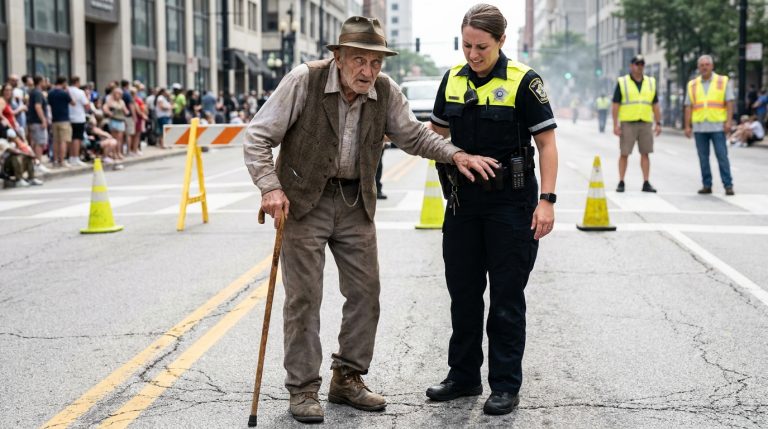
The ice in Arthur’s glass clicked—a sharp, singular sound that seemed too small for the suffocating humidity of the hall. He kept his gaze focused on the way the condensation pooled at the base of the coaster, a miniature lake forming on the scarred, dark-stained oak.
“Some people just warm a stool their whole lives, right?”
The loud man’s voice hit the back of Arthur’s neck, warm and oily. He was still standing there, holding the display case like a holy relic, his knuckles white against the velvet lining. The silver star inside caught the dim overhead light, casting a glint that danced across Arthur’s knuckles.
Arthur moved his fingers. His skin was translucent, mapped with veins that resembled the faded tributaries on an old map. He didn’t turn around. He didn’t want to see the man’s face—the flushed pride, the arrogance that mistook loudness for strength.
“I’m just drinking my water,” Arthur said. His voice was a thin, dry sound, like parchment being folded. It was a voice he rarely used, one that felt unused to the air outside his own throat.
“Drinking water. Right. While heroes are remembered.” The man laughed again, a wet, booming sound that made the other patrons in the bar look away.
Arthur’s hand tightened around his glass. He felt the weight of the pocket watch in his pocket, a silent, heavy presence that reminded him exactly how much space he was entitled to. He thought of a machine gun nest—not the one in the display case, but the one that lived behind his eyelids, the one that smelled of ozone and damp, cold earth.
He took a slow sip, letting the cool liquid trace a path down his throat. He needed to be invisible. He needed to be the ghost they all thought he was.
“You know,” the loud man persisted, nudging Arthur’s shoulder with his elbow—a gesture of forced camaraderie that felt like a blow. “My father, he didn’t sit on his hands. He made sure the world knew what happened.”
Arthur finally turned his head. His eyes were pale, washed out by the years, but when they landed on the loud man, there was a sudden, chilling clarity in them. He looked at the star, then back at the man’s eyes.
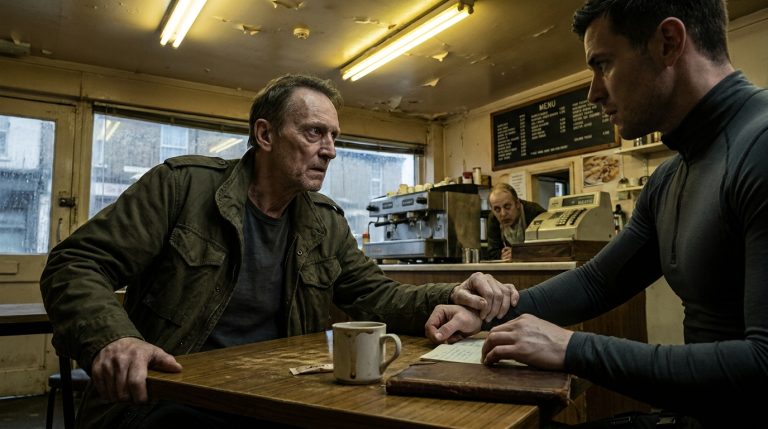
“I remember the machine gun nest,” Arthur whispered, the words barely audible over the hum of the cooling unit behind the bar. “But I don’t remember seeing your father there.”
The loud man’s smile froze, his face shifting from smug certainty to a momentary, flickering confusion. He didn’t pull away; he just blinked, his hand loosening on the display case. It was a tiny crack in the armor, but in the silence that followed, Arthur knew he had just opened a door that was never meant to be unlocked.
Arthur turned back to his glass, but the condensation had dried, leaving only a salt-rimmed ring.
CHAPTER 2: The Echo of Cold Metal
The loud man’s face went through a rapid series of shifts, a shutter clicking on a camera with a broken mechanism. First came the confusion, then a flush of genuine, heated anger, and finally, a fragile, defensive mask of disbelief. He didn’t speak. He couldn’t. The air had been sucked out of the space between them, replaced by the heavy, metallic tang of an old, forgotten fear.
Arthur didn’t pull back. He kept his hand steady, his fingers tracing the rim of his water glass. The cold surface of the glass was a grounding wire, connecting him to the reality of the present, keeping him from drifting back into the static of that day in the field. He felt the phantom weight of the pocket watch against his hip, a steady pulse of leaden stability.
“You don’t know what you’re talking about,” the man finally rasped. His voice lacked its earlier resonance; it sounded hollow, like wind through a rusted pipe. He gripped the display case so hard that the polished wood creaked. “My father was there. He was decorated. Everyone knows that.”
“Everyone knows the story,” Arthur corrected him, his voice still that dry, parchment-paper thinness. “Knowing a story and having been there are two very different things.”
The man turned, the display case held tight against his chest as if it were a shield. His eyes darted around the room, checking for an audience, but the few remaining regulars at the VFW were pointedly ignoring them, lost in their own drinks and flickering shadows.
“I should go,” the man muttered, though his feet remained rooted to the spot. He was looking for a way to restore the narrative, a way to put the pieces of his father’s monument back together.
“You should,” Arthur agreed. He picked up his glass and finished the remaining water. It tasted like nothing, like the dust of the road he had walked for fifty years.
The man turned abruptly, his heels clicking against the linoleum floor with a sharp, aggressive cadence. As he retreated, Arthur felt a strange, cold shiver bloom at the base of his spine. It wasn’t fear—he was far past the age where fear could take root—but a sharp, piercing memory of the way the ground had felt beneath his belly, the way the heat from the machine gun had shimmered like a veil of ghosts in the afternoon sun.
Arthur watched him go, noting the way the man held the display case. He didn’t walk with the swagger of a man who owned the truth; he walked with the stumbling pace of someone carrying a secret weight.
When the door swung open, the muffled roar of the outside world—a passing car, the distant bark of a dog—rushed into the hall, momentarily diluting the suffocating atmosphere of the interior. The door clicked shut, leaving Arthur alone with the silence again.
He stood up, his joints protesting with a quiet, rhythmic ache. He didn’t rush. He moved with the slow, deliberate care of a man who understood the value of a single step. He left a few crumpled bills on the bar, tipped his cap to the barkeep—who didn’t look up from his polishing—and walked out into the cooling evening air.
The sidewalk was uneven, the concrete cracked and heaved by old tree roots. Arthur navigated the path by habit, his mind drifting back to the attic. It had been years since he had looked, but he knew exactly where the lockbox was. He knew exactly which documents lay beneath the woolen blanket.
As he walked, he could hear the echo of the loud man’s footsteps fading down the street. The man was going home, likely to polish the display case and try to scrub away the smudge of doubt Arthur had left on the glass.
Arthur stopped beneath the amber glow of a streetlamp, the light washing out the color of his coat until it looked like a shroud. He reached into his pocket and touched the cold, unmoving metal of the pocket watch.
The truth was a heavy thing, a physical mass that pulled at the earth. He hadn’t meant to speak, but the words had escaped him like a sigh. And now, the silence of the street felt different. It felt like the calm before the wind picked up, a quiet, expectant tension.
He looked down the street, toward the house he had lived in for decades. It stood silent and dark, a tomb for the things he had kept locked away. He knew that by tomorrow, the man might be back, or worse, he might find someone else—someone less patient—to force the truth into the open.
Arthur began to walk again, his pace steady, his eyes fixed on the horizon where the last of the sunset was bleeding into a bruised, deep purple. The secret wasn’t just in the box. It was in him. And for the first time in his life, it felt like it was starting to breathe.
CHAPTER 3: The Archive of Dust
The front door of the house groaned on its hinges—a low, protestant sound that Arthur had intended to fix for three years. He stepped into the foyer, the air inside smelling of dormant cedar and the dry, sweet scent of aging paper. He didn’t turn on the lights. He knew the geography of this place by the feel of the floorboards under his boots, the slight dip in the wood where the foundation had settled over the decades.
He moved through the dark, his hand trailing along the wall. The texture of the wallpaper was peeling in long, thin strips, a topography of neglect. In the living room, a stack of newspapers sat on the side table, yellowed at the edges like old teeth. He passed them without a glance and headed for the narrow, steep staircase that led to the attic.
The stairs were rhythmic in their complaints, a steady creak-thump, creak-thump that sounded too loud in the stillness. Arthur climbed slowly. His breath was shallow, caught in his chest like a bird in a cage. He reached the top landing and pushed open the attic hatch. The space above was a reservoir of filtered moonlight and stillness, crowded with the debris of a life lived largely in retreat.
He navigated the floor, stepping over cardboard boxes that contained the husks of his past: a set of cracked ceramic dishes, a box of tangled wool, a collection of books with water-stained spines. He reached the far corner, where a heavy, iron-bound trunk sat beneath a sloping beam.
He knelt. His knees popped, a dry, sharp sound that seemed to shatter the attic’s quiet. The trunk was locked, a rusted padlock hanging from the hasp like a dead weight. Arthur reached into the small, hidden pocket of his vest and produced the key—a thin, brass instrument that had remained unchanged for half a century.
He inserted the key. It didn’t turn at first; the internal tumblers were seized with grit and disuse. He closed his eyes, centering his focus on the resistance. He applied steady, calculated pressure, the metal of the key biting into his thumb. Wait for it, he whispered to himself. Give it time.
With a sudden, violent click, the lock yielded.
He pulled the padlock free and lifted the lid. The sound was like a long, exhausted exhalation of breath. Inside, folded neatly, was a woolen blanket, and beneath it, a folder of thick, cream-colored stationery.
Arthur’s hands trembled, just slightly, as he peeled back the blanket. He wasn’t looking for medals. He was looking for the truth, the raw, unpolished record that he had hidden away to save the memory of his friend. He lifted the folder, his fingers brushing the rough edges of a document that had been typed on a portable typewriter that had long ago been sold for parts.
As he scanned the top page, the moonlight shifted, creeping across the floorboards to illuminate the ink. These were the field reports. They were incomplete, jagged things, written in the frantic prose of a man who knew he was dying. But they contained the core of the contradiction: the coordinates of the nest, the timeline of the assault, and the names of the men who had been there.
His eyes traced the lines, finding the name of the man the loud fellow had called “Father.” The date listed on the report for that individual’s location was miles away from the machine gun nest. Arthur felt a sudden, heavy pressure in his chest, not of guilt, but of overwhelming, crushing clarity. He had kept this secret to protect the man’s family from the truth of his absence—from the realization that he hadn’t been a hero, but a man who had been somewhere else, perhaps hiding, perhaps just lost.
Arthur sat back on his heels, the document held loosely in his hands. He could hear the wind outside, a low whistling through the attic eaves. The house felt less like a shelter now and more like a vault. By keeping the secret, he had allowed a lie to grow, a lie that was now being wielded as a weapon against his own peace.
He wasn’t sure if he should destroy the papers or burn them. For fifty years, they had been the anchor of his silence. He thought of the loud man’s face, the desperate, hollow pride in his eyes. If Arthur revealed this, the man’s world would collapse. The “Hero’s” legacy, the pride of the local VFW, the very foundation of the man’s identity—all of it would be reduced to ash.
Arthur looked at the document again. There was a handwritten note on the margin, scrawled by his own hand from a time when the ink was fresh and the pain was still sharp. For the sake of his mother.
He felt the weight of the years pressing down on him. The Kintsugi of his own life had been built on the premise that some cracks were better left sealed, even if the ceramic was flawed. But the cracks were widening. The loud man’s intrusion had acted as a mallet, threatening to shatter the vessel entirely.
He tucked the document back into the folder, his movements deliberate. He needed to be careful. He wasn’t just guarding a document anymore; he was guarding the fragile boundary between a comfortable lie and a destructive, unnecessary truth. He heard a noise below—the faint, metallic sound of the front door’s latch.
Arthur froze. He hadn’t locked the front door.
His pulse quickened, a rapid, uneven drumbeat in his ears. He wasn’t supposed to have company. He sat in the darkness of the attic, the folder clutched against his chest, listening to the silence of his home. Someone was downstairs. And they weren’t walking with the heavy, arrogant gait of the loud man from the bar. This was someone lighter, someone deliberate.
He waited, his mind racing through the tactical possibilities, the decades of dormancy falling away to reveal the survival instinct he had never truly shed.
CHAPTER 4: The Guest on the Stairs
Arthur didn’t move. He held the cream-colored folder against his chest like a shield, his knuckles white against the dark, heavy paper. Below him, the floorboards of the second-floor landing groaned—a specific, familiar protest that he hadn’t heard in years. It was a rhythmic tread, light and deliberate, entirely absent of the drunken, bumbling cadence of the man from the VFW.
He didn’t scramble to hide the trunk. There was no time, and hiding it now would only suggest guilt. Instead, he knelt in the narrow space between the trunk and the sloped rafters, his silhouette dissolving into the dust-heavy shadows of the attic.
The intruder reached the top of the stairs. The attic hatch hinge creaked, a thin, high-pitched whine that seemed to linger in the stagnant air. A rectangle of hall light bled into the attic, illuminating a swirling galaxy of dust motes. A shadow stretched long and thin across the floorboards—the silhouette of a woman, trim and upright, her movements characterized by a strange, precise fluidity.
She stepped into the room, her shoes making soft, muffled sounds against the floor. She paused, her head tilting as if listening to the house itself. She didn’t call out. She didn’t need to.
“Arthur?”
The voice was cool, precise, and tinged with a familiar, lingering authority. It was Clara, the daughter of the man whose “heroism” Arthur had spent half a century shielding. She had grown up under the long shadow of her father’s legend, and yet, there was a sharpness to her eyes now that hadn’t been there when she was a girl.
Arthur shifted, his knees protesting the movement. He couldn’t stay in the dark forever. He slowly stood up, his frame silhouetted against the moonlight streaming through the gable window.
“Clara,” he said. His voice was steady, though it felt like iron filings were scraping against his throat.
She turned, not startled, but expectant. She adjusted her coat, the fabric shimmering in the dim light. She didn’t look at the trunk. She looked directly at the folder in his hands.
“I saw you talking to Marcus at the hall,” she said, her tone conversational, yet devoid of warmth. “He’s been acting… unsettled since he left. He seemed to think you were holding onto something that doesn’t belong to you.”
“Belonging is a matter of perspective, Clara,” Arthur replied. He kept his grip on the folder. “And history is rarely as neat as a display case.”
She took a step toward him, her movements elegant and predatory. “Marcus is a loud man, but he’s right about one thing. My father’s memory is not a topic for debate. It’s a legacy. A town’s legacy.”
“Is that why you’re here?” Arthur asked, his eyes narrowing. “To protect the legacy, or to see if the rumors about the missing reports are true?”
Clara stopped. The moonlight cast her face into a harsh relief, emphasizing the line of her jaw and the cold intelligence in her gaze. “I’m here because I know my father better than anyone, Arthur. I know the man he was. And I know what he left behind.”
She looked at the folder again, then up to Arthur’s face. There was no fear in her expression, only a quiet, resolute hardness. It was the face of someone who had spent their entire life constructing a monument and was now prepared to burn anything that threatened its foundation.
“Give it to me,” she said, holding out a gloved hand.
Arthur looked at the folder—at the thin, yellowing sheets of paper that contained the truth of a battlefield half a world away. He thought of his friend, the man who had actually held the line, whose name was now etched in minor print on a plaque no one ever looked at. He thought of the decades of silence he had maintained, the way he had allowed himself to be the town’s silent, slightly pitiable recluse, all to save a grieving mother from the reality of her son’s death and her husband’s cowardice.
He realized then that Clara wasn’t here to save her father’s reputation for the sake of the town. She was here because she had known all along. The rigidity of her posture, the coldness of her ambition—she had been curating the lie just as carefully as he had been guarding it.
“You don’t want the truth,” Arthur said, his voice lowering to a sharp, dangerous frequency. “You want the control.”
Clara’s hand dropped. The polite mask shifted, revealing the exhaustion beneath. “Truth is a luxury for those who don’t have to carry the weight of a name. I have carried it for a lifetime, Arthur. I am not about to let you dismantle it now because of a sudden fit of conscience.”
The air in the attic grew heavy, the scent of dust and cedar intensifying as the wind rattled the rafters. Arthur didn’t move. He knew that if he handed over the folder, the memory of his friend would be erased forever, reduced to nothing more than a footnote in a manufactured history.
He moved his left hand toward the edge of the trunk, his fingers seeking purchase on the iron handle. He didn’t know what he would do if she forced the issue, but he knew he wasn’t going to let her walk out with the evidence. Not today. Not ever.
Clara watched his hand, her eyes flicking to the trunk, then back to his. She took another step, closing the distance, the space between them suddenly crackling with the weight of decades of unspoken bargains.
“This doesn’t have to be difficult,” she whispered, her voice a razor-sharp invitation. “You’ve done your part, Arthur. You’ve been the silent witness for fifty years. Why stop now?”
Arthur held her gaze, his heart hammering against his ribs like a trapped bird. He realized that the decoy secret—the idea that she was just protecting her father—was already falling away, revealing something far more calculated. This wasn’t about the past. It was about the power to decide what the past meant. And he was standing in the middle of it, the last living barrier between the truth and a manufactured peace.
CHAPTER 5: The Weight of a Name
Clara didn’t reach for the folder again, though her hand remained extended, a frozen gesture of command that hung in the stagnant attic air. Her gaze was fixed on Arthur’s, and for a moment, the distance between them vanished. In the reflection of her dark eyes, Arthur saw not a predator, but a woman balancing on the edge of a precipice she had built herself, brick by brick, year after year.
“You speak as if the truth were a simple object,” Clara said, her voice dropping an octave, losing its sharp, serrated edge. “Something you can just hand over, like a pocket watch or a dusty trinket. But you know better than that, Arthur. You know that if you let this out, you aren’t just breaking a story. You are dismantling a life. My life.”
She took a half-step back, though she didn’t leave the small, dust-choked orbit of the trunk. She looked around the attic, her expression shifting from cold resolve to a haunted, weary recognition. She saw the boxes of his life, the accumulated debris of a man who had chosen to be invisible.
“I’ve spent my life living in the shadow of a man who never existed,” she continued, her voice trembling slightly. Arthur noticed it then—the rhythmic, involuntary tremor of her fingers inside her leather gloves. She wasn’t just defending her father; she was defending the only version of her own history that allowed her to function. “Every accolade, every plaque, every ‘Thank you for your service’ spoken to me by strangers on the street—it’s been a performance. And I’ve been the lead actress. Do you have any idea what it’s like to realize your entire identity is a prop?”
“I know what it’s like to be a ghost, Clara,” Arthur replied, his voice gruff, the fatigue finally leaching into his words. “But I chose that. You’re trying to force the world to see a ghost as a statue. There’s a difference.”
“The world doesn’t want the truth,” she shot back, her voice tightening, regaining that sharp, metallic precision. “The world wants heroes. They need them to sleep at night. If you hand those papers over, if you reveal that the ‘hero’ of the machine gun nest was actually an absent, terrified man who got lucky with a press release, what does that give you? A sense of justice? A moment of righteous clarity?”
She stepped closer again, ignoring his implicit demand for space. She was invading his perimeter, but her intensity wasn’t focused on the folder anymore; it was focused on him. “It won’t make the pain go away, Arthur. It won’t bring your friend back. It will just leave a void. And people are terrified of voids. They will hate you for it. They will tear you apart for proving that their pride was built on a lie.”
Arthur felt the truth of her words settle in his marrow. She was right. The town didn’t want the raw, messy reality of the war. They wanted the polished, sanitized version. They wanted the silver star in the display case. If he revealed the truth, he would be the villain who spoiled the ending, not the hero who saved the record.
He looked down at the folder. The paper felt fragile, as if the history written on it were crumbling under his touch.
“I’m not doing this for them,” Arthur said, his voice quiet, barely audible over the wind that had begun to howl against the gables. “I’m not doing it to destroy anyone.”
“Then why keep it?” she demanded. “Why keep the ghost alive?”
“Because it’s the only thing that belongs to him,” Arthur said, nodding toward the documents. “The only thing that belongs to the man who actually stood in that mud. When we die, the truth is all we have left. If we allow that to be rewritten, then we never really existed at all.”
Clara stood still, the light catching the silver clasp of her bag. He could see the conflict raging behind her eyes—the struggle between the woman who had curated the lie and the person beneath the layers, the one who was exhausted by the pretense.
“If you show this to anyone,” she said, her voice a fragile, brittle thing, “it’s not just my father’s reputation that burns. It’s my home. My security. Everything I’ve worked to maintain.”
“Then don’t let it burn,” Arthur countered, holding her gaze. “Help me bury it. Not in a trunk, not in an attic. In the past, where it belongs. Let the story be what it is, but stop using it as a weapon against the people who are still alive.”
Clara turned away, her shoulders slumping. The poise, the calculated elegance—it had all evaporated, leaving behind a woman who looked as tired as he felt. She walked toward the attic hatch, her steps lacking their previous precision. She stopped at the edge of the opening, looking down into the darkness of the house below.
“You think you’re so righteous,” she said, without looking back at him. “But you’re just as guilty as I am. You held the secret for fifty years. You’re the one who built the pedestal, Arthur. You’re just as responsible for the myth as I am.”
She didn’t wait for his answer. She stepped through the hatch, her feet finding the rungs of the ladder with a soft, hollow tapping sound. Arthur stayed in the attic, the folder still clutched to his chest. He listened to her descent, to the sound of her footsteps crossing the living room, to the front door opening and the subsequent, heavy silence that returned to the house.
He sat down on the trunk, his energy suddenly spent. The confrontation had been a battle of ghosts, and he felt the hollow victory of it echoing in the quiet. He realized, with a sudden, sinking dread, that he hadn’t won anything. He had only ensured that the secret would continue to fester.
He looked at the folder again. It felt heavier now, weighted down by the realization that Clara was right—he was an architect of this lie, just as much as her father had been a beneficiary of it. He stood up and walked to the window, watching the street below. He saw her car parked beneath the streetlamp, its engine dark, the headlights off.
She wasn’t leaving. She was sitting in the car, waiting.
He realized then that the confrontation hadn’t ended in the attic. It had only moved to a new theater. He wasn’t the keeper of the truth; he was a target. And the war he had thought he left in the mud fifty years ago was not only still alive—it was parked directly in front of his house.
CHAPTER 6: The Decoy Secret
The rain began as a tentative tapping against the attic glass, then deepened into a rhythmic drumming that blurred the world outside into a smear of gray light and shadows. Arthur watched from the darkness of the gable, his eyes fixed on the dark, still silhouette of Clara’s car. She remained motionless, a sentinel of the status quo.
He felt the weight of the folder in his hands, its edges softened by the humidity of the attic. He needed to move, but the house felt suddenly unfamiliar, as if the floorboards were vibrating with the tension of her presence outside. He realized then that if he stayed, he was trapped. If he left, he was exposed.
Arthur turned away from the window, his movements stiff. He walked to the center of the attic, the floorboards groaning under his weight, and tucked the folder into a loose gap behind the chimney stack. It was a temporary measure, a desperate attempt to create distance between himself and the evidence of his own complicity.
He descended the stairs, his pulse a persistent, thudding rhythm in his ears. He bypassed the living room and went to the small mudroom at the back of the house. He needed to get out, to move, to put physical space between himself and the house that had become a prison. He reached for his raincoat, his fingers brushing against the cold, iron hook where it had hung for years.
He didn’t open the front door. He chose the back exit, the one that led into the overgrown alleyway that hugged the side of the house. He pushed the latch, the metal cold and slick with damp, and eased the door open. The night air hit him like a physical blow, smelling of wet earth and impending storm.
He moved along the wall, his boots sinking into the saturated ground. He didn’t look back until he reached the end of the alleyway, where the shadows of the neighboring garages deepened into a protective, ink-black void. He looked down the street, toward the front of his home.
Clara’s car was still there, but now, there was a second set of lights—a heavy, low-slung sedan pulling up behind her.
Arthur crouched, pulling his coat tighter against the wind. The passenger door of the sedan opened, and a man stepped out—tall, moving with an athletic, predatory grace that belonged to someone much younger than the men Arthur was used to dealing with. It was Marcus. The loud man from the VFW.
He walked up to Clara’s car, leaning into the window. Even from the distance of the alleyway, Arthur could hear the muffled, sharp cadence of their interaction. Clara didn’t get out. She remained inside, her silhouette motionless.
Arthur realized then that the “decoy” was already in motion. Clara hadn’t just been there to confront him; she had been preparing the ground for Marcus. She was feeding him a narrative—perhaps that Arthur was erratic, perhaps that he was hoarding something of value—and Marcus, with his performative pride and his desperate need for a hero to venerate, was the perfect instrument to force the issue.
They weren’t just here to talk. They were here to break the seal.
He watched as Marcus turned back to his car, opening the trunk and retrieving a heavy, metallic object. It wasn’t a weapon—not in the conventional sense—but a pry bar, a tool of cold, pragmatic entry. He walked toward the front of Arthur’s house, his movements purposeful.
The realization hit Arthur with the force of a physical impact: they weren’t looking for the truth. They were looking for the folder. They had assumed that Arthur’s “erratic” behavior at the bar was a precursor to a public revelation, and they were here to preemptively strike, to seize the “threat” before it could be voiced.
Arthur’s chest burned. He thought of the document, the handwritten note in the margin, the quiet, selfless sacrifice he had kept hidden for half a century. If Marcus entered that house, he would tear it apart. He would find the folder, and he would likely destroy it, convinced he was protecting the “legend” he held so dear.
Arthur didn’t think about his age. He didn’t think about the fragility of his own bones or the long, quiet years he had spent in retreat. He stood up, his joints screaming, and began to move toward the back porch. He had to reach the house before they did, not to defend it, but to reclaim the history that was about to be burned.
He took the steps two at a time, his breath coming in ragged, painful gasps. He didn’t care about the noise he made. He reached the back door, his heart hammering, and lunged for the handle. He was inside, in the dark, damp silence of the mudroom, when the front door splintered with a roar of breaking wood.
The sound filled the house, a violent, final punctuation to the years of quiet. Arthur stood in the dark, listening to the heavy, deliberate tread of Marcus crossing the threshold, the sound of the intruder’s boots on his floorboards ringing like a hammer blow against the sanctuary he had built to house the dead.
He wasn’t the keeper of the truth anymore. He was the only thing standing between the lie and the last, fragile evidence of a man who had actually lived.
CHAPTER 7: The Burden of Silence
The darkness in the mudroom was absolute, save for the rhythmic, pulsing amber of the streetlamp filtering through the grime-streaked window. Arthur stood perfectly still, his breath hitched in his chest. Each footfall from the hallway echoed against the interior walls—a heavy, intentional sound that resonated with the weight of someone who knew exactly what they were looking for. Marcus wasn’t stumbling; he was searching.
Arthur reached out, his hand finding the edge of the heavy workbench that cluttered the small room. His fingers brushed against a cold, rusted wrench, the metal biting into his skin. He didn’t pick it up. Instead, he allowed his hand to drift, tracing the familiar outlines of his life—the stacks of dry lumber, the jars of ancient, crusted screws, the lingering, metallic smell of oil. He was an old man in a house that knew his every secret, and he intended to use that familiarity to his advantage.
He moved toward the door that led to the kitchen. He knew the layout by heart: a loose floorboard near the sink that groaned if stepped on with full weight, a heavy cast-iron skillet that lived on the edge of the stove. He didn’t want violence—he wanted to keep this man from finding the folder. He eased the kitchen door open, the hinges, oiled by decades of neglect, remaining mercifully silent.
From the hallway, he heard Marcus’s voice. It was low, muffled, and strained with a frantic, desperate energy. “It’s here. She said it was here.”
Arthur felt a spike of adrenaline, sharp and cold. Clara hadn’t just sent him; she had given him instructions. She was directing the destruction from the safety of her car, using the loud man’s obsession as a blunt instrument.
Arthur moved through the kitchen, his feet finding the soft patches in the linoleum, keeping his weight centered and balanced. He reached the doorway that led to the central corridor. Marcus was standing in the living room now, his silhouette blocked by the open door, his figure illuminated by the dim, flickering hall light. He was systematically pulling books from the shelves, tossing them onto the floor with a rhythmic, careless force.
The sight of the books—the stories Arthur had read to pass the long, lonely nights—made something tighten in his throat. It wasn’t just the invasion; it was the lack of respect for the things that had kept him company while the world outside forgot he existed.
Arthur slipped into the shadow of the pantry. He had to lead him away from the stairs, away from the attic. If Marcus found the ladder, the game was over.
“Who’s there?” Marcus barked. He had stopped moving. The living room went dead silent.
Arthur didn’t answer. Instead, he pushed against the pantry door, letting it swing outward with a sharp, deliberate thwack against the wall. Then, he moved to the left, his boots finding the loose board near the sink. He shifted his weight, allowing the floor to emit a long, slow moan of wood on wood.
Marcus didn’t hesitate. He came around the corner, his presence filling the kitchen. He was holding a small, battery-operated flashlight, the beam cutting through the gloom and sweeping across the room. It illuminated the dust motes, the aging countertops, and the empty space where Arthur had been just seconds before.
“I know you’re in here, Arthur,” Marcus growled, his voice losing its performative edge and descending into a guttural, primal threat. “You’re hiding it. Just give it up, and we can go back to how things were. You can go back to your stool, and I can go back to honoring my father.”
“You aren’t honoring him,” Arthur said, his voice emerging from the shadows of the utility closet, behind the intruder. “You’re just afraid that if you look too closely, you’ll realize he never deserved the star.”
Marcus spun around, the flashlight beam frantically searching the dark. “Shut up! You don’t know anything about him! He was a man of action! A leader!”
“He was a man who knew how to write a good report,” Arthur corrected him. He stepped out from the closet, his posture loose, his hands empty but his stance grounded. He was closer to the hallway than Marcus was.
Marcus leveled the light at him, his face contorted in a mask of violent bewilderment. “Where is it? Where’s the folder?”
“It doesn’t matter where it is,” Arthur said. “Because even if you find it, it won’t change the fact that you weren’t there. And neither was he.”
Marcus lunged, the heavy, metallic weight of his frustration driving him forward. Arthur dropped his center of gravity, sidestepping the charge with a fluid, practiced motion that defied his years. He moved with the sudden, kinetic memory of a man who had navigated fire and shadow in the mud of a trench.
Marcus stumbled, his momentum carrying him into the kitchen island. He crashed against the edge, the wood groaning, the flashlight skittering across the floor and coming to rest under the stove, casting a distorted, upward beam that turned the kitchen into a theater of grotesque, elongated shadows.
“I’m not leaving without it,” Marcus hissed, scrambling to his feet, his breath coming in ragged, ugly gasps.
Arthur watched him, his own lungs burning, his chest tight. He wasn’t afraid of the man; he was afraid of what this would cost. The house was already a crime scene, a graveyard of the life he had carefully curated. He knew that if he didn’t end this now, if he didn’t break the cycle of the obsession, the entire history would be torn to pieces—not just the documents, but the fragile sense of dignity he had fought to preserve.
He felt the weight of the moment—the convergence of a fifty-year silence and a five-minute brawl. He had to choose: finish the fight, or let the truth be buried under the debris of his own home.
CHAPTER 8: The Proof of Valor
The darkness was not a void; it was an extension of the house itself. When the power died with a low, electrical pop, the kitchen became a closed loop of sound and touch. Arthur froze, his back pressed against the cool, enamel-coated surface of the refrigerator. He could hear Marcus, only a few feet away, his movements erratic, the man’s panic finally beginning to outpace his aggression.
“Where are you?” Marcus shouted. His voice was too loud, too high, revealing a trembling insecurity that cut through the darkness. The beam of his dropped flashlight was gone, swallowed by the gloom.
Arthur didn’t answer. He listened to the wet, heavy sound of Marcus’s boots against the floorboards, the slight rattle of a cabinet door being brushed against. He reached out with his left hand, finding the edge of the stove. He was in his element. He knew where every obstacle lived—the corner of the island, the protruding handle of the utility drawer, the exact distance to the hallway.
He didn’t need to fight; he needed to finish this before the house was demolished or the neighbors started calling in reports. He moved with a quiet, ghost-like grace, his feet making no sound against the linoleum. He reached the island and felt the heavy, cast-iron skillet he had placed there moments before. It was a cold, iron weight in his hand—the final, blunt authority of his kitchen.
“You’re a coward, Arthur!” Marcus swung blindly, his fist catching nothing but the empty air of the pantry entrance. “Come out and face me!”
Arthur stepped toward the center of the room. He didn’t rush. He felt the shift in the air pressure as Marcus moved, a slight displacement that told him exactly where the man was. He didn’t want to hurt him, but he needed to stop the destruction. He needed to prove that the history they were fighting over wasn’t just words on a page—it was the reality of the man who had lived it.
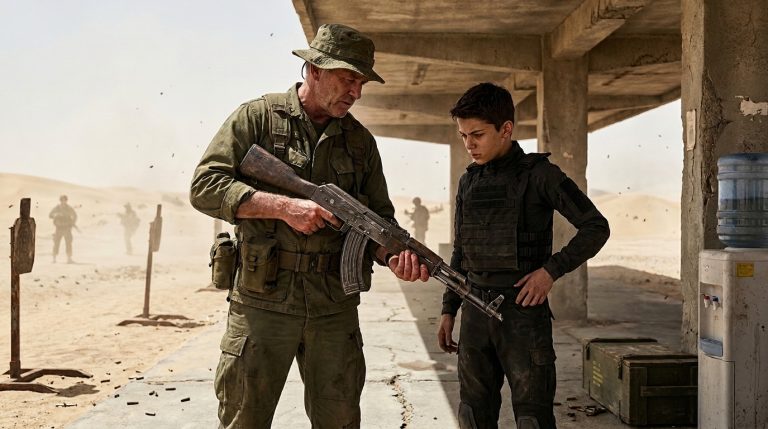
“He wasn’t there, Marcus,” Arthur said, his voice quiet and steady, anchoring the room. “I was. I watched your father run while someone else held the line. And if you break this house, you’re just finishing the job he started.”
Marcus roared—a sound of pure, unadulterated frustration—and charged toward the voice. Arthur felt the vibration in the floor before he heard the strike. He didn’t move away; he sidestepped, his movement minimal, efficient, a ghost dancing in the periphery of a storm.
As Marcus rushed past him, his momentum unchecked, Arthur caught the sleeve of his jacket. It wasn’t a struggle; it was a redirect. He pulled just enough to throw the man off balance. Marcus tumbled forward, his weight carrying him into the corner of the heavy oak table. He hit the floor with a dull, heavy thud, the wind knocked out of him.
He lay there for a long moment, his chest heaving, the darkness pressing in on him. Arthur stood over him, the skillet still in his hand, though he didn’t raise it. He felt no triumph, only a deep, hollow exhaustion.
“The proof isn’t in the folder,” Arthur said, his voice barely a whisper. “The proof is that I’m still here, and he’s gone. And for fifty years, I’ve kept the silence so you could have a father worth remembering. Don’t throw that away for a lie that won’t even keep you warm.”
Marcus didn’t move. He lay on the floor, his breathing finally beginning to settle. The storm raged against the windows, a relentless, drumming fury that seemed to fill the house with the ghosts of a hundred forgotten days.
Arthur knelt beside him, his old bones protesting the movement. He reached out and found the man’s shoulder, holding him there, not in malice, but in a strange, shared burden. The secret was out, at least to the people who had come to steal it. The myth was compromised. And as the storm lightened, revealing the gray, skeletal outlines of the kitchen in the moonlight, Arthur realized that he couldn’t stop the truth from coming out. He could only choose how it was delivered.
He turned toward the hallway, toward the stairs that led to the attic. He was done running. He was done hiding. If the house had to be broken, let it be for something that mattered.
CHAPTER 9: The Quiet Resolution
Arthur didn’t look back at Marcus. The man was still, his breathing steady, the adrenaline of the fight leaching out of him into the damp floorboards of the kitchen. Arthur climbed the stairs. His movements were slow, deliberate—a physical tally of every year he had spent guarding the lie. He reached the attic, the air still thick with the scent of cedar and the ghostly weight of the past.
He didn’t need to hide the folder anymore. He sat on the trunk, under the same beam that had sheltered his secret for half a century. The rain had softened, transitioning to a steady, rhythmic drip against the shingles, a sound that finally felt like an end rather than a threat.
Clara was waiting by the front door when he finally came back down, the front entrance now scarred by Marcus’s intrusion. She stood in the foyer, her coat wet, her face pale in the dim light of the hallway. She looked at the folder in Arthur’s hand, her expression unreadable, a mixture of fear and a strange, hollowed-out resignation.
“You brought it down,” she said, her voice barely a breath.
Arthur walked past her to the kitchen table. He set the folder down and opened it. He gestured to the chair opposite him. “Sit.”
Clara sat. She looked at the documents—the yellowing field reports, the faded ink, the handwritten note in the margin—with an intensity that was almost painful. She read slowly, her eyes tracking the lines of type as if they were a map to a place she had feared to visit. As she read, the mask of the legacy-protector didn’t crack; it dissolved, leaving her looking small, tired, and profoundly human.
“My father,” she whispered, her finger tracing the name on the report. “He wasn’t there.”
“He was a man who wanted to be something more than he was,” Arthur said, his voice soft, lacking the sharp edges of their earlier conflict. “He reached for a hero’s ending because he couldn’t face his own limitations. And I helped him because I couldn’t bear the thought of what it would do to you.”
Clara looked up, her eyes bright with unshed tears. “You didn’t protect me, Arthur. You kept me living in a house made of glass.”
“I know,” Arthur said. “But the glass is broken now.”
He reached into his pocket and pulled out the old, battered pocket watch. He set it on the table. It didn’t tick, but its weight was grounding. He had carried it for fifty years, the silent witness to the truth he had tried to bury. He pushed it across the table toward her.
“What are you going to do?” she asked, her voice steadying.
“I’m going to tell them,” Arthur said. “Not to destroy your father, but to honor the one who died in his place. The truth isn’t a weapon, Clara. It’s just the ending of the story.”
The next few days were a blur of quiet, necessary actions. Arthur didn’t make a spectacle of it. He didn’t go to the papers or the town hall. He walked into the VFW hall one afternoon, found the display case, and simply asked the barkeep to replace the name. He told the small, quiet truth in the way he had lived his life—with a steady, unassuming precision.
The fallout was not the explosion Clara had feared. There was confusion, a few heated arguments, and a long, slow period of adjustment for the townspeople who had tied their pride to a ghost. But as the weeks passed, the weight began to lift. The town didn’t fall apart; it simply settled into a more honest shape.
Arthur spent his evenings on his back porch, watching the light change over the fields. The house was quieter now. He had repaired the front door, the wood a slightly different shade than the rest, a small, visible scar that reminded him of the fight. He had mended the fence, too—a physical task that brought a strange, rhythmic peace to his aging joints.
Clara stopped by once or twice. They didn’t talk much about the past. They sat on the porch, drinking tea, the silence no longer a heavy, suffocating thing, but a place where they could breathe. She had begun to look different—less rigid, more present. She wasn’t carrying the legacy anymore; she was just living her life.
One evening, as the sun dipped below the horizon, painting the sky in soft, bruised purples and golds, Arthur took the pocket watch from the table and wound the stem. It didn’t start—the gears were frozen by time and rust—but the act itself felt like a release. He set it back on the mantelpiece, right next to the empty space where the display case had once sat.
He felt a deep, resonant catharsis. The antagonist of his life—not Marcus, not Clara, but the secret itself—had been laid to rest. He looked at his hands, steady and strong, and realized he hadn’t lost anything. He had finally, after all these years, become the man he was always meant to be: the one who had survived, the one who remembered, and the one who had finally, truly come home.
The house settled around him, a wooden, breathing thing that no longer held secrets. The storm had passed, the dust had settled, and in the quiet of the evening, Arthur closed his eyes and felt the world move on, steady and sure, into the soft, unburdened light of the tomorrow.