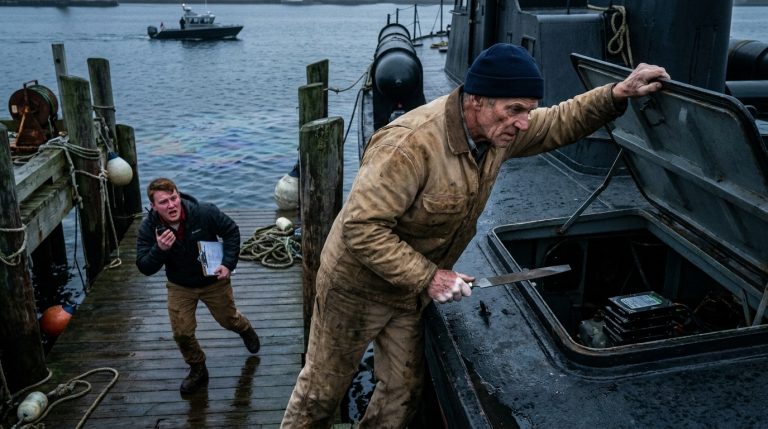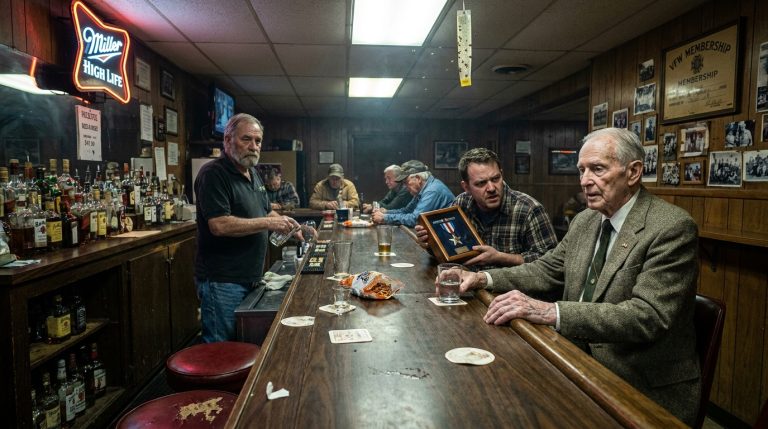
The Weight of Stilled Hands: A Veteran’s Final Audit of Honor and Forgotten Duty
CHAPTER 1: The Weight of the Flag
The silver watch casing clicked shut in my palm, a hollow, metallic sound that barely carried over the rustle of the mourners. I did not blink. My eyes were fixed on the hands of the honor guard leader. His grip was loose, the fabric of the flag sagging between his fingers like a wet sail. It was an insult. A deliberate, careless smear against the silence of the grass.
The airmen were sweating. I could see the dark crescents blooming under their arms, the desperate, frantic twitching of their eyes as they tried to align their movements. They were vibrating with the need to be anywhere but here.
I looked closer, narrowing my vision to the specific arc of the lead airman’s elbow. He wasn’t just nervous. He was shielding something. As he tucked the corner, his thumb pressed hard into the fabric—not to pull it taut, but to dampen the sound of a small, metallic object hitting the base of the casket.
My boots, worn at the heels from decades of measured walking, ground into the dry, pulverized earth. The smell of iron-rich soil and dying lilies filled my nostrils. I didn’t breathe until the last fold was forced home, the sharp, rhythmic snap of the cloth now replaced by a muffled, unnatural thud.
The crowd didn’t notice. They were weeping, lost in the theater of the moment, their grief acting as a blindfold. But I saw the airman’s face as he stepped back. He looked directly at the headstone, his expression not one of reverence, but of a man checking a perimeter.
I shifted my weight, feeling the familiar, grinding ache in my hip. I took a step forward, my shadow stretching long and thin over the grass, reaching toward the casket like a tether. As the group began to break, their voices rising in a discordant hum of polite mourning, the lead airman turned to leave. He brushed past me, and I caught the scent of industrial grease, sharper than the funeral flowers.
He stopped, momentarily caught by the stillness of my posture. His eyes darted to my hands, then to the closed casing of the watch.
“Step back, sir,” he muttered, his voice thin, stripped of the cadence expected of his rank. “The service is over.”
“The service,” I said, my voice sounding like gravel shifting in a bin, “is far from over, son. You left something behind.”
He didn’t look at the casket. He looked at the ground, his jaw tightening into a line of hard, stubborn rust. The air between us grew heavy, thick with the weight of things unsaid. I didn’t move. I waited for the lie to spill out of him, but instead, he just turned, his boots kicking up a cloud of grey, choking dust, and walked toward the gate without once looking back.
I waited until the last of the mourners had faded into the distance. Then, I turned toward the grave, my boots finding the rhythm of a soldier again, and walked toward the spot where he had pressed his thumb. The earth was disturbed, the soil freshly turned and still holding the faint, metallic scent of whatever he had dropped into the dark.
CHAPTER 2: The Geometry of a Lie
The wind picked up, a dry, rasping draft that rattled the dead leaves trapped in the decorative ironwork of the cemetery gate. I stood still, my boots planted on the uneven ground. The airman’s trail was fresh, a disturbance in the dust that pointed toward the maintenance shed, but before I could take a second step, the low, rhythmic growl of a tractor engine surged to life nearby.
I didn’t turn around immediately. I forced myself to maintain the posture of a man just paying his respects, my hands clasped tightly behind my back, the silver watch casing still biting into my palm. The tractor, an old, rusted International Harvester, chugged toward me, its tires crushing the gravel into the earth with a sound like grinding teeth.
“You’re lingering, sir,” a voice called out, muffled by the engine’s idle.
It was Elias, the groundskeeper. I had known him for years, though our relationship was defined by the kind of distance two men who share a profession of silence often keep. He hopped down from the seat, wiping his hands on a rag that was more grease than fabric. He was a man made of stiff joints and weathered skin, his movements echoing the slow, deliberate decay of the grounds he tended.
“Just taking the air, Elias,” I said, my voice steady, stripped of the urgency that was clawing at my throat.
He leaned against the fender, watching me with eyes that had seen too many burials to be surprised by anything. “The ceremony is done. The boys are back in the barracks. It’s quiet now.”
He was trying to move me along. It wasn’t the first time I’d felt the weight of the cemetery’s unspoken rules, but today, the air felt different. It felt thin, brittle. I looked toward the maintenance shed. The airman was gone, but the heavy steel door was slightly ajar, swaying in the draft.
“They were sloppy,” I said, making it a statement rather than a question.
Elias followed my gaze. His shoulders hitched, just a fraction of an inch—a micro-expression of unease that didn’t reach his face. “It’s a new generation, Colonel. They don’t have the training. They have the gear, sure, but they don’t have the practice. It’s just a job for them.”
“It’s not just a job,” I replied, the words feeling heavy, like lead shot in my mouth. “It’s a geometry. If the lines are wrong, the whole structure fails.”
Elias chuckled, a dry, hacking sound. “Structure? It’s just dirt and stone, sir. Sometimes, the stone moves. Sometimes, the dirt settles. You of all people should know how much this ground shifts.”
I held his gaze. He wasn’t just talking about the landscape. He was testing me. He knew, or he suspected, that my interest in this specific plot wasn’t mere sentimentality. I tucked the watch into my pocket, the metal clicking against a spare key I kept for the archive room at the local VFW.
“I’ll be going,” I said, tipping my hat. My heart was a steady, rhythmic thrum against my ribs—the pacing of a man who knew exactly what he was looking for, even if he didn’t want to find it.
“Don’t trip on the way out,” Elias said, his voice dropping to a gravelly, warning tone. “The paths are uneven this time of year. Easy to lose your footing if you aren’t looking down.”
I turned, my back feeling vulnerable as I walked toward the rusted exit. Every step was calculated. I felt the grit beneath my soles, the friction of a world that refused to stay still. I didn’t look back at the shed, but I memorized the exact angle of the door, the way the light caught the rusted edge of the frame.
I was not just an observer anymore. I was a witness, and the ground beneath my feet—the very ground I had fought to keep stable for thirty years—felt like it was beginning to liquefy. I reached the edge of the property, the cold iron of the gate biting into my skin as I pulled it shut behind me. The sound of the latch snapping into place was final, but in the silence that followed, I heard the faint, metallic scrape of the maintenance shed door finally clicking fully shut in the distance.
The investigation had moved from the open air into the shadows, and I was already behind schedule.
CHAPTER 3: The Paper Trail
The VFW basement smelled of damp concrete and the slow, inevitable decay of newsprint. I didn’t turn on the overhead lights. The string was frayed, a thin, pathetic thing that looked like it would snap under the slightest pressure, and I preferred the dim amber glow filtering down from the high, street-level windows. My boots crunched on the grit tracked in from the cemetery, a rhythmic, abrasive sound that seemed far too loud in the hollow silence.
I moved to the rows of filing cabinets that lined the back wall. They were industrial relics, painted a battleship grey that had peeled away in long, serrated strips to reveal the rust beneath. I found the cabinet marked 1994, the year the plot in question had been officially commissioned. The drawer resisted, the internal runners dry and starved of oil, screeching as I forced it open.
My fingers, calloused and stiff, began to sort through the manila folders. The paper was brittle, yellowed at the edges like old teeth. I wasn’t looking for a record of the burial—I knew that would be perfect, sanitized, and hollow. I was looking for the supply requisitions.
I pulled out a folder, the label faded by decades of stagnant air. My eyes scanned the logs. The inventory list for the internment ceremony that year was dense with technical specifications: the weight of the casket, the grade of the shroud, the specific protocol numbers for the honor guard. It was the kind of bureaucratic precision that usually left me feeling satisfied. Today, it made my skin crawl.
Midway down the third page, I found the discrepancy. A requisition for a secondary containment unit—a small, lead-lined box intended for ‘classified commemorative artifacts.’ It had been signed by my own hand, my signature a bold, decisive scrawl that looked like it belonged to a man I no longer recognized. I remembered the day I signed it. I remembered the cold sweat on my neck, the way the light had hit the polished mahogany of my office desk. I had been told it was a precaution, a necessary step for the integrity of the mission.
I looked at the dates. The requisition had been filed two days after the funeral.
The air in the basement suddenly felt thin. I traced the line of text with my index finger, the texture of the ink raised and rough against the paper. The lead-lined box wasn’t for artifacts. It was for the error.
I looked up, my eyes adjusting to the shadows. In the corner of the room, a stack of boxes was pushed haphazardly against the wall, their tape peeling, revealing the same industrial grease I had smelled on the airman at the cemetery. It was a faint, sharp scent, but here, in the enclosed space, it was unmistakable.
I stood slowly, my hip joint popping—a sharp, mechanical reminder of the years that had passed. I hadn’t been the only one visiting these files. The airman wasn’t just incompetent; he was a scavenger, hunting through the history I had tried to bury to see what else might be rotting in the dark.
I turned back to the cabinet. If they were looking for the box, they would have started here. I reached into the back of the drawer, pulling out a metal divider that had felt slightly loose. Behind it, nestled against the cold steel back, was a small, leather-bound logbook—the one I had kept off the record, the one that tracked the movement of that lead-lined box.
My heart surged against my ribs. I pulled it out, but as I did, the floorboards above groaned. Someone was walking in the main hall of the VFW. Not the heavy, uneven gait of the janitor, but the rhythmic, sharp click of tactical boots.
I stood in the darkness, the logbook heavy in my hand, and listened. The boots stopped just outside the basement door. A shadow stretched beneath the gap, long and thin, cutting across the dusty floor like a blade. I didn’t reach for my keys. I didn’t try to hide. I simply stood, my hand resting on the corner of the rusted filing cabinet, feeling the cold, rough iron ground me. The silence stretched, becoming so absolute that I could hear the slow, ticking vibration of my own pulse. The handle of the door began to turn, the mechanism straining with the same rusted, screeching friction that had defined every moment of my day.
CHAPTER 4: The Tactical Retreat
The handle turned fully, the latch disengaging with a sharp, mechanical snap. I didn’t wait for the door to swing wide. I shifted my weight, my heels grinding the grit into the floorboards as I pivoted toward the heavy shelves of the western wall.
“Colonel?” A voice cut through the dark. It was clipped, precise, and entirely devoid of the respect it once would have carried. It was the lead airman.
I didn’t answer. I tucked the logbook deep into the inner pocket of my coat, feeling the edge of it press against my ribs. I scrambled toward the narrow space between the rows of cabinets, my movements heavy but practiced. I had spent a lifetime learning how to exist in the margins of a room, and I used every inch of that knowledge now.
The door swung open, a slice of hallway light cutting across the basement floor. The airman stepped inside, his silhouette framed by the harsh glare of the overhead fluorescent from the corridor. He held a small, black-cased tactical light that swept across the shelves with clinical efficiency.
“I know you’re here, sir,” he said, his voice echoing off the concrete walls. “The floor is covered in dust. I can see the prints.”
I held my breath, pressing my back against the rusted steel of a cabinet. The smell of his industrial grease was stronger here, mingling with the scent of damp paper and ozone. I focused on the sound of his breathing. It was steady, too steady for a man who had just trespassed into a secure archive. He wasn’t acting out of panic; he was operating on a set of instructions.
I looked down. My boot prints were indeed visible in the thick layer of grey dust that coated the floor, leading straight toward the cabinet I had just raided. He wasn’t guessing; he was tracking.
I moved, my motion a low-friction slide along the rows. I wasn’t looking to engage. I was looking for the secondary egress—a coal chute that had been sealed off in the seventies. It was narrow, choked with decades of debris, but it was the only way to avoid a direct confrontation.
“You’re making this difficult,” the airman said, his light sweeping toward my position. The beam passed inches from my face, the brightness blinding in the dark. I squinted, my hand searching the wall behind the shelves. My fingers brushed against the rough brickwork, then, finally, the smooth, cold iron of the chute’s frame.
I hit the release lever. It was rusted solid.
I leaned my weight into it, the metal biting into my palms. It wouldn’t budge. I glanced over my shoulder. The airman was moving systematically, his light illuminating the rows of files, turning them into long, jagged shadows. He was close enough that I could hear the rasp of his uniform as he walked.
“There’s no point in keeping it,” he continued, his tone conversational, as if we were discussing weather patterns. “It’s a liability. For both of us.”
For both of us. The words landed with the weight of an anvil. He knew. He didn’t just know about the box; he knew about my role in its concealment.
I gave the lever a final, desperate wrench, my teeth gritted, my entire body a knot of tension. The rust gave way with a sound like a breaking bone. The chute door fell inward, spilling a cloud of soot and stagnant, airless dust into the room.
The airman pivoted, his light snapping toward the noise. “Sir!”
I didn’t look back. I jammed my foot into the chute and pushed off, feeling the rough edges of the brick tearing at my coat. I slid, the friction of the descent burning through my trousers, the world shrinking into a tunnel of darkness and stinging grit.
I hit the bottom, the floor of the chute hard and unforgiving against my shoulder. I scrambled out, my lungs burning as I inhaled the cool, damp air of the alleyway behind the VFW. I didn’t stop. I rose to my feet, my joints protesting every movement, and sprinted toward the cover of the shadows.
Behind me, the basement door opened fully. A beam of light pierced the night, scanning the alleyway. I pulled my coat tight around the logbook, feeling the sharp corner of the cover digging into my chest. I had lost the element of surprise, but I had gained the one thing I needed: the proof that the past was no longer buried, and that I was the only one left who knew how to dig it back up.
I disappeared into the labyrinth of the city’s backstreets, the sound of my own frantic, uneven breathing the only thing keeping time in the dark.
CHAPTER 5: The Cadence of Pursuit
I pressed myself into the narrow gap between two dumpsters, the metal biting into my shoulder. The air in the alley was thick with the scent of rotting waste and wet asphalt, a claustrophobic contrast to the open expanse of the cemetery. I held the logbook against my chest, my jacket muffling the slight rustle of its worn leather cover.
Above, the city sky was a bruised purple, light-polluted and indifferent. My lungs burned—a sharp, stinging sensation that reminded me my body was no longer designed for sprint-drills or alley-crawling. I waited, my focus narrowing to the sound of those boots.
Clack. Clack. Pause. Clack.
It wasn’t a search pattern. It was a patrol. The lead airman was methodical, his pace steady, disciplined. He wasn’t running; he was waiting for me to make a mistake, to give him a reason to close the distance.
I closed my eyes for a fraction of a second, and suddenly, I wasn’t in the alley anymore. I was back on the parade grounds, thirty years ago, hearing the exact same cadence—the rigid, precise march of an honor guard that had never failed. The memory hit me with the force of a physical blow. That same cadence had signaled the end of my career, the moment I knew I had signed the order that would haunt the rest of my days.
My hands trembled. I forced them into my pockets, clenching my fists until my nails dug into my palms. I could not let the memory unravel me. Not now. I opened my eyes, the reality of the alley—the graffiti-stained brick, the pools of oily water, the suffocating shadows—rushing back to reclaim me.
The airman had stopped at the mouth of the alley. I could see his silhouette, a stark, ink-black shape against the orange glow of the streetlamp at the far end. He wasn’t looking toward me, but he was listening. He knew I was trapped in this block, and he was giving me the opportunity to reveal my position.
I looked at the logbook in my hand. It was a record of ghosts, a ledger of names and dates that shouldn’t exist. If I held onto it, I was a target. If I left it behind, I was just another old man with a failing memory. I needed to move, but the alley was a cul-de-sac.
My gaze fell on a stack of wooden pallets leaned against the back wall of a warehouse. Behind them, a rusted ladder climbed toward a fire escape—a lifeline of twisted steel.
I moved, my steps light, calculating the weight of every footfall. I didn’t rush. The memory of the parade ground was a weight I had to carry, so I leaned into it, using the rhythmic precision of the drill to guide my own motion. I climbed the ladder, the rungs feeling slick under my palms, the iron groaning in protest at the strain.
Each time the metal shifted, I froze, waiting for the airman to react. He remained stationary, a sentinel of modern order, his silhouette unmoved.
I reached the fire escape and pulled myself up. The platform shrieked—a high, piercing sound of rusted metal against metal.
“There,” the airman said, his voice quiet, almost bored.
I scrambled up the stairs, my boots clattering against the grating. I didn’t look down. I pushed off the top landing and grabbed the sill of a window that had been pried open just enough to allow access. I squeezed through, landing on a pile of discarded cardboard inside a dark, echoing warehouse.
I was in. I was safe for the moment, but the logbook felt heavier now—a physical weight that threatened to sink me. I stood in the darkness, letting my eyes adjust to the gloom, and saw that I wasn’t alone.
The warehouse was filled with rows of stacked supply crates, all marked with the same government seal I had seen in the archive. I wasn’t just in a random building; I was in the secondary storage facility for the base. And in the center of the room, illuminated by a single, flickering overhead light, sat a wooden crate, its lid pried open.
Inside, tucked between layers of shock-absorbent foam, sat a small, lead-lined box. It was exactly as I had described it in my files, a relic of a decision I had made in a cold, sterile office decades ago. The airman wasn’t hunting me because of the grave—he was hunting me because I had finally found what he had been trying to keep me from seeing: the box was empty.
The truth was not in the grave, and it was not in the files. It had been moved, and the airman was merely the person tasked with making sure I never realized that the error I had spent my life covering up had been discovered by someone else long ago.
CHAPTER 6: The Empty Vessel
The flickering light hummed—a jagged, electrical sound that seemed to vibrate in my teeth. I stood before the crate, my hands hovering just inches from the empty box. It was a masterpiece of cold, industrial engineering, lined with lead, meant to withstand the decay of decades. Yet, here it sat, stripped of its burden, as silent and accusing as a judge.
I had spent thirty years protecting a secret, believing that the weight of it was keeping the world’s sense of order intact. I had signed the papers. I had authorized the burial of a stranger in that plot, a ghost to cover for a battlefield intelligence failure that would have dismantled my command. I had thought the box contained the only evidence of that transgression.
But it was empty.
A floorboard creaked behind me—a sharp, deliberate protest of wood against steel. I didn’t turn. I felt the presence before I heard it. The air in the warehouse shifted, becoming cooler, carrying the faint, sharp tang of that industrial grease again.
“You look disappointed, Colonel.”
The voice wasn’t the airman’s. It was deeper, smoother, aged like fine leather. I turned slowly. Elias, the groundskeeper, stood in the aisle, his hands tucked into the pockets of his grease-stained coveralls. He wasn’t the broken, weathered man I had seen at the cemetery. He stood with the effortless, dangerous balance of a man who spent his life hiding in plain sight.
“Where is it?” I asked, my voice raspy, the words feeling like dry leaves in my throat.
“Where is what? The truth?” Elias chuckled, stepping into the pool of light. He looked at the crate, then back at me. “You think you’re the only one who knows how to keep a cemetery silent? You were an amateur, Colonel. You buried a man and thought that was the end of the debt.”
“I was following protocol,” I countered, the defensive instinct rising like bile.
“Protocol is just a word for a lie that everyone agrees to repeat,” Elias said. He reached into his pocket and pulled out a small, tarnished silver coin—a memento, perhaps, or a key. He flipped it once, the metal catching the light. “The man you buried wasn’t just a stranger. He was the reason you were promoted. You covered up his death so you could take his seat. But someone saw it. Someone else was in that graveyard that night thirty years ago.”
My pulse hit a jagged, irregular rhythm. Someone else. I searched my memory, the faces of my platoon, the faces of my superiors—they all blurred into a monochromatic haze of duty and cold, rain-slicked earth. I remembered the rain. I remembered the weight of the casket. But my mind began to stutter, the images fracturing like cracked glass. Was it raining? Had I been alone?
“You’re lying,” I whispered, but my resolve was fraying. The certainty I had carried for three decades was being stripped away, leaving me exposed in this warehouse of shadows.
“Check the ledger again,” Elias said, his voice turning cold. “The one you took from the archive. Look at the signature on the last page. Not the one you recognize, but the witness. The one you were too exhausted, too terrified to notice.”
He began to walk toward me, his pace slow, predatory. “The airman wasn’t sabotaging the ceremony, Colonel. He was trying to find out which one of us—you or me—was going to blink first. And you just gave yourself away.”
I reached for the logbook in my pocket, but as I did, the warehouse alarm cut loose—a deafening, rhythmic wail that shook the very foundation of the building. The flickering light overhead blew out, plunging us into total, suffocating darkness.
I dived to the left, my shoulder slamming into a crate. The friction of the wood burned through my coat. I heard Elias move, his heavy, deliberate boots echoing against the concrete, moving not toward me, but toward the exit. He was leaving me in the dark to face the fallout.
I fumbled for the logbook, my hands shaking. I needed to see that signature. I needed to know if I was a murderer, or if I had simply been a pawn in a game I was only now starting to understand. I crawled across the floor, the grit of the warehouse sharp against my palms, and pressed my back against the cold, hard reality of a steel beam, listening to the siren’s scream and the sound of my own history disintegrating.
CHAPTER 7: The Ledger of Ghosts
The darkness was not merely an absence of light; it was a physical weight. I pressed my back against the steel beam, the cold metal bleeding heat from my spine. My fingers, steady despite the adrenaline, gripped the logbook. I needed to see that signature. I needed the light.
I pulled a small, heavy-duty penlight from my coat—a tool from the old days, rugged and battered. I triggered the button, the beam cutting a narrow, focused line through the swirling dust motes. I turned the pages of the logbook, the paper sighing in the stillness.
Page forty-two. The burial detail. The name I had authorized for the coffin—a generic, placeholders name I had manufactured in the heat of a crisis—was there, written in my own hand. But beneath it, in the space reserved for the witness verification, was a signature I had never seen before. It was angular, aggressive, the ink pressed so hard into the paper it had nearly torn the fiber.
E. Vane.
Elias. The groundskeeper. He hadn’t just been there. He had been the one to sign off on the deception. He had held the leverage over me for thirty years, watching from the periphery, tending the graves and the secrets alike.
A sudden, sharp thud echoed from the far end of the warehouse. Then, the hum of the electronic locks engaging. Every exit door, every skylight, every heavy rolling gate—the entire facility had locked down. I was sealed in a tomb of my own making.
I moved away from the beam, my boots making no sound on the oil-stained floor. I needed to get to the foreman’s office. There would be a manual override for the security system there, a relic of the warehouse’s original design that Elias likely thought I’d forgotten.
I navigated the aisles, the narrow shafts of my penlight dancing across the stacked crates. The warehouse felt larger now, more intricate, a labyrinthine monument to bureaucratic waste. I could hear Elias moving somewhere in the maze, his footsteps slow and deliberate. He wasn’t rushing. He had the advantage of time, and he had the knowledge of the terrain.
I reached the office door—a heavy, reinforced slab of steel. I pressed my ear against the metal. Silence. I tried the handle; it was locked. I took a deep breath, the smell of ozone still clinging to the air, and drew my pocket knife. I wasn’t a locksmith, but I knew the weaknesses of industrial hardware. I worked the mechanism, my movements precise, tactical, a memory from a life that felt like it belonged to someone else.
The lock tumbled with a dull, heavy click.
I stepped inside. The room was sterile, illuminated by the emergency red light that had kicked in when the system crashed. On the wall, the manual override switch was protected by a plexiglass box. I smashed it with the heel of my palm, the sound echoing like a gunshot.
I slammed the switch down.
Outside, the heavy mechanical groans of the gates disengaging filled the warehouse. But as the locks cleared, the overhead speakers crackled to life. It wasn’t an alarm. It was a voice.
“You’re still looking at the page, Colonel,” Elias said, his voice piped through the warehouse’s PA system, distorting into a metallic, hollow hum. “But you’re reading the wrong side. The signature isn’t the truth. The date is. Check the date of the witness entry.”
I opened the logbook again, the paper catching on my sweaty thumbs. My eyes flew to the bottom of the page. The date. It was stamped three days before the funeral.
A cold, hollow sensation opened in the pit of my stomach. If the witness had signed it three days before the event, then the burial wasn’t an accident. It wasn’t a cover-up for a battlefield mistake. It was a planned, cold-blooded replacement. They hadn’t just buried a stranger to hide a failure; they had been waiting for someone to die so they could put a specific person in that grave.
I looked up at the red-lit office, the walls closing in. The stranger in the grave wasn’t a victim of war. He was the witness to something else entirely. And I hadn’t been the architect of the lie; I had been the janitor hired to clean up the aftermath.
I heard the office door handle turn. Elias was here. And for the first time in thirty years, the weight of the past wasn’t just a burden—it was a death sentence.
CHAPTER 8: The Final Assessment
The door pushed open, the hinges screaming. Elias stepped into the red-hued office, his presence filling the room with the smell of damp earth and oil. He didn’t carry a weapon. He didn’t need to. He held the only thing that mattered: the absolute, unvarnished reality of what I had done.
“You look tired, Colonel,” he said, his voice quiet, almost compassionate. It was a patronizing sound that made my skin crawl. He walked to the desk, his boots crunching over the shards of the shattered plexiglass box. “You’ve spent thirty years carrying a ghost, and now you find out the grave is empty. That has to be a heavy realization.”
I gripped the logbook, my knuckles white. My heart was a frantic, trapped bird against my ribs. “Why?” I demanded, the word barely a breath. “Why leave it here? Why wait until now?”
Elias leaned against the desk, his gaze sweeping the room with a calm, predatory patience. “Because you were the perfect guardian. You didn’t just hide the truth; you believed in it. You convinced yourself that you were a patriot, that your sacrifice was for the good of the unit. As long as you were here, as long as you were watching that grave, the secret remained sacred. But you got old. You started asking questions. And when a guardian starts to doubt, they become a liability.”
He reached out and tapped the cover of the logbook I was clutching. “Give it here. It’s finished. The cycle is done.”
I looked at the ledger, then at the man standing before me. I thought of the funeral, the clumsy hands of the airman, the scent of the industrial grease—the marks of a machine that had been running perfectly for three decades. I hadn’t been the architect of the lie; I had been the fuel.
I stood, my hip grinding with a dull, persistent ache that anchored me to the floor. “I’m not giving it to you,” I said, my voice hardening, the gravel of my past returning to my throat. “I’m the only one left who knows where the bodies are buried. Literally.”
Elias smiled, but there was no warmth in it. “You think that’s an advantage? You think you’re in control?” He took a step forward, his shadow engulfing me. “You’re just a man with a book of dead names. I’m the one who ensured they stayed dead.”
He moved with a speed that belied his age, reaching for my arm. I pivoted, the tactical training of a lifetime surfacing from the deep, forgotten layers of my mind. I didn’t strike; I parried. I shoved him backward, the force of the movement surprising us both. He stumbled, hitting the edge of the desk, and I used the moment to scramble toward the window.
But I didn’t jump. I turned back, the logbook open to that final page, the ink of the signature staring back at me. I saw it then—not just the name, but the stamp. The bureaucratic seal of the secondary storage facility I was currently standing in.
I wasn’t in a warehouse. I was in a disposal site. Everything in this building—the crates, the ledgers, the ghosts—was slated for incineration.
“You can’t burn this,” I said, holding the book up.
“I don’t have to burn the book,” Elias said, recovering his balance. He reached into his pocket and pulled out a small, metallic device. He clicked it.
The sound of gas hissing through the warehouse vents began to hiss, a low, ominous sound that filled the room. The smell of oil was suddenly replaced by the sharp, suffocating sting of fuel.
“I’m going to burn the entire facility,” he whispered. “And you’re going to be the final entry in the log.”
The air in the room grew heavy, the oxygen being displaced by the fumes. My lungs seized. This was it. The final assessment. The end of the ledger. I looked at the logbook one last time, seeing not just the secrets, but the faces of the people I had betrayed. I dropped the book onto the desk, its pages fluttering in the draft. If I was going down, I would make sure the fire saw what I had seen. I reached into my pocket, pulled out the silver watch I had kept for thirty years, and smashed its glass against the metal desk. The jagged edge of the watch face would be my final, desperate tool—a piece of evidence that wouldn’t burn.
CHAPTER 9: The Final Audit
The room roared. A wall of heat slammed into me, orange and gold light licking at the edges of the desk. The air was a thick, chemical soup that burned with every jagged breath. Elias lunged, his face a mask of primal frustration, but I moved with the cold, calculated precision of a man who had nothing left to lose. I drove the jagged edge of the watch glass into his arm.
He didn’t scream. He grunted, a short, sharp expulsion of air, and stumbled back. He wasn’t a master tactician anymore; he was just an old man fighting for a secret that had already outlived its purpose.
“You think this changes anything?” he wheezed, clutching his bleeding arm. “The records are here. The box is here. You’re just another name on the list.”
“There is no list,” I said, my voice cutting through the rising thunder of the fire. I grabbed a heavy, brass paperweight from the desk—a relic from my days in command—and threw it, not at Elias, but at the fire suppression override panel I had triggered seconds ago. The panel shattered, and the halon system finally sputtered to life, a rush of freezing, inert gas that hissed through the room, battling the flames.
The fire didn’t die, but it slowed, the orange glare receding into a churning, smoky gray. We stood in the half-light, two silhouettes framed by the wreckage of our own history.
I looked at the logbook, then at the box. I realized then that Elias had wanted me to find the empty box. He had wanted me to confront the fact that the person in the grave was a replacement—the man I had essentially sacrificed to secure my own standing. The “witness” wasn’t just a signature; it was the man I had replaced.
“You replaced him,” I said, the realization settling into my bones like lead. “You didn’t protect the secret. You lived it.”
Elias looked down at his wound, his eyes shifting, the predator mask finally dropping away to reveal a man who was as broken as I was. “I was the only one who remembered his name,” he said softly. “You forgot him the moment you signed the order. I spent thirty years waiting for you to realize that you were the one who killed him, not me.”
The fire suppression system wheezed and died, leaving us in a stifling, smoke-choked twilight. Elias walked to the door, his movements heavy, his stature diminished. He didn’t look back. He simply opened the door, the cool air from the warehouse corridor washing over us like a reprieve, and walked out, leaving me standing in the center of the office, surrounded by the charred remnants of a life built on a lie.
I didn’t try to stop him. I didn’t try to follow. I walked to the desk and picked up the logbook. I took a lighter from my pocket—the one Elias had left on the desk—and touched the flame to the corner of the pages. I watched as the ink curled, as the signatures vanished, as the history of a lie turned into fine, gray flakes that drifted to the floor.
I stepped out of the office and into the warehouse. The air was clearing. I walked to the spot where I had found the box and knelt, the concrete cold and unyielding against my knees. I reached into my pocket and pulled out the broken, silver watch. I set it on the floor, right where the empty box had been.
It was a small, foolish gesture, a symbolic repair of a life that couldn’t be fixed.
I turned and walked toward the exit, my steps heavy, measured, and finally, for the first time in thirty years, silent. I left the warehouse, the night air cool against my skin. The cemetery was just across the way, a quiet, dark square of order against the chaos of the city. I didn’t go back. I just kept walking, the weight of the past fading with every step, the rust of my own soul finally beginning to settle into a quiet, enduring peace.