The Weight of Quiet Steel: A Journey into the Unspoken Legacy of a Soldier’s Lost Years
CHAPTER 1: THE FOURTH DECADE OF SILENCE
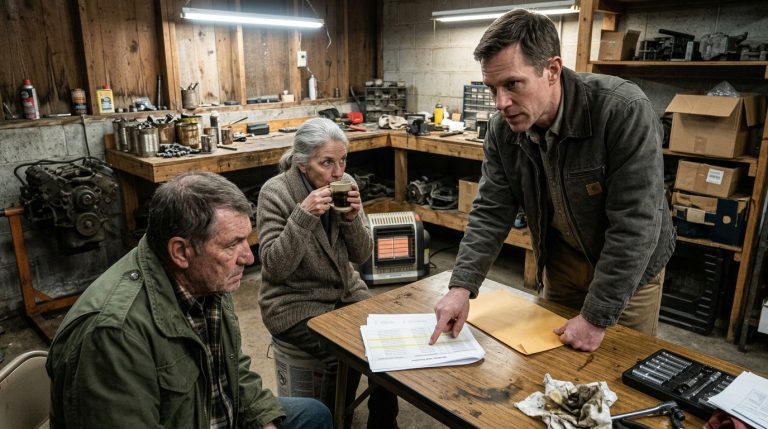
The garage air smelled of dry dust, old motor oil, and the slow, inevitable rot of forgotten hobbies. To the young man leaning against the doorframe, it was just the clutter of a life that had finally run out of runway. To Henry Caldwell, it was a cathedral of discarded memory.
He stood perfectly still. The fluorescent light above flickered with a low, rhythmic hum, casting jagged shadows across the folding tables. His vision, clouded by the haze of age, sharpened with a sudden, painful precision the moment his gaze locked onto the wooden case.
It sat between a stack of National Geographics yellowing at the edges and a chrome toaster that hadn’t toasted a slice of bread since the turn of the century. A crude, handwritten yellow sticker was slapped across the lid.
$40. Works fine.
Henry’s breath hitched. It was a shallow, ragged sound, silenced immediately by the internal discipline that had served him for fifty-eight years. He stepped forward, his boots feeling heavy on the concrete. He didn’t look at the grandsons, who were preoccupied with the glowing screens of their phones, or the young woman discussing the value of a butter churn nearby. He was locked in a private orbit.
The case was walnut, the wood dark and rich, darkened further by the natural oils of a palm that had held it in the mud, in the rain, and in the freezing terror of the dark. He noted the brass corners. They were green with oxidation, hand-fitted by a man who respected his tools. But it was the scuff—a small, crescent-shaped indentation near the lower latch—that stopped his heart.
He knew that mark.
He remembered the morning it was made: a wet, miserable dawn in the Queson Valley. A hurried, desperate motion of a boot heel against the case as the world exploded around them.
“Excuse me, son.”
Henry’s voice sounded thin, eroded by time. He didn’t turn his head away from the case. The young man with the beard looked up, his expression one of polite, bored detachment.
“The case,” Henry whispered. “The wooden one. Is it for sale?”
“Oh, yeah,” the man replied, tapping his phone screen before sliding it into his pocket. “That’s just Grandpa’s old war souvenir. Forty bucks, take it. Honestly, we were going to clear it out by noon anyway.”
Henry’s hand hovered over the lid. He felt the cold, indifferent weight of the bargain—the way a life’s deepest scar had been reduced to the price of a tank of gas. He thumbed the brass latches. They clicked—a sharp, metallic snap that pierced the ambient noise of the estate sale.
He didn’t lift the lid yet. He looked up at the young man, his pale blue eyes searching for a flicker of recognition, a sign that the boy knew whose legacy he was discarding. There was nothing but the easy, hollow boredom of youth.
Henry knelt. His left knee screamed in protest, a sharp reminder of the VA waitlists and the decades that had passed, but he ignored it. He lifted the lid, and the world narrowed down to the green felt interior and the cold, unyielding blue-black steel of the Winchester Model 70.
The serial number stared back at him, the final four digits—4471—engraved in the metal. It was a code that unlocked the only truth he had left, but as he reached out to touch the stock, he noticed something else: a small, dark stain on the felt lining near the trigger guard, faint and almost invisible to anyone who didn’t know exactly what to look for.
It was a drop of dried blood that had sat there, preserved in the dark, for nearly sixty years. And then, as he shifted the rifle an inch to the left, he saw the small, hand-punched letters on the underside of the receiver, and his breath finally left him.
HC November 18th, 1968.
He wasn’t alone in the garage anymore. The shadows around him began to stretch, and the silence of the room was suddenly filled with the roar of a distant, hidden artillery barrage. He realized then that the decoy was gone; he hadn’t just found a souvenir. He had found the end of his own story.
CHAPTER 2: THE PORCH SILENCE
Henry didn’t withdraw his hand. The wood was cool, steadying, a sharp contrast to the sudden, violent tremor that sparked in his chest. He felt the gaze of the two young men on him—the older one, Caleb, shifted his weight, his sneakers squeaking on the cracked concrete, a sound that grated against the phantom echoes of mortar rounds in Henry’s ears.
“Everything good, sir?”
The voice was closer now. The older grandson had stepped down from the porch, his face a mask of awkward, youthful concern. He didn’t understand the geography of the room. To him, the garage was filled with junk to be liquidated; to Henry, the floor was a minefield of memories, and he had to navigate it with the same tactical caution he’d employed in the Queson Valley.
Henry didn’t stand up immediately. He pushed the lid down, the brass latches clicking shut with a finality that felt like closing a tomb. He needed a moment to reset the internal clock that had just jumped back fifty-eight years. He focused on the faded denim of his own jacket sleeve, rubbing the fabric between his thumb and forefinger. The sensation—a coarse, grounding texture—helped dissolve the phantom image of the mud.
He stood, his knee popping with a dry, splintering sound, and turned to face the grandsons. Their faces were young, unlined by the things he’d seen. It was an innocence that Henry found both exhausting and necessary to protect.
“I’m fine,” Henry said, his voice steadying. “I just… I didn’t expect to see this rifle here.”
“It’s just a souvenir, right?” The younger brother, Caleb, leaned in, peering at the case. “We thought maybe it was worth a few bucks to a collector. The guys at the local shop said it was just an old hunting piece.”
Henry felt a flash of something—not anger, but a profound, weary sadness. Just a hunting piece. He looked at the rifle case, then back at the brothers. They were good boys, clearly, but they were swimming in a sea of ignorance, unaware of the depth of the history they were currently presiding over. He saw the paper coffee cups on the porch, the discarded phone, the casual way they handled the remnants of a man who had held the line while others fell.
“It wasn’t a hunting rifle,” Henry said quietly. He walked toward the porch, his pace deliberate. He needed to be careful. If he pushed too hard, he’d alienate them. If he didn’t push enough, the story—the truth—would stay buried under the dust of this garage.
He climbed the porch steps, the wood groaning under his weight. He stopped in front of the older brother, the one who held the clipboard. “What was your grandfather’s name, son?”
The young man blinked, taken aback. “Tom. Tom Mercer. Why?”
“And he served in the service? In the late sixties?”
“Yeah,” the younger one chimed in. “He never really talked about it, though. Mom said he was a Marine. He came back, got a job with the railroad, and that was that. He was a quiet guy. Spent most of his time out on the dock, just staring at the water.”
Henry felt the weight of that silence. It was a shroud, a self-imposed barrier that Tom Mercer had likely constructed to keep the noise of the war from seeping into the lives of his children and grandchildren. It was the same barrier Henry had spent his own life reinforcing.
“He was a Marine,” Henry repeated, nodding slowly. “And he was a quiet man. You’re right about that.”
The older brother looked at the case, then at Henry, a flicker of something—uncertainty, perhaps—moving behind his eyes. “You said you knew him? Where?”
“The Queson Valley,” Henry said. The name tasted like iron in his mouth. “1968. It was a long time ago. But the people you meet in a place like that… you don’t really forget them.”
He stopped. He had said enough for now. The air on the porch was shifting, the easy apathy of the morning beginning to fray at the edges. He watched the brothers exchange a glance. The older one, the one who had been so quick to put a price on the past, seemed to be reconsidering the object sitting on the garage floor.
“Sir,” the older brother began, his tone shifting from casual to probing, “you were saying the rifle… you said you knew the rifle?”
“I knew it,” Henry confirmed. He leaned against the railing, his eyes tracking a hawk circling high above the rusted roof of the farmhouse. “I’m going to stay for a bit, if you don’t mind. I’d like to see what else is in these boxes.”
“Sure,” the younger brother said, his voice noticeably quieter. “Help yourself.”
Henry didn’t go back to the boxes. He stayed on the porch, looking out at the tobacco barns and the rolling hills. He had planted the seed. Now, he had to wait for it to take root, knowing that when it finally did, the life these boys thought they knew would be irrevocably changed.
CHAPTER 3: THE GATHERING
The silence lasted just long enough for the hum of the nearby refrigerator to become intrusive. Then, the sound of a gravel-crunching approach broke the spell. A dark blue sedan pulled into the driveway, rolling to a stop behind Henry’s battered Ford. Susan Mercer stepped out. She was dressed for a Saturday—denim jeans and a light sweater—but her face was tight, her eyes showing the exhaustion of a woman who had spent months dismantling a life she was still grieving.
“Rachel said you needed me,” Susan said, her voice carrying across the yard as she approached the porch. She looked at her sons, Caleb and his older brother, then at Henry, who she clearly didn’t recognize. “Who is this?”
“Mom,” Rachel, the granddaughter with the clipboard, stepped away from the butter churn and met her mother halfway. She didn’t answer the question immediately. She reached out and touched her mother’s arm, a gesture of quiet warning. “This is Henry. He… he knew Grandpa.”
Susan stopped, her hand moving to the strap of her bag. She looked at Henry—really looked at him—for the first time. She saw the faded denim, the cap, the steady hands, and the way he held himself with a stillness that didn’t belong to the casual chaos of an estate sale. She wasn’t a girl anymore, and the look she gave him was wary, maternal, and searching.
“Dad didn’t have many friends from back then,” Susan said, her tone guarded. “He didn’t talk about it. At all.”
“He had one,” Henry said. His voice was lower, more grounded now. He didn’t move toward her. He stayed on the porch, giving her the space to process the intrusion. “My name is Henry Caldwell. We were in the same platoon in 1968. I haven’t seen him since 1972.”
Susan’s shoulders dropped, just an inch. The tension in her face shifted from suspicion to a deep, weary recognition of something she couldn’t quite name. She walked up the steps, her gaze drifting toward the open garage, where the walnut case sat in the center of the concrete floor like a dark star.
“That rifle,” she whispered. “That’s why you’re here?”
“I didn’t know it was here until this morning,” Henry replied. “I came for the estate sale. I like to pay my respects.”
The brothers had gravitated toward their mother, their earlier apathy replaced by a strange, newfound gravity. They looked at the case, then at Henry, waiting for the bridge between the two men to be fully formed. Susan moved toward the garage, and Henry followed, walking slow.
Inside the garage, the air felt different. It was no longer the dusty, cluttered workspace of an old man; it felt like a repository. Susan walked to the wooden case and knelt. She didn’t open it. She just placed her palm against the walnut lid, mirroring Henry’s earlier motion.
“I found this in the attic,” she said, her voice thick. “I thought it was junk. I told the boys to put it out with the kitchenware. I didn’t want to look at it.”
She reached into her bag and pulled out a shoebox. She set it on the table beside the case and took the lid off. Inside were stacks of photographs, held together with yellowing rubber bands. She sorted through them with fingers that were remarkably steady, selecting a single black-and-white print.
She held it out to Henry.
It was them. Fifty-eight years ago. Two boys, really, standing in front of a wall of sandbags that looked tired and sagging. They were thin, their uniforms dusty, their smiles jagged and raw—the kind of grin that only exists when you aren’t sure you’ll see the next sunrise. Tom was on the right, his arm hooked around Henry’s neck, two fingers held up in a sign that had nothing to do with peace and everything to do with survival.
Henry took the photograph. His hands didn’t shake. He traced the edge of the print, the paper brittle and cool. The reality of it hit him—not as a memory, but as a physical presence. He was here. He was alive. And Tom was gone.
“He never told me,” Susan said, her eyes fixed on the photo. “He came back, he worked the railroad, he helped me with my homework, he took the kids fishing. But he never… he never told me he saved anyone’s life.”
“He saved mine,” Henry said, his voice quiet enough that only she could hear. “And he didn’t talk about it because he didn’t want the weight of it to touch you. That was the pact, Susan. We agreed, once upon a time, that if we made it home, we’d keep the darkness behind us so our families didn’t have to carry it.”
The garage went still. The brothers, listening from the edge of the table, hadn’t moved. The light filtering in through the open door hit the dust motes, turning them into a shimmering, golden curtain. Henry looked at the photo, then at Susan. The decoy was gone; the souvenir was gone. All that remained was the truth, heavy and immovable.
“I’m sorry,” Susan whispered, looking up at him. “For selling it. For not knowing.”
“There is nothing to apologize for,” Henry said, handing the photo back. “You didn’t know because he loved you enough to hide it.”
He didn’t pick up the rifle. He didn’t want to. He turned and walked back toward the garage door, looking out at the rolling Tennessee hills. The work of this day wasn’t finished. There were still more stories to tell, and for the first time in nearly six decades, he was going to tell them.
CHAPTER 4: THE VFW SALUTE
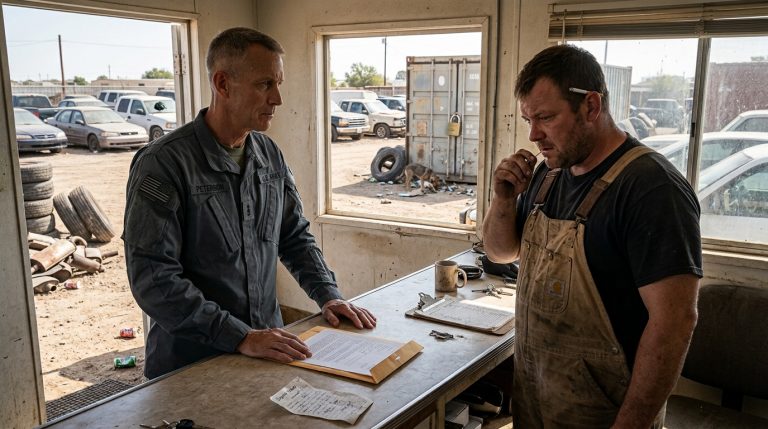
The man was older than Henry, his hair a shock of white cropped close to his scalp, wearing a clean, pressed barracks cover that looked as though it had been kept in a vacuum-sealed bag for forty years. He didn’t speak as he entered the garage; he simply navigated the space with the economy of motion that only comes from decades of drill, stepping around the stacks of paperbacks and the boxes of fishing tackle without a glance.
He stopped in front of the folding table. His eyes—sharp, assessing, and unblinking—locked onto the wooden case.
“Rachel called,” the man said. His voice was a rasp, weathered by tobacco and time. He didn’t introduce himself, nor did he offer a handshake. He was a Gunny, and he knew exactly what the atmosphere of the room demanded: acknowledgment, not pleasantries.
Susan moved aside, her posture softening. She looked at the Gunny as if he were a ghost, or perhaps a guardian. The brothers, Caleb and his brother, had retreated into the background, their movements hushed and respectful, as if the sheer presence of this uniform had forced them into a formation they didn’t know they understood.
Henry stood his ground. He felt the Gunny’s gaze slide from the case to his face, a silent appraisal that transcended rank or age. It was a recognition of shared ghosts. The Gunny saw the way Henry stood, the way he carried the weight of the day, and for a moment, the two veterans stood in the center of the garage in a silence so profound it felt like a command.
“You’re the one who was there,” the Gunny stated. It wasn’t a question.
“November 18th, 1968,” Henry replied.
The Gunny nodded slowly. He stepped up to the table. He didn’t touch the case. He simply leaned forward, his hands clasped behind his back, and stared at the brass latches. He was looking for something—a confirmation of the story, or perhaps a validation of the man who had owned it. His eyes moved to the scuff, the mark on the wood that Henry knew so well, and for the first time, the Gunny’s rigid posture dipped, just a fraction of an inch.
“Model 70,” the Gunny whispered. “The Unertl mount.”
“It’s the one,” Henry said.
The Gunny reached out then. He didn’t lift the lid, but his fingers hovered over the brass, tracing the path of the latch with a tenderness that contradicted the hard, calloused exterior of his hands. He was reading the history etched into the grain of the walnut. He was calculating the friction, the wear, and the sheer, brutal probability of the rifle’s survival.
“I saw the report,” the Gunny said, his voice barely audible. “Not the citation. The internal report. The one that never made it to the files in DC.”
Henry felt a prickle of cold air traverse his spine. He hadn’t expected this. He had expected a nod, a handshake, maybe a shared moment of silence—not an intrusion of the records he had kept buried for fifty-six years.
“Which report?” Henry asked.
“The one about the withdrawal,” the Gunny replied, finally turning his head to look at Henry. His eyes were hard, but there was a flicker of something beneath the surface—not judgment, but a recognition of the cost. “They said the rifle didn’t come back with the unit. They said it was lost in the draw, left behind during the repositioning.”
Henry felt his heart stutter. The decoy was shifting. He had come here to honor a memory, to bridge a gap, but he had inadvertently pulled on a thread that was tied to something much larger, something that had been scrubbed from the official history of that day.
“It wasn’t lost,” Henry said, his voice tightening. “Tom brought it out. I watched him do it.”
“Then the records are wrong,” the Gunny said, his eyes scanning Henry’s face with a new, sharper intensity. “Or the story is more complicated than you told these children.”
The brothers stepped forward, their faces illuminated by the harsh, unfiltered light of the garage. The air was thick with the scent of floor wax, old paper, and the sudden, sharp tang of ozone, as if a storm were brewing outside the farmhouse. Henry looked at Susan, then at the Gunny, and realized with a sickening jolt of clarity that the rifle wasn’t just a symbol of the past. It was a piece of evidence.
The Gunny turned back to the case, his hand resting firmly on the lid. “A Bronze Star with a ‘V’ device,” he said, his voice carrying clearly to every corner of the garage. “That’s what the books say. But if he carried this rifle out of that draw, and if he did what you told these people he did… then why was he never cleared for the Silver?”
Henry felt the garage close in around him. He hadn’t come for a fight, but as the Gunny continued to stare at the rifle, he realized that some truths were meant to stay buried, and he had spent his entire life making sure they did. He had to decide: hold the line, or let the past finally speak.
CHAPTER 5: THE DRIVE HOME
Henry didn’t retreat. He stood his ground on the concrete, his legs feeling every bit of his seventy-seven years, but his posture remained as rigid as the rifle stock in the case. He saw the way the Gunny’s jaw tightened, the way the man’s eyes flickered toward the family—Susan, her knuckles white as she gripped her bag; the brothers, who had stopped whispering, their faces pale in the fading light.
“The history books have a way of being curated,” Henry said, his voice low and dangerous. “Especially when the people who wrote them weren’t there to see the mud.”
“I was there,” the Gunny countered, his voice snapping like a flag in a gale. “I was on the radio when your unit called in the status of that rifle. I know what the report said. It was listed as destroyed in the draw to prevent it from falling into enemy hands. If it’s sitting here, in a walnut case, fifty-six years later… then someone didn’t follow orders.”
Susan stepped forward, her movement sudden and sharp. “It doesn’t matter,” she said. Her voice wasn’t weak; it was the voice of a woman who had just seen her father’s shadow turn into something larger, something more human. “It doesn’t matter what the report says. He kept it. He kept it because it was all he had left of the man who saved him.”
The Gunny looked at her, then back at Henry. He didn’t yield, but the fire in his eyes dimmed, replaced by a weary, heavy recognition. He understood the pact. He had been a part of that world long enough to know that some rules were meant to be broken by the men who lived through the consequences. He reached out, his hand finally resting on the lid of the case, and with a slow, deliberate motion, he clicked the brass latches shut.
“You’re a long way from home, Caldwell,” the Gunny said.
“I’m going,” Henry replied. He took his cap from his head, the worn fabric feeling like the only familiar thing in a world that had suddenly turned jagged and strange.
He didn’t say goodbye to the family. He didn’t have to. He turned and walked out of the garage, the late afternoon sun hitting him with a sudden, blinding intensity. The walk to his truck felt like a long, slow climb through deep water. Every step was a negotiation with his own joints, his own history, and the sudden, overwhelming realization that he had brought the war home with him, right into the middle of a Tennessee Saturday.
He climbed into his 1998 Ford pickup, the seat springs groaning under his weight. He didn’t start the engine immediately. He sat in the silence, watching the garage through the windshield. He saw Susan standing in the center of the garage, her hand resting on the case, the brothers standing nearby in a formation that looked, to Henry’s tired eyes, like a guard.
He turned the key. The engine coughed, sputtered, and finally caught with a familiar, rattling roar that shook the dashboard. He put it in reverse, the gears grinding with the familiar protest of old, neglected metal.
He drove away, slowly, the tires crunching over the gravel driveway. He didn’t look in the rearview mirror. He focused on the road ahead, the way the light played off the rusting edges of the tobacco barns, the way the shadows stretched long and thin across the Baptist cemetery he passed on his way to the highway.
He was tired—a deep, cellular fatigue that no amount of sleep would ever truly cure. He had come here to pay his respects, to find a moment of peace in the quiet echoes of a man he had loved like a brother. Instead, he had ripped open a wound that had been healing for over half a century.
He reached the highway, the truck vibrating as he accelerated. The air coming through the open window was cooling, smelling of damp earth and the oncoming evening. He reached into his jacket pocket and pulled out the photograph Susan had given him. He held it in his left hand, his eyes flicking from the road to the faces of the two boys, grinning into a future they couldn’t see.
He hadn’t brought the rifle with him. He hadn’t brought the truth of that day. He had only brought the memory, and as he drove, he realized that for the first time in his life, he wasn’t carrying it alone. The family knew. The Gunny knew. The pact of silence was broken, and as he looked out at the rolling hills, he felt the first, faint stirrings of a peace he hadn’t known he was allowed to keep.
The road ahead was empty, the shadows deepening into a comfortable, cool gray. He kept his hand on the steering wheel, his eyes on the horizon, driving into the sunset, carrying the weight of the story one last time toward the only home he had left.
CHAPTER 6: THE MANTLEPIECE
The living room was quiet, filled with the soft, ticking rhythm of a grandfather clock that hadn’t been wound in months. The air inside felt different than the dusty, frantic atmosphere of the garage; here, the space was curated with a gentle, deliberate care. Above the fireplace, the glass case Caleb had built caught the afternoon light, refracting it into soft amber pools across the hardwood floor.
The Winchester sat inside, its steel bluing muted by the glass, the serial number ending in 4471 clearly visible to anyone who cared to look. Beside it, the black-and-white photograph of two young Marines—thin, dust-streaked, and grinning against the weight of a world they were trying to hold together—was mounted on heavy archival board. Below it, the brass plaque Caleb had engraved caught the light: Sergeant Thomas Mercer, USMC. Quiet man. Hero. We didn’t know, and now we do.
Susan was waiting in the kitchen, the scent of coffee drifting into the living room, a grounding, domestic tether to the present. She looked up as Henry entered, her expression no longer masked by the guarded suspicion of the estate sale. It was open, softened by the six months of questions, letters, and quiet conversations that had redefined her understanding of the man who had been her father.
“The children are coming over,” she said, her voice warm. “Caleb and Rachel. They wanted to see you.”
Henry nodded, his gaze lingering on the mantle. “That’s good. That’s how it should be.”
He walked over to the fireplace, his boots silent on the rug. He reached out, his hand hovering inches from the glass. He didn’t touch it; he didn’t need to. He could feel the cold, solid reality of the rifle through the barrier, the same rifle that had held the line in the Queson Valley. The truth—the real, raw truth—wasn’t the medal or the records that had been lost in the bureaucracy of the war; the truth was that Tom had brought it home, not as a trophy, but as a silent, physical anchor to a pact they had made in the mud. They had carried the weight so their children would never have to touch the fire.
Caleb arrived a moment later, his face lighting up when he saw Henry standing by the fireplace. He was carrying a small, worn box—the same shoebox of photographs from the estate sale, now reorganized and protected in plastic sleeves.
“I found these in the back of the closet, Henry,” Caleb said, setting the box down on the coffee table. “There were letters. Some of them from 1972. They were addressed to you, but they were never mailed.”
Henry felt his breath hitch. He turned from the mantle, his heart hammering a soft, slow rhythm against his ribs. He sat down on the sofa, the cushion giving under his weight, and opened the box. There, beneath a stack of faded service ribbons, were the envelopes—handwritten in Tom’s careful, blocky script, the stamps long expired, the ink softened by the passage of time.
He pulled one out, his hands finally steady. He didn’t read it aloud. He didn’t need to. He recognized the cadence of the sentences, the familiar, quiet tone of a man who had survived hell and was trying, in his own way, to navigate the peace.
“He never stopped trying to find you,” Caleb said, sitting on the edge of the chair, his hands clasped. “He just… he didn’t know how to reach out without bringing the noise with him.”
Henry looked at the letter, then at the rifle in the glass case. The final piece of the mystery clicked into place. The silence wasn’t a rejection; it was a sanctuary. Tom hadn’t been keeping secrets to hurt them; he had been building a perimeter of normalcy, protecting them from the ghosts that still haunted his own dreams. And now, the perimeter had been breached, not by war, but by the healing, messy, beautiful truth of memory.
The denouement of the day was slow, a quiet settling of dust. They spent the next few hours sitting in the living room, the late sun dipping below the tree line, casting the house into a warm, amber glow. They didn’t talk about the ambushes or the rifles or the missing records. They talked about the man Tom had been—the way he hummed Hank Williams in the shower, the way he meticulously maintained his garden, the way he sat on the dock, watching the water, finding a peace that had taken him a lifetime to earn.
Henry reached out and touched the brass frame of the photograph on the mantle, his thumb lingering on the image of his younger self. The internal battle, the decades of holding the silence, suddenly felt small—a necessary burden that had finally been set down. He looked at Susan, then at Caleb, seeing the continuity of a family that had finally been given the history they deserved.
As evening turned to twilight, Henry stood up to leave. He felt lighter, as if the armor he had been wearing since 1968 had finally been stripped away, leaving only the man beneath. He walked to the door, his steps sure, his posture straight. He wasn’t leaving anything behind—he was taking the peace with him.
“I’ll be back in November,” Henry said, pausing in the doorway.
“We’ll be here,” Susan replied, her hand resting on the mantle, just below the case.
Henry walked out to his truck, the evening air cool and smelling of pine needles and damp earth. He looked back at the house one last time. It was a home, warm and grounded in the middle of a world that often forgot the quiet, ordinary people who had held it all together. He started the engine, the familiar rattle a comfort in the quiet night, and turned onto the road, driving away into the darkness, finally, truly, at rest.