The Salt and the Iron: A Veteran’s Quiet Stand Against the Tide of Corporate Greed
CHAPTER 1: THE WEIGHT OF SALT
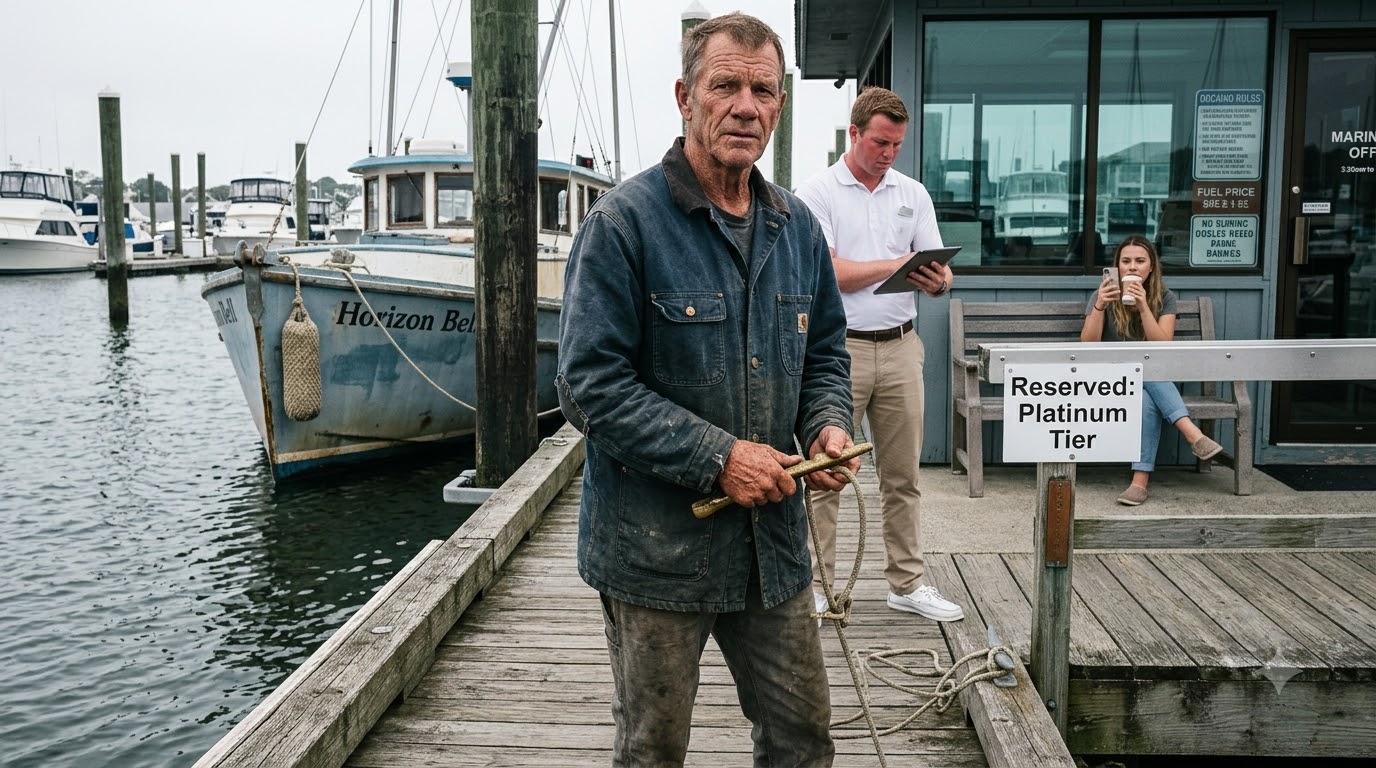
The diesel exhaust from the morning ferry hadn’t even cleared the pilings when I saw the fresh white paint on Slip 12.
A silver plate, held down by four stainless steel tap-screws, gleamed against the weathered cedar. Reserved: Platinum Tier.
I didn’t raise my voice. I just turned the brass cleat tool over in my palm, feeling the cool, pitted surface against my calluses. Behind me, the tide was coming in heavy against the hull of the Horizon Bell, the wood groaning against the hemp fenders like an old joint in winter.
“You’re in the wrong lane, Briggs.” Chad Ellison didn’t look up from his tablet. His polo shirt was tucked tight enough to show the outline of his keycard, his white boat shoes spotless against the salt-crusted deck. “Effective six zero zero hours, this slip is reallocated.”
“I’ve tied off here since eighty-nine, Chad,” I said. My voice stayed down in my chest, low and dry as dry-dock timber. “The town charter guarantees birth rights for active volunteer instructional craft.”
“The town sold the management rights to Coastline Holdings three months ago,” Chad replied, his thumb sweeping across the glass screen. “Visual compliance standards went into effect midnight. Wooden hulls over twenty years old require a secondary aesthetic clearance. You don’t have one.”
He finally looked at me, squinting against the glare off the water. He didn’t see the four coats of spar varnish I’d brushed onto the mahogany gunwales by hand last April. He just saw an old man in a scuffed denim coat standing in the way of a five-hundred-dollar-a-day slip fee.
“Miss Jennings has eight fifth-graders arriving at eight thirty,” I said, tapping the edge of the brass tool against my thigh. “We’re running tide calculations today.”
“They can run them from the public beach,” Chad said, turning his back to inspect a cleat. “Move the boat to the fuel dock by eight, or I call the harbor master’s contract tow line. It’s a six-hundred-dollar release fee.”
A young woman sitting on the patio bench fifty feet away froze with her coffee cup halfway to her mouth, her phone camera angled toward the pier. I didn’t glance at her. I just looked at the fresh epoxy Chad had slopped over the base of the dock post to cover the tarnished copper marker near my feet.
“The fuel dock has four feet of draft at low tide, Chad,” I said quietly. “The keel will hit mud by noon.”
“Then I suggest you pull her out of the water,” Chad said, stepping around my mooring line without touching it. “This marina serves paying clients now. We don’t serve people like you.”
The silence on the dock stretched thin, tight as a three-strand nylon line under a heavy load. I didn’t argue. I didn’t swing the brass tool in my hand. I just bent down, unlooped the bow line from the horn cleat, and watched Chad’s immaculate white shoes walk away toward the glass doors of the manager’s office.
CHAPTER 2: LINES IN THE TIDE
The diesel slicks around Dock 6 smelled like stale kerosene and rot.
I cleated the forward spring line to a rusted iron hoop, watching the tide pull the stern dangerously close to the creosote-soaked pilings. At four feet of depth, the mud below was already visible through the brown water, smooth and thick as wet cement.
“You can’t tie off there without a hazard permit, Mr. Briggs.”
I didn’t turn around right away. I pulled my pocketknife from my coat, using the dull spine of the blade to scrape a crust of dried brine off the starboard rail.
Behind me, Dennis—Chad’s assistant harbor master—stood on the concrete ramp, clutching a clipboard like a shield. He was a local kid, twenty-two, whose uncle used to run the bait shop before the franchise bought the lease.
“The hazard permit is for vessels carrying bulk fuel, Dennis,” I said, folding the knife with a sharp snap. “I’m carrying three wooden oars, two life rings, and forty gallons of marine diesel.”
“It’s the new policy,” Dennis said, his voice dropping an octave as if Chad might be listening from the air-conditioned glass office three hundred yards away. “Anything docked in the service channel has to submit an environmental inspection log. Within two hours. Or it gets flagged for civil impound.”
I looked down at the mud beneath the hull. The tide was falling fast. In ninety minutes, the keel would settle into the silt, tilting the deck fifteen degrees starboard.
“Show me the survey map, Dennis.”
He hesitated, shifting his weight on the slick concrete. “What map?”
“The structural survey Coastline Holdings filed with the county clerk last month,” I said, stepping off the gunwale onto the slippery lower rung of the iron ladder. “The one they used to rezone Slip 12 from public access to private birth.”
Dennis looked down at his clipboard, his fingers twitching against the plastic clip. He didn’t answer. He didn’t have to. The silence carried the exact weight of a lie told by someone who knew he was earning twelve dollars an hour to cover for a six-figure fraud.
“They didn’t re-survey the harbor floor, did they?” I asked, taking one step up the ladder until I was eye-level with his work boots. “They copied the 1998 Army Corps blueprint and pasted new berth numbers over the utility lines.”
“I just deliver the notices, Walter,” Dennis muttered, looking past my head toward the bay. “Chad said if the boat isn’t cleared or moved by eleven, the contract tow comes out.”
“Tell Chad I’m working on the clearance,” I said.
I reached into my coat pocket, pulled out the brass cleat tool, and laid it flat on the clipboard right over his paperwork. The heavy metal pressed into the paper, leaving an imprint of salt and iron across the header.
“And tell him the low-tide mark at Slip 12 hasn’t changed since the town built the retaining wall in seventy-four.”
CHAPTER 3: THE PAPER TRAP
The tow vessel was twenty-four feet of molded fiberglass, painted bright corporate blue with Coastline Fleet Operations stenciled across the gunwale in bold vinyl letters.
The man at the helm wore mirrored sunglasses and a yellow high-visibility vest that smelled faintly of new plastic. He didn’t idle long before cutting the engine entirely, letting the momentum slide the rubber rub-rail right against the starboard quarter of the Horizon Bell.
“You’re tagged for administrative removal, old man,” the driver called out, leaning against the center console without cutting his ignition. “Got the work order right here from management. Slip 6 safety violation.”
I didn’t step back. I kept my weight centered over the keelson, my right hand resting flat on the pitted brass cleat tool in my pocket.
“The safety violation notice was filed forty minutes ago,” I said, my voice cutting cleanly through the putter of the idling exhaust. “County maritime code requires a four-hour cure window for non-structural infractions. You’re two hours early.”
“I don’t read county codes, Briggs,” the driver spat, tossing a yellow nylon tow line toward my deck. “I read work orders. Hook the eyelet or I drop the winch and drag you out into the channel.”
The line hit the pine decking with a sharp, hollow thud, sliding two feet before stopping against the cockpit coaming.
I looked past him toward the glass-fronted marina office on the upper tier. Chad Ellison was standing behind the tinted window, watching us with his arms crossed over his chest, his posture stiff with absolute arrogance. He thought he had engineered a clean, frictionless removal backed by corporate paperwork and a rented tow boat.
“Go ahead and drop the winch,” I said quietly.
The driver paused, his hand hovering over the hydraulic lever on the console. “What did you say?”
“If you hook onto a vessel that has a pending county tax exemption filing on record, you assume personal liability for maritime salvage tampering,” I said, stepping right up to the gunwale until my chest was inches from the rubber bumper. “Look at the transom, son. Check the registration numbers against the county register before you touch my rigging.”
The driver blinked behind his mirrored lenses, his fingers pulling back from the lever as uncertainty flickered across his face.
“That’s a commercial obstruction fine of ten thousand dollars,” I added, letting the dry weight of the words settle into the damp air between us. “And Coastline Holdings won’t reimburse your deductible when the port authority audits their lease on Monday.”
He stared at me for three long seconds, then glanced up toward the glass office. Chad was tapping furiously on his phone now, his face flushing a dull red behind the tinted pane.
CHAPTER 4: CONCRETE AND COPPER
“Send him away, Dennis,” Chad barked, waving a hand toward the tow boat driver without slowing his stride. “I’ll handle the paperwork directly with the town attorney.”
The tow driver didn’t need to be told twice. He shoved his throttle forward, spraying a cloud of black diesel exhaust over the pilings as the blue boat backed out into the open bay.
Chad stopped two feet from me, his chest rising and falling beneath his tight marina polo. A thin sheen of sweat had ruined the carefully applied lotion on his forehead, catching the harsh mid-morning glare off the water.
“You think you’re clever with the tax exemption filing, Briggs?” Chad said, his voice dropping into a low, harsh whisper. “That loophole was closed when the town board authorized our management contract. You’re trespassing on private commercial property.”
“A management contract can’t override a municipal deed restriction, Chad,” I said, keeping my posture steady as the tide continued its steady retreat beneath us.
I stepped off the wooden ramp onto the exposed concrete footing of Slip 12. The falling tide had exposed another six inches of dark, mossy stone near the base of the main piling.
“The town board didn’t sell you this harbor,” I said, pointing down with the tip of my work boot toward the thick layer of white epoxy Chad had poured over the post corner two days ago. “They leased you operational rights. Subject to the 1974 public utility easement.”
Chad’s eyes darted down to where my boot rested against the concrete, his left cheek twitching once before he regained his composure. “That’s ancient history. The re-zoning plot was approved by county engineering.”
“They approved a plot based on falsified mud-line soundings,” I said, pulling my pocketknife back out and kneeling on the damp stone. I jammed the steel blade right into the edge of the fresh epoxy, prying up a thick, brittle chunk.
Underneath the white shell, the tarnished face of the original brass boundary marker gleamed dull green in the sunlight, the engraved letters US COASTAL SURVEY – PUBLIC EASEMENT DOCK 12 clearly legible against the dark metal.
Chad took half a step back, his phone slipping an inch in his palm before he gripped it tighter. “That doesn’t prove anything. A marker on a post doesn’t invalidate an engineering filing.”
“It proves your survey team never inspected the harbor floor,” I said, standing up slowly while wiping the scrapings off my blade onto my jeans. “It proves Coastline Holdings buried a public record to build a mega-yacht berth. And if the county clerk sees this metal before noon, your municipal lease goes into immediate administrative review.”
CHAPTER 5: THE ESCALATION PHASE
“Lock the access gate, Dennis!” Chad screamed down the pier, ignoring whoever was speaking through his phone speaker. “Right now! Padlock the ramp!”
Dennis stood twenty yards up the gangway, holding a heavy steel chain and an orange padlocked chain-link gate. His hands hovered over the latch, his face pale as he looked from Chad to me.
“Chad, the county harbor inspector’s truck just pulled into the upper lot,” Dennis called down, his voice unsteady against the rising wind. “He’s got the municipal deed folder with him.”
Chad didn’t answer. He jammed his phone into his pocket and marched up the ramp, snatching the heavy chain straight out of Dennis’s hands. He wrapped the links twice around the iron handrail, snapping the brass padlock shut with a sharp, echoing clatter.
“Nobody leaves this dock area until security clears the perimeter,” Chad announced, turning around to face the gathering crowd of local boaters and tourists near the patio railings. “We have an unauthorized trespasser tampering with private marina infrastructure.”
I didn’t move from the concrete footing. I just reached down, picked up a piece of the chipped white epoxy, and weighed it in my palm alongside the brass cleat tool.
Miss Jennings stood at the top of the ramp outside the chain-link fence, holding two fifth-graders by their hands. Lena Cho was right behind her, holding her phone steady above the crowd’s heads, the screen recording every second of Chad’s rising volume.
“You locked a public access ramp while a registered instructional vessel is tied to the lower berth, Chad,” I said, stepping up to the bottom rung of the locked gate. “That’s a Class B maritime safety violation under state port regulations.”
“This isn’t a public ramp anymore!” Chad shouted, his face turning dark red as he pointed a finger through the wire mesh. “Coastline Holdings controls ingress and egress! Your boat is an unlicensed hazard, and you’re done in this harbor!”
“Check the lock, Chad,” I said quietly, tapping the brass cleat tool against the steel chain links.
The county inspector—an older man in a navy windbreaker holding a thick leather blueprint binder—stepped up right beside Dennis. He didn’t say a word to Chad. He just pulled a pair of silver reading glasses from his pocket, adjusted them on his nose, and looked down at the uncovered brass marker gleaming on the post below us.
Chad’s breath hitched in his throat as the inspector opened the binder, pulled out a yellowed municipal parchment, and matched the GPS coordinates stenciled on the page directly to the brass marker at my feet.
“You’ve got five minutes to cut that lock, Ellison,” the inspector said, his voice flat and entirely devoid of heat. “Or I call the sheriff to execute a municipal easement warrant.”
Chad backed up against the wire mesh, his jaw working silently as he looked from the inspector’s badge to the crowd of thirty people watching him in total silence.
CHAPTER 6: THE UNBROKEN ANCHOR
Chad dropped to his knees, his spotless white boat shoes skidding on the algae-slick pine as he clawed frantically at the cracks between the deck boards to retrieve the ring.
“It’s a temporary management lock!” Chad yelled, his voice straining into a desperate screech as he looked up at the county inspector. “The state port authority doesn’t have jurisdiction over private commercial access contracts! My legal team will file an injunction before noon!”
The inspector didn’t even look down at him. He pulled a heavy pair of steel bolt cutters from his leather binder case, set the jaw against the shank of the padlock, and put his full weight onto the handles.
The steel snapped with a sound like a pistol shot. The heavy chain slithered off the rail and hit the deck in a heap.
“Coastline Holdings’ operating permit is suspended pending a full municipal land audit,” the inspector said, pushing the gate wide open. “And as of this second, Mr. Ellison, you are no longer authorized to enforce dock regulations on town property.”
Chad scrambled to his feet, his shirt rumpled and stained with green bilge grime at the knees. He looked around the crowd, waiting for someone—a yacht owner, a board member, a tourist—to step forward and back him up.
Nobody moved. Dennis quietly stepped past him, took the bolt cutters from the inspector, and held the gate open for Miss Jennings and her students.
“You can’t do this!” Chad shouted, backing toward the manager’s office while pulling his phone out again. “I built this brand! This marina was nothing before we brought in the expansion team! You’re destroying millions in private investment!”
“The town built this dock in seventy-four, Chad,” I said, stepping through the open gate onto the main pier. “And wood holds up a lot longer than fake survey papers.”
He stared at me for one long, silent second, his mouth opening and closing without a sound. Then he turned on his heel and walked briskly up the asphalt path toward the parking lot, his phone clamped tight to his ear as his voice faded into the morning traffic.
Two hours later, the rising tide brought five feet of clear, green saltwater back into Slip 12.
I stood on the deck of the Horizon Bell, slowly looping a thick length of fresh three-strand cotton line around the horn cleat on the forward deck. Beside me, Miss Jennings’ fifth-graders sat along the mahogany rail, watching the water rise over the brass boundary marker below.
I reached into my coat pocket, took out the pitted brass cleat tool, and laid it neatly inside the wooden tool chest by the helm.
The water tapped gently against the hull, steady and clean, just like it always had.