Breaking the Stone: How a Weary Squad of Civilian-Soldiers Shattered an Elite European Defense Line
CHAPTER 1: THE FROSTLIT MAP
The oil lamp flickers against the damp grain of the wooden table. Outside, the December wind claws at the canvas of the command post three kilometers behind the German lines in Ortona. Major Klaus Verer presses his thumb against the edge of a casualty report, feeling the coarse grain of the paper. His finger shakes, just a fraction of a millimeter, betrayed by the cold seeping through the floorboards.
Across the table, Colonel Friedrich Brown leans forward, the light catching the sharp lines of his tired face. The intelligence documents spread between them make no operational sense. For six months, their defensive lines have held fast against British and American formations by relying on predictable patterns. They know when the enemy rests. They know where the armored columns must crawl. But the numbers coming from the sectors facing Canadian troops mock every manual in the German military archive.
Losses are forty percent higher. In some engagements, sixty. Verer looks up, his breath pluming in the unheated tent. The elite paratroopers holding these positions are veterans of relentless combat across Europe and Africa, yet their strongly fortified strongpoints are collapsing in hours instead of days.
Brown reaches out and taps a reconnaissance photograph with the blunt edge of a scarred brass pocket watch. The image shows a Canadian camp during daylight, unnaturally quiet, equipment sitting idle under gray skies. But Brown’s pencil moves to the night logs. The camps empty entirely after dark. They do not attack at dawn or dusk as doctrine dictates. They strike at two in the morning, moving through freezing mud and shattered masonry when every rule says an army should sleep.
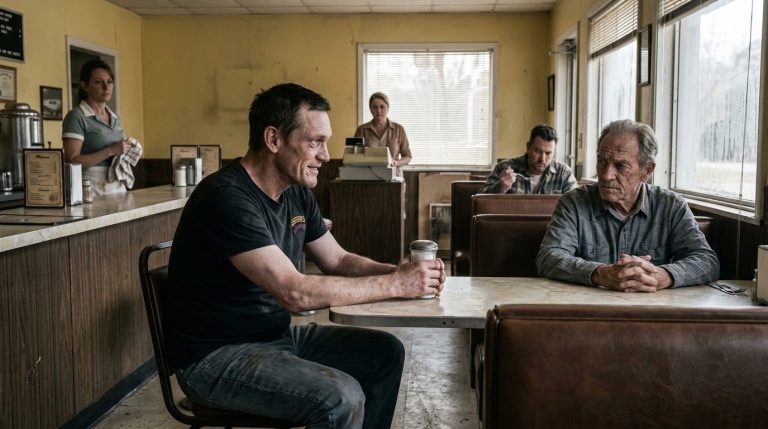
Verer pulls a captured diary from the pile, its pages smelling faintly of damp wool and pipe tobacco. The entries belong to a farmer from a place called Saskatchewan, a man who wrote of fixing tractors and planting wheat just months before crossing an ocean to tear through heavily reinforced stone buildings. The disconnect between that simple background and the brutal efficiency of the front-line assaults leaves a heavy, metallic taste in the back of Verer’s throat.
Brown closes the leather folder with a soft, final thud that rattles the empty tin cups on the table. The high command in Berlin dismissed these troops as ordinary colonial reserves, but the bodies piling up in the Italian hills tell a different story. The quiet sector outside is holding its breath, and neither man knows whether the next five minutes will bring peace or a silent advance straight through their solid stone walls.
CHAPTER 2: THE SILENT ADVANCE
The freezing mud sucks at the heavy boots of the men moving out in the absolute blackness. There are no trumpets here, no orderly formations marching down the paved center of the road. Standard doctrine dictates that an army rests when the stars come out, but the Canadian columns ignore the calendar entirely.
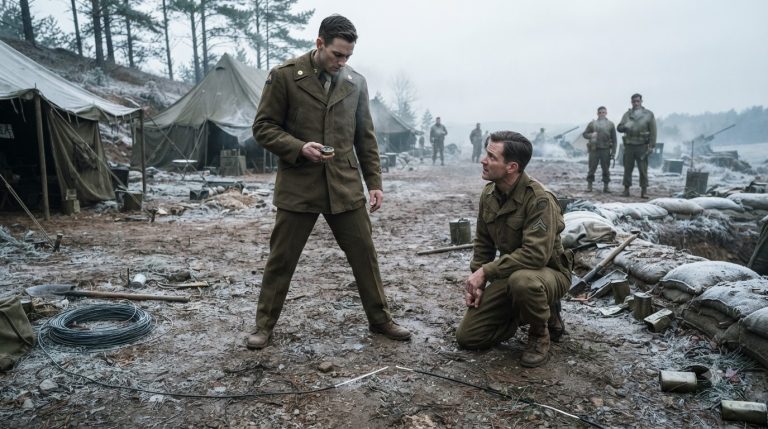
Lieutenant Miller adjusts the strap of his webbing, feeling the familiar weight of his rifle bite into his shoulder. Beside him, Sergeant Thomas checks the winding of the scarred brass pocket watch by touch alone, his thumb sliding over the dented casing in the dark. They are moving across open fields toward a ridge that German intelligence maps mark as entirely dormant.
The wind carries the faint, dry scent of woodsmoke from a distant farmhouse, wrapped in the damp smell of rotting vegetation. Every step requires a deliberate calculation against the frost, boots sinking inches into the stiffening soil before lifting clear with a dull, sucking pop.
A low murmur ripples down the line, passed hand-to-hand without a raised voice. A wire fence blocks the path, cutting diagonally across a neglected orchard where frozen apple branches scrape against their helmets like skeletal fingers.
Miller pauses at the obstruction, reaching down to unclip the wire cutters from his belt. There is no waiting for dawn bombardment, no coordination with distant corps commanders looking at stale maps. The advance relies entirely on the cold calculation of men moving through the blind hours when the enemy expects quiet.
The metal jaws clamp down on the rusted strand, and the single snap of the wire rings out like a pistol shot in the still night air. Miller freezes, his eyes fixed on the dark silhouette of the ridge looming two hundred yards ahead, waiting for the searchlights or the rattling stutter of a defensive machine gun that never comes.
CHAPTER 3: BLASTING THE STONE
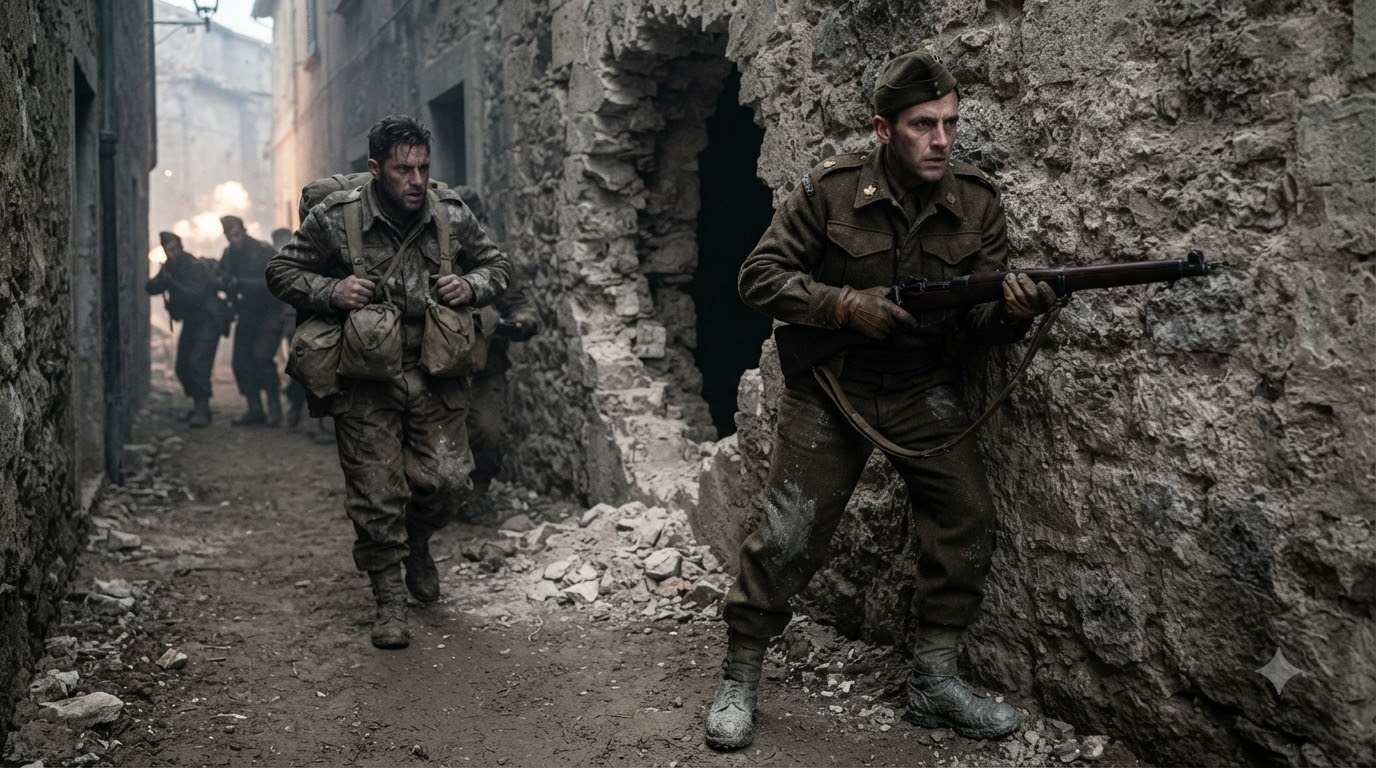
The narrow alleyways of Ortona offer no room for grand maneuvers. Thick stone walls enclose every street like a maze built to trap conventional infantry in deadly crossfire.
Lieutenant Miller signals behind him, his hand cutting through the damp dust hanging thick in the air. Beside him, Dennis hefts a heavy canvas bag filled with shaped explosive charges, his breathing raspy in the freezing air. Standard military doctrine says an army should advance down open roads under the protection of heavy armor. But the streets here are death traps covered by fixed machine gun nests.
Miller presses his back against the rough, freezing surface of a two-foot-thick masonry wall, feeling the steady vibration of distant artillery deep through his boots. There is no waiting for permission from a distant commander. The only way forward requires breaking the physics of the town itself.
Dennis slips a explosive pack into a narrow crack near the base of the stone structure, pressing the detonator cord into the mortar line. The masonry groans under the silent pressure of the impending blast.
Miller checks his watch by the dim glow of a match, his thumb brushing the cold metal casing. He motions the squad back into the recessed doorway of an abandoned bakery, waiting out the micro-second before the charge blows.
The detonation is a dull, muffled thud that vibrates through the bedrock rather than ringing through the air. A cloud of gray dust billows outward, tasting sharply of crushed lime and old mortar. The explosion rips a clean, meter-wide hole straight through the solid stone wall, opening a secret path directly into the adjoining building without ever stepping foot onto the deadly street outside.
Miller crawls through the jagged opening first, his rifle held tight against his chest, emerging into the dark, smoke-filled parlor of a house the enemy believes is entirely secure behind its outer defenses.
CHAPTER 4: THE MONTGOMERY MEMO
The filtered light cuts through the indoor haze, revealing papers stamped with high-command seals scattered across the floorboards. Major Verer stands in a command tent miles away, but the physical evidence of his panic litters this captured room.
Dennis steps through the smashed masonry behind Miller, his boots crunching on broken glass. He kicks a fallen chair aside, his face grim with exhaustion.
— Look at these deployment ledgers, — Dennis mutters, pointing a gloved finger at a carbon-copied directive bearing the red stamp of the 10th Army Command.
Miller scans the typed lines, the cold logic of the enemy laid bare in black ink. The document does not suggest or request; it commands all German units to increase sector troop strength by fifty percent anywhere Canadian forces deploy. They require fifteen hundred men where a thousand used to suffice, simply because traditional doctrine is falling apart under the weight of unannounced night strikes and mouse-holed walls.
Outside, a courier arrives at the German rear headquarters carrying objections written by British commanders who call these rapid methods reckless and wasteful of resources. But the captured directive tells the real truth. The enemy fears this speed more than any methodical, slow-moving bombardment.
Miller folds the intercept and tucks it into his breast pocket, feeling the stiff paper press against his ribs.
— They can call it reckless all they want, — Miller says, wiping a streak of dry mortar dust from his forehead. — The enemy just admitted they need half a division extra just to sleep at night.
CHAPTER 5: THE VALLEY TRAP
The narrow valley between the hills compresses the sound of the artillery into a continuous, physical wave that rattles the teeth in Miller’s jaw. Shells land every twenty meters along the twelfth-kilometer front, creating an unbroken wall of fire that blots out the afternoon sun with thick, oily smoke.
Dennis presses his shoulder against the damp earthen wall of the trench, his ears ringing from the sustained concussive roar. There is no room for hesitation or waiting for slow, methodical reinforcements; the valley floor is a churned wasteland of cratered earth and twisted metal.
— Keep moving! — Miller shouts, his voice stripped raw, pressing his mouth directly against Dennis’s ear to cut through the deafening noise.
The heat rising from the burning transport vehicles down the slope makes the air shimmer and turn dry, raising the temperature to a suffocating degree even in the freezing winter air. German units attempting to retreat find their escape routes systematically closed by the relentless wall of high-explosive impacts.
Miller checks his pocket watch by the red glow of a nearby burning truck, noting the precise timing of the creeping barrage. The enemy command structure is buckling under the weight of this unyielding pressure, unable to predict where the next coordinated strike will land.
Dennis hefts his rifle, his knuckles white against the wooden stock as he scans the swirling smoke ahead for any sign of movement. They are closing the final pocket of resistance, forcing the adversary into a corner with nowhere left to run.
CHAPTER 6: THE NEW DOCTRINE
The smoke finally clears from the ruined hillsides, leaving behind a cold, gray silence that settles heavily over the shattered landscape. Major Verer sits among the detritus of a collapsed command tent, staring blankly at the final operational reports that confirm the total collapse of their defensive architecture.
Dennis lowers his rifle, the steel barrel cooling rapidly in the frosty air as the remaining enemy positions drop their weapons across the line. There are no grand speeches or cinematic celebrations, only the profound, bone-weary realization of men who have survived an impossible trial through sheer, stubborn common sense.
— It is over, — Dennis says, wiping a layer of cold soot from his cheek with the back of a raw, calloused hand.
Miller checks the pocket watch one last time, snapping the brass lid shut with a crisp, final click that echoes softly in the quiet morning. The rigid doctrines of the old military manuals lie in tatters, replaced forever by the hard-earned lessons of adaptability, initiative, and the refusal to break under unreasonable pressure.
They did not win by brute force or endless resources; they won by outthinking an entitled enemy who believed rules could substitute for reality.
Miller turns away from the smoking ridge, stepping carefully over the frozen turf toward the camp kitchen where a battered tin kettle sits waiting on a silent, cold stove.