The Quiet Eye of Saint Dié: How a Montana Elk Hunter Dismantled an Army’s Fortress in Four Hours
CHAPTER 1: THE VALLEY TRAP
The dirt beside my boot jumped three inches, spraying cold grit across my gaiters.
Across the open ground, somewhere up on the ridgeline buried deep beneath gray timber and slate, a German machine gun was hammering out a flat, rhythmic stutter that set my teeth on edge.
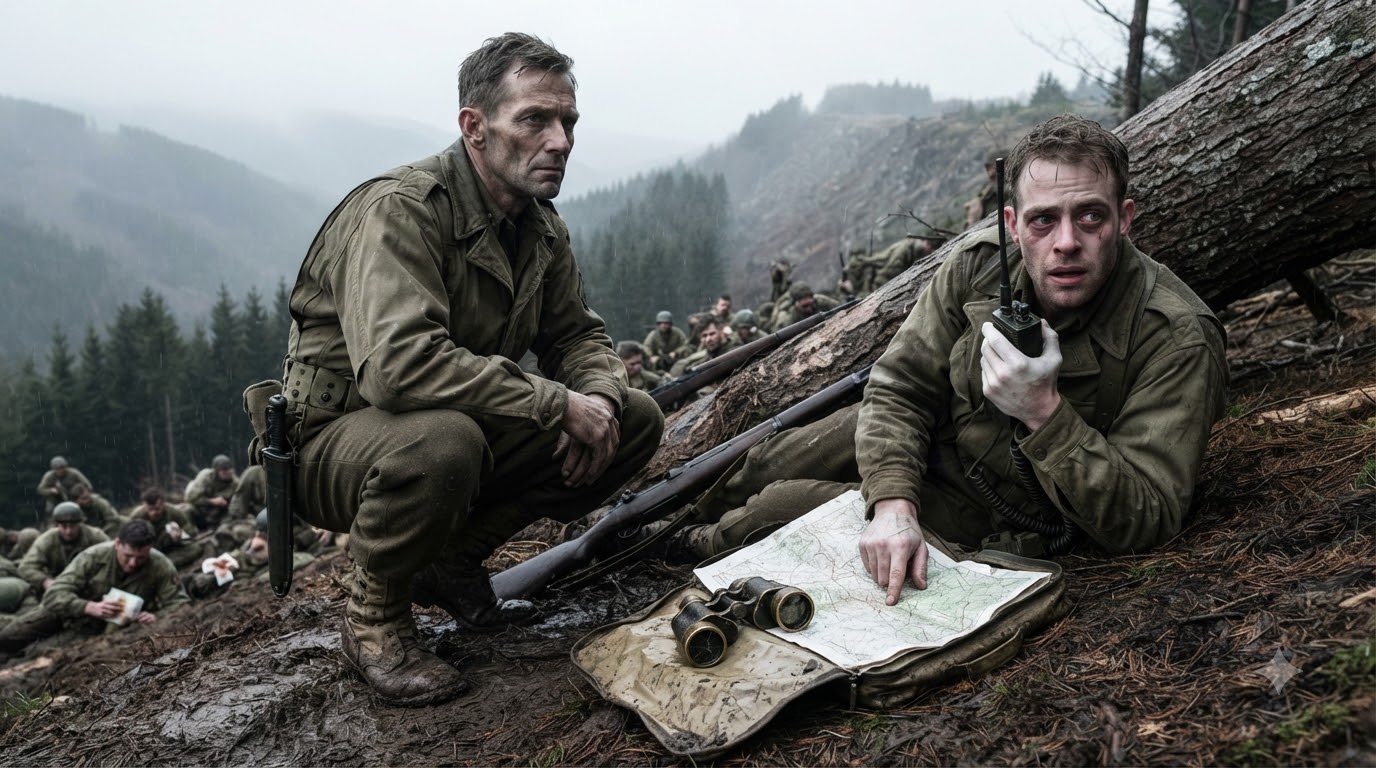
Lieutenant Hayes was pressed hard against the low rise of a fallen oak, his knuckles white around the grip of his radio handset.
“Battery Two, this is Baker Actual, we are pinned down in the open, coordinates are—” he started, his voice cracking against the roar of another burst chewing through the brush above us.
“Shut that box off,” I muttered, wiping a smear of greasy mud off the cracked lens of my binoculars.
Hayes looked back at me, his face pale under a week of stubble and freezing drizzle.
“We need a fire mission right now, Sergeant, or there won’t be anyone left to walk out of this valley.”
The Vosges Mountains looked entirely too much like the Bitterroot range back home, right down to the gray damp clinging to the pine needles and the steep, jagged fall of the ridges.
Except back home, the only thing shouting at you across a draw was a six-point bull elk wondering why you were standing on his trail.
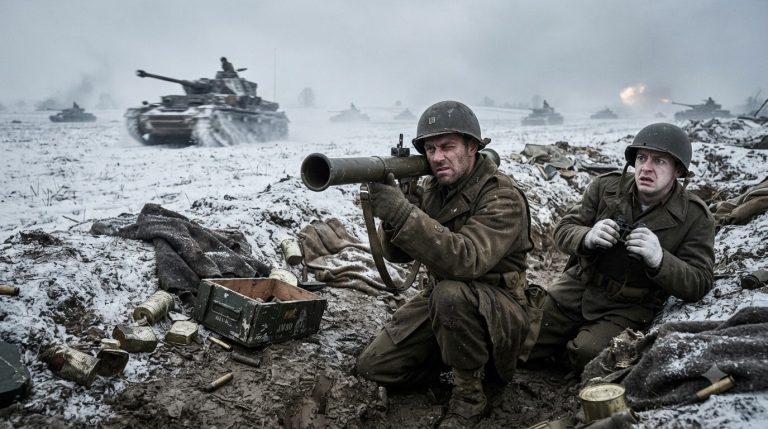
Around us, eighty men were jammed into shallow scrapes in the dirt, clutching their rifles and keeping their heads down while the high ground spat iron.
Hayes was staring at his map case, his thumb tracing contour lines that didn’t match the reality of the slopes rising across the valley floor.
“The rangefinder tops out at one thousand yards,” Hayes said, his breath pluming white in the freezing air as he pointed a shaking finger toward the upper ridge. “That bunker up there is sitting at least fourteen hundred. My first two rounds landed miles short.”
“Because maps flat-line the earth,” I said, resting my elbows on my knees and squinting through the steady gray mist. “You’re measuring horizontal distance. Mountains have vertical drop. The air gets thin, the shadows stretch out, and trees look smaller the higher up you go.”
Hayes blinked at me, wiping rain from his forehead with the back of a bloody glove.
“What does that have to do with anything?”
“It means you’re guessing,” I said, raising the heavy brass-rimmed glasses to my eyes and letting the cold metal press against the bridge of my nose. “And guessing gets men killed.”
CHAPTER 2: THE BLIND ARTILLERY
Hayes shoved the map case back into his canvas bag with a sharp, swearing breath that sounded like dry leaves scraping across frozen pavement.
“The coordinates are completely useless if we don’t know the vertical drop,” he muttered, wiping a streak of black cordite smoke across his cheek.
“Maps don’t account for wind drift across a fifteen-hundred-yard gorge or how pine timber eats an echo,” I said, keeping my thumb pressed against the adjustment wheel of the glass.
Across the gray valley floor, the second bunker blinked twice—a sharp, yellow-white flash of muzzle fire that vanished into the shadows before the sound even reached us.
Down the line, Corporal Miller was trying to stem a bleeding shoulder with a field dressing while cursing the high command for sending them into a textbook ambush without proper reconnaissance.
“Tell the battery to hold their fire,” I said, shifting my weight against the muddy root of a dead pine.
“Hold?” Hayes snapped, his eyes wide and bloodshot as another round clipped the branches overhead, showering us in frozen twigs. “They’ll chew this whole company to pieces in five minutes if we don’t lay down suppression.”
“They’ll waste ammunition hitting empty dirt if you use standard grid lines,” I said, my voice dropping an octave as I tracked the faint, unnatural blue haze hugging the upper tree line where the second bunker was anchored. “Look at the shadow angle on that northern cleft. The sun dropped three degrees since noon.”
Hayes hesitated, his fingers hovering over the Bakelite receiver of the SCR-300 radio like he was trying to defuse an unexploded shell.
“You’re telling me you can read range from a shadow?”
“I’m telling you that bunker is sitting two thousand one hundred and eighty yards out, give or take twenty paces,” I said, lowering the binoculars and looking straight into his panicked eyes. “Call it in or stay in the dirt. It’s your call, Lieutenant.”
CHAPTER 3: THE MOUNTAIN EYE
The radio receiver hummed with static that sounded like dry gravel rolling down a tin roof.
Lieutenant Hayes kept his eyes locked on my face, waiting for me to take the handset, his chest rising and falling in harsh, ragged gasps that plumed white in the gray air.
“Tell them,” Hayes whispered, his voice tightening as another machine-gun burst chewed the bark off a pine trunk three feet above our heads.
I didn’t take the handset right away.
Instead, I looked back across the valley to the upper ridge where the second bunker sat dug into the gray slate, remembering every elk hunt back in the Bitterroots when a miscalculation meant a four-hour hike down a wrong drainage.
“Battery Two, this is Baker Actual forward relay,” I said into the mouthpiece, keeping my voice flat and steady against the background roar of iron. “Target bearing zero-four-zero. Distance two thousand one hundred and eighty yards. Elevation plus four hundred feet.”
Hayes let out a sharp breath, his hands trembling as he gripped the edge of his map board.
“That’s nearly a mile and a half up a steep slope,” Hayes muttered, shaking his head. “No standard gun crew can hit that blind on the first pull.”
“They won’t be blind if they listen to the terrain,” I said, handing the heavy receiver back to him while keeping my thumb hooked in my cartridge belt.
Thirty seconds crawled past like a slow bleed while the valley floor held its breath under the weight of the incoming shell.
There was no whistle of a long arc or the drawn-out whine of a correcting round; just a sudden, tearing crash that shook the pine needles off the branches and slammed a wall of gray smoke directly onto the enemy timberline.
The second bunker vanished behind a thick plume of blasted earth and shattered pine.
Hayes stared across the ravine, his jaw slack as the smoke drifted slowly down the slope into the freezing mud.
“Direct hit,” Hayes breathed, his fingers tightening until his knuckles turned the color of old bone. “How in God’s name did you gauge that windage without a table?”
“Trees don’t lie,” I said, wiping a fleck of wet ash from my cheek. “You just have to stop looking at the map and start looking at the dirt.”
CHAPTER 4: THE FIRST STRIKE
The wind shifted down the draw, carrying the sharp, chemical stench of burning pine and cordite straight into our trenches.
Lieutenant Hayes didn’t wait for another tree branch to shatter above his helmet before he reached for the Bakelite handset.
“Give me the numbers again, Sergeant,” Hayes said, his knuckles turning white as he braced his forearm against the frozen mud.
“One thousand six hundred and twenty yards for the third position,” I said, squinting through the scratched glass of the binoculars while the cold metal bit into the bridge of my nose. “And two thousand three hundred and forty for the fourth, right behind the granite shelf where the timber breaks.”
Hayes repeated the coordinates into the transmitter with a crisp, clipped urgency that left no room for hesitation.
Across the valley, the enemy gunners were shifting their arc, trying to walk their fire back toward our command post as they realized their eastern flank had gone silent.
“They know we’ve got our eyes on them now,” Hayes muttered, ducking low as a spray of frozen gravel rattled off his steel pot.
“They don’t know anything yet,” I said, keeping my thumb hooked over my belt while the distant artillery batteries six miles behind us answered with a dull, heavy thud against the earth. “They think they’re fighting a map. They’re about to find out they’re fighting the mountain.”
Thirty seconds hung in the gray air, thick with the sound of incoming iron whistling through the upper canopy.
The first shell slammed directly into the timber shelf above the fourth bunker with a blinding flash of orange and gray.
The blast tore the reinforced logs apart like matchwood, sending a cascade of frozen dirt and shrapnel rolling down the steep ravine.
Hayes let out a sharp, breathless laugh, his eyes wide as he watched the smoke clear to reveal a smoking crater where the gun position used to be.
“Direct hit,” Hayes shouted over the fading echo. “Call the next one before they have time to blink.”
CHAPTER 5: THE SYSTEMATIC COLLAPSE
The fifth and sixth bunkers didn’t even wait for the full ranging sequence before their timber covers splintered into raw gray toothpicks under the weight of the incoming shells.
Lieutenant Hayes didn’t look back at his map case anymore; he just held the Bakelite handset near his ear and watched the ridgeline disintegrate section by section.
“Bunker eight is trying to pivot their heavy gun toward the lower draw,” Hayes said, his breath hitching as a flurry of pine splinters rained down on our helmets.
“They’re wasting their powder,” I said, squinting through the heavy brass-rimmed glasses while the cold metal bit hard against the bridge of my nose. “Tell the battery two thousand one hundred and ten yards, slight down-slope correction for the shadow line.”
Across the valley, the remaining German defenders could see their fortified positions vanishing one by one without a single preliminary sighting shot or adjustment.
The panic was moving faster than the shrapnel now, rippling down the ridge as crews abandoned their mounts before the artillery could even clear the upper canopy.
“They’re pulling out,” Hayes muttered, lowering the radio with a sharp snap of his jaw as the firing from the opposing slope began to break apart into erratic, uncoordinated bursts.
“They’re learning what happens when you try to fight a mountain you don’t know,” I said, letting my thumb slip from my belt as the last echo of the artillery rolled away down the valley.
CHAPTER 6: THE QUIET RETURN
The valley floor was entirely silent by the time the last wisps of gray smoke dissolved into the darkening canopy of the Vosges foothills.
Eighty men climbed out of their shallow scrapes in the mud, brushing frozen dirt from their sleeves and staring across the ridge where twelve jagged scars marked where the concrete bunkers used to be.
Lieutenant Hayes walked over, his boots crunching on the frosted twigs, and dropped the dead radio into his canvas bag with a heavy, final clatter.
“The battalion commander wants to know how a rifleman managed to out-calculate every radar and map in the regiment,” Hayes said, his voice flat with exhaustion as he wiped his palms on his trousers.
“Tell him I spent eighteen years watching bulls move through timber in Montana,” I said, slinging my rifle over my shoulder and checking the strap.
“He won’t understand that,” Hayes muttered, looking up at the towering ridges fading into the winter dusk. “Nobody down at headquarters knows what it’s like to read a mountain.”
“They don’t have to,” I said, turning my back on the valley floor and stepping out onto the narrow track leading down toward the rear echelon. “They just have to listen when someone tells them where the edge is.”
The rest of the march back to the bivouac was quiet, broken only by the steady crunch of gravel under heavy boots and the bitter wind rattling the bare branches overhead.
Back in Missoula two years later, the air smelled of woodsmoke and wet pine instead of high explosive and wet wool, and the client standing on the gravel path outside the guide shack was holding a five-hundred-dollar check folded twice in his palm.
“You’re dead on, Robert,” the man said, lowering his binoculars and squinting across the steep timber draw toward a six-point bull standing motionless against the gray granite of the upper ridge.
“Sixteen hundred and forty yards,” I said, letting my thumb rest against the brass rim of my pocket knife while the cold mountain air filled my lungs. “Wind’s coming down the draw at five miles an hour, so hold two inches high on the shoulder.”
The client raised his rifle, but I didn’t watch him pull the trigger.
I just turned back toward the cabin porch, picked up a split piece of pine, and let the quiet settle back over the mountains where it belonged.