The Deep Roots of Unspoken Duty: A Reluctant Guardian’s Fight for the Slope
CHAPTER 1: THE WEIGHT OF CERTIFIED PAPER
The top rail of the cedar fence had moved a quarter-inch to the west overnight.
I didn’t need a laser level to see it. I ran my thumb over the fresh, unweathered line where the wood stain ended and bare grain exposed itself against the post. The clay beneath the post was slick, holding dark water from yesterday’s drizzle. The hill was already shifting.
I wiped my thumb on my canvas work pants and looked down at the certified envelope resting on the hood of my truck. White, crisp, completely out of place against the grease-stained fender.
The return address bore a clean logo: Caldwell Design & Living.
Inside, the paper was heavy stock. The words were neatly spaced, typed with the kind of clinical precision that cost three hundred dollars an hour to draft.
Notice of Violation: Visual Non-Compliance.
Structure: Timber Retaining Barrier (Rear Slope).
CHAPTER 2: COLD FRICTION IN THE MUD
The fracture didn’t make a sound, but it moved.
Rain gathered in the hair-thin line, turning dark as it pulled fine stone dust out of the fresh gray silicone. I crouched at the property boundary, the knees of my canvas pants soaking up the cold water trapped in the grass. Up close, the stone deck wasn’t just settled; it was tilting outward by three or four millimeters, leaning toward the grade break like a drunk reaching for a handrail.
Vanessa’s sliding glass door clicked shut, the heavy double-pane glass cutting off the soft hum of her kitchen radio. She didn’t look back through the glass.
I stayed down in the mud, pulling a rusted folding scale from my breast pocket. I opened the six-inch rule and slid the brass tip into the gap between the pool coping and the soil. It went down three inches before hitting solid resistance. Not rock. Compacted backfill—loose gravel that had already washed out from underneath the pour.
A diesel engine clattered up the lane, the slow, heavy idle of a heavy-duty engine bouncing off the wet cedars.
I stood up, my knees cracking in the damp air. David Morales’s white Ford F-350 was pulling up to my shop driveway, towing a tandem-axle utility trailer loaded with a portable soil auger and a dynamic cone penetrometer. On the driver’s side door, faded red lettering read Morales Geotechnical Services. Below it, half-scratched off by years of gravel roads, was a secondary contractor code: Sector 4 Borehole Inspector.
David stepped out of the cab, pulling a high-visibility yellow slicker over his wool sweater. He was fifty-five, built broad and low to the ground, with deep lines carved around his eyes from thirty years of looking at unstable dirt in the Pacific Northwest.
“Luke,” he said, not bothering with a wave. He slammed the truck door, the latch giving a solid, heavy thud. “You sounded like you were hiring or burying something.”
“Maybe both,” I said, walking over to meet him at the trailer. I pointed down the slope with my thumb. “HOA sent a thirty-day tear-down on the tie wall.”
David paused, his hand resting on the ratchet strap holding his auger. He looked over my shoulder, taking in the slope, the dark timbers of my wall, and the sleek blue pool sitting directly in the runout zone below.
“They blind?” David asked.
“President lives down there,” I said. “Says the ties are an eyesore. Says her pool deck has a design award.”
David grunted, unhooking the strap. “Design awards don’t weigh eighty tons. Let’s look at the toe.”
We walked down the side path, our boots sinking into the soft soil. The rain was picking up, turning from a drizzle into a steady, needle-like pour that stung the back of my neck. David didn’t talk. He dropped his clipboard and a brass sampling tube near the base of my wall, then walked straight past my property line, stopping three feet from Vanessa’s pool pump housing.
He dropped to one knee, ignoring the mud that instantly stained his yellow slicker. He pulled an iron probe from his kit and pushed it into the soil right where the slope met her newly poured deck. It went in like butter. Six inches. Twelve. Eighteen.
“She dug out the toe,” David said, his voice flat. He pulled the probe out; it came up covered in slick, blue-gray clay that smelled sour, like stagnant marsh water. “Look at this soil profile. This isn’t native slope wash. She excavated four feet back into the bank to set those footings, then backfilled with crushed rock without laying a geotextile drain.”
“She said she had an architectural review,” I said.
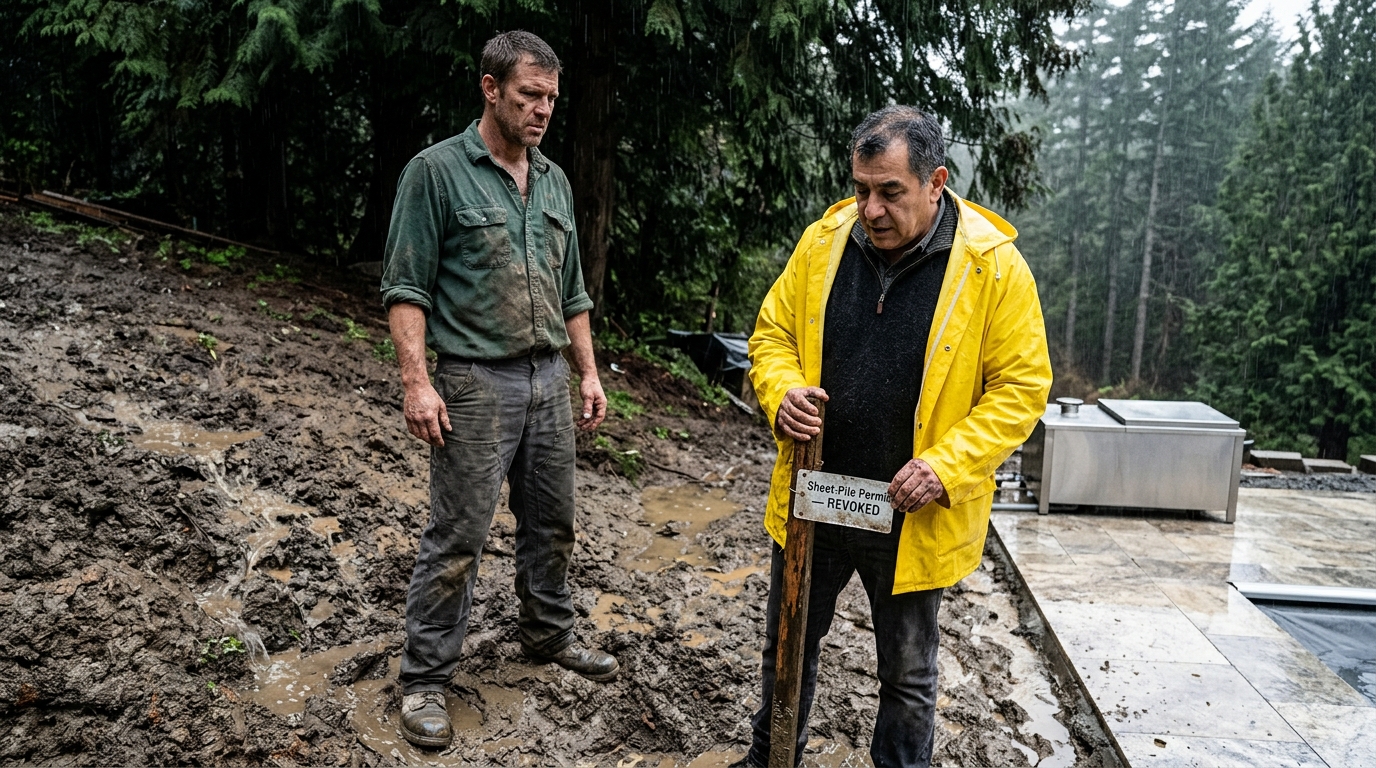
David reached down into the mud near the edge of her pool deck and yanked on something half-buried in the clay. A wooden stake came loose with a wet pop. The top was painted bright orange, but the wood below the soil line was old, rotted, and bore a faded aluminum tag stamped with letters: Sheet-Pile Permit — REVOKED.
David stared at the tag, his thumb rubbing over the cold aluminum. His eyes narrowed.
“This isn’t new,” David muttered, looking up at the pool deck, then back up at my wall. “Someone marked this toe for a steel sheet-pile bulkhead years ago. Before she ever bought the place. Look at the notch in the rock shelf right there under her pump house.”
I looked where he was pointing. Beneath the smooth stone fascia of the pool deck, a fresh cut had been made into the dark basalt shelf. It was crude, scored with a diamond saw to force the pool frame to fit the lot line.
“She didn’t just dig into the slope,” I said, the realization settling cold in my stomach. “She sheared off the natural drain notch.”
“She cut the keyway,” David said, standing up and brushing the gray clay from his gloves. “The water coming down your hill used to bleed off sideways through that natural fissure in the basalt. Now? Her pool deck is acting like a dam. The water has nowhere to go except behind your railroad ties, pooling up until the pore pressure hits critical mass.”
He looked at me, his face hard as granite.
“She wants your wall gone, Luke, because if your wall stays up, the hydrostatic pressure is going to push her pool off the hill. But if you pull your ties, the hill collapses first—and she gets to claim your ‘unmaintained structure’ failed and ruined her house.”
I looked from the rotted stake in David’s hand up to the black timbers of my wall. The creosote smelled thick in the rain, a harsh, oily reek that meant forty years of holding back the earth.
“Can you put that in writing?” I asked.
David pulled his clipboard out from under his arm and clicked a heavy brass pen. “I’ll write it in plain English. But I’m charging you thirty-two hundred bucks, and I’m stamping it with my state engineering seal.”
“Do it,” I said.
Down on the patio, the back door didn’t open this time. But behind the tinted glass of her upper balcony, a shadow moved. Vanessa was standing there, phone pressed to her ear, watching David drive the soil probe deep into the mud at her fence line.
My phone vibrated in my pocket. A short, sharp buzzing against my leg.
I pulled it out with a muddy glove. A text message from Greg Foster, my attorney:
HOA legal counsel just filed a formal pre-lien notice for non-compliance fines. They want a signed removal schedule by Monday morning.
I stared at the screen, the rain wiping across the glass. I turned to David, who was already cranking the recoil starter on his soil auger. The small two-stroke engine roared to life, spitting a puff of blue exhaust into the cold air.
“David,” I called out over the rattle of the motor. “How long does that clay take to liquefy once the saturation hits ninety percent?”
David didn’t look up from the handles. He pushed the spinning bit down into the earth.
“With that cut she made?” he shouted back over the engine. “Twelve hours of heavy rain. Maybe ten.”
CHAPTER 3: THE TRAP EXECUTED
The rain didn’t stop, but the exhaust fumes cleared when David shut down the auger’s engine. The sudden quiet hit hard, filled only by the heavy drip of water off the spruce branches overhead.
I looked down at the glowing screen in my palm. Signed removal schedule by Monday morning.
My thumb wiped a smear of gray clay across the glass, blurring the letters. I didn’t reply to the text. I tapped Greg’s number and brought the phone to my ear, stepping around the back of David’s trailer toward the cab of my own truck.
He answered on the second ring. No greeting, just the faint paper-shuffle sound of a man sitting at a crowded oak desk.
“You read it?” Greg asked.
“I read it,” I said, climbing into the driver’s seat. The smell of old coffee, wet leather, and diesel heater fuel wrapped around me. I pulled the door shut, cutting the rain’s roar down to a steady drumbeat on the aluminum roof. “David’s standing out here right now. He pulled an old permit tag out of the mud by her pool foundation. Sheet-Pile Permit — REVOKED.”
There was a two-second pause on the line. The quiet slide of a pen dropping onto blotter paper.
“She knew,” Greg said softly. “Or the developer who sold her the lot knew. Either way, they tried to bypass a structural tie-back requirement.”
“Her deck is tilting three millimeters,” I said. “She shaved the natural basalt keyway to fit her pool coping. The water’s backing up behind my railroad ties right now. If I pull my wall, the hill takes her pool out. If I don’t, the fines stack up until the county puts a lien on my shop.”
Greg let out a long, dry breath. “She wants a war of attrition, Luke. She thinks you’re a contractor with a mortgage who’ll panic when the daily two-hundred-dollar ticker starts running.”
“I am a contractor with a mortgage,” I said, my knuckles white where I gripped the steering wheel. “And I built that wall to keep Carl’s house from sliding twenty years ago. I’m not paying her two hundred a day for protecting her property.”
“Then don’t fight the removal order,” Greg said.
I turned my head, staring through the rain-streaked side window at the black timbers sticking out of the mud uphill. “What?”
“Give her exactly what she asked for,” Greg said, his voice dropping into that quiet, predatory cadence he used when an opposing party handed him a bad deposition. “Strict compliance. But we don’t do it on her text message thread. We do it on a formal board resolution. Signed by Vanessa Caldwell as HOA President, stamped by the board secretary, explicitly ordering the total demolition of the legacy timber barrier within ten days.”
“Greg, the hill will fail,” I said.
“And David Morales’s signed engineering report will be attached as Exhibit A to the liability release,” Greg countered. “You send the report to the board via certified mail at eight tomorrow morning. In the cover letter, you state that as a licensed land grader, you are bound by state structural safety codes, but as a property owner, you will execute the board’s mandatory removal directive under protest—provided they sign an absolute waiver releasing you from all downhill slope failure damages.”
I rubbed my palm over my face, feeling the raspy stubble on my jaw. “She won’t sign a waiver that says the hill will slide.”
“She won’t read the fine print of the indemnification clause,” Greg said flatly. “She thinks you’re ignorant of municipal code. She thinks that ‘legacy structure’ means ‘unpermitted backyard project.’ She’ll sign it because her ego won’t let her back down in front of the board after filing a pre-lien.”
I looked out at David, who was wiping down his auger bits with an oily rag under the shelter of his tailgate.
“How long to draft it?” I asked.
“It’s on my screen right now,” Greg said. “I’ll have a runner deliver the hard copies to her front door by three o’clock. You rent the excavator for Friday.”
I hung up, setting the phone on the console.
I sat in the dark cab for three minutes, listening to the engine ticking as it cooled down. The cost was already stacking up: thirty-two hundred for David’s stamp, another thousand for Greg’s filing fee, and six hundred a day for a mid-size excavator rental. Almost five grand out of my operational reserve, just to tear down the wall I’d built with my own hands twenty years ago.
I opened the truck door and stepped back out into the cold rain.
David looked up from his tool box. “What’s the play?”
“We’re pulling the ties,” I said.
David stopped wiping the steel auger bit. He stared at me for a long moment, his dark eyes unblinking under the rim of his yellow hood.
“You’re crazy, Harper,” he said quietly.
“I’ve got an engineer’s report that says the toe is compromised,” I replied, pointing at his clipboard sitting on the trailer bed. “And by Friday, I’ll have a signed resolution from the board telling me to clear the lumber. You coming back with the surveyor’s transit when the ground opens up?”
David stared down at the mud on his boots, then looked down the slope toward Vanessa’s house. “I’ll be here. Not for the HOA. I want to see what happens to that sheared basalt shelf when the headwall releases.”
He reached into his pocket and pulled out a small, laminated site card—an old city public works map with faded red lines marking drainage sectors. He slapped it onto his clipboard, right over his fresh inspection report. In the bottom corner, printed in block red ink, were the words: Aquifer Delta Overlay Zone 4.
He didn’t explain it. He just slid the clipboard into his cab and climbed in.
By four o’clock that afternoon, a courier vehicle pulled up to Vanessa’s driveway. I watched from my kitchen window, holding a cold cup of black coffee. A young man in a blue uniform walked up her paved walkway, carrying a thick yellow envelope.
Vanessa opened the door. She didn’t sign immediately. She stood on her porch, holding the heavy paper, her eyes scanning the first page while the courier held out his digital pad.
Even from fifty yards up the hill, I saw the exact moment her shoulders lifted—that posture of absolute, unyielding victory. She signed the pad with a quick flick of her wrist, took the duplicate copy, and shut her door.
Ten minutes later, my email inbox chimed on the kitchen counter.
I walked over and looked at the screen. The document was attached: Executed Board Order for Removal of Non-Compliant Structure. Her signature was clean, bold, written in dark blue ink right above the line reading Board President & Architectural Review Chair.
Attached below it was Greg’s indemnification rider, fully executed, acknowledging receipt of the Geotechnical Report while directing immediate removal.
I closed the laptop lid. The metal latch clicked into place with a sharp, final snap.
Outside, the rain picked up its pace, turning the cedar leaves into a dark, heavy blur against the gray sky. The ground under the house felt solid, but I knew better. The water was pooling in the gravel backfill down below, quiet and heavy, filling every tiny void in the clay.
I picked up the phone and dialed the equipment yard down in Eugene.
“This is Luke Harper,” I said when the desk answered. “I need a CAT 312 excavator delivered to the top of Ridge Line Lane by eight o’clock Friday morning. Heavy bucket with a thumb attachment.”
“Got it, Luke,” the voice came back. “Standard three-day rental?”
“No,” I said, looking out the back window toward the hill. “One day is all it’s going to take.”
CHAPTER 4: THE SOUND OF GIVING WAY
The dial tone cut out before I could hang up.
A sudden, sharp drop in atmospheric pressure made my ears pop inside the quiet kitchen. Through the glass, the torrential downfall turned sideways, slammed by a gust of gale-force wind that whipped the cedar boughs into wild, thrashing arcs.
The low rumble started three seconds later.
It wasn’t thunder. Thunder rolled across the sky, high and hollow. This sound came from deep under the soles of my work boots—a dull, grinding groan, like massive iron gears turning without oil.
I dropped the phone onto the counter and ran out the back door.
The rain hit my face like thrown gravel. By Friday morning, the excavator had already done its work; three hours ago, I’d pulled the last eight-foot railroad tie from the mud, stacking the heavy black timbers neat and square on my upper lawn. The bank sat completely bare now, a steep, dark slope of raw Organ clay glistening under the downpour.
David Morales was standing near his truck at the end of the driveway, his yellow slicker shining under his running lights. He was pointing down the slope, his mouth open, yelling something that got devoured by the storm.
I sprinted toward the grade break.
Along the top edge of the exposed slope, a hairline fissure opened in the turf. It didn’t creep. It zipped across thirty-five feet of lawn in half a second, widening from a crack into a jagged, three-inch trench. Water poured into the opening with a deep, gurgling gulp.
Down below, on her concrete patio, Vanessa stood near her glass perimeter wall. She was wrapped in a black trench coat, holding a massive golf umbrella, watching the water pool around her dark blue pool deck. She looked up at me, her chin tilted high, her posture radiating rigid, unyielding stubbornness.
“Get inside, Vanessa!” I roared over the gale, cupping my hands around my mouth. “Get away from the pool!”
She didn’t move. She shook her head, pointing a gloved finger at her patio drains as if demanding I fix the runoff.
Then the keyway gave out.
The sound was a sickening, wet CRACK—the sound of a hundred tons of saturated earth snapping its last friction bond with the underlying basalt shelf.
The middle section of the slope didn’t slide; it liquefied. A ten-foot wall of brown clay, torn root systems, and heavy gravel lurched forward in one terrifying surge.
The hydraulic pressure behind the cut sheared off the edge of her pool deck like a razor through cardboard. The blue tile coping didn’t just crack—it exploded into a shower of white plaster and blue shards.
Vanessa dropped her umbrella. The wind caught the nylon canopy, tumbling it across the patio like a tumbleweed, but she didn’t look at it. She staggered back two steps as the entire earth beneath her pool deck dropped four feet in a single heartbeat.
The pool structure tilted violently toward the ravine. Eighty thousand gallons of crystal-clear water erupted over the broken concrete lip in a roaring, white-water wave that slammed directly into her glass wall, shattering the tempered panels with a sound like a rifle shot.
“Vanessa! Move!” I shouted, scrambling down the slick side path, my boots tearing through the wet moss.
The mud slide slammed into the pool cavity, filling the dark blue basin with thick, soupy brown sludge. The lower fiberglass shell groaned under the sudden, uneven weight, buckling inward with a loud metallic screech.
She tripped over her own patio chair, hitting the concrete hard on her hands and knees. The mud flow washed across the bluestone pavers, burying her spotless white sneakers up to the ankles in liquid clay.
I reached the bottom of the slope just as the second wave of earth settled. I grabbed her under the shoulders, pulling her backward away from the collapsing edge of the pool deck. Her body was shaking violently, her black coat smeared with cold, foul-smelling clay.
“My… my pool,” she whispered, her voice stripped of every drop of authority. Her eyes were wide, glazed with shock as she stared at the ruined crater where her infinity view had been five seconds ago. “The structure… it’s gone.”
“The whole hill is moving, Vanessa,” I said, my voice cold and steady in her ear as I hauled her onto the higher concrete pad near her back door. “The cut you made into the keyway took out the toe support.”
David came sliding down the access path behind us, his heavy boots throwing up sprays of mud. He held a high-powered spotlight in one hand, the yellow beam slicing through the driving rain. He swept the light across the wreckage—the smashed pool deck, the buried pumps, and the exposed face of the raw hillside.
The light stopped at the base of the slide, right where the raw clay had peeled clean off the dark basalt bedrock.
“Luke,” David said. His voice was unnaturally quiet, entirely stripped of its usual gruff tone.
I stepped past Vanessa, who was sitting against her back wall, shivering in the rain. I walked to the edge of the mud flow, where David was shining his spotlight into the freshly exposed trench behind her ruined pool frame.
Protruding from the sheared rock shelf was a heavy steel pipe, eight inches in diameter, sheared clean in half by the force of the slide. Water wasn’t just trickling from it—it was gushing out in a steady, high-pressure artesian stream, churning the clay into a boiling grey slurry.
Beside the pipe, bolted into the solid rock, was a rusted iron plate stamped with yellow block lettering:
PROPERTY OF MUNICIPAL WATER DISTRICT — SECTOR 4 BOREHOLE — UNAUTHORIZED EXCAVATION STRICTLY PROHIBITED.
David turned his head toward me, the yellow light from his spotlight reflecting off his wet face.
“This isn’t just a surface runoff failure,” David said, pointing the beam directly at the gushing pipe. “Someone drilled an unmapped relief drain straight into the local aquifer shelf decades ago—and then capped it with concrete to pass the original residential lot survey.”
I looked at the water roaring out of the rock, then back up at the top of the hill where Carl Jensen’s house used to sit. The decoy secret—Vanessa’s reckless pool cut—had triggered the slide. But what lay sleeping beneath the hill was something much bigger, and it had just been woken up.
CHAPTER 5: THE TOXIC LEAK
The water coming out of the sheared eight-inch pipe wasn’t cold surface runoff. It was warm, heavy with the sharp, metallic stench of sulfur and dissolved mineral iron.
I knelt at the edge of the newly carved trench, my gloves sinking three inches into the churning grey slurry. The high-pressure stream was expanding the cavity under the basalt shelf, eating away at the soft silt layer holding up the road culvert fifty feet above us.
“Look at the threads on that flange, Luke,” David said, stepping closer. He lowered the spotlight until the harsh white circle focused on the rusted iron plate. “That casing wasn’t sheared by the slide. The slide just ripped off the concrete cap someone poured over the mouth.”
I reached out, my fingers tracing the cold, raised letters on the plate. PROPERTY OF MUNICIPAL WATER DISTRICT — SECTOR 4 BOREHOLE. Beneath the warning text, held by two brass rivets green with corrosion, was a secondary serial tag: AQUIFER DELTA — PRESSURE RELIEF 09-B.
“Carl Jensen didn’t just build a retaining wall back in ’02,” I muttered, the pieces locking together in my head with the cold weight of a dropped anvil. “He was covering this up.”
David wiped rain from his forehead with the back of his sleeve. “Carl worked for the county road department for thirty years before he retired. He knew if this relief valve bled out onto the surface, the state would condemn the entire building envelope on this side of Ridge Line Lane. So he capped the pipe, filled the cut with gravel, and paid you to build a thirty-five-foot tie wall to keep the whole hillside weighed down.”
Behind us, a car door slammed.
Vanessa was still sitting on her ruined patio, her shivering frame wrapped in a mud-stained trench coat, but her eyes were fixed on the gushing pipe. She pushed herself up using the broken edge of a concrete planter, her white sneakers completely caked in clay.
“What is that?” she rasped. Her voice was thin, stripped of all its polished authority, but the sharp, defensive edge remained. “Is that… a city pipe? Is that why the ground collapsed?”
I stood up slowly, the wet clay pulling at my boots. “That’s an unmapped relief casing for the Aquifer Delta, Vanessa. It’s been sitting under this slope for thirty years.”
“Then it’s a municipal failure,” she blurted out, her hands shaking as she pulled her phone from her pocket. The screen was cracked, smeared with grit, but the display still flickered. “The city… the association isn’t responsible for a water main break. You… your wall was supposed to protect my lot from city infrastructure!”
I walked over until I was standing two feet from her. The smell of creosote on my coat mixed with the sour iron tang coming off her ruined lawn.
“My wall held eighty tons of earth in place for twenty years, Vanessa,” I said, keeping my voice dead level. “And it would have kept holding it if you hadn’t brought in a hydraulic ram to shear off the basalt shelf so you could fit a twelve-foot deep infinity pool.”
“I had an architectural permit!” she snapped, though her thumb trembled so hard against her phone screen she couldn’t unlock it. “The board approved the excavation!”
“The board approved a surface pool,” David interrupted, his spotlight beam shifting from the pipe straight to her face. She winced, shielding her eyes with a muddy forearm. “They didn’t approve shaving the keyway. You cut right through the concrete cap Carl poured back in ’98. You opened the valve yourself when you set your lower footings.”
She went silent. Her mouth stayed open, a small, helpless gesture, before she pulled her phone back to her chest.
“I’m calling the association attorney,” she whispered.
“Call him,” I said. “Tell him to bring a pump.”
My phone buzzed in my inner pocket. I pulled it out with clean fingers, keeping the wet casing away from the mic. It was Greg.
“Luke,” Greg said, his voice crisp despite the crackle of the storm over the line. “I just got a notification from the county land registry office. The preliminary disaster report for Ridge Line Lane just hit their desk.”
“The hill gave way, Greg,” I said, staring at the gushing Sector 4 Borehole pipe. “And we found the source. It’s an old municipal pressure relief casing.”
“I know,” Greg replied instantly. “I’m looking at the original 1994 Sector 4 Borehole survey on my screen right now. The one Carl Jensen filed when the subdivision was built.”
I held my breath. “What does it say?”
“It says the permit was revoked because the hydrostatic head under your lot exceeds sixty pounds per square inch,” Greg said softly. “The county knew the Aquifer Delta was unstable. They buried the file, granted Carl a conditional building waiver, and let the developer sell those lots down the slope anyway.”
I looked over at David, who was already running a steel tape down into the mud to measure the rate of soil loss around the pipe base.
“They built this entire lane on top of a ticking pressure valve,” I said.
“And Vanessa’s board mandate just handed us the entire paper trail,” Greg said. “She signed the removal order after receiving David’s structural warning. Every dime of the recovery effort, the road stabilization, and the municipal remediation just landed squarely on the HOA’s insurance policy.”
Down on the patio, Vanessa dropped her phone into the mud. It landed with a soft splat, the screen going dark as a fresh trickle of brown water washed over the glass.
She didn’t reach down to pick it up. She just stared at the roaring stream of iron-rich water tearing through what used to be her view.
CHAPTER 6: A PRICE PAID IN IRON
Greg’s line didn’t go dead, but the storm around us suddenly lost its roar, settling into a steady, quiet drip off the damaged patio overhang.
I didn’t lower the phone immediately. I let the silence sit between us, staring at the mud where Vanessa’s phone lay buried under three inches of grey silt.
“They’re going to try to disclaim liability, Luke,” Greg said, his voice flat, razor-sharp through the speaker. “The county water district will blame Carl. Carl’s estate will point at the original developer. And the HOA’s insurance carrier will try to invoke the legacy design clause.”
“They can try,” I said. My thumb wiped a drop of rain from the mic hole. “Except the HOA President signed an explicit order directing me to remove the structural timber wall after receiving David’s sealed engineering report.”
“I’m filing the injunction and municipal hold right now,” Greg said. “Don’t touch that pipe. Let the city engineers see what’s coming out of the rock.”
I hung up, sliding the phone into my dry chest pocket.
Vanessa pushed herself up against the wall. She was shaking, her designer jacket soaked through, but her chin jerked upward in a final, desperate instinct.
“You planned this,” she spat out, her hands tightly clenched into small, muddy fists. Her eyes flicked toward the gushing iron pipe, then back to me. “You knew what was under that hill. You used the board to pull those ties so the water would destroy my pool.”
David stepped between us, holding his clipboard out like a shield. The laminated site map was pinned to the front, the red block letters—Sector 4 Borehole—glowing under his spotlight.
“Look at the date on this sheet-pile permit, Caldwell,” David said, his voice cold, heavy with thirty years of field authority. “October 1994. The county revoked the excavation permit because the Aquifer Delta head pressure was sixty PSI. Carl Jensen didn’t build that wall for fun. He built it because the city told him the hill would liquefy if the pressure wasn’t weighted down. And then you shaved the keyway.”
Vanessa looked at the paper, then at the gushing pipe, her lips pressing into a thin, colorless line. “I… I didn’t know about a borehole. The seller didn’t disclose…”
“You didn’t ask,” I said, stepping forward. “You saw ugly wood. You wanted an infinity view. And when I handed you an engineer’s warning, you used a two-hundred-dollar-a-day fine to force my hand.”
She opened her mouth, her eyes darting toward her house as if looking for a lawyer, a contractor, or an architectural committee member to step out of the shadows. No one came. The lane was dead quiet except for the rushing water.
“What do you want?” she whispered.
I pulled a folded document from inside my coat—the standard contractor repair agreement Greg had drafted alongside the indemnification rider three days ago.
“The HOA signs a binding ten-year maintenance agreement,” I said, handing her the pen David held out. “I rebuild the retaining wall. Not out of decorative stone. Out of twelve-inch steel H-piles and heavy timber lagging, anchored directly into the basalt shelf behind the borehole. The HOA pays twelve thousand eight hundred for the build, plus eight hundred and fifty a year for structural monitoring.”
Vanessa stared at the paper, her fingers trembling as she took the pen. “And if the board refuses?”
“Then David files his emergency hazard report with the county at five o’clock,” I said. “They’ll condemn your pool deck, red-tag your home, and place an assessment lien on every house on this lane to pay for emergency municipal shoring.”
She didn’t argue. She didn’t call her lawyer. She pressed the paper against the damp brick column of her porch and signed her name in quick, jagged strokes.
Shadows stretched long across the gravel driveway three weeks later.
The rain had finally broken, leaving the Oregon sky a pale, crisp blue. The air smelled of damp earth, hot hydraulic oil, and fresh-sawn lumber.
My CAT 312 excavator sat idling near the top of the slope, its diesel engine purring with a steady, rhythmic thrum. In the trench below, a brand-new retaining wall spanned thirty-five feet across the back of my yard.
It wasn’t pretty. It wasn’t designed for a magazine cover. Heavy steel H-beams were driven ten feet deep into the solid basalt, holding massive eight-by-eight Douglas fir timbers, treated dark and heavy against the weather. Behind the lagging, a double-walled French drain carried the steady trickle from the capped Sector 4 Borehole safely down the rock fissure to the culvert below, relieving the pressure without losing a single cup of soil.
David Morales stood on the upper grade, holding a surveyor’s transit. He adjusted the eyepiece, took a long look at the top beam, and nodded once.
“Zero deflection,” David said, stepping back and snapping the tripod shut. “That bank isn’t moving unless the continent shifts.”
“Good,” I said. I shut down the excavator’s engine. The sudden quiet filled the yard, settled and peaceful.
Down on the lower patio, Vanessa’s pool was gone, replaced by a smooth, graded slope of crushed granite and hydroseeded grass. A moving truck was parked in her driveway, its rear ramp down, two workers in gray uniforms hauling wrapped furniture into the back.
She stood by her back sliding door, holding a small box of kitchenware. She looked up the slope toward me.
She didn’t wave. She didn’t smile. But she stopped, her eyes lingering for a long moment on the dark, unyielding steel and timber wall standing guard above her property line. Then she turned, walked inside, and pulled the glass door shut.
I walked over to the stack of leftover lumber near my shop. Sitting on the top timber was a fresh white envelope that had arrived in the morning mail.
I picked it up and opened it. Inside was a check from the HOA for eight hundred and fifty dollars, accompanied by a voucher stub stamped: Annual Slope Structural Maintenance Agreement — Paid in Full.
I folded the check, slid it into my breast pocket, and picked up my grease gun.
I walked over to the excavator’s boom, wiping a smudge of black grease from the main pivot pin with my rag. The metal was cold under my hand, solid, grounded deep in the earth.
The hill was quiet now. Water was flowing where it belonged. And as long as those steel beams stood anchored in the rock, the ground beneath our feet was going to stay right where it was.