The Keystones of Oakmont: A Cold War of Stone, Physics, and Bureaucratic Ashes
CHAPTER 1: THE KEYSTONE LINE
The ratcheting thimble of the brass micrometer turned twice against my thumb. Click-click.
“That pile of rocks is a liability,” Karen Peterson said. Her voice carried the sharp, chemical tang of cheap floral perfume across the damp air of the gulley. “If it’s not gone in forty-eight hours, I’ll have it bulldozed myself and bill you for the demolition.”
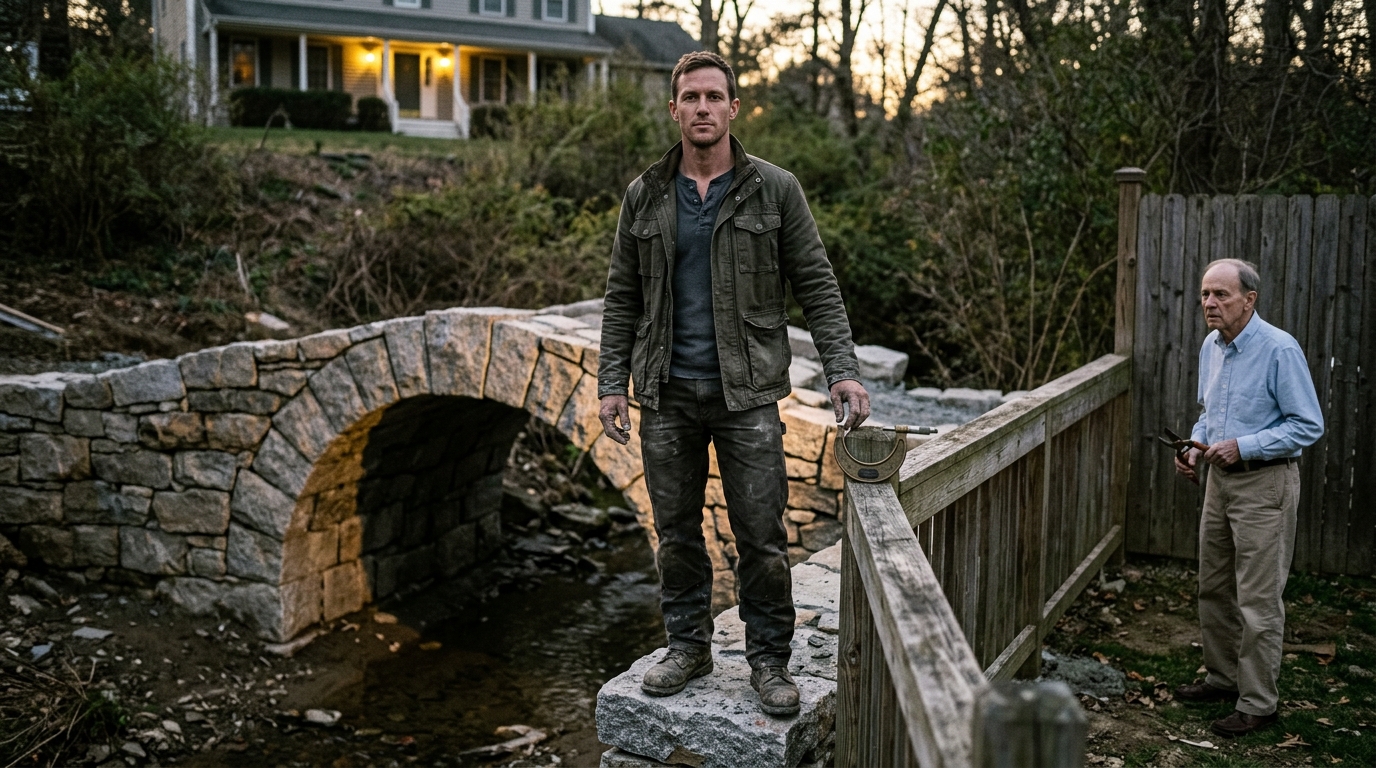
I didn’t answer. I stood on the central keystone of the dry-stack arch, two feet above the trickling waters of the creek bed. My boots gripped the cold granite. The stone was unyielding, locked in place by gravity, friction, and three months of hard, bone-deep manual labor. Beneath my fingernails, grey mortar dust had set into the creases of my skin like concrete grain.
Karen took half a step forward on the embankment. Her sensible shoes sank a quarter-inch into the soft silt. A plastic clipboard was pressed hard against her chest like light body armor. Her floral blouse was stretched taut across her shoulders, the pattern vibrating against the muted grey of the surrounding brush.
“Did you hear me, Mr. Thorne?” She didn’t look at the arch. She looked at my face, searching for a twitch, a flinch, the standard give of a suburban homeowner caught in a violation. “This is a formal notice. This thing is unapproved. It’s a blight and it’s dangerous.”
Click-click.
The micrometer stayed buried in my right jacket pocket, my thumb turning the cold metal screw. Twenty years in the Army Corps of Engineers teaches you to read terrain before you read people. You look for structural load paths. You look for the weak soil.
Right under the toe of Karen’s left shoe, the bank was bleeding water. Not creek water. Clear, pressurized runoff weeping from a plastic drainage pipe half-buried under a clump of invasive honeysuckle on her side of the property line. It wasn’t on the original subdivision plat.
“Forty-eight hours,” she said. She jabbed a thick finger toward the arch, then toward my chest. “Then the machinery rolls.”
She turned on her heel and marched up the incline toward the manicured sod of 18 Willow Lane.
I stayed on the keystone until the sound of her tread vanished into the neat, taupe silence of the neighborhood. I knelt, pressing my palm against the granite block I’d hauled from a collapsed barn wall upstate. The stone was holding the sun’s warmth, but beneath the arch, where the water cut through the shale, the ground was unnaturally soft.
My daughter Sarah was waiting at the edge of the patio when I walked up from the creek. Her beat-up pickup truck sat in the driveway, the bed still dusted with aggregate gravel from our last run to the quarry.
“She gave you the speech?” Sarah asked. She didn’t put down her tablet. Her thumb flicked across the screen, pulling up local property maps.
“She gave the speech,” I said.
I pulled my hand from my pocket and laid the micrometer on the glass patio table next to a stack of yellowing paper. I picked up the printed violation notice Karen had wedged into the door frame on her way down. Article 4, Section 2. Aesthetic harmony. A flat one-hundred-dollar-a-day assessment.
“She’s bluffing about the contractor,” Sarah said, pointing her screen at me. “I ran the county permit logs while you were down there. No commercial demolition permits have been pulled for Creekwood Lane in the last six months. But Dad—look at the soil survey layer.”
I leaned over her shoulder. The digital map showed the lot lines in high-contrast blue. But running directly beneath the creekbed, highlighted in faint yellow gridwork, was an old municipal designation code: Blackwood Survey – Segment 4.
“That’s not an HOA code,” I said.
“No,” Sarah muttered, her eyes narrowing as she zoomed in on the property boundary. “And according to the county clerk’s public cache, that designation was archived ten years ago under an encrypted municipal easement.”
I looked back down toward the creek. The stone arch stood dark against the amber setting sun, solid and silent. Karen wasn’t just enforcing a paint scheme. She was running a clock.
“She wants the bridge down before the rain hits on Thursday,” I said softly, my thumb running over the rough edge of the violation notice. “She doesn’t care about the stone. She cares about what’s under the abutment.”
I pulled my laptop out onto the iron table, flipping open the 148-page PDF of the Oakmont Estates CCNRs.
“Get David Chen on the line,” I told Sarah. “Tell him we’re not filing an appeal. We’re filing a notice of structural survey.”
CHAPTER 2: THE RECONNAISSANCE PHASE
The metal of the micrometer held the chill of the evening long after the sun dropped behind the loblolly pines. Click-click. The brass screw ratcheted under my thumb, measuring the thickness of the violation notice down to the thousandth of an inch. Cheap bond paper. Standard corporate stock.
“David’s on line two,” Sarah said. She set a fresh mug of black coffee beside my laptop. The steam rose straight up in the still air, carrying the bitter scent of dark roast over the smell of wet shale from the gulley below. “He says if we’re pulling land tract deeds, we need the original 1994 master plat, not the sanitized HOA PDF.”
I clicked the speaker button on the desk phone. “David.”
“Marcus,” David Chen’s voice came through crisp, stripped of any neighborly casualness. He was in his study three doors down, surrounded by the same cookie-cutter dry-wall as the rest of us, but his tone belonged to an artillery command post. “I just reviewed the county’s digital map layers you sent over. That Blackwood Survey designation on your lot line isn’t a zoning code. It’s an environmental indemnity waiver.”
I leaned forward, my forearm resting on the edge of the glass table. “Indemnity for who?”
“The developer,” David said. “And by extension, whoever inherited the infrastructure liability. In ’94, Oakmont Estates wasn’t cleared for high-density residential buildout because of sub-surface drainage issues. The county only greenlit the permits after the builder signed off on an internal mitigation system—a network of underground culverts meant to route runoff into the main county basin.”
I looked out into the gathering dark toward 18 Willow Lane. Karen’s two-story colonial sat elevated on a manicured slope, its porch lights casting a harsh yellow glare across her pristine sod.
“The drainage pipe weeping into my creek,” I said, my voice low. “That’s not an overflow line from her gutters.”
“No,” David replied. “If my read on the easement is right, that’s an unpermitted discharge point. She bypassed the municipal culvert. Every time it rains, her lot dumps its foundational hydrostatic pressure directly onto your retaining bank. Your dry-stack arch isn’t an eyesore to her, Marcus. It’s a dam. It’s backing up the water she’s illegally dumping into the creek bed.”
Click-click.
I turned the micrometer’s thimble once more, locking the spindle. “She needs the bridge gone so the water clears before the county inspector does his annual basin audit.”
“Exactly,” David said. “If the bridge stays, the creek pool rises six inches. Six inches is enough to submerge that pipe and flood her lower basement wall. She’s running a clock against the weather.”
“Sarah,” I said, without looking up from the screen. “Pull up the public property records for 18 Willow Lane. Look for the architectural modification permits from five years ago.”
Sarah’s fingers flew across her mechanical keyboard, the rhythmic clack satisfyingly sharp in the quiet night. “Got it. Permitted item: Rear patio extension, poured concrete, March 2021. Contractor: Apex Civil Works.” She paused, her blue light reflecting in her eyes. “Wait. There’s a secondary attachment. An inspection clearance form.”
“Read the file code,” I said.
“It says… Federated-404 Annex B,” Sarah murmured, frowning. “Signed off by a private inspector, not the county.”
A cold wire pulled tight in my chest. The first seed of something larger than a suburban squabble. Federated-404. The master insurance umbrella code used by commercial underwriters when a site carries high-risk geological waivers.
I stood up from the patio chair, the joint in my left knee cracking in the damp air. “I’m taking a walk down the easement line.”
“Marcus, it’s pitch dark,” David warned over the speaker. “Stay on your side of the property marker. If she catches you on her lot with a flashlight, she’ll call the county sheriff for criminal trespass before you can explain fluid dynamics.”
“I don’t need a flashlight,” I said. “I know where the water is.”
I stepped off the stone patio and walked down the gentle slope toward the creek. My boots sank an inch into the soft loam near the water’s edge. The smell here was different—thick, metallic, like wet iron and stagnant clay.
I followed the narrow strip of gravel where my property line met Karen’s timber fence. The wooden pickets were stained a uniform, HOA-approved shade of cedar brown. But near the base, five yards up from the creek bank, the wood was black, rotted through by continuous moisture.
I crouched in the tall grass near the honeysuckle bush. The clear stream of water was still trickling out of the green PVC pipe, a steady, pressurized pulse that didn’t match the dry weather we’d had for the last three days.
I reached out, my fingers brushing against the cold plastic lip of the pipe. Attached to the underside of the outlet, almost completely obscured by wet silt and rotting leaves, was a small, round metal plate. I ran my thumb over the raised lettering, clearing the grime.
PROPERTY OF OAKMONT DRAINAGE DISTRICT – SUB-BASIN A-3.
DO NOT ALTER OR OBSTRUCT. PENALTY OF LAW.
Below the legend, barely visible under a layer of chipped blue enamel, was a stamped serial code: Aquifer-3 Bypaths – Survey 104.
I didn’t pull the plate. I didn’t touch the pipe again. I just took a single photo with my phone, the flash illuminating the rusted galvanized bracket holding the unpermitted line in place against a crumbling slab of old concrete.
Karen hadn’t just tapped a private drain into my creek. She had tapped into a municipal storm easement, rerouting public infrastructure runoff to save her own foundation from settling—and using her position as HOA president to fine anyone whose property caught the overflow.
My phone vibrated in my pocket. A text from Sarah.
County GIS map updated 10 mins ago. Karen just filed an emergency code complaint against 12 Creekwood Lane. Citation: Structural hazard to municipal water flow. She’s moving the timeline up.
I stood up, wiping my clay-stained fingers on my jeans. I looked up at her dark house, the kitchen window casting a single pale square of light onto her yard.
The game had changed from defensive documentation to an engineering siege. She was trying to use the county as her bulldozer.
I reached into my pocket, my fingers settling around the cold, heavy body of the brass micrometer.
“Sarah,” I said when I reached the patio, my voice level and completely free of warmth. “Print out three copies of the 1994 Blackwood Survey. Then call David back. Tell him we aren’t just sending a certified letter to the board tomorrow morning.”
Sarah looked up from her screen, her eyes sharp. “What are we doing?”
“We’re filing an injunction with the county water commissioner,” I said, setting the micrometer on top of the printed violation notice. “And we’re inviting Karen’s insurance adjuster to come take a look at her basement.”
CHAPTER 3: THE FIRST VOLLEY AND COUNTERSTRIKE
The glass table vibrated as the laser printer inside the house kicked into a high-pitched hum. Page after page of the 1994 Blackwood Survey fed into the tray, smelling of hot ozone and fresh toner.
I picked up the micrometer, sliding it into my belt holster alongside my steel measuring tape. “Sarah, load those pages into manila heavy-stock envelopes. Four copies. Certified mail with restricted delivery and physical return receipts.”
“Who gets the fourth?” Sarah asked, her hand steady as she stapled the technical schematics of the dry-stack arch to the county exemption email from Brenda.
“The county water commissioner’s chief inspector,” I said. “If Karen wants to turn municipal code into a weapon, we give the municipality the entire blueprint.”
By six in the morning, the kitchen table was an assembly line of hard evidence. Exhibit A: County building code exemption letter. Exhibit B: High-resolution photographs showing the granite arch interlocking without mortar. Exhibit C: Structural analysis calculating the maximum dead-load capacity at twenty-four thousand pounds. Exhibit D: The high-resolution flash photograph of the Aquifer-3 Bypaths plate hidden behind her honeysuckle bush.
David Chen walked through the back sliding door without knocking, a steam-fogged travel mug in one hand and a manila folder in the other. He didn’t look like a guy getting ready for a suburban commute; his jaw was set, eyes scanning the printouts like tactical overlays.
“I pulled the HOA financial disclosures for the last fiscal year,” David said, dropping the folder on top of my stack. “Article 9, Section 4 requires the board to maintain a liquid legal defense fund of at least fifteen thousand dollars. Know what’s in the account right now?”
I looked at him. “Zero.”
“Close,” David said. “Twelve hundred bucks. Karen’s been reallocating administrative funds to cover private ‘infrastructure maintenance’ contractors without board minutes or public voting.”
“Johnson and Sons Construction,” I said.
David nodded once. “Same contractor who put in her poured concrete patio in 2021. If she tries to use HOA funds to pay for an emergency demolition crew, she’s executing an ultra vires expenditure. It makes her personally liable for every dollar spent.”
I pressed my thumb against the thick wax seal of the first envelope, smoothing the paper down until the edge burned against my skin. “The certified packages go out at seven when the main post office opens. We give her forty-eight hours to respond to the formal board hearing request.”
“She won’t take the bridge down with a bulldozer,” David warned, taking a sip from his mug. “Not now that she knows we’re tracking the paper trail. She’ll go sideways.”
He was right.
At nine-fifteen, the postal carrier delivered the response. It wasn’t a certified envelope or a summons to a board room. It was a single sheet of neon-red paper jammed directly into my mailbox without postage—a clear violation of federal postal regulations, delivered by hand.
The red paper screamed in bold, all-caps lettering: SECOND NOTICE OF VIOLATION – DEMOLITION MANDATE.
Initial Fine: $100/day (2 Days) = $200.
Failure to Comply with Remediation Order: $500.
Special Assessment for Emergency Hazard Inspection: $1,200.
TOTAL DUE: $1,900.
At the bottom, written in thick, aggressive red marker that had bled through the paper: Demolition scheduled for 0800 Friday. Unauthorized structures will be cleared at owner’s expense.
Sarah picked up the paper by the corner, her face tight. “She ignored the county exemption. She ignored your engineering report. She didn’t even address the hearing request.”
“She can’t address it,” I said, taking the paper from her and folding it into a crisp, sharp square. “To address it, she has to put her signature on a public record that acknowledges the Aquifer-3 Bypaths line. If she puts that in the board minutes, her insurance carrier sees it.”
Before I could walk back inside, a throat cleared near the cedar fence line.
Mr. Henderson stood by his rose bushes, a pair of rusted hand-pruners hanging loosely in his grip. He looked around nervously, his eyes darting toward the street before he stepped closer to the property divide.
“Marcus,” he called out, his voice barely above a whisper.
I walked over to the fence. “Morning, Arthur.”
“She was at my door at seven-thirty,” Henderson said, his hands trembling slightly as he adjusted his grip on the pruners. “Karen. She told me… she told me your bridge is causing structural settling on my garage foundation. Said the water backing up from your arch is saturating the soil clear across the property line.”
I kept my tone flat, anchored. “Arthur, my bridge is fifty feet downhill from your garage. Gravity doesn’t push groundwater uphill.”
“I know, I know,” Henderson said quickly, wiping his brow with the back of his sleeve. “I told her that. But then she brought up the community policy. She said if the HOA gets sued over a structural failure, the insurance company will drop the whole neighborhood. She said our home values will fall thirty percent by spring.”
He looked at me, a mixture of shame and genuine fear in his eyes. He wasn’t a bad man; he was seventy-two years old, living on a fixed pension, and his house was his only asset. Karen knew exactly where to twist the knife.
“She’s building a coalition of fear, Arthur,” I said quietly. “She tells you your foundation is failing so you’ll stand behind her when she brings the machinery in.”
“Is it safe, Marcus?” Henderson asked, his voice dropping an octave. “Off the record. Between neighbors. Is that stone arch going to hold if we get three inches of rain this weekend?”
I reached into my pocket, pulled out the brass micrometer, and set it on the top flat rail of the wooden fence between us.
“That arch is built with Roman keystones,” I said. “The harder the rain falls, the heavier the earth gets, and the tighter those stones lock together. It’s stronger today than it was when I laid the top block three weeks ago. And on Friday morning, I’m going to stand on top of it.”
Henderson looked down at the brass tool, then at the solid line of my jaw. The fear in his eyes flickered, yielding to a slow, cold realization.
“She lied to me,” he said softly.
“She lied to everyone,” I replied. “And by tomorrow afternoon, we’re going to show the rest of Creekwood Lane the receipts.”
CHAPTER 4: THE UNDERGROUND COALITION
Arthur Henderson’s gnarled thumb hovered over the brass micrometer resting on the fence rail. He didn’t pick it up. He just stared at the cold, ratcheting thimble until his chest gave a ragged heave.
“She told my wife we’d be named co-defendants if the culvert blew,” Arthur whispered. His eyes stayed glued to the brass tool. “Said if I didn’t sign her petition for an emergency injunction, the HOA’s legal team would lien my house first.”
“She’s bluffing, Arthur,” I said, leaving the micrometer between us. “The HOA doesn’t have a legal team. They have a part-time corporate clerk in Atlanta who handles overdue dues. Every dollar she’s spent on paper and threats is coming out of an unapproved petty cash account.”
I pulled my phone from my pocket and tapped the screen, opening the private encrypted forum Sarah had built three nights ago. The member counter stood at fourteen. Fourteen houses out of forty-two on Creekwood Lane.
“Walk down to number 42,” I told him. “Talk to Maria Garcia. Ask her about the three-hundred-dollar assessment Karen slapped on her garden beds last autumn.”
Henderson hesitated, his hand reaching out to touch the cold cedar fence post for support. “Maria paid that fine. I saw the receipt pinned to her fridge.”
“She paid it because Karen brought a tow truck to her driveway and threatened to haul her son’s sedan for an expired parking tag,” Sarah said, stepping up beside me with a thick blue folder pressed against her hip. “We pulled the bank transfer records. The check didn’t go to the Oakmont Estates master escrow. It was deposited into a sole-proprietor account registered as Apex Civil Works.”
Henderson’s jaw went slack. “Apex? That’s the contractor who poured Karen’s back patio.”
“The same,” I said. “Every fine she’s issued on this street for the last eighteen months wasn’t about community standards. It was a private slush fund paying off her unpermitted foundation work.”
I took the blue folder from Sarah. Inside were nine signed affidavits from homeowners along the gulley line. Tom Vance at number 18 had signed one regarding his kid’s basketball hoop. The Miller family at number 26 had signed one about a five-hundred-dollar penalty for an unpainted shed door that didn’t exist.
“This is Layer 1, Arthur,” I said, tapping the heavy paper against the fence rail. “She’s not trying to protect property values. She’s hiding an illegal diversion pipe that’s under-cutting her own slab, and she’s using your fear to pay for the patch job.”
Henderson reached across the rail, his rough fingers finally wrapping around the brass micrometer. He lifted it, feeling its weight, then handed it back to me.
“Give me two hours,” Arthur said. His voice wasn’t trembling anymore. “I’m going to see Maria. And then I’m calling Tom.”
By four in the afternoon, my kitchen had turned into a tactical command post.
Maria Garcia sat at the head of the table, her hands folded tightly over a worn leather purse. Beside her, Tom Vance was scrolling through a tablet, cross-referencing parcel numbers with the county assessor’s public GIS map. David Chen leaned against the doorframe, a printed copy of the HOA bylaws held in his right hand like a field manual.
“Look at the elevation contours,” Tom said, sliding his tablet across the wood toward me. “The 1994 Blackwood Survey shows a natural two-foot dip right where Karen’s patio sits. The builder filled it with uncompacted clay during the initial lot grading.”
I leaned over the screen. The blue contour lines were crisp. “Which means when the heavy rains hit, the water naturally wants to sit directly under her living room floor.”
“So she tapped the municipal overflow pipe,” Maria said softly, her voice thick with old anger. “She ran the line through my flower beds, under the fence, and out into your creek. And when I asked why her contractor was digging near my fence line last spring, she told me it was a city cable upgrade.”
“She committed municipal utility theft,” David Chen said, his tone deadpan. “And she used HOA violation fines to pay Apex Civil Works for the trenching.”
I opened the blue folder and laid the affidavits side by side until they covered the table.
“This is enough to freeze her bank access at the next board meeting,” David continued, pointing a pen at the signatures. “Article 6 allows a two-thirds member petition to force an emergency audit. We have sixteen signatures now. That’s more than forty percent of the voting power on Creekwood.”
“She knows it’s coming,” Sarah said from the patio doorway. She held her phone up. “Just got a broadcast alert on the neighborhood email list. Karen just posted an emergency notice. Special community meeting, Wednesday night at the clubhouse. Mandatory attendance.”
CHAPTER 5: THE PUBLIC CONFRONTATION
The thumb screw of the brass micrometer sat firm against my palm as I stepped through the double steel doors of the Oakmont Estates clubhouse. The air inside smelled of damp carpet, burnt coffee, and forty-two homeowners sitting shoulder-to-shoulder in rows of beige metal folding chairs.
At the front of the room, behind a long plastic folding table, sat Karen Peterson. Her floral blouse was replaced by a dark navy blazer, structured at the shoulders to project unyielding authority. To her left sat Frank, his chin tucked low into his collar like a turtle bracing for impact. To her right, Susan held a yellow legal pad, her knuckles white around a cheap ballpoint pen.
“Take your seats,” Karen’s voice cut through the ambient murmur, amplified by a crackling portable PA system. She didn’t look at me as I walked down the center aisle with Sarah and David Chen. “We have a strict agenda tonight. We will begin with the emergency safety motion regarding 12 Creekwood Lane.”
I took a chair in the third row next to Arthur Henderson and Maria Garcia. Sarah moved quietly to the side wall, unzipping a canvas tripod bag without making a sound.
“As many of you are aware,” Karen began, leaning into the microphone until it squealed, “an unpermitted masonry hazard was constructed in the lower drainage basin of our community. This structure poses an immediate threat to our shared watershed, risks invalidating our master insurance coverage, and violates Article 4 of our covenants.”
She clicked a wireless remote. Behind her, a pull-down screen lit up with a blurry, zoomed-in photograph of my stone arch taken from her upper deck.
“This jumble of loose rock,” Karen continued, her voice rising in rhythmic cadences she’d practiced in front of a mirror, “has created an artificial choke point. If rain falls this weekend, the hydrostatic back-pressure will compromise surrounding properties. The board has already issued an emergency remediation mandate. Tonight, we vote on ratifying immediate heavy-equipment removal at the owner’s expense.”
A low murmur rippled through the back rows. A few heads turned toward me.
“Mr. Thorne,” Karen said, her eyes finally locking onto mine with cold satisfaction. “You have three minutes to address the board before we call the motion.”
I didn’t rush. I stood up, smoothing the front of my canvas jacket, and walked to the aisle. I didn’t approach the microphone table. Instead, I signaled to Sarah.
With a soft click, Sarah flipped the toggle on our high-lumen projector. A brilliant beam of white light sliced through the dust motes in the air, washing out Karen’s blurry photo and flooding the wall behind her with a ultra-high-definition cross-section schematic.
“My name is Marcus Thorne,” I said. My voice wasn’t raised, but twenty years of giving briefings on engine noise in military staging areas carried every syllable to the back row. “I am a licensed civil engineer with twenty years in the Army Corps. What you are looking at is the structural load analysis for the dry-stack arch at 12 Creekwood Lane.”
Karen slammed her palm onto the plastic table. “This is out of order! We are not reviewing technical—”
“Article 9, Section 4 of the bylaws,” David Chen’s voice rang out from the fourth row, crisp and legally lethal. “Granting the homeowner equal presentation time during an emergency hazard hearing is mandatory. Interrupting the record voids the vote.”
Karen’s mouth snapped shut. Frank looked at her, then shrank back an inch in his chair.
“The bridge is built from local granite,” I continued, pointing to the blue vector lines on the screen. “It is engineered without mortar to allow natural sub-soil hydration to pass through the joints without building hydrostatic head. Its dead-load capacity is twenty-four thousand pounds. It is not a choke point. It is an anchor.”
Sarah clicked the remote. The screen shifted to a high-resolution photograph of the Aquifer-3 Bypaths metal tag hidden behind the honeysuckle bush at 18 Willow Lane.
A sharp intake of breath came from Maria Garcia in the third row.
“What is creating hydrostatic pressure,” I said, my voice dropping into a flat, measured tempo, “is an unpermitted three-inch PVC drainage line running directly from the foundation of 18 Willow Lane, dumping municipal overflow into the private creekbed.”
“That is a lie!” Karen stood up, her navy blazer popping at the button. Her face flushed a deep, mottled red under the fluorescent tubes. “That line is an old county utility conduit!”
“The county water commissioner’s office inspected that conduit at two o’clock this afternoon,” I said, pulling a folded white document from my inside pocket. “They confirmed it is a private bypass. It was installed in March 2021 by Apex Civil Works—the same contractor paid using twelve hundred dollars drawn from the HOA’s unbudgeted maintenance reserve.”
The room went dead silent. The crackle of the PA speaker was the only sound left in the clubhouse.
“You used community dues,” Arthur Henderson stood up from his chair, his voice booming across the room, “to pay for your own basement drainage, Karen?”
“This meeting is adjourned!” Karen shouted, grabbing her clipboard and hitting the microphone, creating a deafening screech of feedback. “The board will vote in closed session!”
“You don’t have a board, Karen,” David Chen stood up, holding a stack of blue paper high enough for the entire room to see. “As of four p.m. today, sixty-two percent of the registered homeowners in Oakmont Estates signed a petition for immediate administrative audit under Section 12. Your authority is suspended pending a review of the bank transfers.”
Frank looked at the blue papers, then at Karen’s purple face. He slowly reached out, slid his name card face-down on the table, and stood up.
“I didn’t know about the bypass,” Frank muttered, his voice barely audible into the live mic. “I just signed the checks she gave me.”
“Frank, sit down!” Karen screamed, her composure shattering completely. “You coward! All of you! You think you can build illegal piles of rocks on my drainage line? I will have the county bulldoze this whole neighborhood before I let you ruin my property value!”
She stood behind the table, breathing heavily, her fingers bent like claws over her clipboard. No one spoke. No one cheered. The forty-two homeowners sat in absolute, stunned silence, watching the woman who had ruled their lawns for six years unravel into pure, unvarnished malice.
I didn’t smile. I didn’t raise my fist. I just reached into my pocket, my thumb feeling the cold, precise threads of the micrometer, and looked at her.
“The county isn’t bringing a bulldozer, Karen,” I said quietly. “They’re bringing a subpoena.”
CHAPTER 6: THE INSURANCE KILLSHOT AND FINAL RECKONING
The silence in the clubhouse didn’t break even as Karen Peterson swept her papers off the table in a jagged stack and marched out through the side exit, her heels clicking violently against the linoleum.
Nobody moved to follow her. Frank sat motionless, staring at his folded hands, while forty-two homeowners slowly stood up, looking at each other like survivors emerging after an artillery barrage.
“We aren’t done,” David Chen whispered beside me, his voice barely carrying above the low hum of the projector fan. “She’s cornered. Cornered people don’t go home and write apology letters.”
“She already played her last card,” I said, thumbing the cold brass casing of the micrometer in my pocket. “Now we let the carrier pull the string.”
By ten the next morning, the corporate sedan from Federated National Mutual was idling outside 12 Creekwood Lane.
Eleanor Albright didn’t carry a clipboard. She carried a slim digital tablet and wore a charcoal blazer that smelled faintly of wool and stale airport coffee. She stood at the crest of the gulley, her eyes fixed on the stone arch.
“Mr. Thorne,” she said, her voice crisp and free of emotion as I walked down the slope to meet her. “I’ve reviewed your engineering credentials, the independent inspection seal, and the county easement documentation. Your bridge isn’t a liability.”
“I know,” I said.
She turned her head slightly, looking toward the honeysuckle bush on Karen’s property line. “What is a liability is the claim file submitted under policy code Federated-404. Specifically, the inspection report signed by Apex Civil Works alleging a structural hazard.”
“The report was fraudulent,” Sarah said, stepping down beside me with the printed land-tract deeds. “Karen Peterson attempted to use a private contractor’s assessment to force an insurance cancellation against my father.”
Eleanor Albright took the papers from Sarah, her thumb flicking through the pages with practiced speed. “It goes beyond a single bad-faith claim, Miss Thorne. When an HOA board officer submits falsified site documentation to alter an underwriter’s risk profile, they breach the fundamental terms of the master policy. The Blackwood Survey was an indemnity agreement designed to protect the developer. By altering the drainage channels along the Aquifer-3 Bypaths, your board president shifted a six-figure structural liability directly onto the association’s general policy.”
She tapped her tablet screen twice, her face unreadable. “Federated National is issuing a formal notice of non-renewal effective at midnight. Furthermore, because Mrs. Peterson acted outside the scope of her fiduciary duties and in bad faith, her personal umbrella coverage will not indemnify her against civil action from the lot owners.”
“She’s exposed,” David Chen said, stepping onto the gravel path behind us.
“She is completely un-insured for any damages arising from the drainage alteration,” Albright corrected precisely. She handed the papers back to Sarah. “Good morning, gentlemen.”
The non-renewal letter landed in every mailbox on Creekwood Lane forty-eight hours later.
It didn’t require legal translation. The corporate prose was devastatingly clear: the HOA’s liability insurance was canceled, the board was exposed to personal financial judgment, and the emergency assessments levied against homeowners over the past eighteen months were under formal review for civil fraud.
Karen Peterson’s house went up for sale four days later. No sign went up in the front yard; only a quiet listing on a real estate portal, priced thirty percent below market value for a cash buyout.
By the following Saturday, the neighborhood was quiet again.
The sun sat low over the loblolly pines, painting the dry-stack stone arch in deep shades of burnt orange and grey. The creek below flowed clear and steady, the water slipping smoothly between the granite abutments without building a single inch of back-pressure.
I sat on the central keystone, my boots resting on the lower step I’d shaped with my hand chisel two months ago. My hands were clean for the first time in weeks, the gray mortar dust finally washed from my knuckles.
Footsteps crunched on the gravel path.
Arthur Henderson walked down the slope, his posture upright, carrying a small cardboard box under one arm. Behind him, Maria Garcia walked carefully across the damp grass, a wide smile softening the lines around her eyes.
“Thought you might be down here,” Arthur said, setting the box down on the flat granite bank. “The interim board met last night. David’s officially taken over as vice president. Maria’s handling the treasury.”
“We checked the books,” Maria said, setting a thermos of hot coffee on the stone beside me. “Every dollar she took from my garden fines… it’s being refunded to the neighborhood maintenance fund. All of it.”
“And the bridge?” I asked softly, though I already knew the answer.
Arthur reached into the cardboard box and pulled out a small, hand-painted ceramic figure. It was a garden gnome with a white beard, a bright red cap, and a tiny fishing pole tucked under its arm.
He walked onto the span, his steps sure and solid on the unyielding stone, and set the gnome carefully on the flat keystone right beside my right boot.
“The board voted unanimously,” Arthur said, looking down at the arch, then across the clear water toward the trees. “Case closed. Permanently. This bridge is a protected community landmark.”
I looked at the little painted gnome, then ran my palm over the rough, cold granite of the keystone. The stone was locked tight, held together by gravity, friction, and the quiet, stubborn weight of the earth.
I pulled the brass micrometer from my pocket. I looked at the ratcheting thimble, the polished steel frame, and the fine gradient marks I’d turned a thousand times in the dark.
I set it down on the stone beside the gnome, letting the cold metal rest against the granite. I didn’t turn the screw. I just left it there, static and silent in the evening sun.
“Ellena would have liked the gnome,” Sarah said softly, coming up behind me and resting her hand on my shoulder.
I looked up at the amber light filtering through the leaves, listening to the soft, steady gurgle of the stream passing under the arch.
“Yeah,” I said, a slow, quiet breath finally leaving my chest. “She would have.”