The Cold Calculations of an Aging Legal Shark Reclaiming His Heritage From a Suburban Tyrant
CHAPTER 1: THE INTRUDERS BREAKFAST
The heavy brass key turned in the mortise lock with a dull, familiar click. The lock was clean. The cylinder didn’t bind.
Inside, the hallway looked intact. Framed botanical prints hung straight on the restored plaster. The heart-pine floorboards held their dark polish.
Then the smell hit.
Not stale air. Not the dry dust of an empty house locked for eight days.
Frying butter. Dark roast coffee. The sharp, synthetic bite of lavender perfume.
Walter Greer didn’t reach for his phone. He didn’t raise his voice. He shifted his grip on his leather satchel, feeling the heavy brass skeleton key resting in his right coat pocket, and took three slow steps down the runner rug toward the kitchen doorway.
Karen Mossfield sat at his oak table.
She wore a plush white bathrobe. Her hair was pulled back into a clip. On the place mat in front of her sat his blue ceramic plate—scraped with the yellow residue of scrambled eggs—and his stoneware coffee mug, steam still rising off the dark surface.
To her right, a stack of mail bearing her name lay beside his personalized desk notepad. Her handwriting filled the top sheet with a grocery list.
“Good morning,” Walter said.
Karen flinched, her phone slipping an inch in her hand before her grip tightened. She stood up slowly, drawing the robe tighter around her waist. Her eyes swept over his pale face, his travel-worn coat, and the slight tremor in his fingers.
“Who gave you permission to come in here?” Karen’s voice was loud, practiced, and tight with immediate offense. “This is private property. You need to turn around and step outside right now.”
Walter didn’t move. His chest felt heavy from four hours behind the wheel against his cardiologist’s explicit orders, but his pulse stayed steady.
“I live here,” he said.
“This residence is currently under association oversight,” Karen said, her chin rising. She reached for her phone on the table, her thumb sliding over the screen. “You’re trespassing, Walter. I am calling the police if you do not clear the doorway immediately.”
“Call them,” Walter said.
He stepped past her, the soles of his shoes silent on the tongue-and-groove pine. He reached out, clicked the brass knob on the gas range, and extinguished the low blue flame under the cast-iron skillet.
He pulled out the heavy oak chair directly across from her plate, sat down, and rested his hands flat on the table.
“My name is Walter Greer,” he said softly, his eyes locked on her face. “I bought this lot in 2002. My deed is in the glove box of my car outside. My key opened the front door. My code disarmed the security system.”
Karen didn’t look at the deed. She didn’t look at his hands. She pressed the phone to her ear, staring straight at the wall above his head.
“Dispatch? I need a unit at 412 Asheford Hill Road,” she said into the receiver, her voice pitched with controlled panic. “I have an intruder inside my residence. He is refusing to leave.”
Walter watched her thumb rub a raw, red patch of skin near her knuckle—a nervous, involuntary motion that violently contradicted the icy composure of her voice. He didn’t interrupt her. He simply sat in his chair, feeling the cool oak beneath his palms, and waited.
CHAPTER 2: THE PROCEDURAL STANDOFF
The sirens were still a mile off, faint and warbling against the ridge of Asheford Hill, but the sound settled into the kitchen like a physical weight.
Karen’s thumb kept rubbing the knuckle of her right hand, red and raw against her pale skin. She hadn’t hung up the phone; she simply lowered it to her hip, holding it like a shield.
“You think you’re clever, Walter,” she said. Her voice lacked the theatrical pitch she’d used with the 911 operator. It had flattened into something narrow and sharp. “You think because you sat in a courtroom for forty years you can ignore community safety.”
“I don’t think anything about community safety,” Walter said, his palms motionless on the dark grain of the oak. “I think about title deeds. I think about trespassing.”
“I am the president of this association.”
“You are a homeowner four doors down who is currently wearing my dead wife’s guest bathrobe.”
Karen’s chin twitched, a micro-flinch that lasted a fraction of a second before her shoulders squared. She backed up two steps until her calf brushed against the counter, right beside her leather tote bag. The bag was open. Tucked inside, between a hairbrush and a ring of heavy brass keys, was a thick manila envelope marked File-87 in bold black marker.
Walter saw it, noted the angle, and filed it away without letting his gaze linger. A document code meant an file system. An association president running small-time code names was either profoundly insecure or hiding an organized paper trail.
“The board instituted an emergency preservation protocol six months ago,” Karen said, her fingers tapping against the edge of the granite counter. “When a home remains unoccupied for more than seven consecutive days without written notification to the committee, it poses an environmental and security hazard to the collective.”
“Show me the recorded amendment,” Walter said.
“It’s in the official ledger.”
“Show me the county filing stamp.”
“We don’t need county approval for internal management policies, Walter. Read the bylaws.”
“I wrote the 2014 revision of the Asheford Hill bylaws, Karen,” Walter said quietly. His voice didn’t rise; it stayed in the low, rasping register of a man who spent forty years letting junior litigators dig their own graves before speaking. “Section 4, Paragraph B. No entry into a private dwelling without a two-week certified written notice or an active water leak verified by an independent contractor. There is no water leak. You have no notice.”
The sirens cut off in the driveway. Tires crunched over the gravel outside—heavy, slow, professional.
Two blue strokes of light flashed across the kitchen window, cutting through the morning sun. Karen took a sharp breath, smoothed the lapels of the plush white robe, and turned toward the hallway just as the heavy iron knocker struck the front door twice.
“I’ll get it,” she said, stepping forward.
“Stay right where you are,” Walter said.
He stood up. The movement was slow, deliberate, accompanied by the dull ache in his chest where the arterial stent was still settling into his flesh, but he moved with absolute authority. He walked past her, his shoulder brushing the sleeve of her robe, and headed down the corridor.
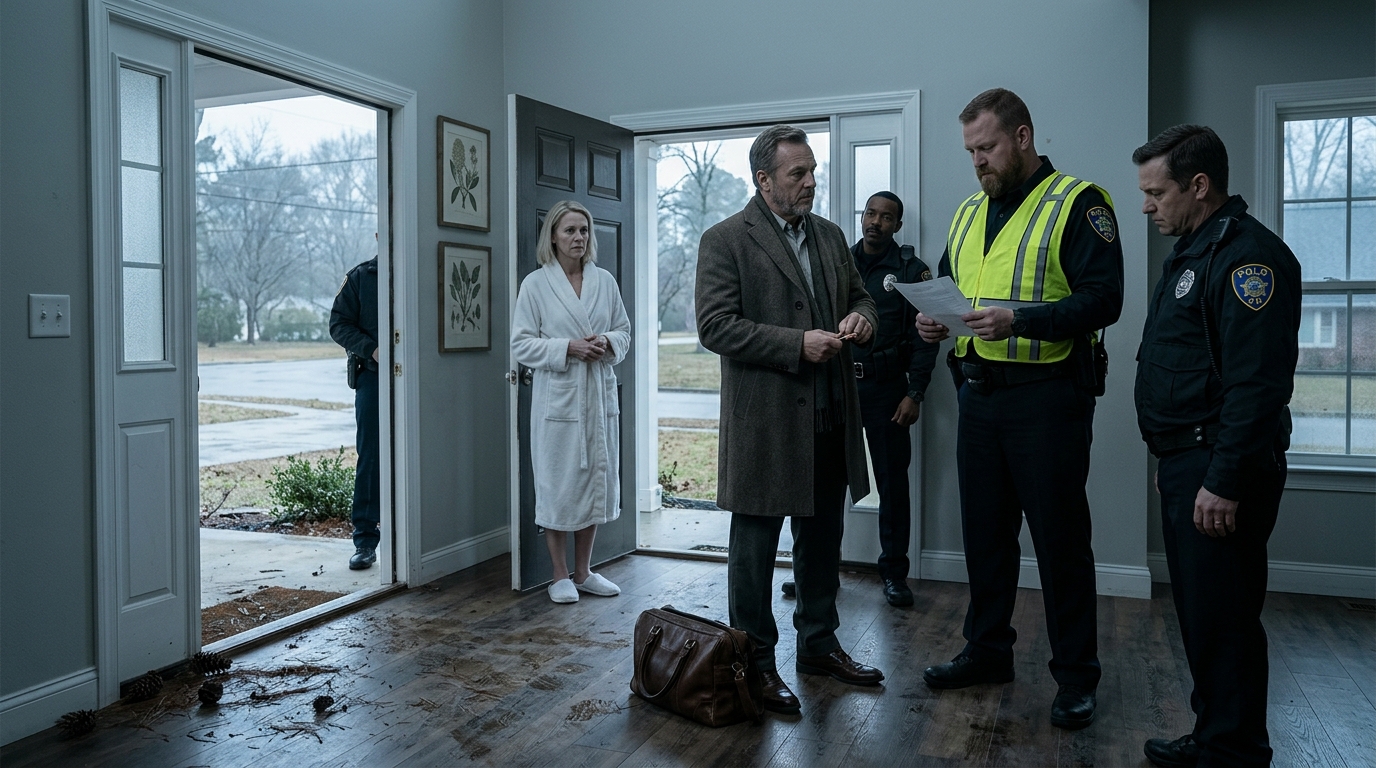
Through the glass panes of the front door, two local deputies stood on the porch. The senior officer was tall, burly, his yellow high-visibility vest stretched tight over a thick chest.
Walter pulled the door open. Cold morning air rushed into the foyer, smelling of pine needles and damp earth, cutting through the warm, stolen scent of coffee and eggs.
“Mr. Greer?” the senior officer asked, checking a digital pad attached to his wrist. “We had a 911 call reporting an active burglary.”
“I made the call,” Karen’s voice piped up from behind Walter. She had followed him into the hall, stopping five feet back, her hands clasped tightly over her stomach like a aggrieved landlord. “Officer, my name is Karen Mossfield. I am the HOA president for Asheford Hill. This man entered the premises without authorization while I was occupying the home.”
The deputy looked at Karen. He looked at her robe. He looked at Walter, who stood in a dark wool coat, his hands resting naturally at his sides.
“Sir?” the officer asked Walter. “Your identification?”
Walter reached into his inner breast pocket, pulled out his leather wallet, and handed his driver’s license directly to the deputy. Alongside it, he produced a folded white sheet of paper—a certified copy of the warranty deed he had pulled from his car’s glove box before walking inside.
“Walter Greer,” the officer read aloud, comparing the name on the license to the deed. “412 Asheford Hill Road.”
“That’s correct,” Walter said. “I’ve owned this property for twenty-two years. I was in Portland recovering from a cardiac procedure. I returned forty minutes ago to find Ms. Mossfield in my kitchen.”
The deputy turned to Karen. “Ma’am. Do you have ID?”
Karen unzipped her robe pocket, pulled out her wallet, and handed over her license. The deputy looked at it for three seconds.
“Ms. Mossfield,” the deputy said, his brow furrowing. “Your address is listed as 420 Asheford Hill Road.”
“That is my primary residential address, yes,” Karen said instantly, her tone smooth, persuasive, and completely devoid of doubt. “However, under the authority of the Asheford Hill Property Owners Association, this parcel was placed under temporary administrative custody due to prolonged abandonment.”
The deputy stared at her. His partner, a younger officer standing near the porch railing, shifted his weight and rubbed the back of his neck.
“Administrative custody?” the senior officer repeated. “Ma’am, is this a rental?”
“No,” Walter said cleanly. “It’s a fee-simple private residence. There is no mortgage. There is no lien. And there is no legal administrative custody in the state of Oregon that allows an HOA president to make scrambled eggs in a homeowner’s kitchen.”
The deputy handed the license back to Karen. The atmosphere in the hallway shifted instantly—the weight of state authority tilting away from the woman in the robe and settling squarely onto the floorboards beneath Walter’s boots.
“Ms. Mossfield,” the officer said, his voice dropping an octave into official caution. “Do you have a court order authorizing you to be inside this house?”
Karen didn’t answer right away. Her hand drifted back to her knuckle, rubbing the raw skin. “I have a master key issued by the board.”
She reached into her robe, pulled out a thick brass key tagged with a red plastic label, and held it out like a badge.
“The board issued this,” she said. “We have an emergency access protocol.”
Walter looked at the key. He didn’t touch it.
“Officer,” Walter said, his voice dropping into a razor-sharp whisper. “I want it documented in your incident report that Ms. Mossfield is in possession of a master key to my deadbolts. And I want her bag searched for any additional copies before she steps off my gravel.”
CHAPTER 3: THE MICROAUDIT
The senior deputy took the brass key from Karen’s hand. The metal clicked softly against the officer’s heavy utility ring as he slipped it into an evidence bag.
“Ma’am,” the officer said, his eyes fixed on Karen’s hovering fingers near the unzipped tote. “Step back from the bag. Hands where I can see them.”
Karen pulled her hands to her chest, her teeth pressing into her lower lip until the skin turned bone-white. She took two rigid steps back toward the living room doorway, her eyes darting between the deputy’s chest and Walter’s face.
“I have personal effects in there,” she said, her voice dropping into a tight, brittle register. “My phone charger. My notes for the community subcommittee.”
“We’ll get to your personal effects,” the deputy replied. He turned to his junior partner. “Miller, start a visual log. Every room she occupied.”
“I am non-combatant here,” Karen snapped, her knee jerking under the hem of her robe. “This is an administrative misunderstanding. I have a memorandum signed by Vanguard Asset Management regarding neighborhood oversight.”
The word Vanguard hit the air and hung there, unremarked upon by the officers, but Walter recorded it behind his eyes. Vanguard wasn’t an HOA subcommittee. Vanguard was a commercial foreclosure receiver operating out of downtown Portland.
“Officer,” Walter said, his voice dropping into the steady, measured rhythm of a cross-examination. “Before Ms. Mossfield removes a single item from my home, I am executing a room-by-room inventory. I want photo verification of every surface she touched, every piece of mail she forwarded, and every drawer she opened.”
“You don’t have the right to photograph my personal belongings,” Karen said, her nostrils flaring.
“This is my property,” Walter said, taking a step toward the kitchen archway. “Inside these four walls, your personal belongings are material evidence of unlawful entry.”
He pulled his smartphone from his coat pocket. His surgical incision pulled tight across his ribs—a dull, burning reminder of his four-hour drive—but his grip on the phone was motionless.
He started in the hall. Click. Karen’s blue leather tote sitting open on the granite counter, revealing the edge of the manila folder labeled File-87. Click. Two letters addressed to Karen Mossfield bearing his street address, postmarked four days prior. Click. His desk notepad, covered in her sharp, slanted cursive detailing groceries and a schedule for a locks-change contractor.
Karen followed three paces behind, escorted by Deputy Miller. Her slippers dragged on the pine boards with a dry, scraping rhythm.
“This is harassment, Walter,” she whispered as he moved into the downstairs bathroom. “You’ve been gone for weeks. The property was falling out of compliance.”
Walter didn’t look at her. He aimed the lens at the vanity. Click. Her lavender perfume bottle sitting next to his shaving kit. Her silk hair wrap hanging over his towel rack. Her prescription bottle resting on the cold marble edge of the sink.
“You took my dead wife’s towels out of the hall linen closet, Karen,” Walter said quietly. He didn’t turn around. He focused the camera on the blue terry-cloth bath sheet draped over the tub. “You put them in the laundry hamper.”
“They needed airing out,” she said. Her voice didn’t crack, but her hand twitched toward her collarbone, pulling the plush white robe tighter around her throat. “The house smelled like dust and neglect.”
“The house smelled like twenty-two years of my life,” Walter said.
He stepped out of the bathroom and moved toward the staircase. Every step up the oak treads felt like climbing through wet cement, his lungs working harder to pull air past the dull ache in his sternum, but he didn’t stop. The deputies followed, their heavy boots thudding against the risers.
On the second-floor landing, the door to the primary bedroom stood wide open.
The bed was made. Not the way Walter made it—with the wool blanket tucked tight under the footboard—but with the top sheet folded back in a neat, hotel-style diagonal. On the nightstand sat a black binder labeled Project-Sanctuary: Phase 1. Beside it lay a brass skeleton key—an exact duplicate of the key Walter carried in his pocket.
Walter stopped on the threshold. The air in the bedroom was thick with the scent of her lotion and the faint, metallic hum of a space heater running on the rug.
“Officer,” Walter said, pointing a finger at the binder on the nightstand without entering the room. “Photograph that cover before she touches it.”
Karen lunged forward half a step, her hand reaching out. “That’s association documentation! That’s proprietary!”
Deputy Miller caught her elbow—not roughly, but with enough firm leverage to stop her momentum cold. “Stay back, ma’am. Let him clear the room.”
Walter stepped inside, his phone raised. He clicked the binder. He clicked the skeleton key on the nightstand. Then he turned to the closet.
The left side held his tweed jackets, his winter coats, his suit bags. The right side held six silk blouses, three pairs of slacks, and a pair of mud-stained walking boots arranged neatly beneath his shoe rack.
He didn’t scream. He didn’t smash the perfume bottles. He stood in the quiet center of his own bedroom, feeling the cold air from the open downstairs window rising through the floorboards, and took three deep breaths to settle his pulse.
“Deputy,” Walter said, turning back to the senior officer standing in the doorway. “She didn’t just break in. She moved in. She shifted my personal property to accommodate her wardrobe.”
“I see it, Mr. Greer,” the deputy said, his face hardening as he looked from the closet to Karen. “Ma’am, get your shoes on. You’re packing your bags now, and you’re doing it with my officer watching every move.”
Karen stood in the doorway, her lips pressed into a thin, bloodless line. She didn’t look defeated; her eyes were cold, calculating, sweeping over the bedroom as if assessing the cost of a temporary setback.
“You’re making a catastrophic legal error, Walter,” she said softly, her voice barely audible over the hum of the space heater. “This house doesn’t belong to a ghost anymore.”
Walter pulled his phone down, locked the screen, and slipped it into his pocket. He reached into his coat, pulled out his brass skeleton key, and rolled it once across his knuckles with a quiet, metallic click.
“We’ll let the county recorder decide who owns the ghost, Karen,” Walter said. “Pack your bags.”
CHAPTER 4: THE PAPERWORK TRAP
The zipper on Karen’s leather suitcase pulled tight with a sharp, metallic screech.
She stood at the foot of the bed, her coat buttoned over her dress, her chin tilted up just enough to avoid eye contact with either officer. Deputy Miller picked up her two heavy bags, while the senior officer gestured toward the door.
“Downstairs, Ms. Mossfield,” the senior deputy said. “Let’s clear the driveway.”
Walter didn’t follow her down immediately. He stood on the landing, listening to the heavy thud of boots and the soft scrape of Karen’s heels on the pine stairs. Once the front door clicked shut and the low rumble of the police cruiser pulled out onto the gravel road, the house fell deathly silent.
The air smelled of lingering lavender and damp pine.
Walter pulled his phone from his pocket, tapped a contact, and pressed the receiver to his ear. His heart hammered a dull, irregular rhythm against his ribs—the surgical site throbbed with a persistent heat—but his posture remained rigid as he leaned against the banister.
The line rang twice before a sharp, rasping voice answered.
“Walter? Ed said you were driving back against doctor’s orders. Tell me you didn’t do something stupid.”
“I drove four hours, Diane,” Walter said, his voice flat. “I found Karen Mossfield eating breakfast in my bathrobe in my kitchen.”
A brief pause stretched across the line. The faint rustle of paper came through the speaker as Diane Roar, former county land-use counsel, adjusted her headset.
“Did you call law enforcement?”
“They just escorted her off the property,” Walter said. “She handed them a brass master key. Claimed the HOA board passed an emergency preservation protocol granting her administrative custody while I was in Portland.”
Diane let out a short, dry laugh that sounded like dry leaves scraping over concrete. “An emergency protocol? On a fee-simple Victorian deed? She might as well claim sovereign jurisdiction over your lawn mower.”
“She had a file,” Walter added, stepping down the first two stairs. “A black binder labeled Project-Sanctuary. And her tote had a folder marked File-87. She also dropped the name Vanguard Asset Management when the deputies pressed her.”
“Vanguard?” Diane’s tone shifted instantly, losing its dismissive edge. The background clicking of her keyboard picked up speed, sharp and rhythmic. “Hold on. I’m pulling the county clerk’s digital portal right now.”
Walter walked down the rest of the stairs, his boots sounding hollow in the empty house. He reached the kitchen, where her half-eaten plate of eggs still sat cold on his oak table. He picked up his notepad—the one she had used for her grocery list—and turned it over under the bright kitchen light.
Indentations from previous pages showed faint white tracks across the yellow paper. He pulled a graphite pencil from a cup near the sink and lightly shaded over the top page.
Letters began to emerge in ragged white lines: Unit 4, Unit 9, Unit 12. Vanguard verification pending.
“Walter,” Diane’s voice broke through the speaker, tight and focused. “I just pulled the Asheford Hill Property Owners Association registry filing for the last eighteen months. There is no recorded amendment for a master key policy.”
“Check the meeting minutes,” Walter said. “She told the officers it was approved six months ago.”
“I’m looking at the uploaded board minutes from November,” Diane replied. “Paragraph three mentions a ‘discussion regarding unmaintained properties and seasonal security checks.’ That’s it. A discussion. No formal vote, no quorum recorded, no homeowner notification, and zero filings with the county auditor.”
“So she cut keys based on a conversation,” Walter said.
“She cut keys based on nothing,” Diane snapped. “In the eyes of the law, she didn’t execute an HOA policy. She manufactured a fake corporate pretext to commit illegal entry.”
Walter stared down at the shaded notepad. His finger traced the indented white outline of Unit 9—the residence of Arthur Vance, an eighty-two-year-old retired civil engineer currently residing in an assisted-living facility in Eugene.
“Diane,” Walter said softly. “If she cut a master key for my house under this fake protocol, how many other locks in Asheford Hill open with that same piece of brass?”
The line went silent for three full seconds. Only the distant click of Diane’s keyboard remained.
“Eleven properties,” Diane whispered. “The association covers twelve homes total. If she pulled this stunt on yours while you were in Portland…”
“She has key access to eleven other homes,” Walter finished for her. “Check Vanguard Asset Management. Find out why an HOA president is routing unit numbers through a commercial foreclosure outfit.”
“I’m submitting a formal record demand to the board’s legal representative right now,” Diane said, her voice turning razor-sharp. “And Walter? Do not throw away those egg dishes or that notepad. That’s not trash anymore. That’s intent.”
Walter hung up the phone. He stood alone in his kitchen, looking at the two pieces of forwarded mail sitting on his counter. He reached into his coat pocket, pulled out his brass skeleton key, and set it down hard against the cold granite surface.
The brass rang out with a clean, solitary chime.
CHAPTER 5: THE ESCALATION SPIKE
The chime rang twice from the center of the oak table.
Walter didn’t rush. He reached out, picked up the brass skeleton key, and dropped it into his coat pocket before stepping over to his phone.
The notification on the lock screen came from the neighborhood digital board—a private group with eighty-four registered addresses on Asheford Hill.
Post by Karen Mossfield (Board President) — 12 minutes ago.
Walter tapped the notification. The thumbnail expanded into a high-resolution photograph taken from the bottom of his staircase, looking up toward the second-floor landing. The lighting was unmistakable: the morning sun pouring through his stained-glass transom window, illuminating the antique pine risers he had spent three months hand-sanding in the spring of 2011.
The caption beneath the image read:
“Community Update: Asheford Hill’s finest historic residence is finally being looked after properly. Following serious concerns regarding property abandonment and owner health instability, the executive board has initiated emergency wellness and structural oversight. We request that neighbors respect the ongoing assessment process during this difficult transition.”
Walter read the four lines twice. His pulse remained dead flat at sixty-two beats a minute, but the skin around his surgical dressing pulled tight as his jaw clamped down.
She hadn’t just posted a statement. She had framed his recovery in Portland as mental incompetence. She had branded his house an endangered asset.
A second notification flashed across the top of the display. A direct text message from Gerald Foss, who lived two doors down at 408 Asheford Hill.
Gerald: Walter? Just saw Karen’s board post. Are you back? She told the subcommittee last week you were in a specialized care facility and couldn’t handle the maintenance.
Walter tapped the screen, his thumb striking the glass with cold, deliberate precision.
Walter: I am standing in my kitchen. She entered my house with an illegal key. The sheriff just removed her.
He barely hit send before the gravel outside gritted under heavy tires.
Walter walked to the front window and pulled back the edge of the linen curtain. A silver estate wagon had pulled into the turn-around spot beside the driveway. Gerald Foss stepped out, his tall frame slightly stooped, holding a manila folder against his chest like a shield against the cold wind. Behind him, Ed Miller—Walter’s immediate neighbor who had left the original voicemail—was walking across the lawn in his work boots.
Walter unlocked the deadbolt and pulled the heavy door open before Gerald could reach the porch steps.
“Walter,” Gerald said, stopping on the top step. His gray eyes scanned Walter’s face, taking in the pale complexion and the slight lean against the doorframe. “Ed called me five minutes ago. He said he saw the patrol car leaving.”
“Come inside, Gerald. You too, Ed,” Walter said, stepping back from the threshold.
The two men stepped into the foyer. Ed shut the door behind them, the iron latch dropping into place with a heavy, metallic thud.
“She put that post up fifteen minutes after the deputy drove her off,” Ed said, rubbing a calloused hand over his beard. “She’s trying to get out ahead of it, Walter. She’s telling people you lost your mind after the heart procedure.”
“She’s building a paper trail of incompetence,” Gerald added, opening his folder. “Look at this. She sent this memo to the finance committee three weeks ago while you were still in Portland.”
Walter took the sheet. The letterhead bore the official seal of the Asheford Hill Property Owners Association, but across the bottom margin, printed in small nine-point type, was a registration line: Document Administered Under Vanguard Management Protocol 87-B.
There was the noun again. Vanguard. Sitting in plain text on an association document sent to a neighbor.
“What is Vanguard, Gerald?” Walter asked, his finger touching the fine print.
“She told us they were an insurance auditor,” Gerald said, his voice dropping into a troubled murmur. “She claimed our master policy was going to spike thirty percent unless we had a professional receiver inspect properties that sat empty for more than seven days. I questioned it at the autumn meeting, Walter. I asked for the underwriting agreement.”
“And what did she do?” Walter asked.
“She brushed me off,” Gerald said bitterly. “Told me the board had executive privilege on risk assessment. Said if I pushed it, the association would hold me personally liable for any rate increases.”
Walter handed the paper back. He reached into his coat pocket, pulled out the brass key Karen had handed the deputy, and held it up between his thumb and forefinger.
“She didn’t just inspect, Gerald,” Walter said. “She moved her wardrobe into my closet. She forwarded her personal mail to my address. She had a grocery list on my counter.”
Ed swore under his breath. Gerald stared at the brass key, the color draining slowly from his cheeks.
“She… she took occupancy?” Gerald whispered.
“She occupied it,” Walter said cleanly. “And if she did it to 412, she’s preparing to do it to 408, 404, and every other house where the owner is old, sick, or living alone.”
He turned back toward the kitchen, his boots striking the floorboards with a sharp, rhythmic tempo.
“Gerald,” Walter called over his shoulder. “Call an emergency meeting of the twelve homeowners. Not through the board portal. Through personal phone calls. Tell them to bring every notice, every memo, and every letter Karen Mossfield has sent them in the last twelve months.”
“What are you going to do?” Gerald asked, following him to the archway.
“I’m going to take her paper trail,” Walter said, picking up his phone to dial Diane, “and I’m going to turn it into a noose.”
CHAPTER 6: THE MIDPOINT BREAK
The phone speaker clicked once before Diane’s voice cut through the hum of the kitchen.
“Walter, I just pulled the subpoenaed document packet from the board’s secondary server,” she said without greeting him. “You need to look at your email right now. I forwarded the master file.”
Walter didn’t move from the counter. He kept his left hand flat on the oak table, feeling the cold grain under his palm, while his right thumb tapped his smartphone screen to open the attachment. Gerald and Ed stepped closer, their shadows falling over the granite top as the document loaded.
On the screen, a four-page PDF bore the header Asheford Hill POA – Emergency Access Resolution 2024-04.
At first glance, it looked ironclad. Heavy legal typeface, formal section breaks, and a dark blue notary seal resting beside Karen Mossfield’s signature.
“Look at page three, Walter,” Diane instructed through the line. “The notary block.”
Walter zoomed in. His eyes, trained by four decades of title searches and conveyance audits, caught the discrepancy instantly.
The stamp belonged to a state notary named Sarah Jenkins. The commission expiration date listed at the bottom of the seal read October 12, 2023. But the execution date written in Karen’s sharp, slanted handwriting above the line was April 14, 2024.
The notary seal was expired six months before the document was allegedly executed.
“She used an old stamp,” Walter said softly. His voice held no heat, only the flat, lethal certainty of an auditor finding a thumb on the scale. “She forged the notary verification.”
“It gets worse,” Diane said, the sound of her turning pages coming sharp through the phone speaker. “Look at the footer on page four. Paragraph 12-C.”
Walter scrolled down. The text was small, indented under a clause titled Special Asset Preservation.
“In the event of owner incapacitation, unnotified vacancy exceeding seven days, or structural risk, the Executive Committee grants administrative power of attorney to Vanguard Asset Management to manage, re-key, and temporarily assign occupancy rights under File-87 protocols.”
Gerald let out a sharp breath behind Walter’s shoulder. “Administrative power of attorney? She gave a private firm the right to lease out our houses?”
“She didn’t just give them the right,” Walter said, turning his head to look at Gerald. “She created a decoy policy. Layer one was telling the board this was an emergency safety measure for maintenance. Layer two was giving Vanguard legal standing to squat on empty properties under the cover of a fake corporate resolution.”
“Walter,” Ed interrupted, pointing a calloused finger at the screen. “Look at the signature line under Karen’s.”
Below Karen’s signature sat a second line, pre-signed in digital blue ink: Vanguard Management Representative – Authorized Signatory. Beside it was a printed project title: Project-Sanctuary Implementation.
The decoy had shattered. It was never about a neighborhood feud over lawn maintenance or a micromanaging HOA president asserting her ego. Karen Mossfield was running a systematic asset-seizure pipeline, using forged board minutes to grant a third-party entity physical access to high-value homes whenever the owners walked out the door.
“Diane,” Walter said, his voice dropping into a razor-sharp whisper. “Where is the physical original of this document?”
“If she filed a digital copy on the board server, the physical paper with the wet signature is either in her house at 420 Asheford Hill,” Diane replied, “or it’s sitting in that tote bag she took with her.”
Walter reached into his coat pocket. He pulled out the brass skeleton key and tapped it against the glass of his phone screen—a single, sharp ring that echoed in the quiet kitchen.
“Ed,” Walter said, turning to his neighbor. “How many homes on this hill currently have owners out of state?”
Ed’s brow furrowed as he counted on his fingers. “Arthur Vance is in the care home in Eugene. The hendricksons are in Arizona for the winter. That’s two. Plus yours made three.”
“Three properties,” Walter said. “Three houses with locks she could open with that red-tagged key.”
“What’s the play, Walter?” Gerald asked, his hands clenching into fists at his sides. “We call an emergency meeting and show the neighbors this forged document?”
“No,” Walter said cleanly. “If we show them now, she claims it was a drafting error by her assistant or an administrative mistake. We don’t give her an exit.”
He picked up his keys from the counter and looked toward the front hallway. His chest throbbed with a dull, persistent ache where the stent had been placed, but his vision was completely clear.
“We go to 420 Asheford Hill,” Walter said. “We serve her with a formal demand for the physical association ledgers before she has time to burn the paper trail.”
CHAPTER 7: THE TOXIC LEAK
The gravel driveway at 420 Asheford Hill crunched under Walter’s boots like breaking glass.
Behind him, Gerald and Ed walked in sync, their coat collars turned up against the biting mountain wind that whipped down off the ridge. The blue sedan Karen had parked at Walter’s house earlier sat idling in front of her double garage, exhaust curling grey into the freezing air.
Walter didn’t wait for his companions to cluster behind him. He marched straight up the three brick steps, his chest tightening under his coat as the cold air bit into his lungs, and struck the heavy brass door knocker twice against the oak paneling.
The sound echoed off the porch pillars with a flat, heavy thud.
Inside, curtains twitched beside the bay window. A lock clicked twice—a fast, anxious rhythm—and the door swung open three inches on a brass security chain.
Karen Mossfield looked through the gap. She was still wearing the dark slacks and sweater she had thrown on under police supervision, her hair pulled back into a hasty, frayed ponytail. Her eyes drifted from Walter’s face to Gerald, then to Ed, her chin twitching upward.
“This is private property, Walter,” she said through the crack. Her voice had lost its smooth, public modulation; it was thin, sharp, and laced with frantic authority. “If you are here to intimidate me after your outburst this morning, I will have the deputy return immediately.”
“Call him,” Walter said. He didn’t reach for the door. He stood on the top step, his hands buried deep in his wool pockets, his thumbs pressing against the hard, cold metal of his car keys. “Ask him to bring a county clerk. We’re here for the physical ledgers.”
“The association records are digital,” Karen said instantly. “And board files are subject to formal written requests under Section 8. You know the rules, Walter. Two weeks’ notice.”
“Section 8 applies to validly elected boards operating under legal resolutions,” Walter said softly. He stepped half an inch closer to the doorframe, leaning into the gap. “It doesn’t cover forged notary seals on fraudulent powers of attorney.”
Karen’s eyelids fluttered—a sharp, involuntary spasm. Her fingers tightened on the edge of the door until her knuckles turned yellow.
“I don’t know what you’re talking about,” she said, but her tone lacked conviction.
“I’m talking about File-87,” Walter said, dropping the noun onto the porch like a heavy iron weight. “I’m talking about Vanguard Asset Management. And I’m talking about the fake emergency protocol you used to cut master keys for eleven homes on this hill.”
Behind Walter, Gerald took a step forward, pulling a folded paper from his pocket. “I called Arthur Vance’s sister in Eugene ten minutes ago, Karen. She checked his bank statements. Someone registered a temporary property management fee against his deed last month under Vanguard’s corporate tax ID. Two thousand dollars.”
Karen’s breath hitched, loud enough to hear over the whistling wind. She tried to push the door shut, but Ed’s heavy leather boot slid cleanly into the jamb, stopping the wood cold before the latch could engage.
“Don’t do that, Karen,” Ed said quietly, his voice carrying the rough, unyielding weight of forty years in construction. “We aren’t going away.”
“You’re breaking the law!” Karen hissed, her voice cracking as she pressed her shoulder against the door to fight Ed’s boot. “You have no legal standing! Vanguard is a licensed receiver!”
“A receiver for foreclosed commercial assets,” Walter corrected her, his voice dropping into the terrifyingly calm register of a prosecutor closing an argument. “Not for inhabited private homes with paid-off deeds. You didn’t just misuse HOA minutes, Karen. You leased our addresses to an asset-stripping firm to generate fake administrative liens. That’s not a administrative dispute. That’s systematic fraud.”
Through the crack in the door, Walter caught a glimpse of her foyer table behind her. Sitting atop a stack of opened mail was a fresh manila folder stamped with a red circle and the words: Project-Sanctuary: Phase 2 Authorization.
The leak was spreading. It wasn’t just about occupying his house while he was recovering from surgery. She was preparing to trigger automated liens against every property on Asheford Hill whose owner failed to respond to a registered letter within seven days.
A flash of memory hit Walter—his late wife Martha sitting at their kitchen window six years ago, carefully filing their property tax receipts into color-coded folders, insisting that a home was only as safe as its paper trail.
“Give us the physical ledger, Karen,” Walter said, his voice flat and absolute. “Or Diane files an emergency injunction with the county circuit court in forty-five minutes. And when the sheriff comes back with a search warrant, he won’t just take the keys. He’ll take your computer.”
Karen stared at him through the narrow gap. The arrogant composure she had displayed in his kitchen hours earlier had vanished completely, replaced by the desperate, wide-eyed calculation of an animal realizing the fence was electrified.
“You think you’re protecting this hill, Walter?” she whispered, her lips trembling with bitter fury. “You think these people care about your precious deeds? Half these houses are falling apart because you old fools won’t let us modernize! Vanguard was going to save this association!”
“Vanguard was going to steal it,” Walter said. “Open the door.”
CHAPTER 8: THE TACTICAL COUNTERSTRIKE
The brass chain drawn across the frame creaked under the tension, the narrow steel screws pulling microscopic grains of wood dust from the door jamb.
“Ed,” Walter said softly. “Step back.”
Ed looked at Walter, his jaw set hard, but he lifted his boot off the threshold. The moment the weight released, Karen slammed the door shut. The deadbolt shot home with a heavy, double-stage metallic thunk that vibrated through the porch floorboards.
“She’s locking down,” Gerald said, his knuckles white against his paper folder. “She’s going to shred every physical page in that hallway.”
“She can’t shred what’s already filed with the bank,” Walter said. He turned his back to the closed door and walked down the three brick steps toward the gravel drive, his long coat snapping in the wind. “And she can’t shred the public record.”
“Where are we going?” Ed asked, catching up with long strides while Gerald jogged to keep pace.
“To your workshop,” Walter said to Ed. “We need twelve chairs, a pot of dark coffee, and every landline number on this ridge.”
Fourteen minutes later, the three men stood inside Ed’s converted timber barn at the base of Asheford Hill. The air smelled of sawed cedar, motor oil, and old cast iron. A pot of black coffee dripped rhythmically into a glass carafe on a workbench, surrounded by rolls of blueprints and blue-lined parcel maps of the county subdivision.
Walter stood over the zinc-topped workbench, his smartphone resting on speaker mode next to a brass desk lamp.
“Diane,” Walter said, his voice cutting through the hum of a space heater. “Did the circuit court clerk accept the filing?”
“Accepted and stamped forty seconds ago,” Diane’s voice rasped through the small speaker. “An emergency petition for an order to freeze association records and compel an immediate audit. Hearing is set for nine o’clock tomorrow morning.”
“That’s sixteen hours from now,” Gerald pointed out, rubbing his thumbs together over a steaming mug. “Karen’s got sixteen hours to transfer those Vanguard files or claim a hard-drive failure.”
“She won’t have sixteen hours,” Walter said. He tapped a folded white sheet resting on the zinc table—a printed roster of the twelve home deeds on Asheford Hill. “Section 14 of the original 1987 covenants. A special assembly of property owners can be convened with two hours’ notice if sixty percent of titled deed holders sign a physical demand.”
“We have three signatures,” Ed said, pointing to himself, Walter, and Gerald. “We need five more to hit sixty percent.”
“We have four right now,” Walter corrected, picking up a pen. “Arthur Vance’s sister has a durable power of attorney registered with the county. I spoke to her from the car. She signed electronically three minutes ago.”
He pulled the roster toward him, his pen scratching across the paper as he added the fourth name. His fingers throbbed with a faint, persistent tremor—the lingering tax of four hours driving and three hours on his feet—but his stroke was thick and precise.
“Gerald,” Walter instructed, without looking up. “Call the Hendricksons in Arizona. Tell them we aren’t asking for money or dues. Tell them their property title has a fraudulent administrative lien pending under Vanguard’s tax ID, and we need their signature to revoke Karen’s signatory power.”
“On it,” Gerald said, pulling his phone from his pocket and stepping toward the back of the workshop.
“Ed,” Walter continued, turning to his neighbor. “Go to 404 and 416. Don’t use the phone. Knock on their doors. Tell them the HOA president has a master key to their front deadbolts in her purse right now, and ask them if they want to see the deputy’s incident report.”
Ed didn’t ask questions. He grabbed his heavy canvas coat off a wall peg, pulled his cap down low over his eyes, and walked out into the wind, the heavy barn door sliding shut behind him with a low, rumbling thud.
Walter sat down on an overturned crate beside the zinc bench. He reached into his coat pocket, pulled out the heavy brass skeleton key, and laid it flat beside his phone.
The lamp light caught the polished edges of the key, casting a sharp, elongated shadow across the parcel map of Asheford Hill.
He didn’t drink the coffee. He didn’t lean back. He sat with his hands resting on his knees, listening to Gerald’s low, urgent pitch over the phone in the background, watching the minute hand on the workshop clock click steadily toward four o’clock.
The physical price was rising; his chest burned with every deep breath, a sharp reminder that his body was still recovering from a surgeon’s scalpel. But as he watched the fifth and sixth signature confirmations flash across his phone screen, a cold, predatory satisfaction settled into his spine.
The paper trail was moving faster than Karen Mossfield could run.
CHAPTER 9: THE TIGHTENING NOOSE
The sixth signature notification vibrated against the zinc bench with a sharp, buzzing rasp.
Gerald hung up his cell phone, wiping a line of sweat from his forehead with his sleeve. “That’s Mrs. Gable from Unit 3. She signed. That makes seven out of twelve verified deed holders.”
Fifty-eight percent. One percent shy of the statutory threshold required to force an immediate emergency board dissolution under Oregon property law.
Before Walter could speak, headlights swept across the frosted glass windows of the barn doors. Heavy boots crunched over the gravel outside, followed by three sharp knocks on the sliding timber frame.
Ed pulled the door open six inches. A courier in a navy windbreaker stood in the gap, breathing fog into the cold twilight air.
“Walter Greer?” the courier asked, holding a black digital signature pad.
“I’m Walter Greer,” Walter said, standing up slowly from his crate. His knees popped in the quiet barn, his surgical dressing tugging against his ribs, but he walked straight to the door.
“Service of legal notice from Mossfield & Associates,” the courier said mechanically, handing over a thick, foil-stamped envelope before sliding his digital pad toward Walter for a thumbprint.
Walter signed the screen with his knuckle, took the envelope, and stepped back into the warmth of the workshop. Ed rumbled a low curse and slid the heavy door shut, dropping the iron latch into its notch.
Walter tore open the top flap. Inside sat a four-page notice printed on heavy twenty-pound cream stock.
“NOTICE OF INTENT TO LEVY ADMINISTRATIVE LIEN & EMERGENCY INJUNCTION”
“To: Walter Greer (Unit 1)
“Take notice that the Executive Committee of the Asheford Hill Property Owners Association, in conjunction with Vanguard Asset Management, has filed a provisional cloud on title under File-87 due to severe structural neglect, unauthorized police disruption, and tortious interference with community governance…”
Gerald leaned over Walter’s shoulder, reading the second paragraph. “She filed a lien on your house? Today? While we were standing on her porch?”
“She didn’t file it today,” Walter said softly. He held the document up to the overhead brass lamp.
The watermark in the paper showed a light grey grid pattern—the signature paper stock of a fast-print print shop in town, not the county clerk’s office. And down in the bottom right corner, beneath a purple rubber stamp, was the pre-printed account number for Vanguard Asset Management: Acct-87-Sanctuary.
“It’s a bluff,” Walter said. “She printed a fake lien notice to scare me into backing off before nine o’clock tomorrow morning.”
“It’s not just a bluff, Walter,” Ed said, stepping over to his workbench and picking up an old iron wrench. “Look at the time stamp on the bottom. She backed it with a forty-eight-hour cure notice. If you don’t vacate 412 by Friday, she claims Vanguard has the legal right to change your locks again.”
Walter didn’t flinch. He folded the cream paper once, twice, and pressed the crease flat against the edge of the zinc table with his thumb until the paper groaned.
“She’s burning her bridges because she knows the paper trail is closing in,” Walter said. He looked down at his phone.
The screen lit up with an incoming call from Diane Roar.
Walter swiped the screen and brought the phone to his ear. “Diane. Tell me you have the eighth name.”
“I have better than the eighth name, Walter,” Diane’s voice came through, loud and sharp enough for Gerald and Ed to hear every word. “I just got off the phone with the county auditor’s supervisor. Karen Mossfield didn’t just register Vanguard as a vendor. She listed herself as a twenty-percent equity partner in Vanguard’s regional subsidiary.”
The air inside the barn seemed to freeze solid.
“She wasn’t just managing the properties,” Walter whispered, his fingers tightening around the folded cream letter until his knuckles turned gray. “She was buying her own distressed liens.”
“Every time a homeowner went to a care facility or spent two weeks away, she generated administrative fines through the HOA,” Diane explained rapidly. “When the fines went unpaid because the owners never got the notices, she assigned the debt to Vanguard. Vanguard filed the cloud on title, bought the debt for pennies on the dollar, and Karen took her cut on the re-lease.”
It was an automated asset-stripping mill operating out of a suburban living room four doors down.
“Gerald,” Walter said, turning his head toward his neighbor, his voice dropping into a register of cold, absolute authority. “Call Mrs. Gable back. Tell her we don’t just need her signature for the emergency meeting. Tell her we’re meeting on Karen’s front lawn at seven o’clock tonight.”
“Seven tonight?” Gerald asked, his eyes widening. “That’s two hours from now.”
“She served me a fake lien at four,” Walter said, picking up his brass skeleton key from the table and dropping it into his coat pocket. “We serve her with the dissolution of her board before she can erase the bank transfers.”
CHAPTER 10: THE CORNERED BEAST
Night fell over Asheford Hill like a slate-grey sheet.
By 6:58 PM, the gravel cul-de-sac outside 420 Asheford Hill was jammed with vehicles. Halogen floodlights on Ed’s estate truck cut through the black pitch, illuminating the frosted lawn and casting long, sharp shadows of eight property owners assembled near the porch steps.
Walter stood at the center of the arc. His coat was buttoned tight against the cutting wind, his hands held flat at his sides. In his left hand, he held the signed physical demand representing sixty-seven percent of the titled deed holders. In his right coat pocket rested his brass skeleton key.
At seven sharp, Karen Mossfield opened her front door.
She didn’t step onto the porch alone. Beside her stood a man in a dark grey suit, carrying a leather briefcase stamped with the silver initials V.A.M.—Vanguard Asset Management.
Karen’s face was pale, her jaw locked tight, but her posture was rigid with weaponized composure.
“This is an illegal assembly on private property,” Karen announced, her voice projected across the lawn through a portable megaphone. “You are in violation of community nuisance ordinances. Mr. Henderson from Vanguard legal counsel is here to document your identities for individual civil suits.”
The attorney stepped forward, unlatching his briefcase. “I advise everyone here to disperse immediately,” he said smoothly. “Under File-87 and Project-Sanctuary corporate filings, this association is under temporary receiver management. Any attempt to disrupt executive board operations will result in immediate clouds on title for tortious interference.”
The neighbors shifted nervously. Gerald looked at Walter, his jaw clenching as he took half a step back.
Walter didn’t move. He stepped out from the cluster of neighbors, his leather boots crunching heavily on the frozen grass until he stood five feet from the bottom porch step.
“Mr. Henderson,” Walter said, his voice cutting cleanly through the hum of the truck’s idling engine. “Are you aware that the document you relied on to establish receiver standing under File-87 carries a forged notary stamp from an expired commission?”
The attorney didn’t flinch. “Administrative irregularities do not invalidate corporate power of attorney, Mr. Greer.”
“They do when the power of attorney was never voted on by a board quorum,” Walter said. He raised the paper in his left hand. “Section 14 of the 1987 covenants. Eight out of twelve titled deed holders have executed an immediate dissolution of the executive board. Karen Mossfield no longer holds administrative authority over this association. Her authority ended four minutes ago.”
Karen grabbed the megaphone from the attorney’s hand. “That petition is invalid! You coerced elderly residents while they were incapacitated!”
“Mrs. Gable signed in person fifteen minutes ago, Karen,” Ed called out from behind his truck, holding up a digital tablet. “She’s watching this on speakerphone right now.”
Karen’s face twitched. The disciplined mask shattered, revealing the desperate, cornered predator underneath. She leaned over the porch railing, pointing a shaking finger directly at Walter’s chest.
“You think you won, Walter?” she spat, her voice cracking over the megaphone’s speaker. “You think a piece of paper stops a registered receiver? Vanguard holds a cross-collateralized lien on your property for unpaid assessment fees going back six months! I signed the deed restriction transfer two hours ago! The county recorder has the filing!”
The crowd gasped. Gerald stepped forward, his face drained of color. “She filed a cloud on your title, Walter?”
Karen laughed—a sharp, shrill sound that died instantly in the freezing wind. “He doesn’t own 412 Asheford Hill anymore! He’s a squatter! And if you don’t clear off my lawn in two minutes, I’m having Vanguard’s private security team padlock every empty house on this ridge!”
Walter stared at her. His chest burned where the stent sat against his artery, his pulse spiking as the cold wind whipped his face. But he didn’t back down. He reached into his coat pocket, wrapped his fingers around his brass skeleton key, and pulled it into the light.
“You didn’t file a deed restriction transfer, Karen,” Walter said, his voice dropping into a razor-sharp whisper that carried across the quiet lawn. “You filed a confession.”
CHAPTER 11: THE CHECKMATE CLIMAX
The cold wind whipped down off the ridge, carrying the sharp scent of exhaust from Ed’s idling estate truck.
Karen’s fingers twitched against the porch railing, her knuckles bone-white as she glared down at the brass key in Walter’s hand. Beside her, the Vanguard attorney froze, his thumb hovering over the latch of his leather briefcase.
“A confession?” Karen shouted over the megaphone, her voice echoing off the surrounding pine trees. “You’re delusional, Walter! That filing is an official corporate instrument!”
“It’s a digital land-grab,” Walter said cleanly. He didn’t raise his voice, but every word carried across the frozen grass with absolute, piercing clarity. “And you didn’t file it with the county recorder. You uploaded it to the county clerk’s provisional holding queue. Pending manual audit.”
He pulled his phone from his inner breast pocket with his free hand and tapped the screen once. He held it up toward the porch.
“Diane,” Walter called out. “Read paragraph four of the county auditor’s preliminary hold order.”
A sharp, rasping voice burst through the phone’s speaker, amplified through the truck’s exterior sound system via Bluetooth.
“Order issued at 6:42 PM,” Diane Roar’s voice boomed across the yard. “All provisional filings associated with Vanguard Asset Management under File-87 and Project-Sanctuary are frozen due to suspected notary fraud, unauthorized power-of-attorney execution, and self-dealing by an association officer.”
The attorney beside Karen closed his briefcase with a loud, hollow snap. He looked at Karen, stepped back two paces toward the front door, and lowered his hands.
“Karen,” the lawyer whispered, loud enough for the front row of neighbors to hear. “You told me the notary stamp was valid. You told me the board passed a unanimous vote.”
“Shut up!” Karen hissed, swinging the megaphone toward him before whipping back to face Walter. “I saved this community! You old fools sit on millions in equity while your roofs rot! Vanguard was going to stabilize the parcel values!”
“Vanguard was going to strip the titles,” Walter said. He took three deliberate steps up the brick stairs, his heavy boots crunching on the frozen steps until he stood on the top landing, eye to eye with her. “You took my dead wife’s towels out of my linen closet, Karen. You put her china in the sink. You thought because I had a heart procedure in Portland, I was too weak to read a land registry.”
Karen took a frantic step back toward her doorway, her hand dropping the megaphone. It struck the timber porch floor with a loud, feedback-screeching bang that made the neighbors flinch.
“I have executive immunity!” she screamed, her voice breaking into a raw, desperate rasp as her back hit the oak doorframe. “You can’t remove me! The bylaws require a thirty-day board review!”
“Section 14 overrides board review when felony fraud is cited in a recorded petition,” Walter said. He pulled a folded document from his coat—the physical dissolution demand signed by eight homeowners—and pressed it flat against her front door.
“You’re done, Karen,” Gerald called out from the bottom of the steps, his voice steady and unyielding. “The board is dissolved. Your signatory power is revoked.”
Two headlights cut through the darkness at the end of the cul-de-sac. A county sheriff’s cruiser turned slowly onto the gravel drive, its red and blue lights flashing silently against the frost-covered trees.
The attorney from Vanguard didn’t wait. He picked up his briefcase, walked past Karen without looking at her, and walked down the porch steps to meet the deputy.
Karen stood paralyzed against her own doorframe. Her mouth worked silently, her chest heaving under her coat as she watched the deputy step out of the patrol car. The arrogant, micromanaging tyrant who had eaten eggs at Walter’s kitchen table six hours ago had collapsed into a hollow, cornered shell.
Walter didn’t gloat. He didn’t raise his fist. He simply stood on the top step, feeling the cold air fill his lungs, and reached into his pocket to slip his brass skeleton key back into its velvet lining.
The paper trail had reached its end.
CHAPTER 12: THE QUIET SANCTUARY
The red and blue strobes of the cruiser swept across the porch ceiling in rhythmic, silent arcs.
Karen Mossfield didn’t move as the deputy stepped up to the landing. Her hand hung loose against her coat, her fingers twitching uselessly against the cold oak casing.
“Ms. Mossfield,” the deputy said, his voice flat and unhurried as he pulled a folded paper from his clipboard. “County prosecutor’s office requested we serve this in person. Injunction freezing all association accounts, pending an investigation into forged notary filings and unauthorized master-key distribution.”
Karen looked at the paper. She didn’t reach for it. Her jaw twitched, a tiny, involuntary tremor working beneath her pale skin, but she spoke no words. Her eyes drifted past the deputy’s shoulder to Walter, who stood three feet away on the cold brick landing.
“You ruined this neighborhood, Walter,” she whispered, her voice barely carrying over the hum of the idling squad car. “You and your ancient house.”
Walter didn’t raise his voice. He didn’t smile. He adjusted his coat collar against the rising mountain wind, feeling the cold air settle into his lungs without the suffocating tightness that had chased him out of Portland.
“The house was built in 1887, Karen,” Walter said softly. “It’ll be standing here long after your legal filings are shredded.”
He turned his back on her, walking down the three steps to where Gerald and Ed stood waiting on the gravel drive. Behind them, the six other homeowners were already dispersing toward their cars, their voices low, steady, and relieved.
“We’ll handle the emergency board filings tomorrow morning, Walter,” Gerald said, stepping up to shake Walter’s hand. His grip was firm, cold from the wind, but solid. “Get some sleep.”
“I intend to,” Walter said.
He walked back to his car, opened the door, and drove the four doors down to 412 Asheford Hill.
The house sat dark against the treeline, its wraparound porch and limestone foundation rising solid and permanent into the night air. The blue sedan was gone. The gravel driveway was empty.
Walter unlocked his front door. The mortise lock turned with the clean, familiar click of well-oiled iron.
Inside, the hallway was quiet. The air no longer carried the sharp bite of lavender perfume or cold grease. The scent of aged plaster, pine floorboards, and damp mountain earth had returned, filling the space like an old friend pulling up a chair.
He walked into the kitchen.
On the counter sat the blue ceramic plate and the stoneware mug he had retrieved from the table hours ago. Walter turned on the brass faucet, filled a bowl with warm water and soap, and washed the plate by hand. He dried it with a clean linen towel, wiping away the faint yellow grease marks until the glaze shone under the kitchen light. He placed the plate back in the cabinet, second shelf from the top, exactly where it belonged.
Next, he walked to the hallway table where his brass deadbolt lock had bound slightly three years ago. He pulled a small oil can and a screwdriver from his library drawer, sat down on a wooden stool, and tightened the strike plate screw by screw until the latch met the frame without a whisper of friction.
He reached into his pocket, pulled out the heavy brass skeleton key, and set it inside the small mahogany valet box on his desk. He closed the lid.
His phone buzzed on the counter. A text message from Diane: Recorded admission of unlawful entry signed by Mossfield’s counsel. County record updated. Vanguard has pulled all File-87 filings permanently. It’s over, Walter.
Walter set the phone down on the oak table. He didn’t reply.
He poured himself a glass of water, walked into the living room, and sat down in his armchair by the east window. The glass was cool against his palm. Outside, the wind rattled the old pine trees along the ridge, but inside the thick plaster walls, the room was warm, silent, and steady.
He leaned his head back against the leather cushion, closed his eyes, and listened to the slow, quiet house breathing in the dark.