The Cold Calculus of Retribution: How a Retired Combat Engineer Dismantled a Suburban Tyranny
CHAPTER 1: THE FROST ON THE GLASS
The boots made no sound on the frosted gravel, a disciplined habit born of twenty years spent moving through spaces where noise was a signature of mortality. Jack kept his hands deep in the pockets of his canvas field jacket, his fingers wrapped around the smooth polymer body of a laser measure. The air smelled of damp earth and burnt plastic—the lingering olfactory ghost of the evening before, when local hands operating under a stranger’s instructions had taken pry bars to his retirement.
Beside the north wall of the barn, a single jagged piece of aluminum racking dangled by a frayed grounding wire, twitching rhythmically in the rising thermal draft.
“They didn’t unbolt it,” Jack murmured to the empty paddock.
His breath plumed white against the gray light of dawn. The contractors had used cutting torches and heavy leverage, treating the thirty-kilowatt array not as a high-precision electrical installation, but as scrap iron to be cleared from a landowner’s path. Every micro-inverter was crushed; every mounting foot had been ripped away with enough violence to scar the underlying standing-seam panels down to the bare timber decking. It was sloppy, angry work, executed with the hurried arrogance of people who believed their positions rendered them completely immune to the friction of consequence.
In the kitchen thirty yards away, the low, steady thrum of the oxygen concentrator could be felt through the floorboards rather than heard. It was a mechanical heartbeat, and it was tethered entirely to the health of the deep-cycle battery banks sitting in the workshop—batteries that were now being forced into heavy auxiliary cycles because the main generation source had been summarily amputated.
Jack pulled his right hand from his pocket, checked the time on his phone, and opened a blank encrypted document.
Asset: Thirty-kilowatt agricultural array. Status: Compromised. Perpetrator entity: Oak Ridge Estates Homeowners Association, acting through executive overreach. Evidence secured: High-resolution micro-imagery, drone telemetry, physical debris samples.
He did not feel anger now. Anger was a volatile propellant, useful only during the initial flash of contact; what remained in his chest was something colder, heavier, and entirely structural. It was the same mental state he had maintained before drawing up operational clearance for a compromised sector overseas. You do not hate the obstruction; you map its load-bearing points and calculate the precise weight required to bring the entire superstructure down.
A movement on the perimeter road caught the edge of his peripheral vision—a neat, powder-blue sedan slowing down near the mailbox before accelerating past. Karen’s observation vector. She liked to check her perimeter before the morning coffee cycle, confirming that her directives had altered the landscape to her satisfaction.
Jack walked slowly toward the back porch, his gaze fixed on the reflection of the ruined roof in the double-paned kitchen window. Sarah was sitting at the oak table, wrapped in a woolen shawl, watching him through the glass with eyes that had seen too many versions of this quiet war. She did not tap on the pane or gesture for him to hurry. She simply waited, her fingers resting lightly beside the three-ring binder of bylaws that lay open like an unexploded ordnance report.
As his hand touched the latch of the screen door, the phone in his jacket vibrated once—a short, digital pulse signaling the arrival of an unread message from an unknown server address in the county records office.
CHAPTER 2: THE COLD RECEPTION
The phone on the kitchen table buzzed again, a short, flat vibration against the scarred butcher block that sounded less like a notification and more like a tripwire being tested in the dark. Jack didn’t reach for it immediately. He stood by the threshold, his boots leaving dark, muddy arcs on the linoleum, his eyes fixed on the illuminated screen.
Sarah didn’t look up from her shawl, but her breathing hitched—just a fraction of a second, the subtle catch of a woman whose life had been anchored to instruments that could not afford a dropped signal.
“County GIS server,” Jack said, his voice level. He reached down, swiped the screen, and stared at the data packet.
It wasn’t a standard public record notice. It was a digital export of the original parcel mapping from sixty years ago, back when the entire western ten acres of Oak Ridge Estates had been classified as an operational livestock farm before the developers moved in with their drainage tiles and zoning exemptions. Highlighted in bright, flat yellow by an automated query script was a single paragraph buried in the county annexation rider: Agricultural easements and standalone power generation infrastructure grandfathered under state title 14-B shall remain immune to internal architectural covenants.
Karen hadn’t just bypassed the rules. She had deliberately overlooked a legal wall that the developers had been forced to sign away half a century ago to keep the county from blocking their initial zoning permits.
Jack let out a slow, measured breath. The ice in his chest shifted, hardening into something dense and geometric. A tactical operation didn’t begin with a counter-attack; it began with a complete inventory of the enemy’s blind spots. Karen had spent a year building a petty empire out of compliance letters and blue plastic clipboards, but her entire framework rested on the assumption that nobody would ever look past the first two pages of the subdivision agreement.
“What is it?” Sarah asked softly, her fingers tracing the edge of the three-ring binder.
“She missed a baseline parameter,” Jack said, turning the phone toward her so she could see the highlighted section. “The land isn’t just grandfathered. It’s legally distinct. The ARC doesn’t even have jurisdiction over the barn roof, and she knows it—or she should have known it if she’d done her due diligence before hiring her cleanup crew.”
Sarah stared at the text, the lines around her eyes tightening before a thin, sharp smile touched her lips. “She didn’t do due diligence, Jack. People like Karen don’t research. They just issue orders and expect the world to fold.”
“Then we stop waiting for her next move,” Jack said. He slipped the phone into his jacket pocket, his movements deliberate and unhurried. “Deputy Miller’s report is going to log this as a civil dispute by noon. If we want to change the classification before she files her own version of the narrative with the board, we have to establish the physical evidence chain right now.”
He turned back toward the door, but paused as a sharp rapping sound echoed from the front porch. It wasn’t the heavy, authoritative knock of a delivery driver or a county official. It was a fast, rhythmic double-tap—nervous, hurried, the unmistakable signature of someone who wanted to drop off bad news and disappear before they could be cross-examined.
Jack walked through the narrow hallway, his eyes scanning the frosted front windows. A small, blue-jacketed figure was retreating down the gravel drive toward the perimeter road, leaving a thin white envelope wedged securely between the wrought-iron handle and the wooden frame of the screen door.
He didn’t rush. He unlatched the door slowly, pulled it open, and lifted the envelope free. There was no return address, only a single word written in hurried, block-capital blue ink: GARRISON.
Inside was a single sheet of cheap lined paper torn from a spiral notebook. The handwriting was jagged and hurried: She’s filing an emergency injunction through the county clerk tomorrow morning claiming your debris is a safety hazard. She’s bringing the board with her. Don’t let them on the property.
Jack looked out across the empty pasture toward the neat, asphalt-paved curves of the subdivision where Karen’s house sat behind a perfectly manicured row of boxwood hedges. The game of letters and administrative delays was over. She was trying to preempt him, rushing the timeline to lock in her version of the events before his legal and photographic inventory could hit the county prosecutor’s desk.
He folded the note, slid it into his pocket alongside his phone, and walked back into the kitchen where Sarah was already closing the binder with a firm, decisive click.
“Who was at the door?” she asked.
“An early warning,” Jack said, his eyes fixed on the shattered solar panels glinting through the kitchen window. “Grab your jacket, Sarah. We’re going to need Tom on the phone, and we’re going to need those high-res aerials uploaded before the county clerk’s office opens its doors.”
CHAPTER 3: THE PRICE OF STEEL
The telephone line to Tom’s fabrication yard hummed with a low, synthetic static before the contractor’s voice cut through, sharp and breathless as though he had been running machinery.
“Jack. I’ve been staring at those aerial drone shots you sent over. What an absolute mess. My guys are ready to pull the remaining structural anchors, but we need to talk numbers before I order the replacement stock.”
“Talk,” Jack said. He kept his eyes on Sarah, who was methodically transferring the county GIS parcel highlights onto a clean legal pad with a black felt-tip pen.
“If we’re replacing that array with top-tier agricultural grade gear—panels rated for high-load wind shear, heavy-gauge aluminum mounting brackets, and a full set of commercial-grade micro-inverters—plus the custom labor required to tear out the mangled galvaloom roofing sheets and reseal the timber deck underneath…” Tom paused, his breath whistling slightly through the receiver. “You’re looking at a staggering baseline. We are easily clearing two hundred thousand on materials and specialized labor alone. And that’s before we factor in the downtime and the backup generator strain.”
“Itemize it,” Jack replied, his voice dropping into the steady cadence he used when reading back grid coordinates to an artillery spotter. “Every bolt, every bracket, every linear foot of copper conduit, and every hour of specialized roofing labor. I want a formal, legally binding estimate printed on your corporate letterhead. No rounded figures. I want it down to the last decimal.”
“Jack, an estimate like that is going to make an insurance adjuster’s teeth fall out,” Tom warned on the other end. “That’s not a repair bill. That’s a corporate acquisition.”
“Good,” Jack said. “Make it bulletproof.”
He clicked the phone off before Tom could ask another question, sliding the device onto the wooden table with a soft, decisive clack. The kitchen was quiet save for the rhythmic, low-frequency pulse of the oxygen concentrator in the adjoining room. Sarah looked up, her expression calm, her pen poised above the yellow paper.
“He’s going to hit high,” she noted.
“He’s going to hit precisely where the architecture demands,” Jack said, pulling out a wooden chair and sitting down opposite her. He leaned forward, resting his forearms on the edge of the table, feeling the cold grain of the oak. “Karen thinks she’s dealing with a retired property owner who will argue about local fines and submit a small claims petition. She doesn’t understand scale. When you apply structural weight to a structure, you don’t push until it bends; you calculate the breaking point of the primary load-bearing pillar and you place the entire tonnage directly onto it.”
“And the board?” Sarah asked, her pen moving in clean, precise strokes as she mapped out the names Marcus Thorne and Brenda alongside their respective property lot numbers. “Marcus is an accountant. If he sees a number with six digits attached to an unauthorized act committed by an officer of the corporation, his professional survival instinct is going to trigger before he even finishes his morning coffee.”
“Which is why we aren’t mailing a simple complaint,” Jack said. He reached into his jacket pocket and pulled out the crumpled, handwritten note left on his porch an hour earlier—the warning about the morning county injunction. “She’s trying to accelerate the timeline. She wants to file an emergency hazard petition with the county clerk before we can establish the forensic baseline. She thinks she can legally trap us with our own debris.”
Sarah’s hand stopped moving. Her eyes narrowed, fixing on the note in his palm. “An emergency injunction? On what grounds?”
“Structural hazard,” Jack said grimly. “She’s going to claim the mangled panels and torn metal present an immediate danger to the community, forcing an expedited county removal order that bypasses our property rights entirely. Once the county hauls it away as ‘abated waste,’ the physical evidence of the vandalism vanishes. There’ll be nothing left for an independent investigator to examine.”
The realization settled over the room like a cold draft off the unheated floorboards. It was a classic administrative trap—bureaucratic gaslighting executed with official letterheads and municipal rubber stamps.
Jack stood up abruptly, his chair legs scraping against the linoleum with a harsh, metallic screech. He walked over to the counter where his ruggedized field laptop sat plugged into a portable surge protector. He flipped the lid open, the screen flooding the dim kitchen with a pale, blue-white glare.
“She wants to race the clock,” Jack said, his fingers flying across the keyboard to open the encrypted storage directory containing the high-resolution drone footage and the thermal imagery of the damaged roof array. “We don’t block her at the county clerk’s office. We let her file.”
Sarah turned her head slowly, a faint, razor-sharp smile touching the corners of her mouth as the tactical logic clicked into place. “Let her commit the paperwork.”
“Exactly,” Jack said, his voice dropping an octave as he watched the progress bar crawl across the screen as the gigabytes of uncompressed forensic data prepared for upload. “The moment she files an official petition based on fabricated hazard claims, she transforms a private neighborhood dispute into a formal legal submission built on false statements of material fact. Every word she writes down under oath becomes an exhibit in our favor.”
He hit enter, sending the complete data package straight to the secure cloud repository shared with the prospective legal counsel downtown. The upload complete light blinked green against the darkened windowpane, steady and cold as a distant star.
The perimeter was set. The trap was baited. Now it was merely a matter of waiting for the enemy to step directly onto the trigger.
CHAPTER 4: MAPPING THE DEFENSES
The three-ring binder lay open across the center of the butcher block like an autopsied report, its thick vinyl spine cracked from years of selective enforcement and administrative tyranny. Jack traced a calloused thumb down the margin of page seventy-eight, where Section 19.4 laid out the mandatory choreography for disciplinary action.
“She skipped step two entirely,” Sarah said, leaning forward into the circle of light cast by the desk lamp. Her voice was steady, though the pale exhaustion in her face betrayed the hours they had spent combing through the dense legalese. “There was no thirty-day cure period. No formal written warning sent via certified mail with a return receipt. Under the corporation laws governing non-profit residential associations, a unilateral action that bypasses the board’s review committee invalidates the corporate shield.”
Jack didn’t look up immediately. His eyes remained fixed on the text, noting how neatly Karen had highlighted clauses that favored executive oversight while leaving the procedural constraints underlined in empty white space.
“It’s worse than that,” Jack said, his voice low and flat. “Look at the sequencing of the dates on the previous page. The architectural review committee’s log entries skip from September twelfth straight to October fourth—the exact day she hired the crew to tear down the array. There are pages missing from the master archive.”
Sarah reached over, pulling the yellow legal pad closer. “A manufactured paper trail. She removed the record of our initial submission so it would look like we built the system without ever filing plans.”
“Which means she didn’t just make an administrative error,” Jack said, leaning back as the wooden chair creaked under his weight. “She falsified the official corporate records to cover up an unauthorized expenditure. In military logistics, altering a maintenance log to hide a missing component isn’t negligence; it’s a deliberate subversion of the chain of command. The moment the insurance investigator or the state regulatory board cross-references those dates with our digital submission receipts, her entire defense collapses from the inside.”
The kitchen hummed with quiet purpose. Outside, the wind shifted, rattling the bare branches of the oak trees against the corrugated metal siding of the barn. Every minute spent mapping these vulnerabilities brought them closer to the structural threshold where Karen’s administrative fortress would no longer hold its own weight.
Jack stood up, walked to the counter, and picked up a printed copy of the bylaws index. “We don’t need to argue her interpretations in front of a sympathetic local magistrate. We feed the exact sequence of missing logs, uncertified actions, and bypassed votes straight to Marcus Thorne. As treasurer, he’s legally exposed if he signs off on a budget that covers an undocumented, unvoted demolition.”
“Marcus won’t protect her once he realizes his own personal savings account is on the line,” Sarah murmured, capping her pen with a sharp click. “He’s an accountant by trade. He understands risk ratios better than anyone in this development. Show him a six-figure liability with his name listed as a managing guarantor, and he’ll drop Karen like a burnt fuse.”
“Then we draft the information packet tonight,” Jack said, his gaze hardening as he looked out toward the dark silhouette of the barn against the horizon. “By morning, the cracks in her board will be wide enough to drive a tank through.”
CHAPTER 5: RECONNAISSANCE IN GRAY
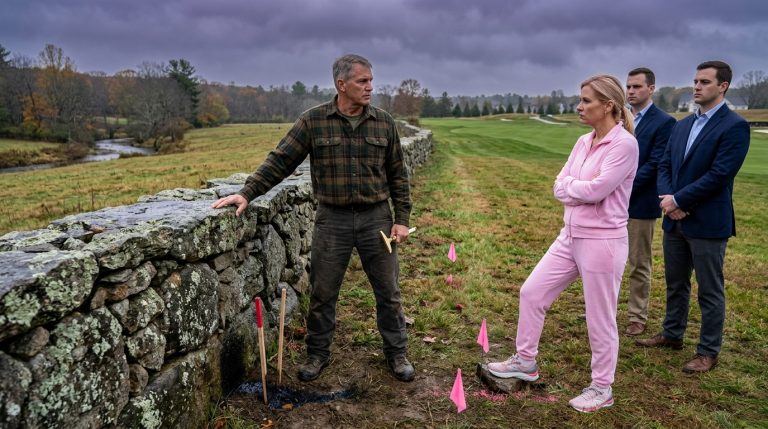
The gravel beneath Jack’s boots sounded sharp and dry in the crisp morning air, each step a deliberate measurement of force against the earth. He walked past the edge of his property line where the manicured turf of Oak Ridge Estates met the unruly green of his ten-acre farm, his eyes scanning the neat, uniform facades of the suburban homes. Every house looked identical in its calculated mediocrity—beige stucco, perfectly trimmed boxwood hedges, and identical asphalt driveways that seemed designed to suppress any sign of individual utility.
He wasn’t here to canvas or complain; he was mapping the perimeter of the opposition.
Three streets over, the immaculate Ford F-150 sat gleaming in Dave Kowalski’s driveway. Jack crossed the asphalt, his shadow stretching long and sharp across the pavement. Before he could reach the front step, the garage door hummed upward, revealing Dave wiping a streak of black grease from his thumb with a frayed shop rag.
“You’re out early, Jack,” Dave said, his sharp eyes taking in the measured pace and the cold set of Jack’s shoulders. “Word’s starting to drift through the morning dog-walking circuit. Karen’s been on the phone since six, trying to convince the block captains that your drone footage was digitally altered.”
“Let her spend her energy on defensive narrative control,” Jack replied, stopping at the edge of the pristine concrete apron. “Has Marcus Thorne responded to the records request I sent him last night?”
Dave let out a short, dry laugh, tossing the rag onto a workbench cluttered with aviation manuals. “Thorne didn’t just respond; he looked like a man who realized he’d been handed a live grenade with the pin pulled. I ran into him near the mail kiosks ten minutes ago. He was shaking so hard he dropped his keys in the drainage grate. He knows the board’s corporate liability shield is gone if Karen’s unauthorized demolition goes to the insurance underwriters.”
“Good,” Jack said. “The pressure is holding. What about the others on her list—Mrs. Gable and the Millers?”
“They’re locked in,” Dave said, leaning against the fender of his truck. “Mrs. Gable has her garden gnomes lined up along the front walk like an infantry platoon. She’s daring Karen to send another letter. And young Tom Miller’s got his kids’ swing set parts laid out in the garage, ready to reassemble the moment the architectural committee is formally dissolved.”
Jack nodded slowly, his gaze drifting past Dave toward Karen’s house visible down the block—a neat two-story colonial with a perfectly square lawn and a blue plastic clipboard sitting conspicuously on the side patio table like an abandoned weapon.
“She’s going to try one last push before the board meeting,” Jack said, his voice flat and unyielding. “She relies on intimidation because she has nothing underneath it. When the financial exposure hits them, the entire structure will crack.”
“Just watch your flanks,” Dave warned, stepping closer and lowering his voice. “She’s desperate. And a desperate administrator with a desk full of rubber stamps is capable of filing motions you won’t see coming until they hit the docket.”
“Let her file,” Jack said, turning back toward the gravel path that led toward the farm. “Every piece of paper she pushes out exposes another blind spot. I’m going back to finish the assessment.”
The walk back across the neighborhood felt different now—not the quiet isolation of a man under siege, but the steady advance of someone who had mapped the enemy’s lines and was waiting for the exact moment to drop the weight.
CHAPTER 6: THE APEX PREDATOR
The elevator doors on the twentieth floor slid open with a whisper of brushed aluminum, revealing a corridor paneled in dark, silent walnut. Jack did not adjust his collar or smooth the front of his canvas field jacket; he stepped out onto the heavy industrial carpet with the measured, low-impact stride of a man accustomed to terrain that offered no margin for error.
The receptionist’s desk was empty, a polished expanse of black granite reflecting the pale glare of the midday sky outside the panoramic floor-to-ceiling windows. Through the glass, the city stretched downward in a grid of concrete canyons and streaming traffic—a massive, humming engine of rules, contracts, and municipal liability.
Without breaking stride, Jack turned down the corner office corridor. The door to Eleanor Albright’s office was already ajar, held open by a heavy brass paperweight cast in the shape of an old locomotive engine.
Inside, Eleanor did not look up from the sprawling array of documents laid out across her mahogany desk. She was wearing a sharply tailored charcoal blazer, her reading glasses perched low on the bridge of her nose as she used a red wax pencil to bracket a paragraph on a certified corporate filing.
“Mr. Garrison,” she said crisply, her voice cutting through the hum of the central ventilation. “You’re twelve minutes ahead of schedule. I assume that means the reconnaissance phase yielded more than just neighborhood gossip.”
Jack walked across the room, pulling a thick, water-resistant manila folder from under his arm and laying it precisely centered on the polished wood surface.
“The county clerk’s office just flagged Karen’s emergency petition for a hazard injunction,” Jack said, his tone flat and level. “She tried to classify the mangled framing of my solar array as an immediate public nuisance to force an unvoted municipal clearance. But she tripped over her own filing dates.”
Eleanor pushed her glasses up, her sharp, intelligent eyes fixing on the folder. A slow, predatory smile touched the corners of her mouth—the expression of someone watching an adversary pull the pin on their own grenade.
“Show me,” she commanded.
Jack opened the folder, revealing the side-by-side printouts of the missing municipal logs and the time-stamped digital exports. “She altered the sequence of the architectural review board’s official minutes to conceal our original 90-day notification clause. But she forgot to scrub the metadata on the county’s automated GIS upload server. The digital fingerprint proves the records were modified on her personal home terminal less than twelve hours after she realized we had invoked the grandfather clause.”
Eleanor leaned back in her high-backed leather chair, the leather groaning slightly under her sudden shift in weight. She picked up a single sheet of paper, her eyes scanning the data points with cold, clinical efficiency.
“Falsification of corporate records to justify an unauthorized tort,” she whispered, her voice sharp with professional admiration. “She didn’t just pierce the corporate veil, Mr. Garrison. She took a sledgehammer to the foundation and left her own signature in wet concrete.”
“Marcus Thorne and the rest of the board received the secondary liability packets this morning,” Jack added, keeping his hands resting flat against the edge of the desk. “Thorne is already looking at a potential personal asset exposure if the insurance underwriters issue a reservation of rights over willful misconduct. The board’s structural integrity is fracturing right down the center line.”
Eleanor removed her glasses, laying them beside the file with a decisive clack. “Then we don’t wait for their monthly meeting. We drop the final demand package before the close of business today. We give them sixty days to cover the full three hundred and forty thousand in damages, dissolve the architectural committee permanently, and issue a public retraction—or we name every single director personally in a federal tort filing.”
She stood up, walking toward the massive glass window to look down at the ant-like flow of traffic far below. “Karen wanted a war of administrative attrition, Sergeant Major. Let’s show her what a coordinated offensive looks like.”
Jack watched her silhouette against the gray light of the city skyline. The machinery was moving now, driven by iron logic and inescapable physics. There was no room left for bluffs, and there was nowhere left for the tyrants of Oak Ridge Estates to hide.
CHAPTER 7: SHOCK AND AWE
The sound of the high-speed laser printer executing its final print cycle was like a sharp dry snap echoing through the quiet confines of Eleanor’s twentieth-floor office. Jack stood beside the automated feeder, his fingers methodically collating the heavy bond pages as they slid out one by one. Each packet was identical, structured with cold, geometric precision: a formal notice of corporate liability, the itemized $340,000 contractor assessment, the forensic metadata proving the alteration of the master board records, and a stark, unyielding demand for compliance within sixty days.
“The board members’ home addresses are mapped and logged,” Jack said, his voice level as he tapped the edges of the stack against the dark wood of the table to align them into crisp, unyielding blocks. “Marcus Thorne gets his package first. Brenda and the rest of the executive committee follow via certified mail with return receipt requested before the afternoon delivery cutoff.”
Eleanor sat at her desk, spinning a red wax marking pencil between her fingers with slow, rhythmic rotation. Her eyes remained locked on the master copy of the demand letter, reading through the dense paragraphs of legal terminology that spelled out the personal exposure of every director who had allowed an unvoted tort to occur under their corporate umbrella.
“You’ve bypassed Karen’s information monopoly entirely,” Eleanor noted, her tone devoid of warmth, clinical and sharp as a scalpel. “By serving the other directors at their private residences, you ensure they can’t pretend ignorance when the insurance underwriters start asking questions about the association’s moral hazard.”
“An officer who rules by suppressing information relies on silence to maintain the structure,” Jack replied, slipping the first set of documents into a thick manila envelope and pressing the adhesive flap down with the heel of his palm. “When that silence is broken by a six-figure liability bearing their individual names, they don’t defend the president. They look for an exit strategy.”
The atmosphere in the room was dense with the quiet momentum of a well-executed maneuver. There were no raised voices, no emotional outbursts—only the methodical assembly of paperwork designed to dismantle a petty tyranny through the sheer weight of institutional law.
Jack picked up the second envelope, his thumb tracking the printed label addressed to Marcus Thorne’s residence. He could already picture the scene in the suburban kitchen later that evening—the casual curiosity turning to cold panic as the treasurer unfolded the pages and saw the numbers staring back at him.
“The insurance adjuster is scheduled to tour the property tomorrow morning to verify the physical damage to the barn roof,” Jack added, sliding the documents into place.
Eleanor stopped spinning her pencil, her gaze rising to meet his with an evaluating intensity. “Let him look at every scratched galvaloom panel and crushed inverter. The more documentation we stack into the file, the harder it will be for their underwriters to issue anything other than a complete denial of coverage for Karen’s actions. At that point, the board will have no choice but to strip her of her title and sue her personally to recover their own losses.”
“The system is executing exactly as calculated,” Jack said. He stacked the completed envelopes in a neat, straight row beside the mahogany blotter, ready for the courier.
The perimeter was closed. The primary salvo was loaded. There was nothing left to discuss, and no counter-move left for the defenders of Oak Ridge Estates to make.
CHAPTER 8: THE SETTLEMENT OF THE LAST ACRE
The courier’s confirmation ping chimed on the desk just as the late afternoon sun began to bleed across the western ridge, casting long, sharp shadows over the corrugated metal siding of the barn. Jack did not wait for an acknowledgment receipt. He stood by the northern window of the farmhouse, watching the pale blue sedan parked across the street where Karen’s front curtains remained tightly drawn.
Within forty-eight hours of the demand packets hitting the directors’ private mailboxes, the administrative fortress constructed over years of petty tyranny had imploded under its own structural weight. Marcus Thorne had broken ranks first, calling an emergency executive session without Karen’s knowledge to review the insurance carrier’s official reservation of rights letter. The underwriters had made their position unequivocally clear: willful, unvoted tortious destruction committed by an officer acting outside corporate bylaws constituted a total breach of coverage. The $340,000 liability would not be paid by the policy; it would fall squarely upon the association’s depleted reserves and, by extension, the personal assets of the directors who had allowed the regime to operate unchecked.
The fallout was swift and unsparing. When Karen attempted to force her way into the emergency clubhouse meeting, she was met not by cowed neighbors, but by a unanimous board resolution stripping her of her title, dissolving the architectural review committee permanently, and executing a binding settlement agreement with the owner of the ten-acre farm.
Now, weeks later, the physical reality of that victory was visible across the property. Tom and his installation crew had finished replacing every damaged galvaloom sheet, securing a new generation of high-efficiency black-on-black solar panels to heavy-gauge aluminum racking rated for hurricane-force winds. The diesel generator that had served as their noisy, fume-belching lifeline for months was gone, hauled away for scrap. In its place, the system hummed with absolute silence, feeding clean energy back into the grid and causing the electric meter to spin steadily backward.
Jack walked out onto the back porch as the evening air cooled, the scent of dry earth and cut grass rising from the fields. Sarah sat wrapped in her woolen shawl, her eyes fixed on the brilliant amber glow reflecting off the barn roof. Inside the house, the oxygen concentrator maintained its steady, effortless rhythm, powered by the inexhaustible energy of the sun.
“The final transfer went through this morning,” Jack said quietly, resting his hand on the porch railing. “The association’s line of credit covered the settlement without triggering the catastrophic special assessment Marcus feared. And the secondary lawsuit filed against Karen personally has forced the sale of her house.”
Sarah turned her head slowly, a faint, genuine smile touching her lips. “She thought she was protecting property values by crushing everything that didn’t fit her template. She didn’t realize that true stability doesn’t come from control; it comes from mutual respect.”
Down the road, Mrs. Gable’s front lawn was alive with a small village of brightly painted garden gnomes standing proudly among the autumn roses, undisturbed and unmonitored. A few doors down, the sound of children’s laughter echoed from the backyard where the Miller family’s new swing set stood against the fence, its primary-colored frame catching the last rays of light.
Jack stepped down from the porch and walked slowly toward the barn. He reached out, his calloused fingertips brushing against the cool, seamless surface of the newly installed metal panels. Every bolt was tight; every seal was impenetrable. He had spent two decades engineering order out of chaos across distant borders, but this terrain—this single acre of quiet earth, protected by law, patience, and unyielding resolve—belonged entirely to peace.
He stood there in the gathering dusk as the sun dipped below the horizon, leaving behind a sky of deep indigo and the steady, brilliant beacon of a home that could no longer be touched.