The Weight of Cedar and Iron: How a Simple Backyard Haven Forged a Quiet Neighborhood Revolution
CHAPTER 1: THE WEIGHT OF CEDAR AND IRON
The iron head of the sledgehammer caught the morning light, a bright, dangerous arc of silver against the faded blue of the truck bed.
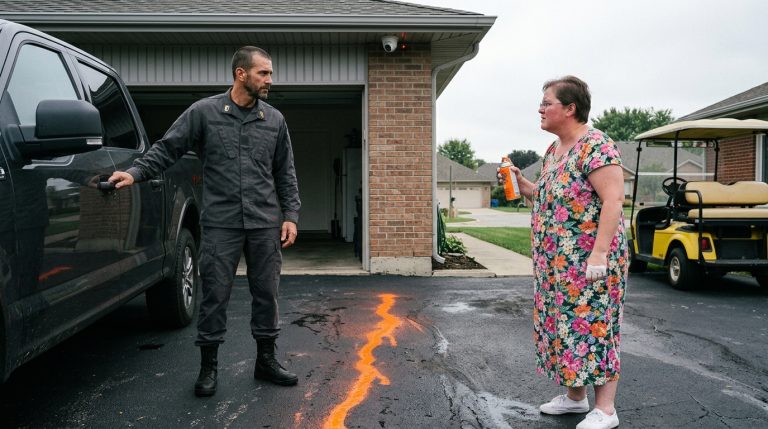
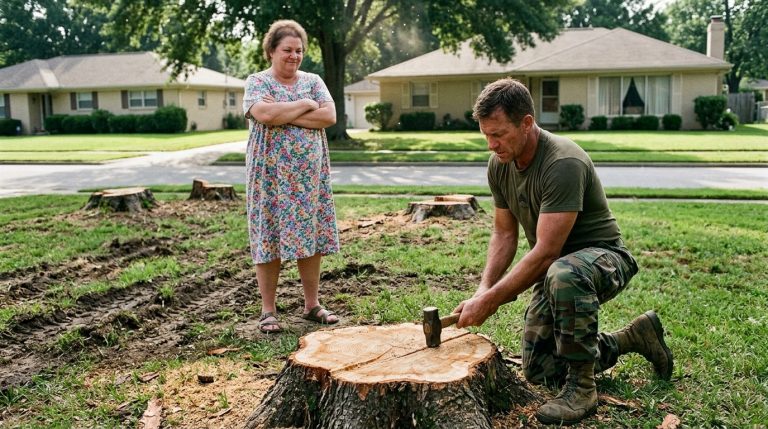
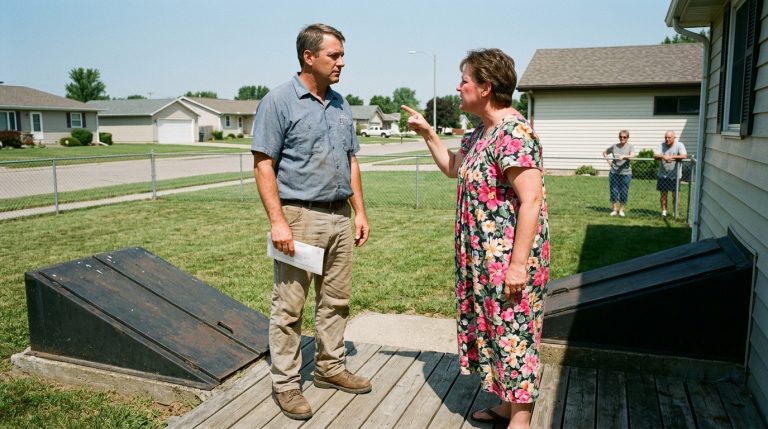
Across the damp expanse of Kentucky bluegrass, Karen stood planted like a fence post driven too deep into dry clay. Her floral-print muumuu rippled faintly in the crisp Saturday air, a loud splash of color against the uniform perfection of Oak Creek Meadows. In her left hand, she gripped a black plastic clipboard as if it were a ceremonial mace. Behind her, the hired muscle—a thick-shouldered man in a sweat-stained work shirt—leaned his forearms against the tailgate, watching with the blank patience of an executioner waiting for a nod.
“Forty-eight hours, Mr. Thorne,” Karen said, her voice sharpened by years of retail complaints and unchecked neighborhood dominion. “Dismantle that insect-infested monstrosity, or my contractor handles the disposal. You’ll be billed for the demolition, the pesticide treatment, and a ten-thousand-dollar non-compliance fine.”
I didn’t move. The ceramic mug in my right hand held coffee that had long since stopped steaming, though the heat of it still radiated through the thick glaze into my palm. My eyes flicked past her, tracking the precise angle of the sun hitting the copper flashing of the structure behind me. It wasn’t an “infestations hazard.” It was a meticulously engineered, scientifically backed solitary bee habitat built from untreated cedar, drilled with thousands of holes calibrated to the exact micro-tolerances required by native pollinators.
Twenty years in the Marine Corps as a combat engineer teaches you a few things about infrastructure. It teaches you how to look at a load-bearing wall and see its faults; it teaches you that noise is rarely a substitute for leverage.
“The structure complies with state environmental statutes, Karen,” I said, keeping my tone flat, stripped of any inflection that might feed her momentum. “It’s registered through Northwood University’s entomology department.”
Her mouth tightened into a hard, white line. Small, humorless eyes swept over my property line, cataloging imaginary infractions—a stray leaf, a blade of grass a quarter-inch too tall—before snapping back to the bee hotel like iron filings to a magnet. This wasn’t about the bylaws. It was about the friction of resistance. For three months, she had circled the neighborhood on her electric golf cart like a shark smelling copper in an enclosed pool, issuing citations for mailbox paint codes and unauthorized shrubs. Everyone else bent. Dave bowed over his Japanese maple. Bill swallowed his pride regarding his flagpole.
They folded because the friction of fighting was too high. They didn’t understand the mechanics of administrative power.
“Section Seven, paragraph B, subsection four,” she recited, her voice climbing an octave, dripping with the intoxicating rush of bureaucratic authority. “No freestanding structures without prior written authorization from the architectural review committee. And I chair that committee.”
She turned on her heel, the heavy rubber soles of her walking shoes crushing the edge of my wife’s prize-winning rose bed, and hauled herself back into the hum of her electric cart. The vehicle whined as it spun around, spitting a tuft of grass toward my shins before accelerating down the cul-de-sac at its agonizingly deliberate pace.
I stood completely still, watching the dust settle over the manicured curb. The silence of the morning rushed back in, but the texture of it had changed. It tasted like dry iron and woodsmoke. I walked slowly back toward the front porch, my boots crunching on the gravel path, and set my coffee mug down on the weathered oak railing.
The front door opened a fraction of an inch behind me, and Sarah’s hand brushed lightly against my shoulder, her fingers cold.
“She’s not going to let this go, Mark,” Sarah murmured, her gaze fixed on the empty street where the golf cart had vanished.
“I know she isn’t,” I replied, my eyes locked on the copper roof of the bee hotel, where a single blue orchard mason bee circled lazily before dipping into a pristine, hand-drilled cedar tube. “Which is why we aren’t going to argue with her anymore.”
I turned around to face the dark, quiet interior of the hallway, letting the screen door click shut behind me. The paperwork was already stacked neatly on the dining room table—two years of public HOA budgets, meeting minutes, and architectural filings. Karen thought she was operating a courtroom. She didn’t realize she had just handed me the blueprints to her own demolition.
CHAPTER 2: THE ANATOMY OF A BLUEPRINT
The garage door was closed down to a six-inch gap, just enough to let a thin ribbon of morning air slice across the concrete floor and carry away the fine cedar flour settling around my boots.
I stood before the CNC router, my palm flat against the cold aluminum gantry. The metal was dead to the touch, retaining none of the sun’s heat that had baked the asphalt outside. Two years ago, when the marine grease of twenty service years had finally been scrubbed from my skin, this space had felt like an absolute sanctuary—a place where wood yielded cleanly to steel, where things were built with square angles and true dimensions. Now, with the certified letter sitting on the workbench beside a cold cup of coffee, the room felt less like a shop and more like a staging area before an advance.
In the Corps, you didn’t react to an ambush by running into the open; you mapped the terrain, identified the enemy’s lines of supply, and calculated the exact load-bearing capacity of whatever structure you were forced to defend. Karen thought she had the high ground because she owned a plastic clipboard and a binder full of arbitrary mandates. But she was operating on pure impulse—the raw, unfiltered adrenaline of petty dominion.
I picked up a scrap piece of untreated cedar, running my thumb across the milled edge. Every hole in the bee hotel out front had been drilled to a precise tolerance of six millimeters, optimized for the nesting tubes of the blue orchard mason bee. It took patience. It took engineering. You couldn’t force wood to accept a bit it wasn’t bored to receive, just as you couldn’t expect a bureaucratic tyrant to understand science without first breaking down her supply lines.
The side door creaked open, the hinge dry and protesting against the damp air. Sarah stepped inside, carrying a cardboard box filled with old tax files and neighborhood directories we had collected over the past two years. She didn’t say anything right away; she just set the box down on the heavy oak workbench with a dull thud that sent a small cloud of sawdust dancing into the morning light.
“Dave stopped by the fence while you were out,” she said, leaning back against the edge of the table and crossing her arms. Her face was tight, the worry lines around her eyes deeper than they had been when we first moved into Oak Creek Meadows. “He said Karen spent the last hour on her golf cart talking to the Millers. Word is she’s pushing for an emergency board vote to expedite the demolition before the month is out. She wants it gone, Mark. She doesn’t want to wait the full fourteen days.”
I set the cedar scrap down, the wood making a sharp tap against the workbench. The memory flickered uninvited—the dry heat of a desert outpost, the sharp, metallic tang of C4 cord, and the calculated silence you maintained right before an engineer unit breached a fortified compound. You didn’t yell back at the barricade. You found the structural fault line and applied pressure precisely where the mortar was weakest.
“Let her push,” I said quietly, walking over to the workbench and pulling the box of neighborhood documents toward me. “If she calls an emergency meeting, she has to follow the HOA bylaws to the letter. And if there’s one thing I know about people like Karen, it’s that when they rush to consolidate power, they get sloppy with the paperwork.”
Sarah watched me, her gaze steady, searching for the soldier beneath the suburban polo shirt. “And if she doesn’t follow the rules?”
“Then she gives us the exact leverage we need to break her.”
I pulled out a thick stack of stapled papers—the quarterly financial summaries downloaded from the community portal six months ago, back when I had archived them out of a simple habit of digital preservation. Most residents treated the HOA website like junk mail, clicking delete without a glance. But an engineer doesn’t throw away a manual until he’s read the schematics.
I flipped open the folder, my fingers tracing the line items under administrative expenditures and seasonal maintenance. For eighteen months, the numbers had remained predictable, almost boring. Then, roughly eight months ago—right around the time Karen had started her aggressive crusade against minor infractions like unapproved mailbox colors—the landscaping budget spiked by nearly forty percent. A single lump-sum disbursement for a “special project retaining wall and fountain installation” totaling twenty-two thousand dollars.
I remembered the community newsletter from that month. Karen had boasted about a beautiful new water feature designed to enhance the front entrance of Oak Creek Meadows. But when I drove past the entrance yesterday to pick up mail, the brick retaining wall looked exactly as it had the day we bought the house—weathered, slightly cracked at the base, and completely devoid of any new stone or running water.
A twenty-two-thousand-dollar ghost project.
The silence in the garage deepened, broken only by the low, rhythmic snoring of Gunner, our golden retriever, curled up on a pile of sawdust in the far corner, completely oblivious to the war being mapped out above him.
“She’s hiding something in the ledger,” I muttered, my eyes scanning the vendor name attached to the disbursement: Green Pastures Landscaping, routed through a secondary shell account rather than their standard billing address.
Sarah leaned in closer, her shoulder brushing mine as she looked down at the figures. “That’s more than a few months of quarterly dues. If she’s pulling that kind of money out of the community fund for a project that doesn’t exist…”
“Then she isn’t just a neighborhood bully,” I finished, the cold certainty settling into my chest. “She’s embezzling.”
I didn’t smile. There was no triumph in it, only the grim satisfaction of finding the primary structural crack in an otherwise imposing facade. Karen thought she was operating a closed circuit where her word was absolute law. She had forgotten a fundamental rule of engineering: every system leaves a trace of its weight.
I picked up my phone from the workbench, opened my contacts, and scrolled down to a name I hadn’t dialed since my days working alongside university grant committees through military outreach programs. Professor Mike was an entomologist, but he had friends in places that understood institutional compliance much better than an angry homeowner with a clipboard.
“What are you doing?” Sarah asked, watching my thumb hover over the screen.
“Making sure our next line of defense has the right credentials,” I said.
Before she could answer, the front gate outside latched shut with a sharp, metallic clang, echoing off the concrete driveway—the unmistakable sound of a golf cart slowing to a halt just past our property line.
CHAPTER 3: THE PAPER TRAIL
The gate latch echoed twice before the silence settled back over the yard, but the friction had already entered the room.
I did not look up from the screen immediately. My index finger rested on the edge of the optical mouse, feeling the cold, smooth plastic while the glowing green line of a downloaded PDF profit-and-loss statement scrolled down past my thumb. Beside me, Sarah stood with her arms locked tightly across her chest, her eyes fixed on the small viewport of the garage door where the lower edge of the daylight showed the muted shadow of a passing tire.
“She’s doubling down,” Sarah said, her voice low and even, devoid of panic. “If she’s already talking to the Millers, she’s trying to lock down the block before the notice expires.”
“Let her talk,” I murmured, my eyes tracking a column of figures under the property maintenance tab. “People who over-communicate in the open usually forget what they left behind in the filing cabinet.”
The workshop smelled of pine flour and stale coffee. Outside, the afternoon sun was beginning to slant long, amber rays across the driveway, but inside the two-car conversion, the light was artificial and sharp, cast by a single adjustable desk lamp I used for fine joinery layout. I clicked open another folder—an archived sub-directory containing two years of scanned community expense reports that the HOA portal had conveniently buried beneath three layers of broken hyperlinks.
In a standard combat engineering assessment, you never look just at the breach point. You map the logistical supply lines. You look at where the fuel, the timber, and the cement actually come from. Karen’s operational model was no different. Her power relied entirely on the steady extraction of quarterly dues and compliance fines, but a tyrant running a small suburban fiefdom always requires a slush fund to finance the architecture of intimidation.
I scrolled down to line item 404: Special Project – Community Entryway Improvements.
The amount was staggering for a subdivision of eighty homes: twenty-two thousand, four hundred and fifty dollars. Approved by executive fiat under an emergency waiver clause, signed by Karen Shipman as president and countersigned by Gerald, the mousy retired accountant who served as treasurer and signed whatever paper was placed beneath his nose without reading the fine print.
“Look at the vendor,” I said, tilting the monitor slightly toward Sarah.
She leaned in, her shoulder pressing against my arm. Her eyes scanned the text. Green Pastures Landscaping. But unlike the standard recurring maintenance invoices that listed a local commercial P.O. Box in the county seat, this specific transaction routed payment through an intermediate clearinghouse account with a residential billing zip code.
“That’s not a commercial yard service zip,” Sarah whispered, her brow furrowing. “That’registry code is for the south ridge. That’s where Karen lives.”
“Not just her neighborhood,” I said, reaching over to click open a separate browser tab containing public county property maps and recent aerial satellite data. “Let’s look at what twenty-two thousand dollars buys in material and labor when you don’t have to report it to the county zoning board.”
I typed in the parcel number for 412 Arbor Lane—Karen’s address, three streets over from ours. The satellite image loaded with a sharp, high-resolution snap, displaying the back of her property from an overhead angle. Last year, the view had shown a standard suburban lawn sloping down toward a chain-link fence. The updated topographical layer, captured during a routine municipal flyover six months ago, showed something entirely different.
A multi-tiered slate patio. A heavy stone retaining wall cutting across the slope. And right at the geometric center of the installation, catching the glare of the midday sun, the unmistakable circular glint of a three-tiered stone water fountain.
The room grew very quiet. The distant hum of a lawnmower two blocks away sounded muffled, almost unreal against the stillness of the workshop.
“She didn’t build an entryway feature,” Sarah said, her voice dropping to a flat, dangerous register. “She used community dues to landscape her own backyard.”
“Every single cent of it,” I replied, leaning back in the chair and letting out a slow, measured breath. “The monthly fines she collects aren’t just about control. They’re a liquidity buffer. When maintenance costs run short because funds were diverted into private stonework, she invents a violation, slaps a two-hundred-fifty-dollar penalty on a resident, and balances her books with our money.”
It was a closed, self-sustaining loop of petty corruption. A domestic protection racket disguised as a neighborhood association.
In the old days, when we cleared routes through contested sectors, you didn’t rush the primary objective until you had mapped every secondary bunker. Karen thought my bee hotel was the core target because it was the most visible thing on her patrol route. She didn’t realize that by fixating on it, she had turned our front yard into an intentional tripwire, drawing her out into the open while we dismantled her infrastructure from the inside.
“We have the invoices,” Sarah said, her hand reaching down to rest firmly on my shoulder. “We have the county property data. But an HOA isn’t a court of law, Mark. If we take this to the board tomorrow, Karen will just table the motion, vote it down with Gerald’s help, and escalate the fines against us.”
“We aren’t taking it to the board,” I said, standing up from the workbench and stretching my shoulders. The joints in my back popped quietly against the cool air. “We’re taking it to the people who actually pay the bills.”
“The residents?”
“Karen spent three months weaponizing the mailboxes with yellow flyers and fabricated stories about aggressive insects,” I said, walking over to the tool rack to pick up a clean rag, wiping down the surface of the drill press. “Fear is a powerful tool, but it has a very short shelf life once people realize their own wallets are being bled to pay for a stone fountain they’re not even allowed to look at.”
I set the rag down and looked straight at her. “We start the ground game tonight. Not with lawyers, and not with noise. With facts, coffee, and a few neighbors who are tired of looking over their shoulders.”
Sarah held my gaze for a long moment, the initial shock fading into the hard, steady resolve of someone who had lived through two decades of military relocations and learned how to build a home out of chaos. She gave a single, slow nod.
“I’ll preheat the oven,” she said quietly. “If we’re going to talk to the fence-sitters down the cul-de-sac, we’re going to need more than just spreadsheets.”
CHAPTER 4: THE COOKIE DIPLOMACY
The asphalt under my boots was cooling rapidly as the October sun dipped below the staggered rooflines of Oak Creek Meadows, painting the sky in cold shades of slate and bruised purple.
I adjusted the plastic wrap over the ceramic plate in my hands. The cookies were still warm, radiating a rich scent of butter and semi-sweet chocolate that cut sharply through the sterile evening air of the cul-de-sac. Beside me, Sarah walked with her hands buried deep in the pockets of her jacket, her eyes tracking the glowing windows of the houses we passed.
In the Corps, you didn’t take a hostile sector by storm if you could split their local support network first. Karen had spent months building an echo chamber of fear, whispering warnings about aggressive swarms and unvetted hazards to anyone who would listen. To break that perimeter, we couldn’t just rely on spreadsheets and legal statutes; we had to break the isolation she had imposed on the street.
We stopped at the edge of Mrs. Henderson’s driveway. The house was quiet, its front porch light casting a weak, yellow glow over a immaculate row of late-season begonias. Two years ago, Dave had planted a Japanese maple ten feet from this very spot before Karen’s certified letters and public shaming forced him to dig it back up. Dave had folded. Mrs. Henderson had spent the last three months crossing the street to avoid our sightline altogether.
“Remember,” I murmured, stepping onto the aggregate concrete path. “No arguments. No talk of the embezzlement ledgers yet. Just facts and sugar.”
I raised my knuckles and tapped twice against the wooden frame of the front door.
For a long moment, there was no sound inside except for the muffled chime of a television game show. Then a lock turned with a dry click. The door opened four inches, held securely by a brass security chain. Mrs. Henderson’s eye peered out through the narrow gap, small and darting behind wire-rimmed glasses. When she saw my face, her breath caught, and she instinctively tried to pull the door back before the chain stopped her.
“Mr. Thorne,” she said, her voice trembling slightly. “It’s… it’s getting late.”
“Good evening, Mrs. Henderson,” I said, keeping my posture relaxed, my hands holding the plate low and open. “Sarah and I were baking this afternoon and realized we made far too many. We wanted to drop a few by. And to apologize if any of the noise from my workshop or the garden project has caused you unnecessary worry.”
She blinked, staring at the plate of cookies as if they might detonate. Her fingers remained clamped around the edge of the door. “The… the newsletter said that structure was drawing insects. Dangerous ones.”
“That’s actually why I brought this,” Sarah interposed smoothly, stepping up beside me and offering a single, folded sheet of heavy paper. “It’s an information sheet straight from Northwood University’s entomology department. It details the biology of solitary mason bees. They don’t have hives, they don’t have queens to defend, and they’re entirely harmless to families and pets.”
Mrs. Henderson looked from Sarah’s face down to the paper, then back to the cookies. A slow, cautious conflict played out across her lined features—the conditioned dread of crossing Karen’s explicit warnings versus the simple, human warmth of an unexpected gift. Slowly, the tension in her knuckles eased. She unlatched the security chain, pulled the door open another six inches, and reached out a tentative hand to take the plate.
“Thank you,” she whispered, her voice losing its edge. “I… I just don’t like trouble, Mr. Thorne. Nobody in the Meadows wants trouble with the committee.”
“Nobody wants trouble, Mrs. Henderson,” I replied evenly. “We just want a neighborhood where people can plant a garden or build a project without wondering if a fine is coming in the mail tomorrow.”
We didn’t push further. We exchanged a polite goodbye, stepped back down the walkway, and continued our circuit down the block, stopping at three other houses—older couples who kept their heads down, families with children who had been warned away from our sidewalk. By the time we reached Bill’s driveway three streets over, the plate was empty, and the seed of doubt had been planted in four separate front yards.
Bill was standing in the open bay of his double garage, a microfiber cloth in hand, methodically wiping down the chrome bumper of his restored 1968 Ford Mustang. He didn’t look up as we approached, but the rhythmic circular motion of his cloth never skipped a beat. A year ago, Karen had shot down his request for a larger flagpole with absolute, bureaucratic cruelty. He had been simmering in silence ever since.
“Engine’s running a bit rich,” Bill said without turning his head, his voice like grinding gravel. “Or maybe the fuel mixture’s just off because there’s too much debris in the intake.”
“Sometimes the intake isn’t the problem,” I said, stopping at the edge of his shop apron. “Sometimes the filter’s just being choked by someone who wants control over the whole garage.”
Bill stopped wiping. He slowly lowered the cloth, turned around, and leaned back against the fender of the Mustang. His eyes met mine under the harsh fluorescent lights of the garage.
“Word is Karen’s calling an emergency meeting for next Tuesday,” Bill said, his jaw tightening. “Mailing out yellow flyers with pictures of hornets. She’s pushing for a binding vote to bring in a contractor and tear your bee hotel down by force.”
“Let her call it,” I said, stepping closer. “And when she does, we’ll make sure the entire neighborhood is there to see who’s really paying for the upgrades.”
Bill stared at me for a long, calculating second, his military background recognizing the precise cadence of a counter-offensive. A slow, grim smile cracked the corner of his mouth. He tossed the microfiber cloth onto the workbench, reached out a heavy, grease-scarred hand, and gripped my palm in a hard, unbreakable clasp.
“Son,” Bill said softly. “What time do you want me at the clubhouse?”
CHAPTER 5: THE CLUBHOUSE AMBUSH
The air inside the community clubhouse was thick with the scent of pine-scented aerosol and the heavy, electric tension of a room braced for a collision.
The folding chairs—flimsy aluminum frames bolted together in long, rigid rows—groaned under the weight of nearly a hundred residents who had packed every square foot of the linoleum-floored room. At the front, beneath a faded banner celebrating the community’s spring barbecue, Karen stood behind a raised wooden lectern. She wore a vibrant purple pantsuit that caught the harsh glare of the overhead fluorescent lights, her chin tilted up with the practiced authority of a magistrate presiding over a kangaroo court. Beside her, Gerald, the mousy treasurer, hovered like a shadow, his hands clamped tightly over a leather folder as if it were a shield.
We entered quietly, filing down the center aisle. Professor Mike took a seat near the back with his briefcase of academic literature resting upright between his knees. Alan Davies, the university attorney, slipped in right behind him, carrying a slim leather portfolio and a small digital projector that he set down gently on the rear AV table. Bill took up position near the side exit doors, his broad shoulders squared against the wall, while Sarah and I slid into a row midway back.
Karen banged her gavel once—a sharp, theatrical crack that silenced the murmurs rippling through the middle rows.
“This emergency meeting of the Oak Creek Meadows Homeowners Association is now in session,” Karen boomed, her voice amplified by the cheap PA system.
Her opening address was a masterclass in manufactured panic. For fifteen minutes, she paced behind the lectern, using loaded phrases like unauthorized environmental hazards, unvetted biological experiments, and flagrant disregard for shared community standards. She did not look at me directly; she cast her gaze across the room, locking eyes with the worried parents and older retirees, deliberately framing my front yard as a threat to their safety and property values.
“If we allow one resident to ignore the architecture review bylaws,” she declared, her voice rising with synthetic passion, “to construct unapproved structures and introduce foreign biological elements into our ecosystem, where does it end? Anarchy. Today we take a stand for order.”
A low murmur of uneasy agreement rippled through the front rows, where her core group of loyalists—the self-appointed crows—nodded in synchronized cadence.
When she finally paused, a triumphant smile curved her lips. “The floor is now open for public commentary before we proceed to the binding vote for removal. The resident at 112 Arbor Lane is present, and in the interest of procedural fairness, will be granted exactly five minutes to speak.”
She thought she had locked the box. Five minutes was designed to make me look defensive, cornered, and reactive.
I stood up slowly, ignoring the aisleway, and walked straight past the front rows—not toward the lectern where she stood, but into the open well of the floor, standing squarely on the same level as my neighbors. I didn’t pull out any notes.
“Good evening,” I said, my voice steady, stripped of all theatrics. “My name is Mark Thorne. I’m a retired Marine combat engineer, a husband, a father, and your neighbor. I am not here to plead for an exception to the rules.”
I turned my head, scanning the faces of the people sitting in the rows before me—Mrs. Henderson, looking up nervously from her seat; Dave, who gave me a sharp, affirming nod; and dozens of others who had lived under the shadow of the clipboard for years.
“The structure on my property is not a hazard,” I continued, pitching my voice to carry without shouting. “It is a scientifically designed solitary bee habitat, built in direct partnership with Northwood University to protect native pollinators. These bees do not swarm. They do not sting unless crushed. They are entirely harmless.”
Professor Mike stood up from his seat in the back, his academic authority cutting cleanly through the tension. “As head of the entomology department,” Mike said, his voice crisp and clear, “I can confirm this project meets every state and federal environmental standard. It is vital research.”
Karen’s face flickered with a sudden, sharp edge of panic. She leaned over the lectern, whispering furiously to Gerald, who merely shook his head, looking as though he wanted the floor to swallow him whole.
“This meeting was never about safety,” I said, stepping forward, letting the full weight of the silence settle over the room. “And it isn’t even about the bees. It’s about accountability, and how community funds are being spent.”
Before Karen could bang her gavel or interrupt, Alan Davies stepped forward from the back of the room, plugging a cable from his laptop directly into the community projector mounted above the AV table. The screen behind Karen abruptly flickered to life, illuminating the white wall with the official seal of the Oak Creek Meadows HOA.
“My name is Alan Davies, associate counsel for Northwood University,” Davies said coolly, his voice cutting through Karen’s sharp gasp of protest. “And tonight, I am assisting Mr. Thorne in a review of public HOA financial disclosures.”
“This is out of order!” Karen screeched, slamming her hand down on the lectern. “That is not on the agenda!”
“An inquiry into fiscal responsibility is always in order, Miss Shipman,” Davies replied without raising his voice, clicking to the first slide.
The projector displayed a high-resolution scan of a line-item invoice from Auntie Kay’s Catering for four thousand five hundred dollars, routed through an unregistered post office box.
“Can anyone recall the spring barbecue this year?” Davies asked the room calmly. A man in the back grumbled that it had been canceled. “Indeed it was,” Davies continued. “Yet the HOA paid over four thousand dollars to a catering company owned by a close relative of the board president.”
The room erupted into an immediate wave of gasps and sharp whispers. Karen stood frozen behind the lectern, her skin draining of color.
“And that,” Davies said quietly, clicking to the final slide, “brings us to the special project landscaping invoice for twenty-two thousand, four hundred and fifty dollars.”
The screen shifted. The projection displayed a sharp, high-resolution satellite overhead view of 412 Arbor Lane—Karen’s personal backyard. Encircling the center of the image was a bright red digital ring, highlighting a multi-tiered slate patio and a gurgling, three-tiered stone water fountain.
“The community water feature requested for the front entrance was indeed installed,” Davies said, his voice dropping into a razor-sharp register. “It is located twelve feet outside Miss Shipman’s back door.”
The clubhouse exploded.
Chairs scraped violently against the linoleum as nearly a hundred people stood up at once. Shouts of anger bounced off the low ceiling. Gerald, the treasurer, dropped his leather folder, put his hands over his face, and bolted for the side exit. Karen stood at the lectern, her mouth opening and closing soundlessly, her purple pantsuit suddenly looking like a costume from a play that had entirely fallen apart.
Bill stood up near the back, his voice cutting through the rising chaos with the undisputed authority of a first sergeant taking command of a broken line.
“Under section four of the bylaws,” Bill called out, his eyes locked on Karen, “I move for an immediate vote of no confidence in the board president.”
“Seconded!” Dave shouted from the center aisle.
“All in favor?” Bill demanded.
Eighty-seven hands shot into the air like a wall of timber. It wasn’t just a vote; it was an absolute reclamation of the ground beneath our feet.
CHAPTER 6: THE DUSTY HORIZON
The fallout from the clubhouse vote was not sudden; it settled over Oak Creek Meadows with the quiet, crushing weight of wet concrete.
Gerald submitted his formal resignation before midnight, sliding a crumpled envelope under Bill’s front door before packing his sedan and driving out of the subdivision entirely. The remaining two board members, recognizing the cold math of eighty-seven votes of no confidence, abdicated their posts by sunrise. By the time the municipal police department arrived two days later with a warrant to inspect the financial records, the administrative machinery that had kept Karen’s regime afloat for four years had entirely seized up.
I stood beside the workbench in the garage, my fingers tracing the grain of a cedar offcut while the morning light filtered through the open bay. The radio on the shelf played a low, steady classic rock track, the music humming beneath the rhythmic tap of a sanding block.
The forensic audit, executed by a certified accountant hired under Bill’s interim presidency, revealed a ledger so thoroughly compromised it looked less like community accounting and more like a shell game. The twenty-two-thousand-dollar fountain was merely the visible anchor of a seventy-thousand-dollar deficit accumulated through inflated maintenance contracts, ghost catering invoices for canceled events, and a steady stream of intimidation fines funneled straight into personal accounts. Karen’s autocratic control had never been about protecting property values; the rules were simply the teeth of a protection racket designed to fund her private resort while keeping the neighborhood too exhausted to look at the books.
When the district attorney’s office formally filed felony embezzlement charges later that week, there was no dramatic confrontation at the property line. Karen didn’t march down the sidewalk with her clipboard; she stayed behind closed blinds until the “For Sale” sign went up on her lawn, a stark white rectangle planted squarely in the dead grass where her golf cart used to idle.
The trial itself never reached a courtroom drama. Faced with an airtight digital trail compiled by Dave and verified by university counsel, her defense attorney negotiated a swift plea deal. Restitution, probation, and two hundred hours of community service—assigned, by a stroke of quiet cosmic irony, to the county parks department’s trail-maintenance and habitat-restoration division. I sometimes imagined her out in the state park wearing an orange safety vest, hauling brush under the supervision of park rangers, her clipboard replaced by a shovel.
Life in Oak Creek Meadows settled into a rhythm that felt less like a garrison and more like a neighborhood.
The new architectural review board, operating under Bill’s steady leadership and my chairmanship, tore up the old compliance binder and replaced it with a streamlined, common-sense charter. Our very first official vote under the revised code took all of three minutes: an unanimous approval for Bill’s twenty-five-foot flagpole, allowing him to fly the garrison flag high and clean against the blue Kentucky sky without a single bureaucratic hurdle.
Outside, in the side yard near Sarah’s prize-winning roses, the bee hotel hummed with quiet, relentless industry.
Professor Mike’s research team had returned twice that month to collect sample data, their clipboards filled with notations of record-high population density and a rare species of leafcutter bee that hadn’t been documented in the county for thirty years. The local kids stopped by on their bikes after school, no longer dodging an imaginary hazard, but peering through magnifying glasses at the pristine cedar tubes with open, unadulterated curiosity.
The sun dipped lower behind the oak trees, casting a long, amber streak across the driveway and catching the burnished copper flashing of the bee habitat so that it glowed like a small, steady flame.
Sarah stepped out onto the back porch, carrying a pair of cold mugs of iced tea, her footsteps light against the weathered planks. She walked down the step and handed one to me, her shoulder pressing gently against mine as we stood looking out over the lawn.
“The new family moved into Karen’s old place this morning,” she said softly, watching a pair of blue orchard mason bees dart from the cedar facade toward the rosebushes. “They stopped by with a plate of brownies. The wife asked me how to register a pollinator garden with the new board.”
I took a slow sip of the tea, letting the cold contrast against the warmth of the late afternoon air. I looked past the garden, past the clean, unhindered property lines stretching down the cul-de-sac, toward the open horizon where the dust of the old conflicts had finally settled into the earth.
“What did you tell her?” I asked.
Sarah smiled, leaning her head against my shoulder while Gunner trotted over from the shade of the porch to rest his heavy chin against my boot.
“I told her,” Sarah said, “that as long as it’s built square and true, she doesn’t even need to ask.”