The Weight of Steel and Paper: How a Retired Engineer Dismantled a Suburban Empire
CHAPTER 1: THE FIRST NOTICE ON THE FRONT LAWN
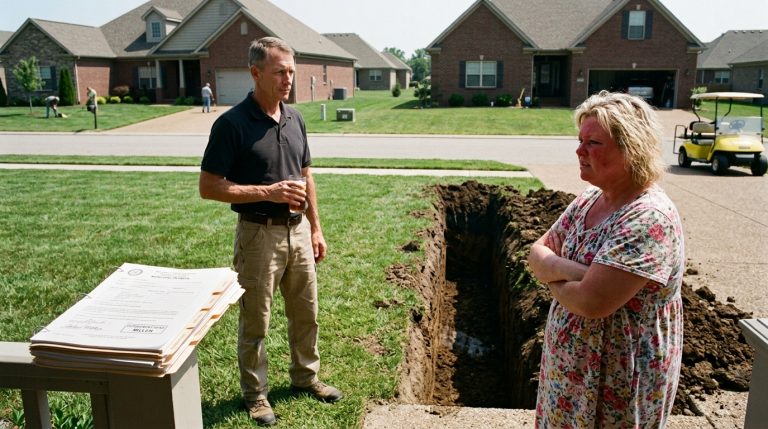
The red streak across Karen’s cheekbone wasn’t from the sun; it was the flush of unbridled administrative fury, packed tight into a violently floral muumuu that strained at the seams. Her finger drove downward again, striking the empty air above Frank’s property with a precision born of endless committee meetings and unbridled suburban rule enforcement.
“That piece of junk is an affront to this community,” she hissed, her voice cutting through the heavy, stagnant air of Oak Meadows like a dry saw blade. “It’s gone by Friday, Frank, or I’ll have it ripped out myself and send you the bill for the sod.”
Frank stood motionless on the worn porch boards, his posture locked into the rigid, economical alignment of a man who had spent twenty-five years calculating load-bearing capacities under fire. He didn’t shift his weight. He didn’t raise his chin. His gaze tracked the violent twitch of her manicured index finger, cataloging the micro-tensions in her wrist, the over-application of lavender perfume that hung heavily in the stagnant afternoon breeze, and the precise angle of the sun beating down on the unapproved steel hatch that had anchored his farmhouse long before these quarter-acre lots were ever surveyed.
“I see,” Frank said. His voice was entirely level, stripped of any defensive spike or ironic edge. It was the tone he used when inspecting a cracked concrete pillar or reviewing a faulty manifest. “I’ll expect a formal written notice of this alleged violation citing the specific article and section of the CC&Rs you believe it violates. Please send it via certified mail.”
Karen’s mouth snapped shut, the intended follow-up insult dying behind tight, plum-colored lips. She had scripted a screaming match. She had rehearsed the satisfying catharsis of a public dressing down on a manicured lawn, complete with sputtering defenses and wounded pride. Instead, she had been handed a bureaucratic speed bump.
“Don’t you play your games with me, Mr. Miller,” she muttered, her voice dropping an octave into a gravelly warning. “You know the rules. All exterior structures must be approved by the Architectural Review Committee.”
“And I’m sure the written notice will detail that,” Frank replied, his expression remaining a smooth, impenetrable mask. He turned away slowly, his hand finding the cool brass of the front door handle with absolute, measured grace. “Have a nice day, Karen.”
The heavy wooden door clicked shut behind him, sealing out the hum of the distant lawnmowers and the rising heat of the afternoon. But as the latch clicked into place, a subtle, sharp discrepancy caught his ear from the corner of the hallway table—a small, blue slip of paper left by the morning carrier that wasn’t there when he checked the box at noon.
CHAPTER 2: THE KITCHEN TABLE AND THE CERTIFIED LETTER
The blue slip of paper lay flat against the polished oak surface of the kitchen table, its red-inked serial number staring back at Frank like a target acquisition marker. Sarah stood by the counter, her hands wrapped tightly around a ceramic mug, watching him with an expression carved from years of quiet endurance.
“She didn’t waste any time,” Sarah said, her voice dropping into a register reserved for approaching storms.
“People who rely on theater never do,” Frank replied. He reached out, his thumb catching the edge of the blue slip. It was a postal hold notice for an accountable item—a certified envelope sent from the corporate offices of the Oak Meadows Homeowners Association. It hadn’t come through the standard drop; it required a physical signature, a documented handoff, a traceable link in a chain of custody that Karen undoubtedly believed would box him into a legal corner.
Frank didn’t rush. He walked back to the front hall, retrieved his keys, and drove down to the local post office branch on Elm Street, treating the errand not as an annoyance, but as a reconnaissance patrol. Twenty minutes later, he sat back down at the kitchen table with a thick, crisp white envelope bearing the embossed oak-tree logo of the subdivision.
He didn’t tear the corner off with a thumb. He used a small, flat-bladed pocketknife, slicing the top seam with clean, mechanical precision. Inside lay a single sheet of heavy-stock paper, covered in aggressive, perfectly aligned black typography.
Violation: Unapproved external structure. Section 7, paragraph C, aesthetic harmony.
Frank read through the boilerplate intimidation with the detached interest of an engineer reviewing a poorly drafted subcontractor bid. Fourteen days to remediate. Initial fine of two hundred and fifty dollars. Compounding daily penalties of fifty dollars thereafter. The signature at the bottom was a series of jagged, sweeping loops that looked less like a legal sign-off and more like a barbed-wire fence meant to keep trespassers out.
“What does it say?” Sarah asked, stepping closer to place the steaming mug of coffee at his elbow. The scent of dark roast rose between them, cutting through the sterile smell of office paper.
“It says she thinks she’s holding all the cards,” Frank murmured, his eyes scanning down to the referenced subsection. He tapped the paper with the back of his fingernail. “Section 7, paragraph C. Aesthetic harmony. It’s entirely subjective. It’s written to catch out people who paint their shutters the wrong shade of blue or leave an old rusted swing set out in the rain.”
“And the cellar door isn’t a swing set,” Sarah noted, her brow furrowing as she leaned against the back of the adjacent chair.
“It’s a structural component of the original 1950s foundation,” Frank said, his voice dropping into a low, even cadence. “Long before Karen ever bought her cookie-cutter split-level down the road. But arguing aesthetics with someone who operates on pure emotion is a tactical error. If we fight her on her terms—on taste, on curb appeal—we’re playing her game. We need to shift the terrain.”
He pushed the letter aside and reached for the thick, binder-bound copy of the Oak Meadows Covenants, Conditions, and Restrictions that he had kept tucked on the bottom shelf since the day they were absorbed into the municipality. The spine was worn, the cardboard edges slightly frayed from years of quiet study. He flipped past the lawn maintenance rules and trash-can restrictions, his fingers pausing at the legal definitions of pre-existing land rights.
A sudden, sharp memory flared behind his eyes—the afternoon decades ago when he had inspected the structural load limits of an emergency drainage culvert during his service with the Corps of Engineers. The logic was identical. You didn’t argue with the weight of the water; you looked at the blueprints to see where the channels were legally carved into the bedrock.
“Where are you going with this, Frank?” Sarah asked, reading the focused stillness in his posture.
“Not going anywhere yet,” Frank said, pulling a yellow legal pad toward him and uncapping a black ink pen with a crisp click. “Before we answer her, we need to ask the right questions. Questions that require documentation she doesn’t have.”
He began to write, his hand moving in steady, disciplined strokes across the paper. He didn’t use exclamation points. He didn’t threaten or posture. He drafted a formal inquiry, demanding the specific date the Architectural Review Committee had adopted the standard for cellar doors, requesting certified copies of the meeting minutes, and asking whether a structure predating the HOA’s incorporation was subject to grandfather clauses.
Every sentence was a calculated brick in a wall he was quietly building around her administrative trap. When he finished, he folded the letter, slipped it into a fresh envelope, and set it beside his keys. Karen wanted a paper trail. Frank was more than happy to bury her in one.
CHAPTER 3: THE COUNTY CLERKS OFFICE AND THE PLAT MAP DISCOVERY
The linoleum floor of the county clerk’s office bore the permanent, scrubbed-out scars of thousands of boots that had walked its corridors looking for legal truth over the past century. The air smelled distinctly of dry cellulose, industrial floor wax, and the quiet, crushing weight of public record.
Frank parked his truck three blocks away, choosing the walk to steady his breathing, his boots striking the sun-baked concrete with methodical rhythm. He didn’t rush his entry. In structural engineering, rushing a site inspection meant missing the hairline fracture in the foundation. He pushed open the heavy oak-and-glass door of the municipal building, crossed the lobby with measured strides, and approached the main counter where a clerk with wire-rimmed glasses was busy stamping a stack of yellow duplicate slips.
“Morning,” Frank said, his voice dropping into a low, resonant register that commanded immediate attention without demanding volume. “I need to pull the original survey and plat maps for the Oak Meadows development area, dating back to the initial zoning filings in the late nineteen-seventies.”
The clerk paused her stamping, looking up over the rim of her glasses with a practiced, weary expression that suggested most visitors came in shouting about property taxes or zoning boundary lines. She assessed Frank’s posture—the straight spine, the unhurried composure—and recognized a man who understood the filing system. Without a word, she spun a heavy mahogany desktop terminal toward herself, her fingers clacking against the mechanical keys.
“Section twelve, township four,” she murmured, her eyes scanning the scrolling digital index. “Before the subdivision went in, that parcel was part of the old Miller-Henderson agricultural tract. You’re looking for the primary utility mapping?”
“Starting there,” Frank replied. “And any subsequent easement dedications recorded prior to the HOA’s incorporation agreement.”
She printed out a retrieval ticket and slid it across the glass partition. “Table four in the archives room down the hall. They’ll roll out the physical blue-line prints for you. Digital scans only go back to ninety-two.”
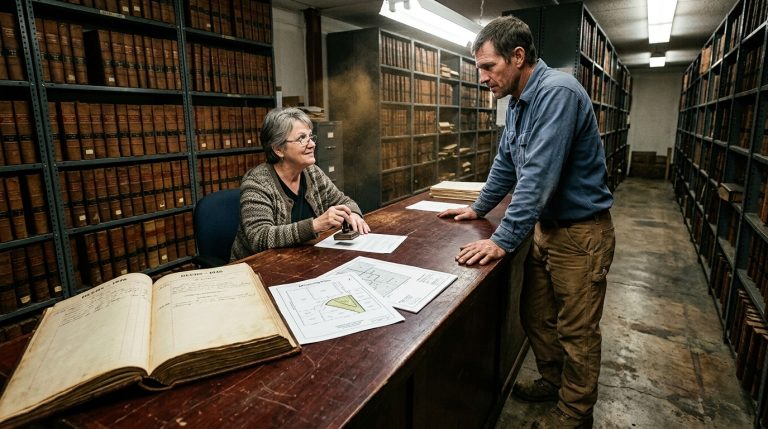
The archives room was cooler, draftier, and quieter than the main hall. Frank sat at the broad wooden table as a junior archivist carefully unrolled a massive, crackling sheet of blueprint paper, anchoring its heavy corners with four small brass weights. The paper was brittle, smelling of dried flax and long-forgotten ink, its margins filled with precise, hand-drawn annotations from draftsmen who had mapped the land decades before a single cookie-cutter foundation had been poured.
Frank leaned in, his eyes tracking the grid lines with the sharp focus of a field commander reading a tactical overlay. He located the boundary lines of his five-acre plot, noting the original farmhouse footprint, and then his gaze drifted outward into what was now the heart of Oak Meadows.
There it was. A thick, solid ink line cut straight across the subdivision map, running diagonally beneath what were now manicured lawns and asphalt driveways, passing directly under the western edge of his property. The legend in the corner identified it tersely: Multi-utility corridor easement.
He didn’t stop there. He traced the line millimeter by millimeter until his finger rested on a tiny, precisely inked square located at the exact coordinates of his root cellar. Next to the square were three capital letters: EAP.
Emergency access point.
The silence of the archives room seemed to thicken around him. The realization didn’t hit him with a surge of panic or triumphant elation; it registered as a cold, undeniable fact of physics and law. That root cellar door wasn’t just a convenient shelter for canned preserves and root vegetables. It was a legally mandated structural threshold—a vital physical portal designed to allow utility crews to reach the main subterranean shutoff valves for water, gas, and telecommunications without tearing up half a mile of newly paved suburban street.
He sat back in his chair, his jaw tightening slightly as the implications clicked into place like the tumblers of a heavy vault lock. Karen wasn’t just attempting to bully an individual homeowner over an aesthetic grievance. In her absolute ignorance of the land’s history, she was demanding the obstruction of critical public infrastructure.
He pulled his notebook from his jacket pocket, uncapped his pen, and began copying the exact file numbers, recording dates, and liber-and-page references from the margins of the map. He needed certified copies of everything—the original plat, the easement dedication, and the municipal code governing utility access.
As he worked, a low, persistent hum of tension settled at the base of his neck. The paper trail wasn’t just a shield anymore. It had evolved into something far heavier. It was a loaded weapon, and Karen had practically handed him the trigger by forcing the issue into the open. He finished his notes, rolled the blueprint with meticulous care, and walked back to the counter to place his order for certified copies. The administrative war was no longer about defending a door; it was about exposing the hollow foundation of an entire HOA regime.
CHAPTER 4: THE ESCALATING PAPER TRAIL AND THE SILENT COUNTERSTRIKE
The kitchen table had transformed into a command post. The edges of the yellow legal pad were weighted down by certified mail receipts, their pink adhesive strips catching the afternoon light filtering through the windowpanes. Frank sat with his shoulders squared, pen in hand, treating the drafting of his second formal reply with the detached precision of an artillery officer plotting coordinates.
Sarah stood nearby, pouring a fresh cup of coffee into his mug without a word. She didn’t need to ask what phase they were entering; the quiet set of his jaw and the absence of emotional static told her everything.
“She’s going to take that first inquiry as an insult,” Sarah observed, watching the rhythmic scratch of his pen against the paper.
“She’ll take it as a personal challenge,” Frank corrected quietly, without looking up. “People who govern by mandate don’t know how to process a request for evidence. They expect compliance or a shouting match. When you hand them a procedural question they can’t answer, their only reflex is to double down on volume.”
And double down she did. Three days later, the response arrived. It didn’t come via standard mail; it was slipped directly through the mail slot by a flustered-looking carrier who seemed eager to clear his hands of the envelope. It was shorter, sharper, and completely stripped of any bureaucratic pretense. The official letterhead remained, but the tone had devolved into raw, unfiltered impatience.
Frank unfolded the crisp white sheet.
Mr. Miller, it began, the ink heavy and pressed deep into the paper fibers. Whilst the board is not required to provide you with a history lesson on community standards, the violation is plain and simple for anyone to see. The structure is an eyesore. Your failure to remediate the issue has resulted in the levying of the initial two-hundred-and-fifty-dollar fine, which is now past due. Continued non-compliance will result in further fines and legal action, including the placement of a lien on your property. This is your final warning.
There was no reference to meeting minutes. No mention of the Architectural Review Committee’s adoption standards. Just a naked appeal to arbitrary authority, wrapped in threats of financial penalties and property liens. Karen had walked straight into the tactical corridor Frank had mapped out for her.
He reached for his checkbook, tearing off a slip with clean, unhurried motions. He filled out the amount for two hundred and fifty dollars, but in the memo line, he wrote in precise block letters: Paid under protest, violation disputed.
“You’re paying it?” Sarah asked, her eyes narrowing as she read the memo line.
“I’m funding the record,” Frank said calmly, slipping the check into a fresh envelope alongside another formal letter. “If you refuse to pay outright, they claim default on a fee. If you pay under protest, you preserve your standing while forcing them to acknowledge the dispute in their own accounting ledgers. Every dollar logged under protest is an administrative footprint they can’t erase.”
His second letter was a masterpiece of cold, clinical containment. He acknowledged receipt of her final warning and the assessment of the fine, then calmly pointed out that the board’s continuous failure to provide the requested legal documentation left him no logical option other than to conclude the violation notice had been issued without jurisdictional basis.
Therefore, he drafted, his pen gliding smoothly across the paper, I consider this matter closed. Should you continue to levy fines or threaten legal action without providing the specific, requested legal basis for the violation, I will be forced to consider it an act of targeted harassment and will seek all available legal remedies through the county courts.
He sealed the envelope, stamped it for certified delivery with return receipt requested, and set it beside the door. The paper chess match was reaching its terminal phase. Karen believed she was tightening a noose around his property, unaware that every loop she tied was actually anchoring her own administration to a liability far larger than a suburban HOA could ever survive.
CHAPTER 5: COFFEE IN THE LIVING ROOM AND ASSEMBLING THE COALITION
The morning sun cast long, angular shadows across the worn hardwood floors of Frank’s living room, illuminating the quiet dust motes dancing in the air. There were no formal podiums here, no parliamentary gavels, only a mismatched collection of armchairs and kitchen chairs dragged into a tight circle.
Dave, the retired Marine from two streets over, sat with his forearms braced on his knees, his jaw set in a permanent, hard line. Across from him, Maria clutched a ceramic mug of tea with hands that trembled slightly, her gaze fixed on the corner where her small ceramic garden gnomes had become the center of a petty municipal war. Beside her, the Millers—a young couple with tired eyes and two toddlers staying quietly with a neighbor—sat huddled together, the weight of daily compounding fines pressing down on their shoulders like wet canvas.
Frank stood near the hearth, his weight balanced evenly, holding a manila folder filled with the county plat maps and certified easement filings. He didn’t waste time with pleasantries or comforting platitudes. In a tactical briefing, you started with the enemy’s position and ended with your own lines of supply.
“She’s not enforcing community standards,” Frank began, his voice cutting through the heavy silence of the room. He tossed a copy of Karen’s latest penalty notice onto the coffee table. “She’s testing our threshold for friction. If we fight her individually—house by house, fine by fine—she picks us apart with administrative exhaustion.”
Dave leaned forward, his eyes narrowing as he looked at the document. “I’ve seen colonels like her in supply depots. Give them a tiny sliver of authority and a rubber stamp, and they think they command a battalion. How do we break the line, Frank?”
“We don’t break it by shouting,” Frank said, walking over to the coffee table and unfolding the large county plat map right over the center of the wood. The thick ink lines mapping out the multi-utility corridor stretched across the paper like a fault line. “We break it by showing them what’s actually buried underneath their feet.”
He laid out the documents one by one—the easement agreements, the municipal maintenance codes, and the statutory definitions governing public infrastructure access. He explained the legal weight of the emergency access point located beneath his root cellar door, translating the dense legal prose into plain, undeniable facts.
As the realization settled over the room, the initial air of defeat began to shift. Arthur Henderson, the retired corporate lawyer living on the cul-de-sac who had arrived quietly just before the meeting started, adjusted his glasses and leaned over the map. His lips parted in a slow, grim realization.
“My word, Frank,” Arthur murmured, his voice dropping into a raspy, disbelieving register. “This isn’t just a violation of the subdivision’s CC&Rs. If she forces the removal or obstruction of a designated emergency access point for high-pressure utility lines, she’s opening the entire association up to liability that could liquidate every reserve fund we possess.”
“Precisely,” Frank said. “And the association’s own bylaws state they are legally bound to uphold pre-existing easements and conduct annual safety inspections. Inspections which county records prove have never been executed.”
Maria looked up, her voice small but steady. “She wants us to pay for her rules while she breaks the law?”
“She’s banking on the fact that nobody checks the basement files,” Frank replied. He looked around the circle, meeting the eyes of each neighbor in turn. “I’ve drafted formal notifications to the legal departments of Piedmont Gas, Tri-County Water, and OmniCom Fiber. They own the pipes and cables running under our lawns. When they realize an HOA president is trying to mandate the illegal sealing of their primary infrastructure, they won’t send a warning letter. They’ll send a legal battalion.”
Dave let out a short, bark-like laugh that held no humor, only cold satisfaction. “The kill zone is already mapped, then. When does she trip the wire?”
“She scheduled a public hearing for next week,” Frank said, tapping the edge of the pink flyer he had retrieved from the community bulletin board. “She wants a public spectacle to make an example of us. We’re going to give her a stage, all right—just not the one she planned on.”
The tension in the room shifted from anxious weariness to sharp, focused resolve. The individual silos of fear—the flagpole, the gnomes, the swing set, the cellar door—dissolved into a single, unified front. They weren’t just victims of an overzealous HOA president anymore; they were an assembled force holding the blueprints to her undoing.
CHAPTER 6: CORPORATE LEGAL INTERVENTION AND THE SETUP FOR THE PUBLIC HEARING
The afternoon sun beat down on the front porch as Frank slid three heavy FedEx envelopes into the metal collection box, the mechanical snap of the spring-loaded flap sounding like a dry bolt sliding home. Each package carried signature confirmation and contained precise copies of Karen’s threatening violation notices, matched side-by-side with the county plat maps designating the multi-utility corridor easement.
He didn’t make phone calls. In his years with the Corps of Engineers, he had learned that verbal warnings evaporated under corporate scrutiny, but a physical document delivered to a legal department’s intake desk created an immediate paper trail that compliance officers could not legally ignore.
Within forty-eight hours, the machinery began to turn.
The first call came on a Tuesday morning. The phone on the kitchen wall rang with a sharp, insistent trill. Frank picked it up on the second ring, his voice neutral and measured.
“Mr. Miller?” a clipped, professional voice inquired. The speaker didn’t bother with pleasantries or introductory small talk. “My name is David Chen, in-house counsel for Piedmont Gas Company. We’ve reviewed the documents delivered to our regional compliance office regarding the property at 128 Old Farm Road.”
“I’m listening, Mr. Chen,” Frank replied, keeping his tone entirely flat.
“We take potential interference with our primary high-pressure distribution lines with extreme gravity,” Chen continued, the background hum of an office switchboard audible behind him. “Can you confirm whether the local homeowners association is actively directing you to remove or obstruct the access hatch located over our easement?”
“Their latest written correspondence demands the permanent removal of the structure under threat of daily financial penalties and property liens,” Frank said, reciting the facts with absolute clarity.
There was a long pause on the line, punctuated only by the faint rustle of papers being shifted across a desk. When Chen spoke again, his professional calm carried a sharp, dangerous edge.
“Let me be entirely unambiguous, Mr. Miller. That hatch is not a decorative lawn ornament. It is a critical component of state-regulated energy infrastructure. Tampering with or sealing that access point constitutes a serious violation of state and federal safety codes. We will be communicating our legal position directly to the Oak Meadows board before the week is out.”
The line clicked dead. Two hours later, a similar call arrived from the Tri-County Water Authority, followed the next morning by a formal courier delivery from OmniCom Fiber. The corporate giants had awakened. They were not stepping in as Frank’s personal allies; they were corporate stakeholders protecting multi-million-dollar assets and public safety mandates. Their operational interests and his defense had forged an unbreakable alignment.
While the corporate legal teams mobilized behind the scenes, Karen made her final tactical error.
A garish flyer printed on blinding pink paper appeared on the community bulletin board at the subdivision entrance, announcing a “Special Executive Hearing” to vote on the forced removal of the structure at Lot 1, complete with motions for liens and public censure. She had chosen the public stage, believing she could use the monthly clubhouse meeting to break the resistance once and for all.
Frank looked at a snapshot of the flyer on his phone, a grim satisfaction settling into the lines around his eyes. She was building her own gallows, arranging the lighting, and sending out the invitations. All he and Arthur Henderson needed to do was bring the blueprints.