The Echo of the Trident: A Legacy Forged in the Quiet Resolve of an Old Warrior
CHAPTER 1: THE WEIGHT OF THE SOIL
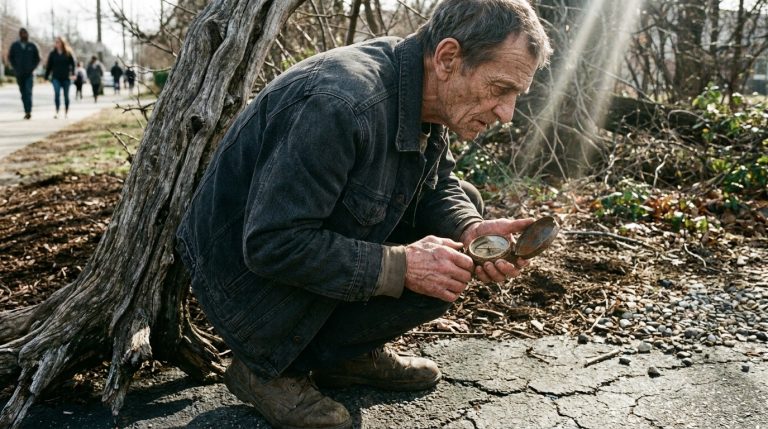
The California sun was relentless, pressing down on the asphalt of the Coronado barracks with a weight that made the air shimmer. Frank Nelson, eighty-four years old and anchored to the earth by habit and a love for things that grew, ignored the heat. His knees pressed into the hard-packed dirt of the flowerbed, his hands—gnarled like the roots of the oaks he’d planted decades ago—patting the soil around a struggling marigold.
“You call that ink?”
The voice was sharp, a jagged blade cutting through the lazy afternoon hum. Frank didn’t look up. He knew the tone. It was the sound of a man who believed the world began the day he signed his enlistment papers.
“I’ve seen better art on bathroom walls, Grandpa.”
Frank felt the vibrations in the soil before he saw them. Three pairs of boots—polished, expensive, and heavy—circled the flowerbed. He kept his focus on the marigold. He felt the phantom phantom weight of a rifle on his shoulder, a different kind of pressure from fifty years ago, and suppressed the urge to check his periphery. Instead, he pulled a small trowel from his canvas bag.
“Is that a tadpole with a fork, pops?” The voice belonged to the one called Peterson, a man whose physical perfection was only matched by his lack of perspective. “What’s that supposed to mean? You were a cook in the tadpole division?”
The group erupted in laughter—a hollow, brittle sound that echoed off the barracks walls. Frank reached for his thermos. He unscrewed the cap, the metallic clink a steady rhythm in his hand. He wasn’t a cook, and he wasn’t a ghost, though he felt like one standing here in the glare of the modern world.
“Come on, Gramps,” Peterson pressed, leaning in until the shadow of his buzzcut fell over Frank’s work. “Don’t be shy. Tell us the war story that goes with your little doodle. Or did you get it on a drunken weekend in Tijuana?”
Frank finally paused. He looked up, his pale blue eyes settling on Peterson with a calm that bordered on the unsettling. He didn’t see a villain; he saw the reflection of a version of himself he had long ago buried in the mud of the Mekong. The boy in front of him was terrified of being invisible, terrified of being forgotten before he had even begun.
“It’s just a memory, son,” Frank rasped, his voice as dry as the dust on his trousers.
Peterson stiffened, his face reddening. The old man wasn’t cowering. He wasn’t even flinching. The disregard for his dominance, for the power he was supposed to wield as a future SEAL, twisted something deep in Peterson’s gut. He reached down, his thick fingers grabbing Frank’s arm, the skin of his thumb pressing hard against the blue-gray ink of the trident.
“This,” Peterson spat, “is an insult to the real ink on this base.”
He squeezed, trying to smudge the lines of the old, faded tattoo. Frank felt the friction burn his skin, and for a fleeting, terrifying micro-second, the sun vanished. The scent of marigolds was replaced by the wet, sulfurous rot of a jungle river, and he heard the PBR boat’s engine thrumming beneath him like the heartbeat of a dying world. The contrast was a physical ache—a memory of blood and brotherhood clashing with the sterile, loud arrogance of the present.
He pulled back, not in pain, but in deep, resonant sorrow for the boy gripping his arm. The lesson was coming, but it would not be a soft one.
CHAPTER 2: THE ECHO IN THE MUD
The pressure on Frank’s arm vanished as abruptly as it had arrived, leaving behind a phantom ache that throbbed in time with his pulse. Peterson recoiled, his hand darting back as if he had been burned by the very skin he had touched. The silence that rushed into the gap was not the peaceful quiet of a garden; it was heavy, expectant, and brittle.
Frank did not rub his arm. He remained on his knees, his hands resting on the damp earth. He focused on the marigold, its orange petals vibrant against the grey-blue dust of the base. For a heartbeat, the California sunshine felt thin, a fragile curtain pulled tight over a reality that was vastly different.
The humidity rose, thick and suffocating. The smell of fertilizer shifted into the deep, sulfurous rot of mangrove mud—a scent so potent it coated the back of his throat. The incessant, high-pitched whine of mosquitoes began to drill into his ears, drowning out the distant, muffled laughter of the base. In his mind’s eye, the barracks dissolved into a wall of dense, dripping green foliage. He was not on a navy base anymore; he was huddled under a poncho with Mac and a third, nameless boy, the rain drumming a frantic, metallic rhythm against the canvas.
They were ghosts then, and they were ghosts now, haunting the edges of a world that refused to acknowledge their existence.
“You okay, pops?”
The voice was Peterson’s, though the arrogance had curdled into a nervous, jagged edge. The young recruit was hovering, his posture a defensive contradiction—shoulders squared, but eyes darting toward the other sailors who had stopped to watch.
Frank blinked, and the jungle retreated, leaving him back in the glare of the noon sun. He felt the grit under his fingernails. He looked up at Peterson, whose face was a mask of youthful agitation. The boy was looking for a reason to justify his own discomfort, waiting for Frank to snap, to curse, to prove that he was indeed just a broken, angry old man—an easy target.
“I am quite well, son,” Frank replied, his voice a low, gravelly rasp that seemed to stabilize the air around them.
He methodically began to gather his hand tools. The trowel, the shears, the small, tarnished silver thermos—each item was returned to the canvas bag with an economy of motion that made Peterson’s frantic shifting look like an uncoordinated dance. Frank stood, his joints protesting with a dull, familiar ache that grounded him in the present. He ignored the eyes of the onlookers. He knew how to move in front of an audience without letting them see his true posture. He had practiced it for years in the dark, in the wet, and in the silence of deep-water operations.
“Maybe you should move along,” Frank added, not as a command, but as a quiet observation of the inevitable. “This garden needs tending, and you have training to get to.”
“Training,” Peterson scoffed, though the word lacked conviction. He gestured vaguely at his own insignia. “We’re the ones doing the real work, Gramps. Keeping the edge sharp. Someone has to keep the standard high.”
“The standard,” Frank repeated softly. He finally turned his full gaze toward the recruit. “The standard is not what you wear on your arm, or how loud you can talk on a sunny afternoon. The standard is what you do when the world is dark, when there is no audience to impress, and when the only thing keeping you whole is the man standing next to you.”
He stepped past Peterson, his movements deliberate. He felt the boy’s eyes on his back, a burning curiosity mixed with a growing, gnawing unease. Frank’s shoulder brushed against the younger man’s arm—a brief, electric contact. In that micro-second, he felt the taut, unused potential in Peterson’s muscle, the same way a hunter feels the tension in a spring.
He didn’t look back. He walked toward the main barracks, his boots leaving faint, clean prints in the dust. He knew he was being watched, not just by the recruits, but by the shadows in the distance. He felt the weight of Master Chief Riggs’ gaze from across the quad—an appraisal, a hesitation, a recognition that he couldn’t quite name.
Frank navigated the path with his head down, but his mind was tracing the perimeter of the base, identifying the choke points, the sightlines, and the gaps in the fence that he hadn’t formally documented in years. It was an old instinct, one that flared to life whenever he was challenged. He felt the cold fire in his chest—not the heat of anger, but the icy, clinical focus of a man who had survived a war that wasn’t supposed to happen.
He reached the edge of the access road, where the black SUVs were beginning to congregate near the command center. He sensed the shift in the air—the sudden, sharp ozone scent of authority. Something was breaking. The routine of the base was fracturing under the weight of an old memory trying to find its way home.
He paused, his hand resting on the metal railing of the command walkway. The cool surface was a welcome contrast to the humid, phantom jungle of his thoughts. He didn’t know yet who had made the call, but he knew the effect it would have. The truth was a tide, and he was the stone in the middle of the river.
He took a slow, steadying breath, let the tension in his shoulders drop an inch, and looked up as a flash of light caught his eye—the gold of a captain’s insignia, catching the sun.
CHAPTER 3: THE MASTER CHIEFS SHADOW
Master Chief Petty Officer Riggs stood in the shadow of a sprawling palm tree, his posture rigid, though his expression remained unreadable. His gaze was not on the recruits, nor on the bustling activity of the base administration. It was tethered to the old man standing near the walkway—Frank Nelson.
Riggs had seen a thousand faces in his thirty years of service. He had seen the fresh-faced innocence of kids who thought they were immortal, and the hollowed-out exhaustion of men who had seen too much. But Frank was something else entirely. There was a stillness in the way the man held his tools, a lack of defensive posture that was, in itself, a testament to a long-forgotten kind of lethality.
The Master Chief’s hand moved instinctively to his belt, brushing the fabric of his uniform. He looked back at the trio of SEAL candidates. Peterson was still posturing, his chest puffed out, but the confidence was fraying at the edges. Riggs felt a surge of professional disgust. It wasn’t just the hazing; it was the sheer, blind ignorance of it. These recruits were so obsessed with the image of the warrior—the polished, marketed version—that they couldn’t see the reality standing three feet away from them.
Riggs pulled his phone from his pocket. His heart, usually as steady as a metronome, had skipped a beat when he saw the tattoo on the old man’s arm. It was a faded, grayish-blue emblem—a sketch he had once seen in a restricted, unofficial history. A legend that wasn’t supposed to exist in the daylight, yet there it was, tending to marigolds in the bright, unforgiving California sun.
“This is Master Chief Riggs,” he murmured into the receiver, his voice barely audible over the hum of the base. He kept his back to the quad, his eyes scanning the periphery for any sign of interruption. “Get me the captain. I don’t care if he’s in a meeting with the Secretary of the Navy.”
There was a pause on the line, the sound of static and the distant clatter of an office in full operation. “Master Chief, he’s in his quarterly command brief. You know the protocols.”
“I am aware of what day it is,” Riggs cut in, his tone dropping into the lethal register he usually reserved for failing instructors. “You tell Captain Thorne that he needs to get down to the grinder right now. And tell him—tell him it’s about Frank Nelson.”
The name landed on the other end of the line like a weight. The silence that followed wasn’t bureaucratic; it was the sudden, breathless pause of someone witnessing an impossible event.
Riggs looked back at the scene. Peterson had moved closer to Frank, his hand reaching out again, this time with a more aggressive, mocking intent. The Master Chief felt his muscles coil, ready to sprint across the quad, but he forced himself to wait. He had to be sure. If he was wrong, if this was just some old man with a coincidence of a mark, he would be the laughingstock of the command. But as he watched Frank’s reaction—the way the old man didn’t flinch, the way his eyes seemed to drift toward a horizon only he could see—Riggs knew he wasn’t wrong.
He was watching a ghost.
“Frank Nelson,” the aide’s voice returned, now sharp with sudden, desperate urgency. “Are you absolutely certain?”
“I’m looking right at him,” Riggs said, his gaze fixed on Frank’s steady hands. “And he’s about to be assaulted by three candidates who don’t know they’re poking a sleeping god. Get him down here. Now.”
He clicked the phone shut and tucked it away. The quad was beginning to draw a crowd. Sailors, civilian contractors, and administrative staff were slowing their pace, drawn by the friction of the confrontation. The air felt heavy, charged with the kind of static that precedes a lightning strike.
Riggs watched as Peterson shoved his hand toward the old man’s arm, his fingers digging in. It was a crude, disrespectful gesture that made the Master Chief’s blood run cold. He didn’t need to hear the words to know what was being said. The tone was loud, performative, and entirely devoid of the honor that defined their profession.
He took a step forward, his boot scuffing the pavement, but then he stopped. He saw Frank’s expression—that distant, watery blue gaze—and for a second, Riggs felt a strange, cold shiver of vulnerability. It was the look of a man who had seen the beginning and the end of the conflict they were all training for.
The Master Chief realized then that he wasn’t just watching a confrontation; he was watching the intersection of two worlds. The loud, proud, and artificial world of the present was pressing up against the silent, hard-won reality of the past.
He took a breath and adjusted his cover. He would stay in the shadows until the Captain arrived. This wasn’t his fight to resolve; it was a reckoning, and the old man in the garden was the only one who truly held the power to decide how it ended. He watched, eyes narrowed, as the first sign of the command convoy—a flicker of flashing lights in the distance—began to approach the base entrance. The storm was coming, and these boys had no idea how much rain it was going to bring.
CHAPTER 4: THE ARRIVAL OF THE STORM
The metallic railing beneath Frank’s palm shuddered. It wasn’t the wind. It was a low-frequency vibration, a mechanical tremor that traveled through the steel of the walkway and into the soles of his boots. Frank didn’t turn his head immediately. He kept his eyes on the far end of the access road, where the shimmering heat haze was beginning to distort the straight lines of the base architecture.
A sound followed the vibration—a piercing, authoritative siren that lacked the chaotic, aggressive note of a police cruiser. This was a command tone, rhythmic and demanding, and it carved through the lazy afternoon air like a hot wire through wax. Around him, the base seemed to catch its breath. The distant clatter of maintenance crews and the low hum of training exercises vanished, swallowed by the rising pitch of the approaching convoy.
Peterson and his friends were still standing near the marigold bed. Their posture had shifted from predatory to uncertain. They were looking toward the main gate, their mouths slightly open, caught in that fragile, fleeting window of time where they were still masters of their own small, arrogant reality.
Frank watched the first black SUV crest the rise, its dark, glossy finish catching the sun with an intensity that hurt his eyes. Behind it, two more vehicles followed, their lights flashing in a silent, hypnotic pulse of red and blue. They didn’t slow down as they entered the quad. They accelerated, cutting off the access road, their tires spraying loose gravel in a precise, tactical arc that blocked the exit.
“What is that?” Peterson muttered, his voice barely audible. He took an instinctive step backward, his hand falling away from his side. His bravado was evaporating, replaced by the instinctual, primal fear of an animal that senses a predator much larger than itself.
“Someone,” Frank said, his voice flat, “is about to have a very long day.”
The vehicles came to a halt in a formation so tight it looked like a wall. The doors opened in a synchronized burst of motion. Frank saw the figures emerge—not MPs, not security, but officers. Their service dress whites were blindingly bright against the dark, sun-baked asphalt. They moved with a singular, terrifying fluidity, their eyes scanning the area with the practiced, cold precision of men who held the power to end careers with a single sentence.
At the center of the formation was Captain Thorne. Frank recognized the set of his shoulders, the deliberate, measured stride. Thorne didn’t look at the crowd. He didn’t look at the gawking onlookers who had retreated to the safety of the barracks shadows. He looked directly at the center of the quad, his gaze locking onto the garden with the intensity of a laser.
The air around the flowerbed felt as if it had been vacuum-sealed. The recruits stood frozen. They were pinned by the sheer weight of the authority closing in on them. Peterson’s face had drained of color, his skin turning a sickly, translucent grey. He looked as though he wanted to run, but his feet were anchored to the earth by the same fear that kept the entire base silent.
Frank stepped away from the railing. He didn’t rush. He moved with that same deliberate economy he had used to tend the flowers, his pace steady, his gaze calm. He watched as Thorne walked through the space between the SUVs, his polished black shoes clicking against the pavement—a sharp, percussive sound that seemed to mark the cadence of their doom.
The officers behind Thorne peeled off, creating a perimeter that effectively isolated the flowerbed from the rest of the world. The atmosphere was no longer mundane; it was pressurized, vibrating with the potential for a complete dismantling of the status quo.
Thorne stopped. He was ten paces away, then five. The space between them seemed to warp under the gaze of the dozens of spectators who had stopped their work to witness the collision. The Captain didn’t speak. He didn’t need to. The way he held his head, the way the golden eagle on his collar caught the light—it was all the introduction needed.
Frank slowed his walk, his hands empty at his sides, his posture relaxed. He saw the flicker in Thorne’s eyes—a momentary, uncontrollable softening of the steel, a brief, fleeting glimpse of something that looked dangerously like reverence. It was a look Frank hadn’t seen in a very long time, and it told him that the “ghost” hadn’t remained as buried as he had intended.
The Captain closed the final distance. The recruits, caught in the middle, were physically shrinking, their bodies hunched in a futile attempt to disappear. The silence was absolute. Even the birds had stopped their singing. In that space, beneath the unforgiving California sky, the weight of a hidden history was finally beginning to manifest, pressing down on the asphalt, the marigolds, and the arrogant, trembling shoulders of the boys who had forgotten that every uniform carried the ghost of the men who had worn it before them.
CHAPTER 5: THE LESSON OF THE TRIDENT
Captain Thorne’s salute was a geometric masterpiece. His hand was a rigid, unyielding blade of white fabric, his elbow perfectly horizontal, his gaze locked into the infinite distance. He held it for ten seconds—a duration that in the lexicon of military discipline meant everything. It was not a gesture for the crowd; it was an acknowledgment of a history that had no official records, a debt owed to a man who had walked out of the jungle with his brothers when the world thought they were lost.
Peterson was shaking. The tremors started in his knees and traveled up his spine, visible through the taut fabric of his uniform. Beside him, his fellow candidates had become statues of pure, unadulterated terror. They had expected an argument, a reprimand, or perhaps even a dismissal, but they had not expected this. The base commander, a man whose stature was forged in the fire of modern naval superiority, was bowing to a gardener.
The air around the flowerbed seemed to thicken, pressing in on the quad. Frank Nelson stood there, his back slightly bent from years of work, his hands hanging loosely at his sides. He looked at Thorne with a faint, weary smile—the expression of a grandfather watching a child learn a difficult, overdue lesson.
“Mr. Nelson,” Thorne said, his voice resonant and clear, vibrating with a depth that reached the furthest edges of the silent crowd. “It is an honor to have you on my base, sir.”
The Captain lowered his hand, the motion sharp and final. He turned slowly, his eyes shifting from the old man to the three candidates. The transition was clinical. The reverence he had just shown Frank was instantly replaced by a cold, arctic detachment. Thorne didn’t shout. He didn’t need to. His whisper carried the weight of a death sentence.
“You three,” he began, his gaze piercing through Peterson’s defenses. “You see this man? You see this tattoo you found so amusing?”
Peterson tried to speak, but his throat was locked. He looked like he was suffocating in the open air. Thorne stepped closer, moving into their personal space until the gold eagle on his collar glittered inches from Peterson’s face.
“This is Frank Nelson,” Thorne continued, his voice dropping an octave, becoming a rhythmic, punishing cadence. “Before there were even SEALs, this man was a frogman in the underwater demolition teams. He didn’t just walk the beaches; he prepared the way for everything you think you are. He volunteered for operations so deep and so secret that for decades, the books said they never happened. He didn’t leave his men in the mud. He brought every single one of them home.”
The Captain’s hand drifted toward the faded, ink-stained forearm of the old man. “This tadpole with a fork, as you so cleverly called it—that is the original mark of a unit that was known only as the Delta Frogmen. They were the ghosts who defined the ethos you pretend to recite every morning.”
The silence in the quad was absolute, broken only by the sound of a distant training siren. The crowd, dozens of sailors and workers, stood as if paralyzed. The myth was being unraveled, and the weight of it was crushing.
Thorne turned back to the candidates, his expressionless mask fracturing into a look of profound disappointment. “You are candidates for an elite brotherhood. The very first principle is honor. The second is respect. You have shown neither. You stood here on ground sanctified by the men who came before you, and you mistook quiet dignity for weakness. You mistook age for irrelevance.”
He paused, letting the words hang in the air. “As of this moment, your candidacies for basic underwater demolition are suspended, pending a full, personal review. Report to my office at 0600 tomorrow. Now get out of my sight.”
The dismissal was total. Peterson and his friends didn’t argue. They didn’t even attempt to stand at attention. They turned with a chaotic, stumbling motion and began to walk away, their heads down, their movements devoid of the arrogant, bouncing stride they had possessed only twenty minutes ago. They moved through the crowd like ghosts, followed by the silent, stinging judgment of every pair of eyes on the base.
Frank reached out and placed a hand on Thorne’s forearm—a touch that was light, almost imperceptible, yet it seemed to draw the tension right out of the Captain’s frame.
“They’re just kids, Captain,” Frank said softly. The fire and vinegar that had remained hidden until now flickered in his eyes—the wisdom of a man who had seen enough blood to know that vengeance was a heavy anchor. “We were the same once.”
He looked toward the remaining crowd—the young sailors who were still watching, their faces reflecting a mix of awe and shame. Frank’s voice didn’t rise, but it reached every corner of the quad. “Pride is a heavy anchor. It can hold you steady in a storm, or it can drag you straight to the bottom. The trick is knowing which it’s doing.”
Thorne watched the candidates disappear behind the barracks, his jaw set in a rigid line. He nodded to Frank, a final, wordless acknowledgment of the truth that had just been spoken. The storm had broken, and now, the long, slow work of letting the world settle into a new understanding had begun.
CHAPTER 6: THE WEIGHT OF THE ANCHOR
The adrenaline that had electrified the quad during the Captain’s address had now completely dissipated, replaced by a strange, heavy stillness. Frank Nelson remained in the flowerbed, his hands resting on the handles of his shears. He watched the last of the onlookers disperse—a slow, hesitant retreat of sailors and civilians who seemed unsure of how to interact with the man they had once looked past.
The sun was beginning its descent, painting the barracks in long, amber shadows that softened the sharp edges of the base. Frank moved with a slowness that felt less like age and more like deliberate peace. He finished pruning the marigolds, the sharp snip-snip of the shears the only sound in the twilight. He was no longer a ghost; the revelation had stripped him of that anonymity, but it had also granted him a strange, quiet dignity. He was no longer a gardener; he was an institution.
His movements were methodical, cleaning the dirt from the tools, wiping the blades, and tucking them back into the worn canvas bag. Each action was an act of repair, a physical manifestation of the order he had long sought to maintain. He didn’t look up when he heard the approach of boots on gravel. He knew the gait—the hesitant, uneven step of a man carrying a burden too large for his shoulders.
Peterson stopped a few paces away. The uniform he wore was the same, but the man inside it had been hollowed out and rebuilt. His shoulders, once squared in arrogant defiance, were now hunched, his gaze fixed on the ground. He looked, Frank thought, exactly like the young men he had once led out of the jungle—men who had seen the limit of their own strength and had been forced to look beyond it.
“Mr. Nelson,” Peterson said, his voice barely a rasp. He didn’t look up, his fingers twisting the edge of his sleeve. “I… I wanted to say. I’m sorry.”
Frank looked at him. The young man’s face was marked by the exhaustion of the last few weeks, the result of his punishment—a six-month cycle of grueling, soul-crushing labor that had stripped away the last vestiges of his vanity. Frank saw the raw, exposed humanity underneath, and it was a look he recognized from a lifetime ago.
“I know, son,” Frank said, his voice steady. He reached into his small, weathered cooler, the metal cool to his touch, and pulled out a bottle of water. He held it out, watching as Peterson took it with shaking hands. The condensation on the plastic, cool and real, seemed to draw the heat of the day right out of the air.
“The lesson is more important than the mistake,” Frank continued. He nodded toward the distant sound of training, where a new class was pushing through their own crucible. “You’ve spent time in the mud. You’ve felt the weight of it. That’s not a punishment. That’s an education.”
Peterson looked up, his eyes meeting Frank’s. The arrogance was gone, replaced by a flicker of genuine, hard-won understanding. He realized, perhaps for the first time, that the Trident he sought wasn’t a symbol of power—it was an anchor, a commitment to keep holding, even when the tide wanted to drag you to the bottom.
“I just wanted to be the best,” Peterson whispered.
“The best don’t need to tell anyone they’re the best,” Frank replied gently. “They just show up, they do the work, and they make sure the person next to them makes it home. That’s all there is.”
He turned back to the flowerbed, his hand moving to the small, damaged bloom he had been tending since the start of the week. He carefully adjusted the stem, anchoring it to a wooden stake he had carved himself. It was a simple, small act, but in the quiet of the evening, it felt monumental—a Kintsugi of the garden, a small piece of beauty preserved despite the harshness of the environment.
Peterson stood there for a long moment, the water bottle held tightly in his grip, before he finally nodded. He turned and walked away, not with the hurried, desperate flight of before, but with the steady, measured pace of a man who had finally learned how to walk with his own history.
Frank remained, the silence of the garden settling around him like a familiar cloak. The mystery of the “gardener” was gone, but the truth of the man remained. He felt a deep, resonant peace. He had been a soldier, a ghost, and a leader, but here, in the dirt, he had found something he had been looking for since he first left the jungle: a place to grow. He took a long, slow breath of the evening air, the scent of earth and salt water blending into the smell of home, and watched the first stars begin to pin themselves against the darkening blue of the sky.