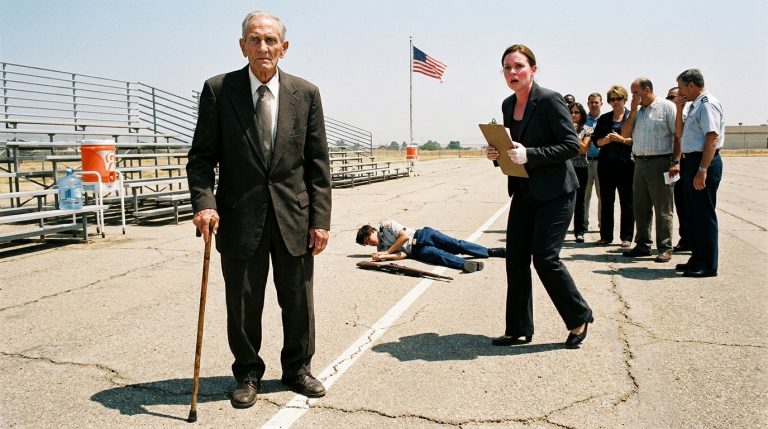
A Second Breath: The Unseen Hands of William Briggs and the Echo of a Life Reclaimed
CHAPTER 1: THE WEIGHT OF THE CONCRETE
The sound of the businessman hitting the pavement was not a thud, but a crisp, final snap, like a branch breaking in a frozen forest. People swirled around the center of the chaos, a blur of colorful jogging gear and frantic, smartphone-lit faces, but for William Briggs, the world had narrowed to the space between the man’s sternum and the cold concrete.
William knelt, his knees protesting with the familiar, grinding pop of eighty-one years of hard living. He didn’t care about the onlookers or the way they recoiled from the grease-stained elbows of his army jacket. He saw only the blue tinge creeping into the man’s lips, the static vacancy in his eyes.
He placed two fingers against the carotid artery. Nothing. No thrum, no pulse, just the stillness of a stopped clock.
“Get back,” William muttered, though the crowd was already shrinking away from him as if he were a contagion. He ignored the whispers—homeless, drunk, crazy—and focused. He ripped the man’s tie away, the silk feeling like an intruder under his calloused fingertips. He unbuttoned the shirt, exposing the pale, vulnerable skin of the chest.
His hands, once trained to pull life from the mud of a rice paddy, moved with a haunting, rhythmic precision that contradicted the shaking of his body. He locked his fingers.
One. Two. Three.
The rhythm was a ghost in his blood, a tempo he hadn’t had to think about in three decades. Every compression was a conversation with the past. He wasn’t in a downtown plaza; he was back in the heat, the smell of damp earth and iron-rich blood, the screams silenced by his own relentless focus. He pushed hard, deeper than the textbook protocols demanded, driving his weight into the man’s ribs until he felt the sickening, wet protest of bone against force.
“Someone get a pulse!” he shouted, his voice a jagged piece of flint.
Two paramedics lunged into the circle, their uniforms crisp and sterile, their expressions curdled with the arrogance of youth and procedure. They were already moving to take over, their hands hovering like hungry birds.
“Step aside, sir,” the younger one, Jake, commanded, his voice tight with the fear of a system being disrupted. “We have the equipment. You’re—”
William didn’t stop. He pushed again, a lung-cracking, rhythmic drive that forced a shallow, unnatural gasp from the man on the pavement.
“He’s flatlined for three minutes,” William interrupted, his eyes locked onto the man’s pale, slack face. “You’re following a manual. I’m following a heartbeat.”
He delivered one long, slow, agonizing breath, forcing air into lungs that had forgotten the necessity of oxygen. The businessman’s chest rose, a fragile, trembling movement that seemed too big for his broken frame. William looked up at the paramedics, his pale blue eyes clear and piercing, devoid of any madness.
“You want to stop?” William asked, his voice barely a whisper against the rising sirens. “Then tell his grandkids why.”
The businessman’s briefcase lay a few feet away, tipped on its side. In the frantic shuffle of the crowd, the leather clasp had popped open. A sliver of a bright, blood-red folder peeked out, wedged between a stack of earnings reports and a thick, unmarked envelope. William caught the glint of it, a secret struggling to escape, but he looked away, returning his focus to the chest under his hands.
There was no room for anything else. Not today.
CHAPTER 2: THE CLINICAL BREACH
The ambulance interior was a claustrophobic box of flashing red light and antiseptic cold. William stood back, his army jacket feeling heavy, damp with a mixture of his own sweat and the misting autumn air. His hands were tucked deep into his pockets to hide their tremor. The adrenaline was receding, leaving behind a hollow ache in his lower back that promised to be much worse by morning.
“Keep the rhythm,” William said, his voice raspy, a low grit beneath the high-pitched whine of the portable monitors.
Jake, the younger paramedic, didn’t snap at him this time. He was hunched over the businessman, his movements precise but hesitant, as if he were afraid the life he’d just witnessed returning would evaporate if he exerted too much pressure. Maria, standing near the equipment racks, kept her gaze fixed on the monitor’s screen. The blips were erratic, a chaotic dance of electrical recovery, but they were there.
“Blood pressure is bottoming out,” Maria noted, her voice steady despite the visible shaking of her fingers as she adjusted the IV drip. She looked at William, not with the condescension of a professional toward a civilian, but with a wary, desperate curiosity. “You said the ratio was for field trauma. Is that… is that enough to stabilize him for the ride?”
William leaned against the padded wall of the ambulance as the doors slammed shut, sealing them into the rhythmic, bouncing motion of the city streets. He closed his eyes for a second, and the smell of the roasted chestnuts from the plaza was suddenly replaced by the cloying, sweet stench of rice paddy mud. 1968. He remembered a night just like this—cold, damp, and impossibly quiet—when he had held a young man’s life in his hands using nothing but a pen and the sheer, stubborn refusal to let the dark win.
He blinked, anchoring himself to the faded texture of the stretcher’s vinyl cover.
“It’s not about the ratio anymore,” William said, his voice regaining its flinty edge. “It’s about the integration. You’ve got the heart beating, but the body is still in shock. It doesn’t know it’s been called back.”
Jake looked up, his brow furrowed with confusion. “We’re supposed to maintain protocol. ACLS guidelines say—”
“The guidelines kept him dead for twenty-three minutes,” William cut in. He reached out, his hand hovering over the businessman’s wrist. He didn’t touch him; he simply monitored the atmosphere, the way the man’s skin began to lose that ghostly, cyanotic tint and slowly regain a shallow, bruised pallor.
The briefcase. It was tucked near the door, the red folder still visible. The sight of it sent a subtle, discordant jolt through William’s awareness. It didn’t belong in a trauma scene. It was too sharp, too precise, a jagged object in a sea of soft, human fragility.
“What’s in the bag?” William asked, gesturing toward the floor.
Jake glanced at it, then back at the businessman. “Doesn’t matter. It’s personal property. We’re not cops.”
“It matters,” William murmured. He felt a sudden, sharp intrusive thought: What if the weight of that red folder is the very thing that stopped his heart in the first place? The idea was a phantom, a whisper from a lifetime of observing men who broke under the pressure of things they couldn’t speak aloud.
The ambulance hit a pothole, and the businessman’s body jolted. His eyelids fluttered, a rapid, involuntary movement. He wasn’t fully conscious, but he was struggling against the heavy, narcotic haze of his own near-death. He let out a low, ragged moan, and his fingers brushed against the side of the stretcher.
“He’s coming around,” Maria said, her tone urgent. “But he’s hypertensive. His heart is racing.”
William stepped forward, his joints protesting the movement as the ambulance swerved. He looked at the businessman, really looked at him—the expensive suit now ruined, the graying hair matted with sweat. He saw a man who had been running away from something, a man whose life was built on a series of carefully constructed layers.
“Don’t sedate him yet,” William cautioned, his eyes fixed on the man’s face. “Let the panic out. If you suppress it now, you’ll lock the stress in his system. He needs to breathe through the shock, not hide from it.”
Jake hesitated, his finger hovering over the medication port. He looked at Maria, then at William. The power dynamic in the small, moving box had shifted entirely. The medic was no longer in control; the observer was.
“We’re two minutes from the trauma center,” Jake whispered, his voice stripped of its earlier arrogance. “If he crashes again…”
“Then I’m still here,” William said simply.
He looked at the businessman again, and for a fleeting moment, the man’s eyes cracked open. They were wild, unfocused, and filled with a terror that had nothing to do with the ambulance. His hand twitched, reaching for the floor, for the briefcase, for the secret that lay within that red folder. William saw the raw, pulsing need to hold onto that burden even in the shadow of death. It was a mirror of his own life—the need to be tethered to something, even if that something was a source of pain.
William leaned down, his voice a low, steady rumble meant to cut through the panic. “You’re back. Don’t go looking for the weight yet. You’re still breathing. That’s enough.”
The businessman gasped, a wet, rattling sound, and his grip tightened on the edge of the stretcher. The ambulance slowed, the siren wailing down to a mournful, dying pitch as they pulled into the emergency bay. The doors swung open, flooding the clinical space with the blinding, harsh light of the hospital exterior.
William stood in the shadows, his faded green jacket a stark contrast to the sterile environment. He was already beginning to fade, to step back into the invisible space he had occupied for thirty years. He watched as the medical team swarmed the stretcher, the transition from his own, unorthodox field technique to the cold, structured reality of the hospital beginning in earnest.
He hadn’t resolved the man’s panic, nor had he touched the briefcase. He had only bought the time. And as he watched them wheel the businessman inside, he realized the war wasn’t over. It had only moved from the plaza to a different kind of battlefield, one where the threats weren’t visible in the mud, but hidden in red folders and the silent, heavy secrets of a life held together by nothing more than the refusal to quit.
CHAPTER 3: THE SILENT GUARDIAN
The transition from the chaos of the plaza to the sterile, climate-controlled silence of the hospital entrance was physically jarring. William stood at the threshold, his shoulders hunched against the sudden drop in ambient noise. The adrenaline that had propelled his hands through five minutes of superhuman effort was beginning to settle into a deep, bone-weary fatigue. He felt the weight of his years in the hitch of his breath and the way his knees locked into a rigid, painful stance.
He did not walk into the triage area. Instead, he retreated to the perimeter, finding a small, recessed bench near the vending machines—a space where the hospital’s frantic energy washed over him without pulling him into the current. He was invisible again, a piece of urban debris that had somehow become the focal point of a miracle.
He watched the sliding glass doors. He didn’t have to wait long. Within minutes, the black SUV he had seen at the plaza pulled to the curb, tires hissing on the damp asphalt.
Admiral Marcus Webb emerged. Even in a civilian-style trench coat, his posture remained that of a man accustomed to the rigid hierarchies of command. He checked his watch—a gold-banded heirloom that caught the flickering fluorescent light—and walked toward the intake desk with the practiced, heavy gait of a man who didn’t expect to be stopped.
William stayed in the shadows, his hands clasped over the worn fabric of his trousers. He watched the interaction unfold from thirty feet away, his ears tuned to the frequency of authority. He saw the way the nurses straightened their scrubs when the Admiral approached; he saw the way the head of the emergency department leaned in, listening with a mixture of confusion and deference.
The Admiral wasn’t there for the hospital staff. He turned, his gaze sweeping the lobby with the practiced efficiency of a man searching for a needle in a haystack. When his eyes locked onto the corner where William sat, there was no hesitation.
Marcus walked toward him, his expression carefully neutral, yet there was a tremor in the set of his jaw. He stopped and sat on the edge of the bench, leaving exactly enough space between them to maintain the invisible barrier of their different worlds.
“They said he’s stable,” Marcus began, his voice a low, resonant hum. “The doctors are baffled. They’re calling it ‘spontaneous recovery’ in the notes. They don’t want to document the field intervention.”
William didn’t look at him. He stared at a crack in the linoleum floor, tracing the path of the grout with his eyes. “Protocols are hard to rewrite in the middle of a shift. I don’t blame them.”
“You should,” Marcus countered, though there was no heat in it. “You saved a life today, William. Again. And you did it while the world looked the other way.”
“The world isn’t looking at me, Marcus. It’s looking at what it needs to see. Right now, they need to see a miracle. It’s cleaner than the truth.”
Marcus looked down at William’s shopping cart, neatly parked against the wall. The bags were filled with the detritus of a survivalist existence—blankets, empty bottles, layers of salvaged cardboard—but in the center of it all sat the small, plastic-wrapped photograph. Marcus reached out, his hand hovering near the edge of the cart, before pulling back, as if afraid to disrupt the delicate ecosystem of William’s life.
“I’ve spent thirty years wondering if you’d ended up in a ditch in the Delta,” Marcus said, his voice tightening. “I had investigators look. We checked every VA facility, every homeless registry, every casualty list from your discharge onward. You were a ghost.”
“Ghosts are harder to kill than soldiers,” William said, a faint, wry smile touching his lips. He finally turned to look at the Admiral. “You didn’t find me because I wasn’t lost. I was just done.”
“Done with what? The service? The life?”
“Done with the illusion that I was anything more than a mechanic,” William replied. “When you’re in the field, the human body is just a machine that’s stopped working. You fix the fuel line, you clear the intake, you restart the heart. It’s not poetic. It’s mechanical. But out here… out here, people treat it like it’s divine. They want a reason for why you saved them. They want to believe that there’s a destiny, a purpose.”
He gestured vaguely toward the emergency department doors. “He has a life waiting. A wife. Grandkids. A job. He has reasons to be here. I don’t need a reason. I just need the rhythm.”
Marcus was silent for a long moment. The hum of the hospital seemed to amplify, the sound of monitors and distant paging systems forming a backdrop to their conversation. “I can give you more than a bench, William. The Admiral of the Atlantic Fleet doesn’t have much pull with local housing authorities, but I have friends in the medical board. You’re a legend in the combat medicine circles. A myth, really. They’d pay anything to hear how you did it.”
William looked at the hospital doors again. He knew what was happening in there. They were prepping the businessman for transfer, likely stripping him of his belongings—including that red-folder-filled briefcase—before moving him to the ICU.
“I don’t want to be a myth,” William said, his voice hard as iron. “I want to be useful. If you want to do something, find out who was chasing him.”
Marcus blinked, taken off guard. “Chasing him? He had a cardiac arrest, William. Stress, age, poor diet—”
“He had a briefcase,” William interrupted, his tone brook-no-argument. “And a red folder inside that looked like it had been handled by someone who didn’t want to be caught. He wasn’t just walking to a meeting, Marcus. He was walking away from something. I saw his face when he regained consciousness. That wasn’t the look of a man who’d just had a heart attack. That was the look of a man who’d just been cornered.”
Marcus stiffened, his internal tactical awareness surfacing. He looked toward the ER doors with new focus. “You think this was more than a medical incident.”
“I think a man doesn’t drop dead at 2:43 p.m. on a Tuesday unless the pressure on him becomes heavier than his own heartbeat,” William said, standing up. His joints cracked in the quiet hallway, a sharp, metallic sound that signaled his readiness to move. “If you want to thank me for those forty minutes in the rice paddy, don’t give me a bed. Find out what was in the red folder. Because if he’s stable, they’re going to come back to finish the job.”
Marcus stood with him, the shift in his posture immediate. The Admiral was gone; in his place was the lieutenant who had once survived because of a pocketknife and a prayer. “I’ll make the call.”
“Make it quiet,” William warned, picking up his shopping cart. The wheels squeaked—a small, shrill, irritating sound in the antiseptic silence. “The ghost doesn’t work if everyone knows he’s in the room.”
CHAPTER 4: THE WEIGHT OF THE BRIEFCASE
William didn’t leave the hospital. Not yet. He maneuvered his shopping cart into a narrow service corridor, tucked between the laundry chutes and the loading dock. It was a space of transition, where the sterile smell of the ICU gave way to the sharp, industrial odor of wet cardboard and floor polish. He sat on his cart, his hands resting on his knees, his breath hitching as the adrenaline finally plummeted.
He watched the loading dock entrance. He didn’t know exactly what he was waiting for, but the instinct—the same one that had once told him when a mortar strike was seconds away—was screaming.
Ten minutes later, the double doors leading to the patient transfer area swung open. It wasn’t a paramedic or a nurse. It was a man in a nondescript gray suit, moving with a fluid, silent confidence that stood out against the hurried pace of the hospital staff. He wasn’t walking like a visitor. He was walking like a hunter who had just realized his prey had slipped the trap.
In his hand, he carried a familiar object: the businessman’s briefcase.
William felt the air in the corridor grow cold. The man approached the security kiosk, said something to the guard, and then turned toward the service exit. He was aiming for the side door, the one that led out to the ambulance parking area—the same path they had used to bring the businessman in.
William stood. His knees groaned, a loud, sharp protest that sounded like a gunshot in the confined space, but he ignored it. He pushed the shopping cart aside, letting it roll into the shadows, and moved toward the service door.
He didn’t have a plan. He had only the knowledge that the man in the gray suit was here for the secret, and if he left with it, the businessman wouldn’t survive the night in the ICU.
William reached the door just as the man in the suit pushed it open. The evening air rushed in, humid and thick with the city’s exhaust. William stepped out into the twilight, his silhouette a jagged, weathered shape against the harsh hospital floodlights.
“You dropped something,” William said, his voice flat, resonant, and utterly devoid of fear.
The man stopped. He didn’t turn around immediately. He stood there, back to William, his shoulders tense. When he finally turned, his face was a mask of cold, calculated indifference. He was young, perhaps in his late twenties, with eyes that held the dead, flat stare of someone who had never seen the value in a life that didn’t have a price tag.
“You’re lost, old man,” the man said. “This is a restricted area.”
“I’m not lost,” William replied, moving slowly, keeping his distance, watching the man’s hands. “I just think that bag belongs to the man in room 302. And I don’t think he gave you permission to take it.”
The man in the suit glanced down at the briefcase. A slow, thin smile spread across his face, not one of amusement, but of recognition. “You. You’re the one from the plaza. The ‘Iron Lung.'”
“I’m the one who doesn’t like loose ends,” William said.
The man took a step forward. He moved with a speed that spoke of rigorous, high-end training. William shifted his weight, his internal compass locking into a defensive posture he hadn’t used since the war. He felt the familiar pull of the phantom sounds—the radio static from a distant medevac, the hiss of a flare—but he shoved the memory down, focusing on the here and now.
“The briefcase isn’t the problem,” the man said, his voice dropping to a low, dangerous register. “The problem is that you’re still breathing. You’re a liability to the current situation.”
“Then you’d better start moving,” William countered. “Because I’m not done yet.”
The man in the suit didn’t draw a weapon. He didn’t need to. He moved for the throat, a swift, practiced strike meant to incapacitate. William dodged, his movement surprisingly agile, a result of decades of learning how to keep his balance on uneven, dangerous ground. He sidestepped, letting the momentum of the man’s strike carry him past. William pivoted, grabbing the man’s forearm, the friction of their contact an electric jolt of violence.
The man slammed his elbow into William’s side. It was a brutal, efficient blow. William gasped, the air leaving his lungs in a sharp rush, his ribs shrieking in protest. He stumbled back, hitting the brick wall of the hospital exterior.
The man didn’t follow up immediately. He stood there, breathing heavily, adjusting his jacket. He was staring at William with a mix of frustration and genuine surprise. He hadn’t expected the old man to be quite that hard to put down.
“You’re a relic,” the man spat, gripping the briefcase tighter. “You think you’re saving someone? You’re just delaying the inevitable.”
William pushed himself off the wall, his vision blurring at the edges. He could feel the bruise forming on his side, the heat of the impact radiating through his entire torso. He looked at the man, then at the briefcase, and then at the dark, sprawling city beyond the hospital gates.
He didn’t need to win a fight. He just needed to hold the line until the Admiral’s people showed up—or until the businessman’s wife arrived. He had bought time in the rice paddy, and he would buy time here.
“I’ve spent eighty-one years delaying the inevitable,” William said, stepping into the man’s path again. “It’s what I do.”
He felt the fraying edges of his jacket catch on the rough brick, a physical anchor to the world he was fighting to keep in order. He reached into his pocket and felt the corner of the faded, plastic-wrapped photograph—the only thing that made him whole. He wouldn’t let this man pass. He couldn’t. Not if he wanted to keep the rhythm.
CHAPTER 5: THE FRAGILE RECONNECTION
The man in the gray suit swore, a low, guttural sound of genuine frustration. He didn’t look at the spilled contents of the briefcase; he looked only at William. He seemed to realize, for the first time, that he wasn’t dealing with a derelict, but with a machine that had been built for a war that never truly ended.
William didn’t give him time to recover. Despite the fire blooming in his ribs, he surged forward. He didn’t swing—he pushed. He used the full weight of his years, the iron-willed momentum of a man who had spent three decades learning how to survive the smallest of spaces. He slammed the man backward into the hospital wall, the impact rattling the bricks.
“You don’t get to take it,” William rasped, his breath hitching. “Not today.”
In the struggle, a small, silver-plated object skittered across the concrete. It clicked against the base of a nearby, rusted metal dumpster. Neither man stopped to look at it, but William saw the light catch the metallic edge. He stepped back, deliberately placing his heel over the drive, his movements shielded by the bulk of his shopping cart.
The man in the suit straightened his jacket, his movements becoming more calculated, more lethal. “You’re an old man fighting for a ghost,” he said, his voice now dangerously calm. “That folder holds the ruin of a dozen lives. You think you’re a hero? You’re just a witness. And witnesses have a short life expectancy.”
“I’ve outlived everyone who tried to tell me that,” William said. He felt the cold pressure of the data drive under his boot. He didn’t know what it held—perhaps the digital key to the blackmail, perhaps a backup—but he knew it was the weight the man was desperate to recover.
The man in the suit glanced at the dumpster, then back at William. He weighed his options. The hospital entrance was only twenty feet away, and the sound of heavy boots echoing against the concrete signaled that hospital security was finally responding to the commotion.
“You want it?” the man said, gesturing to the briefcase. “Keep it. It’s poison.”
He didn’t wait for a reply. He spun on his heel and moved toward the parking lot, his pace measured, not fleeing, but retreating. He knew when the tactical advantage had shifted.
William stood alone in the narrow alleyway, the silence returning with a sudden, crushing weight. His ribs throbbed with every shallow breath. He finally knelt, his joints popping, and reached under the dumpster to retrieve the small drive. He slid it into his pocket, right alongside the faded, plastic-wrapped photograph of the soldiers in the rice paddy.
He heard the heavy, rhythmic thud of security doors opening. Two guards in high-visibility vests rounded the corner, flashlights cutting through the twilight.
“Hey! You! Stay where you are!”
William stood up, his face a mask of weary, impenetrable calm. He wasn’t afraid. He was simply tired. He picked up the briefcase, its leather worn and smelling of expensive mahogany, and placed it on the edge of the service door.
“The owner of this bag is in room 302,” William said, his voice projecting with the practiced authority of a man who had once commanded squads under fire. “He’s been targeted. I suggest you put an armed guard at his door until the Admiral arrives.”
The guards hesitated, caught off-guard by the grit in William’s voice and the sheer, commanding presence of the ‘homeless’ man standing in the alley.
“Who are you?” one of the guards asked, lowering his flashlight.
“I’m just the man who refuses to let the heart stop,” William replied.
He turned and began to push his shopping cart toward the far end of the alley, moving back into the shadows of the city. He didn’t look back to see if they followed. He felt the weight of the silver drive and the photograph in his pocket—the two anchors of his existence. One was the ghost of a past he couldn’t leave behind; the other was a weapon for a future he hadn’t yet defined.
As he reached the street, he saw a black sedan idling at the corner. The back window lowered. Admiral Marcus Webb looked out, his face etched with a rare, naked anxiety. He saw William, saw the bruise on his face and the way he held his side, and he signaled the driver to pull over.
“Get in,” Marcus said, his voice urgent.
William didn’t argue. He loaded his cart into the trunk with the help of the driver, the metallic clatter of his few belongings sounding like armor being stowed away. He climbed into the back seat, the leather upholstery feeling impossibly soft against his worn coat.
“Did you get it?” Marcus asked, his eyes scanning the alleyway.
William reached into his pocket and placed the small silver drive on the console between them. “I got something. The man in the suit wanted it badly. I suspect it’s the reason he’s in the ICU.”
Marcus took the drive, his expression darkening as he looked at it. “You could have been killed, William.”
“I was supposed to be dead thirty years ago,” William said, leaning his head back against the seat and closing his eyes. “Everything since then has just been a bonus.”
He looked out the window as the sedan pulled away from the hospital. The neon lights of the city began to blur into streaks of amber and blue. He was exhausted, but for the first time in three decades, the internal rhythm of his life felt aligned. He wasn’t just observing the world anymore; he was influencing it. He had saved a life, protected a secret, and stepped back into the fray.
The car turned onto the main thoroughfare, heading away from the hospital, away from the silence of his bench, and toward something he hadn’t prepared for. He clutched the photograph in his pocket, the creased paper grounding him as the city lights flickered across his face. The connection was there, strong and steady. He was part of the rhythm again, and for now, that was exactly where he needed to be.
CHAPTER 6: THE FINAL RESONANCE
The ride back to the VA hospital was a long, slow dissolution of the adrenaline that had kept William vertical for the better part of a day. He stared out at the blurred, amber-lit streets, his hand resting on the plastic-wrapped photo in his pocket. Beside him, Admiral Marcus Webb stared at the silver drive, his face a landscape of unspoken conclusions.
“It’s not just blackmail,” Marcus said eventually, his voice barely audible over the hum of the car engine. “It’s a ledger. Personnel files, offshore accounts, a systematic dismantling of the very department the businessman worked for. He wasn’t the victim; he was the whistleblower. And the man in the gray suit? He was the silencer.”
William looked at the Admiral. “Then it’s done. The drive is yours. You have the leverage.”
Marcus nodded slowly. “We have more than leverage. We have the truth. It will be an ugly process, but the people responsible—those who operate in the shadows, believing their protocols protect them—will be held to account. You did it, William. You kept the heart beating long enough to expose the rot.”
William felt a strange, hollow sensation in his chest. It wasn’t the pain of his ribs; it was a quiet, profound realization. For thirty years, he had been a ghost, measuring his existence by the lives he saved in the fleeting moments of trauma. He had been an Iron Lung, designed to work only when the pressure was insurmountable. He had defined himself by the absence of a normal life, a Kintsugi vessel shaped by its own cracks.
He looked down at his hands—calloused, trembling slightly, stained by the work of the day. They were the same hands that had performed a tracheotomy with a pen in 1969. They were the same hands that had held a businessman on the pavement of Thompson Plaza. And in that moment, he realized that he no longer needed to be the ghost. He had been seen. Not just by the crowd or the cameras, but by Marcus, by the medics who had questioned his methods, and by the man whose life he had reclaimed.
“I’m eighty-one years old, Marcus,” William said, his voice softer than he had used all day. “I’ve spent a long time waiting for permission to stop.”
“You don’t need permission,” Marcus said, laying a hand on William’s shoulder. “You need a life. You’ve earned the right to be more than a savior.”
When they arrived at the VA hospital, the facility was bathed in the calm, artificial blue of late-night security lighting. The sterile, quiet air of the lobby felt like a reprieve. Marcus walked him to the residential wing, where a small, quiet room had been prepared. It wasn’t a bench in a park; it was a sanctuary.
William sat on the edge of the bed. It felt strange to be off the cold, hard surfaces he had become accustomed to. He pulled the photograph from his pocket and set it on the nightstand. The young soldiers stared back at him, frozen in the amber of a memory he had carried through the decades.
He didn’t need the photo to remember them anymore. He realized that the ‘Iron Lung’ hadn’t been a curse; it had been a bridge. He had kept them alive in his own memory, and today, he had finally allowed himself to let that weight down. The businessman was alive. The secret was exposed. The cycle was broken.
A nurse knocked softly and stepped in, bringing a tray with a hot meal and a cup of tea. She smiled, a simple, human gesture that didn’t ask for a miracle, didn’t ask for a performance, and didn’t look at him with fear.
William took the tea. The warmth of the ceramic against his palms was the most grounding sensation he had felt in thirty years. He looked at the window, where the city lights were dimming into the dark.
He was not the hero of the story; he was simply a man who had refused to let the rhythm end. And as he took a slow, steady sip of the tea, he let the silence of the room settle over him—a comfortable, quiet, and final peace. The heart was beating, and for the first time, it was his own.