The Weight of Silence: An Unlikely Bond Between Two Generations of Warriors in Post-Conflict America
CHAPTER 1: The Hollow Sound of Pride
The jukebox was playing something classic, a guitar-heavy track that usually vibrated through the floorboards, but tonight it sounded thin, lost against the sheer volume of Staff Sergeant Dylan Mercer’s voice. Mercer stood near the pool table, his Green Beret resting on his knee, his movements as precise and rehearsed as a training manual.
He was holding court. He was always holding court.
“The thing about a night insertion,” Mercer said, his voice ringing off the wood-paneled walls, “is the sensory deprivation. You don’t see the jungle; you feel the humidity. You feel the weight of the gear. You learn to read the space between the heartbeats.”
He paused, letting the silence hang—a calculated, tactical pause. The younger soldiers surrounding him leaned in, eyes fixed on the man who had the medals to back up the swagger. Mercer thrived on this; he fed on the reflected light of their admiration.
Across the room, at the very end of the bar, the world existed in a different frequency.
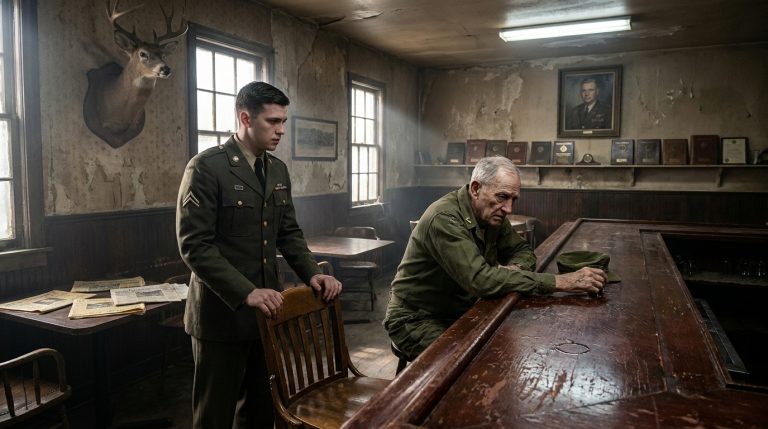
Earl Jessup sat on a stool that groaned under the slightest movement. His flannel shirt was washed thin, the fabric fraying at the collar where years of sunlight and cold air had worked their quiet destruction. In his hands, a ceramic mug of black coffee didn’t just sit; it trembled. It was a rhythmic, near-invisible oscillation—a steady, internal heartbeat that had nothing to do with the room’s atmosphere.
Mercer turned, his gaze sweeping the room like a searchlight before settling on the far corner. He’d noticed the old man before—every Friday for six weeks. The guy never drank, never complained, never cheered, and most offensively, never looked at Mercer with anything approaching awe.
“Hey,” Mercer called out, the word sharp enough to stop a conversation three tables away. He took a step toward the bar, his gait loose, predatory. “Pops. You ever serve, or do you just like the scenery?”
A few of the younger soldiers giggled, but the sound died quickly. The air in the room felt suddenly pressurized, as if the oxygen were being drawn out.
Earl didn’t turn. He didn’t even stiffen. He just took a slow, deliberate sip of his coffee. The heat rose in a faint plume of steam, dissolving into the dim, amber light of the hall.
“I served,” Earl said. His voice was a thin, brittle sound, the noise of dry leaves skittering across pavement.
“Yeah?” Mercer laughed, closing the distance until he was standing just over the man’s shoulder. “Which branch? What unit? Or were you just keeping the seats warm for the rest of us?”
Earl finally turned his head. His eyes weren’t the vibrant, searching blue of a young soldier; they were a dull, muted gray, like the color of a storm cloud viewed through a thick window. There was no anger in them, no defensiveness, just an ancient, bottomless calm.
“Army,” Earl replied, his voice barely rising above the hum of the cooling system. “A long time ago.”
Mercer grinned, leaning in. He noticed the way Earl’s hand gripped the mug—not tight, but with a strange, protective focus. “A long time ago. Right. Supply? Motorpool? I bet you were the guy who made sure the paperwork didn’t get wet.”
Earl didn’t blink. He reached into the breast pocket of his flannel shirt, his movements slow and fluid, and pulled out a small, circular piece of metal on a simple chain. He set it on the scarred surface of the bar. It didn’t clatter; it hit the wood with a dull, heavy thud that seemed to echo deep in the foundation of the building.
Mercer glanced down, expecting the standard, stamped steel of a dog tag. He looked closer, and the color began to drain from his face, a slow, unnatural receding of blood that left his skin the shade of wet ash.
It wasn’t a standard tag. There was no unit, no rank, no blood type. Just a string of characters that didn’t match any protocol Mercer had ever studied, and a suffix that appeared only in the most redacted, inaccessible depths of the national archives.
Mercer opened his mouth to speak, but the words felt suddenly heavy, impossible to form. He looked from the tag to Earl’s trembling hands, and for the first time in his life, he realized he wasn’t looking at a relic. He was looking at a ghost, and the ghost was looking right through him.
CHAPTER 2: The Weight of Steel
The VFW hall had not changed, but the reality inside it had inverted. The air, which moments ago felt like a stage for Mercer’s performance, now pressed against his lungs with the density of a deep-sea dive. He stared at the dog tag resting on the scarred wood of the bar. It was a miserable little thing—dull, unpolished, and scratched by decades of neglect—yet it possessed a gravity that seemed to pull the very light from the room toward it.
Mercer didn’t move. He couldn’t. His legs, trained to carry him through any obstacle, felt suddenly anchored to the worn carpet. He was a man who had spent his career believing that the uniform, the rank, and the stories defined the soldier. Now, looking at the faded identifier, that belief was being dismantled, piece by quiet piece.
Earl Jessup remained perfectly still. He was a man carved from shadow and time, his pale gray eyes fixed not on Mercer, but on a point somewhere beyond the back exit, toward a horizon that nobody else in the hall could see. The tremor in his hands, which Mercer had initially dismissed as the infirmity of age, now looked different—like the vibrating string of a piano that had been struck a long time ago and never quite stopped resonating.
“What is that?” Mercer whispered. The question was involuntary.
Earl didn’t answer. He simply reached out with his left hand, the movement slow and deliberate, and tapped the metal tag with a fingernail. The clink was soft, but it sliced through the room’s silence like a gunshot.
“It’s not what, son,” a voice broke the stillness. It was Bill Tagert, the retired command sergeant major. Mercer hadn’t noticed him approaching, but now he stood on the other side of the bar, his presence radiating an authority that made Mercer’s own posture seem like a fragile imitation. Tagert looked at the tag with an expression of profound, aching recognition. He didn’t pick it up. He wouldn’t touch it without permission.
“It’s a tether,” Tagert murmured, his eyes locking onto Mercer’s. “You’re looking at a spike team identifier from SOG. MACV-SOG. The kind of unit that didn’t exist until the papers were shredded.”
Mercer felt a sudden, sharp spike of vertigo. He thought of his own deployments—the satellite feeds, the support teams, the clear lines of command and the comforting certainty that if something went wrong, the entire weight of the American military machine would pivot to pull him out.
What was it like to be forgotten before you were even finished?
The thought was invasive, a psychological phantom that surged up from his own training. He saw the jungle in his mind’s eye—not the sanitized version he used for his bar stories, but a claustrophobic, suffocating green hell where silence was the only armor. He imagined being out there, five men deep, miles from the nearest extraction point, knowing that if they disappeared, the records would simply be erased, as if they had never been born.
The coldness of the realization seeped into his bones. He realized with a sickening jolt that he had spent six weeks trying to impress a man who had lived through a kind of war that made Mercer’s raids look like tactical exercises in a controlled arena.
“I…” Mercer tried to find his voice, but the swagger had been stripped away, leaving nothing but the raw, vulnerable nerves of a man who had just looked into a mirror and found it empty. He looked at the veterans scattered around the room. They weren’t looking at him with pity; they were looking at Earl with a mixture of reverence and grief.
“I didn’t know,” Mercer managed to say. It felt small. Inadequate.
Earl finally shifted his gaze, turning his head to look Mercer in the eye. There was no judgment there, which was almost worse. It was the detached observation of someone who had seen too much to be surprised by human vanity.
“You didn’t need to know,” Earl said, his voice as dry as dust. “You needed to listen.”
He reached out and retrieved the dog tag, pulling the chain back into the pocket of his flannel shirt. The movement was a quiet act of closing a door. The sanctuary of the VFW hall felt different now—less a place to trade stories, and more a quiet archive of things that could not be spoken.
Mercer felt the urge to apologize, to offer a gesture, to do something to balance the scales of the conversation, but he recognized the futility of it. Words were paper; what these men held in their silences was iron. He remained standing there, his hands hanging at his sides, feeling the immense, crushing weight of the gap between them. For the first time in his life, he didn’t want to talk. He didn’t want to explain his deployments or his training. He wanted to understand how to sit with the ghosts and not be haunted by them.
The jukebox in the corner, forgotten, reached the end of its track and fell silent. The resulting stillness was so heavy it felt like a physical burden. Mercer looked at the bar top, then back at Earl, wondering what it would take to earn the right to sit in the periphery of that silence.
CHAPTER 3: The Weight of Memory
Mercer didn’t move for a long time. The bar was no longer a place of noise and camaraderie, but a landscape of shifting tectonic plates. The younger soldiers who had been listening to his tales of tactical prowess had gradually drifted away, their interest withered by the sudden, gravity-heavy turn of the evening. They weren’t looking at Mercer anymore; they were looking at their own reflections in the dark wood of the bar, as if checking to see if they were still there.
Mercer finally pushed away from the bar. His movements felt sluggish, the effortless swagger replaced by a careful, measured deliberation. He walked to the end of the counter where Earl remained—a small, static point of equilibrium in the room’s chaotic readjustment. The air around the old man seemed to carry a different temperature, a residual chill from a place long gone.
“I’m staying,” Mercer said, his voice flat. It wasn’t a request for conversation. It was a declaration of presence.
Earl didn’t acknowledge him immediately. He lifted his mug, the ceramic clinking softly against his teeth. The tremor in his hand was quieter now, though it never fully vanished. He took a sip, then set the mug down, positioning it exactly in the center of a worn coaster.
“The coffee’s getting cold,” Earl remarked, his tone conversational, as if they were discussing the weather rather than the wreckage of Mercer’s ego.
Mercer pulled out the stool next to him. The metal legs scraped against the linoleum, a harsh, grating sound that made everyone in the vicinity flinch. He sat. He didn’t lean back; he leaned forward, his elbows on the bar, his eyes tracing the grain of the wood.
“I spent three years in the Horn,” Mercer said, the words slipping out before he could filter them. He stopped himself, catching the familiar scent of his own narcissism, and clamped his jaw shut. He looked at Earl, who was watching a moth circle the dim overhead light. “That’s not why I’m here. I mean, it is, but it’s not.”
“You want to know what it feels like,” Earl said. It wasn’t a question. It was a statement of fact, delivered with the casual indifference of a man who had seen a thousand young men arrive with the same hunger for understanding.
“I want to know how you do it,” Mercer corrected. “How you sit in a room like this, surrounded by people who have no idea, and just… exist. How do you keep the noise out?”
Earl chuckled, a dry, rasping sound that barely reached his eyes. “You think it’s about keeping the noise out, son? It’s not. It’s about learning how to listen to it without letting it take the wheel.”
He reached into his pocket again. Mercer flinched, expecting the dog tag, but Earl only produced a small, leather-bound notebook, its edges soft and rounded from years of handling. He laid it on the bar. It was nondescript—something you could buy at any stationer. But the way Earl rested his hand on it, shielding it, told Mercer everything he needed to know. It wasn’t a log of missions or a list of kills. It was an archive of people.
“I had a teammate,” Earl said, his voice dropping into a register that felt almost sacred. “His name was Miller. He was a radio man. Could fix anything with a piece of wire and a prayer. He used to carry a picture of his wife in his boot. Said it was the only thing that stayed dry in the monsoon.”
Mercer listened, his pulse slowing. He noticed the details: the fraying stitching on Earl’s sleeve, the way the light caught the dust motes dancing between them, the smell of damp earth and stale coffee.
“We didn’t get him out,” Earl continued. The sentence was delivered with a strange, hollow flatness, as if the pain had been smoothed away by the friction of forty years. “The unit didn’t exist, so there was no report. No body to send home. Just a silence where he used to be.”
Mercer stared at the notebook. He felt a sudden, sharp ache in his chest—a sympathetic resonance that had nothing to do with training or combat. It was the crushing weight of witnessing a history that had been deliberately erased. He looked around the VFW hall, really looked at it, for the first time. The unit patches, the framed photos of men who had aged into ghosts—it wasn’t just a place for cheap drinks. It was a tomb, a living monument to the people the world had decided were better off forgotten.
“Why tell me?” Mercer asked.
Earl looked at him, and for a fleeting second, the gray in his eyes seemed to fracture, revealing something bright and terrifyingly alive beneath. “Because you were loud enough to be heard, and now you’re quiet enough to understand. Maybe you can carry some of it. Not the pain—that’s mine. But the memory. Someone has to remember the radio men.”
Mercer looked at his own hands, his strong, calloused hands that had been so eager to perform, to demonstrate, to be seen. He felt a profound sense of obsolescence. He realized that the “Brotherhood” he had been bragging about was a pale, flickering shadow compared to the bond Earl carried in his silence.
The room seemed to shrink, the walls closing in until there was nothing but the bar, the mug of cold coffee, and the small, leather-bound notebook. Mercer didn’t speak. He didn’t try to fill the space with stories of his own. He sat there, breathing in the quiet, learning for the first time what it meant to be present in a room full of things that could never be repaired.
He wasn’t sure how long they sat. Time felt warped, expanded by the gravity of Earl’s words. Eventually, the bartender—Hank, the retired Marine—walked by and wordlessly refilled both their mugs. The steam rose in the cool air, a brief, ephemeral ghost that dissolved before it could reach the ceiling.
Mercer didn’t look at the other soldiers. He didn’t care about their gaze. He kept his eyes on the notebook, the physical embodiment of a truth that no official report would ever recognize. He understood now that he hadn’t just been humbled; he had been initiated.
“What was his name?” Mercer finally asked, his voice barely a whisper. “Miller?”
Earl nodded, a slow, stiff motion.
“Miller,” Mercer repeated, tasting the name, letting it settle into the air between them, a small act of restoration.
Earl’s hand tightened on the notebook, then relaxed. It was the closest he would ever come to an embrace. For the rest of the evening, they didn’t talk about the jungle. They talked about the rail line in the history book, the way the steel had been laid across the continent, and the slow, inexorable endurance of things that were built to last.
CHAPTER 4: The Fragile Architecture of History
The transition from the bar’s quiet sanctity to the harsh, fluorescent reality of the VFW archives was a jolt that left Mercer disoriented. Hank, the bartender, had eventually relented, producing a ring of heavy, tarnished keys that opened the door to the “Back Room”—a narrow, windowless closet behind the pool table where the unit’s operational records and historical ephemera were interred in rusting filing cabinets.
Mercer stood in the doorway, his shoulders brushing the frame, the air inside thick with the scent of settling dust and disintegrating paper. He had expected something heroic—a vault of classified secrets, perhaps, or a wall of medals. Instead, he found only the mundane debris of service: broken staplers, stacks of outdated administrative forms, and boxes overflowing with faded photographs that were slowly losing their faces to the relentless humidity of the North Carolina summers.
He had come here looking for a deeper connection to Earl, a way to validate the ghost he had seen at the bar. He had intended to research the unit, to find a trail that led back to Miller, to solidify the fragile bridge he had started to build.
“It’s not all here,” Hank said from behind him, his voice echoing in the tight space. “Most of it never made it into the filing system. The guys who ran those teams… they were taught to leave no paper trail. If they were captured, the paperwork was the first thing that got you killed.”
Mercer ran his fingers along the rim of a cabinet. The metal was cold, biting into his skin. He felt a sudden, sharp frustration—a spike of the old arrogance, the need to know, to catalog, to control the narrative. He wanted a record. He wanted a document that proved Miller existed. He wanted to feel like he was doing something, not just sitting and listening.
As he pulled open the drawer, the friction was audible—a screech of rusted metal that set his teeth on edge. Inside were dozens of manila folders, their edges frayed, their contents an incomprehensible jumble of receipts, duty rosters, and handwritten letters.
He picked up a folder at random. It contained a list of logistical requisitions from 1968—batteries, specialized radio components, boots. He scanned the dates, the locations, the mundane details of a war that had been fought in the shadows. And there, tucked between a shipping manifest and a request for specialized climbing rope, he found a scrap of paper. It wasn’t an official form. It was a note, written in a hand that was shaky, hurried, but unmistakably familiar.
Miller. Missing. Location confirmed. No extraction authorized. Proceed with mission.
The words weren’t a revelation; they were a death sentence, written in ballpoint pen and filed away in a cabinet that nobody had opened in thirty years. The cold realization hit Mercer harder than any physical blow. This wasn’t a mystery waiting to be solved. This was a tragedy that had been filed away and forgotten by the very machine he had spent his life worshiping.
He felt the structural integrity of his world shift. He had been looking for a heroic narrative, a secret history that would allow him to feel part of a noble tradition. Instead, he found the indifference of the system—the cold, bureaucratic reality that Miller wasn’t a soldier to be saved; he was a variable that had been subtracted to protect a mission profile.
The realization sent a wave of nausea through him. He looked at the file, then at the rusting walls of the archive. The “Brotherhood” he had once boasted about, the grand idea of the Special Forces as a unified, impenetrable wall of valor—it felt suddenly hollow, a fragile shell constructed over a void of systemic betrayal.
He gripped the cabinet handle, his knuckles white. The urgency to act—to call the base, to demand answers, to shake the foundation of the local command—surged within him. But then he remembered Earl. He remembered the tremor in those hands, the way Earl sat in the bar, and the quiet, crushing weight of the notebook he held like a reliquary. Earl knew. He had lived with this piece of paper—or one just like it—for decades.
The weight of the secret wasn’t just in the loss of Miller. It was in the burden of having to carry that loss alone, without the support of the very organization that had demanded the sacrifice.
Mercer closed the cabinet. He didn’t take the file. To take it would be to claim it, to make it part of his own history, and he wasn’t worthy of that. He turned to Hank, who was watching him with a tired, knowing expression.
“Does he know?” Mercer asked, his voice barely audible.
“Earl?” Hank shook his head. “He knows what he lived. He doesn’t need the file to remember the silence.”
Mercer walked out of the back room, the cool air of the hall feeling thin and insufficient. The dynamic had changed. He wasn’t just a visitor to Earl’s world anymore; he was a participant in the failure. The mission to understand the hero had become a mission to understand the survivor, and the shift was leaving him breathless, his own identity as a soldier fraying at the edges.
CHAPTER 5: The Unmaking of Silence
The hallway outside the archives was cool, smelling of floor wax and old wood, but to Mercer, it felt stifling. He stepped out, his boots clicking with a rhythmic, measured cadence that seemed too loud for the somber atmosphere of the post. The hall was sparsely populated—a few older regulars nursing beers at the bar, the jukebox silent, a low hum of conversation emanating from the far corner.
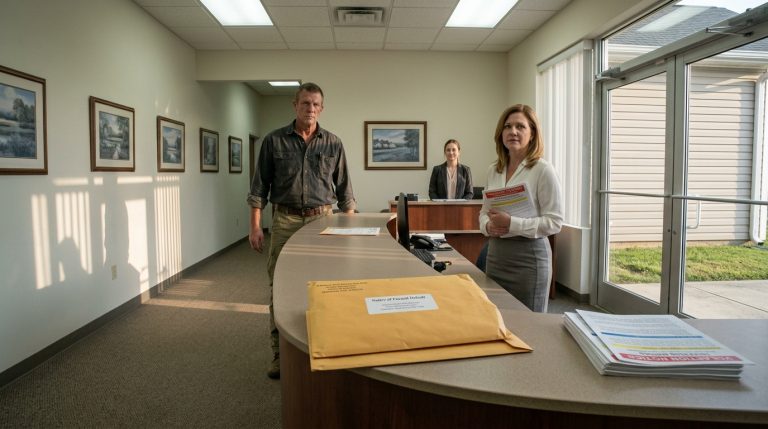
Earl was sitting where he always sat, but the environment had shifted around him. On the bar in front of him lay a thick, cream-colored envelope, its edges sharp and formal against the scarred wood. It looked like a piece of foreign debris dropped into an ecosystem that didn’t know how to process it.
Mercer approached slowly, his eyes fixed on the stationery. The official seal of the Department of the Army was embossed in the top left corner—a stark, authoritative emblem that felt like an intrusion.
“They sent a courier,” Earl said, his voice quiet. He didn’t look up as Mercer took his usual seat. “Formal invitation. Fort Liberty. A ceremony.”
Mercer reached out, his hand hovering over the envelope. He didn’t touch it. He looked at Earl, noting the subtle tightening at the corners of the old man’s mouth—a fracture in his usual, granite-like composure.
“They’re finally doing it,” Mercer said, the words feeling dry in his throat. “The recognition. The citation.”
“It’s a box to check,” Earl replied, his gaze drifting to the window, where the sun was beginning to dip, casting long, bruised shadows across the parking lot. “A way to put a period at the end of a sentence they wrote forty years ago.”
Mercer felt a surge of anger—not at Earl, but at the abstraction of the institution that had sent this paper. He thought of the file in the archive, the casual, bureaucratic disposal of a human life, and now this, a polished, public display of gratitude. It was the same machine, just operating at a different frequency.
“You don’t have to go,” Mercer said.
“If I don’t go, the name stays in the cabinet,” Earl said, turning to look at him. His eyes were clear, the grayness replaced by a sharp, piercing intensity that pinned Mercer to his stool. “Miller’s name. And the others. They want to give me a medal? Fine. I’ll take it. But I’m not taking it for me.”
Mercer realized then that the “decoy” of the recognition—the medal, the ceremony, the public praise—was exactly that: a decoy. It was a societal requirement, a performance of justice that didn’t actually heal the wound. But for Earl, the ceremony was a weapon. It was an opportunity to force the light into the dark places, to make the institution acknowledge what it had spent decades denying.
“I’ll go with you,” Mercer said. It wasn’t a choice; it was a commitment. He understood now that he was part of the history, whether he wanted to be or not.
“You’ll wear your uniform,” Earl said. It was an order, not a request. “You’ll look like the man you’re supposed to be.”
Mercer looked at the envelope again, then back at Earl’s trembling hands. He realized he was seeing the arc of his own life unfolding in real-time. He had entered this building as a man who valued the appearance of the soldier—the beret, the swagger, the story. He would leave it, for the ceremony, as a man who understood the cost of the service.
The tension in the room wasn’t just anticipation; it was the final, agonizing stretch of a secret being prepared for the light. Mercer felt an overwhelming sense of vertigo. Everything was accelerating toward a conclusion he couldn’t stop and didn’t fully understand. The “code” he had bragged about, the brotherhood he had claimed—it all felt like a preliminary exercise for this moment of absolute, devastating clarity.
“What if they don’t want to hear it?” Mercer asked.
“They don’t have to hear it,” Earl said, his voice a low, steady rumble. “They just have to stand there and listen while the names are spoken. That’s enough.”
Mercer stood up, his movements stiff. He needed to get his uniform ready. He needed to ensure his medals were polished, his posture perfect, his presence an undeniable assertion of the reality they were about to force upon the public record. He looked at Earl, who had turned back to his cold coffee, his eyes once again fixed on that distant, phantom horizon.
The silence that followed was different from the ones they had shared before. It was a heavy, expectant void. The VFW hall, once a refuge from the world, now felt like the threshold of a battlefield. Mercer knew that when he walked out of this building to go to the ceremony, he would never be the man who walked in. He would be carrying more than just a story; he would be carrying the weight of a ghost who had finally been granted the right to a name.
CHAPTER 6: The Echo of Honor
The parade ground at Fort Liberty was a vast, geometric expanse of manicured grass, unnervingly green under the midday sun. Lines of soldiers stood in perfect formation, their uniforms a sharp contrast to the civilian clothes of the few veterans gathered in the seating area. Mercer wore his dress uniform, every brass button polished to a mirror finish, but he felt an odd detachment, as if he were wearing the skin of a younger, more naïve version of himself. Beside him, Earl walked with a slow, steady gait, his flannel shirt replaced by a simple, clean jacket that lacked the weight of medals or rank.
The ceremony was a blur of protocol. A brigadier general spoke at the podium, his voice projected across the field by speakers that seemed to turn his words into empty, formal abstractions. He talked about “valor in the shadows,” “the spirit of service,” and “the enduring legacy of the American soldier.” Mercer stood at attention, his eyes fixed forward, but his mind was on the man beside him. Earl stood with his hands loosely at his sides, his shoulders slightly hunched, as if he were trying to minimize his own presence.
When the general called Earl’s name, the sound of it seemed to ripple across the field. Earl stepped forward, his feet finding purchase on the crisp grass. The general presented him with a framed unit citation and a personal letter. The metal of the frame caught the sunlight, a bright, searing reflection that momentarily blinded Mercer.
Earl took the frame. He didn’t smile, and he didn’t bow. He held it for a moment, then turned to face the audience—the rows of active-duty soldiers, the brass, the cameras, and the small, quiet group of survivors.
“The men who deserved this,” Earl said, his voice amplified by the microphone, steady and resonant, carrying across the silent field, “are not here to receive it. I’m just holding it for them.”
He stepped back. The applause was polite, restrained, and ultimately distant. It was the sound of an organization honoring its own past, but it didn’t reach the center of the thing. It was a formal acknowledgment of a reality the government had spent decades denying, and the disconnect was palpable.
After the ceremony, the crowd began to disperse, the precision of the formation dissolving into the messy, human chaos of departure. Mercer walked with Earl toward the parking lot, the weight of the frame cradled in the old man’s arms.
“Is it enough?” Mercer asked.
Earl stopped. He looked at the frame, his fingers tracing the edge of the glass. “It’s a piece of paper, Mercer. It doesn’t change what happened in the jungle. It doesn’t bring back the radio man.”
“Then why did you come?”
“Because you were here,” Earl said, turning to look at him. There was a faint, weary smile on his face. “Because you needed to see that the machine eventually remembers, even if it does it for the wrong reasons.”
Mercer looked at his own hands, then reached out, taking the frame from Earl. He carried it with a new, quiet reverence. He walked Earl to his battered truck, the old vehicle an anchor of rusted pragmatism in the sea of modern, sleek cars. As Earl climbed into the driver’s seat, the engine sputtered, then caught—a familiar, grounding sound.
“You’re going to be okay?” Mercer asked, a rare, unguarded note of concern slipping into his voice.
“I’ve always been okay,” Earl replied. “I just forgot that it helps to share the silence sometimes.”
He put the truck in gear and pulled away, the engine note fading until it was lost in the ambient hum of the base. Mercer stood in the parking lot for a long time. He felt a profound, settling peace—the kind that only comes when a long-standing, jagged tension finally snaps into alignment. He had walked into the VFW hall as a man who needed to announce his own existence, and he had come out as someone who finally understood that the most important parts of a life are the ones that never make it into a report.
He walked back to his own car, his posture relaxed, his stride unhurried. He passed a young soldier, barely twenty, who gave him a casual, respectful nod. Mercer returned it—a small, silent acknowledgment between two men, separated by a generation, but bound by a shared, unspoken reality.
He thought of Miller, the radio man, and the names in the notebook. He realized that the memory wasn’t a burden to be carried in isolation; it was a testament. And as he drove back toward the city, the afternoon light filtering through the trees in long, golden shafts, he felt the heavy, suffocating weight of his own ego dissolve, leaving behind only the quiet, steady resolve of a man who was finally, truly awake.
The VFW hall would still be there on Friday. The coffee would still be black. And for the first time, Mercer knew exactly why he would be there. Not to tell his own stories, but to listen to the ones that never needed to be spoken to be real. The ghosts were no longer something he feared or envied; they were the foundation of everything that truly mattered, and he finally had the strength to stand in their shadow without needing to cast one of his own.