The Price of Blood and Brass: Why the Daughter Who Survived Alone Refused to Pay the Final Debt
CHAPTER 1: THE COLD RINGING LINE
The screen flashed with a single, sharp word.
Dad.
I stood motionless, the wooden spatula half-raised in my right hand, watching the blue light pulse against the dark grain of the quartz countertop.
My first instinct was to flip the phone face down, let the automated silence swallow the ring, and turn my attention back to the browning edges of the fish.
Two years of quiet mornings in Beacon Hill, two years of building a life where my phone only chimed for work, for Harper, or for the quiet hum of routine.
The phone vibrated again, a dull, insistent buzz against the stone.
Curiosity is a sharp, jagged thing, especially when you think you’ve buried it deep enough that it can no longer draw blood.
I wiped my hand on a kitchen towel, picked up the device, and pressed accept before my better judgment could stage an intervention.
Hello, Camille.
His voice wasn’t booming.
It wasn’t coated in that steady, immovable gravel that used to make everyone in the room stop breathing and wait for his ruling.
It was thin, papery, and unmistakably fragile.
I need to see you.
The words hung in the empty space of my kitchen, stripped of any preamble, any polite inquiry into whether I was alive, whole, or breathing.
What’s going on, Dad?
I kept my voice level, anchoring my weight evenly across both heels the way I learned to do during those long, grueling months in the infusion center.
A long, heavy pause hummed through the receiver, filled only by the muffled rustle of background noise and a woman’s voice asking a question in the distance.
I’ve been diagnosed with something.
Another sharp intake of breath on his end, a hesitation I had never heard in sixty-two years of his life.
Parkinson’s disease. Early stage, they say, but—
He trailed off, leaving the sentence dangling like a frayed wire.
I stood entirely still in the warm glow of the overhead lights, watching the thin curl of smoke rise from the pan where the butter was beginning to brown too fast.
I need my family around me right now.
He finally forced the words out, tight and compressed with an underlying panic he was failing to conceal.
There’s a dinner Sunday at the house. Your mother, Derek, and Megan. I want you there. We need to discuss the future.
The future.
The irony tasted like cold ash at the back of my throat.
Okay, I heard myself say, the word slipping out of my mouth before my analytical mind could reject it.
I’ll be there.
CHAPTER 2: THRESHOLD OF GLASS
The sedan door clicked shut with a hollow, muffled thud that felt entirely too quiet for a Sunday evening.
I stood at the base of the brick pathway leading to the white colonial, my fingers hooked firmly over the leather strap of my purse.
The porch light cast a pale, jaundiced glow over the manicured lawn, illuminating blades of grass that stood at uniform height like an army of plastic green pins.
Nothing had changed in two years, and that changelessness felt less like nostalgia and more like a threat.
The brass knocker on the front door caught the streetlamp’s reflection as I approached, polished to a blind, mirror-like finish that mirrored nobody.
I didn’t wait for a second knock; the heavy oak yielded before my knuckles could strike the metal twice.
Camille.
My mother pulled me forward into the threshold with a sudden, urgent tug that smelled overwhelmingly of Chanel Number Five.
Her embrace was stiff, her shoulder blades sharp beneath the champagne silk of her blouse as she pressed her cheek against mine for half a second too long.
You look wonderful, she whispered, her hands lingering on my forearms before sliding down to check the drape of my clothes.
She wasn’t looking at my face; she was scanning my silhouette for flaws, for signs of the exhaustion she expected the last two years to have carved into me.
I stepped past her into the front hall, my heels clicking sharply against the hardwood floor.
The crystal chandelier overhead threw fragmented prismatic rainbows across the wallpaper, casting light over the chronologically frozen family photos lining the corridor.
My mother’s heels clicked in a rapid, anxious rhythm behind me as she trailed toward the dining room.
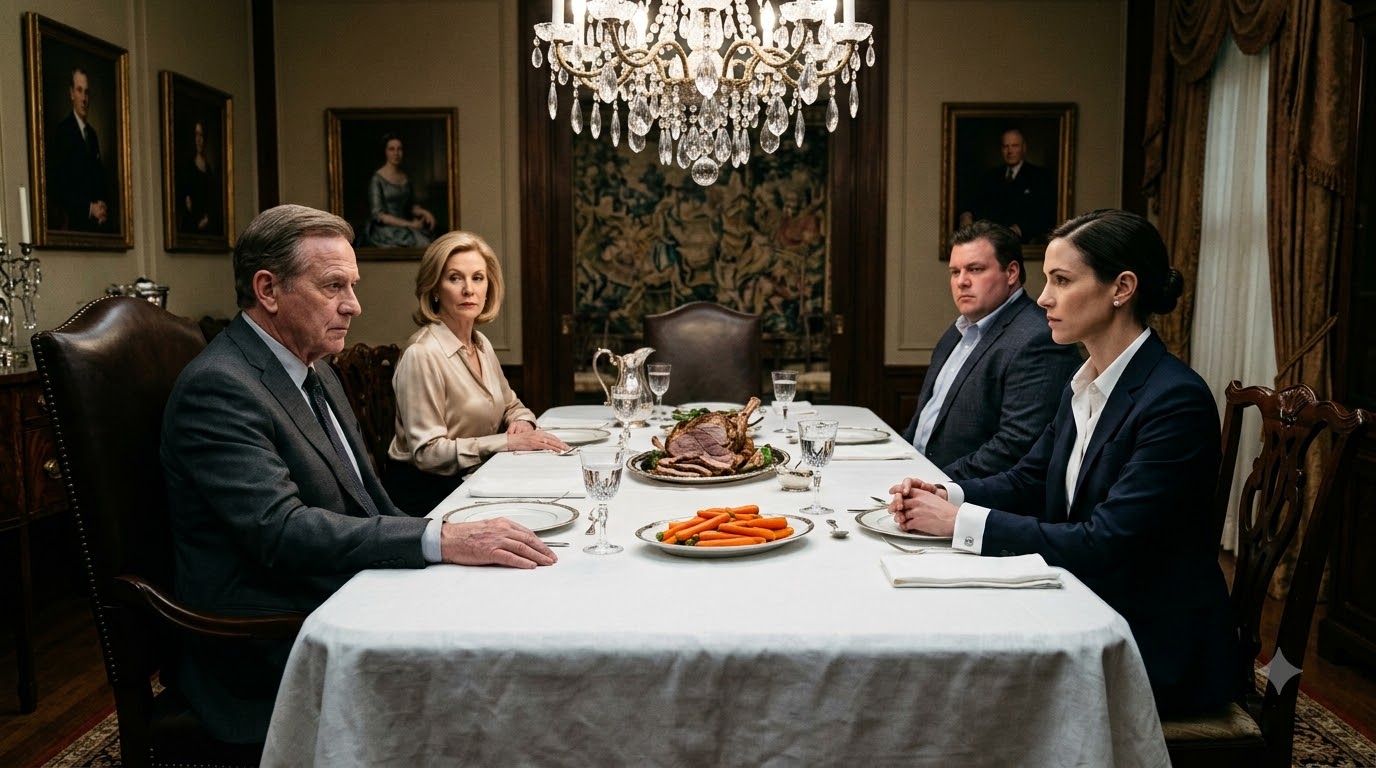
Derek stood beside the mahogany table, his bulky shoulders straining slightly against the fabric of a blazer that cost more than my first monthly rent check in Somerville.
He didn’t walk toward me, merely raised a hand in a loose, half-hearted greeting while his eyes darted nervously toward the head of the table.
Megan sat near the foot of the table, her hand resting flat against the distended curve of her five-month pregnancy.
She didn’t smile, her gaze locked onto the silver-plated water pitcher with an intensity that suggested she wished it would swallow her whole.
And then I saw him.
Richard Atwood sat in the high-backed leather chair where he had arbitrated family law for three decades.
He looked smaller, his shoulders pinched inward as if the heavy wool of his suit was suddenly too large for his frame.
His left hand rested palm-down on the white linen tablecloth, fingers rhythmically twitching against the fabric in a small, involuntary dance that he tried to conceal by pressing his thumb down hard.
Sit down, Camille.
His voice didn’t rattle the glass anymore, but the underlying demand for absolute submission remained etched into every syllable.
CHAPTER 3: THE MAHOGANY JUDGMENT
The white linen tablecloth stretched out before me like an unwritten contract, spotless and completely devoid of any real warmth.
My mother set the silver-plated water pitcher down with a faint clink, her eyes avoiding mine as she slid into the chair beside my father.
We have a lot to discuss, Richard stated, his voice carrying the dry, unyielding authority of a man accustomed to presiding over closed courtrooms.
He didn’t waste time on pleasantries, nor did he ask about my health, my career, or the two years of silence that had stretched between us like a physical chasm.
The roast lamb sat carved on the silver platter at the center of the table, surrounded by glazed carrots that caught the harsh glare of the crystal chandelier.
Derek cleared his throat, leaning forward with the easy, unearned confidence of someone who had never had to look at a medical bill and calculate whether he could afford groceries.
It makes sense, Cam, you know it does, Derek began, waving his fork toward my father with casual dismissal.
Dad needs looking after now, and you’re already set up for remote work over there in your apartment.
Megan remained completely silent at the end of the table, her hand resting heavily on her five-month baby bump as she stared down into her empty water glass.
She didn’t nod, and she didn’t echo Derek’s smooth rationalization; she simply watched the candlelight flicker across the silver rim of her goblet.
You’re the obvious choice, Camille, my mother chimed in, her tone dripping with that practiced, suffocating sweetness meant to disguise a direct command.
You don’t have a family tying you down, no husband to consider, no children depending on your time.
I kept my fingers laced together on top of the napkin, feeling the steady, calm rhythm of my own pulse against my wrists.
Obvious choice, I repeated softly, letting the phrase hang in the stagnant air between the water crystal and the floral centerpieces.
Yes, exactly, Richard nodded, his left hand twitching uncontrollably against his trouser leg before he forced it back onto the wood.
Your old room is already cleared out; your mother packed up your college boxes last week.
CHAPTER 4: THE UNWRITTEN LEDGER
The polished wood bit into my palms, grounding every ounce of steady fury I had carried across the bridge from Boston.
Before I answer, I want to ask you something, Dad.
Richard’s eyebrows twitched upward, a flicker of genuine shock crossing features that had never once expected a challenge from this side of the room.
People didn’t question his decrees; they adjusted their lives to fit them.
When was the last time you asked how I was doing?
The question dropped into the quiet room, sharp and unyielding, cutting straight through the hum of the refrigerator in the pantry.
What are you talking about? Richard scoffed, leaning back as his left hand resumed its erratic drumbeat against the armrest.
You’re here, we’re talking about the future.
When was the last time? I repeated, my voice dropping an octave, steady as stone.
You say I have a responsibility to this family, but when I was sick—really sick, fighting for my life—where was this family?
My mother’s face drained of color, her fingers tightening around her water goblet until her knuckles turned chalk-white.
Camille, that’s not—she started, her voice pitching upward in practiced distress.
No, I want an answer, I cut her off, keeping my eyes fixed on the man at the head of the table.
Dad, do you even know if I’m still in remission? Do you know what my last scan showed? Do you know anything about my health at all?
A heavy, suffocating stillness filled the space between us, broken only by the faint, rhythmic ticking of the grandfather clock in the hall.
My father’s mouth parted slightly, his jaw tightening as he struggled to find an answer that wasn’t rotting beneath the surface.
You said you had a doctor’s appointment, he muttered, his voice losing its iron coating.
I had stage three cancer, I said, letting the words fall one by one like lead shot.
I went through six months of chemotherapy. I lost every strand of hair on my head. I spent forty-seven thousand dollars out of pocket because you told me you couldn’t help.
Derek slammed his palm against the table, the silverware rattling violently against the porcelain plates.
Enough, Cam! You’re bringing up ancient history just to guilt us!
Ancient history? I turned my gaze slowly toward my brother, watching the flush spread up his neck.
Four months before your eighty-thousand-dollar wedding, Derek. While I was vomiting blood on a bathroom floor, you were picking out centerpieces.
CHAPTER 5: THE CRACKING VENEER
The absolute silence of the dining room felt heavy enough to crush bone, broken only by the erratic tapping of my father’s left hand against the polished wood.
Richard’s face drained of color, his chin trembling as he tried to summon a command that no longer obeyed him.
I’m sick, Camille, he choked out, his voice cracking with an ugly, unmasked terror.
I’m scared of what’s coming—you have to understand.
Understand what, Dad? I kept my tone completely level, refusing to let the sudden surge of raw grief sway my footing.
That you only call when you need someone to carry the weight you refuse to touch?
My mother broke down entirely, her hands covering her face as silent tears tracked dark lines through her imported cosmetics.
Please, Camille, she wept, her shoulders heaving beneath the champagne silk.
We didn’t know it was that bad—we were just overwhelmed with the wedding!
Derek dropped his gaze to his untouched plate, his jaw working tightly as he realized his own comfortable life was about to absorb the shockwave.
Megan shifted in her seat, her hand pressing firmly against her belly as she looked at her husband with cold, unsparing disappointment.
Richard slammed his palm against the table, a pathetic, weak blow that only exposed the sheer desperation rattling his frame.
You’re my daughter! You owe this house your loyalty!
Loyalty isn’t a debt you collect after spending two years pretending I didn’t exist, I answered, turning toward the doorway.
CHAPTER 6: THE FOUR WORDS
Please, Camille, don’t do this—we’re your family!
My mother’s voice chased me down the manicured brick pathway, high and frantic, cracking against the silent October night.
I didn’t stop my stride.
My heels struck the concrete with a clean, rhythmic cadence, each step carrying me further away from the glittering crystal chandelier and the suffocating perfection of a home built on conditional love.
Camille, wait! Derek shouted from the open doorway, his voice thick with a sudden, panicked realization of what my departure meant for his own unburdened life.
I reached my car, unlocked the door with a sharp click of the fob, and slid into the driver’s seat without looking back.
My father stood in the amber glow of the porch light, supported by Derek’s arm, his left hand trembling violently against his wool trousers as he stared across the roof of my car.
Camille—please!
His voice broke, stripped of every ounce of authority he had wielded like a hammer for thirty years.
I’m scared! I need you! You’re my daughter!
I rolled the window down just two inches, the cool night air cutting sharply between us like an unyielding blade.
I hear you, Dad, I said, keeping my voice steady, clear, and utterly devoid of malice.
I understand that you’re scared, but there’s something I need you to hear.
He stopped, his tear-streaked face lifting in desperate anticipation of a reprieve.
Two years ago, I called you crying, I continued, resting my hands lightly on the steering wheel.
I told you I had stage three cancer, and you said, “We can’t deal with this right now.”
A suffocating quiet fell over the driveway, broken only by the hum of the engine idling beneath my feet.
So here’s my answer, Dad—I can’t deal with this right now.
Four words.
The exact same words he had thrown at my survival two years ago, handed back with the quiet finality of a closed ledger.
I pressed the window switch, watched the glass rise to seal out their pleas, and shifted the car into drive.
I pulled out of the immaculate driveway, leaving the white colonial and its ghosts behind in the rearview mirror.
Back in Beacon Hill, the apartment was warm, smelling faintly of brewed coffee and the damp soil of the monstera plant resting peacefully on the windowsill.
I hung my navy cashmere scarf over the wooden peg by the door, unzipped my boots, and walked over to the kitchen counter.
There were no screenshots to review, no visitor logs to cross-reference, and no desperate texts waiting on my phone screen.
Just an empty slate, a quiet room, and the steady, unbreakable rhythm of a life I had built entirely with my own hands.
I filled the kettle, struck a match under the burner, and stood watching the blue flame dance against the metal—completely free.