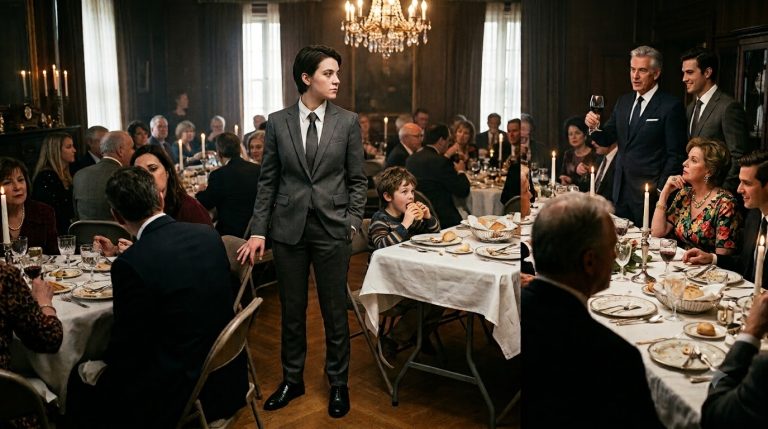
The Legacy of the Hawthorne House: How a Quiet Daughter Reclaimed Her Inheritance Through Cold Facts and Unyielding Resolve
CHAPTER 1: THE MIDNIGHT EXIT
The air in my childhood bedroom smelled of old cedar and dust that had settled decades before I was born.
I didn’t turn on the overhead light.
I moved by the faint amber glow of the streetlamp outside filtering through the curling edges of my old Frank Lloyd Wright poster.
My fingers brushed the empty nightstand drawer where the cream-colored envelope had rested just hours before.
I tucked the manila folder securely into the bottom of my canvas tote bag alongside my passport and spare socks.
From downstairs, the heavy silence of the Brennan house felt suffocating, weighed down by thirty years of unearned authority and quiet misery.
I slipped out of the room in my stocking feet, stepping over the threshold where my father had stood while he humiliated me in front of thirty relatives.
My pulse was steady, cold, and rhythmic.
I descended the staircase without touching the banister, keeping my weight distributed evenly against the outer edge of the treads where the wood stayed quiet.
In the dark foyer, the grandfather clock ticked with agonizing slowness, measuring out the remaining minutes of my old life.
I turned the brass deadbolt with microscopic precision, letting the mechanism slide home without a metallic snap.
The front door opened into the damp November chill of Hawthorne Street, where the wet asphalt gleamed black under the gray dawn.
I closed the door behind me, sealing the lock with a single decisive click.
My 2014 Honda Civic idled three blocks away, its engine shivering against the cold air as I settled into the driver’s seat.
I tossed my tote bag onto the passenger side, checked the clasp of the manila folder, and reached for my phone.
The screen lit up with a single unread text from my brother Garrett asking if I was ready to apologize.
I thumbed the screen off, dropped the phone into the center console, and dialed Harold Caldwell’s private office line.
The phone rang twice before his measured, gravelly voice answered in the darkness.
“Mr. Caldwell,” I said, keeping my tone flat against the rising tide of adrenaline. “Bring the originals to the house at eight o’clock sharp.”
“I’ll be there,” Caldwell replied without a fraction of hesitation.
I ended the call, shifted into drive, and pulled away from the curb without looking back in the rearview mirror.
CHAPTER 2: THE EMPTY DOORWAY
The diner window was smeared with grease and rain, distorting the neon sign across the empty asphalt.
I didn’t order food.
I just stared at the chipped laminate of the booth table, listening to the hum of the refrigerator motor in the back.
My phone sat face down beside a paper cup of lukewarm black coffee.
At precisely 7:42 a.m., the screen flashed bright against the dark vinyl seat.
A text message from Garrett lit up the display.
—Where are you? Dad’s looking for you.
I left the message unread, picked up the phone, and slipped it into my coat pocket.
Back at the Brennan house, the morning routine was ticking forward with absolute, arrogant precision.
Richard Brennan pushed open the heavy oak door of his study, his Oxford shirt crisp and his silver hair combed flat.
He didn’t knock on my door with hesitation; he delivered his signature judicial rap—two sharp, authoritative strikes against the hollow panel.
—Tori, it’s morning. You ready to apologize to your brother?
Silence answered him from the empty room.
He twisted the brass handle and stepped across the threshold, expecting to find me sitting on the edge of the twin bed in disgrace.
Instead, his eyes swept over a stripped mattress, an empty closet, and bare wooden drawers.
The only object left behind was the framed photograph of Grandma Eleanor resting face down on the nightstand.
His jaw tightened, the blood draining from his temples as he realized he had been outmaneuvered in his own domain.
CHAPTER 3: THE ARRIVAL OF HAROLD CALDWELL
The morning air outside the Brennan house was sharp and biting, carrying the distinct scent of wet oak leaves and exhaust fumes.
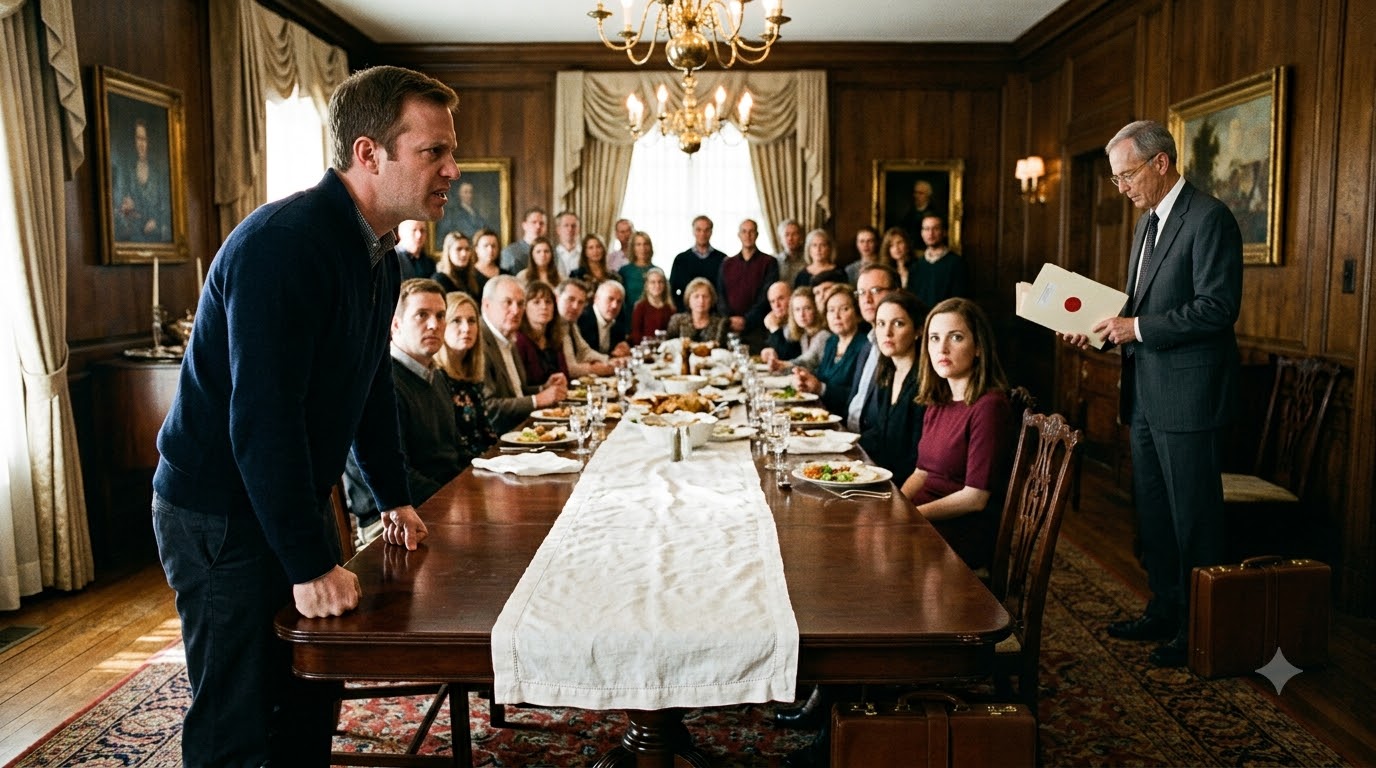
Thirty relatives sat frozen in the dining room and living room, their holiday chatter grinding to a halt as the stranger in the gray suit crossed the threshold.
Richard Brennan stood up from the head of the table, his 6-foot-1 frame towering over the hallway entrance as his face darkened into a barrier of absolute resistance.
—Harold, what are you doing here? This is a private family residence.
Caldwell did not blink behind his wire-rimmed gold frames.
He unclasped his brown leather briefcase right on top of the Thanksgiving linen runner without being invited to sit.
—This is the home that Eleanor Brennan purchased with her family’s money, Mr. Brennan, and I am here because I hold a legal fiduciary duty to her true beneficiary.
Richard’s knuckles whitened against the edge of the mahogany surface as he tried to stare down the older attorney.
—Tori has no rights to anything, and you are trespassing.
Caldwell reached inside the open briefcase and extracted a thick cream-colored folder bound with a red notary seal.
—I have the original trust documents right here, executed twenty years ago and updated eight years before her passing.
The silence in the room grew so absolute that the distant hum of the kitchen refrigerator sounded like a low engine.
Richard’s jaw locked as he looked at the red seal, realizing his authority was slipping away into the quiet winter light.
CHAPTER 4: THE COLLAPSING ALLIANCE
The silence in the dining room became a physical weight, pressing down on the thirty relatives who had gathered for what they thought was a routine family holiday.
Harold Caldwell did not raise his voice.
He simply slid a printed packet across the polished oak surface, exposing the email chain between father and son.
—You drafted the petition to alter an irrevocable trust, didn’t you, Garrett?
The younger lawyer stared at the paper, his practiced courtroom smirk evaporating into an open-mouthed stare of absolute disbelief.
—Mr. Caldwell, I suggest we discuss this in private legal channels— Garrett stammered, his fingers twitching over the edge of the table.
—There are no private channels left when you commit fraud against an estate, Caldwell replied, his tone as sharp as a scalpel.
Garrett’s head snapped toward the head of the table, his eyes darting frantically to his father for the guidance he always relied upon.
—Dad, tell him we need to handle this offline—
Richard Brennan sat frozen in his chair, his jaw set in stubborn denial as the foundation beneath his thirty-year dominion finally cracked.
CHAPTER 5: THE READING OF THE TRUE WILL
The crystal chandelier threw fractured rainbows across the ceiling, catching the sharp angles of my father’s hardened face.
He pointed a shaking finger toward the doorway, his judicial baritone fracturing under the sudden weight of exposure.
—Get out of my house, Tori. You have no business here.
I walked past him without breaking stride, my boots clicking against the hardwood floor until I reached the mantlepiece.
—I am not leaving, and this is not your house, I said, setting the thick dossier down on the wood.
Harold Caldwell stepped up beside me, opening his leather briefcase to reveal the red notary seal of the State of Oregon.
—The irrevocable trust names Victoria Brennan as sole beneficiary, and the deed to this property transfers directly to her upon the settler’s passing.
A collective gasp rippled through the crowded room as Aunt Margaret leaned forward to inspect the cream-colored pages.
Richard’s face drained of color entirely, his gaze darting frantically around the room as his assembled audience realized they had been lied to for decades.
—She was confused! he shouted, slamming his hand down on the edge of the table.
Caldwell slid Dr. Margolus’s cognitive evaluation across the surface, proving my grandmother had scored in the ninety-third percentile when she signed.
Garrett slumped back on the sofa, his laptop sliding unheeded onto the cushion as his professional facade completely disintegrated.
CHAPTER 6: THE NEW FOUNDATION
The house was silent in a way it had never been during my father’s decades of absolute rule.
I walked through the empty rooms, tracing my fingers along the polished edge of the oak dining table where the port wine glass had shattered.
Outside, the hundred-year-old oak trees stood stark against the gray Portland sky, their branches framing the overgrown peony beds in the yard.
My phone rested silently on the counter, displaying a single text message from my mother and a quiet acknowledgment from my brother.
Richard Brennan had retreated across town to a rented apartment, leaving behind a legacy built on unearned entitlement and administrative pretense.
I knelt down by the back door, pressing my palms flat against the cold earth of my grandmother’s garden.
The soil was damp, rich, and waiting for the spring roots to take hold.
I stood up, wiped the dark dirt from my hands, and walked back inside to the drafting table in the converted study.
The Frank Lloyd Wright poster hung straight on the wall above my desk, its curling edges catching the afternoon light through the deep window sills.
I sat down, picked up a pen, and drew a clean, unbroken line across a blank sheet of tracing paper.
The structure was mine, the boundaries were set, and the foundation had finally been cleared of dead weight.